Kerala Plus One Answer Key 2025 Botany
Finished viewing? Save it for later —
Download Kerala Plus One Answer Key 2025 Botany (PDF · 3 pages)About Kerala Plus One Answer Key 2025 Botany
Kerala Plus One Answer Key 2025 Botany is available here for free download. Published by Kerala Board for Class 11, this answer key can be viewed online or downloaded as a PDF (3 pages). Candidates preparing for Class 11 can use Kerala Plus One Answer Key 2025 Botany to understand the exam pattern, the type of questions asked, and the overall difficulty level.
Frequently Asked Questions
How can I download Kerala Plus One Answer Key 2025 Botany?
Open this page and click the Download button to save Kerala Plus One Answer Key 2025 Botany as a PDF. It is completely free on AglaSem Docs.
Is Kerala Plus One Answer Key 2025 Botany free to download?
Yes. Kerala Plus One Answer Key 2025 Botany can be viewed online and downloaded as a PDF free of cost on AglaSem Docs.
How many pages does Kerala Plus One Answer Key 2025 Botany have?
Kerala Plus One Answer Key 2025 Botany contains 3 pages, which you can read online or download together as a single PDF.
Where can I find more Class 11 study material?
You can find more Class 11 question papers, sample papers, syllabus, and answer keys on AglaSem Docs.
Kerala Plus One Answer Key 2025 Botany – Text
Read the full text of this answer key below — useful to quickly search, copy and reference the content online without downloading the PDF.
📄 View text version (3 pages)
Page 1
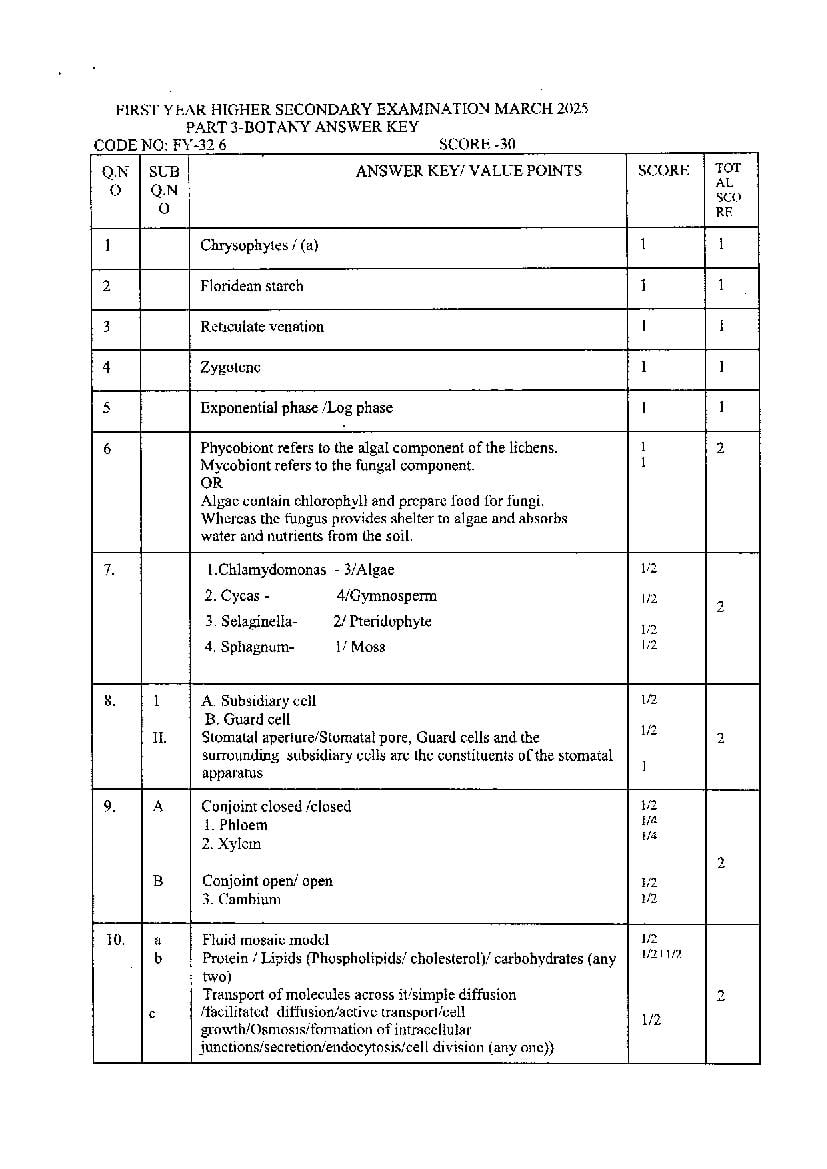
PART 3-BOTAI.IY ANSWER KEY
CODE NO: FY-32 6 SCORE.3O
SIJB ANSWER KEY I VALUE POINTS SCORE TOT
Q.N AL
o Q.N SCO
o RE
I Chrysophytes / (a) I 1
2 Floridean starch 1 I
3 Reticulate venation I 1
4 Zygotene 1 I
5 Exponential phase /Log phase I I
6 Phycobiont refers to the algal component of the lichens. I 2
Mycobiont refers to the fungal component. I
OR
Algae contain chlorophyll and prepare food for fungi.
Whereas the fungus provides shelter to algae and absorbs
water and nutrients from the soil.
7 l.Chlamydomonas - 3/Algae U2
2. Cycas - 4/Gymnosperm U2
",
3. Selaginella- 2/ Pteridophyte
112
4. Sphagnum- 1/ Moss y2
8. I A. Subsidiary cell v2
B. Guard cell
U2
il. Stomatal aperture/Stomatal pore, Guard cells and the 2
surrounding subsidiary cells are the constituents of the stomatal
1
apparatus
9 A Conjoint closed /closed l2
1. Phloem U4
U4
2.Xylem
)
B Conjoint open/ open U2
3. Cambium U2
10 a Fluid mosaic model y2
b Protein / Lipids (Phospholipids/ cholesterol)/ carbohydrates (any u2+U2
two)
Transport of molecules across itlsimple diffusion 2
c /facilitated diffrrsion/active transporVcell
U2
growth/Osmosis/formation of inhacellular
junctions/secretior/endocytosis/cell division (any one))
Page 2
Cristae are infoldings of Mitochondria/ all other terms related
to parts of chloroplast. %
b Fimbriae. %
The fimbriae are small bristle like fibres sprouting out of the 2
cell of bacteria / helps bacteria for attachments/ all other terms Y,
related to parts of chromosome.
12. Ribulose l-5 bis phosphate/ Ribulose 1-5 biphosphate 1
/Ribulose bis phosphate
2
RuBp is the accepter of COz during the dark reaction of I
photosynthesis
l3 .a Photorespiration 1
b In this process neither synthesis of sugars /
No energy formation or ATP/ NADPH. 1 2
It results in release of CO2 with the utilization of ATP. ( any two
points)
14. a Acetyl CoA 1 2
b Pynrvic dehydrogenase /Pynrvate dehydrogenase 1
15 a Internode elongation just prior to flowering 1 2
b Gibberellins/ GA/ GAs/ Gibberellic acid 1
16. a Auxins v,
b Help to initiate rooting in stem cuttings/promote flowering
/prevent leaf and fruit drop in early stages/promote abscission
of older mature leave and fruits/ induce I v, 2
parthenocarpy/used as herbicide(used to prepare weed free
lawn/control xylem differentiation and help in cell
division/promote apical dominance/ (any three)
17 a A. Cymose inflorescence 1 l2
B. Recemose inflorescence 1 t2
Cymose: Main axis terminates in a flower/ limited growth/
b 1
flowers are bome in a basipetal order( Older flowers at tip and
younger flowers at the bottom) 3
Racemose
Main axis continues to grow / unlimited growth /
Flowers are borne in a acropetal order(Older 1
flowers at the base and younger at the tip )
( any two differences)
Page 3
b i. Centomere split /sister chromatids separate
ii. Chromosomes migration towards two poles/Chromatids move to y2+y2
opposite poles
3
c Growth and developmenV Tissue( cell) repair/ regeneration/
genetic continuity(production of diploid daughter cells with ll2x3
identical genetic compliment/ equational division/ help to
maintain the nucleo-cfloplasmic ratio/help to continuous growth
of plants throughout their life by mitotic division in meristem
(any three)
t9 a. A. Mesophyll cell B. Bundle sheath cell v2+U2
y2
b !!rst plgduct formed in this cycle is four carbon compound 3
(C4 acid / OAA /Oxaloacetic acid)
c Tolerate high temperaturel Higher photosynthetic y2x3
effrciency(have greater productivity of biomass )/ Response
to high light intensity /They lack photorespiration / They have
a special type of leaf anatomy(Kranz anatomy) (any three)
20 a. Glycolysis/ EMP pathway %
b A. Glucose-6-phosphate U4
B.Triose phosphate/Glyceraldehyde-3 -phosphate/PcAl
v4
C.2-phoryhogtyceric acid/2-phosphoglycerate l2PG A U4 3
D. Phospho enol pynrvate/ PEP v4
c
i. aerobic respiration or its explanation
ii. Alcohol fermentation or its explanation
%x3
iii. Lactic acid fermentation or its explanation.
l. JETplvroADl+qvfrN'T 11 ++9Y tt 6ao 1.s.1- ag-
L . set€ry vE?raDt?fTntEll -ro(-t1to61r
s- D.- A-il L'eron Q.4ui h ootq q
doj.n L^l l^'P
+ Dr' 1++6 lozLa?-
5 ,{AJ+5s )l1;: E 'n qhkbtlf, ne
e, fabina,14,k. q+q6ez1s7q
v B iru ;?utlanun c- q49TtQlras
E {and,r,r .ktil 14+z+t ?ztr
cl - flofu Jt6 14 7r314 o t7
to.ProlQ{}hc^ . E.P e+qsq" L6z & I
Document Details
| Board / Org | Kerala Board |
| Exam | Class 11 |
| Type | Answer Key |
| Pages | 3 |
| Updated | 24 Sep 2026 |