DU SOL Question Paper 2018 BA Mathematics
Course : BA
Semester: III Sem.
Paper Code: C-155
Subject: Mathematics
More Detail
Finished viewing? Save it for later —
Download DU SOL Question Paper 2018 BA Mathematics (PDF · 12 pages)About DU SOL Question Paper 2018 BA Mathematics
DU SOL Question Paper 2018 BA Mathematics is available here for free download. Published by University of Delhi for DU SOL, this question paper can be viewed online or downloaded as a PDF (12 pages). Candidates preparing for DU SOL can use DU SOL Question Paper 2018 BA Mathematics to understand the exam pattern, the type of questions asked, and the overall difficulty level.
Frequently Asked Questions
How can I download DU SOL Question Paper 2018 BA Mathematics?
Open this page and click the Download button to save DU SOL Question Paper 2018 BA Mathematics as a PDF. It is completely free on AglaSem Docs.
Is DU SOL Question Paper 2018 BA Mathematics free to download?
Yes. DU SOL Question Paper 2018 BA Mathematics can be viewed online and downloaded as a PDF free of cost on AglaSem Docs.
How many pages does DU SOL Question Paper 2018 BA Mathematics have?
DU SOL Question Paper 2018 BA Mathematics contains 12 pages, which you can read online or download together as a single PDF.
Where can I find more DU SOL study material?
You can find more DU SOL question papers, sample papers, syllabus, and answer keys on AglaSem Docs.
DU SOL Question Paper 2018 BA Mathematics – Text
Read the full text of this question paper below — useful to quickly search, copy and reference the content online without downloading the PDF.
📄 View text version (12 pages)
Page 1
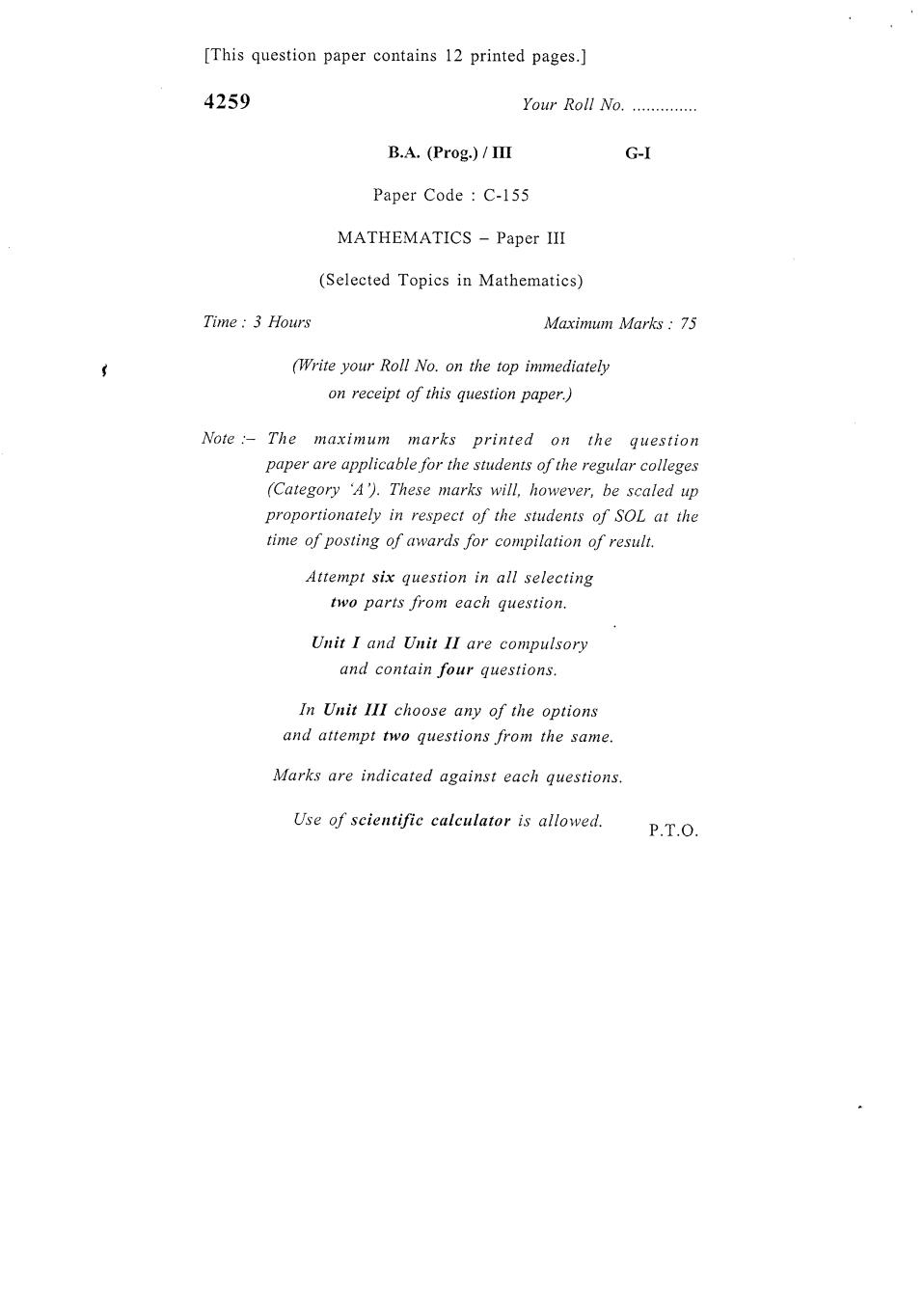
4259 Yottr Roll No.
B.A. (Prog.) / nI G-I
Paper Code : C-l55
MATHEMATICS - Paper III
(Selected Topics in Mathematics)
Time : 3 Hours Maximum Marks : 75
(Write your Roll No. on the top immecliatelt
on receipt of this question paper.)
Note :- The maximum marks printed on the question
paper are applicable.for the stuclents of the. regular colleges
(Category 'A'). These marks will, hou,ever, be scalecl up
proportionately in respect of the students of SOL at the
time o.f posting of awards for compilation of result.
Attempt six question in all selecting
two parts from each question.
Unit I ctnd (Irtit II are contpttlsory
ancl contain four questions.
In Unit III choose any of the options
ancl attempt two questions from the same.
Marks are indicated against each questions.
Use of scientific calculator is allowed p.T.O.
Page 2
Unit I
(Real Analysis)
1. (a) State the order completeness property. Prove that the
set Q of rational numbers is not order complete. (6)
(b) Define limit point of a set. Determine the limit points
of the following sets:
(i) The set Z of integers
(ii) The set N of natural numbers. (6)
(c) Prove that flx) = sin x is uniformly continuous on
[0,*]
(6)
2. (a) Prove that the sequence . en > defined by
t=
al: \/ /ranr1 = n>l
converges to the positive root of x2 - x
- 7- 0 (7)
(b) Test the convergence of the following infinite series:
(i) r(;)"'
nl.
(ii) I (7)
n"
Page 3
(c) State ancl prove Cauchy's nth toot test for
infinite series'
(7)
(a) Test for uniforn convergence of
the secluence of
3.
functions {4,}, where
J,(x) = t'txe-""
xe[0,i]
(6)
State clearlY any result You are using'
(b) Prove that
(6)
,lir?m) = 22m-tY1*)n (m + |)
on la' b)
(c) Prove that a bounded function / is integrable
b] such
if for every e > 0 there exists a partition P of [4,
that
(6)
U(P,fl-L(P,.fl<e
Unit II
(ComPuter Programming)
ecluation'
4. (a) Write a program to find roots of a cluadratic
(6.s)
Explain how it
(b) Write the general form of the for loop'
(6'5)
rvorks, with an examPle'
P.T.O.
Page 4
(c) Find the invalid conditional statement from the
following. Explain why they are invalid:
(i) if a>=b; x:y: else x:z;
(ii) if (x:l') 1=l; else if(x!:y) i=2;
(iii) 1I (z>=a-+c) {x:x*l ; y:y+z;} (6.s)
Unit III (1)
(Numerical AnalYsis)
5. (a) Find the root of the equation f(x) : x3 - 3x + 5 : 0 by
the Newton-Raphson Method corrected up to three
decimal places. (6)
(b) Compare the Bisection method with Newton Raphson
method for solving an equation. Also do the compare
their order of convergence, mentioning the advantages
of one method over the other. (6)
12 dx
(c) Calculates ttl. :using Simpson's cne-third rule with 10
X
sub-intervals. (6)
6. (a) Use Gauss-Jordan to solve
(t r tlf",) ftl
I
t4 3 -1 ll r, l=l6l (6)
I
s sJ[', ) lo)
Page 5
(b) For the following system of ecluations:
/Qv+y-22 = lJ, 3x+20y-z:-18' 2x-3y +202 = 25'
Jacobi rlethod'
Starting with X=(0, 0, 0), using Gauss
(6)
find the solution after performing three iterations'
(c) Fincl the uniclue interpolating polynomial P ( x ) of
degree
points x: 1' 3'
2 or less which interpolates f(x) at the
4 such that
f (1) = 1, f (3) : 21' f (4) = 64 by Newton's divided
difference formula' Hence evaluate P
(1'5)' (6)
Unit III (2)
(Discrete Mathematics)
5. (a) Define the following:
(i) The directed multigraPh'
(ii) A Path in a graPh'
(6)
(iii) A connected graPh'
(b) For any planar connected graph' prove
that
n - e * r:2 where n, e and r are the number of vertices'
(6)
edges and regions of the graph respectively'
z in
(c) Obtain a shortest path from the vertex a to vertex
the weighted graPh'
P.T.O.
Page 6
(6)
6. (a) Write the truth tables for p -+ q and p e q and show
that:
peq:(p-+q)n(q_>p). (6)
(b) Show that the following statement is a tautclogy:
(A -+ B) + (A -+ B) + B
Where 7 denotes the negation of A. (6)
(c) Define and illustrate the following:
(i) amaxterm
(ii) conjunctive normal form
(iii) disjunctive normal form
Write (4nx2)v(4nrr)v(3, nr3) in disjunctive normal
form. (6)
Page 7
Unit III (3)
Mathematical Statistics)
independent of
5. (a) Show that the standard deviation is
(6)
change of origin but not of scale'
(b) The contents of urns T, II and III
are as foilows:
1 white, 2 red and 3 black balls'
2 white, 3 red and 1 black balls' and
3 wirite, 1 red and 2 black balls'
One urn is chosen at random and
two balls drawn' They
happen to be white and red' What
is the probability that
(6)
theY come from urns I, II and III?
(c) Two variables are correlated by
the equation
coefficient
aX + bY + c : 0' Show that the Correlation
as a and b have
between them is +1 or -1, according
(6)
unlike and like signs'
6. (a) Determine the binomial distribution, uvhen
RO
1
(6)
t P2 - aa
5 JU
items are under 45
(b) In a normal distribution 31% of the
and standard
and 8% are over 64' Find the mean
deviation of the distribution' Given
that if p.T.O.
Page 8
fifiexp (-?) dx,rhenf (0.4e6)
:0.e eur.df (1'405) -0'42' (6)
S1t1 =
(c) For two variables X and Y, the two regression lines are
3X+2Y:26 and 6X+Y=31.
Calculate
(i) the mean values of X and Y
(ii) the correlation coefficient between X and Y. (6)
Unit III (4)
(Mechanics)
5. (a) Three forces P,Q,R in one plane act on a particle,the
angles between Q and R,R and P,P and Q being cr, B,
and y respectively. Show that their resultant is
(6)
P2+ - 2QRcosa - 2RP cos B - 2PQ cos Y
(b) A particle of weight W rest on a rough horizontal plane.
If the angle of friction be, Prove that the least force
which will just rnake it move along the plane is P :
lV sin1t (6)
(c) Find the mass centre of a wire bent into the form of an
isosceles right-angled triangle. (6)
Page 9
the x-axis is given by
6. (a) The speed 'v' ot a particle along
the relation
motion is simPle
vz = p2(8bx - x2 - 12bz). Show that the
al x = 4b' and amplitude is
harmonic motion with centre
2b. Frnd also the time from x
= 5b to x : 6b. (6)
for motion of a
(b) Derive the exPres "on ft*'=f7
under an attraction 'P'
particle describing central orbit
1. (6)
L hu"
per unit mass where P = '0 =
of height '/r' metres
(c) A projectile just goes:over a wall
andatadistance.d,tnetresapartfromthepointof
metres
at a height'ft'
projection, and later it hits a mark
that the velocity of
and distan ce '2tl' metres' Show
projection 'r" is given bY
. -t
4v- 4d- +9tr- ^,l
(6)
c,h
-=
D
of period T about a
6. (a) A particie is performing a S'H'M'
point P' lvhere
centre'O'and it passes through a
direction OP' Prove that
OP = b with velocity v in the
the time which eiapses before
its return to P is
P.T.O.
Page 10
(r\
|
,( vT \
lt2n -,1_l (6)
tt'*--
-
\7T ) \2rb )
(b) A particle moves under the influence of a centre which
attracts with a force:
(u , "\
Lr
\r- r4l)
'b' and 'c' being positive constants and 'r' the distance
from the centre. The particle moves in a circular orbit
of radius 'a'. Prove that the motion is stable if and only
if, a2b > c. (6)
(c) If r,,, ancl r, be tire velocities at the ends of a focal
chord of a projectile's path and 'u', the horizontal
cornponent of velocity, show that
111 =-'
--.--+ -; (6)
vi v; u-
Unit III (5)
(Theory of Games)
5. (a) Solve graphically the follor.ving LPP
Maximize Z:8xr-2x,
Page 11
Subject to: x, - xr2 0, -X, * 5xr)- 4, x,, x, 2 0
(6)
(b) Use Big-M method to solve following problem:
Minimize Z:3xr*x,
Subject to:
2x,+xz=3
3x,*3*r.u6,xr*xz<3
x' , xr2 0
(c) Find the dual of the LPP:
Maximize i Z: xt- xz * 4x.' + 3a,
subject to:
x, * xr) -2
v -1r
''t -r-"3 <6
,
r, * r: - 3xo: -1
xt, x2 > 0, x, x3 are unrestricted' (6)
6. (a) Explain tire max-Min and Min-Max principle used in
game theory. Determine the saddle point of a game r'vhose
pay-off matrix is: p.T.O.
Page 12
Player B
Bt B'
u,l-t 6l
PIoyer A A.l 2 4l (6)
A.l-z 6l
(b) Solve graphically the rectangular game whose pay-off
matrix is:
[04-B-s1-l
L1 s B -4 0.1
(6)
(c) Transform the matrix game:
[r -1
r
3]
l3 -rl
2
L6 -2)
into its corresponding primal and dual I-PP and solve.
(6)
(400)
Document Details
| Board / Org | University of Delhi |
| Exam | DU SOL |
| Type | Question Paper |
| Pages | 12 |
| Updated | 23 Oct 2026 |