UPSC IFS 2017 Question Paper for Chemistry Paper-I
Finished viewing? Save it for later —
Download UPSC IFS 2017 Question Paper for Chemistry Paper-I (PDF · 6 pages)About UPSC IFS 2017 Question Paper for Chemistry Paper-I
UPSC IFS 2017 Question Paper for Chemistry Paper-I is available here for free download. Published by UPSC for Indian Forest Service Examination, this question paper can be viewed online or downloaded as a PDF (6 pages). Candidates preparing for Indian Forest Service Examination can use UPSC IFS 2017 Question Paper for Chemistry Paper-I to understand the exam pattern, the type of questions asked, and the overall difficulty level.
Frequently Asked Questions
How can I download UPSC IFS 2017 Question Paper for Chemistry Paper-I?
Open this page and click the Download button to save UPSC IFS 2017 Question Paper for Chemistry Paper-I as a PDF. It is completely free on AglaSem Docs.
Is UPSC IFS 2017 Question Paper for Chemistry Paper-I free to download?
Yes. UPSC IFS 2017 Question Paper for Chemistry Paper-I can be viewed online and downloaded as a PDF free of cost on AglaSem Docs.
How many pages does UPSC IFS 2017 Question Paper for Chemistry Paper-I have?
UPSC IFS 2017 Question Paper for Chemistry Paper-I contains 6 pages, which you can read online or download together as a single PDF.
Where can I find more Indian Forest Service Examination study material?
You can find more Indian Forest Service Examination question papers, sample papers, syllabus, and answer keys on AglaSem Docs.
UPSC IFS 2017 Question Paper for Chemistry Paper-I – Text
Read the full text of this question paper below — useful to quickly search, copy and reference the content online without downloading the PDF.
📄 View text version (6 pages)
Page 1
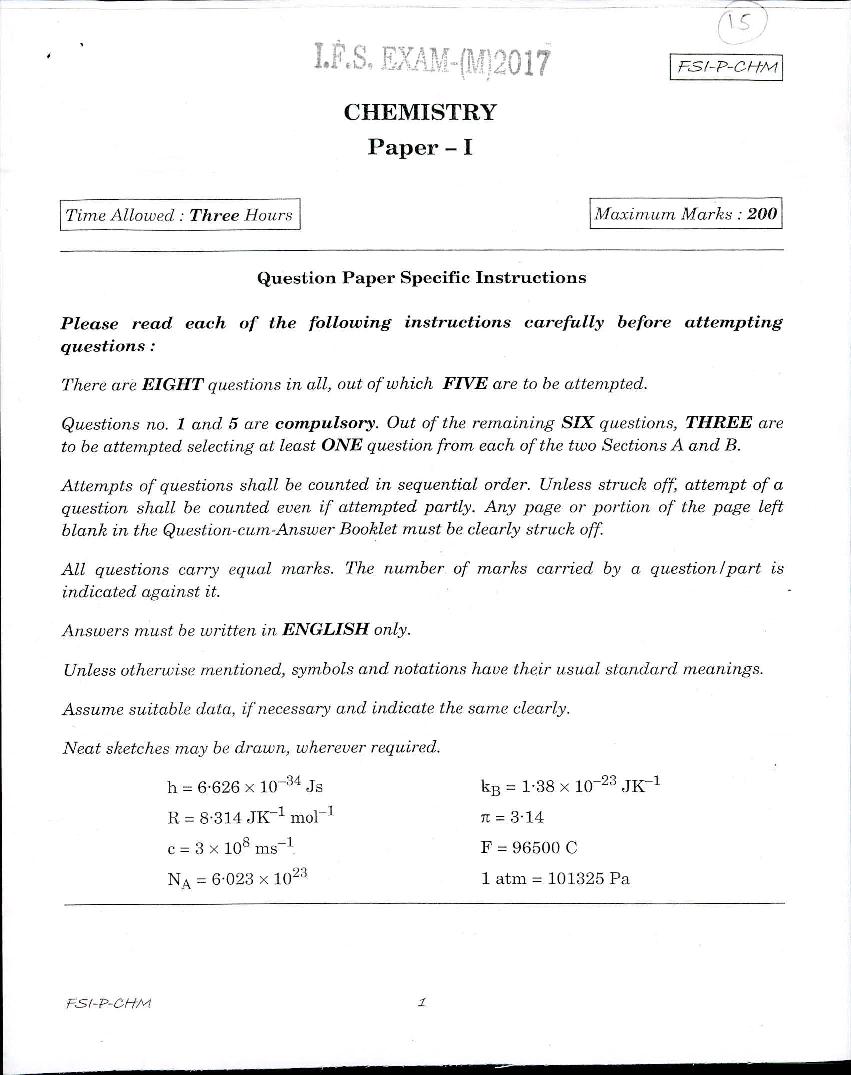
CHEMISTRY
Paper - I
Time Allowed: Three Hours Maximum Marks : 200
Question Paper Specific Instructions
Please read each of the following instructions carefully before attempting
questions:
There are EIGHT questions in all, out of which FIVE are to be attempted.
Questions no. 1 and 5 are compulsory. Out of the remaining SIX questions, THREE are
to be attempted selecting at least ONE question from each of the two Sections A and B.
Attempts of questions shall be counted in sequential order. Unless struck off attempt of a
question shall be counted even if attempted partly. Any page or portion of the page left
blank in the Question-cum-Answer Booklet must be clearly struck off
All questions carry equal marks. The number of marks carried by a question/pan is
indicated against it.
Answers must be written in ENGLISH only.
Unless otherwise mentioned, symbols and notations have their usual standard meanings.
Assume suitable data, if necessary and indicate the same clearly.
Neat sketches may be drawn, wherever required.
h = 6-626 x 10-34 Js kB = 1-38 x 10-23 JIC-1
R = 8-314 JK-1 mo1-1 = 344
c = 3 x 10⁸ ms-1 F = 96500 C
NA = 6.023 x 10²³ 1 atm = 101325 Pa
1
Page 2
Q1- (a) NaC1 (molecular weight : 58-5) consists of a face-centred cubic lattice of
Na+ ions interlocked with a similar lattice of Cl- ions and has a density
of 2.17 g/cm3.
Draw the unit cell structure of NaCl.
Calculate the number of Nat and cr ions that are present in a
unit cell.
Calculate the volume of the unit cell.
The first-order reflection from the d100 planes of NaCI occurs at
5.9°. Calculate the wavelength of X-ray. 5+5+5+5=20
For the reaction
A —> B + C,
the following data were obtained:
t in sec 900 1800
conc. of A 50.8 19.7 7.62
Prove that the reaction is of the first order. 5
What would be the value of the principal quantum number, if an electron
in a hydrogen atom was in the orbital of energy - 0.242 x 10⁻¹⁸ J?
Given : k = 2-179 x 10 18 J. 5
Calculate the work done when 1 mole of He expands isothermally and
reversibly from a volume of 1 litre to a volume of 10 litres at 25°C. 10
Q2. (a) If uncertainty in position is written as Ax and in momentum as zip, then
Heisenberg Uncertainty principle is zip Ax h147-c. If the position of an
electron is known to within 10-12 m, what is the uncertainty in its
momentum? Given h = 6.626 x 10⁻³⁴ Js and g = 3.14. 5
(b) One mole of water is vapourised reversibly at 100°C and 1 atm.
H20 (1) H2O (g)
The heat of vapourisation of water is 9720 cal/mol. Calculate W, AE, AH
and AS. 20
Page 3
significance of this property ? Discuss the effect of temperature on the
molecular partition function. 10
Write brief notes on n-type and p-type semiconductors. 5
Q3. (a) Calculate the mean activity coefficient at 25°C of (i) 0-01 molal solution
of LiC1, and (ii) 0.001 molal solution of BaC12. Given : A = 0.509 for
water at 25°C. 10
(b) Consider the Arrhenius equation. Derive the expression relating
rate-constant, energy of activation and frequency factor, in the form of a
straight line equation. 10
(c) According to Van der Waals' equation, calculate the pressure required to
confine one mole of CO2 in a volume of 1 litre at 0°C. 10
Given:. R = 0.082 litre atm
a = 3.60 atm litre2/mol2
b = 4.27 x 10⁻² litre/mol
(d) For the photochemical reaction
it is found that 1.00 x 10⁻⁵ mole of B is formed, as a result of the
absorption of 6.00 x 10⁷ ergs at 3600 A. Calculate the quantum yield. 10
Given: Avogadro number 6-02 x 1023
Planck's constant 6.626 x 10⁻³⁴ J-sec
Velocity of light 3 x 1010 cm/sec
Q4. (a) Considering molecular-orbital energy level diagram, justify the 0 - 0
bond distances in 02, 02 and 022 as 121, 128 and 149 A, respectively. 10
Draw and discuss the pressure-temperature diagram for H20. Apply the
phase rule to the diagram 10
Calculate the equilibrium constant for the following reaction at 25°C :
Zn + Cu2+ >Zn2+ + Cu 10
Given at 25°C:
e(Zn2+/Zn) = - 0.76 V and
e(Cu2+/Cu) = 0.34 V
FSI-P-C1-1-A4 3
Page 4
PC15 (g) ÷
- k- PC13 (g) + C12 (g)
Derive the expression relating Kp and degree of dissociation
a.
Given : At 250°C and 1 atm, Kp for the above reaction is F78.
Calculate a.
8+2=10
FSI-P-C1--fM 4
Page 5
Q5. (a) Draw the structures and d-orbital splitting diagrams of (i) [NiC1412-, and
(ii) [Co(H20)03+. Calculate their crystal-field stabilization energy
(CFSE) and spin-only magnetic moment values. 10+10=20
(b) Draw the structures of the proteins (i) de-oxy myoglobin, and
(ii) oxidised form of cytochrome-c. Comment on the properties of
de-oxy myoglobin. 5+5+10=20
Q6. (a) Explain the structure and bonding in [Cr(C0)61 and [PtC13(C2H4)]-,
showing metal-ligand orbital interactions, both or-type and 7C-type. In
each case, show the counting of valence-electrons around the metal. 10+10=20
Consider CO insertion reaction in [Rh(PPh3)2(C0)2(CH2CH2R)]. Draw
the structure of the reactant and the product. Also identify the oxidation
state of Rh in the reactant and in the product, showing valence-electron
count around Rh in each case. 15
The A 0 value for [Mn(H20)613+ is 21,000 cm-1. For this metal ion, the
value of pairing energy is 28,000 cm-1. Decide the spin-state of the
complex. Briefly justify your answer. 5
Q7. (a) Draw the solid-state structure of Co2(C0)8 and show valence-electron
count around Co atom. 10
Explain the term 'over potential'. Discuss the application of over
potential in (i) electro-deposition of metals from solutions, and
(ii) corrosion of metals. 15
Consider the complex [Co(NH3)4C12]+. Draw the structures of possible
geometrical isomers. 5
(d) Draw the structure of ferrocene. Showing the number of electrons
contributed, count the number of valence-electrons around the Fe atom. 10
Page 6
Q8. (a)
Derive the B.E.T. equation for adsorption on a solid surface. How can
the surface area be determined with the help of B.E.T. equation? 10
Discuss the merits and demerits of liquid hydrogen fluoride as a
non-aqueous solvent. Give the chemical reactions which take place in
this solvent. 10
What do you understand by quantum yield ? Discuss high and low
values of quantum yield by taking suitable examples. /0
PSI-P-0/1M 6
Document Details
| Board / Org | UPSC |
| Exam | Indian Forest Service Examination |
| Type | Question Paper |
| Pages | 6 |
| Updated | 30 Apr 2026 |