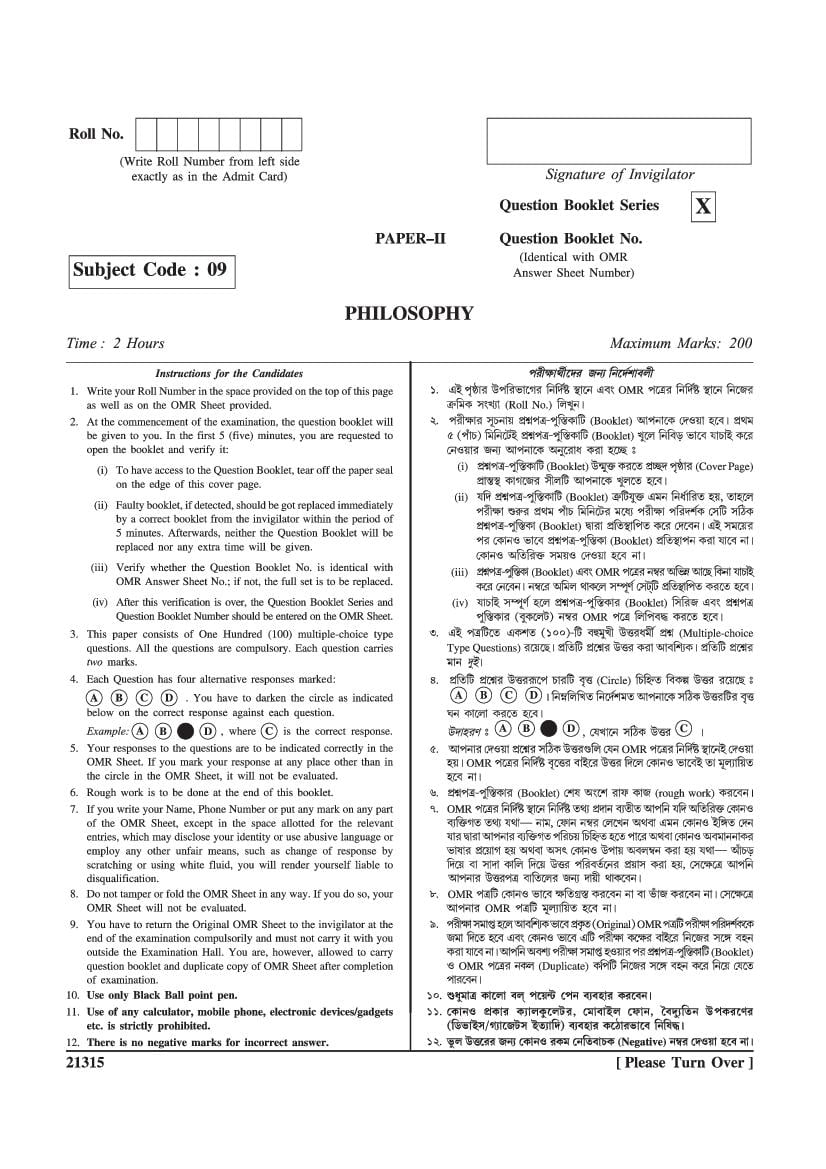
WB SET 2022 Question Paper Philosophy
Finished viewing? Save it for later —
Download WB SET 2022 Question Paper Philosophy (PDF · 32 pages)About WB SET 2022 Question Paper Philosophy
WB SET 2022 Question Paper Philosophy is available here for free download. Published by Default for Govt Jobs Exams, this question paper can be viewed online or downloaded as a PDF (32 pages). Candidates preparing for Govt Jobs Exams can use WB SET 2022 Question Paper Philosophy to understand the exam pattern, the type of questions asked, and the overall difficulty level.
Frequently Asked Questions
How can I download WB SET 2022 Question Paper Philosophy?
Open this page and click the Download button to save WB SET 2022 Question Paper Philosophy as a PDF. It is completely free on AglaSem Docs.
Is WB SET 2022 Question Paper Philosophy free to download?
Yes. WB SET 2022 Question Paper Philosophy can be viewed online and downloaded as a PDF free of cost on AglaSem Docs.
How many pages does WB SET 2022 Question Paper Philosophy have?
WB SET 2022 Question Paper Philosophy contains 32 pages, which you can read online or download together as a single PDF.
Where can I find more Govt Jobs Exams study material?
You can find more Govt Jobs Exams question papers, sample papers, syllabus, and answer keys on AglaSem Docs.
WB SET 2022 Question Paper Philosophy – Text
Read the full text of this question paper below — useful to quickly search, copy and reference the content online without downloading the PDF.
📄 View text version (30 pages)
Page 3
X–3 09-II
PAPER II
(PHILOSOPHY)
1. The individual soul is essentially of the nature 1. Êœı±R± ıdÓ¬– :±Ú¶§ı˛+¬Û ¤ı— :±ÀÚı˛ ’±Ò±ı˛/ ¤˝◊
of knowledge or JÈÈøıËnasvar”ıËpa, and is also the ˜Ó¬ı± Œ¬Û±¯∏Ì fl¬Àı˛Úñ
substratum of knowledge. This notion is upheld by
(A) øÚ•§±fl«¬
(A) NimbøıËrka
(B) Vallabha (B) ı{°ˆ¬
(C) Madhva (C) ˜m
(D) RøıËmøıËnuja (D) ı˛±˜±Ú≈Ê
2. Which among the following theories are related 2. øÚ•ßø˘ø‡Ó¬ Œfl¬±Ú Ó¬MW&ø˘ ά◊˝◊ø˘˚˛±˜ ŒÊ˜¸ ¤ı˛ ¸Àº
to William James? ¸•Ûøfl«¬Ó¬∑
1. Stream of consciousness 1. Œ‰¬Ó¬Ú± √õ∂ı±˝
2. Voluntarism 2. ˝◊B±ı±
3. Pluralism 3. ıUQı±
4. Pragmatism
4. √õ∂À˚˛±·ı±
Codes:
¸—Àfl¬Ó¬ †
(A) 1 and 2
Í (A) 1 ¤ı— 2
(B) 1, 2 and 3
(C) 2, 3 and 4 (B) 1, 2 ¤ı— 3
(D) 1, 2, 3 and 4 (C) 2, 3 ¤ı— 4
(D) 1, 2, 3 ¤ı— 4
3. Match List I with List II and select the correct 3. Ó¬±ø˘fl¬±-I ¤ı— Ó¬±ø˘fl¬±-II ¤ı˛ ŒÊ±h¬ Œ˜˘±Ú ¤ı— øÚÀ•ß
answer from the codes given below: √õ∂M ¸—Àfl¬Ó¬ ı…ı˝±ı˛ fl¬Àı˛ ¸øͬfl¬ ŒÊ±h¬ øÚÌ«˚˛ fl¬èÚ/
List-I List-II Ó¬±ø˘fl¬±-I Ó¬±ø˘fl¬±-II
(a) ∑Ófireyas and Preyas (i) RøıËmøıËnuja (a) Œ|˚˛¸ƒ ¤ı— Œ√õ∂˚˛¸ƒ (i) ı˛±˜±Ú≈Ê
(b) ∑ÓfiabdavivartavøıËda (ii) Jaina (b) ˙søııÓ«¬ı± (ii) ΔÊÚ
(c) Bhakti-prapatti (iii) Bhart–˝Áhari
(c) ˆ¬øMêõ∂¬ÛøM (iii) ˆ¬Ó‘¬«˝øı˛
(d) Triratna (iv) Vedas and
(d) øSı˛P (iv) Œı ¤ı— ά◊¬ÛøÚ¯∏
Upani—˝Áadas
Codes:
¸—Àfl¬Ó¬ †
(a) (b) (c) (d) (a) (b) (c) (d)
(A) (iv) (iii) (i) (ii) (A) (iv) (iii) (i) (ii)
(B) (iv) (i) (ii) (iii) (B) (iv) (i) (ii) (iii)
(C) (ii) (iii) (i) (iv) (C) (ii) (iii) (i) (iv)
(D) (iv) (i) (iii) (ii) (D) (iv) (i) (iii) (ii)
[ Please Turn Over ]
Page 4
4. Which one of the following schools belives that 4. øÚ•ßø˘ø‡Ó¬ ¸•x±˚˛ &ø˘ı˛ ˜ÀÒ… Œfl¬±Ú ¸•x±˚˛ øıù´±¸
svarga is attained by the performance of sacrifices? fl¬Àı˛Ú Œ˚ ¶§·«˘±ˆ¬ fl¬ı˛± ˚±˚˛ ˚: ’Ú≈ᬱÀÚı˛ Z±ı˛±∑
(A) SøıËÀÛflkhya (A) ¸±—‡…
(B) Yoga
(B) Œ˚±·
(C) Advaita VedøıËnta
(D) P”ıËrva-M¤ıÂmøıËÀÛflsøıË (C) ’ÕZÓ¬Àı±ôL√
(D) ¬Û”ı«˜œ˜±—¸±
5. According to RøıËmøıËnuja, the term nirguÃ˝Èa, which 5. ı˛±˜±Ú≈ÀÊı˛ ˜ÀÓ¬ ëøÚ&«Ìí ¬ÛøȬ, ˚± ıËpÀfl¬ øıÀ˙ø¯∏Ó¬ fl¬ı˛±ı˛
is used to quality Brahman, signifies that Brahman— ÊÚ… ı…ı˝+Ó¬ ˝˚˛, øÚÀ«˙ fl¬Àı˛ Œ˚ ıËp ñ
(A) does not have any guÃ˝Èa (A) &Ì ı˛ø˝Ó¬
(B) is not simply constitued by guÃ˝Èa
(B) Œfl¬ı˘˜±S &Ì Z±ı˛± ¸‘©Ü ÚÚ
(C) does not have any heyaguÃ˝Èa
(D) None of the above (C) Œ˝˚˛&Ì ı˛ø˝Ó¬
(D) ά◊¬ÛÀı˛ı˛ Œfl¬±ÀÚ±øȬ˝◊ Ú˚˛
6. Match List I with List II and select the correct 6. Ó¬±ø˘fl¬±-I ¤ı— Ó¬±ø˘fl¬±-II ¤ı˛ ŒÊ±h¬ Œ˜˘±Ú ¤ı— øÚÀ•ß
answer from the codes given below: √õ∂M ¸—Àfl¬Ó¬ ı…ı˝±ı˛ fl¬Àı˛ ¸øͬfl¬ ŒÊ±h¬ øÚÌ«˚˛ fl¬èÚ/
List-I List-II Í Ó¬±ø˘fl¬±-I Ó¬±ø˘fl¬±-II
(a) VedøıËntasøıËra (i) DignøıËga (a) Œı±ôL√¸±ı˛ (i) ø„ƒÚ±·
(b) PramøıËÃ˝Èa- (ii) SadøıËnanda (b) √õ∂˜±Ì ¸˜≈B‰¬˚˛ (ii) ¸±Új Œ˚±·œf
samuccaya Yog¤ıÂndra
(c) Ú…±˚˛ ı±øM«fl¬ (iii) ά◊ÀV…±Ó¬fl¬ı˛
(c) NyøıËya-VøıËrttika (iii) Uddyotakara
(d) ¬Û±Ô« Ò˜« ¸—·Ë˝ (iv) √õ∂˙ô¶∏¬Û±
(d) PadøıËrtha dharma (iv) Pra—˜ÁastapøıËda
SaÀÛflgraha ¸—Àfl¬Ó¬†
Codes: (a) (b) (c) (d)
(a) (b) (c) (d) (A) (ii) (i) (iii) (iv)
(A) (ii) (i) (iii) (iv) (B) (iv) (ii) (i) (iii)
(B) (iv) (ii) (i) (iii) (C) (ii) (iii) (i) (iv)
(C) (ii) (iii) (i) (iv) (D) (i) (ii) (iii) (iv)
(D) (i) (ii) (iii) (iv)
7. Which of the following methods are admitted as 7. øÚ•ßø˘ø‡Ó¬ ¬ÛX¬øÓ¬&ø˘ı˛ ˜ÀÒ… Œfl¬±ÚøȬ ’ÕZÓ¬Àı±ôL√œı˛±
means for self-realization by the Advaita VedøıËntins? ’±ÀR±¬Û˘ıøX¬ı˛ ά◊¬Û±˚˛ ø˝À¸Àı ¶§œfl¬±ı˛ fl¬Àı˛Ú∑
(A) Yama- Niyama- §Ò‡sana (A) ˚˜- øÚ˚˛˜- ’±¸Ú
(B) DhøıËraÃ˝Èa- DhyøıËna- SamøıËdhi
(B) Ò±ı˛Ì±- Ò…±Ú- ¸˜±øÒ
(C) ∑ÓfiravaÃ˝Èa- Manana- NididhyøıËsana
(D) Maitr¤ıÂ- KaruÃ˝ÈøıË- Upek—˝ÁøıË (C) |ıÌ- ˜ÚÚ- øÚøÒ…±¸Ú
(D) Δ˜Sœ- fl¬è̱- ά◊À¬Û鬱
Page 5
8. Which one of the following is not accepted by 8. øÚ•ßø˘ø‡Ó¬ Œfl¬±ÚøȬÀfl¬ ˜œ˜±—¸fl¬ ¸•x±˚˛ ¬Û±Ô«ı˛+À¬Û ¶§œfl¬±ı˛
the M¤ıÂmøıËÀÛflsakas as a category? fl¬Àı˛Ú Ú±∑
(A) Substance (Dravya) (A) ^ı…
(B) Inherence (SamavøıËya)
(B) ¸˜ı±˚˛
(C) Quality (GuÃ˝Èa)
(C) &Ì
(D) Action (Karma)
(D) fl¬˜«
9. What is the probability of getting 12 when 9. ˘≈Àά± Œ‡˘±ı˛ ≈øȬ Â!¬±Àfl¬ ¤fl¬¸Àº ‰¬±˘À˘ ¬12 Û±ı±ı˛
rolling two dice? ¸y¬±ı…Ó¬± fl¬Ó¬∑
(A) 1/12 (A) 1/12
(B) 1/36 (B) 1/36
(C) 1/8 (C) 1/8
(D) 1/16 (D) 1/16
10. ‘Every entity has infinite number of properties’ 10. ë’ÚôL√Ò˜«±Rfl¬— ıdíñ ¤˝◊ ˜Ó¬øȬ Œ¬Û±¯∏Ì fl¬Àı˛Úñ
(ëanantadharmøı Ë tmakaÀÛ fl vastuí) — this view is (A) ΔÊÚ
advocated by the
(B) ‰¬±ı«±fl¬
(A) Jainas Í
(B) CøıËrvøıËkas (C) Ú…±˚˛ ΔıÀ˙∏ø¯∏fl¬
(C) NyøıËya- Vai—˜Áe—˝Áikas (D) ¸±—‡…
(D) SøıËÀÛflkhyas
11. ‘The blue colour is nothing but the consciousness 11. ëÚœ˘ ı˛— Úœ˘ øı:±Ú ’øÓ¬øı˛Mê øfl¬Â≈ Ú˚˛í/ ¤˝◊ ıMêı…øȬ
of blue’.— This statement expresses the theories of the Œfl¬±Ú ˙«Ú ¸•x±À˚˛ı˛ Ó¬MW∑
(A) MøıËdhyamika (A) ˜±Ò…ø˜fl¬
(B) YogøıËcøıËra
(B) Œ˚±·±‰¬±ı˛
(C) VaibhøıË—˝Áika
(D) SautrøıËntika (C) Δıˆ¬±ø¯∏fl¬
(D) Œ¸ÃS±øôL√fl¬
12. ëAvik–˝Áta- PariÃ˝ÈøıËmavøıËdaíó is the view held by 12. ë’øıfl‘¬Ó¬ ¬Ûøı˛Ì±˜ı±í Ó¬MWøȬı˛ ¸˜Ô«fl¬ñ
(A) ∑ÓfiuddhøıËdvaitins (A) qX¬±ÕZÓ¬ı±œ ·Ì
(B) Advaitins
(B) ’ÕZÓ¬ı±œ ·Ì
(C) Dvaitins
(C) ΔZÓ¬ı±œ ·Ì
(D) M¤ıÂmøıËÀÛflsakas
(D) ˜œ˜±—¸fl¬ ·Ì
[ Please Turn Over ]
Page 6
13. Which one of the following fallacy is committed 13. ëı±˚˛≈ &è, fl¬±ı˛Ì Ó¬± ˙”Ú…íñ ¤˝◊ ’Ú≈˜±ÚøȬÀÓ¬ øÚ•ßø˘ø‡Ó¬
in the exampleó ëAir is heavy, because it is emptyí? Œ˝Q±ˆ¬±¸&ø˘ı˛ ˜ÀÒ… Œfl¬±ÚøȬ √õ∂À˚±Ê…∑
(A) Asiddha
(A) ’ø¸X¬
(B) Viruddha
(B) øıèX¬
(C) Satpratipak—˝Áa
(D) SavyabhicøıËra (C) ¸»√õ∂øÓ¬¬Ûé¬
(D) ¸ı…øˆ¬‰¬±ı˛
14. Match List I with List II and select the correct 14. Ó¬±ø˘fl¬±-I ¤ı— Ó¬±ø˘fl¬±-II ¤ı˛ ŒÊ±h¬ Œ˜˘±› ¤ı— øÚÀ•ß
answer from the codes given below: √õ∂M ¸—Àfl¬Ó¬ ı…ı˝±ı˛ fl¬Àı˛ ¸øͬfl¬ ŒÊ±h¬ øÚÌ«˚˛ fl¬Àı˛±/
List-I List-II Ó¬±ø˘fl¬±-I Ó¬±ø˘fl¬±-II
(a) AdvaitavøıËda (i) RøıËmøıËnuja (a) ’ÕZÓ¬ı± (i) ı˛±˜±Ú≈Ê
(b) DvaitavøıËda (ii) ∑ÓfiaÃÛÈkara (b) √ΔZÓ¬ı± (ii) ˙Ǭı˛
(c) DvaitøıËdvaitavøıËda (iii) NimbøıËrka
(c) ΔZÓ¬±ÕZÓ¬ı± (iii) øÚ•§±fl«¬
(d) Vi—˜Ái—˝Á“˝ÂøıËdvaitavøıËda (iv) Madhva
(d) øıø˙©Ü±ÕZÓ¬ı± (iv) √˜ÒT
Codes:
¸—Àfl¬Ó¬†
(a) (b) (c) (d)
(a) (b) (c) (d)
(A) (ii) (iv) (iii) (i)
(A) (ii) (iv) (iii) (i)
(B) (ii) (iii) (iv) (i)
Í (B) (ii) (iii) (iv) (i)
(C) (iv) (iii) (ii) (i)
(C) (iv) (iii) (ii) (i)
(D) (i) (ii) (iii) (iv)
(D) (i) (ii) (iii) (iv)
15. What does astikøıËya mean in Jaina philosophy? 15. ΔÊÚ ˙«ÀÚ ’øô¶∏fl¬±˚˛ ı˘ÀÓ¬ fl¬œ Œı±Á¬±˚˛∑
(A) Extension in time (A) fl¬±À˘ı˛ øıô¶∏±ı˛
(B) Extension in space (B) ŒÀ˙ı˛ øıô¶∏±ı˛
(C) Extension in body (C) ŒÀ˝ı˛ øıô¶∏±ı˛
(D) Extension in nature (D) √õ∂fl‘¬øÓ¬ı˛ øıô¶∏±ı˛
16. ëKhyøıËtivøıËdaí according to Indian Philosophy 16. ˆ¬±ı˛Ó¬œ˚˛ ˙«ÀÚ ‡…±øÓ¬ı± ı˘ÀÓ¬ Œı±Á¬±˚˛
means: (A) w˜ ¸•Ûøfl«¬Ó¬ ˜Ó¬ı±
(A) Theory of error (B) ¸Ó¬… ¸•Ûøfl«¬Ó¬ ˜Ó¬ı±
(B) Theory of truth
(C) :±Ú ¸•Ûøfl«¬Ó¬ ˜Ó¬ı±
(C) Theory of knowledge
(D) √ά◊¬ÛÀı˛±Mê Œfl¬±ÀÚ±øȬ˝◊ Ú˚˛
(D) None of the above
Page 7
17. Which fallacy occurs when the locus itself is 17. ¬Ûé¬øȬı˛ ’øô¶∏Q Ú± Ô±fl¬À˘ øÚ•ßø˘ø‡Ó¬ Œfl¬±Ú Œ±¯∏øȬ ˝˚˛∑
unreal? (A) ’±|˚˛±ø¸X¬
(A) øıË—˜ÁrayøıËsiddha
(B) ¶§ı˛+¬Û±ø¸X¬
(B) svar”ıËpøıËsiddha
(C) savyabhicøıËra (C) ¸ı…øˆ¬‰¬±ı˛
(D) viruddha (D) øıèX¬
18. Which of the following pair of schools accepts 18. øÚ•ßø˘ø‡Ó¬ ¸•x±À˚˛ı˛ ŒÊ±h¬&ø˘ı˛ ˜ÀÒ… Œfl¬±ÚøȬ ά◊¬Û˜±Ú
UpamøıËna as an independent pramøıËÃ˝Èa? Œfl¬ ¶§Ó¬La √õ∂˜±Ì ı˛+À¬Û ¶§œfl¬±ı˛ fl¬Àı˛∑
(A) SøıËÀÛflkhya and VedøıËnta (A) ¸±—‡… ¤ı— Œı±ôL√
(B) Buddhism and NyøıËya
(B) ŒıÃX¬ ¤ı— Ú…±˚˛
(C) VedøıËnta and P”ıËrva-M¤ıÂmøıËÀÛflsøıË
(D) P”ıËrva-M¤ıÂmøıËÀÛflsøıË and Yoga (C) Œı±ôL√ ¤ı— ¬Û”ı«˜œ˜±—¸±
(D) ¬Û”ı«˜œ˜±—¸± ¤ı— Œ˚±·
19. Identify the correct combination: 19. ¸øͬfl¬ ŒÊ±h¬øȬ ø‰¬ø˝êÓ¬ fl¬èÚ –
(A) MøıËyøıËvøıËda- AnøıËtmavøıËda (A) ˜±˚˛±ı± ñ ’Ú±Rı±
(B) K—˝ÁanikatvøıËda- §Ò‡tmavøıËda
Í (B) é¬øÌfl¬Qı± ñ ’±Rı±
(C) AnøıËtmavøıËda- Prat¤ıÂtya samutpøıËda
(C) ’Ú±Rı± ñ √õ∂Ó¬œÓ¬…¸˜≈»¬Û±
(D) VivartavøıËda- AnityavøıËda
(D) øııÓ«¬ı± ñ ’øÚÓ¬…ı±
20. Which among the followings conditions is 20. ëıø˝ê Z±ı˛± ı‘é¬ Œ¸‰¬Ú fl¬ı˛ ïıø˝ê̱ ø¸=¡øÓ¬óíñ¤˝◊ ı±fl¬…øȬı˛
violated in the sentence — ‘Water the plant with fire’ Œé¬ÀS øÚ•ßø˘ø‡Ó¬ Œfl¬±Ú ˙Ó«¬øȬ ˘øfÓ¬ ˝À˚˛ÀÂ∑
(VahÃ˝ÈiÃ˝ÈøıË SiÈÈcati)?
(A) ’±fl¬±e±
(A) §Ò‡køıËÃÛÈk—˝ÁøıË
(B) ¸øißøÒ
(B) Sannidhi
(C) YogyatøıË (C) Œ˚±·…Ó¬±
(D) TøıËtparya (D) Ó¬±»¬Û˚«
21. According to SøıËÀÛflkhya puru—˝Áa is 21. ¸±—‡… ˜ÀÓ¬ ¬Û≈è¯∏ ˝Ú
(A) Conscious and active (A) Œ‰¬Ó¬Ú ¤ı— fl¬Ó«¬±
(B) Conscious and indifferent (B) Œ‰¬Ó¬Ú ¤ı— ά◊±¸œÚ
(C) Unconscious and active
(C) ’À‰¬Ó¬Ú ¤ı— fl¬Ó«¬±
(D) None of the above
(D) ά◊¬ÛÀı˛ı˛ Œfl¬±ÀÚ±øȬ˝◊ Ú˚˛
[ Please Turn Over ]
Page 8
22. The book ‘City of God’ is authored by 22. ëø¸øȬ ’Ù¬ ·Îƒ¬í ı˝◊øȬı˛ Œ˘‡fl¬ Œfl¬∑
(A) St. Augustine (A) Œ¸KȬ ’·±øà¬Ú
(B) St. Thomas Aquinas (B) Œ¸KȬ Ô˜±¸ ’…±fl≈¬˝◊Ú±¸
(C) St. Anselm
(C) Œ¸KȬ ’…±ÚÀ¸˘˜ƒ
(D) William James
(D) ά◊˝◊ø˘˚˛±˜ ŒÊ˜¸
23. Who among the following philosophers 23. øÚ•ßø˘ø‡Ó¬ ±˙«øÚfl¬Àı˛ ˜ÀÒ… Œfl¬ ÷ù´Àı˛ı˛ √õ∂˜±Ì øı¯∏À˚˛
advocated the ontological argument for the existence ’øô¶∏Q˜”˘fl¬ ˚≈øMê ¶§œfl¬±ı˛ fl¬Àı˛ÀÂÚ∑
for God?
(A) Œ¸KȬ Ô˜±¸ ’…±fl≈¬˝◊Ú±¸
(A) St. Thomas Aquinas
(B) Œ¸KȬ ’·±øà¬Ú
(B) St. Augustine
(C) Œ¸KȬ ’…±ÚÀ¸˘˜ƒ
(C) St. Anselm
(D) Socrates (D) ¸ÀSêøȬ¸
Í
24. Match List I with List II and select the correct 24. Ó¬±ø˘fl¬±-I ¤ı— Ó¬±ø˘fl¬±-II Œfl¬ Œ˜˘±Ú ¤ı— √õ∂M ¸—Àfl¬Ó¬
answer from the codes given below: ı…ı˝±ı˛ fl¬Àı˛ ¸øͬfl¬ ŒÊ±h¬ øÚÌ«˚˛ fl¬èÚ –
List-I List-II Ó¬±ø˘fl¬±-I Ó¬±ø˘fl¬±-II
(a) Thales (i) Air (a) Ô…±À˘¸ (i) ı±˚˛≈
(b) Pythagoras (ii) Harmony of the (b) ø¬ÛÔ±À·±ı˛±¸ (ii) øı¬Ûı˛œÀÓ¬ı˛ ¸˜i§˚˛
opposites
(c) ’…±Ú±ø'À˜ÀÚ¸ (iii) Ê˘
(c) Anaximenes (iii) Water
(d) Œ˝ı˛±flv¬±˝◊Ȭ±¸ (iv) ¸—‡…±
(d) Heraclitus (iv) Number
¸—Àfl¬Ó¬ –
Codes:
(a) (b) (c) (d) (a) (b) (c) (d)
(A) (iii) (iv) (ii) (i) (A) (iii) (iv) (ii) (i)
(B) (iii) (iv) (i) (ii) (B) (iii) (iv) (i) (ii)
(C) (iv) (ii) (iii) (i) (C) (iv) (ii) (iii) (i)
(D) (iii) (i) (ii) (iv) (D) (iii) (i) (ii) (iv)
Page 9
25. Consider the Assertion (A) and Reason (R) and 25. √õ∂øÓ¬:±ı±fl¬… (A) ¤ı— ˚≈øMêı±fl¬… (R)-¤ı˛ ¬Ûøı˛À√õ∂øé¬ÀÓ¬
select the correct answer from the codes given below: øÚÀ•ß ø˘ø‡Ó¬ ¸—Àfl¬Ó¬&ø˘ ŒÔÀfl¬ ¸øͬfl¬ ά◊Mı˛øȬ øÚ –
Assertion (A) : It is impossible to conceive a õ∂øÓ¬:±ı±fl¬… ïAó – ¸—‡…± ŒÚ˝◊ ¤˜Ú ¤fl¬øȬ ıËp±ÀG¬ı˛
universe in which number is fl¬äÚ± ’¸y¬ı/
not found.
˚≈øMêı±fl¬… ïRó – ¸—‡…± ıdı˛ ’Ó¬…ôL√ &èQ¬Û”Ì« øı¯∏˚˛
Reason (R) : Number is an extermely
¤ı— Ó¬± Ê·ÀÓ¬ı˛ ¬Ûøı˛fl¬±Í¬±À˜±ı˛ ˜”˘
important aspect of things and
’—˙/
forms a fundamental part of
the framework of the world. ¸—Àfl¬Ó¬ –
Codes: (A) ïAó ¤ı— ïRó ¸Ó¬… ¤ı— ïRó, ïAó ¤ı˛ ¸øͬfl¬ ı…±‡…±/
(A) Both (A) and (R) are true and (R) is the (B) ïAó ¤ı— ïRó ¸Ó¬…, øfl¬c ïRó, ïAó-ı˛ ¸øͬfl¬ ı…±‡…±
correct explanation of (A). Ú˚˛/
(B) Both (A) and (R) are true, but (R) is not the (C) ïAó ¸Ó¬… øfl¬c ïRó ø˜Ô…±/
correct explanation of (A). (D) ïAó ø˜Ô…± øfl¬c ïRó ¸Ó¬…/
(C) (A) is ture but (R) is false.
(D) (A) is false but (R) is true.
26. Match List I with List II and select the correct 26. Ó¬±ø˘fl¬±-I ¤ı— Ó¬±ø˘fl¬±-II Œ˜˘±Ú ¤ı— √õ∂M ¸—Àfl¬Ó¬
answer from the codes given below: ı…ı˝±ı˛ fl¬Àı˛ ¸øͬfl¬ ŒÊ±h¬ øÚÌ«˚˛ fl¬èÚ –
List-I List-II Ó¬±ø˘fl¬±-I Ó¬±ø˘fl¬±-II
(a) Aristotle (i) Transcendental (a) ’…±øı˛à¬È¬˘ (i) ¸•xÓ¬…é¬ÀÌı˛ ’øÓ¬ıÓ«¬œ
Í
unity of ‹fl¬…
apperception
(b) ø¶ÛÀڱʱ (ii) ¬Û”ı«√õ∂øÓ¬øá¬Ó¬ ¸±˜?¸…
(b) Spinoza (ii) Pre-established øÚ˚˛˜
harmony
(c) ˘±˝◊ıƒøÚ»Ê (iii) øÚ}¬˘ ·øÓ¬˜±Ú
(c) Leibniz (iii) Unmoved mover
(d) fl¬±KȬ (iv) ı≈øX¬¸?±Ó¬ Œ√õ∂˜
(d) Kant (iv) Intellectual love
of God ¸—Àfl¬Ó¬ –
Codes: (a) (b) (c) (d)
(a) (b) (c) (d) (A) (iii) (iv) (i) (ii)
(A) (iii) (iv) (i) (ii) (B) (iii) (iv) (ii) (i)
(B) (iii) (iv) (ii) (i) (C) (ii) (i) (iv) (iii)
(C) (ii) (i) (iv) (iii) (D) (iv) (iii) (ii) (i)
(D) (iv) (iii) (ii) (i)
27. Descartes pursues the method of doubt which 27. Œfl¬±Ó«¬-¤ı˛ ¸—˙˚˛ ¬ÛX¬øÓ¬ ¤fl¬øȬ øıÀ˙¯∏ øÀfl¬ ¬Ûøı˛‰¬±ø˘Ó¬
initiates a move in the direction of fl¬Àı˛
(A) Negativism (A) Ú¤ûÔ«fl¬ı±
(B) Solipsism
(B) ’±R:±Úı±
(C) Scepticism
(C) ¸—˙˚˛ı±
(D) Certitude
(D) øÚ}¬˚˛Ó¬±
[ Please Turn Over ]
Page 10
28. “Be a philosopher, but amidst all your philosophy 28. ë¤fl¬ÊÚ ±˙«øÚfl¬ ˝›, øfl¬c ŒÓ¬±˜±ı˛ ¸˜ô¶∏ ˙«ÀÚı˛ ˜ÀÒ…›
be still a man”— is the assertion of ¤fl¬ÊÚ ˜±Ú≈¯∏ ˝›íñ ¤˝◊ ά◊øMêøȬ fl¬±ı˛∑
(A) J.S. Mill (A) ŒÊ. ¤¸. ø˜˘
(B) D. Hume
(B) øά. ø˝Î¬◊˜
(C) I. Kant
(C) ˝◊. fl¬±KȬ
(D) P. Singer
(D) ø¬Û. ø¸º±ı˛
29. Match List I with List II and select the correct 29. Ó¬±ø˘fl¬±-I ¤ı— Ó¬±ø˘fl¬±-II Œfl¬ Œ˜˘±Ú ¤ı— øÚÀ•ß √õ∂M
answer by using the codes given below: ¸—Àfl¬Ó¬ ı…ı˝±ı˛ fl¬Àı˛ ¸øͬfl¬ ά◊Mı˛ øÚÌ«˚˛ fl¬èÚ –
List-I List-II Ó¬±ø˘fl¬±-I Ó¬±ø˘fl¬±-II
(a) Problem of evil (i) Thomas Aquinas (a) ’qˆ¬ı˛ ¸˜¸…± (i) Ô˜±¸ ’…±fl≈¬˝◊Ú±¸
(b) Theory of ideas (ii) St. Anselm (b) Ò±ı˛Ì± Ó¬MW (ii) Œ¸KȬ ’…±ÚÀ¸˘˜ƒ
(c) Analogical (iii) St. Augustine (c) ¸±‘˙…˜”˘fl¬ Ò˜« ’±Àı˛±¬Û (iii) Œ¸KȬ ’·±øà¬Ú
predication
(d) ’øô¶∏Q˜”˘fl¬ ˚≈øMê (iv) Œõ≠ÀȬ±
(d) Ontological (iv) Plato
argument ¸—Àfl¬Ó¬ –
Codes: (a) (b) (c) (d)
(a) (b) (c) (d) (A) (i) (ii) (iii) (iv)
(A) (i) (ii) (iii) (iv) Í (B) (ii) (i) (iv) (iii)
(B) (ii) (i) (iv) (iii) (C) (iii) (i) (ii) (iv)
(C) (iii) (i) (ii) (iv) (D) (iii) (iv) (i) (ii)
(D) (iii) (iv) (i) (ii)
30. Consider the Assertion (A) and Reason (R) and 30. √õ∂øÓ¬:±ı±fl¬… (A) ¤ı— ˚≈øMêı±fl¬… (R)-¤ı˛ ¬Ûøı˛À√õ∂øé¬ÀÓ¬
select the correct code given below: øÚ•ßø˘ø‡Ó¬ ¸—Àfl¬Ó¬&ø˘ı˛ ˜ÀÒ… ¸øͬfl¬ ά◊Mı˛øȬ ı±Â±˝◊ fl¬èÚ –
Assertion (A) : Hume is an extreme empiricist õ∂øÓ¬:±ı±fl¬… ïAó – ø˝Î¬◊˜ Ò±ı˛Ì±Ó¬ÀMWı˛ øfl¬ ŒÔÀfl¬ ¤fl¬ÊÚ
in the theory of ideas. ‰¬ı˛˜¬ÛLöœ ’øˆ¬:Ó¬±ı±œ/
Reason (R) : According to him every idea ˚≈øMêı±fl¬… ïRó – Ó“¬±ı˛ ˜ÀÓ¬ √õ∂øÓ¬øȬ Ò±ı˛Ì±˝◊ ¤fl¬øȬ
is formed through a process
Ò±ı˛±ı˛ ˜Ò… øÀ˚˛ ·Àh¬ ›Àͬ ¤ı— Œ¸˝◊
and the most important factor
Ò±ı˛±ı˛ ¸ı«±À¬Û鬱 &èQ¬Û”Ì« øı¯∏˚˛
of the process is experience.
˝˘ ’øˆ¬:Ó¬±/
Codes:
¸—Àfl¬Ó¬ –
(A) (A) is ture, (R) is false.
(B) (A) is true, (R) is true and (R) is the correct (A) ïAó ¸Ó¬…, ïRó ø˜Ô…±/
explanation of (A). (B) ïAó ¸Ó¬…, ïRó ¸Ó¬… ¤ı— ïRó ˝˘ ïAó-ı˛ ¸øͬfl¬
(C) Both are false. ı…±‡…±/
(D) (A) is false, (R) is true. (C) ≈øȬ˝◊ ø˜Ô…±/
(D) ïAó ø˜Ô…±, ïRó ¸Ó¬…/
Page 11
31. Match List I with List II and select the correct 31. Ó¬±ø˘fl¬±-I ¤ı— Ó¬±ø˘fl¬±-II Œfl¬ Œ˜˘±Ú ¤ı— øÚÀ•ß √õ∂M
answer from the codes given below: ¸—Àfl¬Ó¬ ı…ı˝±ı˛ fl¬Àı˛ ¸øͬfl¬ ά◊Mı˛ øÚ –
List-I List-II Ó¬±ø˘fl¬±-I Ó¬±ø˘fl¬±-II
(a) Cogito ergo sum (i) Berkeley (a) Cogito ergo sum (i) ı±fl«¬À˘
(b) Esse est percipi (ii) Aristotle (b) Esse est percipi (ii) ’…±øı˛à¬È¬˘
(c) Per gennus et (iii) Descartes (c) Per gennus et (iii) Œfl¬±Ó«¬
differtia
differatia
(d) Natura Naturatans (iv) Spinoza
(d) Natura Naturatans (iv) ø¶ÛÀڱʱ
Codes:
¸—Àfl¬Ó¬ –
(a) (b) (c) (d)
(a) (b) (c) (d)
(A) (i) (iii) (ii) (iv)
(A) (i) (iii) (ii) (iv)
(B) (iii) (i) (ii) (iv)
(B) (iii) (i) (ii) (iv)
(C) (ii) (i) (iii) (iv)
(C) (ii) (i) (iii) (iv)
(D) (iv) (ii) (i) (iii)
(D) (iv) (ii) (i) (iii)
32. Choose the correct answer from the codes given 32. √õ∂øÓ¬:±ı±fl¬… (A) ¤ı— ˚≈øMêı±fl¬… (R)-¤ı˛ ¬Ûøı˛À√õ∂øé¬ÀÓ¬
below: øÚ•ßø˘ø‡Ó¬ ¸—Àfl¬Ó¬&ø˘ı˛ ˜ÀÒ… ¸øͬfl¬ ά◊Mı˛øȬ øÚ –
Assertion (A) : For Hegel, the essence of õ∂øÓ¬:±ı±fl¬… ïAó – Œ˝À·À˘ı˛ ˜ÀÓ¬ ’±R±ı˛ ¶§ı˛+¬Û ˝˘
Spirit is Freedom. Í ¶§±ÒœÚÓ¬±/
Reason (R) : For Hegel, freedom means ˚≈øMêı±fl¬… ïRó – Œ˝À·À˘ı˛ ˜ÀÓ¬ ¶§ ± ÒœÚÓ¬± ˝˘
little more than the right to
øÚ˚˛˜±Ú≈ıøÓ«¬Ó¬±ı˛ ’øÒfl¬±ı˛ ŒÔÀfl¬ ’ä
obey the law.
øfl¬Â≈ Œıø˙/
Codes:
¸—Àfl¬Ó¬ –
(A) Both (A) and (R) are true and (R) is the
correct explanation of (A). (A) ïAó ¤ı— ïRó ≈øȬ˝◊ ¸Ó¬… ¤ı— ïRó ˝˘ ïAó-ı˛
(B) Both (A) and (R) are true but (R) is not the ¸øͬfl¬ ı…±‡…±/
correct explanation of (A). (B) ïAó ¤ı— ïRó ≈øȬ˝◊ ¸Ó¬… øfl¬c ïRó, ïAó-ı˛ ¸øͬfl¬
(C) (A) is true but (R) is false. ı…±‡…± Ú˚˛/
(D) (A) is false but (R) is true. (C) ïAó ¸Ó¬… øfl¬c ïRó ø˜Ô…±/
(D) ïAó ø˜Ô…± øfl¬c ïRó ¸Ó¬…/
33. William James, C. S. Peierce and John Dewey 33. ά◊˝◊ø˘˚˛±˜ ŒÊ˜¸, ø¸. ¤¸. ¬Û±¸« ¤ı— ÊÚ øάά◊˝◊ Œfl¬±Ú
are supporters of which philosophical doctrine? ±˙«øÚfl¬ ˜Ó¬ı±Àfl¬ ¸˜Ô«Ú fl¬ı˛ÀÓ¬Ú∑
(A) Representationalism (A) √õ∂Ó¬œfl¬ı±
(B) Positivism
(B) √õ∂Ó¬…é¬ı±
(C) Pragmatism
(C) √õ∂À˚˛±·ı±
(D) Empiricism
(D) ’øˆ¬:Ó¬±ı±
[ Please Turn Over ]
Page 12
34. Which among the following is a work of Richard 34. øÚ•ßø˘ø‡Ó¬ Œfl¬±ÚøȬ øı˛‰¬±Î«¬ ı˛øÈ«¬ı˛ Œ˘‡±∑
Rorty? (A) ø ø˜ı˛ı˛ ’Ù¬ ŒÚ‰¬±ı˛
(A) The Mirror of Nature
(B) √¤À¸Ê ’Ú ı˛…±øάfl¬…±˘ ¤ø˜ø¬Ûøı˛ø¸Ê˜ƒ
(B) Essays on Radical Empiricism
(C) √’±`¬±ı˛à¬…±ø`¬— ŒÚ‰¬±ı˛
(C) Understanding Nature
(D) Reflections on Nature (D) øı˛ÀÙv¬fl¬˙Ú¸ƒ ’Ú ŒÚ‰¬±ı˛
35. What does the ‘other’ mean in Levinas’, 35. Œ˘øˆ¬Ú±íı˛ ë’¬Ûı˛í øı¯∏˚˛fl¬ ˙«ÀÚ ë’¬Ûı˛í ı˘ÀÓ¬ fl¬œ
Philosophy of ‘other’? Œı±Á¬±˚˛∑
(A) Signifier which manifests itself in (A) ı±‰¬fl¬ ˚± øÚÀÊÀfl¬ ˆ¬±¯∏±˚˛ √õ∂fl¬±˙ fl¬Àı˛
language
(B) √÷ù´ı˛
(B) God
(C) √õ∂fl‘¬øÓ¬
(C) Nature
(D) None of the above (D) ά◊¬ÛÀı˛ı˛ Œfl¬±ÀÚ±øȬ˝◊ Ú˚˛
Í
36. Which among the following is a book of Willam 36. øÚ•ßø˘ø‡Ó¬ ·ËLö&ø˘ı˛ ˜ÀÒ… Œfl¬±ÚøȬ ά◊˝◊ø˘˚˛±˜ ŒÊ˜À¸ı˛
James? Œ˘‡±∑
(A) Varieties of Religious Experience (A) ˆ¬…±ı˛±˝◊øÈ¬Ê ’Ùƒ¬ øı˛ø˘øÊ˚˛±¸ ¤'ø¬Ûøı˛À˚˛k
(B) A Common Faith
(B) ¤ fl¬˜Ú ŒÙ¬Ô
(C) Religion and Rational Theology
(C) √øı˛ø˘øÊ˚˛Ú ’…±`¬ ı˛…±˙Ú±˘ øÔÀ˚˛±˘øÊ
(D) Lectures on the Philosophy of Religion
(D) Œ˘fl¬‰¬±ı˛¸ ’Ú ø øÙ¬˘ÊøÙ¬ ’Ù¬ øı˛ø˘øÊ˚˛Ú
37. Among the following Philosophers who was not 37. øÚ•ßø˘ø‡Ó¬ ±˙«øÚfl¬Àı˛ ˜ÀÒ… Œfl¬ øˆ¬À˚˛Ú± ¸±fl«¬˘-¤ı˛ ¸¸…
a member of the Vienna Circle? øÂÀ˘Ú Ú±∑
(A) B.R. Carnap (A) øı. ’±ı˛. fl¬±ı˛Ú±¬Û
(B) M. Schlick
(B) ¤˜. øù≠fl¬
(C) O. Neurath
(C) √›. øÚά◊ı˛±Ô
(D) A. J. Ayer
(D) ¤. ŒÊ. ¤˚˛±ı˛
Page 13
38. Match List I with List II and select the correct 38. Ó¬±ø˘fl¬±-I ¤ı— Ó¬±ø˘fl¬±-II Œ˜˘±Ú ¤ı— øÚÀ•ß √õ∂M
answer from the codes given below: ¸—Àfl¬Ó¬&ø˘ ŒÔÀfl¬ ¸øͬfl¬ ά◊Mı˛ øÚ –
List-I List-II Ó¬±ø˘fl¬±-I Ó¬±ø˘fl¬±-II
(a) Descartes (i) All the materials of (a) Œfl¬±Ó«¬ (i) ’±˜±Àı˛ ø‰¬ôL√±ı˛ ¸ı
our thinking are øı¯∏˚˛&ø˘ ’ôL√Àı˛ı˛ ¤ı—
derived from outward ı±ø˝Àı˛ı˛ ˜≈^Ì ŒÔÀfl¬
and inward øÚ–¸‘Ó¬ ˝˚˛/
impressions.
(b) ˘fl¬ (ii) ø‰¬Ì≈&ø˘ ’±Ò…±øRfl¬
(b) Locke (ii) Monads are spiritual
(c) ø˝Î¬◊˜ (iii) ¤fl¬øȬ ø‰¬ôL√Ú˙œ˘ ı…øMê
(c) Hume (iii) A thinking being is
that who doubts ˝À˘Ú, øÓ¬øÚ˝◊ ø˚øÚ ¸—˙˚˛
(d) Leibniz (iv) The idea of cause and
fl¬Àı˛Ú
effect is the most (d) ˘±˝◊ıøÚ»Ê (iv) fl¬±˚« ¤ı— fl¬±ı˛ÀÌı˛
comprehensive Ò±ı˛Ì±øȬ˝◊ ¸ı«±À¬Û鬱
relation derived from ’øˆ¬:Ó¬±õ∂¸”Ó¬ ¸±˜ø·Ëfl¬
experience. Ò±ı˛Ì±
Codes: ¸—Àfl¬Ó¬ –
(a) (b) (c) (d) (a) (b) (c) (d)
(A) (iv) (iii) (ii) (i) (A) (iv) (iii) (ii) (i)
(B) (i) (ii) (iii) (iv)
(B) (i) (ii) (iii) (iv)
(C) (ii) (iii) (iv) (i)
(C) (ii) (iii) (iv) (i)
(D) (iii) (i) (iv) (ii)
(D) (iii) (i) (iv) (ii)
39. Match List I with List II and select the correct Í 39. Ó¬±ø˘fl¬±-I ¤ı— Ó¬±ø˘fl¬±-II-Œfl¬ Œ˜˘±Ú ¤ı— øÚÀ•ß √õ∂M
answer from the codes given below: ¸—Àfl¬Ó¬ ı…ı˝±ı˛ fl¬Àı˛ ¸øͬfl¬ ά◊Mı˛ øÚ –
List-I List-II Ó¬±ø˘fl¬±-I Ó¬±ø˘fl¬±-II
(a) Wittgenstein (i) On sense and (a) ά◊˝◊ȬÀ·Úƒà¬±˝◊Ú (i) ’Ú Œ¸k ’…±`¬ Œı˛Ù¬±Àı˛k
Reference (b) ˜”ı˛ (ii) ø øÙ¬˘ÊøÙ¬ ’Ù ˘øÊfl¬±˘
(b) Moore (ii) The Philosophy of ’…±ÀȬ±ø˜Ê˜
Logical Atomism
(c) ı˛±À¸˘ (iii) ˝◊Ú øάÀÙ¬k ’Ù¬ fl¬˜ÚÀ¸k
(c) Russell (iii) In Defense of
Common Sense. (d) ŒÙˬÀ· (iv) ’Ú ¸±ÀÈ«¬ÚøȬ
(d) Frege (iv) On Certainty ¸—Àfl¬Ó¬ –
Codes: (a) (b) (c) (d)
(a) (b) (c) (d) (A) (ii) (i) (iii) (iv)
(A) (ii) (i) (iii) (iv) (B) (iii) (ii) (iv) (i)
(B) (iii) (ii) (iv) (i) (C) (iv) (iii) (ii) (i)
(C) (iv) (iii) (ii) (i) (D) (i) (iv) (iii) (ii)
(D) (i) (iv) (iii) (ii)
40. Who among the following philosopher does not 40. øÚ•ßø˘ø‡Ó¬ ±˙«øÚfl¬Àı˛ ˜ÀÒ… Œfl¬ ëfl¬KÈò¬±" øÔ›øı˛í ¶§œfl¬±ı˛
advocate Contract Theory? fl¬Àı˛Ú Ú±∑
(A) Jean- Jacques Rousseau (A) √Ê“± ʱÀfl¬± èÀ˙±
(B) Thomas Hobbes (B) √Ô˜±¸ ˝ı¸
(C) Karl Heinrich Marx (C) √fl¬±˘« ˝±˝◊Úøı˛‡ ˜±'«
(D) John Rawls (D) ÊÚ ı˛˘¸
[ Please Turn Over ]
Page 14
41. Choose the correct answer from the codes given 41. øÚ•ßø˘ø‡Ó¬ ¸—Àfl¬Ó¬&ø˘ı˛ ¸±˝±À˚… ¸øͬfl¬ ά◊Mı˛øȬ øÚ –
below: õ∂øÓ¬:±ı±fl¬… ïAó – ŒıÃX¬ ˜ÀÓ¬ ’Ú≈¬Û˘øt Œfl¬±ÀÚ± ¶§Ó¬La
Assertion (A) : Non-apprehension is not an √õ∂˜±Ì Ú˚˛/
independent source of
˚≈øMêı±fl¬… ïRó – ŒıÃX¬ ˜ÀÓ¬ ’Ú≈¬Û˘øt ¤fl¬øȬ Œ˝Ó≈¬/
knowledge, according to the
Buddhists. ¸—Àfl¬Ó¬ –
Reason (R) : Non-apprehension is a (A) ïAó ¤ı— ïRó ≈øȬ˝◊ ¸Ó¬… ¤ı— ïRó ˝˘ ïAó-ı˛
probans according to the ¸øͬfl¬ ı…±‡…±/
Buddhists. (B) ïAó ¤ı— ïRó ≈øȬ˝◊ ¸Ó¬… øfl¬c ïRó, ïAó-ı˛ ¸øͬfl¬
Codes: ı…±‡…± Ú˚˛/
(A) Both (A) and (R) are true and (R) is the (C) ïAó ¸Ó¬… øfl¬c ïRó ø˜Ô…±/
correct explanation of (A). (D) ïAó ø˜Ô…± øfl¬c ïRó ¸Ó¬…/
(B) Both (A) and (R) are true, but (R) is not the
correct explanation of (A).
(C) (A) is true but (R) is false.
(D) (A) is false but (R) is true.
42. Nozick’s entitlement theory of justice accords 42. ŒÚ±øÊfl¬-¤ı˛ Ú…±˚˛øı‰¬±Àı˛ı˛ ’øÒfl¬±ı˛ Ó¬MW øÚ•ßø˘ø‡Ó¬
all the principles except øıfl¬ä&ø˘ı˛ ˜ÀÒ… ¤fl¬øȬÀfl¬ ±h¬± ¸ı&ø˘ ¶§œfl¬±ı˛ fl¬Àı˛/ Œ¸øȬ ˝˘
(A) the principle of justice in acquisition (A) ’øÒ·Ë˝Ì ¸—Sê±ôL√ Ú…±˚˛øı‰¬±ı˛ ÚœøÓ¬
(B) the principle of equality of opportunity
Í (B) ¸≈À˚±À·ı˛ ¸±˜… ¸—Sê±ôL√ ÚœøÓ¬
(C) the principle of justice in transfer
(C) √ıø˘ ¸—Sê±ôL√ Ú…±˚˛øı‰¬±ı˛ ÚœøÓ¬
(D) None of the above
(D) ά◊¬ÛÀı˛ı˛ Œfl¬±ÀÚ±øȬ˝◊ Ú˚˛
43. Following statements are either True or False. 43. øÚ•ßø˘ø‡Ó¬ ıMêı…&ø˘ ˝˚˛ ¸Ó¬… (True) Ú˚˛ ø˜Ô…± (False)/
Examine these and find the correct answer using codes: ¤&ø˘Àfl¬ ¬Ûı˛œé¬± fl¬Àı˛ øÚÀ•ß √õ∂M ¸—Àfl¬ÀÓ¬ı˛ ¸±˝±À˚… ¸øͬfl¬ ά◊Mı˛
(a) Wittgenstein made a distinction between øÚ –
M predicate and P predicate. (a) ά◊˝◊ȬÀ·Ú଱˝◊Ú M-predicate ¤ı— P-predicate-
(b) Moore relies on ordinary language in order ¤ı˛ ˜ÀÒ… ¤fl¬øȬ ¬Û±Ô«fl¬… fl¬Àı˛Ú/
to defend commonsense beliefs.
(b) ˜”ı˛ ¸±Ò±ı˛Ì øıù´±¸Àfl¬ ¸˜Ô«Ú fl¬ı˛±ı˛ Œé¬ÀS Œ˘Ãøfl¬fl¬
(c) Strawson believes in the analysis of
ˆ¬±¯∏±ı˛ ›¬Ûı˛ øÚˆ«¬ı˛ fl¬Àı˛øÂÀ˘Ú/
ordinary language in order to get a glimpse
of reality. (c) ¶Üò¸Ú ¸M±ı˛ Á¬˘fl¬ ¬Û±ı±ı˛ ÊÚ… Œ˘Ãøfl¬fl¬ ˆ¬±¯∏±ı˛
(d) Ryle initiates category mistake. øıÀù≠¯∏ÀÌ øıù´±¸ fl¬ı˛ÀÓ¬Ú/
Codes: (d) √ı˛±˝◊˘ Œ|Ìœw±øôL√ı˛ ¸”‰¬Ú± fl¬Àı˛øÂÀ˘Ú/
(a) (b) (c) (d) ¸—Àfl¬Ó¬ –
(A) False True False True (a) (b) (c) (d)
(B) True False True False (A) False True False True
(C) True True False False (B) True False True False
(D) False False True True (C) True True False False
(D) False False True True
Page 15
44. Kierkegaard speaks of human existence in terms 44. øfl¬À˚˛Àfl«¬·±Î«¬ ˜±Úı ’øô¶∏QÀfl¬ ı…±‡…± fl¬Àı˛ÀÂÚ
of (A) Ú±jøÚfl¬ ’øô¶∏Q, ΔÚøÓ¬fl¬ ’øô¶∏Q ¤ı— Ò˜«œ˚˛ì±˙«øÚfl¬
(A) Aesthetic existence, ethical existence and ’øô¶∏Q
religious/ philosophical existence
(B) Ú±jøÚfl¬ ’øô¶∏Q, ΔÚøÓ¬fl¬ ’øô¶∏Q ¤ı— ’øÓ¬ıÓ«¬œ
(B) Aesthetic existence, ethical existence and
’øô¶∏Q
transcendental existence
(C) Good existence, bad existence and (C) √qˆ¬ ’øô¶∏Q, ’qˆ¬ ’øô¶∏Q ¤ı— ’˚Ô±Ô« ’øô¶∏Q
inauthentic existence (D) ˚Ô±Ô« ’øô¶∏Q, ’˚Ô±Ô« ’øô¶∏Q ¤ı— ±˙«øÚfl¬ ’øô¶∏Q
(D) Authentic existence, inauthentic existence
and philosophical existence
45. Sartre speaks of all of the following modes of 45. ¸M±ı˛ øÚ•ßø˘ø‡Ó¬ √õ∂fl¬±ı˛&ø˘ı˛ ˜ÀÒ… ¸±ÀS« ¤fl¬øȬ ±h¬±
being except : ¸ı&ø˘Àfl¬ ¶§œfl¬±ı˛ fl¬Àı˛Ú/ Œ¸øȬ ˝˘
(A) Being in itself (A) ¶§ı˛+¬Û ¸M±
(B) Being for itself
(B) ¶§øÚˆ«¬ı˛ ¸M±
(C) Being above the world
(C) Ê·» ’øÓ¬øı˛Mê ¸M±
(D) Being for others
(D) ’¬Ûı˛ ¸ı ı…øMê¸M±
Í
46. What, according to Frege, constitutes the 46. ŒÙˬÀ·ı˛ ˜ÀÓ¬ ë’…±øı˛à¬È¬˘ ˝Ú ’…±øı˛à¬È¬˘í ¤ı— ë’…±øı˛à¬È¬˘
difference between the two statements ‘Aristotle is ˝Ú ’±À˘'±`¬±Àı˛ı˛ ø˙é¬fl¬í ¤˝◊ ı‰¬Ú ≈øȬı˛ ¬Û±Ô«Àfl¬…ı˛ Œ˝Ó≈¬ fl¬œ∑
Aristotle’ and ‘Aristotle is the teacher of Alexander’?
(A) Ó¬±»¬Û˚« øı¯∏À˚˛
(A) In respect of sense
(B) ı±‰¬… øı¯∏À˚˛
(B) In respect of reference
(C) ı±‰¬… ¤ı— Ó¬±»¬Û˚« øı¯∏À˚˛
(C) In respect of sense and reference
(D) In respect of none (D) Œfl¬±ÀÚ± øı¯∏À˚˛˝◊ Ú˚˛
47. Which is acceptable to Kierkegaard? 47. øÚ•ßø˘ø‡Ó¬ Œfl¬±ÚøȬ øfl¬À˚˛Àfl¬«·±ÀΫ¬ı˛ fl¬±À ·Ë˝ÌÀ˚±·…∑
(A) Truth is objectivity (A) ¸Ó¬… ˝˘ øı¯∏˚˛Ó¬±
(B) Truth is subjectivity (B) ¸Ó¬… ˝˘ øı¯∏˚˛œÓ¬±
(C) Truth is correspondence
(C) ¸Ó¬… ˝˘ ¸±ı˛+¬Û…
(D) Truth is what works
(D) ¸Ó¬… Ó¬±˝◊ ˚± fl¬±˚«fl¬ı˛
[ Please Turn Over ]
Page 16
48. Match List I with List II and select the correct 48. øÚÀ•ß √õ∂M ¸—Àfl¬Ó¬ ı…ı˝±ı˛ fl¬Àı˛ √I ¤ı— II Ó¬±ø˘fl¬± Ó≈¬˘Ú±
answer from the codes given below: fl¬Àı˛ ¸øͬfl¬ ά◊Mı˛ ø‰¬ø˝êÓ¬ fl¬èÚ –
List-I List-II Ó¬±ø˘fl¬±-I Ó¬±ø˘fl¬±-II
(a) Russell (i) Phenomenological (a) ı˛±À¸˘ (i) ı±˝…¸M±ı˛ ı˛+¬Û±ôL√ı˛fl¬ı˛Ì
reduction (b) Œfl¬±˚˛±˝◊Ú (ii) Œ˜Ãø˘fl¬ Ó¬MWøı…±ì
(b) Quine (ii) Fundamental ¬Ûı˛±øı…±
ontology
(c) U¸±˘« (iii) ¶§ˆ¬±ıı±œ :±Úøı…±
(c) Husserl (iii) Epistemology
(d) ˝±˝◊Àά·±ı˛ (iv) ıÌ«Ú±Ó¬MW
naturalized
(d) Heidegger (iv) Theory of description ¸—Àfl¬Ó¬ –
Codes: (a) (b) (c) (d)
(a) (b) (c) (d) (A) (iv) (iii) (i) (ii)
(A) (iv) (iii) (i) (ii) (B) (iv) (ii) (i) (iii)
(B) (iv) (ii) (i) (iii) (C) (i) (ii) (iii) (iv)
(C) (i) (ii) (iii) (iv) (D) (iv) (ii) (iii) (i)
(D) (iv) (ii) (iii) (i)
49. Match List I with List II and select the correct 49. Ó¬±ø˘fl¬±-I ¤ı— Ó¬±ø˘fl¬±-II Œ˜˘±Ú ¤ı— øÚÀ•ß √õ∂M
answer by using the codes given below: ¸—Àfl¬Ó¬&ø˘ ı…ı˝±ı˛ fl¬Àı˛ ¸øͬfl¬ ά◊Mı˛ øÚ –
List-I List-II Ó¬±ø˘fl¬±-I Ó¬±ø˘fl¬±-II
(a) Richard Rorty (i) Concept of Truth Í (a) øı˛‰¬±Î«¬ ı˛øÈ«¬ (i) fl¬ÚÀ¸õI◊ ’٠Ȭ™”Ô
(b) Immanuel (ii) Critique of (b) ˝◊˜±Ú≈À˚˛˘ Œ˘øˆ¬Ú±¸ (ii) øSêøȬfl¬ ’Ù
Levinas representationalism øı˛À√õ∂ÀÊÀKȬ˙Ú±ø˘Ê˜
(c) ά◊˝◊ø˘˚˛±˜ ŒÊ˜¸ (iii) ¤øÔ' ’…±Ê ¤ Ù¬±à«¬
(c) William James (iii) Ethics as a first
øÙ¬˘ÊøÙ¬
philosophy
(d) ÊÚ øάά◊˝◊ (iv) ˆ¬…±ı˛±˝◊øÈ¬Ê ’Ùƒ¬
(d) John Dewey (iv) Varieties of Religious
experience øı˛ø˘øÊ˚˛±¸ ¤'ø¬Ûøı˛À˚˛k
Codes: ¸—Àfl¬Ó¬ –
(a) (b) (c) (d) (a) (b) (c) (d)
(A) (ii) (iv) (i) (iii) (A) (ii) (iv) (i) (iii)
(B) (ii (iii) (iv) (i) (B) (ii) (iii) (iv) (i)
(C) (iii) (iv) (ii) (i) (C) (iii) (iv) (ii) (i)
(D) (ii) (iii) (i) (iv) (D) (ii) (iii) (i) (iv)
50. The core concern of hermeneutics is 50. ı…±‡…±Ó¬MWíı˛ ˜”˘ øı¯∏˚˛øȬ ˝˘
(A) reading of a text (A) ˙±¶a ¬Û±Í¬ fl¬ı˛±
(B) interpretation of text (B) ˙±¶aı˛ ˆ¬±¯∏…fl¬ı˛Ì
(C) finding out of a text
(C) ˙±¶a ’Ú≈¸g¬±Ú fl¬ı˛±
(D) None of the above
(D) ά◊¬ÛÀı˛ı˛ Œfl¬±ÀÚ±øȬ˝◊ Ú˚˛
Page 17
51. Match List I with List II and select the correct 51. Ó¬±ø˘fl¬±-I ¤ı— Ó¬±ø˘fl¬±-II Œ˜˘±Ú ¤ı— √õ∂M ¸—Àfl¬Ó¬&ø˘
answer from the codes given below: ı…ı˝±ı˛ fl¬Àı˛ ¸øͬfl¬ ά◊Mı˛ øÚ –
List-I List-II Ó¬±ø˘fl¬±-I Ó¬±ø˘fl¬±-II
(a) Perception (i) v–˝ÁddhavyavahøıËra (a) √õ∂Ó¬…é¬ (i) ı‘X¬ı…ı˝±ı˛
(b) Inference (ii) søıËd–˝Á—˜Áya (b) ’Ú≈˜±Ú (ii) ¸±‘˙…
(c) Comparison (iii) parøıËmar—˜Áa
(c) ά◊¬Û˜±Ú (iii) ¬Ûı˛±˜˙«
(d) Testimony (iv) Sannikar—˝Áa
(d) ˙±sÀı±Ò (iv) ¸øißfl¬¯∏«
Codes:
¸—Àfl¬Ó¬†
(a) (b) (c) (d)
(a) (b) (c) (d)
(A) (iv) (iii) (ii) (i)
(A) (iv) (iii) (ii) (i)
(B) (iv) (ii) (i) (iii)
(B) (iv) (ii) (i) (iii)
(C) (iv) (iii) (i) (ii)
(C) (iv) (iii) (i) (ii)
(D) (iv) (i) (ii) (iii)
(D) (iv) (i) (ii) (iii)
52. All of the following themes are related to 52. øÚ•ßø˘ø‡Ó¬ øı¯∏˚˛&ø˘ı˛ ˜ÀÒ… ¤fl¬øȬ ±h¬± ¸ı&ø˘˝◊ U¸±À˘«ı˛
Husserl’s phenomenology except ’ıˆ¬±¸ı±Àı˛ ’ôL·«Ó¬
(A) Reduction (A) ı˛+¬Û±ôL√ı˛
(B) Intentionality
(B) ’øˆ¬√õ∂±˚˛Ó¬±
(C) Auto-constitution of self
(C) ’±R±ı˛ ¶§øÚø˜«øÓ¬fl¬ı˛Ì
(D) Genetics
Í (D) ÊøÚÓ¬ ά◊»¬ÛøM øı¯∏˚˛fl¬ìøııÓ«¬Ú
53. ‘~ O’ follows: validly from the two premises 53. øÚ•ßø˘ø‡Ó¬ øÚ˚˛˜&ø˘ √õ∂À˚˛±· fl¬Àı˛ ‘O P’ ¤ı—
‘O P’ and ‘P ~P’ by the application of the ‘P ~P’ ¤˝◊ ≈øȬ ˚≈øMêı±fl¬… ŒÔÀfl¬ ‘~ O’ ¤˝◊ ı‰¬ÚøȬ ΔıÒˆ¬±Àı
following rules: øÚ–¸‘Ó¬ ˝˚˛ –
(A) Simplification, Modus Ponens and (A) Simplification, Modus Ponens ¤ı—
Tautology.
Tautology.
(B) Tautology, Double Negation and
(B) Tautology, Double Negation ¤ı—
Implication.
Implication.
(C) Implication, Tautology and Modus Tollens.
(D) Disjunctive syllogism, Implication and (C) Implication, Tautology ¤ı— Modus Tollens.
Double Negation. (D) Disjunctive syllogism, Implication ¤ı—
Double Negation.
54. The basic difference between a deductive and 54. ’ıÀı˛±˝ ¤ı— ’±Àı˛±˝ ˚≈øMêı˛ ˜”˘ ¬Û±Ô«fl¬… ˝˘
inductive argument lies in respect of __________. (A) ˚≈øMêı±Àfl¬…ı˛ ¶§ı˛+¬Û
(A) nature of the premises
(B) ø¸X¬±ÀôL√ı˛ ¶§ı˛+¬Û
(B) nature of the conclusion
(C) ÚÓ≈¬Ú ˚≈øMêı±fl¬… ¸—À˚±ÊÀÚı˛ èÌ ø¸X¬±ÀôL√ı˛ ˜˚«±±ı˛
(C) change in the status of the conclusion with
the addition of new premises
¬Ûøı˛ıÓ«¬Ú
(D) None of the above (D) ά◊¬ÛÀı˛ı˛ Œfl¬±ÀÚ±øȬ˝◊ Ú˚˛
[ Please Turn Over ]
Page 18
55. If A and B are true statements and the value of 55. ˚ø A ¤ı— B ά◊ˆ¬˚˛˝◊ ¸Ó¬… ı‰¬Ú ˝˚˛, ¤ı— X ¤ı— Y-ı˛
X and Y are not known, what would be the truth-value ¸Ó¬…˜”˘… ʱڱ Ú± Ô±Àfl¬, Ó¬±˝À˘ (B A) . (X ~ A)-¤˝◊
of the statement— (B A) . (X ~ A)? ı‰¬ÚøȬı˛ ¸Ó¬…˜”˘… fl¬œ ˝Àı∑
(A) True (A) ¸Ó¬…
(B) False
(B) ø˜Ô…±
(C) Not known
(C) ’:±Ó¬
(D) None of the above
(D) ά◊¬ÛÀı˛ı˛ Œfl¬±ÀÚ±øȬ˝◊ Ú˚˛
56. An argument is valid when 56. ¤fl¬øȬ ˚≈øMê ΔıÒ ˝˚˛ ˚‡Úñ
(A) its premises are true. (A) Ó¬±ı˛ ˚≈øMêı±fl¬…&ø˘ ¸Ó¬… ˝˚˛/
(B) its conclusion is false. (B) Ó¬±ı˛ ø¸X¬±ôL√øȬ ø˜Ô…± ˝˚˛/
(C) one of the premises is false.
(C) Œ˚ Œfl¬±ÀÚ± ¤fl¬øȬ ˚≈øMêı±fl¬… ø˜Ô…± ˝˚˛/
(D) the premises and true and conclusion is
false. (D) ˚≈øMêı±fl¬…&ø˘ ¸Ó¬… ¤ı— ø¸X¬±ôL√øȬ ø˜Ô…± ˝˚˛/
Í
57. Match List I with List II and select the correct 57. øÚÀ•ß √õ∂M ¸—Àfl¬Ó¬ ı…ı˝±ı˛ fl¬Àı˛ Ó¬±ø˘fl¬±-I ¤ı—
answer from the codes given below: Ó¬±ø˘fl¬±-II ¤ı˛ Ó≈¬˘Ú±¬Û”ı«fl¬ ¸øͬfl¬ ŒÊ±h¬ øÚÌ«˚˛ fl¬èÚ –
List-I List-II Ó¬±ø˘fl¬±-I Ó¬±ø˘fl¬±-II
(a) All scientists are (i) (x) (Sx Px) (a) √¸fl¬˘ Δı:±øÚfl¬ (i) (x) (Sx Px)
philosophers ˝Ú ±˙«øÚfl¬
(b) Aristotle is a (ii) Pa
(b) ’…±øı˛à¬È¬˘ (ii) Pa
philosopher
¤fl¬ÊÚ ±˙«øÚfl¬
(c) Some Greeks (iii) (x) (Gx .Px)
(c) Œfl¬±ÀÚ± Œfl¬±ÀÚ± ø·Ëfl¬ (iii) (x) (Gx .Px)
are philosopher
(d) No apples are (iv) (x) (Ax ~ Ox)
˝À˘Ú ±˙«øÚfl¬
orange (d) Œfl¬±ÀÚ± ’±À¬Û˘-˝◊ (iv) (x) (Ax ~ Ox)
Codes: fl¬˜˘± Ú˚˛
(a) (b) (c) (d) ¸—Àfl¬Ó¬ –
(A) (i) (ii) (iii) (iv) (a) (b) (c) (d)
(B) (iv) (iii) (i) (ii) (A) (i) (ii) (iii) (iv)
(C) (ii) (i) (iii) (iv) (B) (iv) (iii) (i) (ii)
(D) (i) (iii) (ii) (iv) (C) (ii) (i) (iii) (iv)
(D) (i) (iii) (ii) (iv)
Page 19
58. Which among the following is the correct 58. øÚ•ßø˘ø‡Ó¬ ø‰¬S&ø˘ı˛ ˜ÀÒ… Œfl¬±ÚøȬ 븱± ˝±øÓ¬ ’±ÀÂí ¤˝◊
representation of ‘There are white elephants’? ı±Àfl¬…ı˛ ø‰¬S±˚˛Ú∑
(A) E W (A) E W
(B) E W (B) E W
(C) E × W (C) E × W
(D) E × W (D) E × W
59. Consider the Assertion (A) and Reason (R) and 59. √õ∂øÓ¬:± ı±fl¬… (A) ¤ı— ˚≈øMêı±fl¬… (R) ¤ı˛ ¬Ûøı˛À√õ∂øé¬ÀÓ¬
select the correct answer from the codes given below: øÚÀ•ß ά◊ø{°ø‡Ó¬ ¸—Àfl¬Ó¬&ø˘ ı…ı˝±ı˛fl¬Àı˛ ¸øͬfl¬ ά◊Mı˛ øÚ –
Assertion (A) : Gandhi suggests that when an õ∂øÓ¬:± ı±fl¬… (A) – ·±g¬œ ıÀ˘Ú Œ˚ ˚‡Ú Œfl¬±ÀÚ± ı…øMêı˛
individual has more than his √õ∂À˚˛±ÊÀÚı˛ ’øÓ¬øı˛Mê ¸•Û Ô±Àfl¬
proportionate portion, he
Ó¬‡Ú øÓ¬øÚ ÷ù´Àı˛ı˛ ˜±Ú≈À¯∏ı˛ ÊÚ… Œ¸˝◊
becomes a trustee for that
’øÓ¬øı˛Mê ¸•ÛÀı˛ ’ø ˝À˚˛ ¬ÛÀh¬Ú/
portion for God’s people.
Reason (R) : The wealthy should not be ˚≈øMê ı±fl¬… (R) – ÒÚœÀfl¬ Ó¬“±ı˛ ¸•Û ŒÔÀfl¬ ¸øı˛À˚˛ ı˛±‡±
dispossessed of their ά◊ø‰¬Ó¬ Ú˚˛ fl¬±ı˛Ì Ó¬± ø˝—¸±˚˛ ¬Û˚«ıø¸Ó¬
Í
possessions, because that ˝ÀÓ¬ ¬Û±Àı˛/
would imply resort to violence. ¸—Àfl¬Ó¬ –
Codes: (A) (A) ¤ı— (R) ≈øȬ˝◊ ¸Ó¬… ¤ı— (R) ˝˘ (A)-ı˛ ¸øͬfl¬
(A) Both (A) and (R) are true and (R) is the ı…±‡…±/
correct explanation of (A).
(B) (A) ¤ı— (R) ≈øȬ˝◊ ¸Ó¬… øfl¬c (R), (A)-ı˛ ¸øͬfl¬
(B) Both (A) and (R) are true but (R) is not the ı…±‡…± Ú˚˛/
correct explanation of (A).
(C) (A) ¸Ó¬… øfl¬c (R) ø˜Ô…±/
(C) (A) is true but (R) is false.
(D) (A) is false but (R) is true. (D) (A) ø˜Ô…± øfl¬c (R) ¸Ó¬…/
60. Determine the correct symbolization of the 60. øÚ•ßø˘ø‡Ó¬ ı±fl¬…øȬı˛ ¸øͬfl¬ √õ∂Ó¬œfl¬œfl¬ı˛Ì Œfl¬±ÚøȬ Ó¬± øÚÒ«±ı˛Ì
following sentence: fl¬èÚ –
If Argentina mobilizes, then Brazil will protest If Argentina mobilizes, then Brazil will protest
to the U.N. unless Chile calls for a meeting of all the to the U.N. unless Chile calls for a meeting of all the
Latin American states. Latin American states.
(A) A (B C) (A) A (B C)
(B) B (A C) (B) B (A C)
(C) A (B C) (C) A (B C)
(D) A (B .C) (D) A (B .C)
[ Please Turn Over ]
Page 20
61. Mark the correct symbolization for the given 61. øÚ•ßø˘ø‡Ó¬ øıfl¬ä&ø˘ı˛ ˜ÀÒ… √õ∂M ı±fl¬…øȬı˛ ˚Ô±Ô«
sentence: √õ∂Ó¬œfl¬œfl¬ı˛ÌøȬÀfl¬ ø‰¬ø˝êÓ¬ fl¬èÚ –
Foremen and foremen alone are competent √õ∂M ı±fl¬… – Foremen and foremen alone are
workers (Fx, Cx) competent workers (Fx, Cx)
Symbolization: øıfl¬ä –
(A) (x) (Fx ~ Cx)
(A) (x) (Fx ~ Cx)
(B) (x) (Fx Cx)
(B) (x) (Fx Cx)
(C) (x) [(Fx Fx)Cx]
(C) (x) [(Fx Fx)Cx]
(D) (x) (Fx Cx)
(D) (x) (Fx Cx)
62. Which among the following is the ‘.’ form of 62. øÚ•ßø˘ø‡Ó¬ øıfl¬ä&ø˘ı˛ ˜ÀÒ… ‘p q’ ¤˝◊ ı‰¬Ú±fl¬±ı˛øȬı˛
p q? ë.í-ı˛+¬Û Œfl¬±ÚøȬ∑
(A) (~ ~ p ~ q) (A) (~ ~ p ~ q)
(B) ~(p . ~ q) (B) ~(p . ~ q)
(C) ~ (~ p . ~ q) (C) ~ (~ p . ~ q)
(D) ~ (p ~ q) (D) ~ (p ~ q)
Í
63. Which of the following is not a method of 63. øÚ•ßø˘ø‡Ó¬ øıfl¬ä&ø˘ı˛ ˜ÀÒ… Œfl¬±ÚøȬ ˚≈øMêı˛ ΔıÒÓ¬±ì
testing the validity/invalidity of arguments? ’ÕıÒÓ¬± øı‰¬±Àı˛ı˛ ¬ÛX¬øÓ¬ Ú˚˛∑
(A) Truth-Tree Method (A) ¸Ó¬…˙±‡œ ¬ÛX¬øÓ¬
(B) Truth-Table Method
(B) ¸Ó¬…¸±ı˛Ìœ ¬ÛX¬øÓ¬
(C) Venn diagram Method
(C) Œˆ¬Úø‰¬S ¬ÛX¬øÓ¬
(D) Method of Indirect Proof
(D) ¬ÛÀı˛±é¬ √õ∂˜±Ì ¬ÛX¬øÓ¬
64. Which among the following is valid? 64. øÚ•ßø˘ø‡Ó¬ ˚≈øMê&ø˘ı˛ ˜ÀÒ… Œfl¬±ÚøȬ ΔıÒ∑
(A) (x) Sx (A) (x) Sx
(x) (Px Sx)/ (x) Px (x) (Px Sx)/ (x) Px
(B) (x) Sx (B) (x) Sx
(x) ~ Sx / (x) (Sx Px) (x) ~ Sx / (x) (Sx Px)
(C) (x) (Px Qx) (C) (x) (Px Qx)
(x) (Qx Rx)/ (x) (Rx Px) (x) (Qx Rx)/ (x) (Rx Px)
(D) (x) ~ Sx (D) (x) ~ Sx
(x) (Rx Sx)/ (x) Rx (x) (Rx Sx)/ (x) Rx
Page 21
65. Which one of the following purøıËÃ˝Èas contains 65. øÚ•ßø˘ø‡Ó¬ ¬Û≈ı˛±Ì&ø˘ı˛ ˜ÀÒ… Œfl¬±ÚøȬÀÓ¬ ë’±|˜ Ò˜«í
the dialogue between NøıËrada and Yudhi—˝Á“˝Âhira on øı¯∏À˚˛ Ú±ı˛ ¤ı— ˚≈øÒøá¬Àı˛ı˛ fl¬ÀÔ±¬Ûfl¬ÔÚ øıÒ‘Ó¬ ˝À˚˛ÀÂ∑
§Ò‡—˜Árama dharma?
(A) ˆ¬±·ıÓ¬¬Û”ı˛±Ì
(A) BhøıËgavata purøıËÃ˝Èa
(B) ’ø¢ü¬Û≈ı˛±Ì
(B) Agni purøıËÃ˝Èa
(C) BrahmøıËÃ˝È¬˝›a PurøıËÃ˝Èa (C) ıËp±G¬¬Û≈ı˛±Ì
(D) VøıËyu PurøıËÃ˝Èa (D) ı±˚˛≈¬Û≈ı˛±Ì
66. Which of the following is the correct 66. øÚ•ßø˘ø‡Ó¬ øıfl¬ä&ø˘ı˛ ˜ÀÒ… Œfl¬±ÚøȬ ‘Somebody is
symbolization of the statement ‘Somebody is loved by loved by everybody’-¤˝◊ ı‰¬ÚøȬı˛ ¸øͬfl¬ √õ∂Ó¬œfl¬œfl¬ı˛Ì, Œ˚‡±ÀÚ
everybody.’ When xLy means ‘x loves y’? ‘xLy’ ı˘ÀÓ¬ Œı±Á¬±˚˛ ëx y-Œfl¬ ˆ¬±À˘±ı±À¸í∑
(A) (x) (y) xLy (A) (x) (y) xLy
(B) (y) (x) xLy (B) (y) (x) xLy
(C) (y) (x) xLy (C) (y) (x) xLy
(D) (x) (y) xLy (D) (x) (y) xLy
67. The Artha—˜ÁøıËstra deals with 67. ’Ô«˙±¶a-ı˛ ’±À˘±‰¬… øı¯∏˚˛ ˝˘
Í
(A) Statecraft (A) ı˛±©ÜòÚœøÓ¬
(B) Economic policy (B) ’Ô«ÚœøÓ¬
(C) Military system
(C) ¸±˜øı˛fl¬ ı…ı¶ö±
(D) All of the above
(D) ά◊¬ÛÀı˛ı˛ ¸ı&ø˘˝◊
68. Consider the Assertion (A) and Reason (R) and 68. √õ∂øÓ¬:± ı±fl¬… (A) ¤ı— ˚≈øMêı±fl¬… (R) ¤ı˛ ¬Ûøı˛À√õ∂øé¬ÀÓ¬
select the correct answer from the codes given below: øÚ•ßø˘ø‡Ó¬ ¸—Àfl¬Ó¬&ø˘ ŒÔÀfl¬ ¸øͬfl¬ ά◊Mı˛ øÚ –
Assertion (A) : Capital punishment is an õ∂øÓ¬:± ı±fl¬… (A) – ˜‘Ó≈¬…G¬ ˙±øô¶∏ı˛ ‰¬ı˛˜Ó¬˜ ı˛+¬Û/
extreme form of punishment.
˚≈øMê ı±fl¬… (R) – ¤˝◊ ˙±øô¶∏ı˛ ˆ¬˚˛˝◊ ˜±Ú≈¯∏Àfl¬ ’¬Ûı˛±Ò
Reason (R) : The threat of this punishment
fl¬ı˛± ŒÔÀfl¬ øıı˛Ó¬ ı˛±À‡/
will deter people from
committing crime. ¸—Àfl¬Ó¬ –
Codes : (A) (A) ¤ı— (R) ≈øȬ˝◊ ¸Ó¬… ¤ı— (R) ˝˘ (A)-ı˛ ¸øͬfl¬
(A) Both (A) and (R) are true and (R) is the ı…±‡…±/
correct explanation of (A). (B) (A) ¤ı— (R) ≈øȬ˝◊ ¸Ó¬…, ¤ı— (R), (A)-ı˛ ¸øͬfl¬
(B) Both (A) and (R) are true and (R) is not the ı…±‡…± Ú˚˛/
correct explanation of (A). (C) (A) ˝˘ ¸Ó¬… øfl¬c (R) ø˜Ô…±/
(C) (A) is true but (R) is false.
(D) (A) ˝˘ ø˜Ô…± øfl¬c (R) ¸Ó¬…/
(D) (A) is false but (R) is true.
[ Please Turn Over ]
Page 22
69. ‘Tirukkural’ is written by 69. øÓ¬è!≈¬è˘ ¤ı˛ Œ˘‡fl¬ ˝À˘Ú
(A) Thiruvalluvar (A) øÔ般±{°±ˆ¬±ı˛
(B) Radhakrishnan (B) ı˛±Ò±fl‘¬¯ûÚ
(C) Parthasarathi Rangaswami
(C) ¬Û±Ô«¸±ı˛øÔ ı˛º¶§±˜œ
(D) M. S. Golwalkar
(D) ¤˜.¤¸. Œ·±˘›˚˛±fl¬±ı˛
70. What does the ancient concept of DaÃ˝È¬˝›an¤ıÂti 70. √õ∂±‰¬œÚ ëG¬ÚœøÓ¬ı˛í Ò±ı˛Ì±øȬ øÚ•ßø˘ø‡Ó¬ Œfl¬±ÚøȬÀfl¬ √õ∂fl¬±˙
consist of? fl¬Àı˛∑
(A) A branch of knowledge, dealing with (A) :±ÀÚı˛ ¤fl¬øȬ ˙±‡± ˚± Ú…±˚˛øı‰¬±ı˛ ¤ı— ’øı‰¬±ı˛
justice and injustice. øÚÀ˚˛ ’±À˘±‰¬Ú± fl¬Àı˛/
(B) The rules that one needs to adhere while
(B) øÚ˚˛˜±ıø˘ ˚± ˜±Ú≈¯∏Àfl¬ ’¬Ûı˛Àfl¬ G¬ ±Ú fl¬±À˘
punishing others.
’Ú≈¸ı˛Ì fl¬ı˛ÀÓ¬ ˝˚˛/
(C) Both (A) and (B)
(C) (A) ¤ı— (B) ≈øȬ˝◊
(D) None of the above
(D) ά◊¬ÛÀı˛ı˛ Œfl¬±ÀÚ±øȬ˝◊ Ú˚˛
Í
71. “Woman is not born, but made”— is the 71. ëÚ±ı˛œ Êiú±˚˛Ú±, Ú±ı˛œÀfl¬ øÚ˜«±Ì fl¬ı˛± ˝˚˛íñ ¤ fl¬Ô±
statement made by ıÀ˘øÂÀ˘Ú
(A) Mary Wollstonecraft (A) Œ˜øı˛ ά◊˘À଱ÚSê±Ù¬Èƒ¬
(B) Emma Goldman
(B) ¤˜± Œ·±ã˜…±Ú
(C) Simone de Beauvoir
(C) ø¸˜Ú … Œı±ˆ¬±Àı˛
(D) Luce Irigary
(D) ˘≈ø¸ ˝◊øı˛·…±øı˛
72. Ethical principles in support of abortion do not 72. ·ˆ«¬¬Û±ÀÓ¬ı˛ ¸˜Ô«ÀÚ ΔÚøÓ¬fl¬ øÚ˚˛˜&ø˘ı˛ ˜ÀÒ… Œfl¬±ÚøȬ
include— ·Ë˝ÌÀ˚±·… Ú˚˛∑
(A) A woman’s right to autonomous choice. (A) øÚʶ§ ¶§±ÒœÚ ¬ÛÂj øı¯∏À˚˛ Ú±ı˛œı˛ ’øÒfl¬±ı˛/
(B) A woman has no moral obligation or duty
(B) Ú±ı˛œı˛ w”ÌÀfl¬ ı˝Ú fl¬ı˛±ı˛ Œfl¬±ÀÚ± ΔÚøÓ¬fl¬ ı…Ò…ı±Òfl¬Ó¬±
to carry a foetus.
’Ôı± fl¬Ó«¬ı… ŒÚ˝◊/
(C) Fertilisation does not bestow moral status
on a foetus. (C) øÚø¯∏Mêfl¬ı˛Ì w”ÌÀfl¬ Œfl¬±ÀÚ± ΔÚøÓ¬fl¬ ’ı¶ö±Ú Œ˚˛ Ú±/
(D) Abortion is of utilitarian value to a woman. (D) Ú±ı˛œı˛ fl¬±À ·ˆ«¬¬Û±ÀÓ¬ı˛ ά◊¬ÛÀ˚±ø·Ó¬± ˜”˘… ’±ÀÂ/
Page 23
73. Following statements are either True or False. 73. øÚ•ßø˘ø‡Ó¬ ıMêı…&ø˘ ˝˚˛ ¸Ó¬… (True) Ú˚˛ ø˜Ô…± (False)/
Examine these and find the correct answer using the ¤˝◊ ı±fl¬…&ø˘ ¬Ûı˛œé¬± fl¬Àı˛ øÚ•ßø˘ø‡Ó¬ ¸—Àfl¬Ó¬ ı…ı˝±ı˛ fl¬Àı˛ ¸øͬfl¬
given codes: ά◊Mı˛øȬ øÚ –
(a) Intuition means for Kant nothing but an (a) fl¬±ÀKȬı˛ ˜ÀÓ¬ ¶§:± ˝˘ ¸±é¬±» ’¬ÛÀı˛±é¬ :±Ú ˚±ÀÓ¬
immediate cognition in which the object is
øı¯∏˚˛ ¸ı˛±¸øı˛ˆ¬±Àı √õ∂M/
given directly.
(b) ø˝Î¬◊À˜ı˛ ˜ÀÓ¬ ¸ı ¬Û”ı«Ó¬– ø¸X¬ ’ıÒ±ı˛Ì ˝˘ Ò±ı˛Ì±ı˛
(b) According to Hume, all a priori judgments
are propositions concerning relations of ¸•§g¬ øı¯∏˚˛fl¬ ı‰¬Ú/
ideas. (c) ˘±˝◊ıøÚ»Ê ˜ÀÚ fl¬Àı˛Ú Œ˚ ¸ı ¬Û”ı«Ó¬– ø¸X¬
(c) Leibnitz maintains that all a priori ’ıÒ±ı˛Ì&ø˘ Ó¬±±R… ¸•§g¬œ˚˛ ’ıÒ±ı˛Ì Ú˚˛/
judgments are not judgments of identity. (d) Œfl¬±˚˛±˝◊Ú ˜ÀÚ fl¬Àı˛Ú Œ˚ ¬Û”ı«Ó¬– ø¸X¬ ¸—Àù≠¯∏fl¬
(d) Quine argues that synthetic a priori ’ıÒ±ı˛Ì ’±ÀÂ/
judgments are there.
¸—Àfl¬Ó¬ †
Codes:
(a) (b) (c) (d)
(a) (b) (c) (d) (A) True False True False
(A) True False True False (B) False False True True
(B) False False True True (C) True True True True
(C) True True True True (D) True True False False
(D) True True False False
74. Which of the following pairs is not true? 74. øÚ•ßø˘ø‡Ó¬ ŒÊ±h¬&ø˘ı˛ ˜ÀÒ… Œfl¬±ÚøȬ ¸øͬfl¬ Ú˚˛∑
(A) John Stuart Mill— Rule Deontology Í (A) ÊÚ à≈¬˚˛±È«¬ ø˜˘ñ ˜±Ú˜≈Mê ÚœøÓ¬øı…±ı˛ øÚ˚˛˜
(B) Peter Singer— Preference Utilitarianism (B) ø¬ÛȬ±ı˛ ø¸º±ı˛ñ ¬ÛÂj øˆ¬øMfl¬ ά◊¬ÛÀ˚±ø·Ó¬±ı±
(C) John Rawls— Veil of ignorance
(C) ÊÚ ı˛±›˘¸ƒñ ’:±ÀÚı˛ ’±ıı˛Ì
(D) Immanuel Kant— Reflective Equilibrium
(D) ˝◊˜±Ú≈À˚˛˘ fl¬±KȬñ √õ∂øÓ¬Ù¬ø˘Ó¬ ¸±˜…±ı¶ö±
75. Match List I with List II and select the correct 75. Ó¬±ø˘fl¬±-I › Ó¬±ø˘fl¬±-II Œ˜˘±Ú ¤ı— øÚÀ•ß √õ∂M ¸—Àfl¬Ó¬&ø˘
answer by using the codes given below: ı…ı˝±ı˛ fl¬Àı˛ ¸øͬfl¬ ŒÊ±h¬ øÚÌ«˚˛ fl¬èÚ –
List-I List-II Ó¬±ø˘fl¬±-I Ó¬±ø˘fl¬±-II
(a) Propositional Logic (i) Truth, Tautology (a) √ı±fl¬… ˚≈øMêøı:±Ú (i) ¸Ó¬…Ó¬±, ¶§Ó¬–ø¸øX¬
(b) Set Theory (ii) Possibility, (b) Œ¸È¬ Ó¬MW (ii) ¸y¬±ı…Ó¬±, ’±ıø˙…fl¬Ó¬±
Necessity
(c) ˜±øSfl¬ ˚≈øMêøı:±Ú (iii) ¸¸…Ó¬±, ’ôL√ˆ≈¬«øMê
(c) Modal Logic (iii) Membership,
(d) ’øÒ ˚≈øMêøı:±Ú (iv) ¸—·øÓ¬, ¶§±Ó¬La
inclusion
¸—Àfl¬Ó¬†
(d) Meta Logic (iv) Consistency,
(a) (b) (c) (d)
independence
(A) (i) (ii) (iii) (iv)
Codes:
(B) (i) (iii) (ii) (iv)
(a) (b) (c) (d)
(C) (iv) (ii) (iii) (i)
(A) (i) (ii) (iii) (iv)
(D) (iii) (iv) (i) (ii)
(B) (i) (iii) (ii) (iv)
(C) (iv) (ii) (iii) (i)
(D) (iii) (iv) (i) (ii)
[ Please Turn Over ]
Page 24
76. Match List I with List II and select the correct 76. Ó¬±ø˘fl¬±-I › Ó¬±ø˘fl¬±-II Œ˜˘±Ú ¤ı— øÚÀ•ß √õ∂M ¸—Àfl¬Ó¬&ø˘
answer from the codes given below: ı…ı˝±ı˛ fl¬Àı˛ ¸øͬfl¬ ŒÊ±h¬ øÚÌ«˚˛ fl¬èÚ –
List-I List-II Ó¬±ø˘fl¬±-I Ó¬±ø˘fl¬±-II
(a) Hinduism (i) Local beliefs (a) ø˝j≈ Ò˜« (i) ¶ö±Úœ˚˛ Œ˘Ãøfl¬fl¬ øıù´±¸
(b) Christianity (ii) Testament (b) ø‡Ëà¬±Ú Ò˜« (ii) ŒÈ¬à¬±À˜KȬ
(c) Buddhism (iii) Bhagavadg¤ıÂtøıË
(c) ŒıÃX¬ Ò˜« (iii) ˆ¬·ıƒ·œÓ¬±
(d) Tribal Religion (iv) NikøıËya
(d) ’±øı±¸œ Ò˜« (iv) øÚfl¬±˚˛
Codes:
¸—Àfl¬Ó¬ –
(a) (b) (c) (d)
(a) (b) (c) (d)
(A) (iv) (ii) (iii) (i)
(A) (iv) (ii) (iii) (i)
(B) (iii) (iv) (i) (ii)
(B) (iii) (iv) (i) (ii)
(C) (iii) (ii) (iv) (i)
(C) (iii) (ii) (iv) (i)
(D) (i) (ii) (iii) (iv)
(D) (i) (ii) (iii) (iv)
Í
77. Normative ethics mainly emphasises on 77. ’±˙«øÚᬠڜøÓ¬øı…±ı˛ √õ∂Ò±Ú &èQ ˝˘
(A) to formulate a grand norm for evaluating (A) ’±˜±Àı˛ ¸˜ô¶∏ ‹øBÂfl¬ øSê˚˛±ı˛ ˜”˘…±˚˛ÀÚı˛ ÊÚ…
all of our voluntary actions.
‰¬ı˛˜ ’±˙« øÚÒ«±ı˛Ì fl¬ı˛±/
(B) to determine the truth-value of moral
judgements. (B) ΔÚøÓ¬fl¬ ’ıÒ±ı˛ÀÌı˛ ¸Ó¬…˜”˘… øÚÒ«±ı˛Ì fl¬ı˛±/
(C) to devise different methods for evaluating (C) øıøˆ¬iß Òı˛ÀÌı˛ øSê˚˛±ı˛ ˜”˘…±˚˛ÀÚı˛ ÊÚ… øıøˆ¬iß
different types of activities. ¬ÛX¬øÓ¬ øÚı˛+¬ÛÌ fl¬ı˛±/
(D) to analyse moral concepts. (D) ΔÚøÓ¬fl¬ Ò±ı˛Ì±&ø˘ı˛ øıÀù≠¯∏Ì fl¬ı˛±/
78. Metaethics is specifically interested in 78. ’øÒøı…±ı˛ øıÀ˙¯∏ √õ∂ıÌÓ¬± ˝˘
(A) analysis of moral concepts. (A) ΔÚøÓ¬fl¬ Ò±ı˛Ì±&ø˘ı˛ øıÀù≠¯∏Ì fl¬ı˛±/
(B) analysis of meaning of moral judgements. (B) ΔÚøÓ¬fl¬ ’ıÒ±ı˛ÀÌı˛ ’Ô« øıÀù≠¯∏Ì fl¬ı˛±/
(C) methodology of moral investigations.
(C) ΔÚøÓ¬fl¬ ’Ú≈¸g¬±Ú ¬ÛX¬øÓ¬ øÚÒ«±ı˛Ì fl¬ı˛±/
(D) None of the above
(D) ά◊¬ÛÀı˛ı˛ Œfl¬±ÀÚ±øȬ˝◊ Ú˚˛
Page 25
79. Which among the following statements are True? 79. øÚ•ßø˘ø‡Ó¬ ıMêı…&ø˘ı˛ ˜ÀÒ… Œfl¬±ÚøȬ ¸Ó¬… (True)∑ øÚÀ•ß
Choose the correct answer from the codes given below: √õ∂M ¸—Àfl¬Ó¬&ø˘ı˛ ¸±˝±À˚… ¸øͬfl¬ ά◊Mı˛ øÚ –
(a) VyøıËpti is determined by anvaya-vyatireka, (a) ΔÚ˚˛±ø˚˛fl¬ ˜ÀÓ¬ ’i§˚˛ı…øÓ¬Àı˛fl¬ Z±ı˛± ı…±øl øÚÒ«±øı˛Ó¬
according to the NaiyøıËyikas. ˝˚˛/
(b) VyøıËpti is based on effect-cause relation
(b) ŒıÃX¬ ˜ÀÓ¬ ı…±ølı˛ øˆ¬øM˝◊ ˝˘ fl¬±˚«fl¬±ı˛Ì ¸•§g¬ ¤ı—
and the relation of identity according to
the Buddhists.
Ó¬±±R… ¸•§g¬/
(c) VyøıËpti being formulated on the perception (c) ‰¬±ı«±fl¬ ˜ÀÓ¬ ı…±øl Œ˚À˝Ó≈¬ fl¬Ó¬&ø˘ øıÀ˙¯∏ Œé¬ÀSı˛
of a few individual cases cannot be valid, √õ∂Ó¬…Àé¬ı˛ ά◊¬Ûı˛ øÚˆ«¬ı˛˙œ˘ Ó¬±˝◊ ΔıÒ Ú˚˛/
according to the CøıËrvøıËkas. (d) ΔÊÚ ˜ÀÓ¬ ’ôLı…«±øl ¶ö±¬ÛÀÚ ¬Û鬽◊ ¬Û˚«±l/
(d) The locus itself is sufficient to establish ¸—Àfl¬Ó¬ –
antarvyøıËpti according to the Jainas.
(a) (b) (c) (d)
Codes: (A) True True True True
(a) (b) (c) (d) (B) True False True False
(A) True True True True (C) False True False True
(B) True False True False (D) False False False False
(C) False True False True
(D) False False False False
80. Dialectical materialism does not admit the 80. Z±øefl¬ ıdı± ÚœøÓ¬ ¸˜Ô«Ú fl¬Àı˛ Ú±
principle of
Í (A) øıÀı˛±øÒÓ¬±ı˛ ‹fl¬… ¤ı— ¸—‚±Ó¬/
(A) unity and conflict of the opposites.
(B) ¬Ûøı˛˜±Ì ŒÔÀfl¬ &Ì/
(B) from quantity to quality.
(C) double negation. (C) ˚≈¢¨ øÚÀ¯∏Ò/
(D) the negation of negation. (D) øÚÀ¯∏ÀÒı˛ øÚÀ¯∏Ò/
81. Which of the following is not a form of marriage? 81. øÚ•ßø˘ø‡Ó¬ Œfl¬±ÚøȬ øıı±À˝ı˛ √õ∂fl¬±ı˛ Ú˚˛∑
(A) Monogamy (A) ¤fl¬øıı±˝
(B) Polygamy
(B) ıUøıı±˝
(C) Polyandry
(D) Androcentricity (C) ıUˆ¬Ó‘¬«fl¬Q
(D) ¬Û≈è¯∏Àfl¬øffl¬Ó¬±
82. All of the followings are different types of 82. øÚ•ßø˘ø‡Ó¬ øıfl¬ä&ø˘ı˛ ˜ÀÒ… ¤fl¬øȬ ı…Ó¬œÓ¬ ’Ú…&ø˘
democracy except ·ÌÓ¬ÀLaı˛ øıøˆ¬iß √õ∂fl¬±ı˛
(A) Direct Democracy
(A) ¸±é¬±» ·ÌÓ¬La
(B) Social Democracy
(B) ¸±˜±øÊfl¬ ·ÌÓ¬La
(C) Liberal Democracy
(D) Minority Democracy (C) ά◊±ı˛ ·ÌÓ¬La
(D) ¸—‡…±˘‚≈ ·ÌÓ¬La
[ Please Turn Over ]
Page 26
83. The differences between the liberal and the 83. ά◊±ı˛ ÛLöœ ¤ı— ‰¬ı˛˜¬ÛLöœ ≈˝◊ √õ∂fl¬±ı˛ Ú±ı˛œı±Àı˛ ˜ÀÒ…
radical versions of feminism can be understood in ¬Û±Ô«fl¬… Œı±Á¬± ˚±˚˛ øÚÀ•ßø˘ø‡Ó¬ ¬ÛX¬øÓ¬ı˛ Z±ı˛±
terms of
(A) ’ôL√ˆ≈¬«øMêì ıø˝©®ı˛Ì
(A) Inclusivism/ exclusivism
(B) Acts of ommission/ acts of commission (B) ·Ë˝ÀÌı˛ øSê˚˛±ì ıÊ«ÀÚı˛ øSê˚˛±
(C) Reformation/ revolution (C) ¸—À˙±ÒÚì ’±˜”˘ ¬Ûøı˛ıÓ«¬Ú
(D) All of the above (D) ά◊¬ÛÀı˛ı˛ ¸ıfl¬øȬ˝◊
84. Which among the alternatives does not signify 84. øÚ•ßø˘ø‡Ó¬ øıfl¬ä&ø˘ı˛ ˜ÀÒ… Œfl¬±ÚøȬ ıU¸—¶‘®øÓ¬ı±Àfl¬
multiculturalism? øÚÀ«˙ fl¬Àı˛ Ú±∑
(A) It is a fairer system that allows differences.
(A) ¤øȬ ¤fl¬øȬ ά◊»fl‘¬©ÜÓ¬ı˛ ı˛œøÓ¬ ˚± ¬Û±Ô«Àfl¬…ı˛ ¸≈À˚±·
(B) It emphasises on extreme individualism.
¤ÀÚ Œ˚˛/
(C) It is associated with the ‘politics of
recognition’. (B) ¤øȬ ‰¬ı˛˜ ı…øM궧±Ó¬Laı±Àfl¬ &èQ Œ˚˛/
(D) It also favours ‘identity politics’. (C) ¤øȬ ‘Politics of recognition’-¤ı˛ ¸Àº ˚≈Mê/
Í
(D) ¤øȬ ‘identity politics’-¤ı˛ ¬ÛÀé¬/
85. Match the followings, and say which is the 85. øÚ•ßø˘ø‡Ó¬ øıfl¬ä&ø˘ ŒÔÀfl¬ ¸øͬfl¬ ŒÊ±h¬ øÚÌ«˚˛ fl¬èÚ –
correct option? (a) ΔÊıÀfl¬øffl¬Ó¬± ı± (i) ’±Àã± ø˘›¬Ûã
(a) Bio centricism (i) Aldo Leopold (b) √õ∂fl‘¬øÓ¬ Œfl¬øffl¬Ó¬± ı± (ii) ¬Û˘ ŒÈ¬˘ı˛
(b) Eco centricism (ii) Paul Taylor
(c) √õ∂±Ìœı˛ ’øÒfl¬±ı˛ (iii) ø¬ÛȬ±ı˛ ø¸º±ı˛
(c) Animal rights (iii) Peter Singer
(d) √õ∂±Ìœ fl¬˘…±Ì (iv) Ȭ˜ Œı˛·±Ú
(d) Animal welfare (iv) Tom Regan
¸—Àfl¬Ó¬ –
Codes:
(a) (b) (c) (d)
(a) (b) (c) (d)
(A) (i) (ii) (iv) (iii)
(A) (i) (ii) (iv) (iii)
(B) (ii) (i) (iv) (iii)
(B) (ii) (i) (iv) (iii)
(C) (iv) (iii) (ii) (i)
(C) (iv) (iii) (ii) (i)
(D) (iv) (ii) (iii) (i)
(D) (iv) (ii) (iii) (i)
Page 27
86. Consider the Assertion (A) and Reason (R) and 86. √õ∂øÓ¬:± ı±fl¬… (A) ¤ı— ˚≈øMêı±fl¬… (R) ¤ı˛ ¬Ûøı˛À√õ∂øé¬ÀÓ¬
select the correct answer from the codes given below: øÚ•ßø˘ø‡Ó¬ ¸—Àfl¬Ó¬&ø˘ ŒÔÀfl¬ ¸øͬfl¬ ά◊Mı˛ øÚ –
Assertion (A) : The NaiyøıËyikas believe that õ∂øÓ¬:± ı±fl¬… (A) – ΔÚ˚˛±ø˚˛Àfl¬ı˛± øıù´±¸ fl¬Àı˛Ú Œ˚ ÷ù´ı˛
God is one, infinite and eternal. ¤fl¬, ’ÚôL√ ¤ı— øÚÓ¬…/
Reason (R) : Space and time, minds and souls
˚≈øMê ı±fl¬… (R) – ’±fl¬±˙ ¤ı— fl¬±˘, ˜Ú ¤ı— ’±R±
does not limit Him.
Ó“¬±Àfl¬ ¸œø˜Ó¬ fl¬Àı˛Ú±/
Codes :
(A) Both (A) and (R) are true and (R) is the
¸—Àfl¬Ó¬ –
correct explanation of (A). (A) (A) ¤ı— (R) ά◊ˆ¬˚˛˝◊ ¸Ó¬…, (R) ˝˘ (A)-ı˛ ¸øͬfl¬
(B) Both (A) and (R) are true but (R) is not the ı…±‡…±/
correct explanation of (A). (B) (A) ¤ı— (R) ά◊ˆ¬˚˛ ¸Ó¬…, øfl¬c (R), (A)-¤ı˛ ¸øͬfl¬
(C) (A) is true but (R) is false. ı…±‡…± Ú˚˛/
(D) (A) is false but (R) is true. (C) (A) ¸Ó¬…, øfl¬c (R) ø˜Ô…±
(D) (A) ø˜Ô…±, øfl¬c (R) ¸Ó¬…
87. Which among the following sentences is not 87. øÚ•ßø˘ø‡Ó¬ ı±fl¬…&ø˘ı˛ ˜ÀÒ… Œfl¬±ÚøȬ ¸Ó¬… Ú˚˛∑
true?
(A) ŒıÃX¬ı˛± ¶⁄©Ü± ÷ù´Àı˛ øıù´±¸œ/
(A) The Buddhists believe in a creator God.
(B) ΔÚ˚˛±ø˚˛fl¬ı˛± ÷ù´ı˛Àfl¬ Ê·ÀÓ¬ı˛ fl¬Ó«¬±ı˛+À¬Û øıù´±¸
(B) The NaiyøıËyikas believe that God is the
creator of the universe. fl¬Àı˛Ú/
(C) The SøıËÀÛflkhyas believe that the world is an (C) ¸±—‡…ı˛± øıù´±¸ fl¬Àı˛Ú Œ˚ Ê·» √õ∂fl‘¬øÓ¬ı˛ øııøÓ«¬Ó¬
Í
evolution of Prak–˝Áti. ı˛+¬Û/
(D) The CøıËrvøıËkas deny the existence of God. (D) ‰¬±«ı±fl¬ı˛± ÷ù´Àı˛ı˛ ’øô¶∏Q ’¶§œfl¬±ı˛ fl¬Àı˛Ú/
88. Which of the following statements are true? 88. øÚ•ßø˘ø‡Ó¬ ı±fl¬…&ø˘ı˛ ˜ÀÒ… Œfl¬±ÚøȬ ¸Ó¬…∑ øÚÀ•ß √õ∂M
Choose your answer from the codes given below: ¸—Àfl¬Ó¬&ø˘ı˛ ¸±˝±À˚… ¸øͬfl¬ ά◊Mı˛ øÚÌ«˚˛ fl¬èÚ –
(a) According to Yoga, there are four kinds of (a) Œ˚±· ˜ÀÓ¬ ¸•x:±Ó¬ ¸˜±øÒ ‰¬±ı˛ √õ∂fl¬±ı˛/
saÀ˝flprajÈÈøıËta samøıËdhi.
(b) ˆ¬±A ˜œ˜±—¸fl¬ ˜ÀÓ¬ :±Ú ά◊»¬ÛøM fl¬±À˘ øÚÀÊÀfl¬,
(b) BhøıË“˝Â“˝Âa M¤ıÂmøıËÀÛflsakas hold that whenever
øı¯∏˚˛Àfl¬ ¤ı— ’±R±Àfl¬ √õ∂fl¬±˙ fl¬Àı˛/
knowledge arises it reveals itself, its objects
and the subject. (c) Ú…±˚˛ ΔıÀ˙ø¯∏fl¬ ±˙«øÚfl¬Àı˛ ˜ÀÓ¬ Z…Ì≈Àfl¬ı˛ ’¸˜ı±˚˛œ
(c) The non-inherent cause (asamavøı y¤ı køıËraÃ˝Èa) fl¬±ı˛Ì ˝˘ ¬Ûı˛˜±Ì≈ ¸—À˚±·/
of a dyad (dvyaÃ˝Èuka) is the conjunction of (d) fl≈¬˜±øı˛˘ ˜ÀÓ¬ :±Ú øSê˚˛±/
atoms according to the Nyaya-Vai—˜Áe—˝Áika ¸—Àfl¬Ó¬ –
thinkers.
(a) (b) (c) (d)
(d) For KumøıËrila, cognition is an action.
(A) True True False False
Codes : (B) True False True False
(a) (b) (c) (d) (C) True False False False
(A) True True False False (D) True False True True
(B) True False True False
(C) True False False False
(D) True False True True
[ Please Turn Over ]
Page 28
89. Which of the following is not a branch of applied 89. ÚœÀ‰¬ı˛ øıfl¬ä&ø˘ı˛ Œfl¬±ÚøȬ ı…ı˝±øı˛fl¬ ÚœøÓ¬ øı…±ı˛ ˙±‡±
ethics? Ú˚˛∑
(A) Medical ethics
(A) ø‰¬øfl¬»¸± ¸—Sê±ôL√ ÚœøÓ¬øı…±
(B) Business ethics
(B) ı…ı¸± ¸—Sê±ôL√ ÚœøÓ¬øı…±
(C) Metaethics
(D) Political ethics (C) ’øÒÚœøÓ¬ øı…±
(D) ı˛±ÊÚœøÓ¬ ¸—Sê±ôL√ ÚœøÓ¬øı…±
90. Jyotiba Phule’s Satyashodhak SamøıËj was to 90. ŒÊ…±øÓ¬ı± Ù≈¬À˘ı˛ ¸Ó¬…À˙±Òfl¬ ¸˜±Ê-¤ı˛ ά◊ÀV˙… ø¢
(A) focus on rights of oppressed groups such (A) øÚ¬Ûœøh¬Ó¬ ¸•x±˚˛ Œ˚˜Ú Ú±ı˛œ, ø˘Ó¬ ¤ı— ˙”^Àı˛
as women, the dalit and the ∑Ófi”ıËdra.
’øÒfl¬±ı˛ øı¯∏À˚˛ ’±À˘±fl¬¬Û±Ó¬/
(B) campaign for the spread of rational
thinking. (B) ŒıÃøX¬fl¬ ø‰¬ôL√ÀÚı˛ √õ∂‰¬±ı˛ › √õ∂¸±ı˛/
(C) reject the need for priests. (C) ¬Û≈Àı˛±ø˝Ó¬Àı˛ √õ∂À˚˛±ÊÚœ˚˛Ó¬± ’¶§œfl¬±ı˛/
(D) All of the above (D) ά◊¬ÛÀı˛ı˛ ¸ı&ø˘˝◊
Í
91. Which of the following are True. Choose your 91. øÚÀ•ß √õ∂M ¸—Àfl¬Ó¬&ø˘ ı…ı˝±ı˛ fl¬Àı˛ ά◊ø{°ø‡Ó¬ ı±fl¬…&ø˘ı˛
answer from the codes given below. Œfl¬±ÚøȬ ¸Ó¬… (True) øÚÌ«˚˛ fl¬èÚ –
(a) Krishnamurti accepts that awareness is the (a) fl‘¬¯û˜”øÓ«¬ ˜ÀÚ fl¬Àı˛Ú Œ˚ Œ‰¬Ó¬Ú± ˝˘ ë˚± ’±ÀÂí Ó¬±ı˛
silent and choiceless observation of ‘what øÚ–˙s ¤ı— ¬ÛÂj ı˛ø˝Ó¬ ¬Û˚«Àıé¬Ì/
is’.
(b) ı˛ıœfÚ±ÀÔı˛ ˜ÀÓ¬ ˜Ú≈¯∏…Qı˛ ’Ô« ˝˘ ¸˜±Ê Œ¸ı±/
(b) According to Tagore manhood means
social service. (c) øıÀıfl¬±Új ˜ÀÚ fl¬Àı˛Ú ’±Új Œ√õ∂À˜ı˛ ˜ÀÒ… Ô±Àfl¬/
(c) For VivekøıËnanda øıËnanda lies in love. (d) |œ’ı˛øıjı˛ ˙«ÀÚ ¸˜i§˚˛ ˝˘ ’ıÓ¬ı˛ÀÌı˛ ˜Ò… øÀ˚˛
(d) Integration in the philosophy of Sri ά◊Mı˛Ì/
Aurobindo means ascent through descent. ¸—Àfl¬Ó¬ –
Codes: (a) (b) (c) (d)
(a) (b) (c) (d) (A) True True True True
(A) True True True True (B) True False True True
(B) True False True True (C) False True False True
(C) False True False True (D) False False False False
(D) False False False False
Page 29
92. Which among the following is not the character 92. ˝◊flƒ¬ı±À˘ı˛ ˜ÀÓ¬ øÚÀ•ß ά◊ø{°ø‡Ó¬ Œfl¬±ÚøȬ ’±R±ı˛ Δıø˙©Ü…
of self, according to Iqbal? Ú˚˛∑
(A) Freedom
(A) ¶§±ÒœÚÓ¬±
(B) Immortality
(B) ’˜ı˛Q
(C) A series of activities
(D) Attraction and distraction (C) fl¬À˜«ı˛ √õ∂ı±˝
(D) ’±fl¬¯∏«Ì › øıfl¬¯∏«Ì
93. Whose name is associated with the ideology of 93. ¸±øı«fl¬ øıõ≠Àıı˛ Ò±ı˛Ì±ı˛ ¸Àº fl¬±ı˛ Ú±˜ ˚≈Mê∑
Total Revolution?
(A) ¤¸. ø¬Û. Ú±ı˛±˚˛Ì
(A) S. P. Narayan
(B) ŒÊ. ø¬Û. Ú±ı˛±˚˛Ì
(B) J. P. Narayan
(C) K. R. Narayan (C) Œfl¬. ’±ı˛. Ú±ı˛±˚˛Ì
(D) None of the above (D) ά◊¬ÛÀı˛ı˛ Œfl¬Î¬◊ Ú±
Í
94. Match List I with List II and select the correct 94. Ó¬±ø˘fl¬±-I ¤ı— Ó¬±ø˘fl¬±-II ¤ı˛ ˜ÀÒ… Ó≈¬˘Ú± fl¬Àı˛ øÚ•ßø˘ø‡Ó¬
answer by using the codes given below: ¸—Àfl¬Ó¬ √õ∂À˚˛±· fl¬Àı˛ ¸øͬfl¬ ά◊Mı˛ øÚı«±‰¬Ú fl¬èÚ –
List-I List-II Ó¬±ø˘fl¬±-I Ó¬±ø˘fl¬±-II
(a) NyøıËyal¤ıÂløıËvati (i) VallabhøıËcøıËrya (a) Ú…±˚˛˘œ˘±ıÓ¬œ (i) ı{°ˆ¬±‰¬±˚«
(b) NyøıËyøıËvatøıËra (ii) Siddhasena-DivøıËkara (b) √Ú…±˚˛±ıÓ¬±ı˛ (ii) ø¸X¬À¸Ú øı±fl¬ı˛
(c) NyøıËyabindu (iii) Dharmak¤ıÂrti
(c) Ú…±˚˛øıj≈ (iii) Ò˜«fl¬œøÓ«¬
(d) NyøıËyakandal¤ıÂ (iv) ∑Ófir¤ıÂdhara
(d) √Ú…±˚˛fl¬j˘œ (iv) |œÒı˛
Codes:
¸—Àfl¬Ó¬ –
(a) (b) (c) (d)
(a) (b) (c) (d)
(A) (i) (ii) (iii) (iv)
(A) (i) (ii) (iii) (iv)
(B) (i) (ii) (iv) (iii)
(B) (i) (ii) (iv) (iii)
(C) (iv) (iii) (ii) (i)
(C) (iv) (iii) (ii) (i)
(D) (i) (iv) (ii) (iii)
(D) (i) (iv) (ii) (iii)
[ Please Turn Over ]
Page 30
95. Who makes a distinction between Subject as 95. 붧±ÒœÚ ı˛+À¬Û øı¯∏˚˛œí ¤ı— 붧±ÒœÚÓ¬± ı˛+À¬Û øı¯∏˚˛œí ¤˝◊
free and Subject as freedom? ¬Û±Ô«fl¬…øȬ Œfl¬ fl¬Àı˛ÀÂÚ∑
(A) Radhakrishnan
(A) ı˛±Ò±fl‘¬¯ûÚ
(B) Rabindranath
(B) ı˛ıœfÚ±Ô
(C) K. C. Bhattacharya
(D) J. Krishnamurti (C) fl‘¬¯û‰¬f ˆ¬A±‰¬±˚«
(D) ŒÊ. fl‘¬¯û˜”øÓ«¬
96. Ambedkar opposed the caste system prevalent 96. ’±À•§fl¬ı˛ ˆ¬±ı˛Ó¬ıÀ¯∏« √õ∂‰¬ø˘Ó¬ ıÌ« ı…ı¶ö±ı˛ øıÀı˛±øÒÓ¬±
in India because it is: fl¬Àı˛øÂÀ˘Ú, fl¬±ı˛Ì –
(A) a foreign innovation.
(A) ¤øȬ øıÀ˙œÀı˛ ά◊æ±ıÚ/
(B) vedic heritage.
(B) Δıøfl¬ ‹øÓ¬˝…/
(C) creating social discrimination and
inequality. (C) ¸˜±ÀÊ Δı¯∏˜… › Œˆ¬±Àˆ¬ ¸‘ø©Ü fl¬Àı˛/
(D) supported by the Sm–˝Átis. (D) ¶ú‘øÓ¬ ˙±À¶aı˛ Z±ı˛± ¸˜øÔ«Ó¬/
Í
97. ‘We want neither capitalism nor socialism. We 97. ë’±˜ı˛± ¬Û≈“øÊı± ‰¬±˝◊Ú± ¸˜±Êı±› ‰¬±˝◊Ú±/ ’±˜±Àı˛ ˘é¬…
aim at the progress and happiness of Man, the Integral ˜±Ú≈À¯∏ı˛ ά◊ißøÓ¬ ¤ı— ¸≈‡, ¬Û”Ì« ˜±Úıíñ ¤øȬ fl¬±ı˛ ά◊øMê∑
Man.’— Who says this?
(A) ¤˜. Œfl¬. ·±g¬œ
(A) M. K. Gandhi
(B) K. C. Bhattacharya (B) Œfl¬. ø¸. ˆ¬A±‰¬±˚«
(C) D. D. Upadhyay (C) øά. øά. ά◊¬Û±Ò…±˚˛
(D) B. R. Ambedkar (D) øı. ’±ı˛. ’±À•§fl¬ı˛
98. The name of the political theory of M. N. Roy is 98. ¤˜. ¤Ú. ı˛±À˚˛ı˛ ı˛±ÊÕÚøÓ¬fl¬ ˜Ó¬ı±Àı˛ Ú±˜
(A) Democratic Humanism (A) ·ÌÓ¬±øLafl¬ ˜±ÚıÓ¬±ı±
(B) Radical Humanism
(B) ‰¬ı˛˜¬ÛLöœ ˜±ÚıÓ¬±ı±
(C) Liberal Humanism
(D) None of the above (C) ά◊±ı˛¬ÛLöœ ˜±ÚıÓ¬±ı±
(D) ά◊¬ÛÀı˛ı˛ Œfl¬±ÀÚ±øȬ˝◊ Ú˚˛
Page 31
99. “One caste, one religion, one God for man; one 99. ë똱Ú≈À¯∏ı˛ ÊÚ… ¤fl¬øȬ ıÌ«, ¤fl¬øȬ Ò˜«, ¤fl¬øȬ ÷ù´ı˛, ¸fl¬À˘ı˛
form and the same blood in all; I cannot find any ¤fl¬ ’±fl¬±ı˛ ¤ı— ¤fl¬ ı˛MêÄ ’±ø˜ Œfl¬±ÀÚ± ¬Û±Ô«fl¬… ‡≈“ÀÊ
difference.”— Who proclaims this?
Û±˝◊ Ú±íí ¤ fl¬Ô± Œfl¬ ıÀ˘Úñ
(A) D. D. Upadhyay
(A) œÚ˚˛±˘ ά◊¬Û±Ò…±˚˛
(B) Joytiba Phule
(C) Narayan Guru (B) ŒÊ…±øÓ¬ı± Ù≈¬À˘
(D) B. R. Ambedkar (C) Ú±ı˛±˚˛Ì &è
(D) øı. ’±ı˛. ’±À•§fl¬ı˛
100. In which of the following books does Moulana 100. øÚ•ßø˘ø‡Ó¬ ·ËLö&ø˘ı˛ ˜ÀÒ… Œfl¬±ÚøȬÀÓ¬ Œ˜Ã˘±Ú± ’±Ê±
Azad deal with his social and spiritual life? Ó¬±“ı˛ ¸±˜±øÊfl¬ › ’±Ò…±øRfl¬ ÊœıÚ øı¯∏À˚˛ ’±À˘±‰¬Ú± fl¬Àı˛ÀÂÚ∑
(A) Freedom at Midnight
(A) øÙˬά˜ƒ ’…±È¬ ø˜Î¬Ú±˝◊Ȭ
(B) India Wins Freedom
(B) ˝◊ø`¬˚˛± ά◊˝◊Ú¸ƒ øÙˬά˜
(C) Gubar-e-Khatir
(D) None of the above (C) &ıı˛-˝◊-‡±øÓ¬ı˛
(D) ά◊¬ÛÀı˛ı˛ Œfl¬±ÀÚ±øȬ˝◊ Ú˚˛
Í
[ Please Turn Over ]
Page 32
Space for Rough Work
Í
Document Details
| Board / Org | Default |
| Exam | Govt Jobs Exams |
| Type | Question Paper |
| Pages | 32 |
| Updated | 30 Apr 2026 |