UPSC IFS 2017 Question Paper for Civil Engineering Paper-II
Finished viewing? Save it for later —
Download UPSC IFS 2017 Question Paper for Civil Engineering Paper-II (PDF · 4 pages)About UPSC IFS 2017 Question Paper for Civil Engineering Paper-II
UPSC IFS 2017 Question Paper for Civil Engineering Paper-II is available here for free download. Published by UPSC for Indian Forest Service Examination, this question paper can be viewed online or downloaded as a PDF (4 pages). Candidates preparing for Indian Forest Service Examination can use UPSC IFS 2017 Question Paper for Civil Engineering Paper-II to understand the exam pattern, the type of questions asked, and the overall difficulty level.
Frequently Asked Questions
How can I download UPSC IFS 2017 Question Paper for Civil Engineering Paper-II?
Open this page and click the Download button to save UPSC IFS 2017 Question Paper for Civil Engineering Paper-II as a PDF. It is completely free on AglaSem Docs.
Is UPSC IFS 2017 Question Paper for Civil Engineering Paper-II free to download?
Yes. UPSC IFS 2017 Question Paper for Civil Engineering Paper-II can be viewed online and downloaded as a PDF free of cost on AglaSem Docs.
How many pages does UPSC IFS 2017 Question Paper for Civil Engineering Paper-II have?
UPSC IFS 2017 Question Paper for Civil Engineering Paper-II contains 4 pages, which you can read online or download together as a single PDF.
Where can I find more Indian Forest Service Examination study material?
You can find more Indian Forest Service Examination question papers, sample papers, syllabus, and answer keys on AglaSem Docs.
UPSC IFS 2017 Question Paper for Civil Engineering Paper-II – Text
Read the full text of this question paper below — useful to quickly search, copy and reference the content online without downloading the PDF.
📄 View text version (4 pages)
Page 1
ad4 ,tei DETACHABLE
CIVIL ENGINEERING
Paper II
Time Allowed : Three Hours Maximum Marks: 200
QUESTION PAPER SPECIFIC INSTRUCTIONS
Please read each of the following instructions carefully before attempting questions.
There are EIGHT questions in all, out of which FIVE are to be attempted.
Question Nos. 1 and 5 are compulsory. Out of the remaining SIX questions, THREE are to be
attempted selecting at least ONE question from each of the two Sections A and B.
Attempts of questions shall be counted in sequential order. Unless struck off, attempt of a question
shall be counted even if attempted partly Any page or portion of the page left blank in the
Question-cum-Answer Booklet must be clearly struck off
All questions carry equal marks. The number of marks carried by a question/part is indicated
against it.
Answers must be written in ENGLISH only.
Unless otherwise mentioned, symbols and notations have their usual standard meanings.
Assume suitable data, if necessary and indicate the same clearly.
Neat sketches may be drawn, wherever required.
SECTION 'A'
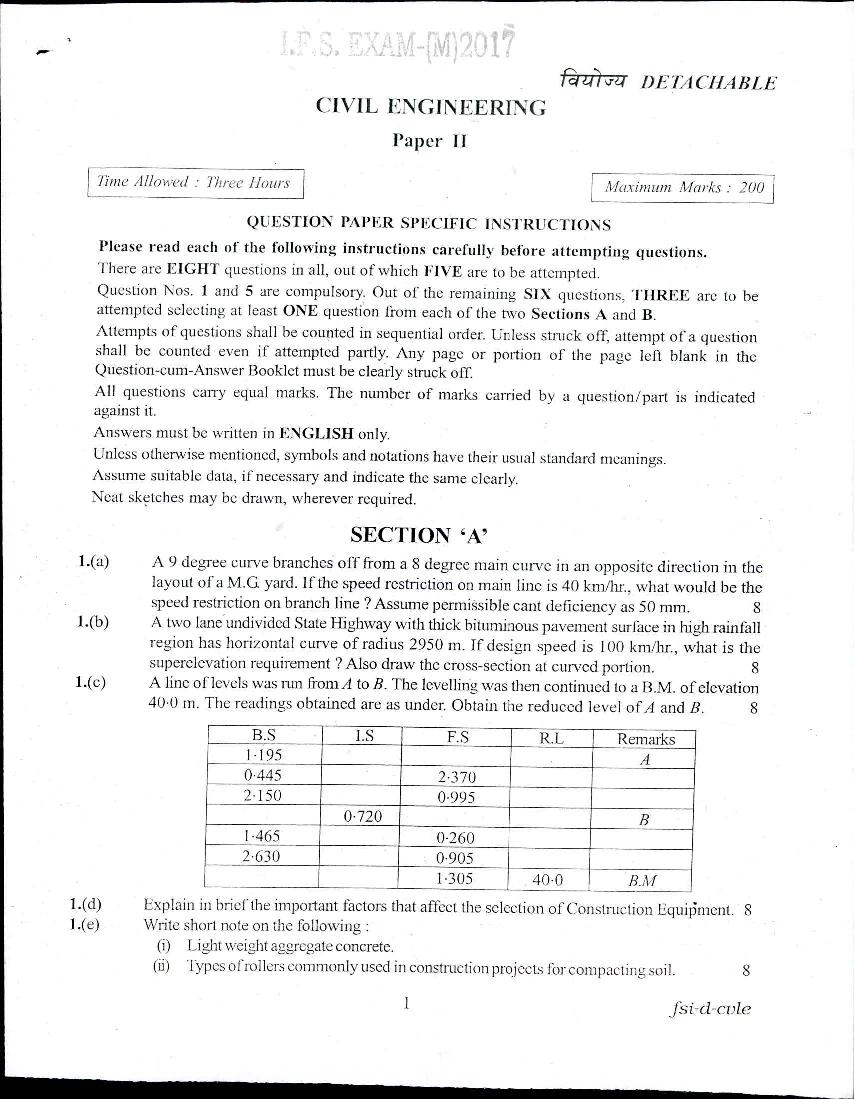
A 9 degree curve branches off from a 8 degree main curve in an opposite direction in the
layout of a M.G yard. If the speed restriction on main line is 40 km/hr., what would be the
speed restriction on branch line ? Assume permissible cant deficiency as 50 mm 8
A two lane'undivided State Highway with thick bituminous pavement surface in high rainfall
region has horizontal curve of radius 2950 m. If design speed is 100 km/hr., what is the
superelevation requirement ?Also draw the cross-section at curved portion. 8
A line of levels was run from A to B. The levelling was then continued to a B.M. of elevation
40-0 m. The readings obtained are as under. Obtain the reduced level of A and B. 8
B.S LS F.S R.L Remarks
1.195 A
0.445 2-370
2.150 0.995
0.720 B
1-465 0.260
2.630 0-905
1-305 40-0 B.M
Explain in brief the important factors that affect the selection of Construction Equiliment. 8
Write short note on the following:
Light weight aggregate concrete.
Types ofrollers commonly used in construction projects for compacting soil. 8
1 fsi-d-cule
Page 2
causes of segregation ? What are the methods of prevention of segregation ? How bleeding
is different from segregation? What are the causes and how it can be prevented ? 15
For the following traverse, compute the length of line CD so that A, D and E may be in one
straight line : 15
Line Length(m) Bearing
AB 110 83°12'
BC 165 30°42'
CD ? 346°06'
DE 212 16°18'
Draw a labelled sketch of Right hand turnout, clearly highlighting the movement of train on
both the routes i.e. main and diverted. 10
3.(a) Draw a network diagram to represent the following project. Calculate the occurrence times
of the events and activity times. Also determine the critical path. 10
Activity Id Predecessor Description Time (weeks)
A — Prepare site 1
B A Pour foundation 6
C B Buy shrubs etc. 3
D B Roof 2
E D Do interior work 3
F C Landscape • 4
G E, F Move in 1
What are the approximate oxide composition limits found in ordinary portland cement ?Briefly
explain the functions of following oxides: 10
(i) Lime (ii) Silica (iii) Alumina (iv) Iron oxide
Calculate stopping sight distance on a highway at level stretch for a design speed of 80 km/
hr. Also calculate the effect of 2% descending gradient on the SSD. Assume other data as per
IRC recommendations. 10
A flexible pavement is designed for a 7.0 m wide carriage way with following data:
Commercial traffic per day = 600 (As on 1.1.2012)
Planning and construction period = 1 year
Rate of traffic growth per annum = 10%
Design life = 15 years
Vehicle damage factor = 2-0
Because of some legal issues project could not be completed in time and it got delayed by
4 years. However pavement design remains the same. Will it have some implications on
design life of the project ? What will be the new design life of the road? 10
fsi-d-cule 2
Page 3
4.(b) Write a short note on the following. Wherever necessary explain the questions. 10
Slack
CPM vs PERT
What does a positive slack, a zero slack and a negative slack indicate in a real life project
scenario?
Bar chart
4.(c) The maximum increase in temperature is expected to be 24°C after the construction of cement
concrete pavement. If the expansion gap is of 2.0 cm design the spacing between the expansion
and contraction joints. Assume allowable stress in concrete (tension) during initial period
of curing = 0.8 kg/cm2; coeff of thermal expansion of cement concrete 10 x 10-6 per °C,
unit wt. of concrete =2400 kg/m3 and coeff of friction at interface as 1-3. 10
4.(d) A vehicle moving at 40 lam/hr was stopped by applying the brakes and the length of skid mark
was 12-2 m. If the average skid resistance of the pavement is known to be 0.70, determine
the brake efficiency of the test vehicle. 10
SECTION 'B'
5.(a) Define-the infiltration indices 0-index and co-index with sketches and determine the 0-index
and co-index when the half hourly rainfall rate for a period of 4 hours storm are 1.8, 2.7, 3-8,
5.5, 3.2, 2-6, 2-2 and 1.2 cm/hr. The corresponding run-off is 3.3 cm. The effective surface
retention is zero. 8
5-(b) Write the various losses in canals. 4
Explain Drainage and Pressure release arrangements behind canal lining. 4
Explain the design considerations of earth dams in Earthquake regions. 8
A small town with water demand as given below requires a storage reservoir. Assuming that
the pumping is done uniformly @ constant rate for 24 hrs, estimate the storage capacity of
the reservoir. Population of the town is 50000. Assume fire demand as 2 1pcd. 8
Time 0-4 4-8 8-12 12-16 16-20 20-24
Demand (ML) 0.48 0.87 1.33 1.00 0.82 0.54
Explain the impacts of disposal of wastewater with following characteristics into fresh
water: 8
(i) Nutrients (ii) Heavy metals (iii) Oil and grease (iv) Suspended solids
Three wells are situated forming an equilateral triangle with a side distance of 110 m. Al! the
three wells are penetrated fully into a 10 m thick Aquifer with medium sand having coefficient
of permeability of 50 tn/day. The radius of wells are 15 cm and worked under a depression
head of 3.5 mat well face. The radius of influence of each well is 240 m. All the wells have
same characteristics. Compute the yield of each well. 10
(i) Whatis the purpose of unit hydrograph and how it is derived from a simple flood
hydrograph of isolated storms. 5
(ii) What is synthetic unit hydrograph and write the equations for standard duration, lag
time and width of the synthetic unit hydrograph at various percentages of discharges.
5
3 fsi-d-cvle
Page 4
the effects of these parameters on human health : to
(i) Fluorides (ii) Nitrates (iii) Chlorides (iv) Total hardness (v) Total dissolved solids
6.(d) A river with saturation DO (@ 25°C) 8-4 mg// and self purification ratio, (f) 2.4 receives
treated wastewater. Find the permissible BUD in the treated wastewater if rate constant k1
(@ 25°C) is 0-1/day. 10
7.(a) The section of throat of saddle syphon spillway is width = 5 m and height = 2-5 m.
Full reservoir level = +252-00 m
Crest level of spillway = +248.00 m
Level of center of syphon outlet = +240.00
High flood level in the reservoir = +254.00
If the high flood discharge is 650 cumecs, determine the number of syphon units required to
pass the high flood discharge safely. Coeff. of discharge = 0-85 and the syphon discharges
freely into air. 10
7.(b) Explain hygroscopic water in soil and permanent wilting point along with diagram. 5
What is consumptive use of water and write the factors affecting consumptive use of
water in irrigation. 5
7.(c) (i) Give a flow chart indicating sequence of units in domestic wastewater treatment plant.
Specify the objectives of each unit. 5
(ii) Differentiate between BUD and COD. Explain the importance of CUD/BUD ratio in
selection of treatment units. 5
7.(d) Explaining the environmental impacts ofriver valley projects, suggest environmental management
plan to mitigate the negative impacts of the project. 10
8.(a) Explain the causes of failures of weirs and write the preventive measures. 10
8.(b) Explain the purpose and suitability of the following with diagrams:
Aqueducts 4
Non modular pipe outlet 3
Groynes in river training 3
8.(c) Explaining the advantages of sanitary landfills over open dumps, discuss how landfill problems
are addressed. 10
8.(d) With help of line sketch, explain the working principles of Electrostatic precipitators and fabric
filters in air pollution control. 10
fsi-d-cvle 4
Document Details
| Board / Org | UPSC |
| Exam | Indian Forest Service Examination |
| Type | Question Paper |
| Pages | 4 |
| Updated | 30 Apr 2026 |