UPSC IFS 2017 Question Paper for Forestry Paper-I
Finished viewing? Save it for later —
Download UPSC IFS 2017 Question Paper for Forestry Paper-I (PDF · 4 pages)About UPSC IFS 2017 Question Paper for Forestry Paper-I
UPSC IFS 2017 Question Paper for Forestry Paper-I is available here for free download. Published by UPSC for Indian Forest Service Examination, this question paper can be viewed online or downloaded as a PDF (4 pages). Candidates preparing for Indian Forest Service Examination can use UPSC IFS 2017 Question Paper for Forestry Paper-I to understand the exam pattern, the type of questions asked, and the overall difficulty level.
Frequently Asked Questions
How can I download UPSC IFS 2017 Question Paper for Forestry Paper-I?
Open this page and click the Download button to save UPSC IFS 2017 Question Paper for Forestry Paper-I as a PDF. It is completely free on AglaSem Docs.
Is UPSC IFS 2017 Question Paper for Forestry Paper-I free to download?
Yes. UPSC IFS 2017 Question Paper for Forestry Paper-I can be viewed online and downloaded as a PDF free of cost on AglaSem Docs.
How many pages does UPSC IFS 2017 Question Paper for Forestry Paper-I have?
UPSC IFS 2017 Question Paper for Forestry Paper-I contains 4 pages, which you can read online or download together as a single PDF.
Where can I find more Indian Forest Service Examination study material?
You can find more Indian Forest Service Examination question papers, sample papers, syllabus, and answer keys on AglaSem Docs.
UPSC IFS 2017 Question Paper for Forestry Paper-I – Text
Read the full text of this question paper below — useful to quickly search, copy and reference the content online without downloading the PDF.
📄 View text version (4 pages)
Page 1
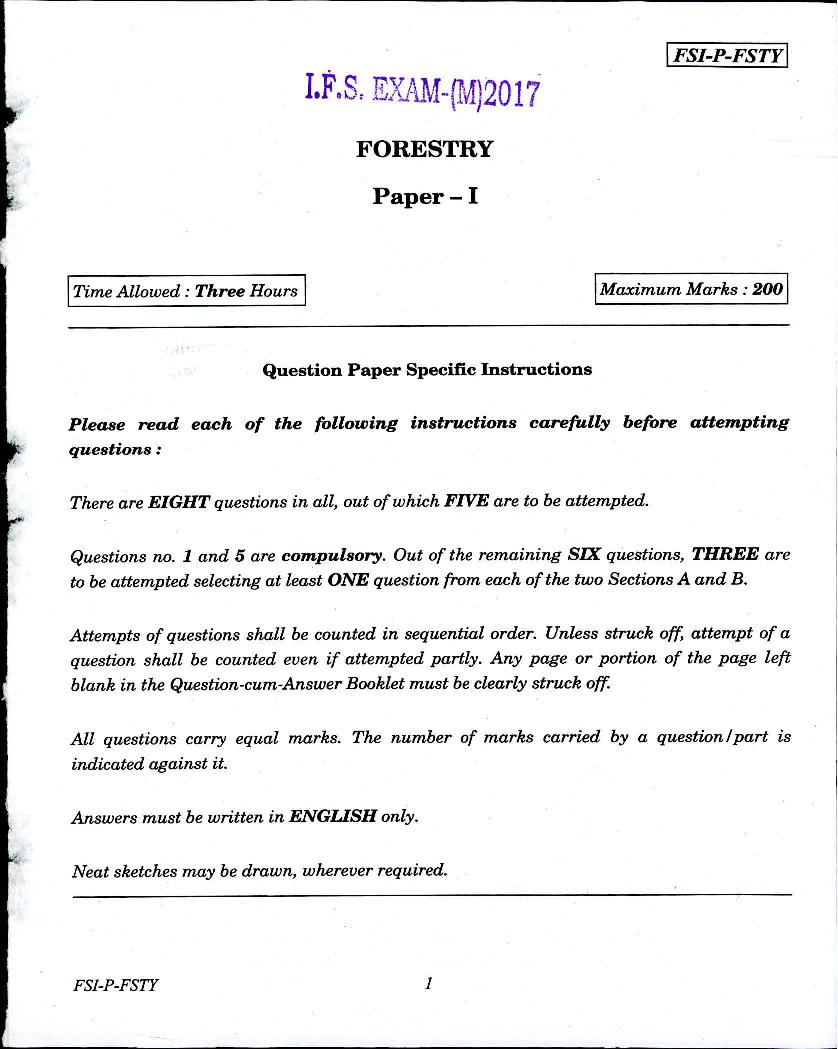
LESS EMM-(M)2017
FORESTRY
Paper - I
Time Allowed: Three Hours Maximum Marks : 200
Question Paper Specific Instructions
Please read each of the following instructions carefully before attempting
questions:
There are EIGHT questions in all, out of which FIVE are to be attempted.
Questions no. I and 5 are compulsory. Out of the remaining SIX questions, THREE are
to be attempted selecting at least ONE question from each of the two Sections A and B.
Attempts of questions shall be counted in sequential order. Unless struck off attempt of a
question shall be counted even if attempted partly. Any page or portion of the page left
blank in the Question-cum-Answer Booklet must be clearly struck off.
All questions carry equal marks. The number of marks carried by a question/part is
indicated against it.
Answers must be written in ENGLISH only.
Neat sketches may be drawn, wherever required.
FSI-P-FSTY
Page 2
Ql. Answer the following: 8x5=40
Give four examples of uses of Pollarding in Indian forestry. 8
Enlist four groups of forest types under the moist tropical forest as per
the Champion and Seth classification of forest types. 8
Name the method of thinning that best promotes genetic improvement
of the regular stand besides controlling density. Give reasons in support
of your answer. 8
Enlist six genera of mangroves. Name two States and one Union
territory with the largest area under mangrove forests. 8
Calculate the number of seeds required to raise a 20 hectare plantation
with 4 m x 4 m spacing and an extra plant in the centre of each square.
Plant percent of the species is 75%. 8
Q2. (a) Describe the natural distribution of
Shorea rob usta, and
Azadirachta indica. 10
(b) Write silvicultural characters of
Casuarina equisetifolia, and
(ii) Abies pindrow. 10
(c) Some rural communities are opposed to chir pine and advocate removal
of chir pine and its replacement with broadleaved multipurpose trees.
What is your reaction in this matter? 10
(d) Regulation of solar radiation gives a powerful tool to the forester.
Justify. 10
Q3. Where are cold deserts found in India ? Explain site characteristics
encountered in a cold desert and steps suggested to overcome problems
in their afforestation. 10
Describe the technique of Sand Dune Fixation in the Thar Desert. Also
mention the choice of species for planting. 15
Enlist the general rules governing the felling of bamboo in forests. What
are the consequences of gregarious flowering of bamboo ? What special
measures would you take in the event of gregarious flowering? 15
FSI-P-FSTY 2
Page 3
A soil can be wet, yet physiologically dry. How ? What steps are
suggested to correct the problem? 10
What is Sub-climax? Explain its importance in the context of Indian
forestry. 10
Enlist the advantages and disadvantages of vegetative propagation.
What future do you foresee for it in forestry? 10
FSI-P-FSTY 3
Page 4
Q5. Answer the following: 8x5=40
Write in brief on advanced generation tree improvement. 8
Discuss in detail, the kinds of soil mycorrhizae and the benefits derived
by plants from them. 8
Explain General Combining Ability (GCA), Specific Combining Ability
(SCA) and their utility. 8
Comment on the possible impact of greenhouse gases on the global
environment. 8
Discuss the impact of agroforestry practices on the environment in
general and on soil properties in particular, with a suitable example. 8
Q6. (a) Discuss the term Biodiversity. Explain the levels in which it can be
studied. What are the different measures employed to measure
biological diversity? Elaborate. 20
(b) Explain the scope and aims of Urban forestry. Discuss the need of urban
forestry in the improvement of city environment. 20
Q7. (a) What are Seed Production Areas (SPA) ? Explain the purpose of
establishing them. Briefly highlight the advantages and disadvantages
of SPA. List the steps involved in establishing SPA. 20
What are the various methods adopted to conserve the soil on sloping
areas ? Explain in brief. 10
Differentiate between Windbreaks and Shelterbelts. Discuss in brief,
their impact on the environment. 10
Q8. (a) What is Water harvesting ? List the different methods of water
harvesting and suggest various practices for efficient use of conserved
water. 20
Explain various types of Succession. Describe the major theories
explaining succession. 10
List the different components of Phenotypic variation. How are they
important for tree breeders? 10
FSI-P-FSTY 4
Document Details
| Board / Org | UPSC |
| Exam | Indian Forest Service Examination |
| Type | Question Paper |
| Pages | 4 |
| Updated | 30 Apr 2026 |