TN 11th Question Paper 2022 Textile & Dress Designing
Finished viewing? Save it for later —
Download TN 11th Question Paper 2022 Textile & Dress Designing (PDF · 6 pages)About TN 11th Question Paper 2022 Textile & Dress Designing
TN 11th Question Paper 2022 Textile & Dress Designing is available here for free download. Published by Tamil Nadu Board for Class 11, this question paper can be viewed online or downloaded as a PDF (6 pages). Candidates preparing for Class 11 can use TN 11th Question Paper 2022 Textile & Dress Designing to understand the exam pattern, the type of questions asked, and the overall difficulty level.
Frequently Asked Questions
How can I download TN 11th Question Paper 2022 Textile & Dress Designing?
Open this page and click the Download button to save TN 11th Question Paper 2022 Textile & Dress Designing as a PDF. It is completely free on AglaSem Docs.
Is TN 11th Question Paper 2022 Textile & Dress Designing free to download?
Yes. TN 11th Question Paper 2022 Textile & Dress Designing can be viewed online and downloaded as a PDF free of cost on AglaSem Docs.
How many pages does TN 11th Question Paper 2022 Textile & Dress Designing have?
TN 11th Question Paper 2022 Textile & Dress Designing contains 6 pages, which you can read online or download together as a single PDF.
Where can I find more Class 11 study material?
You can find more Class 11 question papers, sample papers, syllabus, and answer keys on AglaSem Docs.
TN 11th Question Paper 2022 Textile & Dress Designing – Text
Read the full text of this question paper below — useful to quickly search, copy and reference the content online without downloading the PDF.
📄 View text version (6 pages)
Page 1
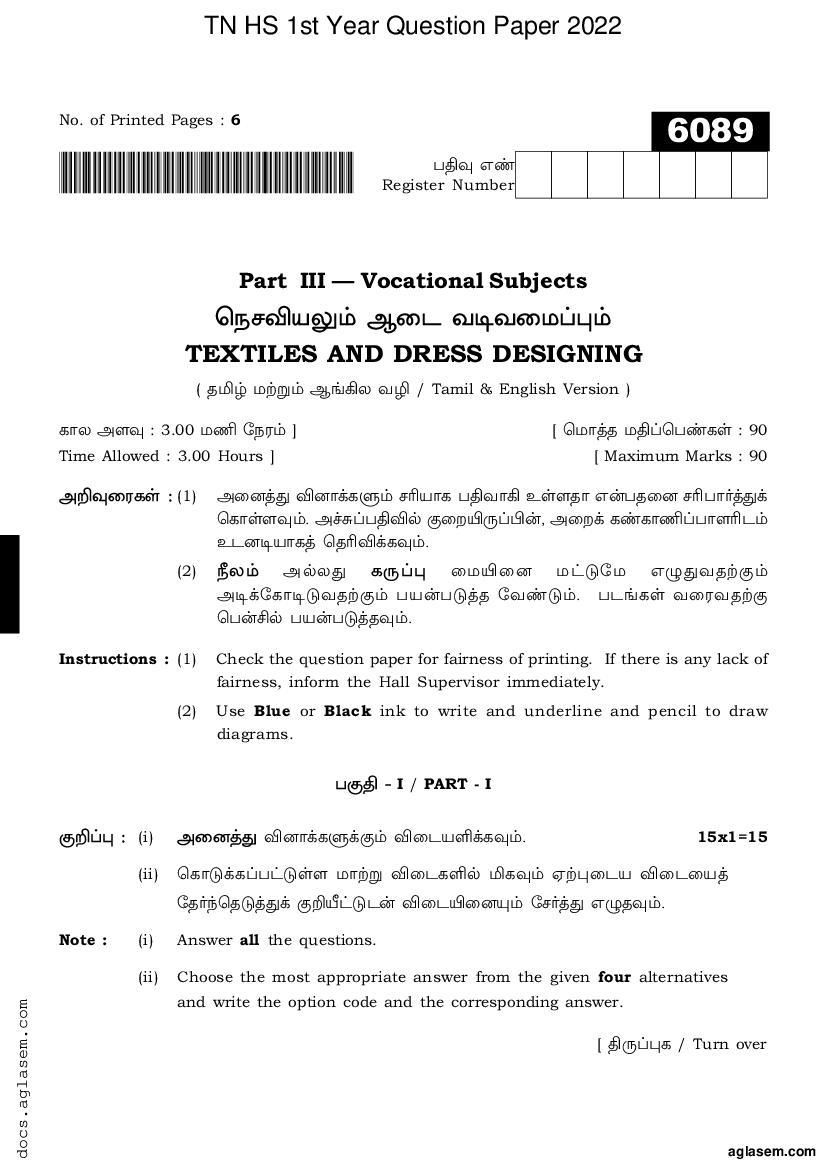
6089
!6089IstYearTextilesDressDesg! £vÄ Gs
Register Number
Part III — Vocational Subjects
ö|\¯¾® Bøh ÁiÁø©¨¦®
TEXTILES AND DRESS DESIGNING
( uªÌ ©ØÖ® B[Q» ÁÈ / Tamil & English Version )
Põ» AÍÄ : 3.00 ©o ÷|µ® ] [ ö©õzu ©v¨ö£sPÒ : 90
Time Allowed : 3.00 Hours ] [ Maximum Marks : 90
AÔÄøµPÒ : (1) AøÚzx ÂÚõUPЮ \›¯õP £vÁõQ EÒÍuõ GߣuøÚ \›£õºzxU
öPõÒÍÄ®. Aa_¨£vÂÀ SøÓ°¸¨¤ß, AøÓU PsPõo¨£õÍ›h®
EhÚi¯õPz öu›ÂUPÄ®.
(2) }»® AÀ»x P¸¨¦ ø©°øÚ ©mk÷© GÊxÁuØS®
AiU÷PõikÁuØS® £¯ß£kzu ÷Ásk®. £h[PÒ ÁøµÁuØS
ö£ß]À £¯ß£kzuÄ®.
Instructions : (1) Check the question paper for fairness of printing. If there is any lack of
fairness, inform the Hall Supervisor immediately.
(2) Use Blue or Black ink to write and underline and pencil to draw
diagrams.
£Sv & I / PART - I
SÔ¨¦ : (i) AøÚzx ÂÚõUPÐUS® Âøh¯ÎUPÄ®. 15x1=15
(ii) öPõkUP¨£mkÒÍ ©õØÖ ÂøhPÎÀ ªPÄ® Hئøh¯ Âøhø¯z
÷uº¢öukzxU SÔ±mkhß Âøh°øÚ²® ÷\ºzx GÊuÄ®.
Note : (i) Answer all the questions.
(ii) Choose the most appropriate answer from the given four alternatives
and write the option code and the corresponding answer.
Page 2
1. ö\¯ØøP CøÇPÒ G¢u ¡ØÓõsk Psk¤iUP¨£mhx ?
(A) 18 &B® ¡ØÓõsk (B) 19 &B® ¡ØÓõsk
(C) 17 &B® ¡ØÓõsk (D) 20 &B® ¡ØÓõsk
When was artificial yarns manufactured :
(a) 18th century (b) 19th century
(c) 17th century (d) 20th century
2. ö\i°ß __________ £õPzv¼¸¢x £g_ QøhUQÓx.
(A) £Ç[PÒ (B) ÂøuPÒ (C) £møhPÒ (D) CøÇPÒ
Cotton is obtained from __________.
(a) Fruit (b) Seed (c) Bark (d) Leaf
3. ÷µ¯õß CøÇPøÍU öPõsk £Í£Í¨£õÚ __________ ÷£õßÓ xoPøÍz
u¯õ›UP»õ®.
(A) P®£Î (B) £¸zv (C) \nÀ (D) £mk
Rayon filament yarns can be used for shiny fabrics that resemble __________.
(a) Wool (b) Cotton (c) Jute (d) Silk
4. _ÇØ ¡À Gߣx __________ C¸US®.
(A) ö©ßø©¯õÚuõP (B) }Í©õÚuõP
(C) Smøh¯õÚuõP (D) £¸zuuõP
Staple fibres are __________ fibres.
(a) Fine (b) Long
(c) Short (d) Bulky
5. }ÍÁõUQÀ öPõsh xo°ß Âή¦PÒ __________ GßÖ AøÇUP¨£kQÓx.
(A) £õÄ (B) Pøµ (C) |õhõ (D) ö|\Ä
The lengthwise edge of fabric is called __________.
(a) Warp (b) Selvedge (c) Shuttle (d) Weaving
6. EhÀ AÍÄPøÍ Gk¨£uØS¨ £¯ß£kÁx :
(A) ©õºUQ[ \UPµ® (B) AiU÷PõÀ
(C) ¡À (D) AÍÄ|õhõ
The important tool in taking body measurement __________.
(a) Tracing Wheel (b) Scale
(c) Thread (d) Measuring tape
Page 3
7. xoPÎß •øÚPøÍ •iUP¨ £¯ß£kÁx __________.
(A) E¸mkz øu¯À (B) öPmiz øu¯À
(C) C¯¢vµ øu¯À (D) ©i¨¦z øu¯À
__________ is used to finish the raw edges of the fabric.
(a) Whipping stitch (b) Back stitch
(c) Machine stitch (d) Hem stitch
8. A»[Põµz øu¯ÀPÒ öPõsk øu¨£x __________ GßÖ AøÇUP¨£kQÓx.
(A) §zøu¯À (B) {ø»¯õÚ øu¯À
(C) ©i¨¦z øu¯À (D) Kmkz øu¯À
The art of using decorative stitches is called __________.
(a) Embroidery (b) Permanent stitch
(c) Hem stitch (d) Running stitch
9. F]zusk GuÚõÀ ‰h¨£mkÒÍx ?
(A) |Pºzx® uPk (B) G®¤µõ´h› ¤÷Ím
(C) •P¨¦z uPk (D) C¯[S® \UPµzøu ¤iUS® v¸Põo
The needle bar is covered by __________.
(a) Slide plate (b) Embroidery plate
(c) Face plate (d) Thumb screw
10. |À» Bøh ÁiÁø©¨¦ \›¯õÚ __________ AÍÃkPøÍ Ai¨£øh¯õPU
öPõshx.
(A) AÍÄ |õhõ (B) EhÀ (C) £õo (D) Bøh
Good garment designing is based upon the perfect __________ measurements.
(a) Inch Tape (b) Body (c) Style (d) Dress
11. PõQu ©õv›PÒ __________ ÁøP¨£k®.
(A) Cµsk (B) ‰ßÖ (C) BÖ (D) I¢x
There are __________ types of paper patterns.
(a) Two (b) Three (c) Six (d) Five
12. __________ Aø©UP¨ö£Ö® ¡ÀPÒ Áõº¨ GßÓøÇUP¨£kQÓx.
(A) ‰ø»ÂmhÁõUQÀ (B) }ÍÁõUQÀ
(C) ö\[SzxÁõUQÀ (D) SÖUSÁõmiÀ
The yarn which runs in the __________ direction is called warp.
(a) Diagonal (b) Lengthwise
(c) Verticalwise (d) Crosswise
Page 4
13. xoPøÍ ö|kUS ÁõUQ¾® SÖUS ÁõUQ¾® ›US® •øÓ __________ GÚ
AøÇU-P¨-£-k-Q-Ó-x.
(A) £õv ©zv¯ ©i¨¦ (B) P»¨¦ ©i¨¦
(C) vÓ¢u ©i¨¦ (D) }ÍÁõUQÀ ©i¨¦
Folding fabric in lengthwise and crosswise direction is called __________.
(a) Lengthwise layout (b) Combination fold
(c) Open layout (d) Off centre crosswise fold
14. xoPøÍ ÃnõUPõ©À C¸¨£uØS __________ •øÓø¯¨ £¯ß£kzu»õ®.
(A) ÷» AÄm (B) i÷µ¨¤[ (C) iµõL¨i[ (D) Q÷µi[
Method used for preventing the wastage of fabric is known as __________.
(a) Layout (b) Draping (c) Drafting (d) Grading
15. __________ J¸ •U÷Põn ©i¨¦PÒ BS®.
(A) hUì (B) hõºmì (C) _¸UP[PÒ (D) ©i¨¦PÒ
__________ are triangular folds.
(a) Tucks (b) Darts (c) Gathers (d) Pleats
£Sv & II / PART - II
SÔ¨¦ : GøÁ÷¯Ý® £zx ÂÚõUPÐUS ©m-k® _¸U-P-©õ-P Âøh¯ÎUPÄ®. ÂÚõ
Gs 28 &US Psi¨-£õP Âøh¯ÎUPÄ®. 10x3=30
Note : Answer any ten questions. Question No. 28 is Compulsory.
16. £õxPõ¨¦ BøhPÒ £ØÔ GÊxP.
Write about safety clothes.
17. P®£Î £u¨£kzx® •øÓø¯¨ £ØÔ ÂÁ›UPÄ®.
Explain the processing of wool.
18. ÷µ¯õß GßÓõÀ GßÚ ?
What is Rayon ?
19. ¡À E¸ÁõUP® £ØÔ SÔ¨¦ ÁøµP.
Write short notes on yarn formation.
20. AÍÄ |õhõ £ØÔ GÊxP.
Write about measuring tape.
Page 5
21. ö£À øP GßÓõÀ GßÚ ?
What is a bell sleeve ?
22. £À÷ÁÖ Âu©õÚ øu¯À C¯¢vµ[PøÍ GÊxP.
What are the different types of sewing machines ?
23. ©õº¦ _ØÓÍøÁ GÆÁõÖ AÍUP ÷Ásk® ?
How will you take bust round measurement ?
24. PõQu ©õv› ÁøPPøÍU TÖP.
How many paper patterns are there ?
25. CøÇ°ß vø\ GßÓõÀ GßÚ ?
What is grain ?
26. Cøn¨¦PÎß ÁøPPøÍU TÖP.
How many types of seams are there ?
27. SÖUS hUì GßÓõÀ GßÚ ? Auß £¯ßPøÍU TÖP.
What is a cross tuck ? Write its uses.
28. A»[Põµz øu¯ÀPÎß ö£¯ºPøÍU TÖP.
Name some decorative stitches.
£Sv & III / PART - III
SÔ¨¦ : GøÁ÷¯Ý® I¢x ÂÚõUPÐUS ©mk® Âøh¯ÎUPÄ®. AÁØÔÀ ÂÚõ
Gs 35&US Pmhõ¯©õP Âøh¯ÎUPÄ®. 5x5=25
Note : Answer any five questions. Question No. 35 is Compulsory.
29. £¸zv°ß £s¦PøÍ ÂÁ›UPÄ®.
What are the properties of cotton ?
30. A]÷hm CøÇPøͨ £ØÔ ]Ö SÔ¨¦ ÁøµP.
Write a short note on acetate fibre.
31. øu¯À C¯¢vµzvß £õP[PÎÀ H÷uÝ® I¢vøÚ ÂÍUSP.
Explain any five parts of sewing machine.
Page 6
32. £»Âu©õÚ PõQu ©õv›PøÍ Â›US® •øÓPøÍ ÂÁ›UPÄ®.
What are the types of pattern layout ? Explain.
33. £h[PøÍU öPõsk öÁÆ÷ÁÖ Âu©õÚ PÊzx ÁøÍÄPøÍ ÂÁ›UPÄ®.
Describe the different types of neckline with diagram.
34. ø©mhº vÓ¨ø£ ÂÁ›UPÄ®.
Explain miter placket.
35. _¸UP® Aø©¢u øP & ÂÁ›UPÄ®.
Explain - Gathered Sleeves.
£Sv & IV / PART - IV
SÔ¨¦ : ›ÁõP Âøh¯ÎUPÄ®. 2x10=20
Note : Answer the following questions in detail.
36. (A) I¢x ÁøP¯õÚ A»[Põµz øu¯ø» ÂÁ›UPÄ®.
AÀ»x
(B) GøÁ÷¯Ý® Cµsk ÁøP¯õÚ ©i¨¦PøÍ ÂÍUSP.
(a) Describe any five decorative stitches.
OR
(b) Explain any two types of pleats.
37. (A) Põ»›ß ÁøPPøÍ ÂÍUSP.
AÀ»x
(B) øPPÎß ÁøPPøÍ £h® Áøµ¢x ÂÍUSP.
(a) Describe the different types of collars.
OR
(b) Explain the different types of sleeves with diagram.
-o0o-
Document Details
| Board / Org | Tamil Nadu Board |
| Exam | Class 11 |
| Type | Question Paper |
| Pages | 6 |
| Updated | 30 Apr 2026 |