UPSC IFS 2017 Question Paper for General Knowledge – Text
Read the full text of this question paper below — useful to quickly search, copy and reference the content online without downloading the PDF.
📄 View text version (2 pages)
Page 1
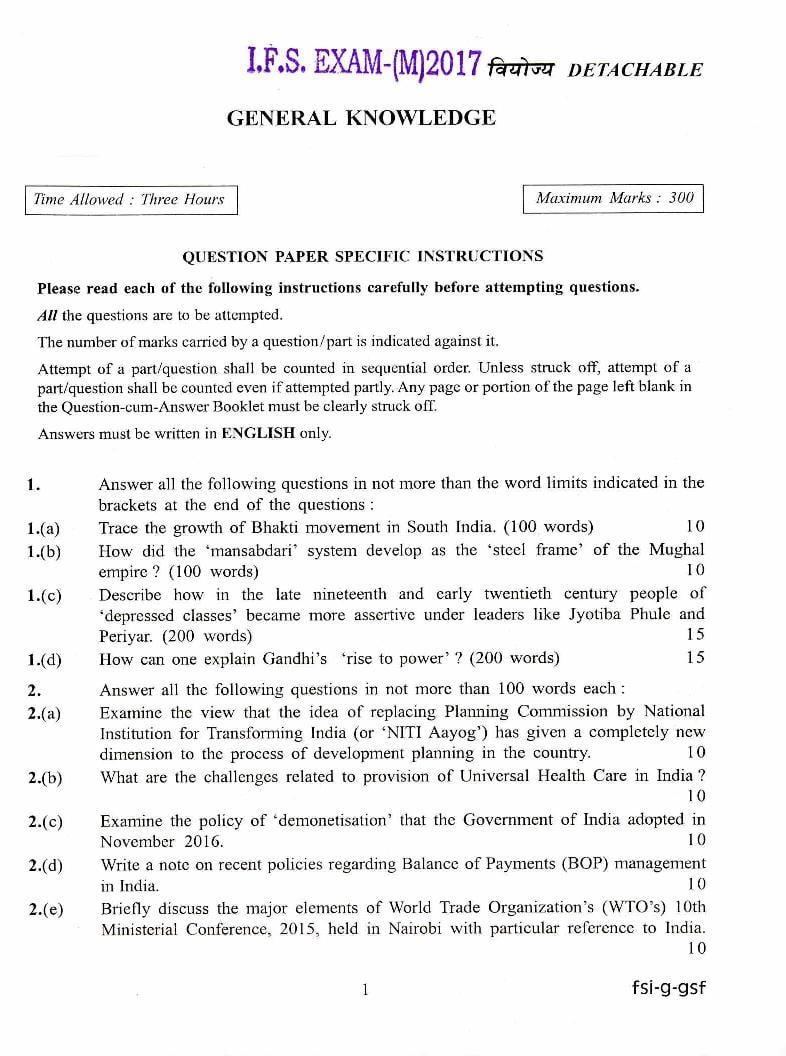
I.F.S. EXAM-(M)2017 DETACHABLE GENERAL KNOWLEDGE Time Allowed : Tiiree Hours Maximum Marks : 300 QUESTION PAPER SPECIFIC INSTRUCTIONS Please read each o f the following instructions carefully before attem pting questions. A ll the questions are to be attempted. The number o f marks carried by a question/part is indicated against it. Attempt o f a part/question shall be counted in sequential order. Unless struck off, attempt o f a part/question shall be counted even if attempted partly. Any page or portion o f the page left blank in the Question-cum-Answer Booklet must be clearly struck off. Answers must be written in E N G L ISH only. 1. Answer all the following questions in not more than the word limits indicated in the brackets at the end o f the questions : l.(a) Trace the growth o f Bhakti movement in South India. (100 v^ords) 10 l.(b) How did the ‘mansabdari’ system develop as the ‘steel fram e’ o f the Mughal empire ? (1 GO words) 10 l.(c ) Describe hovi^ in the late nineteenth and early twentieth century people of ‘depressed classes’ became more assertive under leaders like Jyotiba Phule and Periyar. (200 words) 15 1.(d) How can one explain G andhi’s ‘rise to pow er’ ? (200 words) 15 2. Answer all the followmg questions in not more than 100 words each ; 2.(a) Examine the view that the idea o f replacing Planning Commission by National Institution for Transforming India (or ‘NITI Aayog’) has given a completely new dimension to the process o f development planning in the country. 10 2.(b) What are the challenges related to provision o f Universal Health Care in India ? 10 2.(c) Examine the policy o f ‘demonetisation’ that the Government o f India adopted in November 2016. 10 2,(d) Write a note on recent pohcies regarding Balance o f Payments (BOP) management in India. 10 2.(e) Briefly discuss the major elements of World Trade Organization’s (W TO’s) 10th Ministerial Conference, 2015, held in Nairobi with particular reference to India. 10 1 fsi-g-gsf
Page 2
3. Answer all the following questions in not more than 100 words each : 3 .(a) What are the significant features of Directive Principles o f State Policy? 10 3.(b) What is rule o f law ? Explain. 10 3.(c) Do you think National Commission for Scheduled Castes succeeded in protecting Scheduled Caste communities ? Give reasons for your answer. 10 3.(d) Do you perceive development discourse in contemporary India ensures economic dem ocracy? Elaborate. 10 3.(e) Why is that Media is characterised as the Fourth Pillar of Indian Democracy ? 10 4. Answer all the following questions within the word limits indicated in brackets at the end o f the questions : 4.(a) Write the mechanism of landslides. What are the causes of the occun'ence of landslides? (150 words) 5+10=15 4.(b) Distinguish between soil erosion and land degradation. How can you control soil erosion? (150 words) 5 + 1 0-15 4.(c) “Most of the important hot deserts o f the world are located in the tropical region” - Justify this fact. (150 words) 10 4.(d) What are ‘geomorphological resources’ ? How are geomorphological resources linked with geomorphological hazards? (150 words) 5+5=10 5. Answer all the following questions in not more than 100 words each : 5.(a) What are the advantages o f organic farming ? 10 5.(b) Describe the uses of ‘Neem Coated Urea’. 10 5.(c) What are biogradable plastics ? 10 5.(d) Explain dryland farming. 10 5.(e) What are biogeographic zones of India ? 10 5.(f) What is ‘M ridaparikshak’ developed by ICAR ? 10 6. Answer all the following questions in not more than 100 words : 6.(a) What are the significant uses of drones ? 10 6.(b) What is meant by digital signature ? 10 6.(c) What are gravitational waves ? 10 6.(d) Explain the meaning o f ‘Robotarium’. 10 fsi-g-gsf