UPSC IFS 2017 Question Paper for Geology Paper-I
Finished viewing? Save it for later —
Download UPSC IFS 2017 Question Paper for Geology Paper-I (PDF · 4 pages)About UPSC IFS 2017 Question Paper for Geology Paper-I
UPSC IFS 2017 Question Paper for Geology Paper-I is available here for free download. Published by UPSC for Indian Forest Service Examination, this question paper can be viewed online or downloaded as a PDF (4 pages). Candidates preparing for Indian Forest Service Examination can use UPSC IFS 2017 Question Paper for Geology Paper-I to understand the exam pattern, the type of questions asked, and the overall difficulty level.
Frequently Asked Questions
How can I download UPSC IFS 2017 Question Paper for Geology Paper-I?
Open this page and click the Download button to save UPSC IFS 2017 Question Paper for Geology Paper-I as a PDF. It is completely free on AglaSem Docs.
Is UPSC IFS 2017 Question Paper for Geology Paper-I free to download?
Yes. UPSC IFS 2017 Question Paper for Geology Paper-I can be viewed online and downloaded as a PDF free of cost on AglaSem Docs.
How many pages does UPSC IFS 2017 Question Paper for Geology Paper-I have?
UPSC IFS 2017 Question Paper for Geology Paper-I contains 4 pages, which you can read online or download together as a single PDF.
Where can I find more Indian Forest Service Examination study material?
You can find more Indian Forest Service Examination question papers, sample papers, syllabus, and answer keys on AglaSem Docs.
UPSC IFS 2017 Question Paper for Geology Paper-I – Text
Read the full text of this question paper below — useful to quickly search, copy and reference the content online without downloading the PDF.
📄 View text version (3 pages)
Page 1
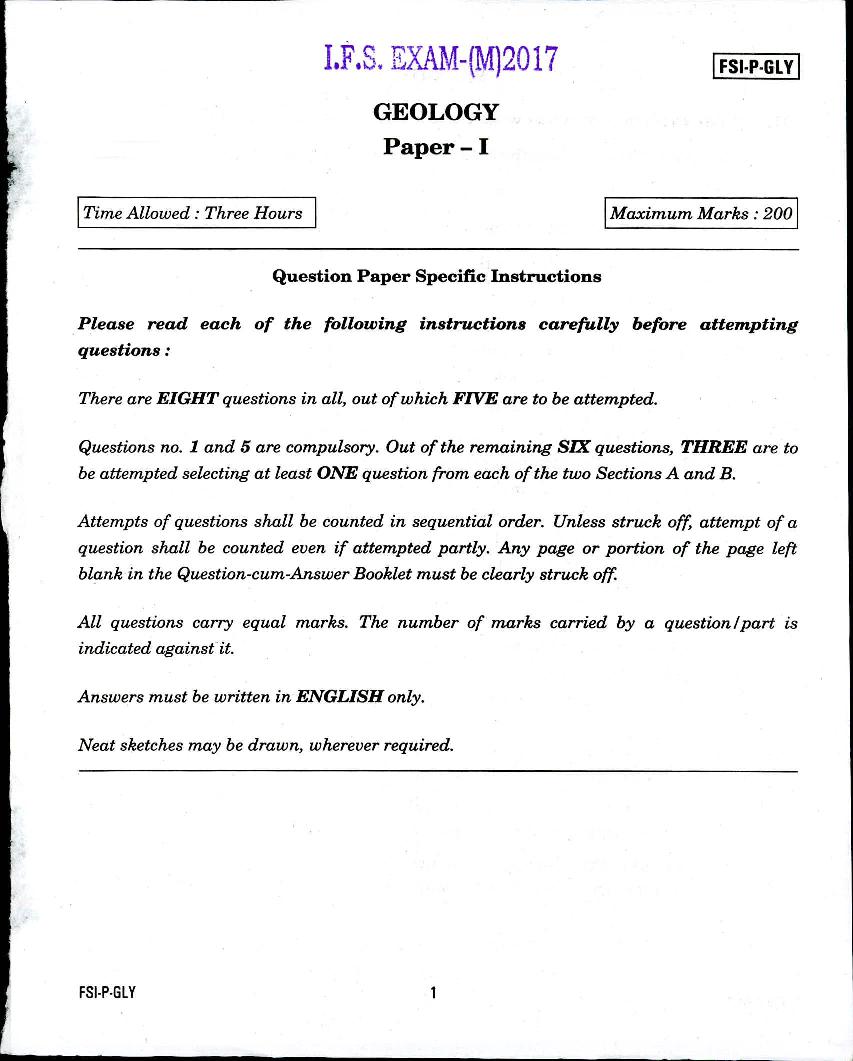
GEOLOGY
Paper - I
!Time Allowed: Three Hours Maximum Marks : 200
Question Paper Specific Instructions
Please read each of the following instructions carefully before attempting
questions:
There are EIGHT questions in all, out of which FIVE are to be attempted.
Questions no. 1 and 5 are compulsory. Out of the remaining SIX questions, THREE are to
be attempted selecting at least ONE question from each of the two Sections A and B.
Attempts of questions shall be counted in sequential order. Unless struck off, attempt of a
question shall be counted even if attempted partly. Any page or portion of the page left
blank in the Question-cum-Answer Booklet must be clearly struck off.
All questions carry equal marks. The number of marks carried by a question/part is
indicated against it.
Answers must be written in ENGLISH only.
Neat sketches may be drawn, wherever required.
FSIT-GLY 1
Page 2
Ql. Write explanatory notes within 150 words each, on the following: 8x5=40
Protoplanetary hypothesis and its relationship to the Solar Nebula 8
Geomorphic features along the eastern coast of India 8
Salient characters of Geostationary and Polar orbiting satellites 8
Classification of folds on the basis of orientation of axial plane 8
Petrofabric analysis 8
Q2. Explain the geological and palaeontological evidences of continental drift
and comment on the mechanism of plate separation and collision. 15
Using case studies, explain the application of geomorphology in mineral
prospecting. 15
Describe unconformities and their types, and give the various criteria to
distinguish them from faults. 10
Q3. Discuss the evidences of seafloor spreading and explain with illustrative
diagrams, how earthquakes and subduction processes are related to
each other. 15
Describe the components and working principles of (i) Cross-track
scanners, and RISAT. 15
Enumerate the tools and equipment required to undertake geological
mapping. Explain the importance of geological mapping. 10
Q4. With the help of a case study, describe the methodology for using
satellite imagery and GIS to identify potential zones of groundwater. 15
How are stress and strain related to each other ? Explain the
stress — strain curves in terms of brittle, ductile and viscous materials. 15
Discuss the internal structure of the Earth and comment on
S and P-waves shadow zones with suitable diagrams. 10
FSI-P-GLY 2
Page 3
Write explanatory notes within 150 words each, on the following: 8x5=40
Q5.
Mineral-walled microfossils and their applications in stratigraphic
correlation 8
Chronological order of volcanic events of the Indian Plate, and
explanation of causes and manner of Deccan volcanism 8
Ghyben-Herzberg relationship 8
Palaeogeographic reconstruction of India during Gondwana times, using
suitable diagrams 8
Causes, effects and mitigation measures of concrete cancer 8
Q6. (a) Define Lithostratigraphy and comment on the criteria for
lithostratigraphic classification and description of various rank terms. 15
Briefly describe organic-walled microfossils. Discuss their applications
in petroleum exploration. 15
Describe the geological considerations for designing and constructing
earthquake resistant structures. /0
Q7. (a) Elaborate the procedure for 'Aquifer Performance Test' and estimation of
hydraulic properties of aquifers. 15
Describe using diagrams, the morphology of Graptolites and comment on
the significance of Graptolites in the evolution of vertebrates. 15
Discuss the stratigraphy and distribution of marine depositional
episodes in the Gondwana sequence of India. 10
Q8. (a) Discuss the geological history of Trilobites with specific description of
the abundance, decline and extinction of the group through the
Palaeozoic Era. 15
Give a detailed account of the field and laboratory tests carried out to
determine the engineering properties of rocks. 15
Tabulate the Palaeozoic stratigraphic successions and their equivalents
in Spiti, Kashmir and Kumaon basins of the Himalayas. 10
FSI-P-GLY 3
Document Details
| Board / Org | UPSC |
| Exam | Indian Forest Service Examination |
| Type | Question Paper |
| Pages | 4 |
| Updated | 30 Apr 2026 |