JELET 2024 Syllabus
Finished viewing? Save it for later —
Download JELET 2024 Syllabus (PDF · 5 pages)About JELET 2024 Syllabus
JELET 2024 Syllabus is available here for free download. Published by WBJEEB for JELET, this syllabus can be viewed online or downloaded as a PDF (5 pages). Candidates preparing for JELET can use JELET 2024 Syllabus to understand the exam pattern, the type of questions asked, and the overall difficulty level.
Frequently Asked Questions
How can I download JELET 2024 Syllabus?
Open this page and click the Download button to save JELET 2024 Syllabus as a PDF. It is completely free on AglaSem Docs.
Is JELET 2024 Syllabus free to download?
Yes. JELET 2024 Syllabus can be viewed online and downloaded as a PDF free of cost on AglaSem Docs.
How many pages does JELET 2024 Syllabus have?
JELET 2024 Syllabus contains 5 pages, which you can read online or download together as a single PDF.
Where can I find more JELET study material?
You can find more JELET question papers, sample papers, syllabus, and answer keys on AglaSem Docs.
JELET 2024 Syllabus – Text
Read the full text of this syllabus below — useful to quickly search, copy and reference the content online without downloading the PDF.
📄 View text version (5 pages)
Page 1
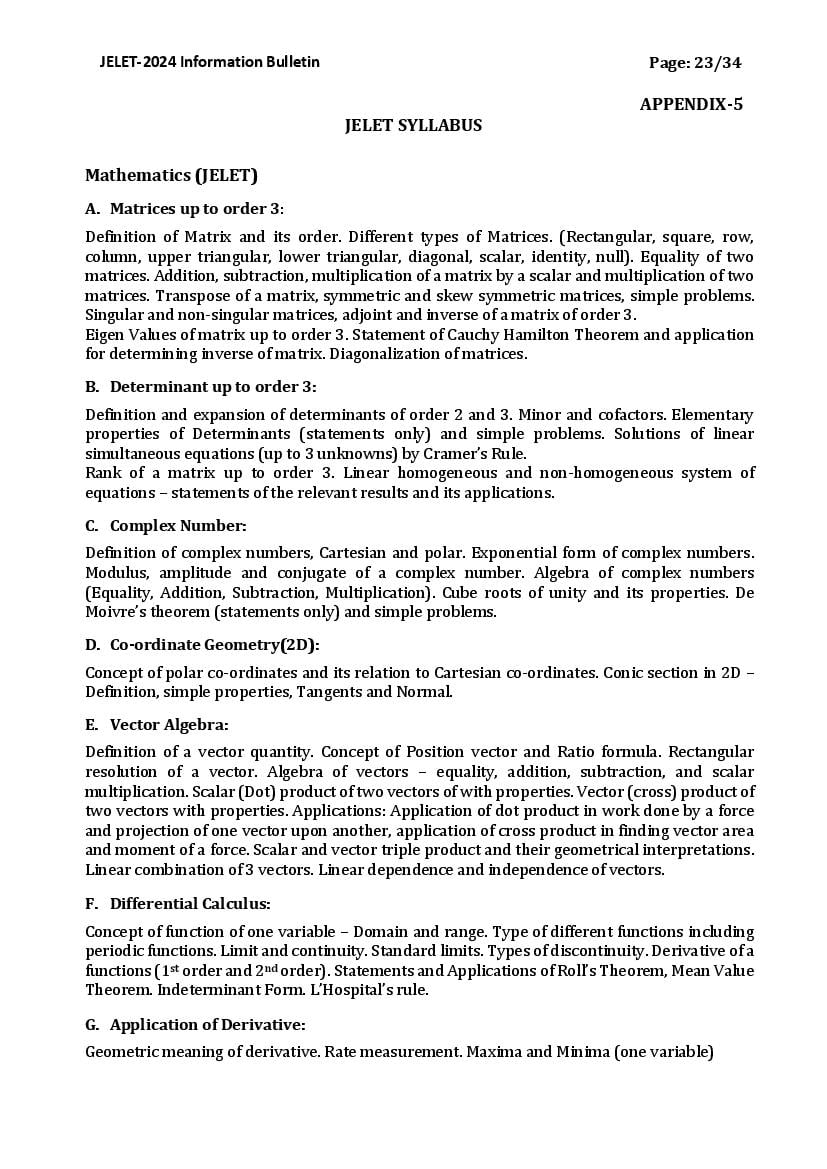
APPENDIX-5
JELET SYLLABUS
Mathematics (JELET)
A. Matrices up to order 3:
Definition of Matrix and its order. Different types of Matrices. (Rectangular, square, row,
column, upper triangular, lower triangular, diagonal, scalar, identity, null). Equality of two
matrices. Addition, subtraction, multiplication of a matrix by a scalar and multiplication of two
matrices. Transpose of a matrix, symmetric and skew symmetric matrices, simple problems.
Singular and non-singular matrices, adjoint and inverse of a matrix of order 3.
Eigen Values of matrix up to order 3. Statement of Cauchy Hamilton Theorem and application
for determining inverse of matrix. Diagonalization of matrices.
B. Determinant up to order 3:
Definition and expansion of determinants of order 2 and 3. Minor and cofactors. Elementary
properties of Determinants (statements only) and simple problems. Solutions of linear
simultaneous equations (up to 3 unknowns) by Cramer’s Rule.
Rank of a matrix up to order 3. Linear homogeneous and non-homogeneous system of
equations – statements of the relevant results and its applications.
C. Complex Number:
Definition of complex numbers, Cartesian and polar. Exponential form of complex numbers.
Modulus, amplitude and conjugate of a complex number. Algebra of complex numbers
(Equality, Addition, Subtraction, Multiplication). Cube roots of unity and its properties. De
Moivre’s theorem (statements only) and simple problems.
D. Co-ordinate Geometry(2D):
Concept of polar co-ordinates and its relation to Cartesian co-ordinates. Conic section in 2D –
Definition, simple properties, Tangents and Normal.
E. Vector Algebra:
Definition of a vector quantity. Concept of Position vector and Ratio formula. Rectangular
resolution of a vector. Algebra of vectors – equality, addition, subtraction, and scalar
multiplication. Scalar (Dot) product of two vectors of with properties. Vector (cross) product of
two vectors with properties. Applications: Application of dot product in work done by a force
and projection of one vector upon another, application of cross product in finding vector area
and moment of a force. Scalar and vector triple product and their geometrical interpretations.
Linear combination of 3 vectors. Linear dependence and independence of vectors.
F. Differential Calculus:
Concept of function of one variable – Domain and range. Type of different functions including
periodic functions. Limit and continuity. Standard limits. Types of discontinuity. Derivative of a
functions (1st order and 2nd order). Statements and Applications of Roll’s Theorem, Mean Value
Theorem. Indeterminant Form. L’Hospital’s rule.
G. Application of Derivative:
Geometric meaning of derivative. Rate measurement. Maxima and Minima (one variable)
Page 2
H. Partial Differentiation:
Definition and meaning of partial derivative. Evaluation of partial derivatives. Definition and
examples of homogeneous functions. Euler’s theorem (1st order) on homogeneous functions for
2 variables (without proof). Problems.
I. Integral Calculus:
Definition of Integration as inverse process of differentiation. Rules for integration (sum,
difference, scalar multiple). Integration of standard functions. Integration by substitution.
Integration by parts. Integration by partial fraction.
Definition of definite integral and simple problems. Properties of definite integral with simple
problems. Application of definite integral – area of bounded region.
J. Ordinary Differential Equation:
Definition of ordinary differential equation, order and degree. Solution of differential equation
of first order and first degree. Separation of variables. Homogeneous type. Exact type. Linear
type. Solution of differential equation of first order but not of the first degree. Solution of linear
second order differential equation with constant coefficients. Complementary Functions (C.F).
Particular integral for polynomial function eax, sinax and cosax, [F(-a2) ≠0] eaxV where V is a
function. Simple problem.
K. Probability:
Definition of random experiment, sample space, event, occurrence of events and types of events
(e.g., Impossible, mutually exclusive, Exhaustive, Equally likely). Classical definition of
probability, simple problems. Statements of total probability, compound probability and Base’s
Theorem and simple problems.
Physics (JELET)
A. Units, dimension, and measurement: CGS, MKS, SI units. Dimensions of common physical
quantities, dimensional analysis. Common errors in measurement. Error, accuracy,
precision, resolution, significant figure.
B. Kinematics: Speed, velocity, acceleration, uniform/non-uniform, rectilinear/ circular
motion. Position/ velocity-time graph. Resolution and composition of vectors, scalar
multiplication of vectors.
C. Laws of motion: Newton’s laws of motion. Force, momentum, inertia, moment of inertia,
impulse, couples, moment. Conditions of equilibrium. Conservation of momentum.
Centripetal and centrifugal forces. Angular displacement/ velocity/ acceleration/
momentum, torque. Static and dynamic friction, angle of repose, banking of roads.
D. Work, power, energy: Definition, measures, and units. Law of conservation of energy.
Kinetic and potential energy.
E. Gravitation: The universal law of gravitation. Acceleration due to gravity and its variation
on/ above/ below Earth’s surface. Gravitational potential energy. Vertical linear/ vertical
circular/ projectile motion.
F. Elasticity: Deforming force and restoring force, elastic, and plastic body. Stress-strain
relationship, Hook’s law, Young’s modulus, Bulk modulus, Rigidity modulus, Poisson’s ratio
and relation between them. Elastic energy.
Page 3
G. Surface tension: Cohesive and adhesive forces. Definition, dimension and SI unit of surface
tension. Surface energy. Angle of contact. Formation of droplets, bubble; their adhesion.
Capillarity, shape of liquid meniscus in a capillary tube, rise of liquid in a capillary tube.
Effect of impurity and temperature on surface tension.
H. Fluid mechanics/ Hydrostatics: Pascal’s law. Hydraulic lift. Buoyancy. Conditions of
equilibrium of floating body. Archimedes’ principle. Streamline flow and turbulent flow of
a fluid, critical velocity. Equation of continuity and Bernoulli’s theorem. Viscosity,
Newton’s formula for viscous force, co-efficient of viscosity. Stokes law and terminal
velocity. Effect of temperature on viscosity.
I. Thermal expansion of solid: Linear, areal and volume expansion. Coefficients of
expansions and their relation. Change of density with temperature.
J. Transmission of heat: Conduction, convection, radiation. Thermal conductivity (formula,
definition, dimensions, and SI unit).
K. Thermodynamics: Thermal equilibrium, calorimetry. Zeroth law of thermodynamics. Heat,
work, temperature and internal energy. First law of thermodynamics. Specific heats of gas,
their relation and their ratio. Isothermal, isobaric, isochoric and adiabatic process.
L. Reflection of Light: Reflection of light in plane mirror. Formation of image.
M. Refraction of light: Refraction of light through plane surface. Laws of refraction. Refractive
index, its relationship with the velocity of light in different media. Total internal reflection
and critical angle. Principle of optical fibre.
N. Lens: Convex and concave lenses. Formation of image. Relation between u, v, f. Power of a
lens (in different mediums). Equivalent focal length & power of two thin lenses in contact.
O. Photoelectricity: Photoemission, Work function. Photoelectric current, its variation with
intensity and frequency of incident radiation. Stopping potential, Threshold frequency.
Concept of photon. Einstein’s photoelectric equation. Principle of solar photo-voltaic cell
and its uses.
Chemistry (JELET)
A. Atomic Structure: Bohr model of atom, de Broglie wave equation, Quantum numbers,
Orbits and Orbitals, Aufbau principal, Pauli’s Exclusion principle, Hund’s rule of maximum
multiplicity, electronic configuration of elements. Definition of Atomic number, Mass
number, isotopes, isotones and isobars. Concept of hybridization sp3, sp2, sp and shape of
molecules.
B. Chemical Bonding: Electrovalent, Covalent, and coordinate bonds, H-bond in HF, water,
and ice. Classification of solids – crystalline and amorphous. Relationship between
structure and properties of crystalline solids namely ionic solid, covalent solid and
molecular solids. Covalent bonds in Carbon, Silicon and Germanium.
C. Acids, Bases & Salts: Avogadro number, Mole concept, weight and volume relations.
Acids, Bases and Salts (Arrhenius and Lewis concept). Acidity, basicity, neutralization
reaction, hydrolysis of Salts. Equivalent Weight of acids, bases, & salts; strength of
solution- normality, molarity, molality, formality and percentage strength, standard
solution- primary and secondary standards, concept of pH, and pH scale. Indicators and
choice of indicator, principles of acidimetry and alkalimetry. Buffer solution. Solubility
product principle. Common ion effect with relation to group analysis.
Page 4
D. Oxidation, Reduction, Electrochemistry: Oxidation and Reduction by electronic
concept, balancing chemical equations by ion-electron method, Redox Titration,
Electrolysis, Arrhenius theory, Faraday’s Laws, electrolysis of CuSO4 solution using Pt-
electrode and Cu-electrode. Application of electrolysis such as Electroplating, Electro-
refining and Electrotyping, Electrochemical Cells, Primary Cell- Dry Cell, Secondary Cell-
Lead storage cell, Electrochemical series.
E. Chemical Equilibrium: Reversible and irreversible reactions, exothermic and
endothermic reactions, chemical equilibrium, Le Chatelier’s principle. Industrial
preparation of Ammonia by Haber’s Process, Nitric acid by Ostwald’s process and
Sulphuric acid by Contact Process. Catalyst and catalysis.
F. Metallurgy: Minerals, Ores, Gangue, Flux, Slag, General method of extraction of metals
with reference to Iron, copper and Aluminium. Definition of Alloy, purposes of making
Alloy, Composition and uses of alloys such as brass, bronze, German silver, duralumin,
nichrome, bell metal, gun metal, Monel metal, alnico, Dutch metal, babbitt metal, stainless
steel. Amalgams, properties and uses of cast iron, wrought iron, steel and sponge iron.
Uses of different alloy steels.
G. Water: Soft and Hard water, action of soap on water, types of Hardness, causes of
hardness, units of hardness, disadvantages of using hard water, estimation of total
hardness by EDTA method, removal of hardness by Permutit process, Ion-exchange
process, phosphate conditioning and Calgon treatment.
H. Organic Chemistry: Organic compounds, Classification, Homologous series, Functional
groups, Isomerism, Nomenclature. Properties and preparation of Methane, Ethylene and
Acetylene, Methylated spirit, Rectified spirit, Power alcohol, Proof spirit. Uses of Benzene,
Naphthalene and phenol.
Fundamentals of Electrical & Electronics Engineering (JELET)
A. Electrical components, measuring instruments: Electrical components, measuring
instruments: Resistors, capacitors, inductors. Principle of operation of PMMC & MI type
Instrument. Principles of Voltage and Current measurement. Wheatstone bridge.
B. Transformers: Basic principle and construction. BH characteristics. Transformation ratio.
Equivalent circuit, losses, regulation, efficiency. Auto transformer.
C. Electrical machines: Types of motors and their applications. Generation of rotating
magnetic fields. Basic construction and working of DC motor, single phase induction motor.
Torque-Speed characteristics. Speed control.
D. DC sources and circuits: Voltage and current sources, their transformation, Thevenin’s,
Norton’s theorems. Kirchhoff current and voltage laws. Superposition, equivalence.
Determination of branch current/ voltage in passive circuits. Time domain characteristics
of reactive components.
E. AC sources and circuits: Amplitude, frequency, time-period, phase, peak/average/ RMS
values. Exponential, complex and phasor form of representation of sinusoidal voltage and
current. Impedance, power factor, active/reactive power. Voltage and current relationship
in star-delta connections. Behaviour of simple RLC circuits with AC excitation.
F. Basic semiconductor devices: Energy level diagrams of insulator, conductor & semi-
conductor. Intrinsic & extrinsic, P-type, N-type semiconductors. P-N junction diode. PNP and
NPN transistors, MOSFET, CMOS.
Page 5
G. Analog Circuits: OPAMP, virtual ground, inverting and non-inverting amplifiers, adder,
subtractor, integrator, differentiator.
H. Digital Electronics: Boolean Algebra, basic gates (AND, OR, NOT, NAND, NOR, Ex-OR, Ex-
NOR) – truth tables, symbols, and combination of gates.
Pharmacy (JELET)
Diploma Level syllabus in Pharmacy as prescribed by the Pharmacy Council of India.
Document Details
| Board / Org | WBJEEB |
| Exam | JELET |
| Type | Syllabus |
| Pages | 5 |
| Updated | 09 Jun 2026 |