CMC Vellore Nursing 2027 Sample Paper B.Sc Nursing
Finished viewing? Save it for later —
Download CMC Vellore Nursing 2027 Sample Paper B.Sc Nursing (PDF · 33 pages)About CMC Vellore Nursing 2027 Sample Paper B.Sc Nursing
CMC Vellore Nursing 2027 Sample Paper B.Sc Nursing is available here for free download. Published by CMC Vellore for CMC Vellore Nursing, this sample paper can be viewed online or downloaded as a PDF (33 pages). Candidates preparing for CMC Vellore Nursing can use CMC Vellore Nursing 2027 Sample Paper B.Sc Nursing to understand the exam pattern, the type of questions asked, and the overall difficulty level.
Frequently Asked Questions
How can I download CMC Vellore Nursing 2027 Sample Paper B.Sc Nursing?
Open this page and click the Download button to save CMC Vellore Nursing 2027 Sample Paper B.Sc Nursing as a PDF. It is completely free on AglaSem Docs.
Is CMC Vellore Nursing 2027 Sample Paper B.Sc Nursing free to download?
Yes. CMC Vellore Nursing 2027 Sample Paper B.Sc Nursing can be viewed online and downloaded as a PDF free of cost on AglaSem Docs.
How many pages does CMC Vellore Nursing 2027 Sample Paper B.Sc Nursing have?
CMC Vellore Nursing 2027 Sample Paper B.Sc Nursing contains 33 pages, which you can read online or download together as a single PDF.
Where can I find more CMC Vellore Nursing study material?
You can find more CMC Vellore Nursing question papers, sample papers, syllabus, and answer keys on AglaSem Docs.
CMC Vellore Nursing 2027 Sample Paper B.Sc Nursing – Text
Read the full text of this sample paper below — useful to quickly search, copy and reference the content online without downloading the PDF.
📄 View text version (33 pages)
Page 1
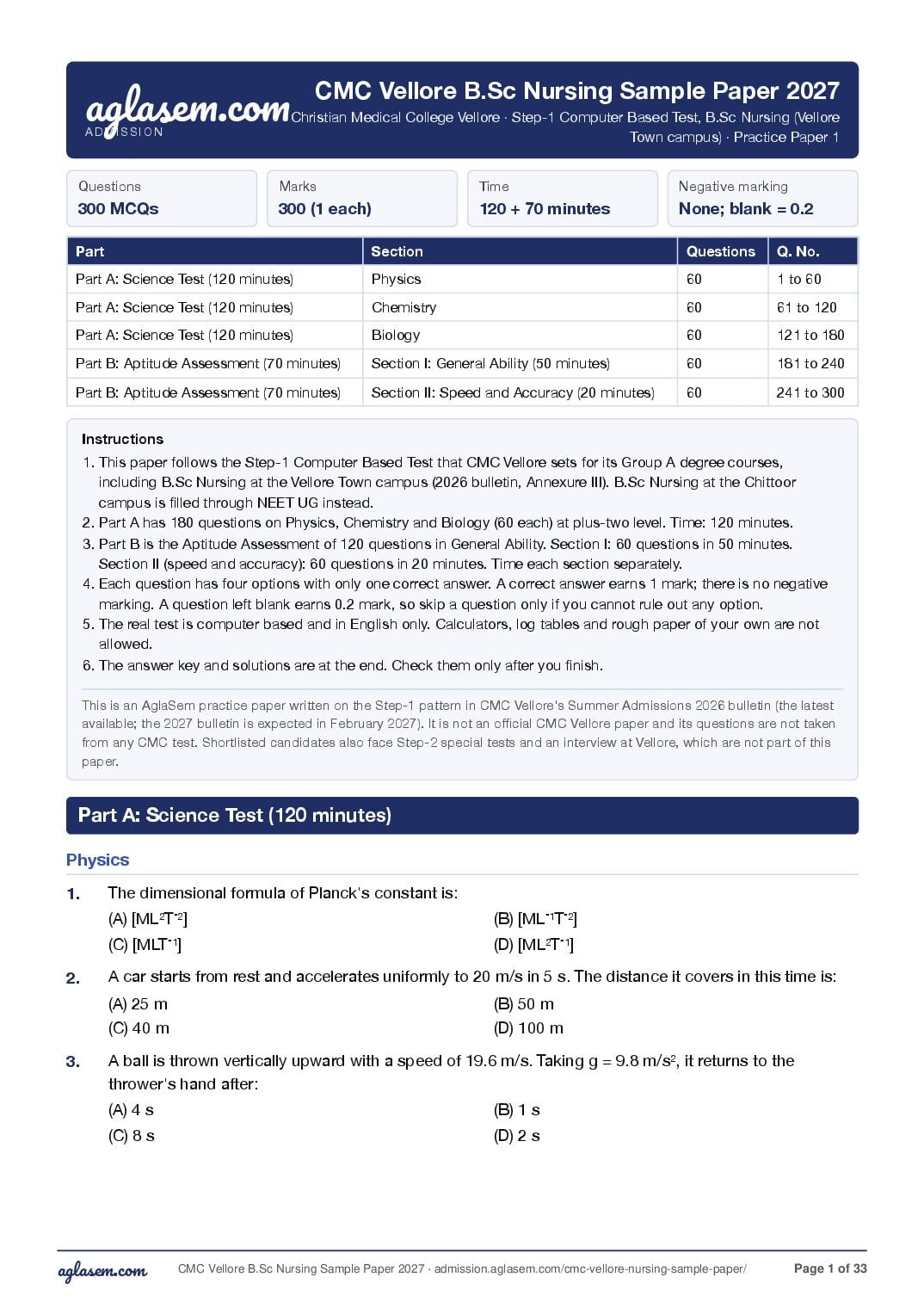
Christian Medical College Vellore · Step-1 Computer Based Test, B.Sc Nursing (Vellore
ADMISSION
Town campus) · Practice Paper 1
Questions Marks Time Negative marking
300 MCQs 300 (1 each) 120 + 70 minutes None; blank = 0.2
Part Section Questions Q. No.
Part A: Science Test (120 minutes) Physics 60 1 to 60
Part A: Science Test (120 minutes) Chemistry 60 61 to 120
Part A: Science Test (120 minutes) Biology 60 121 to 180
Part B: Aptitude Assessment (70 minutes) Section I: General Ability (50 minutes) 60 181 to 240
Part B: Aptitude Assessment (70 minutes) Section II: Speed and Accuracy (20 minutes) 60 241 to 300
Instructions
1. This paper follows the Step-1 Computer Based Test that CMC Vellore sets for its Group A degree courses,
including B.Sc Nursing at the Vellore Town campus (2026 bulletin, Annexure III). B.Sc Nursing at the Chittoor
campus is filled through NEET UG instead.
2. Part A has 180 questions on Physics, Chemistry and Biology (60 each) at plus-two level. Time: 120 minutes.
3. Part B is the Aptitude Assessment of 120 questions in General Ability. Section I: 60 questions in 50 minutes.
Section II (speed and accuracy): 60 questions in 20 minutes. Time each section separately.
4. Each question has four options with only one correct answer. A correct answer earns 1 mark; there is no negative
marking. A question left blank earns 0.2 mark, so skip a question only if you cannot rule out any option.
5. The real test is computer based and in English only. Calculators, log tables and rough paper of your own are not
allowed.
6. The answer key and solutions are at the end. Check them only after you finish.
This is an AglaSem practice paper written on the Step-1 pattern in CMC Vellore's Summer Admissions 2026 bulletin (the latest
available; the 2027 bulletin is expected in February 2027). It is not an official CMC Vellore paper and its questions are not taken
from any CMC test. Shortlisted candidates also face Step-2 special tests and an interview at Vellore, which are not part of this
paper.
Part A: Science Test (120 minutes)
Physics
1. The dimensional formula of Planck's constant is:
(A) [ML²T⁻²] (B) [ML⁻¹T⁻²]
(C) [MLT⁻¹] (D) [ML²T⁻¹]
2. A car starts from rest and accelerates uniformly to 20 m/s in 5 s. The distance it covers in this time is:
(A) 25 m (B) 50 m
(C) 40 m (D) 100 m
3. A ball is thrown vertically upward with a speed of 19.6 m/s. Taking g = 9.8 m/s², it returns to the
thrower's hand after:
(A) 4 s (B) 1 s
(C) 8 s (D) 2 s
CMC Vellore B.Sc Nursing Sample Paper 2027 · admission./cmc-vellore-nursing-sample-paper/ Page 1 of 33
Page 2
the angle of projection is:
(A) 90° (B) 45°
(C) 60° (D) 30°
5. Newton's first law of motion gives a qualitative idea of:
(A) action and reaction (B) gravitation
(C) conservation of energy (D) inertia
6. A force of 10 N acts on a 2 kg body at rest for 3 s. The momentum of the body at the end of 3 s is:
(A) 60 kg m/s (B) 15 kg m/s
(C) 30 kg m/s (D) 6 kg m/s
7. The motion of a rocket is based on the principle of conservation of:
(A) linear momentum (B) angular momentum
(C) mass (D) kinetic energy
8. The work done by the centripetal force on a body in uniform circular motion is:
(A) equal to its kinetic energy (B) zero
(C) negative (D) positive and constant
9. If the momentum of a body is doubled, its kinetic energy becomes:
(A) twice (B) four times
(C) eight times (D) half
10. A pump lifts 100 kg of water through a height of 10 m in 20 s. The power of the pump is (g = 10 m/s²):
(A) 1000 W (B) 500 W
(C) 200 W (D) 50 W
11. The moment of inertia of a thin ring of mass M and radius R about an axis through its centre and
perpendicular to its plane is:
(A) MR²/2 (B) MR²
(C) 2MR² (D) 2MR²/5
12. An ice skater spinning with arms stretched out pulls the arms close to the body. The skater's angular
speed:
(A) decreases (B) becomes zero
(C) increases (D) stays the same
13. The acceleration due to gravity at a height equal to the radius of the Earth above its surface is:
(A) g/4 (B) g/2
(C) 2g (D) g
14. The escape velocity from the surface of the Earth is about:
(A) 3 km/s (B) 11.2 km/s
(C) 42 km/s (D) 7.9 km/s
15. The period of revolution of a geostationary satellite is:
(A) 1 hour (B) 365 days
(C) 12 hours (D) 24 hours
16. The Young's modulus of a perfectly rigid body is:
(A) zero (B) equal to its bulk modulus
(C) infinite (D) 1
CMC Vellore B.Sc Nursing Sample Paper 2027 · admission./cmc-vellore-nursing-sample-paper/ Page 2 of 33
Page 3
(A) energy (B) mass
(C) momentum (D) charge
18. Small drops of a liquid take a spherical shape because of:
(A) gravity (B) buoyancy
(C) viscosity (D) surface tension
19. The terminal velocity of a small sphere falling through a viscous liquid is proportional to (r = radius of the
sphere):
(A) 1/r (B) r²
(C) r (D) r³
20. Water is used in car radiators mainly because it has a:
(A) high density (B) high specific heat capacity
(C) low boiling point (D) low thermal conductivity
21. Heat from the Sun reaches the Earth by:
(A) radiation (B) both conduction and convection
(C) convection (D) conduction
22. In an isothermal process of an ideal gas, the change in internal energy is:
(A) equal to the work done (B) always negative
(C) zero (D) equal to the heat supplied
23. A Carnot engine works between a source at 500 K and a sink at 300 K. Its efficiency is:
(A) 40% (B) 75%
(C) 60% (D) 25%
24. The root mean square speed of the molecules of an ideal gas is proportional to (T = absolute
temperature):
(A) T (B) T²
(C) √T (D) 1/T
25. The rms speed of gas molecules at 27°C is to be doubled. The gas must be heated to:
(A) 1200°C (B) 54°C
(C) 108°C (D) 927°C
26. If the length of a simple pendulum is made four times, its time period becomes:
(A) half (B) four times
(C) unchanged (D) twice
27. In simple harmonic motion, the acceleration of the particle is maximum:
(A) at the mean position
(B) at the extreme positions
(C) midway between mean and extreme
(D) nowhere; it is constant
28. Sound cannot travel through vacuum because sound waves:
(A) travel too fast
(B) are mechanical waves that need a medium
(C) are electromagnetic waves
(D) are transverse waves
CMC Vellore B.Sc Nursing Sample Paper 2027 · admission./cmc-vellore-nursing-sample-paper/ Page 3 of 33
Page 4
per second is:
(A) 8 (B) 2
(C) 4 (D) 258
30. A whistling train approaches a person standing on the platform. The pitch heard by the person is:
(A) higher than the actual pitch (B) lower than the actual pitch
(C) equal to the actual pitch (D) zero
31. The distance between two point charges is halved. The electrostatic force between them becomes:
(A) one-fourth (B) half
(C) four times (D) twice
32. The electric field inside a charged hollow conducting sphere is:
(A) uniform and non-zero
(B) zero
(C) inversely proportional to the distance from centre
(D) maximum at the centre
33. One volt is equal to:
(A) one joule per coulomb (B) one joule per second
(C) one coulomb per second (D) one newton per coulomb
34. A slab of dielectric constant K completely fills the space between the plates of a parallel plate capacitor.
Its capacitance:
(A) decreases K times (B) increases K times
(C) stays the same (D) becomes zero
35. Three capacitors of 3 µF each are connected in series. Their equivalent capacitance is:
(A) 1 µF (B) 9 µF
(C) 3 µF (D) 1/3 µF
36. A wire is stretched to double its length without any change in volume. Its resistance becomes:
(A) four times (B) unchanged
(C) twice (D) half
37. Three resistors of 6 Ω each are connected in parallel. The equivalent resistance is:
(A) 6 Ω (B) 2 Ω
(C) 18 Ω (D) 3 Ω
38. The resistance of the filament of a bulb rated 100 W, 220 V is:
(A) 484 Ω (B) 220 Ω
(C) 2.2 Ω (D) 48.4 Ω
39. Kirchhoff's junction (current) law is based on the conservation of:
(A) charge (B) mass
(C) momentum (D) energy
40. In a balanced Wheatstone bridge, P = 10 Ω, Q = 20 Ω and R = 15 Ω. The fourth resistance S is:
(A) 25 Ω (B) 7.5 Ω
(C) 30 Ω (D) 45 Ω
CMC Vellore B.Sc Nursing Sample Paper 2027 · admission./cmc-vellore-nursing-sample-paper/ Page 4 of 33
Page 5
(A) µ₀I/2πR (B) µ₀IR/2
(C) µ₀I/2R (D) µ₀I/4πR
42. A charged particle moves parallel to a uniform magnetic field. The magnetic force on it is:
(A) along the field (B) zero
(C) maximum (D) opposite to its velocity
43. Soft iron is preferred for the core of an electromagnet because it has:
(A) high permeability and low retentivity
(B) low permeability and low susceptibility
(C) high retentivity and high coercivity
(D) low permeability and high retentivity
44. According to Faraday's law, the emf induced in a coil is proportional to the:
(A) square of the current
(B) magnetic flux linked with it
(C) resistance of the coil
(D) rate of change of magnetic flux linked with it
45. Lenz's law is a consequence of the law of conservation of:
(A) charge (B) energy
(C) mass (D) momentum
46. A step-up transformer has a turns ratio (primary : secondary) of 1 : 10. If 220 V AC is applied to the
primary, the secondary voltage is:
(A) 110 V (B) 220 V
(C) 2200 V (D) 22 V
47. In an AC circuit containing only a pure inductor, the current:
(A) lags the voltage by 180° (B) lags the voltage by 90°
(C) leads the voltage by 90° (D) is in phase with the voltage
48. Of the following electromagnetic waves, the one with the shortest wavelength is:
(A) gamma rays (B) X-rays
(C) ultraviolet rays (D) infrared rays
49. Of the colours violet, blue, green and red, the one with the lowest frequency is:
(A) red (B) green
(C) blue (D) violet
50. A person who cannot see nearby objects clearly (hypermetropia) is given spectacles with:
(A) concave lenses (B) plane glass
(C) convex lenses (D) cylindrical lenses only
51. The power of a convex lens of focal length 50 cm is:
(A) −2 D (B) +50 D
(C) +2 D (D) +0.5 D
52. Optical fibres carry light signals over long distances using the principle of:
(A) polarisation (B) total internal reflection
(C) dispersion (D) diffraction
CMC Vellore B.Sc Nursing Sample Paper 2027 · admission./cmc-vellore-nursing-sample-paper/ Page 5 of 33
Page 6
(A) 1.5 × 10⁸ m/s (B) 2 × 10⁸ m/s
(C) 4.5 × 10⁸ m/s (D) 3 × 10⁸ m/s
54. In Young's double slit experiment, the distance between the two slits is halved, other things remaining
the same. The fringe width:
(A) becomes four times (B) remains unchanged
(C) becomes half (D) becomes double
55. In the photoelectric effect, the maximum kinetic energy of the emitted electrons depends on the:
(A) time for which light falls
(B) frequency of the incident light
(C) area of the metal surface
(D) intensity of the incident light
56. The de Broglie wavelength of a particle of momentum p is (h = Planck's constant):
(A) h/p (B) p/h
(C) hp (D) h/p²
57. In Bohr's model of the hydrogen atom, the radius of the nth orbit is proportional to:
(A) n² (B) 1/n²
(C) 1/n (D) n
58. The half-life of a radioactive sample is 5 days. The fraction of the sample left undecayed after 15 days
is:
(A) 1/4 (B) 1/8
(C) 1/3 (D) 1/16
59. The energy of the Sun is produced mainly by:
(A) chemical burning of hydrogen (B) radioactive decay
(C) nuclear fusion (D) nuclear fission
60. Pure silicon doped with a small amount of boron becomes a:
(A) n-type semiconductor (B) perfect insulator
(C) conductor (D) p-type semiconductor
Chemistry
61. The number of moles in 22 g of carbon dioxide is:
(A) 0.25 (B) 1
(C) 0.5 (D) 2
62. The number of molecules in 18 g of water is about:
(A) 6.022 × 10²³ (B) 18 × 10²³
(C) 3.011 × 10²³ (D) 1.8 × 10²²
63. 4 g of NaOH is dissolved in water to make 500 mL of solution. The molarity of the solution is:
(A) 0.2 M (B) 0.1 M
(C) 2 M (D) 0.4 M
64. The maximum number of electrons that the shell with n = 3 can hold is:
(A) 9 (B) 8
(C) 32 (D) 18
CMC Vellore B.Sc Nursing Sample Paper 2027 · admission./cmc-vellore-nursing-sample-paper/ Page 6 of 33
Page 7
(A) p subshell (B) f subshell
(C) d subshell (D) s subshell
66. The ground state electronic configuration of chromium (Z = 24) is:
(A) [Ar] 4s² 4p⁴ (B) [Ar] 3d⁶
(C) [Ar] 3d⁴ 4s² (D) [Ar] 3d⁵ 4s¹
67. Isotopes of an element have:
(A) the same number of neutrons only
(B) different numbers of protons
(C) the same atomic number but different mass numbers
(D) the same mass number but different atomic numbers
68. The most electronegative element is:
(A) oxygen (B) fluorine
(C) chlorine (D) nitrogen
69. On moving from left to right across a period, the atomic radius generally:
(A) remains the same
(B) decreases
(C) increases
(D) first decreases and then increases sharply
70. The hybridisation of each carbon atom in ethyne (C₂H₂) is:
(A) sp³d (B) sp³
(C) sp² (D) sp
71. The shape of a water molecule is:
(A) tetrahedral (B) linear
(C) trigonal planar (D) bent (angular)
72. The bond between sodium and chlorine in sodium chloride is:
(A) metallic (B) coordinate
(C) covalent (D) ionic
73. Water has a much higher boiling point than hydrogen sulphide mainly because of:
(A) hydrogen bonding (B) van der Waals forces only
(C) a higher molar mass (D) ionic bonding
74. At constant temperature, 2 L of a gas at 1 atm is compressed to 0.5 L. The new pressure is:
(A) 2 atm (B) 0.25 atm
(C) 4 atm (D) 1 atm
75. A process is spontaneous at constant temperature and pressure when the Gibbs energy change ΔG is:
(A) positive (B) equal to ΔH
(C) zero (D) negative
76. The pH of a 0.001 M HCl solution is:
(A) 1 (B) 0.001
(C) 11 (D) 3
CMC Vellore B.Sc Nursing Sample Paper 2027 · admission./cmc-vellore-nursing-sample-paper/ Page 7 of 33
Page 8
(A) the pressure is decreased (B) nitrogen is removed
(C) ammonia is added (D) the pressure is increased
78. A solution containing acetic acid and sodium acetate acts as a(n):
(A) strong acid (B) neutral salt solution
(C) acidic buffer (D) basic buffer
79. The oxidation number of manganese in KMnO₄ is:
(A) +4 (B) +7
(C) +6 (D) +5
80. Oxidation, in terms of electrons, is defined as the:
(A) gain of electrons (B) sharing of electrons
(C) gain of protons (D) loss of electrons
81. Heavy water is:
(A) H₂O₂ (B) D₂O
(C) H₂O with dissolved salts (D) T₂O
82. Hardness of water is caused mainly by dissolved salts of:
(A) calcium and magnesium (B) zinc and aluminium
(C) iron and copper (D) sodium and potassium
83. The chemical formula of plaster of Paris is:
(A) CaSO₄·2H₂O (B) CaO
(C) CaCO₃ (D) CaSO₄·½H₂O
84. Baking soda is:
(A) sodium carbonate (B) sodium hydrogen carbonate
(C) sodium hydroxide (D) calcium carbonate
85. Of the alkali metals Li, Na, K and Cs, the one that reacts most vigorously with water is:
(A) Na (B) K
(C) Li (D) Cs
86. Graphite differs from diamond in that graphite:
(A) is a compound of carbon
(B) has a three-dimensional network of sp³ carbons
(C) is harder
(D) conducts electricity
87. The noble gas used to fill weather balloons is:
(A) argon (B) helium
(C) krypton (D) neon
88. Depletion of the ozone layer is caused mainly by:
(A) nitrogen gas (B) carbon monoxide
(C) sulphur dioxide (D) chlorofluorocarbons
89. Which of the following is NOT a greenhouse gas?
(A) N₂O (B) CH₄
(C) CO₂ (D) N₂
CMC Vellore B.Sc Nursing Sample Paper 2027 · admission./cmc-vellore-nursing-sample-paper/ Page 8 of 33
Page 9
(A) 2 (B) 4
(C) 6 (D) 1
91. Which of the following is NOT a colligative property?
(A) elevation of boiling point (B) depression of freezing point
(C) viscosity (D) osmotic pressure
92. The van't Hoff factor for NaCl that dissociates completely in water is:
(A) 1 (B) 2
(C) 0.5 (D) 3
93. Sea water can be made drinkable by:
(A) osmosis (B) sublimation
(C) reverse osmosis (D) electrolysis
94. One faraday of electricity is about:
(A) 6.022 × 10²³ C (B) 9,650 C
(C) 1.6 × 10⁻¹⁹ C (D) 96,500 C
95. In a galvanic cell, oxidation takes place at the:
(A) salt bridge (B) cathode
(C) anode (D) external circuit
96. Iron rusts only when it is in contact with:
(A) oxygen alone (B) nitrogen
(C) both oxygen and water (D) water alone
97. The unit of the rate constant of a first-order reaction is:
(A) mol⁻¹ L s (B) L mol⁻¹ s⁻¹
(C) mol L⁻¹ s⁻¹ (D) s⁻¹
98. A first-order reaction has a half-life of 10 minutes. The time taken for 75% of it to be completed is:
(A) 40 minutes (B) 15 minutes
(C) 30 minutes (D) 20 minutes
99. A catalyst increases the rate of a reaction by:
(A) lowering the activation energy (B) increasing the enthalpy change
(C) raising the temperature (D) shifting the equilibrium
100. The Tyndall effect (scattering of a light beam) is shown by:
(A) dilute sugar solution (B) pure water
(C) true solutions (D) colloidal solutions
101. Most compounds of transition metals are coloured because of:
(A) the presence of s electrons only
(B) d-d transitions of electrons
(C) their high melting points
(D) their metallic bonding
102. The chief ore of aluminium is:
(A) zinc blende (B) galena
(C) haematite (D) bauxite
CMC Vellore B.Sc Nursing Sample Paper 2027 · admission./cmc-vellore-nursing-sample-paper/ Page 9 of 33
Page 10
(A) 4 (B) 2
(C) 3 (D) 6
104. The IUPAC name of CH₃–CH(CH₃)–CH₃ is:
(A) 1-methylpropane (B) 2-methylpropane
(C) isopropane (D) butane
105. Ethanol and dimethyl ether are:
(A) chain isomers (B) position isomers
(C) functional isomers (D) identical compounds
106. Two successive members of a homologous series differ by:
(A) a CH₃ unit (B) two carbon atoms
(C) a CH₂ unit (D) an OH group
107. Addition of HBr to propene (no peroxide) gives mainly:
(A) propane (B) 1,2-dibromopropane
(C) 2-bromopropane (D) 1-bromopropane
108. Benzene mainly undergoes:
(A) nucleophilic substitution reactions
(B) elimination reactions
(C) electrophilic substitution reactions
(D) addition reactions only
109. Chloroform is stored in dark coloured bottles filled to the brim because in light and air it forms the
poisonous gas:
(A) carbon dioxide (B) chlorine
(C) methane (D) phosgene
110. An SN2 reaction at a chiral carbon proceeds with:
(A) formation of a carbocation (B) retention of configuration
(C) complete racemisation (D) inversion of configuration
111. Primary, secondary and tertiary alcohols are distinguished by:
(A) biuret test (B) Lucas test
(C) Fehling's test (D) Tollens' test
112. Phenol is more acidic than ethanol because:
(A) phenol has more hydrogen atoms
(B) phenol has a higher molar mass
(C) ethanol is a stronger acid in water
(D) the phenoxide ion is stabilised by resonance
113. Tollens' reagent gives a silver mirror with:
(A) aldehydes (B) ethers
(C) alkanes (D) ketones
114. Formalin is an aqueous solution of:
(A) methanal (B) methanol
(C) methanoic acid (D) ethanal
CMC Vellore B.Sc Nursing Sample Paper 2027 · admission./cmc-vellore-nursing-sample-paper/ Page 10 of 33
Page 11
(A) lactic acid (B) ethanoic acid
(C) methanoic acid (D) citric acid
116. Of the following, the strongest base in aqueous solution is:
(A) methylamine (B) ammonia
(C) aniline (D) acetanilide
117. Glucose is an:
(A) ketohexose (B) ketopentose
(C) aldohexose (D) aldopentose
118. The bond that joins amino acids in a protein is the:
(A) peptide bond (–CO–NH–) (B) phosphodiester bond
(C) glycosidic bond (D) hydrogen bond
119. Nylon-6,6 is made from hexamethylenediamine and:
(A) ethylene glycol (B) terephthalic acid
(C) adipic acid (D) caprolactam
120. Of the following drugs, the antibiotic is:
(A) aspirin (B) penicillin
(C) paracetamol (D) ranitidine
Biology
121. The organelle known as the powerhouse of the cell is the:
(A) mitochondrion (B) Golgi apparatus
(C) lysosome (D) ribosome
122. Ribosomes of prokaryotic cells are of the type:
(A) 70S (B) 60S
(C) 80S (D) 90S
123. The fluid mosaic model of the cell membrane was proposed by:
(A) Robert Hooke (B) Schleiden and Schwann
(C) Watson and Crick (D) Singer and Nicolson
124. Crossing over takes place during the following stage of meiosis I:
(A) anaphase I (B) pachytene
(C) leptotene (D) diakinesis
125. The number of chromosomes in a normal human egg cell is:
(A) 23 (B) 22
(C) 44 (D) 46
126. Meselson and Stahl showed that DNA replication is:
(A) dispersive (B) conservative
(C) semi-conservative (D) non-template based
127. In a DNA molecule, adenine pairs with:
(A) thymine by two hydrogen bonds
(B) guanine by two hydrogen bonds
(C) cytosine by three hydrogen bonds
(D) thymine by three hydrogen bonds
CMC Vellore B.Sc Nursing Sample Paper 2027 · admission./cmc-vellore-nursing-sample-paper/ Page 11 of 33
Page 12
(A) methionine and acts as the start codon
(B) phenylalanine and acts as a stop codon
(C) tryptophan only
(D) a stop signal at the end of every gene
129. In Mendel's monohybrid cross, the phenotypic ratio in the F₂ generation is:
(A) 1 : 2 : 1 (B) 3 : 1
(C) 9 : 3 : 3 : 1 (D) 1 : 1
130. The phenotypic ratio in the F₂ generation of a Mendelian dihybrid cross is:
(A) 3 : 1 (B) 9 : 3 : 3 : 1
(C) 1 : 2 : 1 (D) 12 : 3 : 1
131. A person with blood group AB has both A and B antigens on the red cells. This is an example of:
(A) incomplete dominance (B) epistasis
(C) complete dominance (D) codominance
132. Haemophilia is a:
(A) sex-linked recessive disorder (B) chromosomal disorder
(C) autosomal dominant disorder (D) deficiency disease
133. Down syndrome is caused by:
(A) monosomy of the X chromosome (B) trisomy of chromosome 21
(C) deletion of chromosome 5 (D) an extra X chromosome in males
134. The five-kingdom classification was proposed by:
(A) Ernst Haeckel (B) R. H. Whittaker
(C) Carolus Linnaeus (D) Charles Darwin
135. The binomial system of naming organisms was popularised by:
(A) Carolus Linnaeus (B) Aristotle
(C) R. H. Whittaker (D) Gregor Mendel
136. The cell wall of bacteria is made mainly of:
(A) cellulose (B) peptidoglycan
(C) chitin (D) lignin
137. The oxygen released during photosynthesis comes from:
(A) water (B) glucose
(C) chlorophyll (D) carbon dioxide
138. Kranz anatomy is a feature of the leaves of:
(A) all algae (B) C₄ plants such as maize
(C) CAM plants only (D) C₃ plants such as wheat
139. Glycolysis takes place in the:
(A) nucleus (B) inner mitochondrial membrane
(C) cytoplasm (D) mitochondrial matrix
140. The Krebs cycle takes place in the:
(A) chloroplast stroma (B) endoplasmic reticulum
(C) cytoplasm (D) mitochondrial matrix
CMC Vellore B.Sc Nursing Sample Paper 2027 · admission./cmc-vellore-nursing-sample-paper/ Page 12 of 33
Page 13
(A) cytokinin (B) gibberellin
(C) abscisic acid (D) auxin
142. The plant hormone that hastens the ripening of fruits is:
(A) auxin (B) gibberellin
(C) cytokinin (D) ethylene
143. In flowering plants, food prepared in the leaves is carried to other parts by:
(A) phloem (B) cambium
(C) epidermis (D) xylem
144. Stomata open when the guard cells:
(A) store starch
(B) lose water and become flaccid and thin
(C) lose potassium ions to nearby cells
(D) take up potassium ions and become turgid
145. Nitrogen fixation in the root nodules of legumes is carried out by:
(A) Rhizobium (B) Pseudomonas
(C) Nitrosomonas (D) Azotobacter
146. Double fertilisation is a characteristic feature of:
(A) pteridophytes (B) bryophytes
(C) gymnosperms (D) angiosperms
147. The endosperm of angiosperms is usually:
(A) diploid (B) haploid
(C) triploid (D) tetraploid
148. Pollination by wind is called:
(A) anemophily (B) ornithophily
(C) hydrophily (D) entomophily
149. Pepsin, secreted in the stomach, acts on:
(A) fats (B) nucleic acids
(C) starch (D) proteins
150. Bile is produced by the liver and helps in the:
(A) digestion of starch (B) emulsification of fats
(C) absorption of water (D) digestion of proteins
151. The villi of the small intestine mainly:
(A) secrete bile into the intestine
(B) increase the surface area for absorption
(C) produce hydrochloric acid for digestion
(D) store glycogen
152. The normal pH of human arterial blood is about:
(A) 7.0 (B) 6.4
(C) 8.4 (D) 7.4
CMC Vellore B.Sc Nursing Sample Paper 2027 · admission./cmc-vellore-nursing-sample-paper/ Page 13 of 33
Page 14
(A) by white blood cells and platelets
(B) dissolved directly in the plasma
(C) by haemoglobin as oxyhaemoglobin
(D) as bicarbonate ions
154. The blood group regarded as the universal donor for red cell transfusion is:
(A) B negative (B) A positive
(C) AB positive (D) O negative
155. The pacemaker of the human heart is the:
(A) atrioventricular (AV) node (B) sinoatrial (SA) node
(C) bundle of His (D) Purkinje fibres
156. The normal blood pressure of a healthy adult is about:
(A) 80/120 mm Hg (B) 120/80 mm Hg
(C) 100/60 cm Hg (D) 140/100 mm Hg
157. The structural and functional unit of the kidney is the:
(A) nephron (B) neuron
(C) alveolus (D) sarcomere
158. Antidiuretic hormone (ADH) acts on the kidney to:
(A) increase reabsorption of water (B) remove urea from blood
(C) increase the volume of urine (D) reabsorb glucose
159. Exchange of gases in the human lungs takes place in the:
(A) larynx (B) trachea
(C) bronchi (D) alveoli
160. Inspiration (breathing in) occurs when the diaphragm:
(A) does not move
(B) moves upward
(C) contracts and flattens
(D) relaxes and becomes dome-shaped
161. The number of bones in the skeleton of an adult human is:
(A) 300 (B) 212
(C) 196 (D) 206
162. During muscle contraction, the thin filaments slide over the thick filaments. The proteins of these
filaments are:
(A) albumin and globulin (B) fibrin and fibrinogen
(C) keratin and collagen (D) actin and myosin
163. A nerve impulse in a neuron normally travels in the direction:
(A) axon → cell body → dendrite (B) dendrite → cell body → axon
(C) axon → dendrite → cell body (D) cell body → dendrite → axon
164. Insulin is secreted by the:
(A) anterior pituitary
(B) β-cells of the islets of Langerhans
(C) adrenal cortex
(D) α-cells of the islets of Langerhans
CMC Vellore B.Sc Nursing Sample Paper 2027 · admission./cmc-vellore-nursing-sample-paper/ Page 14 of 33
Page 15
(A) diabetes insipidus (B) Addison's disease
(C) cretinism (D) acromegaly
166. The hormone that prepares the body for 'fight or flight' is:
(A) oxytocin (B) thyroxine
(C) adrenaline (D) insulin
167. Sperms are produced in the:
(A) prostate gland (B) urethra
(C) seminiferous tubules (D) vas deferens
168. In humans, fertilisation normally takes place in the:
(A) cervix
(B) cavity of the uterus near the cervix
(C) ampullary region of the fallopian tube
(D) ovary
169. The hormone detected in a urine pregnancy test is:
(A) human chorionic gonadotropin (hCG)
(B) testosterone
(C) oxytocin
(D) prolactin
170. In a typical 28-day menstrual cycle, ovulation occurs around:
(A) day 1 (B) day 28
(C) day 5 (D) day 14
171. Antibodies are produced by:
(A) B lymphocytes (plasma cells) (B) red blood cells
(C) platelets (D) neutrophils
172. The immunity produced by a vaccine is:
(A) active acquired immunity (B) no immunity at all
(C) passive acquired immunity (D) innate immunity
173. Malaria is caused by:
(A) a virus spread by Aedes mosquitoes
(B) Plasmodium, spread by female Anopheles mosquitoes
(C) Entamoeba, spread through contaminated drinking water
(D) a bacterium spread by houseflies
174. HIV, which causes AIDS, mainly attacks the:
(A) helper T lymphocytes (B) B lymphocytes
(C) platelets (D) red blood cells
175. The Widal test is used to confirm:
(A) typhoid (B) dengue
(C) malaria (D) tuberculosis
CMC Vellore B.Sc Nursing Sample Paper 2027 · admission./cmc-vellore-nursing-sample-paper/ Page 15 of 33
Page 16
(A) copy DNA
(B) translate mRNA
(C) join broken DNA fragments together
(D) cut DNA at specific base sequences
177. Bt cotton is resistant to bollworms because it carries a toxin gene from:
(A) Rhizobium (B) Bacillus thuringiensis
(C) Escherichia coli (D) Agrobacterium tumefaciens
178. In an ecosystem, the pyramid that is always upright is the pyramid of:
(A) both number and biomass (B) biomass
(C) energy (D) number
179. The 10 per cent law of energy transfer in food chains was given by:
(A) Odum (B) Haeckel
(C) Tansley (D) Lindeman
180. The forelimbs of a whale and the wings of a bat have the same basic bone plan but different functions.
Such organs are:
(A) vestigial organs
(B) organs of no evolutionary value
(C) homologous organs showing divergent evolution
(D) analogous organs showing convergent evolution
Part B: Aptitude Assessment (70 minutes)
Section I: General Ability (50 minutes)
181. What number comes next? 3, 7, 15, 31, 63, ?
(A) 126 (B) 125
(C) 127 (D) 129
182. What number comes next? 2, 6, 12, 20, 30, ?
(A) 40 (B) 42
(C) 44 (D) 36
183. What number comes next? 5, 11, 23, 47, ?
(A) 95 (B) 93
(C) 96 (D) 94
184. What letter comes next? A, C, F, J, O, ?
(A) S (B) T
(C) U (D) V
185. What number comes next? 2, 3, 5, 7, 11, 13, ?
(A) 19 (B) 16
(C) 17 (D) 15
186. Doctor is to Hospital as Teacher is to:
(A) Student (B) Lesson
(C) Book (D) School
CMC Vellore B.Sc Nursing Sample Paper 2027 · admission./cmc-vellore-nursing-sample-paper/ Page 16 of 33
Page 17
(A) Humidity (B) Rainfall
(C) Atmospheric pressure (D) Altitude
188. Kidney is to Nephron as Lung is to:
(A) Diaphragm (B) Alveolus
(C) Trachea (D) Bronchus
189. 8 is to 64 as 5 is to:
(A) 125 (B) 25
(C) 40 (D) 10
190. Find the word that is different from the rest.
(A) Kidney (B) Heart
(C) Femur (D) Liver
191. Find the number that is different from the rest.
(A) 144 (B) 64
(C) 27 (D) 125
192. Find the one that is different from the rest.
(A) Mercury (B) Mars
(C) Moon (D) Venus
193. In a certain code NURSE is written as OVSTF. How is CARE written in that code?
(A) DBQF (B) BZSD
(C) DBSF (D) DCSF
194. In a certain code MOTHER is written as REHTOM. How is SISTER written in that code?
(A) SISRET (B) RETSSI
(C) RETSIS (D) RESTIS
195. If A = 1, B = 2, C = 3 and so on, what is the sum of the letters of HEAL?
(A) 24 (B) 25
(C) 26 (D) 27
196. Pointing to a man, Ravi said, "He is the son of my father's only sister." How is the man related to Ravi?
(A) Nephew (B) Brother
(C) Uncle (D) Cousin
197. A is the brother of B. C is the mother of A. D is the father of C. How is D related to B?
(A) Uncle (B) Father
(C) Brother (D) Grandfather
198. Anu walks 5 km north, turns right and walks 3 km, then turns right again and walks 5 km. How far and in
which direction is she from her starting point?
(A) 8 km east (B) 5 km north
(C) 3 km east (D) 3 km west
199. A man is facing north. He turns 90° clockwise and then 180° anticlockwise. Which direction is he facing
now?
(A) East (B) North
(C) West (D) South
CMC Vellore B.Sc Nursing Sample Paper 2027 · admission./cmc-vellore-nursing-sample-paper/ Page 17 of 33
Page 18
(A) 24th (B) 26th
(C) 27th (D) 25th
201. Statements: All nurses are caregivers. Some caregivers are volunteers.
Conclusions: I. Some volunteers are caregivers. II. Some nurses are volunteers.
(A) Neither I nor II follows (B) Both I and II follow
(C) Only conclusion II follows (D) Only conclusion I follows
202. If 1 January of a non-leap year is a Monday, what day of the week will 1 January of the next year be?
(A) Monday (B) Sunday
(C) Wednesday (D) Tuesday
203. What is the angle between the hour hand and the minute hand of a clock at 3:30?
(A) 60° (B) 105°
(C) 90° (D) 75°
204. What is 20% of 450?
(A) 900 (B) 45
(C) 90 (D) 80
205. The price of rice rises by 25%. By what percentage must a family cut its consumption so that its
spending on rice stays the same?
(A) 20% (B) 25%
(C) 30% (D) 15%
206. Rs 720 is divided between P and Q in the ratio 4 : 5. What is Q's share?
(A) Rs 400 (B) Rs 360
(C) Rs 450 (D) Rs 320
207. What is the average of the first 10 natural numbers?
(A) 6 (B) 5.5
(C) 5 (D) 4.5
208. A can finish a piece of work in 10 days and B can finish it in 15 days. In how many days can they finish
it working together?
(A) 6 days (B) 8 days
(C) 5 days (D) 12.5 days
209. A train 150 m long runs at 54 km/h. How long does it take to pass a signal post?
(A) 9 s (B) 15 s
(C) 12 s (D) 10 s
210. What is the simple interest on Rs 5,000 at 8% per year for 3 years?
(A) Rs 1,200 (B) Rs 1,500
(C) Rs 1,000 (D) Rs 400
211. A book bought for Rs 400 is sold for Rs 500. What is the profit percentage?
(A) 20% (B) 100%
(C) 50% (D) 25%
212. The average age of 5 students is 16 years. When the teacher's age is included, the average becomes
17 years. What is the teacher's age?
(A) 33 years (B) 17 years
(C) 22 years (D) 21 years
CMC Vellore B.Sc Nursing Sample Paper 2027 · admission./cmc-vellore-nursing-sample-paper/ Page 18 of 33
Page 19
(A) Rs 115 (B) Rs 135
(C) Rs 120 (D) Rs 105
214. Choose the word nearest in meaning to BENEVOLENT.
(A) Kind (B) Cruel
(C) Wealthy (D) Lazy
215. Choose the word opposite in meaning to SCARCE.
(A) Small (B) Costly
(C) Plentiful (D) Rare
216. Choose the correctly spelt word.
(A) Accommodate (B) Accomodate
(C) Acomodate (D) Acommodate
217. Choose the correctly spelt word.
(A) Haemorrage (B) Haemorhage
(C) Hemorage (D) Haemorrhage
218. Fill in the blank: The patient, along with his relatives, ___ waiting outside the ward.
(A) have (B) is
(C) are (D) were
219. Fill in the blank: She is very good ___ mathematics.
(A) in (B) on
(C) at (D) with
220. A person who is unable to sleep is called:
(A) an insomniac (B) a somnambulist
(C) an amateur (D) a pessimist
221. The idiom 'to turn a blind eye' means to:
(A) feel sorry for someone (B) deliberately ignore something
(C) look carefully (D) lose one's eyesight
222. Choose the correct form of the sentence: 'Each of the nurses have a duty roster.'
(A) Each of the nurse have a duty roster.
(B) Each of the nurses have duty rosters.
(C) Each of the nurses has a duty roster.
(D) Each of the nurses having a duty roster.
223. Find the word that does not belong to the group: Tibia, Fibula, Aorta, Radius
(A) Tibia (B) Radius
(C) Aorta (D) Fibula
224. Arrange in a logical order: 1. Diagnosis 2. Symptoms 3. Treatment 4. Recovery
(A) 2, 3, 1, 4 (B) 2, 1, 3, 4
(C) 1, 3, 2, 4 (D) 1, 2, 3, 4
225. When the words Nurture, Nursery, Nurse and Nutrient are arranged in dictionary order, which word
comes third?
(A) Nurse (B) Nursery
(C) Nurture (D) Nutrient
CMC Vellore B.Sc Nursing Sample Paper 2027 · admission./cmc-vellore-nursing-sample-paper/ Page 19 of 33
Page 20
(A) 65 (B) 57
(C) 64 (D) 63
227. If 2 + 3 = 13 and 3 + 4 = 25, then 4 + 5 = ?
(A) 40 (B) 45
(C) 41 (D) 20
228. Statement: 'Wash your hands with soap before touching a patient.' Which assumption is implicit in this
statement?
(A) Handwashing with soap reduces the spread of infection
(B) Soap is expensive
(C) All patients are very sick
(D) Patients dislike being touched
229. Find the wrongly matched pair.
(A) Skin : Dermatologist (B) Eye : Ophthalmologist
(C) Kidney : Neurologist (D) Heart : Cardiologist
230. The headquarters of the World Health Organization (WHO) is in:
(A) Geneva (B) Paris
(C) New York (D) Rome
231. The Red Cross movement was founded on the initiative of:
(A) Louis Pasteur (B) Henry Dunant
(C) Mother Teresa (D) Florence Nightingale
232. International Nurses Day is observed every year on 12 May, the birth anniversary of:
(A) Ida Scudder (B) Florence Nightingale
(C) Clara Barton (D) Mary Seacole
233. Oral Rehydration Solution (ORS) is mainly used to treat:
(A) dehydration caused by diarrhoea
(B) vitamin deficiency
(C) high blood pressure
(D) bacterial infection of the skin
234. Night blindness is caused by a deficiency of:
(A) vitamin C (B) vitamin K
(C) vitamin D (D) vitamin A
235. The BCG vaccine gives protection against:
(A) tetanus (B) polio
(C) tuberculosis (D) measles
236. World Health Day, marking the founding of WHO, is observed on:
(A) 1 December (B) 31 May
(C) 5 June (D) 7 April
237. If x/3 = 12, then x/4 = ?
(A) 16 (B) 8
(C) 12 (D) 9
CMC Vellore B.Sc Nursing Sample Paper 2027 · admission./cmc-vellore-nursing-sample-paper/ Page 20 of 33
Page 21
(A) 1,440 (B) 8,640
(C) 86,400 (D) 36,000
239. Which of the following fractions is the largest?
(A) 5/8 (B) 2/3
(C) 7/12 (D) 3/5
240. A shopkeeper marks an article at Rs 800 and gives a discount of 15%. What is the selling price?
(A) Rs 720 (B) Rs 785
(C) Rs 650 (D) Rs 680
Section II: Speed and Accuracy (20 minutes)
241. 0.25 × 0.4 = ?
(A) 0.1 (B) 0.01
(C) 1.0 (D) 0.001
242. 1/4 + 1/8 = ?
(A) 2/8 (B) 2/12
(C) 1/6 (D) 3/8
243. 15% of 80 = ?
(A) 12 (B) 15
(C) 8 (D) 10
244. 999 + 99 + 9 = ?
(A) 1097 (B) 1117
(C) 1007 (D) 1107
245. 72 ÷ 0.8 = ?
(A) 57.6 (B) 900
(C) 9 (D) 90
246. 13 × 17 = ?
(A) 201 (B) 231
(C) 211 (D) 221
247. 1.5 + 2.25 + 0.75 = ?
(A) 4.5 (B) 4.0
(C) 5.5 (D) 3.5
248. √196 = ?
(A) 16 (B) 18
(C) 14 (D) 13
249. 2³ × 3² = ?
(A) 36 (B) 48
(C) 54 (D) 72
250. 1000 − 456 = ?
(A) 554 (B) 644
(C) 544 (D) 456
CMC Vellore B.Sc Nursing Sample Paper 2027 · admission./cmc-vellore-nursing-sample-paper/ Page 21 of 33
Page 22
(A) 25 (B) 100
(C) 16 (D) 50
252. 0.6 ÷ 0.03 = ?
(A) 20 (B) 200
(C) 2 (D) 0.2
253. 3/4 of 96 = ?
(A) 64 (B) 72
(C) 84 (D) 48
254. 11² − 9² = ?
(A) 40 (B) 4
(C) 44 (D) 20
255. 48 × 25 = ?
(A) 960 (B) 1200
(C) 1250 (D) 1150
256. Find the pair in which the two entries are exactly the same.
(A) 4719386 – 4719836 (B) 4719386 – 4719386
(C) 4719386 – 4791386 (D) 4719386 – 4713986
257. Find the pair in which the two entries are exactly the same.
(A) KPRMTZ – KPRNTZ (B) KPRMTZ – KPRMZT
(C) KPRMTZ – KRPMTZ (D) KPRMTZ – KPRMTZ
258. Find the pair in which the two entries are NOT the same.
(A) NURSING – NURSING (B) VELLORE – VELLORE
(C) VELLORE – VELORRE (D) HOSPITAL – HOSPITAL
259. Find the pair in which the two entries are exactly the same.
(A) 63A8B21 – 63A8B21 (B) 63A8B21 – 36A8B21
(C) 63A8B21 – 63A8B12 (D) 63A8B21 – 63A8821
260. Find the pair in which the two entries are exactly the same.
(A) Mary Thomas – Marry Thomas (B) Mary Thomas – Mary Thoma
(C) Mary Thomas – Mary Thomas (D) Mary Thomas – Mary Tomas
261. Find the pair in which the two entries are NOT the same.
(A) 7766554 – 7766554 (B) 9081726 – 9087126
(C) 5544332 – 5544332 (D) 1029384 – 1029384
262. Find the pair in which the two entries are exactly the same.
(A) QWXZRT – QWZXRT (B) QWXZRT – OWXZRT
(C) QWXZRT – QWXZRT (D) QWXZRT – QWXZTR
263. How many of the following pairs are exactly the same?
4581 – 4581; 7293 – 7239; 6604 – 6604; 3318 – 3381; 9025 – 9025
(A) 3 (B) 2
(C) 4 (D) 5
CMC Vellore B.Sc Nursing Sample Paper 2027 · admission./cmc-vellore-nursing-sample-paper/ Page 22 of 33
Page 23
BMC – BMC; RTP – RPT; LKJ – LKJ; WQE – WQE; DFG – DGF
(A) 2 (B) 3
(C) 4 (D) 1
265. Find the pair in which the two entries are exactly the same.
(A) 0.07059 – 0.07095 (B) 0.07059 – 0.07509
(C) 0.07059 – 0.07059 (D) 0.07059 – 0.70059
266. Which letter is the 7th to the right of the 12th letter from the left in the English alphabet?
(A) T (B) Q
(C) R (D) S
267. Which letter is 5th from the right end of the English alphabet?
(A) W (B) T
(C) V (D) U
268. If the English alphabet is written in reverse order, which letter will be 10th from the left?
(A) P (B) R
(C) J (D) Q
269. How many letters are there between D and K in the English alphabet?
(A) 5 (B) 6
(C) 8 (D) 7
270. How many times does the digit 3 appear in the number 353832391373?
(A) 4 (B) 6
(C) 7 (D) 5
271. In the series 7 4 2 7 7 4 1 7 4 4 7 2, how many times is 7 immediately followed by 4?
(A) 2 (B) 3
(C) 5 (D) 4
272. How many vowels (A, E, I, O, U) are there in the word PHYSIOTHERAPY?
(A) 3 (B) 6
(C) 4 (D) 5
273. If CAT = 24 (C = 3, A = 1, T = 20), then DOG = ?
(A) 26 (B) 25
(C) 27 (D) 24
274. If 1 = A, 2 = B and so on, decode 8-5-1-18-20.
(A) HEATS (B) HEARD
(C) HEARS (D) HEART
275. In a code, BED is written as 254. How is FADE written in that code?
(A) 6135 (B) 6145
(C) 5146 (D) 6154
276. Which number does not fit the series? 2, 4, 8, 15, 32
(A) 32 (B) 15
(C) 8 (D) 4
CMC Vellore B.Sc Nursing Sample Paper 2027 · admission./cmc-vellore-nursing-sample-paper/ Page 23 of 33
Page 24
(A) Square (B) Cube
(C) Pentagon (D) Triangle
278. Find the odd one out.
(A) Rose (B) Lily
(C) Lotus (D) Mango
279. Find the odd one out.
(A) 290 (B) 121
(C) 225 (D) 169
280. Find the odd one out.
(A) RTW (B) BDF
(C) MOQ (D) HJL
281. What number comes next? 100, 90, 81, 73, ?
(A) 66 (B) 64
(C) 67 (D) 65
282. What letter comes next? Z, X, V, T, ?
(A) R (B) Q
(C) S (D) P
283. What number comes next? 1, 1, 2, 3, 5, 8, ?
(A) 12 (B) 11
(C) 13 (D) 16
284. What number comes next? 4, 12, 36, 108, ?
(A) 324 (B) 144
(C) 432 (D) 216
285. Which number is the greatest?
(A) 0.7 (B) 0.68
(C) 0.072 (D) 0.699
286. Which fraction is the smallest?
(A) 7/9 (B) 3/4
(C) 5/6 (D) 4/5
287. Choose the word opposite in meaning to ASCEND.
(A) Rise (B) Climb
(C) Descend (D) Mount
288. Choose the word nearest in meaning to RAPID.
(A) Slow (B) Heavy
(C) Steady (D) Swift
289. The plural of 'analysis' is:
(A) analysiss (B) analysises
(C) analyses (D) analysis
290. Which word can be formed using only the letters of TEMPERATURE?
(A) TAMPON (B) TAMPER
(C) CAPTURE (D) MATTRESS
CMC Vellore B.Sc Nursing Sample Paper 2027 · admission./cmc-vellore-nursing-sample-paper/ Page 24 of 33
Page 25
(A) 12:05 p.m. (B) 12:15 p.m.
(C) 12:25 p.m. (D) 11:75 a.m.
292. In a leap year, how many days are there in February, March and April together?
(A) 92 (B) 90
(C) 91 (D) 89
293. 2.5 kg = ? g
(A) 250 (B) 2050
(C) 25000 (D) 2500
294. 1.2 litres = ? mL
(A) 12000 (B) 1020
(C) 1200 (D) 120
295. If today is Wednesday, what day of the week will it be after 10 days?
(A) Friday (B) Thursday
(C) Saturday (D) Sunday
296. What comes next? AB, DE, GH, ?
(A) HI (B) KL
(C) IJ (D) JK
297. 12 × 12 − 12 = ?
(A) 144 (B) 120
(C) 0 (D) 132
298. What is the average of 12, 18 and 24?
(A) 20 (B) 18
(C) 54 (D) 16
299. 5% of 2000 + 10% of 500 = ?
(A) 150 (B) 125
(C) 100 (D) 250
300. How many letters of the word NURSING come after M in the English alphabet? (Count repeated letters
each time.)
(A) 5 (B) 4
(C) 6 (D) 3
CMC Vellore B.Sc Nursing Sample Paper 2027 · admission./cmc-vellore-nursing-sample-paper/ Page 25 of 33
Page 26
1 D 2 B 3 A 4 B 5 D 6 C 7 A 8 B 9 B 10 B
11 B 12 C 13 A 14 B 15 D 16 C 17 A 18 D 19 B 20 B
21 A 22 C 23 A 24 C 25 D 26 D 27 B 28 B 29 C 30 A
31 C 32 B 33 A 34 B 35 A 36 A 37 B 38 A 39 A 40 C
41 C 42 B 43 A 44 D 45 B 46 C 47 B 48 A 49 A 50 C
51 C 52 B 53 B 54 D 55 B 56 A 57 A 58 B 59 C 60 D
61 C 62 A 63 A 64 D 65 C 66 D 67 C 68 B 69 B 70 D
71 D 72 D 73 A 74 C 75 D 76 D 77 D 78 C 79 B 80 D
81 B 82 A 83 D 84 B 85 D 86 D 87 B 88 D 89 D 90 A
91 C 92 B 93 C 94 D 95 C 96 C 97 D 98 D 99 A 100 D
101 B 102 D 103 D 104 B 105 C 106 C 107 C 108 C 109 D 110 D
111 B 112 D 113 A 114 A 115 B 116 A 117 C 118 A 119 C 120 B
121 A 122 A 123 D 124 B 125 A 126 C 127 A 128 A 129 B 130 B
131 D 132 A 133 B 134 B 135 A 136 B 137 A 138 B 139 C 140 D
141 D 142 D 143 A 144 D 145 A 146 D 147 C 148 A 149 D 150 B
151 B 152 D 153 C 154 D 155 B 156 B 157 A 158 A 159 D 160 C
161 D 162 D 163 B 164 B 165 C 166 C 167 C 168 C 169 A 170 D
171 A 172 A 173 B 174 A 175 A 176 D 177 B 178 C 179 D 180 C
181 C 182 B 183 A 184 C 185 C 186 D 187 C 188 B 189 B 190 C
191 A 192 C 193 C 194 C 195 C 196 D 197 D 198 C 199 C 200 B
201 D 202 D 203 D 204 C 205 A 206 A 207 B 208 A 209 D 210 A
211 D 212 C 213 C 214 A 215 C 216 A 217 D 218 B 219 C 220 A
221 B 222 C 223 C 224 B 225 C 226 A 227 C 228 A 229 C 230 A
231 B 232 B 233 A 234 D 235 C 236 D 237 D 238 C 239 B 240 D
241 A 242 D 243 A 244 D 245 D 246 D 247 A 248 C 249 D 250 C
251 A 252 A 253 B 254 A 255 B 256 B 257 D 258 C 259 A 260 C
261 B 262 C 263 A 264 B 265 C 266 D 267 C 268 D 269 B 270 B
271 B 272 C 273 A 274 D 275 B 276 B 277 B 278 D 279 A 280 A
281 A 282 A 283 C 284 A 285 A 286 B 287 C 288 D 289 C 290 B
291 B 292 B 293 D 294 C 295 C 296 D 297 D 298 B 299 A 300 A
Solutions
Physics
1. (D) h = E/ν, so [ML²T⁻²]/[T⁻¹] = [ML²T⁻¹].
2. (B) Average speed = (0 + 20)/2 = 10 m/s; distance = 10 × 5 = 50 m.
3. (A) Time to reach the top = u/g = 2 s; total time of flight = 2u/g = 4 s.
4. (B) R = u² sin 2θ / g is largest when sin 2θ = 1, that is θ = 45°.
5. (D) The first law says a body keeps its state of rest or uniform motion unless acted on by a net force; this property is
inertia.
CMC Vellore B.Sc Nursing Sample Paper 2027 · admission./cmc-vellore-nursing-sample-paper/ Page 26 of 33
Page 27
7. (A) The momentum given to the exhaust gases backward equals the momentum gained by the rocket forward.
8. (B) The centripetal force is always perpendicular to the displacement, so W = Fs cos 90° = 0.
9. (B) KE = p²/2m, so doubling p multiplies KE by 4.
10. (B) Power = mgh/t = 100 × 10 × 10 / 20 = 500 W.
11. (B) All the mass of a ring is at distance R from this axis, so I = MR².
12. (C) Angular momentum Iω is conserved; pulling the arms in lowers I, so ω increases.
13. (A) g' = g R²/(R + h)² = g R²/(2R)² = g/4.
14. (B) Escape velocity √(2gR) ≈ 11.2 km/s; 7.9 km/s is the orbital speed close to the surface.
15. (D) A geostationary satellite turns with the Earth, so its period equals one rotation of the Earth, about 24 hours.
16. (C) A perfectly rigid body has no strain for any stress, so Y = stress/strain is infinite.
17. (A) Bernoulli's equation states that pressure energy + kinetic energy + potential energy per unit volume stays
constant along a streamline.
18. (D) Surface tension makes a liquid surface shrink to the least area; for a given volume a sphere has the least area.
19. (B) From Stokes' law, v = 2r²(ρ − σ)g / 9η, so v ∝ r².
20. (B) Water can absorb a large amount of heat for a small rise in temperature, so it is a good coolant.
21. (A) Space between the Sun and the Earth is nearly empty; only radiation needs no medium.
22. (C) Internal energy of an ideal gas depends only on temperature, which stays constant.
23. (A) η = 1 − T₂/T₁ = 1 − 300/500 = 0.4 = 40%.
24. (C) v_rms = √(3RT/M), so v_rms ∝ √T.
25. (D) v ∝ √T, so T must become 4 × 300 K = 1200 K = 927°C.
26. (D) T = 2π√(L/g), so T ∝ √L; four times the length gives twice the period.
27. (B) a = −ω²x is largest in size where the displacement x is largest, at the extremes.
28. (B) Sound is a mechanical (longitudinal) wave carried by the vibration of particles of a medium.
29. (C) Beat frequency = 260 − 256 = 4 per second.
30. (A) By the Doppler effect, a source moving towards the listener is heard at a higher frequency.
31. (C) Coulomb force F ∝ 1/r²; halving r makes F four times.
32. (B) The charge resides on the outer surface and, by Gauss's law, the field inside is zero.
33. (A) Potential difference is work done per unit charge: 1 V = 1 J/C.
34. (B) C = Kε₀A/d, so the capacitance becomes K times its value in air.
35. (A) 1/C = 1/3 + 1/3 + 1/3 = 1, so C = 1 µF.
36. (A) Length doubles and cross-sectional area halves, so R = ρL/A becomes 2 × 2 = 4 times.
37. (B) 1/R = 3 × 1/6 = 1/2, so R = 2 Ω.
38. (A) R = V²/P = 220 × 220 / 100 = 484 Ω.
39. (A) Charge cannot pile up at a junction, so current entering equals current leaving.
40. (C) Balance condition P/Q = R/S gives S = RQ/P = 15 × 20/10 = 30 Ω.
41. (C) From the Biot-Savart law, B at the centre of a circular loop = µ₀I/2R.
42. (B) F = qvB sin θ and θ = 0°, so F = 0.
43. (A) Soft iron magnetises strongly and loses its magnetism as soon as the current is switched off.
44. (D) e = −dΦ/dt; the induced emf depends on how fast the flux changes.
45. (B) The induced current opposes the change that causes it; otherwise energy would be created from nothing.
46. (C) Vs/Vp = Ns/Np = 10, so Vs = 2200 V (ideal transformer).
47. (B) For a pure inductor the voltage leads the current by π/2, that is, current lags by 90°.
48. (A) In the electromagnetic spectrum, gamma rays have the highest frequency and shortest wavelength.
CMC Vellore B.Sc Nursing Sample Paper 2027 · admission./cmc-vellore-nursing-sample-paper/ Page 27 of 33
Page 28
50. (C) A converging (convex) lens brings the image of near objects back onto the retina.
51. (C) P = 1/f (in metres) = 1/0.5 = +2 dioptre.
52. (B) Light striking the core-cladding boundary at more than the critical angle is reflected back again and again.
53. (B) v = c/n = 3 × 10⁸ / 1.5 = 2 × 10⁸ m/s.
54. (D) Fringe width β = λD/d, so halving d doubles β.
55. (B) Kmax = hν − φ; intensity changes only the number of electrons, not their maximum energy.
56. (A) de Broglie relation: λ = h/p.
ₙ
57. (A) r = 0.529 n² Å, so r ∝ n².
58. (B) 15 days = 3 half-lives, so the fraction left = (1/2)³ = 1/8.
59. (C) In the Sun's core, hydrogen nuclei fuse to form helium, releasing energy.
60. (D) Boron is trivalent; each boron atom creates a hole, so holes are the majority carriers.
Chemistry
61. (C) Molar mass of CO₂ = 44 g/mol; 22/44 = 0.5 mol.
62. (A) 18 g of water is 1 mol, which contains Avogadro's number of molecules.
63. (A) Moles = 4/40 = 0.1; molarity = 0.1/0.5 L = 0.2 M.
64. (D) Maximum electrons in a shell = 2n² = 2 × 9 = 18.
65. (C) l = 0, 1, 2, 3 correspond to s, p, d, f.
66. (D) A half-filled 3d⁵ set is extra stable, so one 4s electron moves to 3d.
67. (C) Isotopes differ only in the number of neutrons, so their mass numbers differ.
68. (B) Fluorine has the highest electronegativity (4.0 on the Pauling scale).
69. (B) Nuclear charge increases while electrons enter the same shell, pulling them closer.
70. (D) Each carbon forms a triple bond and one single bond in a linear arrangement, so it is sp hybridised.
71. (D) Oxygen has two bond pairs and two lone pairs; the lone pairs push the bonds into a bent shape (about 104.5°).
72. (D) Sodium transfers an electron to chlorine, forming Na⁺ and Cl⁻ ions held by electrostatic attraction.
73. (A) Strong intermolecular hydrogen bonds in water need extra energy to break; H₂S hardly forms them.
74. (C) Boyle's law: P₁V₁ = P₂V₂, so P₂ = 1 × 2/0.5 = 4 atm.
75. (D) A negative ΔG means the process can occur on its own.
76. (D) HCl ionises fully: [H⁺] = 10⁻³ M, so pH = 3.
77. (D) Four moles of gas give two; by Le Chatelier's principle, higher pressure favours the side with fewer moles.
78. (C) A weak acid with its salt of a strong base resists change in pH on the acidic side.
79. (B) +1 + x + 4(−2) = 0, so x = +7.
80. (D) Oxidation is loss of electrons; reduction is gain of electrons.
81. (B) Heavy water is deuterium oxide, D₂O.
82. (A) Bicarbonates, chlorides and sulphates of calcium and magnesium make water hard.
83. (D) Plaster of Paris is calcium sulphate hemihydrate; gypsum is CaSO₄·2H₂O.
84. (B) Baking soda is NaHCO₃; washing soda is Na₂CO₃·10H₂O.
85. (D) Reactivity of alkali metals with water increases down the group as ionisation energy falls.
86. (D) In graphite each carbon is sp² with one free electron that moves through the layers.
87. (B) Helium is light and non-inflammable.
88. (D) Chlorine atoms released from CFCs in the stratosphere break down ozone.
89. (D) Nitrogen does not absorb infrared radiation; CO₂, methane and nitrous oxide do.
90. (A) 8 corners × 1/8 + 1 body centre = 2.
CMC Vellore B.Sc Nursing Sample Paper 2027 · admission./cmc-vellore-nursing-sample-paper/ Page 28 of 33
Page 29
92. (B) NaCl gives two ions, Na⁺ and Cl⁻.
93. (C) Pressure greater than osmotic pressure pushes water out of salt water through a semipermeable membrane.
94. (D) 1 F is the charge on one mole of electrons: 6.022 × 10²³ × 1.6 × 10⁻¹⁹ ≈ 96,500 C.
95. (C) Oxidation always occurs at the anode.
96. (C) Rusting is an electrochemical process that needs both oxygen and moisture.
97. (D) For first order, rate = k[A], so k has the unit of 1/time.
98. (D) 75% completion leaves 25% = two half-lives = 20 minutes.
99. (A) A catalyst offers an alternative path with lower activation energy.
100. (D) Colloidal particles are big enough to scatter light; particles in true solutions are not.
101. (B) Incompletely filled d orbitals let electrons absorb visible light while jumping between d levels.
102. (D) Aluminium is extracted from bauxite, Al₂O₃·2H₂O.
103. (D) Six cyanide ligands are bonded to the central iron ion.
104. (B) The longest chain has three carbons with a methyl group on carbon 2.
105. (C) Both are C₂H₆O but one is an alcohol and the other an ether.
106. (C) Each member differs from the next by –CH₂–, that is, 14 mass units.
107. (C) By Markovnikov's rule, Br goes to the carbon with fewer hydrogens.
108. (C) Substitution keeps the stable aromatic ring intact.
109. (D) Light and air oxidise CHCl₃ to COCl₂ (phosgene).
110. (D) The nucleophile attacks from the back side in one step, flipping the configuration.
111. (B) With Lucas reagent (conc. HCl + ZnCl₂), tertiary alcohols turn turbid at once, secondary in about 5 minutes,
primary not at room temperature.
112. (D) The negative charge of the phenoxide ion is spread over the ring.
113. (A) Aldehydes are easily oxidised and reduce Ag⁺ to silver; simple ketones do not.
114. (A) Formalin is about 40% formaldehyde (methanal) in water, used to preserve specimens.
115. (B) Vinegar is a dilute solution (about 5–8%) of acetic (ethanoic) acid.
116. (A) The methyl group pushes electrons to nitrogen; in aniline and acetanilide the lone pair is delocalised.
117. (C) Glucose has six carbons and an aldehyde group.
118. (A) The –COOH of one amino acid condenses with the –NH₂ of the next.
119. (C) Condensation of hexamethylenediamine with adipic acid gives nylon-6,6.
120. (B) Penicillin kills bacteria; paracetamol and aspirin relieve pain and fever; ranitidine reduces stomach acid.
Biology
121. (A) Mitochondria are the main site of aerobic respiration and ATP production.
122. (A) Prokaryotes have 70S ribosomes (50S + 30S); eukaryotic cytoplasm has 80S.
123. (D) Singer and Nicolson proposed it in 1972.
124. (B) Exchange of segments between non-sister chromatids of homologous chromosomes occurs in pachytene.
125. (A) Gametes are haploid and carry 23 chromosomes.
126. (C) Each new DNA molecule has one old strand and one new strand.
127. (A) A pairs with T by two hydrogen bonds; G pairs with C by three.
128. (A) AUG is the initiation codon and codes for methionine.
129. (B) Dominant and recessive phenotypes appear in a 3 : 1 ratio; 1 : 2 : 1 is the genotypic ratio.
130. (B) Independent assortment of two gene pairs gives 9 : 3 : 3 : 1.
131. (D) Alleles Iᴬ and Iᴮ are both fully expressed in the heterozygote.
CMC Vellore B.Sc Nursing Sample Paper 2027 · admission./cmc-vellore-nursing-sample-paper/ Page 29 of 33
Page 30
133. (B) Down syndrome results from an extra copy of chromosome 21.
134. (B) Whittaker (1969) proposed Monera, Protista, Fungi, Plantae and Animalia.
135. (A) Linnaeus gave each organism a genus name and a species name.
136. (B) Bacterial walls contain peptidoglycan (murein); cellulose is in plants, chitin in fungi.
137. (A) Photolysis of water in the light reaction releases oxygen.
138. (B) C₄ plants have bundle sheath cells arranged like a wreath (Kranz) around the veins.
139. (C) Glucose is broken down to pyruvate in the cytoplasm.
140. (D) The enzymes of the citric acid cycle are in the matrix of mitochondria.
141. (D) Auxin from the shoot tip suppresses the growth of lateral buds.
142. (D) Ethylene is a gaseous hormone that promotes fruit ripening.
143. (A) Phloem translocates sugars; xylem carries water and minerals.
144. (D) K⁺ uptake lowers the water potential of guard cells; water enters and they swell, opening the pore.
145. (A) Rhizobium lives symbiotically in legume root nodules; leghaemoglobin protects its nitrogenase from oxygen.
146. (D) In flowering plants one male gamete fuses with the egg and the other with the secondary nucleus.
147. (C) It forms from the fusion of a male gamete with two polar nuclei (3n).
148. (A) Anemo means wind; entomophily is by insects, ornithophily by birds.
149. (D) Pepsin breaks proteins into proteoses and peptides in an acidic medium.
150. (B) Bile salts break fat into small droplets so lipase can act; bile has no enzymes.
151. (B) Finger-like villi and microvilli give a huge area for absorbing digested food.
152. (D) Blood is slightly alkaline, with pH 7.35–7.45.
153. (C) About 97% of oxygen is transported bound to haemoglobin in red blood cells.
154. (D) O negative red cells have no A, B or Rh(D) antigens.
155. (B) The SA node in the right atrium starts each heartbeat.
156. (B) Systolic about 120 and diastolic about 80 mm Hg.
157. (A) Each kidney has about a million nephrons.
158. (A) ADH (vasopressin) makes the distal tubule and collecting duct more permeable to water.
159. (D) Thin-walled alveoli surrounded by capillaries are the site of gas exchange.
160. (C) Contraction of the diaphragm enlarges the chest cavity and air rushes in.
161. (D) An adult has 206 bones; a newborn has about 300, some of which fuse later.
162. (D) Actin forms the thin filaments and myosin the thick filaments (sliding filament theory).
163. (B) Dendrites receive signals, the cell body processes them and the axon carries them away.
164. (B) β-cells secrete insulin; α-cells secrete glucagon.
165. (C) Cretinism causes stunted growth and mental retardation in children.
166. (C) Adrenaline from the adrenal medulla raises heart rate, blood glucose and alertness in emergencies.
167. (C) Spermatogenesis takes place in the seminiferous tubules of the testes.
168. (C) The ovum meets the sperm in the ampulla (ampullary-isthmic junction) of the oviduct.
169. (A) hCG is made by the developing placenta and appears in urine early in pregnancy.
170. (D) A surge of LH around mid-cycle causes release of the ovum.
171. (A) B cells change into plasma cells that secrete antibodies.
172. (A) A vaccine makes the body produce its own antibodies and memory cells.
173. (B) Plasmodium is a protozoan transmitted by the bite of the female Anopheles.
174. (A) HIV destroys CD4 helper T cells, weakening the immune system.
175. (A) The Widal test detects antibodies against Salmonella typhi.
CMC Vellore B.Sc Nursing Sample Paper 2027 · admission./cmc-vellore-nursing-sample-paper/ Page 30 of 33
Page 31
177. (B) The cry gene from Bacillus thuringiensis produces an insecticidal protein.
178. (C) Energy decreases at each higher trophic level, so the energy pyramid can never be inverted.
179. (D) Lindeman (1942) found that only about 10% of energy passes to the next trophic level.
180. (C) Same structure and origin but different function means homologous organs, evidence of divergent evolution.
Section I: General Ability (50 minutes)
181. (C) Each term is double the previous term plus 1: 63 × 2 + 1 = 127.
182. (B) Differences are 4, 6, 8, 10, so the next difference is 12: 30 + 12 = 42.
183. (A) Each term is double the previous term plus 1: 47 × 2 + 1 = 95.
184. (C) Gaps are +2, +3, +4, +5, so the next is +6: O (15) + 6 = U (21).
185. (C) These are the prime numbers in order; the prime after 13 is 17.
186. (D) A doctor works in a hospital; a teacher works in a school.
187. (C) A thermometer measures temperature; a barometer measures atmospheric pressure.
188. (B) The nephron is the functional unit of the kidney; the alveolus is the functional unit of the lung.
189. (B) 64 is the square of 8, so the answer is the square of 5, which is 25.
190. (C) Liver, kidney and heart are organs; the femur is a bone.
191. (A) 27, 64 and 125 are perfect cubes (3³, 4³, 5³); 144 is not.
192. (C) Mercury, Venus and Mars are planets; the Moon is a natural satellite.
193. (C) Each letter moves one place forward: C→D, A→B, R→S, E→F.
194. (C) The word is written in reverse order.
195. (C) H + E + A + L = 8 + 5 + 1 + 12 = 26.
196. (D) Ravi's father's sister is Ravi's aunt; her son is Ravi's cousin.
197. (D) C is the mother of both A and B; D is C's father, so D is B's (maternal) grandfather.
198. (C) The two 5 km walks (north, then south) cancel; she is 3 km east of the start.
199. (C) North → 90° clockwise → East → 180° anticlockwise → West.
200. (B) Position from right = 40 − 15 + 1 = 26.
201. (D) I is the converse of 'some caregivers are volunteers', so it follows. The volunteers among caregivers need not
include any nurse, so II does not follow.
202. (D) A non-leap year has 365 days = 52 weeks + 1 day, so the day moves forward by one.
203. (D) Hour hand at 3:30 is at 105°, minute hand at 180°; difference = 75°.
204. (C) 20% of 450 = 0.2 × 450 = 90.
205. (A) Cut = 25/125 × 100 = 20%.
206. (A) Q's share = 5/9 × 720 = 400.
207. (B) Sum = 55; average = 55/10 = 5.5.
208. (A) Together they do 1/10 + 1/15 = 1/6 of the work per day, so 6 days.
209. (D) 54 km/h = 15 m/s; time = 150/15 = 10 s.
210. (A) SI = 5000 × 8 × 3 / 100 = 1,200.
211. (D) Profit = 100; profit % = 100/400 × 100 = 25%.
212. (C) Total with teacher = 6 × 17 = 102; total of students = 80; teacher = 22 years.
213. (C) One pen costs 15, so 8 pens cost 120.
214. (A) Benevolent means well-meaning and kind.
215. (C) Scarce means in short supply; plentiful is its opposite.
216. (A) Accommodate has double c and double m.
CMC Vellore B.Sc Nursing Sample Paper 2027 · admission./cmc-vellore-nursing-sample-paper/ Page 31 of 33
Page 32
218. (B) The subject is 'the patient' (singular); 'along with ...' does not change the number.
219. (C) The correct phrase is 'good at' a subject or skill.
220. (A) Insomnia is the inability to sleep; a somnambulist walks in sleep.
221. (B) To turn a blind eye is to pretend not to notice something.
222. (C) 'Each' is singular and takes a singular verb, 'has'.
223. (C) Tibia, fibula and radius are bones; the aorta is an artery.
224. (B) Symptoms appear first, then diagnosis, then treatment, then recovery.
225. (C) Dictionary order: Nurse, Nursery, Nurture, Nutrient.
226. (A) The rule is n² + 1: 8² + 1 = 65.
227. (C) The rule is a² + b²: 16 + 25 = 41.
228. (A) The advice only makes sense if handwashing helps prevent the spread of germs.
229. (C) A kidney specialist is a nephrologist; a neurologist treats the nervous system.
230. (A) WHO, founded in 1948, has its headquarters in Geneva, Switzerland.
231. (B) Henry Dunant's efforts after the Battle of Solferino led to the International Committee of the Red Cross (1863).
232. (B) Florence Nightingale, the founder of modern nursing, was born on 12 May 1820.
233. (A) ORS replaces the water and salts lost in diarrhoea.
234. (D) Vitamin A is needed to form rhodopsin in the rods of the retina.
235. (C) BCG (Bacillus Calmette-Guérin) vaccine protects against tuberculosis.
236. (D) WHO was set up on 7 April 1948; 1 December is World AIDS Day, 31 May No Tobacco Day, 5 June
Environment Day.
237. (D) x = 36, so x/4 = 9.
238. (C) 24 × 60 × 60 = 86,400 seconds.
239. (B) 2/3 ≈ 0.667, 5/8 = 0.625, 3/5 = 0.6, 7/12 ≈ 0.583.
240. (D) Discount = 15% of 800 = 120; selling price = 680.
Section II: Speed and Accuracy (20 minutes)
241. (A) 25 × 4 = 100, with three decimal places: 0.100.
242. (D) 2/8 + 1/8 = 3/8.
243. (A) 0.15 × 80 = 12.
244. (D) 999 + 99 = 1098; 1098 + 9 = 1107.
245. (D) 72 ÷ 0.8 = 720 ÷ 8 = 90.
246. (D) 13 × 17 = 13 × 10 + 13 × 7 = 130 + 91 = 221.
247. (A) 1.5 + 2.25 = 3.75; + 0.75 = 4.5.
248. (C) 14 × 14 = 196.
249. (D) 8 × 9 = 72.
250. (C) 1000 − 456 = 544.
251. (A) 25% of 400 = 100; 25% of 100 = 25.
252. (A) 0.6 ÷ 0.03 = 60 ÷ 3 = 20.
253. (B) 96 ÷ 4 = 24; 24 × 3 = 72.
254. (A) (11 + 9)(11 − 9) = 20 × 2 = 40.
255. (B) 48 × 100 / 4 = 1200.
256. (B) Only the first pair matches digit for digit.
257. (D) The other pairs differ in one or two letters.
CMC Vellore B.Sc Nursing Sample Paper 2027 · admission./cmc-vellore-nursing-sample-paper/ Page 32 of 33
Page 33
259. (A) Only the first pair is identical.
260. (C) The other names each have one letter added or missing.
261. (B) In 9087126 the digits 1 and 7 are swapped.
262. (C) Only the first pair matches; the last one has O in place of Q.
263. (A) 4581, 6604 and 9025 pairs match; 7293/7239 and 3318/3381 do not.
264. (B) BMC, LKJ and WQE pairs match.
265. (C) Only the first pair is identical.
266. (D) The 12th letter is L; 7 places to the right is the 19th letter, S.
267. (C) Counting from Z: Z, Y, X, W, V.
268. (D) Z, Y, X, W, V, U, T, S, R, Q.
269. (B) E, F, G, H, I, J: six letters.
270. (B) 3 appears at positions 1, 3, 5, 7, 10 and 12.
271. (B) 7-4 occurs at positions 1-2, 5-6 and 8-9.
272. (C) I, O, E, A: four vowels (Y is not counted).
273. (A) D + O + G = 4 + 15 + 7 = 26.
274. (D) 8 = H, 5 = E, 1 = A, 18 = R, 20 = T.
275. (B) Each letter is its position in the alphabet: F 6, A 1, D 4, E 5.
276. (B) Each term doubles; 16 should be in place of 15.
277. (B) A cube is a solid; the others are plane figures.
278. (D) Rose, lotus and lily are flowers; mango is a fruit.
279. (A) 121, 169 and 225 are perfect squares; 290 is not.
280. (A) The others skip one letter each time (+2, +2); RTW has +2, +3.
281. (A) Differences −10, −9, −8, so next −7: 73 − 7 = 66.
282. (A) Each letter moves back two places.
283. (C) Each term is the sum of the two before it: 5 + 8 = 13.
284. (A) Each term is multiplied by 3.
285. (A) 0.700 > 0.699 > 0.680 > 0.072.
286. (B) 3/4 = 0.75, 7/9 ≈ 0.78, 4/5 = 0.8, 5/6 ≈ 0.83.
287. (C) Ascend means go up; descend means go down.
288. (D) Rapid means fast; swift means the same.
289. (C) Nouns ending in -is form the plural with -es: analyses.
290. (B) TAMPER uses T, A, M, P, E, R, all present. The others need O/N, C or S.
291. (B) 11:30 + 0:30 = 12:00; + 0:15 = 12:15 p.m.
292. (B) 29 + 31 + 30 = 90.
293. (D) 1 kg = 1000 g, so 2.5 kg = 2500 g.
294. (C) 1 L = 1000 mL, so 1.2 L = 1200 mL.
295. (C) 10 days = 1 week + 3 days; Wednesday + 3 = Saturday.
296. (D) Each pair starts three letters after the previous one: A, D, G, J.
297. (D) 144 − 12 = 132.
298. (B) (12 + 18 + 24)/3 = 54/3 = 18.
299. (A) 100 + 50 = 150.
300. (A) N, U, R, S, N come after M; I and G do not.
CMC Vellore B.Sc Nursing Sample Paper 2027 · admission./cmc-vellore-nursing-sample-paper/ Page 33 of 33
Document Details
| Board / Org | CMC Vellore |
| Exam | CMC Vellore Nursing |
| Type | Sample Paper |
| Pages | 33 |
| Language | english |
| Updated | 27 Oct 2026 |