TN 11th Question Paper 2022 Zoology
Finished viewing? Save it for later —
Download TN 11th Question Paper 2022 Zoology (PDF · 11 pages)About TN 11th Question Paper 2022 Zoology
TN 11th Question Paper 2022 Zoology is available here for free download. Published by Tamil Nadu Board for Class 11, this question paper can be viewed online or downloaded as a PDF (11 pages). Candidates preparing for Class 11 can use TN 11th Question Paper 2022 Zoology to understand the exam pattern, the type of questions asked, and the overall difficulty level.
Frequently Asked Questions
How can I download TN 11th Question Paper 2022 Zoology?
Open this page and click the Download button to save TN 11th Question Paper 2022 Zoology as a PDF. It is completely free on AglaSem Docs.
Is TN 11th Question Paper 2022 Zoology free to download?
Yes. TN 11th Question Paper 2022 Zoology can be viewed online and downloaded as a PDF free of cost on AglaSem Docs.
How many pages does TN 11th Question Paper 2022 Zoology have?
TN 11th Question Paper 2022 Zoology contains 11 pages, which you can read online or download together as a single PDF.
Where can I find more Class 11 study material?
You can find more Class 11 question papers, sample papers, syllabus, and answer keys on AglaSem Docs.
TN 11th Question Paper 2022 Zoology – Text
Read the full text of this question paper below — useful to quickly search, copy and reference the content online without downloading the PDF.
📄 View text version (11 pages)
Page 1
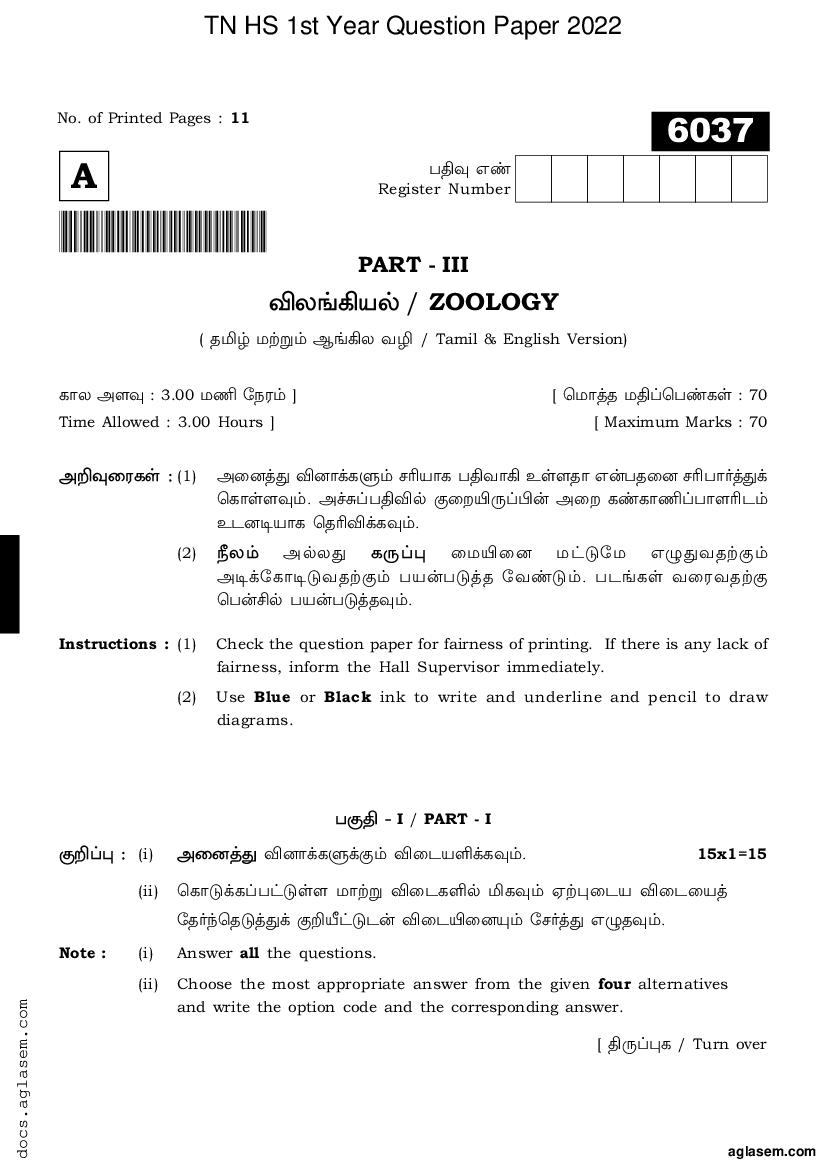
6037
£vÄ Gs
A Register Number
!6037IstYearZoology!
PART - III
»[Q¯À / ZOOLOGY
( uªÌ ©ØÖ® B[Q» ÁÈ / Tamil & English Version)
Põ» AÍÄ : 3.00 ©o ÷|µ® ] [ ö©õzu ©v¨ö£sPÒ : 70
Time Allowed : 3.00 Hours ] [ Maximum Marks : 70
AÔÄøµPÒ : (1) AøÚzx ÂÚõUPЮ \›¯õP £vÁõQ EÒÍuõ GߣuøÚ \›£õºzxU
öPõÒÍÄ®. Aa_¨£vÂÀ SøÓ°¸¨¤ß AøÓ PsPõo¨£õÍ›h®
EhÚi¯õP öu›ÂUPÄ®.
(2) }»® AÀ»x P¸¨¦ ø©°øÚ ©mk÷© GÊxÁuØS®
AiU÷PõikÁuØS® £¯ß£kzu ÷Ásk®. £h[PÒ ÁøµÁuØS
ö£ß]À £¯ß£kzuÄ®.
Instructions : (1) Check the question paper for fairness of printing. If there is any lack of
fairness, inform the Hall Supervisor immediately.
(2) Use Blue or Black ink to write and underline and pencil to draw
diagrams.
£Sv & I / PART - I
SÔ¨¦ : (i) AøÚzx ÂÚõUPÐUS® Âøh¯ÎUPÄ®. 15x1=15
(ii) öPõkUP¨£mkÒÍ ©õØÖ ÂøhPÎÀ ªPÄ® Hئøh¯ Âøhø¯z
÷uº¢öukzxU SÔ±mkhß Âøh°øÚ²® ÷\ºzx GÊuÄ®.
Note : (i) Answer all the questions.
(ii) Choose the most appropriate answer from the given four alternatives
and write the option code and the corresponding answer.
[ v¸¨¦P / Turn over
Page 2
1. uø\ |õ›¾ÒÍ BUêáøÚa ÷\ªUS® {Óª :
(A) ø©÷¯õ]ß (B) ø©÷¯õS÷Íõ¤ß
(C) BUiß (D) m÷µõ÷£õÛß
The pigment present in the muscle fibre to store oxygen is :
(a) Myosin (b) Myoglobin
(c) Actin (d) Troponin
2. BºÛøuß _ÇØ]°ß ÂøÍö£õ¸Ò ¯õx ?
(A) ³›¯õ (B) Põº£ß øh BUø\k
(C) A®÷©õÛ¯õ (D) ³›U Aª»®
The end product of Ornithine Cycle is :
(a) Urea (b) Carbon dioxide
(c) Ammonia (d) Uric acid
3. Eh¼ß ªP¨ö£›¯ |õͪÀ»õa _µ¨¤ __________ BS®.
(A) ¥Û¯À _µ¨¤ (B) ¤m³mh›
(C) AmŸÚÀ _µ¨¤ (D) øuµõ´k
__________ is the largest endocrine gland in the body.
(a) Pineal gland (b) Pituitary
(c) Adrenal gland (d) Thyroid
A
Page 3
4. ]Á¨£qÂß ÷©Ø¦Ó¨ £h»zvÀ Põn¨£kÁx __________ GÚ¨£k®.
(A) vµõ®÷£õø\mkPÒ (B) ø©U÷µõQίõ
(C) AUÑmi÷ÚõáßPÒ (D) AUÑmiÛßPÒ
Surface antigens on RBCs are called __________.
(a) thrombocytes (b) microglia
(c) agglutinogens (d) agglutinin
5. £À¾°º ußø© GßÓ £uzøua `mi¯Áº ¯õº ?
(A) A›ìhõmiÀ (B) ÁõÀhº ÷µõ\ß
(C) G¤.i. Põs÷hõÀ (D) G.â. hõßì÷»
Who coined the term ‘Biodiversity’ ?
(a) Aristotle (b) Walter Rosen
(c) AP.de. Candole (d) A.G. Tansley
6. G› £mk __________ ¼¸¢x ö£Ó¨£kQÓx.
(A) AmhõPì ›]Û
(B) B¢u÷µ°¯õ Aìéõö©ß]ì
(C) £õ®¤Uì ÷©õ›
(D) B¢u÷µ°¯õ ø©¼mhõ
Eri Silk is obtained from :
(a) Attacus ricini
(b) Antheraea assamensis
(c) Bombyx mori
(d) Antheraea mylitta
A [ v¸¨¦P / Turn over
Page 4
7. ö£õ¸zxP :
(1) ¼¨÷£ì (i) ìhõºa
(2) ö£¨]ß (ii) Põ]ß
(3) öµßÛß (iii) ¦µu®
(4) h¯¼ß (iv) ¼¨¤k
(A) (1) - (iv), (2) - (iii), (3) - (ii), (4) - (i)
(B) (1) - (iv), (2) - (ii), (3) - (i), (4) - (iii)
(C) (1) - (iii), (2) - (ii), (3) - (iv), (4) - (i)
(D) (1) - (iii), (2) - (iv), (3) - (ii), (4) - (i)
Match the following :
(1) Lipase (i) Starch
(2) Pepsin (ii) Casein
(3) Rennin (iii) Protein
(4) Ptyalin (iv) Lipid
(a) (1) - (iv), (2) - (iii), (3) - (ii), (4) - (i)
(b) (1) - (iv), (2) - (ii), (3) - (i), (4) - (iii)
(c) (1) - (iii), (2) - (ii), (3) - (iv), (4) - (i)
(d) (1) - (iii), (2) - (iv), (3) - (ii), (4) - (i)
8. PÚ\xµ ÁiÁ G¤w¼¯zvß •UQ¯¨ £o :
(A) £õxPõ¨¦ (B) _µ¨¦
(C) EÔg_uÀ (D) (B) ©ØÖ® (C) Cµsk®
The main function of the cuboidal epithelium is :
(a) Protection (b) Secretion
(c) Absorption (d) Both (b) and (c)
9. J¸ \õuõµn ©ÛuÛß ‰a_UPõØÖ AÍÄ :
(A) 500 ª.¼. (B) 800 ª.¼.
(C) 1100 - 1200 ª.¼. (D) 1200 ª.¼.
The Tidal Volume of a normal person is :
(a) 500 mL (b) 800 mL
(c) 1100 - 1200 mL (d) 1200 mL
A
Page 5
10. ©Ûu ‰øÍ°ß G¨£Sv EhÀ öÁ¨£{ø» Pmk¨£õmkhß öuõhº¦øh¯x ?
(A) •SÍ® (B) ]Ö‰øÍ
(C) øí¨÷£õu»õ©ì (D) ö£¸‰øÍ
Which part of the human brain is concerned with the regulation of body
temperature ?
(a) Medulla Oblongata (b) Cerebellum
(c) Hypothalamus (d) Cerebrum
11. GzöuõSv E°›PÎß ¦Óa\mhP® øPmiÚõ»õÚ Q³miQøÍU öPõskÒÍx ?
(A) PqUPõ¼PÒ (B) ÁøÍuø\¨ ¦ÊUPÒ
(C) •m÷uõ¼PÒ (D) xøͲh¼PÒ
Exoskeleton of which phylum consists of chitinous cuticle ?
(a) Arthropoda (b) Annelida
(c) Echinodermata (d) Porifera
12. P¸Áͺa]ø¯ __________ •øÓ°À PshÔ¯»õ®.
(A) ECG (B) AÀmµõ ÷\õ÷ÚõQµõ®
(C) EEG (D) X&PvºPÒ
Foetus development can be observed by using __________.
(a) ECG (b) Ultra sonogram
(c) EEG (d) X-Ray
A [ v¸¨¦P / Turn over
Page 6
13. uÁøÍ°ß uø»¨¤µmøh°À Põn¨£k® ö\ÄÒPÒ Gøu EnºzxQßÓÚ ?
(A) Á¸® Põ»[PÎÀ uÁøÍPÒ ö\ÄÒPøͨ ö£Ö®.
(B) •ß¦ «ßPЮ C¸ÁõÌÂPÍõ´ C¸¢uÚ.
(C) ö\ÄÒPÒ öPõsh •ß÷ÚõiPμ¸¢x uÁøÍPÒ ÷uõßÔÚ.
(D) uÁøÍ Jzu •ß÷ÚõiPμ¸¢x «ßPÒ ÷uõßÔÚ.
Presence of gills in the tadpole of frog indicates that :
(a) Frogs will have gills in future.
(b) Fishes were amphibious in the past.
(c) Frogs evolved from gilled ancestor.
(d) Fishes evolved from frog - like ancestors.
14. •uÀ •Òö;®¦ ©ØÖ® Aa_ •Òö;®¦PÐUS Cøh÷¯ EÒÍ ‰miß
ö£¯º :
(A) ÷\n ‰mk (B) E¯Ä ‰mk
(C) RÀ ‰mk (D) •øÍAa_ ‰mk
Name of the joint present between the atlas and axis is :
(a) Saddle joint (b) Synovial joint
(c) Hinge joint (d) Pivot joint
15. £UPU÷Põmk EnºÄ EÖ¨¦PÒ __________ CÀ Põn¨£kQÓx.
(A) uspº £õ®¦ (B) \»©õßhº
(C) «ß (D) uÁøÍ
Lateral line sense organs occur in __________.
(a) Water snake (b) Salamander
(c) Fish (d) Frog
A
Page 7
£Sv & II / PART - II
SÔ¨¦ : GøÁ÷¯Ý® BÖ ÂÚõUPÐUS ©mk® Âøh¯ÎUPÄ®. ÂÚõ Gs
24 &US Pmhõ¯©õP Âøh¯ÎUPÄ®. 6x2=12
Note : Answer any six questions. Question No. 24 is compulsory.
16. öÁÒøÍ Ai¨÷£õì v_øÁ¨ £Ê¨¦ Ai¨÷£õì v_¼¸¢x ÷ÁÖ£kzxP.
Differentiate white adipose tissue from brown adipose tissue.
17. Bs uÁøÍø¯ ö£s uÁøÍ°hª¸¢x GÆÁõÖ ÷ÁÖ£kzxÁõ´ ?
How will you differentiate the male frog from female frog ?
18. ]ÖSh¼À ©mk® EÔg]PÒ EÒÍÚ. Hß Cøµ¨ø£°À CÀø» ?
Why are Villi present in the intestine and not in the stomach ?
19. Cu¯z xi¨¦ GÚ¨£kÁx ¯õx ?
What is called Heart Beat ?
20. ]Ö}º E¸ÁõUPzvß ‰ßÖ ö\¯À£õkPÎß ö£¯›øÚ GÊxP.
Name the three processes involved in Urine formation.
21. öÁsm›UQÒPÎß _Áº B›UQÒPÎß _Áøµ Âhz uizxU Põn¨£kQÓx. Hß ?
The wall of the Ventricle is thicker than the auricle. Give reason.
22. íõº÷©õßPÒ GߣøÁ ÷ÁvzyxÁºPÒ GÚ¨£k® & {¯õ¯¨£kzxP.
Hormones are known as chemical messenger. Justify.
A [ v¸¨¦P / Turn over
Page 8
23. Cµzu ö\ÀPÎß GsoUøPø¯ PnUQkÁvÀ £¯ß£k® ]Á¨¦ ©ØÖ® Cµzu
öÁÒøÍ AqUPøÍ }ºUPa ö\´²® vµÁ[PÎß ö£¯ºPøÍ GÊxP.
Name the RBC and WBC diluting fluids used in blood cell counting.
24. Gsön´ £»Põµ[PøÍ }sh |õmPÐUS EmöPõsk Á¸® ÷£õx ¤zuU PØPÒ
÷uõßÓ»õ®. ÂÍUSP.
Prolonged intake of oily snacks may lead to gall stone formation. Explain.
£Sv & III / PART - III
SÔ¨¦ : GøÁ÷¯Ý® BÖ ÂÚõUPÐUS ©mk® Âøh¯ÎUPÄ®. ÂÚõ Gs
6x3=18
33 &US Pmhõ¯©õP Âøh¯ÎUPÄ®.
Note : Answer any six questions. Question No. 33 is compulsory.
25. ÷£¸»S – BºUQ¯õ £ØÔ SÔ¨ö£ÊxP.
Write a note on the Domain Archaea.
26. ¤ÍÄ EhØSÈø¯ EnĨ £õøu EhØSȲhß J¨¤kP.
Compare Schizocoelom with Enterocoelom.
27. H›÷¯õ»õº v_ £h® Áøµ¢x £õP[PøÍU SÔUPÄ®.
Draw and label the areolar tissue.
28. ø|mµáß |õº÷Põêì {ø» GÚ¨£kÁx ¯õx ?
What is a condition called ‘Nitrogen narcosis’ ?
A
Page 9
29. öPõkUP¨£mh £hzvÀ SÔUP¨£mkÒÍ £õP[PøÍ GÊxP.
Write the marked parts in the given diagram.
30. ]Ö}µP¨ £oPøÍ ö|Ô¨£kzx® íõº÷©õøÚa _µ¨£vÀ Cu¯zvß £[øP
ÂÍUSP. A¢u íõº÷©õÛß ö£¯º GßÚ ?
Explain the heart’s role in secreting a hormone that regulates renal function.
What hormone is this ?
31. Sa] ©ØÖ® T®¦ ö\ÀPøÍ ÷ÁÖ£kzxP.
Differentiate between rod and cone cells.
A [ v¸¨¦P / Turn over
Page 10
32. 3F íõº÷©õß GÚ AøÇUP¨£kÁx Gx ? Põµn[PøÍU TÖP.
What are referred as ‘3F hormone’ ? Give reasons.
33. ADH &íõº÷©õß _µ¨ø£ Gvº©øÓ ©ØÖ® ÷|º©øÓ ¤ßÞmh® Pmk¨£kzx&
QÓx. C¢{PÌÄPÐUPõÚ {£¢uøÚPøÍ ÂÍUSP.
ADH is controlled by both positive and negative feedback mechanisms. Explain
the conditions for these two mechanisms.
£Sv & IV / PART - IV
SÔ¨¦ : AøÚzx ÂÚõUPÐUS® Âøh¯ÎUPÄ®. 5x5=25
Note : Answer all questions.
34. (A) ö£¸®£õ»õÚ Â»[SPÎÀ Põn¨£k® ö£õxÁõÚ |õßS £s¦PÒ ¯õøÁ ?
ÂÍUSP.
AÀ»x
(B) »õ®¤m÷hõ ©õ›mj°ß ¦Óz÷uõØÓzøu ÂÍUSP.
(a) What are the four common characteristics found in most animals ? Explain.
OR
(b) Describe the external morphology of Lampito mauritii.
35. (A) Cøµ¨ø£°À |øhö£Ö® ö\›©õÚzøu ÂÁ›UPÄ®.
AÀ»x
(B) Cµzu® Põº£ß&øh&BUøéøh v_UPμ¸¢x ~øµ±µ¾US GÆÁõÖ
PhzxQÓx ?
(a) Explain the process of digestion in the stomach.
OR
(b) How does the blood transport CO2 from the tissue cells to the lungs ?
A
Page 11
36. (A) Cu¯ C¯UPa _ÇØ] Gߣx ¯õx ? ÂÍUSP.
AÀ»x
(B) G¾®¦•ÔÄ HØ£k® Âu® ©ØÖ® G¾®¦•ÔÄ Sn©õuÀ £ØÔ ÂÁ›UPÄ®.
(a) What is Cardiac Cycle ? Explain.
OR
(b) Write about the mechanism and healing of bone fracture.
37. (A) ©Ûu ‰øÍ°ß }ÒöÁmkz ÷uõØÓzøu¨ £h® Áøµ¢x £õP[PøÍU
SÔUPÄ®.
AÀ»x
(B) øuµõ´k _µ¨¤ _µUS® íõº÷©õßPÒ ¯õøÁ ? AÁØÔß £oPøÍU
SÔ¨¤kP.
(a) Draw and label the L.S. of human brain.
OR
(b) What are the hormones secreted by thyroid gland ? Mention their functions.
38. (A) X &PvºPÒ GߣøÁ ¯õøÁ ? AÁØÔß ©¸zxÁ •UQ¯zxÁzøuU
SÔ¨¤kP.
AÀ»x
(B) £õ®¤Uì ÷©õ›°ß ÁõÌUøP _ÇØ]ø¯ £h[PÎß ‰»® ÂÍUSP.
(a) What are X-rays ? Mention its clinical significance.
OR
(b) Illustrate the life cycle of Bombyx mori with the help of diagrams.
-o0o-
A [ v¸¨¦P / Turn over
Document Details
| Board / Org | Tamil Nadu Board |
| Exam | Class 11 |
| Type | Question Paper |
| Pages | 11 |
| Updated | 30 Apr 2026 |