CUSAT CAT 2019 Question Paper Chemistry
Finished viewing? Save it for later —
Download CUSAT CAT 2019 Question Paper Chemistry (PDF · 36 pages)About CUSAT CAT 2019 Question Paper Chemistry
CUSAT CAT 2019 Question Paper Chemistry is available here for free download. Published by Cochin University for CUSAT Common Admission Test, this question paper can be viewed online or downloaded as a PDF (36 pages). Candidates preparing for CUSAT Common Admission Test can use CUSAT CAT 2019 Question Paper Chemistry to understand the exam pattern, the type of questions asked, and the overall difficulty level.
Frequently Asked Questions
How can I download CUSAT CAT 2019 Question Paper Chemistry?
Open this page and click the Download button to save CUSAT CAT 2019 Question Paper Chemistry as a PDF. It is completely free on AglaSem Docs.
Is CUSAT CAT 2019 Question Paper Chemistry free to download?
Yes. CUSAT CAT 2019 Question Paper Chemistry can be viewed online and downloaded as a PDF free of cost on AglaSem Docs.
How many pages does CUSAT CAT 2019 Question Paper Chemistry have?
CUSAT CAT 2019 Question Paper Chemistry contains 36 pages, which you can read online or download together as a single PDF.
Where can I find more CUSAT Common Admission Test study material?
You can find more CUSAT Common Admission Test question papers, sample papers, syllabus, and answer keys on AglaSem Docs.
CUSAT CAT 2019 Question Paper Chemistry – Text
Read the full text of this question paper below — useful to quickly search, copy and reference the content online without downloading the PDF.
📄 View text version (36 pages)
Page 1
19
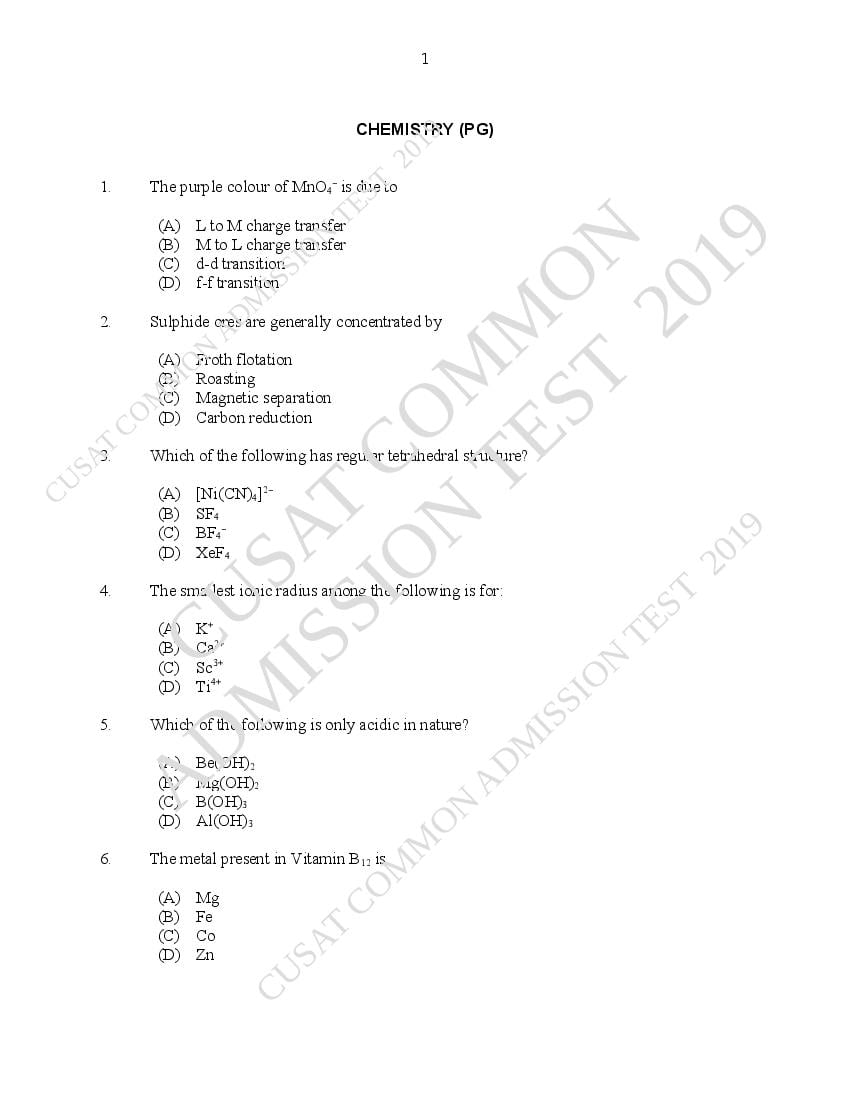
CHEMISTRY (PG)
20
1. The purple colour of MnO4– is due to
S T
E
(A) L to M charge transfer T
N
(B)
O
M to L charge transfer
(C) d-d transition
SI
(D) f-f transitionIS
M
2. D
M
Sulphide ores are generally concentrated by
A
N flotation
(A)
OFroth
M
(B) Roasting
M Magnetic
O
(C) separation
CO
E
(D)Carbon reduction
SA3.T
C T
Which of the following has regular tetrahedral structure?
CU (A)
(B)
AT
SF4
N
[Ni(CN)4]2–
19
S IO
(C) BF4–
(D) XeF4
2 0
4.
U
C IS
(A)
(B)
K+ S
Ca2+ T E
T
The smallest ionic radius among the following is for:
S
(C) Sc3+ N
O
M I
(D) Ti4+
S
IS
D
5. Which of the following is only acidic in nature?
M
A D
(A) Be(OH)2
(B) Mg(OH)2
A
(C) B(OH)3
N
(D)
O
Al(OH)3
6. The metal present in Vitamin B12 is M
M
(A) Mg
C O
(B) Fe
(C) Co
AT
(D) Zn
S
CU
Page 2
7. Ionic radii of K+, Ca2+, Cl–, S2– ions decrease in the order
(A) Cl–>S2–> K+> Ca2+ 019
(B) K+> Ca2+> Cl–>S2– 2
(C) S2–> Cl–> K+> Ca2+
S T
E
(D) Ca2+> K+> Cl–> S2–
T
N
8.
O
Which of the following molecules has three fold axis of symmetry?
SI
(A) NH3 IS
M
M
(B) C2H4
(C) CO2 D
A
(D) SO2
N
9. TheM
O
metallic character of beryllium is due to
SA
O
M
O E
(A) partially filled 2s band
C (B) completely filled 2s band
C T
T (C) overlap of 2s and 2p bands
T
(D) empty 2p band
CU 10.
A N
Which of the following contains P-O-P bond?
19
(A)
(B)
S IO
Hypophosphorous acid
Phosphorous acid 2 0
11.
(C)
(D)
U
C IS S
Pyrophosphoric acid
Orthophosphoric acid
T
Cubic unit cell is defined by
E ST
N
O
M I
(A) a≠b≠c, α=β=γ=90°
S
IS
(B) a=b=c, α=β=γ=90°
D
(C) a=b≠c, α=β=γ=90°, γ=120°
(D) a=b=c, α≠β≠γ
M
12.
A A
D
Which second-row transition can form compounds in which the metal has the +8
N
oxidation state?
O
(A)
(B)
Palladium
Ruthenium M
(C) Molybdenum M
(D) Cadmium
C O
AT
S
CU
Page 3
13. The most important ore of aluminium is
(A) bauxite 019
(B) magnetite 2
(C) haematite
S T
E
(D) monazite
T
14. N
Among the following shortest bond length is found in
O
SI
(A) C2 IS
M
M
(B) N2
(C) O2 D
(D) F2 A
N
O
15.
M
Ziegler-Natta catalyst for polymerization of ethylene consists of TiCl and
3
SA
M
O E
CO (B) triphenyl phosphine
(A) triethylaluminium
T (C) EDTA
C T
T
(D) triethylphosphine
CU 16.
A N
Which one of the following is the weakest Lewis base?
19
(A)
(B)
S IO
CH3–
NH2– 2 0
(C)
(D)
UOH–
C IS
F–
S T E ST
17. What is the bond order of
N ?
O
(A)
M
3
IS
S I
D
(B) 2
(C) 1
M
A
(D) 2.5
D
18. A
P4 O10 is the anhydride of
N
(A) H3PO2 O
(B) H3PO3 M
(C) H3PO4
M
(D) H4P2O7
C O
AT
S
CU
Page 4
19. A positron ion is emitted from 23Na11, the ratio of the atomic mass and atomic number of
19
the resulting nuclide is
(A) 22/10 20
(B) 22/11
S T
E
(C) 23/10
(D) 23/12 T
N
O
Consider a titration of Ipotassium dichromate solution with acidified Mohr’s salt solution
SSas indicator. The number of moles of Mohr’s salt required per mole
20.
using diphenylamine
of dichromate isM
I
(A) 3 A
D
M
(B) 4 N
O
M
(C) 5
M
O
(D) 6
SA T
O
4
2–
E
21. C [Ni(CN) ] is diamagnetic. The hybridization of nickel in this complex is
C T
T
3
(A) sp
CU
N
(B) dsp2
A
(C) d2sp3
19
S IO
(D) dsp3
22. 2 0
The calculated magnetic moment (B. M.) of Eu3+ system will be
(A)
(B)
(C)
U
C IS
0
3.42
7.91
S T E ST
(D) 3.61 N
O
23.
M S I
Dual character of an electron was explained by
IS
(A)
D Bohr
M
A D
(B) Heisenberg
(C) de Broglie
A
(D) Pauli
N
O
24.
M
The IUPAC name for the complex [Co(NO2)(NH3)5]Cl2 is
M chloride
(A) nitrito-N-pentaamminecobalt(III)
CO chloride
(B) nitrito-N-pentaamminecobalt(II)
(C) pentaamminenitrito-N-cobalt(II) chloride
AT
(D) pentaamminenitrito-N-cobalt(III) chloride
S
C U
Page 5
25. Hydrogen bomb is based on the principle of
(A) Nuclear fission 019
(B) Natural radioactivity 2
(C) Nuclear fusion
S T
E
(D) Artificial radioactivity
T
26. N
In oxy-hemoglobin the iron is
O
S I
IS
(A) Low spin, paramagnetic
M
M
(B) High spin, diamagnetic
D diamagnetic
(C) Low spin,
(D) HighAspin, paramagnetic
N
O
27.
M
In which one of the following pairs do the species have similar geometry?
SA
CO
M
(A) CO and SO
T (B) NH and BH O
C T
2
3
E
2
3
CU (C)
AT N
and
19
S IO
(D)
and
2 0
28.
(A)
(B)
U 92
1
S
U235
H3 T E
T
Which isotope is used for dating archeological finding?
C IS
S
(C) 8
O18 N
O
M I
6
(D) C14
S
IS
D
29. Which statements best describe the structure of NaCl?
M
A D
(I) Each sodium ion is surrounded by six chloride ions.
(II)
A
The chloride ions are arranged octahedrally around each sodium ion.
(III
N
The lattice forms cubic structure.
)
O
(A) I and II only M
(B) I and III only M
(C)
(D)
II and III only
All of the above C O
AT
30.
S
Predict the number of unpaired electron and spin only magnetic moments for the
U
following compound [Ru(NH3)6]3+.
C
Page 6
(A) 1 and 1.73μB
19
(B) 2 and 2.8μB
(C) 3 and 3.8μB
(D) 0 and 0.5μB 20
31.
S
Which of the following can function as a hexadentate ligand? T
E
(A) ethylenediamine T
(B) EDTA N
O
(C) CO
SI
(D) C2O42– IS
M
32.
M
D
The set of ions in which the members all have the same electron configuration is
A
N , Fe
OFe
2+ 3+
(A)
M , SeO , TeO
3– 2– –
(B) N ,O ,F
M SO
O
2– 2– 2–
(C)
E
4 4 4
CO
– – –
(D)
F , C , Br
SA T
33.
C T
Which of the following element has the highest first ionization energy?
CU (A)
(B)
As
A
Ge
T N 19
S IO
(C) Ga
(D) Rb
2 0
34.
U
C IS
geometry?
(A)
S
CO2 and N2O only T E
T
Which of the following species: CO2, H2O, BeCl2, and N2O have the same molecular
S
(B) H2O and N2O only N
O
M I
(C) H2O and BeCl2 only
S
IS
(D) CO2, BeCl2, and N2O
35.
D M
Which of the following compounds is expected to have the strongest ionic bond?
A
(A)
(B)
(C)
RbF
NaF
NaI
O
N
A
D
(D) CsBr
M
36. Mthe metal ion –ligand interaction is
In accordance with crystal field theory,
C O
(A) Covalent
(B) Acid-Base
A T
(C) Electrostatic
S
U
(D) None of the above
C
Page 7
019
2
S T
E
T
N
O
SI
IS
M
A
D
M
N
O
M
SAT
CO
M
O
C T E
CU
AT N 19
S IO 2 0
U
C IS S T E ST
N
O
M IS
S I
D M
A O
N
A
D
M
M
C O
AT
S
CU
Page 8
37. CFSE of [Cr (H2O)6]2+
19
(A) –16.0Δo
(B) –0.6 Δo
(C) +0.6 Δo 20
(D) –0.4 Δo
S T
E
38. EAN of [Co(NH3)6]3+ is T
N
O
(A) 38 SI
(B) 34 IS
M
M
(C) 36
(D) 46 D
A
N
39.
O
Water gas is an equimolar mixture of
M
M
O
(A) CO and N
E
2 2
CO (C) CO and H
(B) CO and H O
C T
2
AT (D) CO2 and H2O
2
S
CU 40.
T1
N
Find the missing particle in the following nuclear reaction
A
1
0 n 1 p + ?
19
S IO
(A) γ rays
(B) H– 2 0
U S
(C) –1 e 0
C IS
(D) +1 e 0
T E ST
41. N
The actual shape of XeF6 is
O
(A)
M S
Square pyramidal
IS
I
D
(B) Octahedral
(C) Pentagonal bipyramidal
M
A D
(D) Distorted octahedral
42. A
Coordination number and oxidation state of Cr in K3[Cr (C2O4)3] are respectively
N
(A) O
3 and +3
(B) 3 and 0 M
(C) 6 and +3 M
(D) 6 and +4
C O
AT
S
CU
Page 9
43. Which of the following system has maximum number of unpaired electrons?
(A) d5 (tetrahedral, high spin) 019
(B) d6 (octahedral, high spin) 2
(C) d4 (octahedral, low spin)
S T
E
(D) d7 (octahedral, high spin)
T
44. N
The number of unpaired electrons in tetrahedral [Ni(CO)4] complex is
O
O 20 SI
(A) 2 IS
M
M
(B) 4
(C) 0 D
(D) 3 A
N
O
45.
M
The crystal field splitting energy for octahedral (Δ ) and tetrahedral (Δ ) complexes is
o t
M as
O
related
SA
CO (A) Δ ≈ 4/9 Δ
T (B) Δ ≈ 1/2 Δ
C T
t
t E o
o
T
(C) Δ ≈ 2 Δ
CU
o t
N
(D) Δo ≈ 4/9 Δt
46.
A
S IO
19
Which of the following products is obtained on heating, B2H6 with NH3 in the ratio (1:2)
at higher temperature?
2 0
(A)
(B)
(C)
(D)
U
C IS S
B3N3H3
B2H6 2NH3
Boron nitride
B3N3H6 T E ST
N
O
M I
47. I3– ion is
S
IS
D
(A) Linear
(B) Triangular
M
A D
(C) Bent
(D)
A
Tetrahedral
N
48.
O
Germanium is an example of a/an
(A) intrinsic semiconductor M
(B) n-type semiconductor M
(C) p-type semiconductor
C O
(D) extrinsic semiconductor
AT
S
CU
Page 10
49. Which is called white graphite?
(A) SiO2 019
(B) CaC2 2
(C) BN
S T
E
(D) B2O3
T
50. N
The chemical constituent of clay is
O
SI
IS
(A) Silicon oxide
M
M
(B) Aluminum borosilicate
(C) ZeoliteD
A silicate
(D) Aluminum
N
O
51.
M
Among compounds 1, 2, 3 and 4, which will exhibit optical activity?
SA
T
CO
M
O
C T E
CU (A)
(B)
(C) T
Compounds 1 and 4
A N
Compound 1 only
Compounds 1, 2 and 4
19
S IO 0
(D) All compounds are optically inactive
2
U S T
52. IUPAC name for the compound shown below is:
S
C IS O
N
T E
M IS
S I
D
(A) (S)-3-methylpent-1-en-4-yne
(B) (R)-3-methylpent-1-yn-4-ene
(C) M
(R)-3-methylpent-1-en-4-yne
53. A
(D)
N
A
D
(S)-3-methylpent-1-yn-4-ene
-D-Glucopyranose and β-D-glucopyranose do not constitute a pair of
O
(A) geomertical isomers M
(B) epimers
M
(C)
(D)
enantiomers
diasteromers C O
AT
S
CU
Page 11
54. Which among the following reactions is suitable for isolation of isocynates in pure form?
(A) Beckmann rearrangement 019
(B) Curtius rearrangement 2
(C) Hofmann rearrangement
S T
E
(D) Fries rearrangement
T
55. N
Use Woodward-Fieser rules to predict absorption maximum for the given compound
O
SI
IS
M
A
D
M
N
(A) O302 nm
M 293 nm
O
(B)
M 272 nm
E
(C)
CO
C T
(D) 252 nm
A T
S 56. β-Sheet found in a protein can be considered as an example of
CU (A)
(B)
AT N
Primary structure
Tertiary structure
19
S IO 0
(C) Quaternary structure
(D) Secondary structure
2
57.
U
C IS
(A) S
Terminal Acetylene T E ST
A strong peak at 1700 cm-1 in IR spectrum indicates the presence of the functional group
(B) Nitro Group
N
O
M
(C) Carbonyl
(D) Nitrile ( )
S I
IS
58.
D
Quinoline on oxidation with alkaline KMnO4 followed by acidification gives
M
A
(A)
O
N
A
D
M
(B) M
C O
AT
(C)
S
CU
Page 12
(D)
019
2
59. S T
2-Ethylpyridine reacts with N-bromosuccinimide to give a brominated product. Structure
E
of the brominated product is
T
N
O
(A) SI
IS
M
A
D
M
(B) N
O
M
SAT
M
CO (C) O
C T E
CU (D)
AT N 19
S IO 2 0
U S
60. Oxidation of aniline with MnO2 and H2SO4 gives
ST
C IS E
(A) Phenylhydroxylamine
(B) Nitrobenzene
T
(C) p-Benzoquinone
N
O
M
(D) Phenol
S I
IS
61. The reaction of pyridine with sodamide in liquid ammonia to yield 2-aminopyridine is
(A)
D M
a nucleophilic substitution reaction on pyridine
A
(B)
(C)
(D)
D
an electrophilic substitution reaction on pyridine
A
a free radical substitution reaction on pyridine
N
pericyclic reaction
O
62.
M
Longifolene (C15H24) is categorized as a:
M
C O
A T
S
C U
(A) polycyclic flavonoid
Page 13
(B) diterpene
19
(C) tripterpene
(D) sesquiterpene
20
S T
E
T
N
O
SI
IS
M
A
D
M
N
O
M
SAT
CO
M
O
C T E
CU
AT N 19
S IO 2 0
U
C IS S T E ST
N
O
M IS
S I
D M
A O
N
A
D
M
M
C O
AT
S
CU
Page 14
63. The order of basicity among pyrrole, pyridine and piperidine is
(A) Pyridine > Piperidine > Pyrrole 019
(B) Pyrrole > Piperidine > Pyridine 2
(C)
S T
Piperidine > Pyrrole > Pyridine
E
(D) Piperidine > Pyridine > Pyrrole
T
64. N
The name of the rearrangement given below is
O
SI
IS
M
D
M
(A) FriesArearrangement
N rearrangement
(B) Claisen
O
(C) Favorskii rearrangement
M Wagner-Meerwein rearrangement
O
(D)
M
S
65.
AT E
COWhich among the following is used as a free radical initiator?
C T
T
(A) Benzoyl peroxide
CU (B) KI
(C)
(D)
A
CH3I
N
Nitrobenzene
19
66.
S IO 2 0
The following photochemical transformation proceeds through
U
C IS S T E ST
(A) N
Norrish type I reaction
O
M I
(B) -hydrogen abstraction
(C) Barton reactionS
IS
D
(D) Paterno-Buchi reaction
M
A D
67. The ligand system present in vitamin B12 is
A
(A)
N
Porphyrin
(B)
O
Crown ether
(C)
(D)
Corrin
Heme M
M
C O
AT
S
CU
Page 15
68. A vitamin which exists as an ene-diol is
(A) Vitamin A 019
(B) Vitamin B2 2
(C) Vitamin C
S T
E
(D) Vitamin K
T
69. N
Which among the following reactions will give the same product from the following
O
aldohexoses?
SI
IS
M
A
D
M
N
O
M
SAT
CO
M
(A)
O
C T E
Oxidation with HNO3
CU
(B)
(C)
(D) T
Oxidation with HOBr
A N
Wohl degradation
Ruff degradation
19
70.
S IO 2 0
Rapid interconversion of α-D-glucose and β-D-glucose in solution is known as
(A)
U
C IS
(B)
(C) S
Mutarotation
Racemisation
Asymmetric inductionT E ST
(D)
N
Fluxional isomerisation
O
71.
M S I
In the structure elucidation of alkaloids the number of methoxyl group present is
IS
D
estimated by
M
A
(A) Kuhn-Roth method
(B) D
Hofmann method
(C) A
Herzig-Meyer method
(D) N
Zeisel method
O
M
72.
M
Aromatic electrophilic substitution on pyridine is preferentially at position/positions
(A) 2 and 4
C O
(B)
(C)
3
4 AT
(D) 2 S
CU
Page 16
73. Friedlander Quinoline synthesis involves reaction between the following reagents
(A) Aniline and glycerol 019
(B) 2
o-aminobenzaldehyde and α-methylene carbonyl compound
(C)
S
acetoacetic ester and aniline T
E
(D) anthranilic acid and acetophenone
T
74. N
The following are the four heteroaromatic bases present in DNA. Which base pair can
O
SI
form three hydrogen bonds?
IS
M
A
D
M
N
O
M
SAT
M
CO (B) A-T
(A) A-C
(C) G-C
O
C T E
T
(D) G-T
CU 75.
A N
Which is the main acid-catalyzed rearrangement product of the following 1, 2-diol?
19
S IO 2 0
U
C IS
(A)
S T E ST
N
O
M IS
S I
D
(B)
M
A
(C)
O
N
A
D
M
M
(D)
C O
AT
S
CU
Page 17
76. Which of the following molecules does not have a dipole moment?
(A) CH3Cl 019
(B) CH2Cl2 2
(C) CHCl3
S T
E
(D) CCl4
T
77. N
In the most stable conformer of but-1-yn-1-ylcyclohexane a maximum of how many
O
O 20 SI
carbon atoms will remain collinear?
IS
M
A
D
M
N
O
M3
O
(A)
M
E
(B) 5
CO (C)
C T
2
A T (D) 4
S 78.
CU
T
Which among the following is least reactive towards an electrophile?
A N 19
S IO
(A)
2 0
(B)
U
C IS S T E ST
N
(C)
O
M IS
S I
(D)
D M
79. A N
A
D
Which list below gives NMR active nuclei only?
O
M
1
(A) H, 13C, 19F
1
H, 2H, 12C
(B)
M
O
2
(C) H, 12C, 19F
C
3
(D) H, 14C, 31P
80.
AT
In which of the following are the π-electrons not delocalized?
S ketone
U
(A) An α,β-unsaturated
C
Page 18
(B) Buta-1,3-diene
19
(C) Hepta-1,6-diene
81.
(D) Allyl anion
20
Which molecule best corresponds to IR spectrum below with molecular formula C6H14O
S T
E
T
N
O
SI
IS
M
A
D
M
N
O
M
SAT
M
CO (A) O
C T E
CU (B)
AT N 19
S IO 0
(C)
2
U S T
(D)
S
82.
C IS T E
The product formed in Aldol condensation is
O
N
M I
(A) a β-hydroxy aldehyde or a -hydroxy ketone
(B)
S
an -hydroxy aldehyde or ketone
IS
D
(C) an , -unsaturated ester
(D) a -hydroxy acid
M
83.
A
(A)
(B) O
N
A
D
In which of the following reactions new carbon-carbon bond is not formed?
Cannizzaro reaction
Wurtz reaction
(C) Reimer-Tiemann reaction M
(D) Friedel-Crafts reaction M
84. Which among the following hasC
O
the most acidic hydrogen?
A T
(B) 2,4-HexanedioneS
(A) 3-Hexanone
CU
(C) 2,5-Hexanedione
Page 19
(D) 2,3-Hexanedione
019
2
S T
E
T
N
O
SI
IS
M
A
D
M
N
O
M
SAT
CO
M
O
C T E
CU
AT N 19
S IO 2 0
U
C IS S T E ST
N
O
M IS
S I
D M
A O
N
A
D
M
M
C O
AT
S
CU
Page 20
85. Acyl chlorides are made by reacting carboxylic acids with
(A) AlCl3 019
(B) HCl 2
(C) Cl2
S T
E
(D) PCl5
T
86. N
What is the correct order of reactivity (most reactive first) of pyrrole, furan and thiophene
O
S I
towards electrophilic substitution?
IS > thiophene
M
M
(A) furan > pyrrole
D > pyrrole > furan
(B) thiophene
(C) furanA> thiophene > pyrrole
N
O > furan > thiophene
(D) pyrrole
M can be stereoselectively reduced to give either the cis or trans isomer of
M
O
87. But-2-yne
CObut-2-ene?
E
but-2-ene. Which among the following statements is true for the reduction of but-2-yne to
SA T
C T
T
(A) Catalytic hydrogenation in the presence of Lindlar’s catalyst gives the trans isomer
CU
N
while reduction with one equivalent of lithium in liquid ammonia yields the cis
A
isomer
19
S IO
(B) Catalytic hydrogenation in the presence of Lindlar’s catalyst gives the cis isomer
isomer 2 0
while reduction with one equivalent of lithium in liquid ammonia yields the trans
U S T
(C) Reduction with one equivalent of lithium in liquid ammonia gives the cis isomer
S
while reduction with excess sodium in liquid ammonia gives the trans isomer
C IS O
N
T E
(D) Catalytic hydrogenation over palladium catalyst gives the trans isomer while
catalytic hydrogenation over finely divided platinum yields the trans isomer.
M I
88. Paraldehyde is the trimer of
S
IS
D
(A) Methanal
(B) Glyoxal
M
A D
(C) Benzaldehyde
(D) Ethanal
A
N
O
M
M
C O
AT
S
CU
Page 21
89. In Hunsdiecker reaction, silver salts of carboxylic acids react with a halogen to produce
19
an organic halide. Since the reaction is successful on bridgehead positions as well, the
0
most significant intermediate involved in this reaction is:
2
S T
E
T
N
O
(A)
(B)
carbocation
carbene SI
(C) IS
carbon centered free radical
M
M
(D) carbanion
D
A
90. Pick the N
statement that is not true for SN2 reactions
O
M SN2 reaction rates are unaffected by the nature of solvents
(A)
SA
O
M
O
C T E
(B) SN2 reactions proceed with inversion of configuration at the reacting center.
C (C) SN2 reaction rates are controlled by the nature of both leaving groups and
T (D) Presence of electron withdrawing groups on the reacting center accelerates SN2
nucleophiles
CU
T
reaction rates
91.
A N 9
The following base-catalyzed cyclization reaction is an example for
1
S IO 2 0
U
C IS S T E ST
N
O
(A)
(B)
M IS
S I
aldol condensation
Dieckmann condensation
(C)
(D)
D Nazarov cyclization
M
Michael addition
92.
A A
D
Pick the reagent suitable for effecting the following ring expansion reaction:
O
N
M
(A) concentrated nitric acid O
M
C(CF CO H)
(B) peroxytrifluoroacetic acid
(C) periodic acid(HIO ) T
3 3
(D) osmium tetroxide A
4
S
C U
Page 22
93. Pick the statement that is not true for Diels-Alder reactions
019
(A) It is a suitable method for the preparation of six-membered rings having one or
two double bonds 2
(B) It is stereospecific in nature
S T
E
(C) It is a concerted 4+2 cycloaddition reaction
T
(D) Diels Alder reactions are equally feasible under thermal and photochemical
conditions N
O
S I
94.
IS
Which among the following reactions proceeds through an intermediate?
M
D
M
(A) SN2 substitutions
A
(B) E2 eliminations
N
(C) Ring opening of cyclobutene to give 1,3-butadiene under thermal conditions
(D) O
M Rearrangement of phenyl acetate to give 4-hydroxyacetophenone
95. OWhich
SA
T
C benzaldehyde?O
M among the following reactions is not a suitable method for the preparation of
C T E
T
(A) Oxidation of benzyl alcohol using PCC
CU (B) Rosenmund reduction of benzoyl chloride
A N
(C) Reaction of phenylmagnesium bromide with carbon monoxide
9
(D) Ozonolysis of styrene (vinylbebzene)
1
S IO 2 0
U S T
96. The following reaction is an example for
S
C IS O
N
T E
M IS
S I
D
(A) Claisen condensation
(B)
M
Knoevenagel reaction
A D
(C) Stobbe condensation
(D)
A
Mannich reaction
N
97.
O
Which among the following reactions is not suitable for the preparation of cyclohexane-
1,2-diol?
(A) Oxidation of cyclohexene withM
M
osmium tetroxide
O
(B) Treatment of cyclohexene oxide with aqueous NaOH
C oxide with Lewis acid such as boron trifluoride in
(C) Treatment of cyclohexene
nonaqueous media T
SA with magnesium metal
(D) Treatment of adipaldehyde
CU
Page 23
98. The following ring contraction reaction is achieved by
019
2
S T
E
(A) a base such as hydroxide ion
(B) Lewis acids T
(C) N
triphenylphosphine
O
(D) periodic acid
SI
99. IS
A ring opening polymerization is involved in the preparation of
M
A
D
(A) nylon-6,6
M
N
(B) nylon-6
O
(C) polyurethane
M polyurea
O
(D)
M
SA T
O
C T E
100.C Which among the following will not give a positive test with Ninhydrin?
CU
T
(A
N
)
(B)
A
S IO 2 0 19
U
(C)
(D
)
C IS S N
T E ST
O
M IS
S I
D
101. A solution whose pKa is greater than pKb is _____________ in nature
M
A D
(A) acidic
(B) neutral
A
(C) alkaline
N
(D)
O
None of the above
M
M
C O
AT
S
CU
Page 24
102. The coagulation of 100 mL of a colloidal solution of gold number is completely
19
prevented by the addition of 0.25 g of starch to it before adding 1 mL of 10% NaCl
0
solution. Calculate the gold number of starch.
2
(A) 50
S T
E
(B) 250
(C) 25 T
(D) 500 N
O
SI
S
103. The coefficient of Iviscosity is expressed in units of
M
D cm
M
–2
(A) dynes sec
Acm –2
(B) dynes
N
O
–3
(C) dynes sec cm
M dynes sec cm
–1 –20
(D)
SA
T
M
O E
104. OA first order reaction has a rate constant of 0.0051 min . If we begin with 0.10 M
-1
C concentration of the reactant, what concentration of reactant will remain in the solution
after 3 hours?
C T
CU (A)
(B)
AT
.05 M
0.04 M
N 19
S IO
(C) 0.03 M
(D) 0.003 M
2 0
105.
U
C IS S ST
The internal energy of an ideal gas is ………. the volume at constant temperature.
(A) independent of T E
(B) proportional to N
O
M I
(C) inversely proportional to
(D)
S
proportional to the square root of
IS
106.
D M
In a reversible adiabatic expansion of a real gaseous system the temperature of the system
(A)
(B)
(C)
(D)
A increases
decreases
O
N
A
D
remains the same
tends to 0K
M
M
C O
AT
S
CU
Page 25
107. The slope of the graph of log (a-x) versus time for the first order rate equation is
2.303 019
(A)
k 2
S T
E
(B) k
T
(C) –k N
O
SI
IS
–k
(D)
2.303
M
108. The rate ofA
D
M
a gaseous reaction becomes half when volume of the vessel is doubled. What
N of the reaction?
is the order
O
M
O
(A) 0
M
O
E
(B) 1
C (C) 2
SA T (D) 0.5
C T
CU 109.
(A)
AT
A perfectly ideal gas
N 9
can be liquefied only below inversion temperature
1
S IO 0
(B) can be easily liquefied
(C) 2
can be liquefied at low temperature
U S T
(D) cannot be liquefied
S
C IS E
110. If v=300b, the reduced volume is
T
(A) 3 N
O
M I
(B) 100
(C) 10
S
IS
D
(D) 1/100
M
A D
111. At 700 K the equilibrium constant Kp for the reaction 2SO3(g) == 2SO2(g) + O2(g) is
A
1.8 × 10⁻³ kPa. What is the numerical value in moles per dm 3 of Kc for the reaction at the
same temperature?
N
(A) O
3.09 × 10⁻⁴ mol cm–3
(B) 3.09 × 10⁻⁴ mol m–3 M
(C) 3.09 × 10⁴ mol m–3 M
(D) 3.09 × 10⁻⁷ mol m–3
C O
AT
S
CU
Page 26
112. Half-life of a second order reaction is given by
(A) 1/ka 019
(B) 0.693/ka 2
(C) 2.303 /ka
S T
E
(D) ka/2.303
T
N
O
SI
IS with rate
113. The order of a reaction is
M
(A) 2
A
D
M
(B) 3/2
(C) O 1
N
(D)M 1/2
SA
T
M
O
C T
(A) Arrhenius base E
114. OIn the reaction NH + H O NH +OH , NH is considered as
C 3 2 4
+ –
3
CU
T
(B) Lowry Bronsted base
N
(C) Lewis base
115. A
(D) Conjugate base
S IO 2 0 19
Radioactive disintegration of the substance is an example of a ……… order reaction
(A)
U
C IS
(B)
(C)
0
1
2 S T E ST
(D) fractional
N
O
116.
M I
The addition of ………. to a colloidal solution causes flocculation
IS
S
(A)
(B)
D an acid
M
a surfactant
A D
(C) an electrolyte
(D) an alkaliA
N
117. O
Which among the following is an example for hydrophilic sols
M
(A) gum
M
(B)
(C)
starch
starch and gum
C O
(D) None of the above
AT
S
CU
Page 27
118. The H+ ion concentration of a weak monobasic acid of concentration ‘C’ is given by
(A) KaC1/2 019
2
(B) C
S T
E
(C) T
N
O
(D) SI
IS
M
119. D
M
The ionic product of water at 50°C is 4×10–14. The concentration of H+ ion is
A
N moles /litre
O2×10
7
(A)
M moles /litre
(B) –7
2×10 moles /litre
M 10
O
–7
(C)
CO
E
+7
(D)
10 moles /litre
SA T
120.
C T
The expression for pH of acetic acid - sodium acetate buffer solution is
CU (A)
AT N
pH= p k a + log 10
[ sodium acetate ]
9
[ acetic acid ]
1
S IO
pH= p k a + log 10
(B)
2 0
U
(C) pH=¿
C IS
(D)
S
pH = p k a + n log 10
N
T E ST
[ sodium acetate ]
[ acetic acid ]
121.
O
Precipitation occurs only when the product of ionic concentrations
(A)
M IS
S I
exceeds the solubility product
D
(B) is lesser than solubility product
(C) M
is equal to the solubility product
A D
(D) is lesser than viscosity of the solution
A
122.
N
Movement of colloidal particles under the influence of electric field is called
O
(A) Electrophoresis
M
(B) Brownian movement
M
(C)
(D)
Flocculation
Tyndal effect
C O
123.
A T
Schulz Hardy rule is concerned with
S in colloids
U
(A) Brownian movement
C
Page 28
(B) Coagulation of sols by electrolytes
19
(C) Protecting power of hydrophilic sols
(D) Cohesive forces
20
124.
S T
The expression for the average velocity is given by
E
T
√ SION
(A) Ĉ=
3 RT
M
IS RT
√ADM
M
(B) Ĉ=
πM
N 2 kT
O √
(C) Ĉ=
M
M
T
CO
SA125.
M
√
(D) Ĉ=
O
8 kT
C T
πm
E
T
For an isothermal process of an ideal gas ΔH is
CU
A N
(A) less than zero
19
S IO 0
(B) greater than zero
2
U S
(C) zero
ST
C IS E
(D)
T
N
O
In a consecutive reaction of the type A →
k1 B k 2 C
M
126. if k2>> k1, the formation of C takes
S I
place without time lag. This statement
→
IS
(A)
D is true
M
A D
(B) can’t be predicted
(C)
(D)
is false
A
is true below room temperature only
N
O
127.
M
The efficiency of heat engines is given by
M
(A) E=
T 2− T1
T1 C O
(B) E=
T 2− T1
AT
T2
S
CU
Page 29
T2
(C) E=
T 2− T1
019
(D) E=
T 1− T2
2
T2
S T
E
T
N
O
SI
IS
M
A
D
M
N
O
M
SAT
CO
M
O
C T E
CU
AT N 19
S IO 2 0
U
C IS S T E ST
N
O
M IS
S I
D M
A O
N
A
D
M
M
C O
AT
S
CU
Page 30
128. Two gases have molecular masses 64 and 100 respectively. The diffusion rate for the
19
former is 15 mLs–1. What is the diffusion rate for the other?
(A) 12 L s–1 20
(B) 1.2 mL s–1
S T
E
(C) 12 μL s–1
(D) 12 mL s–1 T
N
O
129. According to kinetic S I of gases, for a diatomic molecule
theory
ISexerted by the gas is proportional to the mean velocity of the
M
M
(A) the pressure
D
molecule
A
(B) the pressure exerted by the gas is proportional to the root mean velocity of the
N
Omolecule
(C)M the root mean square velocity of the molecule is inversely proportional to the
M
O
temperature
CO temperature
E
(D) the mean translation kinetic energy of the molecule is proportional to the absolute
A T
C T
S 130. The value α (degree of dissociation) for 0.05 N acetic acid is 0.03. Calculate the
CU
T N
dissociation constant for acetic acid
A 19
S IO
(A) 1.55 × 10⁻³
(B) 9.28 × 10⁻⁴
4.64 × 10⁻⁵ 2 0
U
(C)
S T
(D) 5.73 × 10⁻²
S
131.
C IS T E
Calculate the solubility product of compound AB 2 (molar mass = 400) if at 25 oC it
requires 0.08 g of A to form its 1 litre saturated solution
O
N
M I
(A) 8.0 × 10⁻⁴
S
IS
(B) 2.05 × 10⁻³
D
(C) 2.05 × 10⁻¹²
(D) 3.2 ×10⁻¹¹ M
132.
A N
A
D
Calculate the degree of hydrolysis of 0.1 N KCN solution at 25 oC. (The dissociation
constant of HCN is 5.0 × 10⁻⁵ and ionic product of water is 1.0 × 10⁻¹⁴)
O
(A) 2.0 × 10⁻⁹
M
(B) 0.2 × 10⁹
M
O
–5
(C) 3.16 ×10
(D) 3.16 × 10⁻³
C
AT
S
CU
Page 31
133. When [N2O5] = 0.22 M the rate of decomposition of N2O5 is 1.1 × 10⁻⁴ mol L–1 s–1. What
19
is the value of k for this first order reaction?
(A) 1.1 × 10⁻³ s–1 20
(B) 5 × 10⁻⁴ min
S T
E
(C) 5×10⁻⁴ s–1
(D) 5 × 10⁻³ s–1 T
N
O
S I 2A + B 3C the rate of appearance of C at time ‘t’ is
134. For an elementary reaction
1.3×10 mol L s I.SCalculate the rate of disappearance of A at this time
–4 –1 –1
M
(A) 8.67 × D
M–5
10 mol L s
(B) 2.6 ×A10 mol L s
–1 –1
–5 –1 –1
(C) O N× 10 mol L s
3.9 –5 –1 –1
(D)M 6.5 × 10 mol L s
–5 –1 –1
T
M
O
10 –1
E
135. OIn the Arrhenius equation for a certain reaction, the value of A and E (activation energy)
C are 4.0 × 10 s and 80 kJ mol respectively. If the reaction is of first order, calculate the
C T
–1
SA temperature at which the rate constant becomes 1.2 × 10 s .
-3 -1
a
CU (A)
(B)
AT N
256.21 K
269.16 K
19
S IO
(C) 2.69oC
(D) 276.56 K
2 0
136.
U
C IS S
Eocell = 1.50 at 25oC
T E ST
In the cell Zn/Zn2+ (0.01 M) // Ag+ (1.0 M)/ Ag. Calculate EMF of the cell at 25oC if
N
(A) 1.259
O
M I
(B) 2.559
S
IS
(C) 1.559
D
(D) 0.155
M
A D
137. Smoke is an example of
A
(A)
N
gas dispersed in solid
(B)
O
gas dispersed in liquid
(C) liquid dispersed in solid
M
(D) solid dispersed in gas
M
C O
AT
S
CU
Page 32
138. 8.5 J heat flow out into the surroundings when a sample of a gas contracts 400 mL by an
19
average pressure of 0.5 atm. Calculate the work done
(A) 2.02 kJ 20
(B) 20.26 kJ
S T
E
(C) 20.26 J
(D) 2.02 kJ mol-1 T
N
O
139. Calculate the standard Iheat of formation of carbon disulphide . Given that the standard
S (s) (s)
(l)
heat of combustionISof carbon , sulphur and carbon disulphide are –333.3, 222.2 and
(l)
–111.1 kJ mol M
M
–1
respectively.
D
AkJ mol –1
(A) 404.4
N kJ mol
O
–1
(B) 244.4
(C)M 4.04 kJ mol –1
M
O
(D) –444.4 kJ mol –1
SA
T
O
o
E
140.C The value of standard state free energy for the reaction CO + H O CO + H
C T (g) 2 (g) at
25 C is 6.66 kcal. Calculate the value of equilibrium constant k (R=1.987 cal deg mole
p
2 2(g)
–1 –
T
1
CU
)
(A)
A
13 × 10–5
N 19
S IO
(B) 1.3 × 10⁻⁵
(C) 1.3 × 10⁻⁷
2 0
U
(D) 0.3 × 10⁻⁷
141.
C IS S E ST
Enthalpy change (ΔHvap) for the transition of liquid water to steam at 100 oC is
T
74.6 kJ mol–1. Calculate the entropy change for this purpose
N
(A) 20 J mol–1 K–1
O
(B)
(C)
M
0.5 kJ mol–1 K–1
200 J mol–1 K–1
IS
S I
(D)
D
2.0 J mol–1 K–1
M
A D
142. For an adiabatic process which of the following is correct
A
(A) q=0
N
(B) q = +w O
(C) ΔE = q
M
(D) ΔH = 0
M
C O
AT
S
CU
Page 33
143. For rhombohedral crystal system
(A) a = b = c , all angles = 90o 019
(B) 2
a=b=c , all angles are equal but not equal to 90o
(C)
S T
a ≠ b ≠ c , all angles are different and not equal to 90o
E
(D) a ≠ b ≠ c , all angles = 90o
T
144. N
A compound formed by elements A and B crystallises in the cubic arrangement in which
O
SI
A atoms are at the corners of a cube and B atoms are at the face centres. What is the
IS
formula of the compound?
M
(A)
(B)
A3B
AB A
D
M
N
(C)
O
AB3
M
(D) A2B3
SA
T
M
O E
145. OAluminium crystallizes in an fcc structure. Atomic radius of the metal is 125 pm.
C Calculate the edge length of the unit cell of the metal?
C T
T
(A) 353.3 nm
CU
N
(B) 4.28 pm
A
(C) 2.828 nm
19
S IO
(D) 3.147 nm
146. 2 0
The radius of Na+ ion is 95 pm and that of Cl- ion is 181 pm. Predict the coordination
(A)
(B)
U 4
8
S
number of Na+ ion
C IS T E ST
(C) 6 N
O
M I
(D) 12
S
IS
D
147. An element having bcc geometry has atomic mass 50 u. Calculate the density of the unit
M
cell, if its edge length is 290 pm
A
(A)
(B)
(C)
O
N
A
D
5.75 g cm–3
6.81 × 10⁻¹³ kg m–3
6810 kg m–3
(D) 6.81 g cm–3
M
M defects on the density of the crystal?
148. What is the effect of presence of Schottky
O
(A) The substance may start C melting even at room temperature
(B) The number of cations
A Tand anions become equal
(C) The number of anions
S decreases
CU
(D) The overall density of a crystalline substance decreases due to Schottky defects
Page 34
149. Close packing is maximum in the crystal, which is
(A) fcc 019
(B) simple cubic 2
(C) bcc
S T
E
(D) monoelinic
T
150. N
The equivalent conductivity of NH4Cl at infinite dilution is 120 ohm –1 cm2 equiv–1 and
O
SI
ionic conductance at OH– and Cl– ions are 180 and 60 ohm–1 cm2 equiv–1 respectively at
IS
25oC. Calculate the equivalent conductivity of NH4OH at infinite dilution
M
(A) D
M
220 ohm–1 cm2 equiv–1
A
(B) 235 ohm–1 cm–2 equiv–1
N
(C)
O
440 ohm cm2 equiv–1
M
(D) 240 ohm–1 cm2 equiv–1
SAT
CO
M
O
C T E ***
CU
AT N 19
S IO 2 0
U
C IS S T E ST
N
O
M IS
S I
D M
A O
N
A
D
M
M
C O
AT
S
CU
Page 35
1
20 CODE: 604
TEST
QN. NO. KEY QN. NO. KEY QN. NO. T KEY QN. NO. KEY QN. NO. KEY
E S
1 A 26 C 51 T A 76 D 101 C
2 A 27 D N
O52 C 77 D 102 C
I
3 C 28 D
ISS 53 C 78 B 103 A
4 D 29 D M 54 B 79 A 104 B
5 C 30 A AD 55
M B 80 C 105 A
6 C 31 N
OBB 56 D 81 C 106 B
7 C 32 M 57 C 82 A 107 D
8
9
10
A
C
C
33
34 T C
SA
35
O
M A
D
B
O
C TE
59
60
58
C
C
A
84
85
83
B
D
A 108
109
110
B
D
B
11
12
B
B
U
C 36
37
C
B
AT N
61
62
A
D
86
87
D
B
19
111
112
B
A
13 A 38 C
S I O63 D 88
2 0D 113 C
U S
14 B 39 C 64 B 89 C 114 B
15 A 40 C 65 A 90ST A 115 B
16
17
D
A
41
42 C IS
D
C
66
67
B
C
O
N
T E
91
92
D
B
116
117
C
C
18 C 43 A
M 68
IS
C
S I 93 D 118 A
D
19 C 44 C 69 A 94 D 119 B
20 D 45 A 70 M A 95 C 120 A
21
22
23
B
A
C
46
47
48
A D
A
A
71
72
O
73
N
A
D D
B
B
96
97
98
D
C
A
121
122
123
A
A
B
M
24 D 49 C 74
MC 99 B 124 D
CO
25 C 50 D 75 A 100 B 125 C
AT
S
CU
Page 36
2
QN. NO. KEY
S T
TE
126 A
127 B N
O
128 D SI
129 D IS
M
130 C A
D
M
131 D N
O
132 C M
133
134
135
C
A
B SA
T
CO
M
O
C TE
136
137
C
D
CU
AT N 19
138 C
S I O 2 0
U S
139 D
140 B ST
141
142
C
A C IS O
N
T E
143 B
M IS
S I
D
144 C
145 A M
146
147
148
C
D
D
A O
N
A
D
M
149 A
M
CO
150 D
AT
S
CU
Document Details
| Board / Org | Cochin University |
| Exam | CUSAT Common Admission Test |
| Type | Question Paper |
| Pages | 36 |
| Updated | 30 Apr 2026 |