TN TRB Polytechnic Lecturer 2019-2020 Syllabus for Electrical and Electronics Engineering
Finished viewing? Save it for later —
Download TN TRB Polytechnic Lecturer 2019-2020 Syllabus for Electrical and Electronics Engineering (PDF · 3 pages)About TN TRB Polytechnic Lecturer 2019-2020 Syllabus for Electrical and Electronics Engineering
TN TRB Polytechnic Lecturer 2019-2020 Syllabus for Electrical and Electronics Engineering is available here for free download. Published by Default for Govt Jobs Exams, this syllabus can be viewed online or downloaded as a PDF (3 pages). Candidates preparing for Govt Jobs Exams can use TN TRB Polytechnic Lecturer 2019-2020 Syllabus for Electrical and Electronics Engineering to understand the exam pattern, the type of questions asked, and the overall difficulty level.
Frequently Asked Questions
How can I download TN TRB Polytechnic Lecturer 2019-2020 Syllabus for Electrical and Electronics Engineering?
Open this page and click the Download button to save TN TRB Polytechnic Lecturer 2019-2020 Syllabus for Electrical and Electronics Engineering as a PDF. It is completely free on AglaSem Docs.
Is TN TRB Polytechnic Lecturer 2019-2020 Syllabus for Electrical and Electronics Engineering free to download?
Yes. TN TRB Polytechnic Lecturer 2019-2020 Syllabus for Electrical and Electronics Engineering can be viewed online and downloaded as a PDF free of cost on AglaSem Docs.
How many pages does TN TRB Polytechnic Lecturer 2019-2020 Syllabus for Electrical and Electronics Engineering have?
TN TRB Polytechnic Lecturer 2019-2020 Syllabus for Electrical and Electronics Engineering contains 3 pages, which you can read online or download together as a single PDF.
Where can I find more Govt Jobs Exams study material?
You can find more Govt Jobs Exams question papers, sample papers, syllabus, and answer keys on AglaSem Docs.
TN TRB Polytechnic Lecturer 2019-2020 Syllabus for Electrical and Electronics Engineering – Text
Read the full text of this syllabus below — useful to quickly search, copy and reference the content online without downloading the PDF.
📄 View text version (3 pages)
Page 1
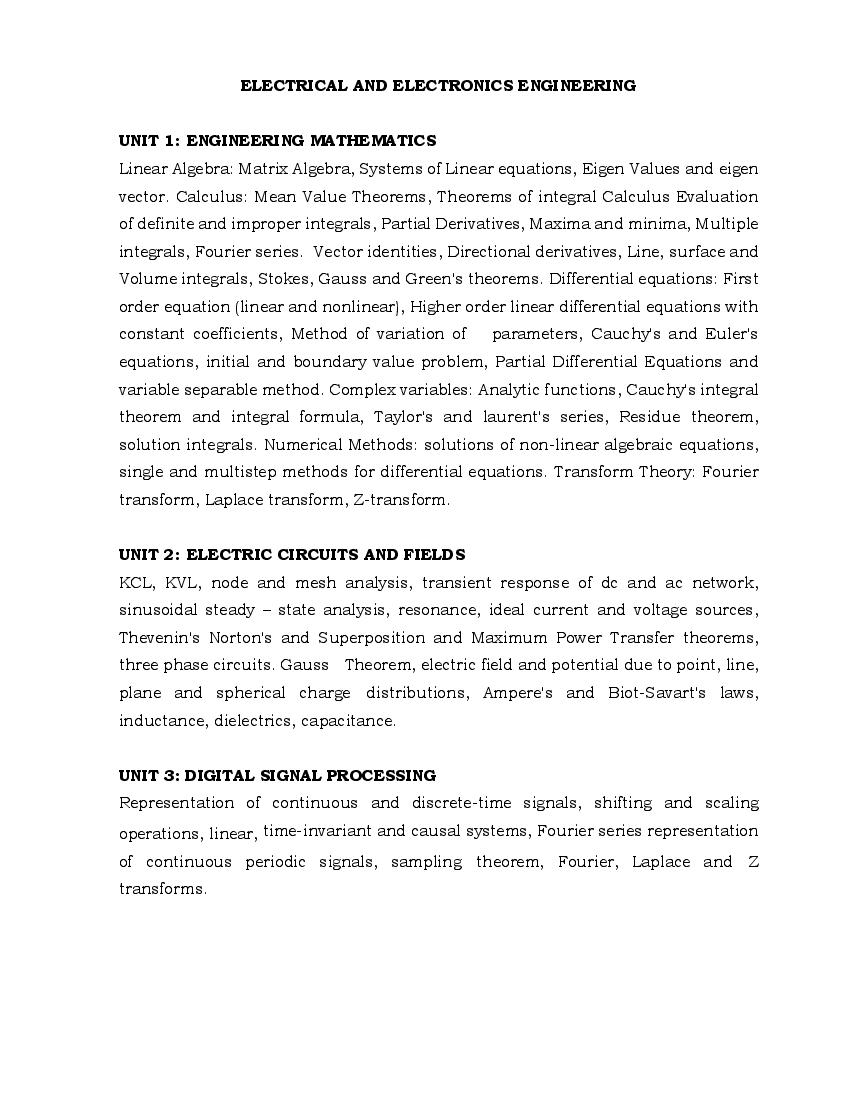
UNIT 1: ENGINEERING MATHEMATICS
Linear Algebra: Matrix Algebra, Systems of Linear equations, Eigen Values and eigen
vector. Calculus: Mean Value Theorems, Theorems of integral Calculus Evaluation
of definite and improper integrals, Partial Derivatives, Maxima and minima, Multiple
integrals, Fourier series. Vector identities, Directional derivatives, Line, surface and
Volume integrals, Stokes, Gauss and Green's theorems. Differential equations: First
order equation (linear and nonlinear), Higher order linear differential equations with
constant coefficients, Method of variation of parameters, Cauchy's and Euler's
equations, initial and boundary value problem, Partial Differential Equations and
variable separable method. Complex variables: Analytic functions, Cauchy's integral
theorem and integral formula, Taylor's and laurent's series, Residue theorem,
solution integrals. Numerical Methods: solutions of non-linear algebraic equations,
single and multistep methods for differential equations. Transform Theory: Fourier
transform, Laplace transform, Z-transform.
UNIT 2: ELECTRIC CIRCUITS AND FIELDS
KCL, KVL, node and mesh analysis, transient response of dc and ac network,
sinusoidal steady – state analysis, resonance, ideal current and voltage sources,
Thevenin's Norton's and Superposition and Maximum Power Transfer theorems,
three phase circuits. Gauss Theorem, electric field and potential due to point, line,
plane and spherical charge distributions, Ampere's and Biot-Savart's laws,
inductance, dielectrics, capacitance.
UNIT 3: DIGITAL SIGNAL PROCESSING
Representation of continuous and discrete-time signals, shifting and scaling
operations, linear, time-invariant and causal systems, Fourier series representation
of continuous periodic signals, sampling theorem, Fourier, Laplace and Z
transforms.
Page 2
Single phase transformer – equivalent circuit, phase diagram, tests, regulation and
efficiency, three phase transformers - connections, parallel operation, auto-
transformer, energy conversion principles, DC machines - types, windings,
generator characteristics, armature reaction and commutation, starting and speed
control of motors, three phase induction motors - principles, types, performance
characteristics, starting and speed control, single phase induction motors,
synchronous machines - performance, regulation and parallel operation of
generators, motor starting, characteristics and applications, Special Electrical
machines.
UNIT 5: POWER SYSTEMS
Basic power generation concepts, transmission line models and performance, cable
performance insulation, corona and radio interference, distribution systems, per –
unit quantities, bus impedance and admittance matrices, load flow, voltage control,
power factor correction, Economic operation, symmetrical components, fault
analysis.
UNIT 6: PROTECTION AND SWITCHGEAR
Principle of over - current, differential and distance protection, solid state relays
and digital protection, circuit breakers, system stability concepts, swing curves and
equal area criterion. High voltage generation and measurements.
UNIT 7: CONTROL SYSTEM
Principle and feedback, transfer function, block diagrams, steady – state errors,
Routh and Nyquist techniques, Bode plots, root loci, lag, lead and lead-leg
compensation.
UNIT 8: ELECTRICAL AND ELECTRONICS MEASUREMENTS
Bridges and potentiometers, PMMC, moving iron, dynamometer and induction type
instruments, measurement of voltage, current, power, energy and power factor,
instruments transformers, phase, time and frequency measurement, Q-meters,
Oscilloscopes, Transducers and Data acquisition systems.
Page 3
Characteristics of diodes, BJT, FET, amplifiers - biasing. equivalent circuit and
frequency response, oscillators and feedback amplifiers, operational amplifiers-
characteristics and applications, simple active filters, VCOs' and timers,
combinational and sequential logic circuit, multiplexer, Schmitt trigger, multi
Vibrators, sample and hold circuit, A/D and D/A convertors, 8085 and 8086 -
microprocessor and 8051 microcontroller basics, architecture, programming and
interfacing.
UNIT 10: POWER ELECTRONICS AND DRIVES
Semiconductor power diodes, transistors, thyristors, TRIACs, MOSFETs and IGBTs-
static characteristics and principles of operation, triggering circuits, phase control
rectifiers, bridge converters – fully controlled and half controlled, principles of
choppers and inverters, basic concepts of adjustable speed dc and ac drives.
Document Details
| Board / Org | Default |
| Exam | Govt Jobs Exams |
| Type | Syllabus |
| Pages | 3 |
| Updated | 22 Jul 2026 |