UPSC IFS 2017 Question Paper for Physics Paper-II
Finished viewing? Save it for later —
Download UPSC IFS 2017 Question Paper for Physics Paper-II (PDF · 4 pages)About UPSC IFS 2017 Question Paper for Physics Paper-II
UPSC IFS 2017 Question Paper for Physics Paper-II is available here for free download. Published by UPSC for Indian Forest Service Examination, this question paper can be viewed online or downloaded as a PDF (4 pages). Candidates preparing for Indian Forest Service Examination can use UPSC IFS 2017 Question Paper for Physics Paper-II to understand the exam pattern, the type of questions asked, and the overall difficulty level.
Frequently Asked Questions
How can I download UPSC IFS 2017 Question Paper for Physics Paper-II?
Open this page and click the Download button to save UPSC IFS 2017 Question Paper for Physics Paper-II as a PDF. It is completely free on AglaSem Docs.
Is UPSC IFS 2017 Question Paper for Physics Paper-II free to download?
Yes. UPSC IFS 2017 Question Paper for Physics Paper-II can be viewed online and downloaded as a PDF free of cost on AglaSem Docs.
How many pages does UPSC IFS 2017 Question Paper for Physics Paper-II have?
UPSC IFS 2017 Question Paper for Physics Paper-II contains 4 pages, which you can read online or download together as a single PDF.
Where can I find more Indian Forest Service Examination study material?
You can find more Indian Forest Service Examination question papers, sample papers, syllabus, and answer keys on AglaSem Docs.
UPSC IFS 2017 Question Paper for Physics Paper-II – Text
Read the full text of this question paper below — useful to quickly search, copy and reference the content online without downloading the PDF.
📄 View text version (4 pages)
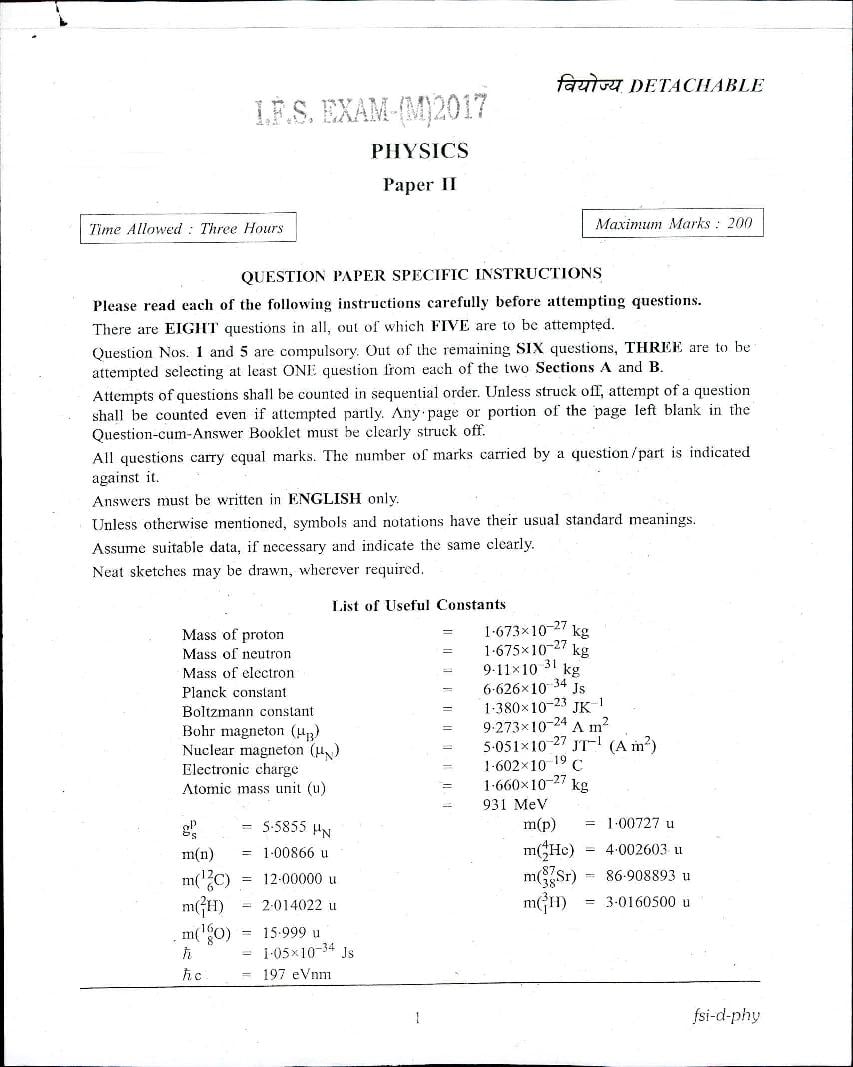
Page 1
ViltS. EXAM-(\1)2°' i
PHYSICS
Paper H
Time Allowed: Three Hours Maximum Marks: 200
QUESTION PAPER SPECIFIC INSTRUCTIONS
Please read each of the following instructions carefully before attempting questions.
There are EIGHT questions in all, out of which FIVE are to be attempted.
Question Nos. I and 5 are compulsory. Out of the remaining SIX questions, THREE are to be
attempted selecting at least ONE question from each of the two Sections A and B.
Attempts of questions shall be counted in sequential order. Unless struck off, attempt of a question
shall be counted even if attempted partly Any-page or portion of the *page left blank in the
Question-cum-Answer Booklet must be clearly struck off.
All questions carry equal marks. The number of marks carried by a question/part is indicated
against it.
Answers must be written in ENGLISH only.
Unless otherwise mentioned, symbols and notations have their usual standard meanings.
Assume suitable data, if necessary and indicate the same clearly.
Neat sketches may be drawn, wherever required.
List of Useful Constants
Mass of proton 1-673x10-27 kg
Mass of neutron 1-675x10-27 kg
Mass of electron 9-11x10-31 kg
Planck constant 6-626x10-34 Js
Boltzmann constant 1-380x10-23 JEC-1
9.273x10⁻²⁴ A m2
Bohr magneton (Mn)
Nuclear magneton 0'N) 5-051x 10-27 JT-1 (Atn2)
Electronic charge 1-602x10-19 C
Atomic mass unit (u) 1-660x10-27 kg
931 MeV
5-5855 m(p) = 1-00727 u
Os
m(n) 1.00866 u m(He) = 4-002603 u
m(1C) if 12.00000 u m(Sr) = 86-908893 u
m(irT) 2.014022 u m(11-1) = 3-0160500 u
m(1680) = 15-999 u
1-05x10-34 Js
hc = 197 eVnm
1 fsi-d-phy
Page 2
I. Answer all of the following questions : 8x5=40
1. (a) Use the uncertainty principle to estimate the binding energy of the hydrogen atom
in the ground state in terms of me, e, h and c. Estimate the answer in eV. 8
I. (b) An electron is described by the following wave function:
w(x)=O for x < 0
= Ce-x(1- e-x) for x 0
where C is a constant. Find out the average position of the electron. 8
1. (c) What is the main inference drawn from the Stem Gerlach experiment ? What would
be the change in the result in the following cases :
_electron spin is -23- h instead of
a beam of neutral atoms is passed through a homogeneous magnetic field. 8
1. (d) What is meant by Larmour precession? Calculate the Larmour frequency for protons
in a magnetic field of I Tesla. 8
(e) Describe the differences in the behaviour of a quantum harmonic oscillator with the
corresponding classical oscillator. 8
(a) A particle of mass m is confined in a one dimensional box on the x-axis between
x = 0 and x=1.. Obtain the allowed energy states of the particle and the
corresponding eigenfunctions. What will be the energy pattern in the limit of L->co ?
15
L
2. (b) Estimate the probability of finding the particle between x=0 and x = - in the
3
lowest energy state. 5
2. (c) Generalize the results obtained in part (a) to obtain the allowed energy states and the
corresponding eigenfunctions of a particle in a three dimensional isotropic box of
dimension L. What is the degeneracy of the first two excited states of the particle?
20
3. (a) Consider two electrons system in (3p)'(4s)' configuration. Derive the allowed energy
states of the system in (i) LS coupling and (ii) jj coupling sketching the energy level
diagram in each case. Name the interactions which are responsible for different
splittings. 25
3. (b) Show that
(i) I x = ihi
[1,,, ]= 2hi,
15
(iii) x&
y az =-i
fsi-d-phy 2
Page 3
N:r
0
A beam of particles of mass in and energy E is incident on a step potential of height
Vo from the left as shown in the figure. Discuss the behaviour of the particle for
(i) E < Vo and (ii) E> Vo. Obtain expressions for the reflection and the transmission
coefficients and sketch them as a function of the incident energy of the particle.
15
4. (b) The first rotational line in the rotational spectrum of CO is observed at
3-84235 cm-1. Calculate the rotational constant B and the bond length. 10
4. (c) What are Stokes and anti-Stokes lines? What is their importance in understanding
the molecular structure ? 15
SECTION 'B'
5. Answer all of the following questions: 8x5=40
5. (a) How much energy is required to separate ip nucleus into its constituent nucleons?
What is the binding energy per nucleon for this nucleus? 8
5.(b) Determine the values of emitter current and the collector current of the transistor
having a = 0-98 and collector to base leakage current Imo = 4 µA. The base current
is • 50 µA. 8
5. (c) What are noncentral nuclear forces? Discuss qualitatively how the presence of a
small noncentral component in the nuclear force can account for the nonvanishing
quadrupole moment of deuteron. 8
5. (d) Define the terms critical magnetic field and critical temperature in a superconductor.
Find the magnetic field strength necessary to destroy the superconductivity in a
.sample of lead at 4.2 K. The critical magnetic field at 0 K is 0.80 Tesla and the
critical temperature is 7.2 K. 8
5. ( Write the quark contents and the quantum numbers (B, 1, 5, 13) of the following
hadrons :
k° 8
3 fsi-d-phy
Page 4
the sum of the masses of their constituent quarks ? 12
6. (b) Describe the main features of the shell model of the nucleus. Explain how it can
account for the magic numbers of nuclei. - 20
'
(c) Predict the spin and parity for the ground sfate of the following nuclei on the basis
of the shell model :
15n 16n 17n 18n 8
8 8N.-/
(a) Write down the semiempirical mass formula for nuclei and sketch the variation of
isobaric masses with atomic number for both odd and even values of A. How many
stable isobars would be there in each case ? 20
What is Meissner effect? Explain perfect diamagnetism in reference to this. 10
7.(b)
7. (c) Explain briefly SU(3) flavor symmetry and SU(2) isospin symmetry in particle
physics. 10
8. (a) Explain with the help of a neat diagram the working of an RC coupled common
emitter amplifier. 15
8.(b)
Find the Boolean algebra expression for the above system. 15
8. (c) Why does the resistance of a semiconductor decrease with increase in temperature?
10
fsi-d-phy
Document Details
| Board / Org | UPSC |
| Exam | Indian Forest Service Examination |
| Type | Question Paper |
| Pages | 4 |
| Updated | 30 Apr 2026 |