CUSAT CAT 2019 Question Paper MCA LET
Finished viewing? Save it for later —
Download CUSAT CAT 2019 Question Paper MCA LET (PDF · 40 pages)About CUSAT CAT 2019 Question Paper MCA LET
CUSAT CAT 2019 Question Paper MCA LET is available here for free download. Published by Cochin University for CUSAT Common Admission Test, this question paper can be viewed online or downloaded as a PDF (40 pages). Candidates preparing for CUSAT Common Admission Test can use CUSAT CAT 2019 Question Paper MCA LET to understand the exam pattern, the type of questions asked, and the overall difficulty level.
Frequently Asked Questions
How can I download CUSAT CAT 2019 Question Paper MCA LET?
Open this page and click the Download button to save CUSAT CAT 2019 Question Paper MCA LET as a PDF. It is completely free on AglaSem Docs.
Is CUSAT CAT 2019 Question Paper MCA LET free to download?
Yes. CUSAT CAT 2019 Question Paper MCA LET can be viewed online and downloaded as a PDF free of cost on AglaSem Docs.
How many pages does CUSAT CAT 2019 Question Paper MCA LET have?
CUSAT CAT 2019 Question Paper MCA LET contains 40 pages, which you can read online or download together as a single PDF.
Where can I find more CUSAT Common Admission Test study material?
You can find more CUSAT Common Admission Test question papers, sample papers, syllabus, and answer keys on AglaSem Docs.
CUSAT CAT 2019 Question Paper MCA LET – Text
Read the full text of this question paper below — useful to quickly search, copy and reference the content online without downloading the PDF.
📄 View text version (40 pages)
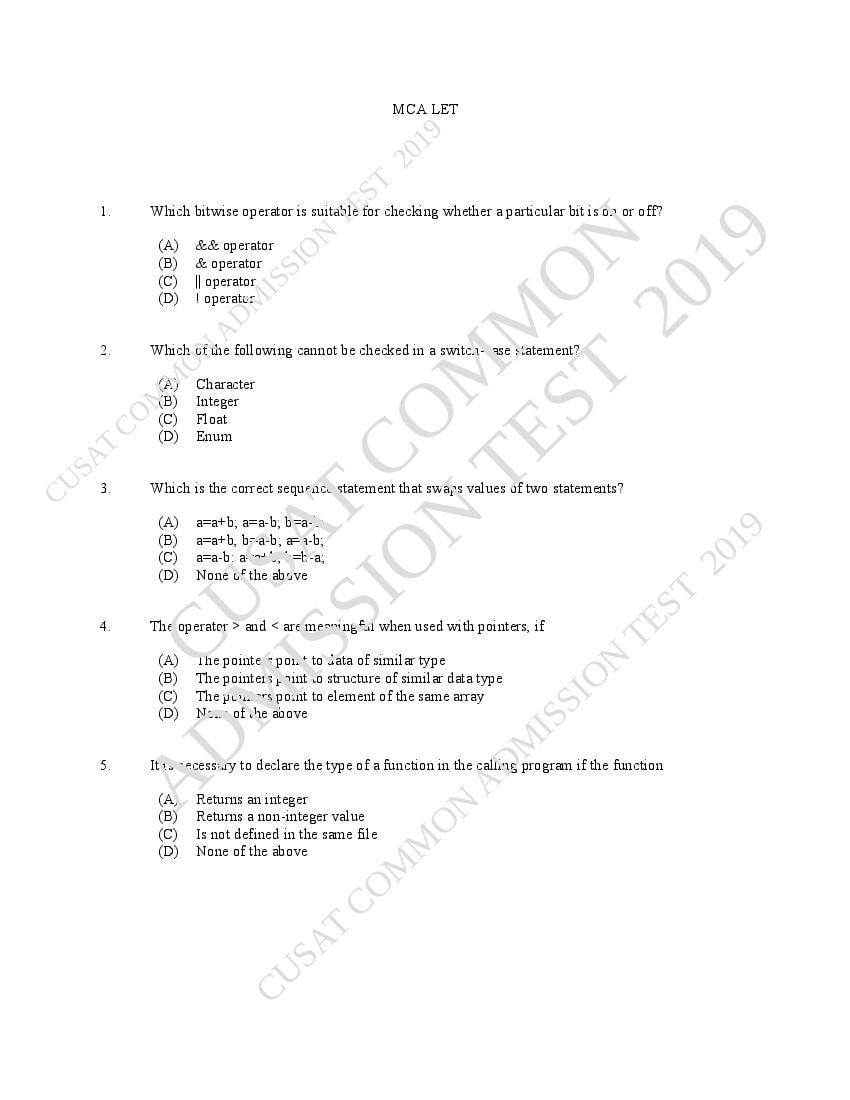
Page 1
019
2
S T
Which bitwise operator is suitableEfor checking whether a particular bit is on or off?
1.
T
N
(A) && operator
O
(B) & operator
S I
(D) ! operator I
(C) || operator S
M
A
D
M
2. Which ofNthe following cannot be checked in a switch-case statement?
O
(A)M Character
M
O
(B) Integer
O
E
(C) Float
C (D) Enum
SA T
C T
CU 3.
(A)
AT
Which is the correct sequence statement that swaps values of two statements?
N
a=a+b; a=a-b; b=a-b;
19
S IO
(B) a=a+b, b=a-b; a=a-b;
(C) a=a-b; a=a+b; b=b-a;
2 0
U
(D) None of the above
4.
(A)C IS S N
T E ST
The operator > and < are meaningful when used with pointers, if
The pointers point to data of similar type
O
M I
(B) The pointers point to structure of similar data type
(C)
S
The pointers point to element of the same array
IS
D
(D) None of the above
M
A D
5. It is necessary to declare the type of a function in the calling program if the function
A
(A)
N
Returns an integer
(B)
(C) O
Returns a non-integer value
Is not defined in the same file
(D) None of the above M
M
C O
AT
S
CU
Page 2
int fun(int x, int y)
019
{ 2
if (x == 0)
return y; S T
E
return fun(x - 1, x + y);
T
}
N
O
(A) 13 SI
(B) 12 IS
M
M
(C) 9
(D) 10 D
A
N
7. O
Standard ANSI C recognizes ______ number of keywords
M
SAT
M
(A) 30
CO (B) 32
(C) 34
(D) 36
O
C T E
CU 8.
AT N
The correct value returned to the OS on successful completion of a ‘C’ program is
19
S IO 0
(A) 1
(B) -1
2
U S
(C) 0
(D) null character
ST
9.
C IS T E
What is the output of this C code?
O
N
M I
#include <stdio.h>
void main()
S
IS
D
{
int b = 5 - 4 + 2 * 5;
M
printf("%d", b);
A D
}
A
(A) 25
N
(B)
(C)
-5
11 O
(D) None of the above M
M
C O
AT
S
CU
Page 3
#include <stdio.h>
019
void main() 2
{
int b = 5 & 4 & 6; S T
E
}
printf("%d", b);
T
N
O
(A) 5
SI
(B) 6
IS
M
M
(C) 3
(D) 4 D
A
N
11. O
What is the output of this C code?
M
M
O
#include <stdio.h>
CO
E
void main()
C T
{
AT int b = 5 & 4 | 6;
S
T
printf("%d", b);
CU
}
A N 19
S IO
(A) 6
(B) 4
2 0
U
(C) 1
S T
(D) 0
S
12.
C IS T E
What is the output of this C code?
O
N
M I
#include <stdio.h>
int main() S
IS
D
{
int i = 0;
M
A D
for (i++; i == 1; i = 2)
printf("In for loop ");
A
printf("After loop\n");
}
N
O
(A)
(B)
In for loop after loop
After loop M
(C) Compile time error M
(D) Undefined behavior
C O
13. AT
What is the output of this C code?
S
U
#include <stdio.h>
C
Page 4
19
{
char *str = "";
do 20
{
printf("hello"); S T
E
} while (str);
T
}
N
O
SI
(A) Nothing
(B) Run time errorS
I
M
M
(C) Varies
(D) Hello isDprinted infinite times
A
14.
N
What isOthe output of this C code?
M <stdio.h>
M
O
#include
COvoid
E
main()
C T
{
A T int i = 0;
S
T
if (i == 0)
CU
N
{
A
printf("Hello");
continue;
19
S IO 0
}
}
2
(A)
(B)
(C)
(D)
U S
Hello
Varies
Compile time error T E
T
Hello is printed infinite times
C IS
S
N
O
M IS
S I
D M
A O
N
A
D
M
M
C O
AT
S
CU
Page 5
#include <stdio.h>
019
void foo(); 2
int main()
{ S T
E
void foo(int);
T
foo(1);
N
return 0;
O
}
SI
void foo(int i)
IS
M
M
{
D
printf("2 ");
} A
N
(A) O2
M Compile time error
(B)
A T
S 16.
CO
(C)
(D) 12
O
M Depends on the compiler
C T E
T
Comment on the output of this C code?
CU
int main()
A N
#include <stdio.h>
19
S IO 0
{
int i;
2
U S
for (i = 0;i < 5; i++)
int a = i;
ST
C IS E
printf("%d", a);
}
T
(A) N
a is out of scope when printf is called
O
M I
(B) Redeclaration of a in same scope throws error
(C)
S
Syntax error in declaration of a
IS
D
(D) No errors, program will show the output 5
M
A O
N
A
D
M
M
C O
AT
S
CU
Page 6
#include <stdio.h>
019
int main() 2
{
int i = 97, *p = &i; S T
E
foo(&i);
printf("%d ", *p); T
N
}
O
I
void foo(intSS
I *p)
{
M
D
M
int j = 2;
pA= &j;
} O
Nprintf("%d ", *p);
M
M
O
(A) 2 97
E
CO (C) Compile time error
(B) 2 2
SAT (D)
C T
Segmentation fault/code crash
CU 18.
AT N
A constructor function is generally defined
19
S IO
(A) In the private section of a class
(B)
2 0
In the public section of a class
U
(C) In the protected section of a class
S T
(D) None of the above
S
19.
C IS T E
Which classes allow primitive types to be accessed as objects?
O
N
M I
(A) Storage
(B) Virtual
S
IS
D
(C) Friend
(D) Wrapper
M
20.
(A)
(B)
A O
N
A
D
How can we make a class abstract?
By making all member functions constant.
By making at least one member function as pure virtual function.
(C) M
By declaring it abstract using the static keyword.
(D)
M
By declaring it abstract using the virtual keyword.
C O
21.
T
In case of inheritance where both base and derived class are having constructors, when an object
A
of derived class is created then
S
U
(A) constructor of derived class will be invoked first
C
Page 7
19
(C) constructor of derived class will be executed first followed by base class
(D)
0
constructor of base class will be executed first followed by derived class
2
22. S T
…………. can be invoked like a normal function without the help of any object.
E
T
(A)
N
Constant member function
(B)
O
Private member function
(C)
SI
Static member function
(D)
IS
Friend function
M
23. How can weA
D
M
restrict a function to throw certain exceptions?
(A) O
N
Defining multiple try and catch block inside a function
(B)M Defining generic function within try block
A T
O
M
O E
(C) Defining function with throw clause
C (D) It is not possible in CPP to restrict a function
C T
S 24. Which of the following is/are the header files listed in C++ standard library.
CU
(A)
AT N
i) <ctype.h> ii) <float.h> iii) <date.h> iv) <limits.h>
i, ii and iii only
19
S IO 0
(B) i, ii and iv only
(C) ii, iii and iv only
2
U S
(D) i, ii, iii and iv
ST
25.
C IS T E
A member function can always access the data in _______ (in C ++)
(A) N
The class of which it is member
O
M I
(B) The object of which it is a member
(C)
S
The public part of its class
IS
D
(D) The private part of its class
M
A O
N
A
D
M
M
C O
AT
S
CU
Page 8
(A)
019
All members of a structure are public and structures don't have constructors and
destructors 2
(B)
T
Members of a class are private by default and members of struct are public by default.
S
When deriving a struct from a class/struct, default access-specifier for a base class/struct
E
T
is public and when deriving a class, default access specifier is private.
(C)
N
All members of a structure are public and structures don't have virtual functions
(D) All of the above O
S I
IS
M
M
27. Which of the following, in C++, is inherited in a derived class from base class?
D
A
(A) constructor
(C) O
N
(B) destructor
data members
(D)M virtual methods
SA
O
M
O E
28. C Which of the following is not a member of class?
T
C T
T
(A) Static function
CU
N
(B) Friend function
A
(C) Const function
(D) Virtual function
19
S IO 2 0
U S
29. When one object reference variable is assigned to another object reference variable then
ST
C IS E
(A) a copy of the object is created.
(B)
(C) T
a copy of the reference is created.
a copy of the reference is not created.
(D) N
it is illegal to assign one object reference variable to another object reference variable.
O
M IS
S I
D
30. When a method in a subclass has the same name and type signatures as a method in the
superclass, then the method in the subclass _____ the method in the superclass.
M
(A)
(B)
(C)
(D)
A Overloads
A
Friendships
Inherits
O
N
Overrides
D
M
M
C O
AT
S
CU
Page 9
(A) Constant
019
(B) Structure 2
(C)
(D)
Array
Header file S T
E
T
N
32.
O
Which of the following is not correct (in C++) ?
SI
IS templates are instantiated in the same way
1. Class templates and function
M
M
2. Class templates differ from function templates in the way they are initiated
3. Class templateDis initiated by defining an object using the template argument
A are generally used for storage classes
4. Class templates
(A) O
N
(1)
(B)M (2), (4)
A T
S 33.
O
M
C (D) (4) O
(C) (2), (3), (4)
C T E
T
Assume that an integer and a pointer each takes 4 bytes. Also, assume that there is no alignment
CU
N
in objects. Predict the output of following program.
A
#include<iostream>
S IO
using namespace std;
class Test
2 0 19
U S
{
static int x;
ST
C IS E
int *ptr;
};
int y;
T
N
O
M I
int main()
{
S
IS
D
Test t;
cout << sizeof(t) << " ";
M
cout << sizeof(Test *);
A D
}
A
(A) 12 4
N
(B)
(C)
12 12
84 O
(D) 88 M
M
C O
AT
S
CU
Page 10
#include<iostream>
019
using namespace std; 2
class Empty {};
int main() S T
E
{
cout << sizeof(Empty); T
N
return 0;
O
}
SI
IS
M
(A) A non-zero value
(B) 0
A
(C) Compiler
D
M
Error
N Error
(D) Runtime
O
M is a set of an attribute which can uniquely identify a tuple and __________ is the
M
O
35. __________
SA E
COcolumn of the table which is used to point to the primary key of another table.
C T
T (A) Super key, Foreign key
T
(B) Foreign key, Super key
CU
N
(C) Primary key, Candidate key
A
(D) Candidate key, Primary key
19
36.
S IO
The notation for reflexive rule is
2 0
(A)
(B)
(C)
(D)
U
C IS S
If X → Y, then XZ → YZ
E ST
If X → Y and Y → Z, then X → Z
T
If X → Y and YZ → W, then XZ → W
If X ⊇ Y, then X → Y
N
O
37.
M S I
When a hash function generates an address at which data is already stored, then the next bucket
IS
D
will be allocated to it. This mechanism is called as
M
A
(A) Overflow chaining
(B) D
Linear Probing
(C) A
Bucket overflow
(D)
N
None of the above
O
M
M
C O
AT
S
CU
Page 11
(A) Data Control Language
019
(B) Data Definition Language 2
(C)
(D)
Data Manipulation Language
Transaction Control Language S T
E
T
N
39.
O
________ is also known as Project-join normal form.
SI
(A) 3NF
IS
M
M
(B) 2NF
(C) D
Boyce codd normal form
(D) 5NF A
N
O
40. M
The ____ in a table is the column that makes each record different from all others
SAT
M
(C)
O
CO (B) Primary key
(A) Unique field
C T
Sort key E
T
(D) Candidate key
CU
41.
A N
Which is not a SQL comparison operator?
19
(A)
S IO
<>
2 0
U
(B) <=
42.
(C)
(D)
!>
C IS
%
S N
T E ST
Given the relations "employee (name, salary, deptno) and department (deptno, deptname,
O
M I
address)" which of the following queries cannot be expressed using the basic relational algebra
S
operations (U, -, x, π, σ, p)?
IS
(A)
D M
Department address of every employee
A D
(B) Employees whose name is the same as their department name
(C) The sum of all employees’ salaries
(D) A
All employees of a given department
N
O
M
M
C O
AT
S
CU
Page 12
19
same as r, provided
(A) r has no duplicates and s is non-empty2 0
(B) r and s have no duplicates
S T
TE of tuples
(C) s has no duplicates and r is non-empty
(D) r and s have the same number
N
O
44. S I null values, and comparisons with null values are treated as
In SQL, relations can contain
unknown. Suppose all IScomparisons with a null value are treated as false. Which of the following
M
M
pairs is not equivalent?
D
(A) x = 5,Anot (not (x = 5)
(B) x N = 5, x > 4 and x < 6, where x is an integer
(C) O x < 5, not(x = 5)
(D)M None of the above
SA
O
M
O E
45. C Consider a schema R(A, B, C, D) and functional dependencies A -> B and C -> D. Then the
C T
T decomposition of R into R1 (A, B) and R2(C, D) is
CU (A)
(B)
AT N
dependency preserving and loss less join
loss less join but not dependency preserving
19
S IO
(C) dependency preserving but not loss less join
(D)
0
not dependency preserving and not loss less join
2
46.
(A)
(B)
U
C IS
NAME
ID
S T E ST
Consider attributes ID, CITY and NAME. Which one of this can be considered as a super key?
(C) CITY N
O
M I
(D) CITY, ID
S
IS
47.
D
A _____ is a property of the entire relation, rather than of the individual tuples in which each
M
A D
tuple is unique.
(A) Rows A
(B) Keys
N
(C)
O
Attributes
(D) Fields
M
M
C O
AT
S
CU
Page 13
(A) Domain relational calculus
019
(B) Tuple relational calculus 2
(C)
(D)
Relational algebra
Query language S T
E
T
N
49.
O
The_____ operation allows the combining of two relations by merging pairs of tuples, one from
SI
each relation, into a single tuple.
IS
M
M
(A) Select
(B) Join D
(C) UnionA
(D) N
Intersection
O
M
SA
50.
O
M
O E
A ________ is a pictorial depiction of the schema of a database that shows the relations in the
C database, their attributes, and primary keys and foreign keys.
C T
T (A) Schema diagram
CU
T
(B) Relational algebra
N
(C) Database diagram
A
(D) Schema flow
19
51.
S IO 2 0
Which one of the following is used to define the structure of the relation, deleting relations and
U S T
relating schemas?
S
C IS E
(A) DML(Data Manipulation Langauge)
(B)
T
DDL(Data Definition Langauge)
(C) Query
N
(D) Relational Schema
O
M IS
S I
D
52. The Time Complexity of best case in Merge sort is
M
A D
(A) O
(B)
(C)
O(n)
O(log n) A
(D) N
O(n log n)
O
M
M
C O
AT
S
CU
Page 14
(A) Root element
019
(B) Adjacent element 2
(C)
(D)
Minimum element
Maximum element S T
E
T
N
54.
O
Bucket sort is also known as
SI
(A) Bin sort
IS
M
M
(B) Tim sort
(C) D
Merge sort
(D) A
Quick sort
N
O
55. M
The average number of key comparisons done in a successful sequential search in a list of length
SAT
M
‘n’ , it is
CO (A) log n
(B)
O
C T
(n-1)/2 E
T
(C) n/2
CU
N
(D) (n+1)/2
56.
A
S IO 0 19
Which among the following scheduling algorithms gives minimum average waiting time?
2
U S
(A) FCFS
(B) SJF
ST
C IS E
(C) Round robin
(D) On priority
T
N
O
M I
57. What is the time complexity of Huffman Coding?
S
IS
D
(A) O(N)
(B) O(NlogN)
M
A
(C) O(N(logN)^2)
(D) O(N^2) D
A
N
O
M
M
C O
AT
S
CU
Page 15
19
algorithms should be preferred so that the number of swap operations are minimized in general?
(A) Heap Sort 20
(B) Selection Sort
S T
E
(C) Insertion Sort
(D) Merge Sort T
N
O
59. You have to sort 1 GB S
ofIdata with only 100 MB of available main memory. Which sorting
IS appropriate?
technique will be most
M
(A) Heap sort
(B) Merge
D
Asort
M
N
(C) Quick Sort
(D) O
M Insertion sort
SA
O
M
O E
60. C Traversal of a graph is different from tree because
C T
T (A) There can be a loop in graph so we must maintain a visited flag for every vertex
CU
T
(B) DFS of a graph uses stack, but inorder traversal of a tree is recursive
N
(C) BFS of a graph uses queue, but a time efficient BFS of a tree is recursive
A
(D) All of the above
19
61.
S IO 2 0
Which of the following data structure is useful in traversing a given graph by breadth first search?
(A)
(B)
(C) U
C IS
List
S
Stack
Queue
T E ST
(D) None of the above
N
O
62.
M S I
Which of the following is not a backtracking algorithm?
IS
(A)
D M
Knight tour problem
A D
(B) N queen problem
(C) Tower of Hanoi
(D) A
M coloring problem
N
O
M
M
C O
AT
S
CU
Page 16
19
abc d + - * (where a = 8 , b = 4 , c = 2 and d = 5)
(A) -3/8 20
(B) -8/3
S T
E
(C) 24
(D) -24 T
N
O
64. S I case of QuickSort and what is the time complexity in Worst case?
What is recurrence for worst
IST(n) = T(n-2) + O(n) and time complexity is O(n^2)
Mis T(n) = T(n-1) + O(n) and time complexity is O(n^2)
M
(A) Recurrence is
D
(B) Recurrence
A is T(n) = 2T(n/2) + O(n) and time complexity is O(nLogn)
(C) Recurrence
N
(D) Recurrence is T(n) = T(n/10) + T(9n/10) + O(n) and time complexity is O(nLogn)
O
M
65.
T
SA {
O
M
C int fun(int n) O
C T E
What is time complexity of fun()?
CU
T
int count = 0;
A N
for (int i = n; i > 0; i /= 2)
for (int j = 0; j < i; j++)
19
S IO
count += 1;
return count;
2 0
U
}
(A)
(B)
(C)
(D)
S
O(n^2)
C IS
O(nLogn)
O(n)
O(nLognLogn)
N
T E ST
O
M IS
S I
D M
A O
N
A
D
M
M
C O
AT
S
CU
Page 17
int tfun(int n)
019
2
{
int count = 0; S T
E
T
for (int i = 0; i < n; i++)
for (int j = i; j > 0; j--)
N
count = count + 1;
O
return count;
SI
}
IS
M
D
M
(A) Theta (n)
(B) A
Theta (n^2)
(C) N
Theta (n*Logn)
(D) O
Theta (nLognLogn)
M
SA
T
M
O E
67. OWhat is the worst case time complexity of insertion sort where position of the data to be inserted
C is calculated using binary search?
C T
T
(A) N
CU
N
(B) NlogN
A
(C) N^2
(D) N(logN)^2
19
S IO 2 0
U S
68. The Postfix form of the following expression: (A + B) * (C - D) is
ST
C IS E
(A) AB+CD-*
(B)
(C)
A+B*C-D
+AB*-CD T
(D) A+BC-D* N
O
M IS
S I
D
69. ___________ is a composite data type that defines a grouped list of variables that are to be placed
under one name in a block of memory.
M
(A)
(B)
(C)
(D)
A Pointer
Array
N
Structure
O
A
D
None of the above
M
M
C O
AT
S
CU
Page 18
(A) number of rows
019
(B) number of columns 2
(C)
(D) S T
(number of rows / number of columns)
(number of rows * number of columns)
E
T
N
71.
O
________________ is a complex type of linked list in which a node contains a pointer to the
S I
previous as well as the next node in the sequence.
(A) Linked listM
IS
(B) DoublyD
M
linked list
A singly linked list
(C) Circular
N doubly linked list
(D) Circular
O
M
SA
72.
O
M
O E
________ is used to adding an element onto the stack and __________ is used to removing an
C element from the stack.
T (A) Push, pop
C T
CU
T
(B) Pop, push
N
(C) Peek, pop
A
(D) Pop, peek
19
73.
S IO 2 0
A queue can be defined as an ordered list which enables insert operations to be performed at one
U S T
end called _______ and delete operations to be performed at another end called _________.
S
C IS E
(A) FIFO, LIFO
(B) LIFO, FIFO
T
(C) FRONT, REAR
N
(D) REAR, FRONT
O
M IS
S I
D
74. _________ traverse the left sub-tree and then traverse the right sub-tree and root respectively.
M
A D
(A) Pre- order traversal
(B)
(C) A
In- order traversal
Post-order traversal
(D) N
None of the above
O
M
M
C O
AT
S
CU
Page 19
19
by removing the desired number of edges from a graph.
(A) Binary tree 20
(B) Binary search tree
S T
E
(C) Spanning tree
(D) B+ tree T
N
O
76. SI of the below function?
What is the time complexity
IS int arr[])
M
M
void fun(int n,
D
{
A
N
int i = 0, j = 0;
Ofor(; i < n; ++i)
M j++; < n && arr[i] < arr[j])
while(j
SA T
CO}
M
(A) O(n)
(B) O(n^2)
O
C T E
CU
(C)
(D)
AT
O(nlogn)
N
O(n(logn)^2)
19
77.
S IO 2 0
What does the following function do for a given Linked List with first node as head?
U S T
void fun1(struct node* head)
{
S
C IS E
if(head == NULL)
return; T
N
O
M
fun1(head->next);
S I
printf("%d ", head->data);
IS
}
(A)
D M
Prints all nodes of linked lists
A D
(B) Prints all nodes of linked list in reverse order
(C)
A
Prints alternate nodes of linked list
(D)
N
Prints alternate nodes in reverse order
O
M
M
C O
AT
S
CU
Page 20
19
with array?
0
2 in linked list
(A) It is easy to insert and delete elements
(B) Random access is not allowed T in a typical implementation of linked lists
E S
(C) The size of array has to be pre-decided, linked lists can change their size any time
(D) All of the above T
N
O
79. I algorithms can be used to sort a random linked list with minimum
Which of the followingSsorting
time complexity? IS
M
DSort
(A) Insertion
(B) Quick ASort
M
N
(C) Heap Sort
(D) O
M Merge Sort
SA
O
M
O E
80. C Which one of the following is an application of Stack Data Structure?
C T
T (A) Managing function calls
CU
T
(B) The stock span problem
N
(C) Arithmetic expression evaluation
A
(D) All of the above
19
81.
S IO 2 0
How many stacks are needed to implement a queue? Consider the situation where no other data
U S T
structure like arrays, linked list is available to you.
S
C IS E
(A) 1
(B) 2
T
(C) 3
N
(D) 4
O
M IS
S I
D
82. Which of the following is true about Binary Trees?
M
A D
(A) Every binary tree is either complete or full.
(B)
(C) A
Every complete binary tree is also a full binary tree.
Every full binary tree is also a complete binary tree.
(D) N
None of the above
O
M
M
C O
AT
S
CU
Page 21
19
need 3 drives. The maximum value of 'n' for which the system is guaranteed to be deadlock free is
(A) 1 20
(B) 2
S T
E
(C) 3
(D) 4 T
N
O
84. S I the number of processes that may be simultaneously inside the
To avoid the race condition,
critical section is IS
M
(A) 12
(B) 3 A
D
M
(C) 1 N
(D) O
M0
SA
O
M
O E
85. C What must reside in the main memory under all situations in a resident - OS computer?
T (A) Linker
C T
CU
T
(B) Loader
N
(C) Assembler
A
(D) Compiler
19
86.
S IO 2 0
Four Jobs to be executed on a single processor system arrive at time 0 in the order A, B, C, D.
U S T
Their burst CPU time requirements are 4,1,8,1 time units, respectively. The completion time of A
S
under round robin scheduling with time slice of one time unit is
(A)
(B)C IS
10
4
O
N
T E
M
(C) 8
(D) 9
S I
IS
87.
D M
Determine the number of page faults when references to pages in the order - 1, 2, 4, 5, 2, 1, 2, 4.
A D
Assume that the main memory can accommodate 3 pages and the main memory already has the
A
pages 1 and 2, with page 1 having been brought earlier than page 2, (Assume LRU algorithm is
used)
N
O
(A) 3
(B) 5 M
(C) 4 M
88.
(D) None of the above
C O
What should be the size of ROM if it is used to store the table for multiplication of two 8 - bit
unsigned integers?
AT
(A) 64k×8 S
(B) 64k × 24
CU
Page 22
19
(D) 64k ×16
20
89. What is page cannibalizing?
S T
E
(A)
T
Page swapping or Page replacements
(B)
N
Adding timestamps to the page
(C)
O
Avoiding page replacements
(D)
S
All of the aboveI
IS
M
90. D
Thrashing occurs when
A
M
(A) AN page fault occurs
(B) OProcesses on system frequently access pages not memory
(C)M Processes on system are in running state
SA T
91.
CO
M
Page stealing
O
C T E
(D) Processes on system are in waiting state
CU (A)
(B)
(C) T N
is a sign of efficient system
A
is taking page frames other working sets
should be the tuning goal
19
S IO 0
(D) is taking larger disk spaces for pages paged out
2
92.
(A)
(B)
U
C IS S
What is compaction?
T E ST
Technique for overcoming internal fragmentation
A paging technique
(C) N
A technique for overcoming external fragmentation
O
M I
(D) A technique for overcoming fatal error
S
IS
D M
A O
N
A
D
M
M
C O
AT
S
CU
Page 23
19
the virtual address space is of the same size as the physical address space, the operating system
0
designers decide to get rid of the virtual memory entirely. Which one of the following is true?
2
(A) T
Efficient implementation of multi-user support is no longer possible
S
E
(B) The processor cache organization can be made more efficient now
(C) T
Hardware support for memory management is no longer needed
(D) N
CPU scheduling can be made more efficient now
O
S I
94. Increasing the RAMIofS a computer typically improves performance because
M
(A) Virtual D
(B) Larger
M
memory increases
ARAMs are faster
N
(C) Fewer page faults occur
(D) O
M Fewer segmentation faults occur
SA
O
M
O
C T E
95. C A CPU generates 32-bit virtual addresses. The page size is 4 KB. The processor has a translation
T look-aside buffer (TLB) which can hold a total of 128 page table entries and is 4-way set
associative. The minimum size of the TLB tag is
CU (A)
(B)
AT
11 bits
13 bits
N 19
S IO
(C) 15 bits
(D) 20 bits
2 0
96.
U S
Virtual memory is
(A)
C IS T
Large secondary memory
E ST
(B) Large main memory
N
O
M
(C) Illusion of large cache memory
(D)
S I
Illusion of large main memory
IS
97.
D
Page fault occurs
M
(A)
(B)
(C)
(D)
A A
D
when a requested page is in memory
when a requested page is not in memory
N
when a page is corrupted
O
when an exception is thrown
M
M
C O
AT
S
CU
Page 24
(A) Settle time
019
(B) Rotational latency 2
(C)
(D)
Seek time
Waiting time S T
E
T
N
99.
O
A CPU generally handles an interrupt by executing an interrupt service routine
S I
IS
(A) as soon as an interrupt is raised
Mthe interrupt register after finishing the execution of the current instruction.
M
(B) by checking the interrupt register at the end of fetch cycle.
D
(C) by checking
A the interrupt register at fixed time intervals.
(D) by checking
N
O
100. HowMmany undirected graphs (not necessarily connected) can be constructed out of a given set
SA
T
OV=
C (A) 2^(n(n-1)/2)
(B) 2^n
O
M {V 1, V 2,…V n} of n vertices ?
C T E
T
(C) n!
CU
N
(D) n(n-l)/2
101.
A
S IO 0 19
The product of complex numbers (4,3) and (5,-6) is ?
2
U S
(A) (18,3)
(B) (18,-3)
ST
C IS E
(C) (38,9)
(D) (38,-9)
T
N
O
102.
M
The function
IS
S I is called derivative with respect to x, if the limit h
(A)
D M
(B)
(C)
A O
N
A
D
(D) M
; where
M
is an integer
C O
AT
S
CU
Page 25
019
2
S T
E
T
N
O
SI
IS
M
A
D
M
(A) 4
N
(B) O
5
M
(C) 7
M
O
(D) 9
SA T
CO
104.
C T E
Which number replaces the question mark?
CU
AT N 19
S IO 2 0
U
C IS S T E ST
N
O
M IS
S I
D
(A) 3
(B) 1
M
A
(C) 9
(D) 5 D
A
N
O
M
M
C O
AT
S
CU
Page 26
019
2
S T
E
T
N
O
SI
IS
M
A
D
M
N
O
M
SAT
M
CO (A) 1
(B) 2
(C) 3
O
C T E
CU
T
(D) 4
A N 19
S IO
106. Which letter replaces the question mark?
2 0
U
C IS S T E ST
N
O
M IS
S I
D M
A D
(A) F
(B) K A
(C) O
N
(D) P
O
M
M
C O
AT
S
CU
Page 27
019
2
S T
E
T
N
O
SI
IS
M
A
D
M
N
O
(A)M Five minutes to ten
M
O
(B) Ten minutes to fifteen
E
CO (D) Fifty minutes to sixty
(C) 20 minutes to thirty
A T
S 108. C T
CU (X).
AT
Find out which of the figures (1), (2), (3) and (4) can be formed from the pieces given in figure
N 19
S IO 2 0
U
C IS S T E ST
N
(A) 1
(B) 2
O
M I
(C) 3
(D) 4 S
IS
D M
A O
N
A
D
M
M
C O
AT
S
CU
Page 28
19
(X).
20
S T
E
T
N
O
SI
(A) 1
IS
(B) 2
M
D
M
(C) 3
(D) 4 A
N
110. FindM
O
out which of the figures (1), (2), (3) and (4) can be formed from the pieces given in figure
SA T
CO
M
(X).
O
C T E
CU
AT N 19
(A)
S IO
1
2 0
U
(B) 2
S T
(C) 3
S
C IS E
(D) 4
T
111. N
Identify the figure that completes the pattern.
O
M IS
S I
D M
A D (1) (2) (3) (4)
A
(A) 1 N
(B) 2 O
(C) 3
M
(D) 4
M
C O
AT
S
CU
Page 29
019
2
S T
E
T(1) (2) (3) (4)
N
O
(A) 1
SI
IS
(B) 2
(C) 3
M
M
(D) 4
D
A
N
113.
O
Identify the figure that completes the pattern.
M
SAT
CO
M
O
C T E
CU (A)
(B)
1
2
AT N 19
S IO
(C) 3
(D) 4
2 0
U S T
Direction (Q.Nos. 114-117): In each series, look for the degree and direction of change between the
S
numbers. In other words, do the numbers increase or decrease, and by how much
114.
C IS T E
Look at this series: 2, 1, (1/2), (1/4), ... What number should come next?
(A) (1/3)
O
N
M I
(B) (1/8)
S
IS
(C) (2/8)
D
(D) (1/16)
M
115.
A
(A)
(B)
7
10 O
N
A
D
Look at this series: 7, 10, 8, 11, 9, 12, ... What number should come next?
(C) 12
M
(D) 13
M
C O
AT
S
CU
Page 30
(A) 20
019
(B) 22 2
(C)
(D)
23
26 S T
E
T
N
117.
O
Look at this series: 53, 53, 40, 40, 27, 27, ... What number should come next?
SI
(A) 12
IS
M
M
(B) 14
(C) 27 D
(D) 53 A
N
O
118. M
Find out which of the figures (1), (2), (3) and (4) can be formed from the pieces given in figure
SAT
CO
M
(X).
O
C T E
CU
AT N 19
(A)
(B)
S IO
1
2 2 0
U S T
(C) 3
(D) 4
S
119.
C IS N
T E
Ravi left home and cycled 10 km towards South, then turned right and cycled 5 km and then
O
M
again turned right and cycled 10 km. After this he turned left and cycled 10 km to reach home.
S I
How many kilometers will he have to cycle to reach his home straight?
IS
(A)
(B)
D 10 km
15 km
M
A D
(C) 20 km
(D) 25 km
A
N
120. O
Which one will replace the question mark?
M
19, 25, 32, 40, ?, 59
M
(A) 46
C O
(B)
(C)
49
55
A T
(D) 51
S
121.
C U
Which one will replace the question mark?
Page 31
(A) 8
019
(B) 6 2
(C) 4
S T
E
(D) 3
T
N
O
122.
I
Which one will replace the question mark?
S
S ?, 343
1, 4, 27, 16,I125,
M
(A) 216 D
(B) 25 A
M
(C) 36N
(D) O
M 225
S
123.
AT
M
O E
COWhich one will replace the question mark?
C T
CEH, ?, OQT, UWZ
CU (A)
(B)
ACG
A
IKN
T N 19
S IO
(C) FGJ
(D) KLM
2 0
124.
U S ST
Which one will replace the question mark?
C ISAEFG, BHIJ, ?, DNOP T E
N
O
M
(A) CIJK
(B) CFGH
S I
IS
(C) CKLM
D
(D) CKMN
M
125.
A A
D
Which one will replace the question mark?
N
H8, L12, O15, S19, ?
O
(A) U21 M
(B) W23
M
(C)
(D)
V22
Y25
C O
AT
126.
S
In a certain code language if the word ‘MUSEUM’ is coded as ‘LSPAPG’, then how will the
U
word ‘PALACE’ is coded in that language?
C
Page 32
19
(B) OYIXYW
(C)
(D)
IYXYWO
YXWYOI 20
S T
E
127.
T
If DELHI is coded as 73541 and CALCUTTA as 82589662, how can CALICUT be coded?
N
(A) 5279431
O
(B) 5978213
SI
(C) 8251896
IS
M
M
(D) 8543691
D
A
Direction : These questions are based on the figure given below in which
N (a) Rectangle represents Males
O (b) Circle represents the Urbans
M (c) Square represents the Educated
M
O
(d) Triangle represents the Civil Servants
SAT
CO
C T E
CU
AT N 19
S IO 2 0
U
C IS S T E ST
128.
N
The number indicating the uneducated urban males is
O
M I
(A) 4
S
IS
(B) 5
D
(C) 7
(D) 11
M
129.
A A
D
The number indicating the educated civil servants who are males but not urbans is
(A) 7 O
N
(B) 8
M
(C) 9
M
(D) 10
C O
130. T
The number indicating the educated urban males who are not civil servants is
A
(A) 8 S
(B) 9
CU
Page 33
19
(D) 11
20
131.
T
The number indicating the educated males who are urban civil servants is
S
E
(A) 4
T
(B) 7
N
(C) 8
O
(D) 9
S I
IS
M
132. The number indicating
A
M
D the uneducated females who are urban civil servants is
(A) 6 N
(B) O 9
(C)M 10
T
O
M
(D) 11
O E
C Directions: In the following question given below, there is a sentence of which some parts have
C T
SA sentence. Choose the proper sequence.
been jumbled up. Rearrange these parts which are labeled P, Q, R and S to produce the correct
CU
133. When he
AT N 19
S IO 0
P: did not know
Q: he was nervous and
2
U S
R: heard the hue and cry at midnight
S: what to do
ST
(A)C IS
RQPS
O
N
T
The proper sequence should be:E
M I
(B) QSPR
(C) SQPR
S
IS
D
(D) PQRS
M
A D
134. It has been established that
P: A
Einstein was
Q:
N
although a great scientist
R:
O
weak in arithmetic
S: right from his school days
M
The proper sequence should be: M
(A) SRPQ C O
(B) QPRS
(C) QPSR
A T
(D) RQPS S
C U
Page 34
19
P: it struck me
Q:
R:
of course
suitable it was 20
S: how eminently
S T
E
The proper sequence should be:
T
N
(A) SPQR
O
(B) QSRP
SI
(C) PSRQ
IS
M
M
(D) QPSR
D
A
136. N
I read an advertisement that said
P: O
posh, air-conditioned
M
O
Q: gentleman of taste
M
E
R: are available for
COS: fully furnished rooms
SAT
C T
The proper sequence should be:
CU (A)
(B)
(C) T
PQRS
A
PSRQ
PSQR
N 19
S IO 0
(D) SRPQ
2
137.
P:
Q:
R:
U S
Since the beginning of history
C IS
have managed to catch
T E ST
the Eskimos and Red Indians
by a very difficulty method
S: N
a few specimens of this aquatic animal
O
M S I
The proper sequence should be:
IS
(A)
(B)
D QRPS
SQPR M
A
(C)
(D)
SQRP
QPSR
O
N
A
D
M
M
C O
AT
S
CU
Page 35
2, 5, 10, 17, 26, ………… 019
2
(A) 35
S T
E
(B) 37
(C) 41 T
(D) 40 N
O
S I
IS replace the question mark?
139. Which number should
M
A
M
D9, 18, 54, 216, ? , 6480.
N
(A) O
432
M
O
(B) 1080
M
E
(C) 864
O
C (D) 1512
SA T
C T
U
T
140. Which number should replace the question mark?
N
C
(A) A
21, 34, 55, 89, 144, ?, 377
S IO
199
2 0 19
U S
(B) 233
(C) 220
ST
C IS E
(D) 241
T
N
141.
O
Look at the series below . Which number should come next?
M IS
S I
22, 21, 23, 22, 24, 23, …..
(A)
D 22
M
A D
(B) 24
(C) 25
A
(D) 26
N
O
142. M
Look at the series below . Which number should come next?
4, 6, 12, 14, 28, 30,O
M
…….
C
(A) 40
A T
(B) 60
S
(C)
(D)
48
38
C U
Page 36
2
143. If then S T
E
(A) 10 T
(B) 12 N
O
(C) 14
SI
(D) 16
IS
M
144. Consider theA
D
M
velocity of the car What is the acceleration for t = 2?
N
(A) O28
(B)M 30
SA T
O
M
(C) 32
C (D) 34 O
C T E
CU 145. If
AT N
then
19
S IO
(A) 0
2 0
U
(B)
(C)
(D)
C IS S N
T E ST
O
M IS
S I
D
146. If then
M
A D
(A) 2
(B)
(C)
3
4 A
(D) 5 N
O
M
147. What is the value of x in the equationO
M
C
(A) 2
(B) 1/2 A T
(C) 3 S
(D) 1/3
C U
Page 37
2
S T
E
T
N
O
SI
IS
M
A
D
M
N
O
M
SAT
CO
M
O
C T E
CU
AT N 19
S IO 2 0
U
C IS S T E ST
N
O
M IS
S I
D M
A O
N
A
D
M
M
C O
AT
S
CU
Page 38
(A) 2
019
(B) 3 2
(C)
(D)
4
5 S T
E
T
N
O
149. I
What is the value of x in the logarithmic equation
S
?
(A) 2 IS
M
M
(B) 3
(C) 4 D
A
(D) 5
N
O
M
M
O
150. What is the value of x in the exponential equation
SAT
CO (A) 2
(B) 3
C T E
T
(C) 4
CU
N
(D) 5
A
S IO 2 0 19
U
C IS S T E ST
N
O
M IS
S I
D M
A O
N
A
D
M
M
C O
AT
S
CU
Page 39
1
20 CODE: 502
TEST
QN. NO. KEY QN. NO. KEY QN. NO. T KEY QN. NO. KEY QN. NO. KEY
E S
1 B 26 B 51 T B 76 A 101 D
2 C 27 C N
O52 D 77 B 102 A
I
3 B 28 B
ISS 53 B 78 D 103 B
4 C 29 B M 54 A 79 D 104 C
5 B 30 D AD
M
55 D 80 D 105 D
6 A 31 DN 56 B 81 B 106 C
O
7 B 32 MC 57 B 82 D 107 A
8
9
10
C
C
D
33
34 T
S
35A
CO
M C
A
A
O
C TE
58
59
60
B
B
A
83
84
85
B
C
B
108
109
110
A
C
A
11
12
A
A
CU36
37 B
D
AT N
62
61
C
C
87
86
C
19
D 111
112 D
C
13 D 38 A
S I O63 D 88
2 0A 113 B
U S
14 D 39 D 64 B 89 A 114 B
15 A 40 A 65 C 90ST B 115 B
16
17
C
A
41
42 C IS
D
C
66
67
B
C
O
N
T E
91
92
B
C
116
117
B
B
18 B 43 A
M 68
IS
A
S I 93 C 118 C
D
19 B 44 C 69 C 94 C 119 B
20 B 45 C 70 M D 95 C 120 B
21
22
23
D
D
C
46
47
48
AB
B
C
71
72
O
73
N
A
D B
A
D
96
97
98
D
B
C
121
122
123
B
C
B
M
24 B 49 B 74
MC 99 C 124 C
CO
25 A 50 A 75 C 100 A 125 C
AT
S
CU
Page 40
2
QN. NO. KEY
S T
TE
126 A
127 B N
O
128 B SI
129 D IS
M
130 B A
D
M
131 C N
O
132 D M
133
134
135
A
B
C SA
T
CO
M
O
C TE
136
137
B
D
CU
AT N 19
138 B
S I O 2 0
U S
139 B
140 B ST
141
142
C
B C IS O
N
T E
143 A
M IS
S I
D
144 D
145 A M
146
147
148
D
D
A
A O
N
A
D
M
149 C
M
CO
150 A
AT
S
CU
Document Details
| Board / Org | Cochin University |
| Exam | CUSAT Common Admission Test |
| Type | Question Paper |
| Pages | 40 |
| Updated | 30 Apr 2026 |