MAHA SET 2024 Paper II Philosophy Set A Question Paper
Finished viewing? Save it for later —
Download MAHA SET 2024 Paper II Philosophy Set A Question Paper (PDF · 36 pages)About MAHA SET 2024 Paper II Philosophy Set A Question Paper
MAHA SET 2024 Paper II Philosophy Set A Question Paper is available here for free download. Published by Maharashtra Exams for MAHA SET, this question paper can be viewed online or downloaded as a PDF (36 pages). Candidates preparing for MAHA SET can use MAHA SET 2024 Paper II Philosophy Set A Question Paper to understand the exam pattern, the type of questions asked, and the overall difficulty level.
Frequently Asked Questions
How can I download MAHA SET 2024 Paper II Philosophy Set A Question Paper?
Open this page and click the Download button to save MAHA SET 2024 Paper II Philosophy Set A Question Paper as a PDF. It is completely free on AglaSem Docs.
Is MAHA SET 2024 Paper II Philosophy Set A Question Paper free to download?
Yes. MAHA SET 2024 Paper II Philosophy Set A Question Paper can be viewed online and downloaded as a PDF free of cost on AglaSem Docs.
How many pages does MAHA SET 2024 Paper II Philosophy Set A Question Paper have?
MAHA SET 2024 Paper II Philosophy Set A Question Paper contains 36 pages, which you can read online or download together as a single PDF.
Where can I find more MAHA SET study material?
You can find more MAHA SET question papers, sample papers, syllabus, and answer keys on AglaSem Docs.
MAHA SET 2024 Paper II Philosophy Set A Question Paper – Text
Read the full text of this question paper below — useful to quickly search, copy and reference the content online without downloading the PDF.
📄 View text version (37 pages)
Page 1
MAHA SET 2024 Paper
II Philosophy Set A
Question Paper
EXAM YEAR TYPE
MAHA SET 2024 Question Paper
Notes · Sample Papers · Previous Year Papers · Mock Tests
Page 2
.co s e m
s em l a
a ag
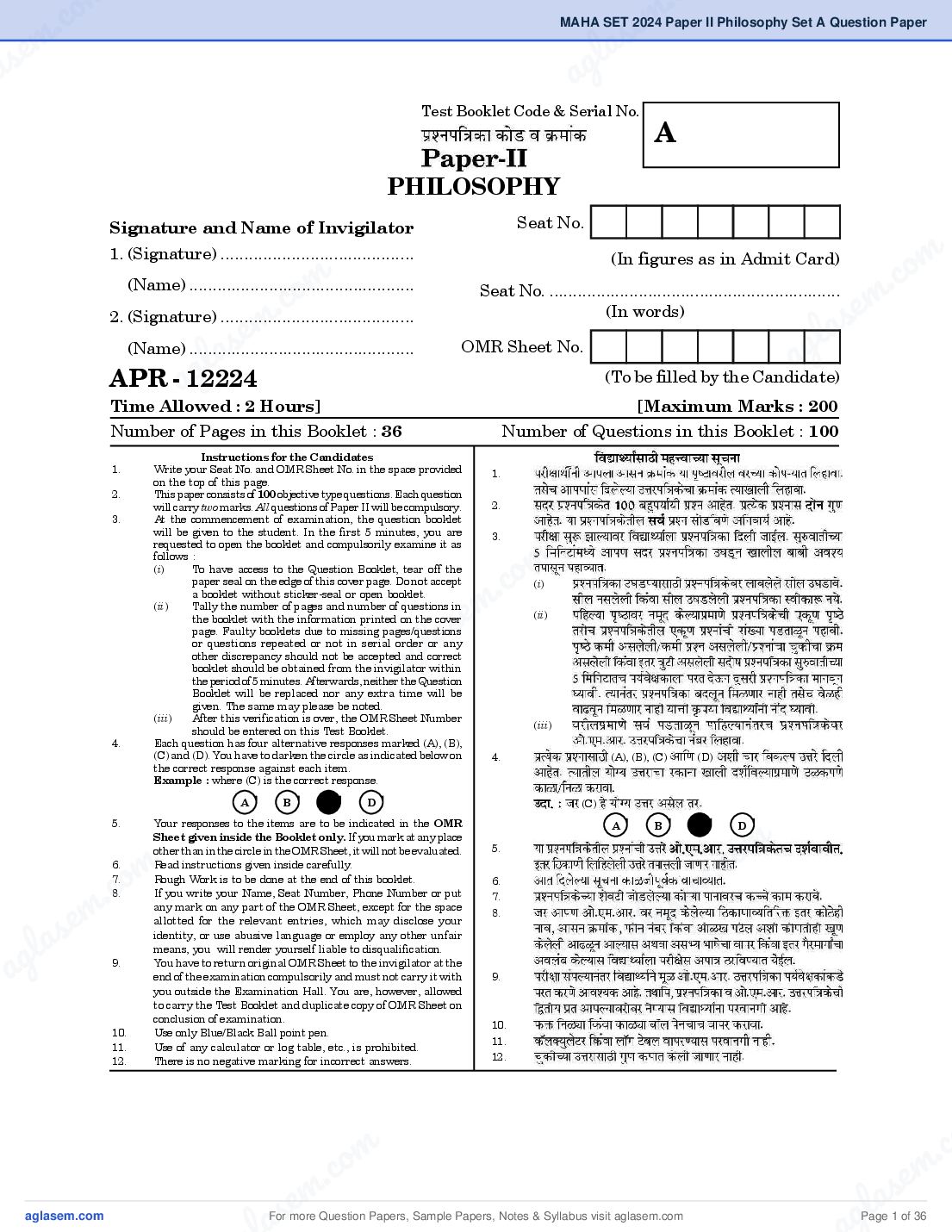
Test Booklet Code & Serial No.
A
PHILOSOPHY
Signature and Name of Invigilator Seat No.
m
co
1. (Signature) ......................................... (In figures as in Admit Card)
c om
(Name) ................................................
. e
Seat No. ..............................................................
m .
em
2. (Signature) ......................................... (In words)
l as
l a s
(Name) ................................................ OMR Sheet No.
a g
APR -a12224g (To be filled by the Candidate)
Time Allowed : 2 Hours] [Maximum Marks : 200
Number of Pages in this Booklet : 36 Number of Questions in this Booklet : 100
Instructions for the Candidates
1. Write your Seat No. and OMR Sheet No. in the space provided 1.
on the top of this page.
2. This paper consists of 100 objective type questions. Each question
will carry two marks. All questions of Paper II will be compulsory. 2.
3. At the commencement of examination, the question booklet
will be given to the student. In the first 5 minutes, you are 3.
m
requested to open the booklet and compulsorily examine it as
.co
follows :
(i) To have access to the Question Booklet, tear off the
paper seal on the edge of this cover page. Do not accept (i)
a booklet without sticker-seal or open booklet.
e m
s
(ii) Tally the number of pages and number of questions in
a
the booklet with the information printed on the cover (ii)
l
page. Faulty booklets due to missing pages/questions
ag
or questions repeated or not in serial order or any
other discrepancy should not be accepted and correct
booklet should be obtained from the invigilator within
the period of 5 minutes. Afterwards, neither the Question
Booklet will be replaced nor any extra time will be
given. The same may please be noted.
(iii) After this verification is over, the OMR Sheet Number
(iii)
should be entered on this Test Booklet.
4. Each question has four alternative responses marked (A), (B),
(C) and (D). You have to darken the circle as indicated below on 4. (A), (B), (C) (D)
the correct response against each item.
Example : where (C) is the correct response.
A B D (C)
5. Your responses to the items are to be indicated in the OMR
m
A B D
.co
Sheet given inside the Booklet only. If you mark at any place
5.
m
other than in the circle in the OMR Sheet, it will not be evaluated.
.co
6. Read instructions given inside carefully.
7. Rough Work is to be done at the end of this booklet. 6.
e m
m s
8. If you write your Name, Seat Number, Phone Number or put 7.
e la
any mark on any part of the OMR Sheet, except for the space
s
8.
g
allotted for the relevant entries, which may disclose your
la a
identity, or use abusive language or employ any other unfair
ag 9.
means, you will render yourself liable to disqualification.
You have to return original OMR Sheet to the invigilator at the
end of the examination compulsorily and must not carry it with 9.
you outside the Examination Hall. You are, however, allowed
to carry the Test Booklet and duplicate copy of OMR Sheet on
conclusion of examination.
10.
10. Use only Blue/Black Ball point pen.
11.
11. Use of any calculator or log table, etc., is prohibited.
12. There is no negative marking for incorrect answers. 12.
m . c
c. o s e m
s em
For more Question Papers, Sample Papers, Notes & Syllabus visit
gl a
Page 1 of 36
Page 3
For more Question Papers, Sample Papers, Notes & Syllabus visit Page 2 of 36
Page 4
.co s e m
s em l a
a ag
Philosophy
o m
m II
. c
Time Allowed : 120
co Hundred (100) multiple choice questions. Each question sem
Note : This paper .contains
Minutes] [Maximum Marks : 200
s emTwo (2) All
g l a
g la (100) a (2)
a
1. Match the pairs : 1.
Name of the system
(i) ˆ
Sankhya (i)
(ii) Vedanta
(ii)
m
c. o (iii)
(iii) Nyaya
(iv) Purvmimamsa
e m
Name of the founder/ as
(iv)
g l
Sutrakara a
(a)
(a) Jaimini
(b) Kapila (b)
(c) Badarayana (c)
(d) Aksapada (d)
Choose the correct option :
o m
m . c
m .co (i) (ii) (iii) (iv) (i) (ii) (iii) m
e
s (a)
(iv)
s e a
(A) (b) (c) l(d)
la ag
(A) (b) (c) (d) (a)
ag (B) (c) (b) (d) (a) (B) (c) (b) (d) (a)
(C) (b) (d) (c) (a) (C) (b) (d) (c) (a)
(D) (b) (a) (d) (c)
(D) (b) (a) (d) (c)
3 [P.T.O.
m . c
c. o s e m
s em
For more Question Papers, Sample Papers, Notes & Syllabus visit
gl a
Page 3 of 36
Page 5
granted three boons to Naciketas.
Naciketas did not ask the following
boon : (A)
(A) Let Gautama be pleased in
mind and forget his anger
against Naciketas (B)
(B) The fire by which heaven is
gained should be known to
(C)
Naciketas
(C) Naciketas should live as many
years as he chooses and attain
(D)
heaven after death
(D) Some say the soul exists after
death of a man; others say it
does not exist. Naciketas should
like to know this as instructed
by Yama
3. According to the revised view of 3.
Carvakas soul is identical with :
(A) four gross elements (A)
(B) body (B)
(C) body qualified by consciousness (C)
(D) sense organs (D)
4. Following systems do not accept 4.
Verbal Testimony as an
independent :
(A)
(A) Carvaka , Buddhism, Jainism
(B) Carvaka , Buddhism, (B)
(C) Carvaka , , Nyaya (C)
(D) Carvaka , Buddhism, (D)
4
For more Question Papers, Sample Papers, Notes & Syllabus visit Page 4 of 36
Page 6
.co s e m
s em l a
a ag
5. What can be the examples of five- 5.
sensed mobile J ivas according to
Jainism ?
m
co
(A)
(A) Microorganisms
. c om (B)
e m .
(B) Ants
e m l as
as
l beings
(C) Worms
(C)
ag
ag
(D) Human (D)
6. Match the pairs : 6.
Four causal categories
(1) Only creator, not created
(1)
(2) Creator as well as created
(2)
(3) Only created
m
c. o
(3)
(4) Neither creator nor created
Sankhya principles which
e m (4)
come under it
l as
(a) ag (a)
(b) Class of 16 : Five gross elements,
(b)
five senses, five motor organs
and manas
(c) Class of 7 : Buddhi, Ahamkara (c)
and five Tanmatras (d)
m
.co
(d) Mulaprakrti
m
c. o Choose from the following options : (1)
s
(2)em(4)(3)
e m (1) (2) (3) (4) a
(A) (b) (c) gl(d) (a)
las a
ag (A) (b)
(B) (a)
(c)
(c)
(d) (a)
(b) (d) (B) (a) (c) (b) (d)
(C) (c) (d) (b) (a) (C) (c) (d) (b) (a)
(D) (d) (c) (b) (a) (D) (d) (c) (b) (a)
5 [P.T.O.
m . c
c. o s e m
s em
For more Question Papers, Sample Papers, Notes & Syllabus visit
gl a
Page 5 of 36
Page 7
Cittavrttis the following is not
included by Patanjali : (A)
(A) (B)
(B) Svapna
(C)
(C) Smrti
(D)
(D) Nidra
8. According to Nyaya , Tarka is : 8.
(A) An independent (A)
(B) Reducible to inference (B)
(C) Hypothetical reasoning used for (C)
confirming
(D) Method of refutation (D)
9. Consider the following statements 9.
about the theory of atom
( ) :
(i)
(i) An atom has circular shape
(ii)
(ii) Atoms of all Mahabhutas have
the same qualities
(iii) There are three atoms in one (iii)
(iv)
(iv) Atoms and cannot be
seen by ordinary perception
Choose among the following
options : (A) (i) (iv)
(A) (i) and (iv) are true
(B) (i) (ii)
(B) (i) and (ii) are true
(C) (ii) (iii)
(C) (ii) and (iii) are true
(D) All the statements are true (D)
6
For more Question Papers, Sample Papers, Notes & Syllabus visit Page 6 of 36
Page 8
.co s e m
s em l a
a ag
10. Prabhakara’s view about the 10.
relation between word-meaning and
m
om
sentence-meaning is known as : . co
. c e m
e m
(A) Anvitabhidhanavada (A)
l as
as ag
(B) gl (B)
a
(C) Apohavada (C)
(D) Abhihitanvayavada (D)
11. The opposite that is not included in 11.
the list of 10 opposites stated by
m
Pythogoras is : c. o (A)
e m
(A) Limited and Unlimited
l as
(B) Odd and Even ag (B)
(C)
(C) Right and Left
(D)
(D) Right and Wrong
12. According to Socrates knowledge is 12.
m
m .co
acquired through :
c. o (A) Perception s e m
e m (A)
la
las ag
g (B) Faith (B)
a (C) Both perception and concepts (C)
(D) Concepts (D)
7 [P.T.O.
m . c
c. o s e m
s em
For more Question Papers, Sample Papers, Notes & Syllabus visit
gl a
Page 7 of 36
Page 9
from ignorance to enlightenment.
(A) Parable of the Good (A)
(B) Simile of the sun (B)
(C) Allegory of the cave (C)
(D) Apology (D)
14. ‘‘Universals are not independent 14.
entities. They exist in particular
objects rather than in a separate
realm’’, is the view of :
(A) Plato (A)
(B) Aristotle (B)
(C) Hegel (C)
(D) Heraclitus (D)
15. ‘‘I know that I am, I also know that 15.
I know. And when I love both to be
and to know, then I add to things
I know a third and equally important
knowledge. The fact that I love.’’ This
is stated in ‘‘City of God’’ by ........
(A) St. Augustine (A)
(B) Descartes (B)
(C) St. Anselm (C)
(D) Thales (D)
8
For more Question Papers, Sample Papers, Notes & Syllabus visit Page 8 of 36
Page 10
.co s e m
s em l a
a ag
16. Which of the following is applicable 16.
to Descartes ?
m
co
(A)
om .
(A) ‘‘It doubt’’ cannot be doubted
. c e m
e m
(B) ‘‘I doubt’’ can be doubted
(B)
l as
a s
(C) ‘‘Il doubt’’ can be doubted ag
g
asometimes (C)
(D)
(D) ‘‘I exist therefore God exists’’
17. According to Leibnitz, the necessary 17.
and eternal truths are known
m
c. o (A)
by :
e m
(A) Sensation
l as (B)
(B) Intuition
ag (C)
(C) Mystic experience (D)
(D) Reason 18.
18. Berkeley said his house continued
to exist even when he wasn’t
m
.co
perceiving it, because :
m
c. o (A) The substance does not depend (A)
s e m
e m la
las on the properties
(B)
ag
ag (B) He was thinking of it
(C)
(C) God perceived it
(D)
(D) The house was invisible
9 [P.T.O.
m . c
c. o s e m
s em
For more Question Papers, Sample Papers, Notes & Syllabus visit
gl a
Page 9 of 36
Page 11
fundamental difference between
impressions and ideas is :
(A)
(A) Impressions are innate, ideas
are not (B)
(B) Impressions are real and ideas
are imagination (C)
(C) Ideas are more vivid and
forceful than impressions
(D)
(D) Impressions are more vivid and
forceful than ideas
20. According to Kant ............ is not an 20.
empirical concept from sense
experience.
(A)
(A) Space
(B)
(B) Colour
(C)
(C) Taste
(D) Material objects (D)
21. The concept of Svadharma is like : 21.
(A) Mill’s utlitarianism (A)
(B) Kant’s deontological ethics (B)
(C) Bradley’s idea of ‘‘My station (C)
and its duties’’
(D) Bentham’s Hedonism (D)
10
For more Question Papers, Sample Papers, Notes & Syllabus visit Page 10 of 36
Page 12
.co s e m
s em l a
a ag
22. In Indian ethics purity of means is 22.
insisted by :
m
co
(A) K. C. Bhattacharya (A)
(B) M. N. Roy om m .
. c (B)
s e
s em
(C) J. Krishnamurti (C)
g l a
g la Gandhi a
a the
(D) Mahatma (D)
23. In Bhagavadg ita , 23.
Sthitaprajna is said to be like :
(A) Tortoise and ocean (A)
(B) Tortoise and cow (B)
(C)
m
(C) Ocean and stream
(D) Tortoise, cow and ocean c. o (D)
e m24.
as
24. The concept of ‘ Rta ’ is closely
related to the concept of : gl
a (A)
(A) Dhyana
(B) Samadhi (B)
(C) Satya (C)
(D) Asteya (D)
25. The concept of Brahmaviharas as 25.
m
m
c. o (A) Yoga as well as Buddhism
Maitri, etc. is stated in :
m.co
m s e
e la
(A)
las (B) Yoga as well as Carvaka
ag
ag philosophy
(B)
(C)
(C) Carvaka philosophy
(D)
(D) Bhagavadg ita
11 [P.T.O.
m . c
c. o s e m
s em
For more Question Papers, Sample Papers, Notes & Syllabus visit
gl a
Page 11 of 36
Page 13
Yoga and Sadhana is :
(A) eightfold (A)
(B) as we wish (B)
(C) God’s wish (C)
(D) accidental (D)
27. Jainism maintains that the goal of 27.
life is :
(A)
(A) Dharma
(B)
(B) Artha
(C)
(C) Kama
(D)
(D) Moksa
28. Kama is the fruit of : 28.
(A) Artha and Dharma (A)
(B) Artha and Moksa (B)
(C) Dharma and Moksa (C)
(D) Dharma, Artha and Moksa (D)
12
For more Question Papers, Sample Papers, Notes & Syllabus visit Page 12 of 36
Page 14
.co s e m
s em l a
a ag
29. Match the pairs : 29.
List I I
m
(a)
m
Yajnavalkya (a)
. co
c. o
(b) Lord Krsna (b)
s e m
(c) Yama em l a
l as (c)
ag
(d) g
aUddalaka (d)
List II II
(i) Nachiketa (i)
(ii) Garg i
(ii)
(iii)
(iii)
(iv) Arjuna
m
c. o (iv)
(a) (b) (c) (d)
e m (a) (b) (c) (d)
(A) (ii) (iv) (iii) (i)
l as
ag
(A) (ii) (iv) (iii) (i)
(B) (ii) (iv) (i) (iii) (B) (ii) (iv) (i) (iii)
(C) (ii) (i) (iv) (iii) (C) (ii) (i) (iv) (iii)
(D) (i) (iv) (iii) (ii) (D) (i) (iv) (iii) (ii)
30. Which hedonistic dimension gets 30.
m
highlighted by a dictum ‘‘Pigeon of
m
c. o tomorrow’’ ?
today is better than a peacock of
m .co
m s e
e la
(A)
las (A) Fecundity
ag
ag (B) Propinquity
(B)
(C)
(C) Certainty
(D)
(D) Purity
13 [P.T.O.
m . c
c. o s e m
s em
For more Question Papers, Sample Papers, Notes & Syllabus visit
gl a
Page 13 of 36
Page 15
(A) ‘Rare’
(A)
(B) ‘Retina’
(B)
(C) ‘Rain’
(C)
(D) ‘Rectus’ (D)
32. Reformative theory of punishment 32.
is also known as ................. theory.
(A) Preventive (A)
(B) Logical (B)
(C) Educative (C)
(D) Philosophical (D)
33. Which, among the following 33.
philosophers, is not moral definist
philosopher ?
(A)
(A) Mill
(B)
(B) Bentham
(C)
(C) Moore
(D) Spencer (D)
34. Which of the following are types of 34.
Deontological theories ?
(A) Moral and non-moral
(A)
(B) Philosophical and non-
philosophical (B)
(C) Act-deontological and rule-
(C)
deontological
(D) Traditional and modern (D)
14
For more Question Papers, Sample Papers, Notes & Syllabus visit Page 14 of 36
Page 16
.co s e m
s em l a
a ag
35. Whom according to the following 35.
thinkers, ‘‘the study of what is right
m
co
or good in conduct is Ethics’’ ?
(A) Mackenzie om .
. c (A)
e m
em (B)
l as
s
(B) Muirhead
la James ag
g
(C) William
a
(C)
(D) Sidgwick (D)
36. The principle of ‘‘Tit for Tat’’ is 36.
included in ..............
(A) The Deterrent theory (A)
(B) The Reformative theory (B)
m
(C) The Retributive theory
c. o (C)
e m (D)
(D) The Naturalist theory
l as
a g
37. ‘‘It is worse for a man to do wrong 37.
than to suffer wrong’’ is a statement
by .......................
(A) Socrates (A)
(B) Plato (B)
(C) Aristotle (C)
m
m (D) Anselm (D)
.co
m .co
38. Bentham’s Hedonism is ............. . 38.
s e m
s e g la
la a
(A) Quantitative (A)
ag (B) Qualitative (B)
(C) Cognitive (C)
(D) Rational
(D)
15 [P.T.O.
m . c
c. o s e m
s em
For more Question Papers, Sample Papers, Notes & Syllabus visit
gl a
Page 15 of 36
Page 17
List-II of philosophical work done by II
them and mark the correct code :
I
List I
(i)
(i) G. E. Moore
(ii) A. J. Ayer (ii)
(iii) C. L. Stevenson (iii)
(iv) R. M. Hare (iv)
List II II
(a) Language of Morals (a)
(b) Principia Ethica (b)
(c) Ethics and Language (c)
(d) Language, Truth and Logic (d)
Codes :
(i) (ii) (iii) (iv) (i) (ii) (iii) (iv)
(A) (d) (c) (b) (a) (A) (d) (c) (b) (a)
(B) (d) (b) (a) (c) (B) (d) (b) (a) (c)
(C) (b) (d) (c) (a) (C) (b) (d) (c) (a)
(D) (c) (d) (a) (b) (D) (c) (d) (a) (b)
40. Prescriptivism as a metaethical 40.
theory is propounded by :
(A) Moore (A)
(B) Ayer (B)
(C) Stevenson (C)
(D)
(D) Hare
16
For more Question Papers, Sample Papers, Notes & Syllabus visit Page 16 of 36
Page 18
.co s e m
s em l a
a ag
41. J. Krishnamurti highlights human : 41.
(A) Sensitivity, Novelty, Creativity (A)
m
(B) Subjectivity
m
as well as
. co
objectivity co m
(B)
m . s e
s e (C)
g l a
g l a
(C) Rationality
a
a
(D) Rationality and objectivity (D)
42. According to Vivekananda, Maya is 42.
a convenient name for the fact of :
(A) Negation (A)
(B) Contradiction (B)
(C) Conjunction
o m
(C)
m (D) .c
(D) Separation
e
s 43.
l a
ag
43. Both Iqbal and Radhakrishnan
attempted to reform :
(A) Religions (A)
(B) Regions (B)
(C) Sciences (C)
(D) Languages (D)
m
m
44. According to K. C. Bhattacharya,
c. o philosophical judgements are :
44.
m.co
m s e
s e g la
la a
(A) Literal (A)
ag (B) Symbolic (B)
(C) Partial (C)
(D) Uncertain (D)
17 [P.T.O.
m . c
c. o s e m
s em
For more Question Papers, Sample Papers, Notes & Syllabus visit
gl a
Page 17 of 36
Page 19
List I
(a) Mahatma Gandhi (a)
(b) K. C. Bhattacharya (b)
(c) Iqbal (c)
(d) J. Krishnamurti (d)
List II
(i) I am the creative truth (i)
(ii) Truth is God
(ii)
(iii) Truth is a pathless land
(iii)
(iv) Truth is absolute as known
(iv)
(a) (b) (c) (d)
(a) (b) (c) (d)
(A) (iv) (i) (ii) (iii) (A) (iv) (i) (ii) (iii)
(B) (ii) (i) (iv) (iii) (B) (ii) (i) (iv) (iii)
(C) (ii) (iv) (iii) (i) (C) (ii) (iv) (iii) (i)
(D) (ii) (iv) (i) (iii) (D) (ii) (iv) (i) (iii)
46. In his book ‘‘Brahmananche Kasab’’ 46.
Jyotiba Phule exposed the issue of :
(A) Exploitation by the Priest class
(A)
(B) Exploitation by Rulers
(B)
(C) Exploitation by the British
(C)
(D) Exploitation by the traders (D)
18
For more Question Papers, Sample Papers, Notes & Syllabus visit Page 18 of 36
Page 20
.co s e m
s em l a
a ag
47. S. Radhakrishnan and Iqbal 47.
highlight the significance of :
m
co
(A) Theism and Atheism (A)
m .
c. o Intuition
(B) Intellect and (B)
s e m
s em and Agnosticism
(C) Scepticism (C)
g l a
g la (D) a
a
(D) Gnosticism and Agnosticism
48. What, according to Sree Narayan 48.
Guru, does Spirituality mean ?
(A) Service to Nation (A)
(B) Service to Weaker Section (B)
(C) Service to farmers (C)
m
(D) Service to mankind c. o (D)
e m49.
49. According to Gandhi, the ultimate
l as
aim of Satyagraha is :
a g (A)
(A) Eradication of Bad Government
(B)
(B) Eradication of Evil tendencies
(C) Eradication of Bad person (C)
(D) Eradication of enemies (D)
50. Jyotiba Phule was greatly 50.
m
minfluenced by Thomas Paine’s idea
c. o of : m.co
m s e
e la
(A)
las (A) Rights of women
ag
ag (B) Rights of farmers
(B)
(C)
(C) Rights of untouchables
(D) Rights of man (D)
19 [P.T.O.
m . c
c. o s e m
s em
For more Question Papers, Sample Papers, Notes & Syllabus visit
gl a
Page 19 of 36
Page 21
sentence is the :
(A) Object it denotes (A)
(B) Truth-value it bears (B)
(C) Thought it expresses (C)
(D) True object (D)
52. In Moore’s view, which among the 52.
following statements is the most
basic proposition ?
(A)
(A) Material substance exists
(B)
(B) Mental substance exists
(C)
(C) God exists
(D) Body exists (D)
53. Wittgenstein in his Philosophical 53.
Investigation shows the apparent
uniformity of words with the
example of :
(A)
(A) Tool box
(B)
(B) Locomotive engine
(C)
(C) Five red apples
(D) Pictorial model (D)
54. According to Ayer, the nature of 54.
knowledge is :
(A)
(A) A unique mental state
(B)
(B) Dispositional
(C)
(C) Verbal
(D) Intuitional (D)
20
For more Question Papers, Sample Papers, Notes & Syllabus visit Page 20 of 36
Page 22
.co s e m
s em l a
a ag
55. Which of the following specific views 55.
is problematic according to Quine ?
m
(A) Each statement
m
can be
. co
c. o disconfirmed in
(A)
confirmed or
e m
em l as
s
isolation
la statement cannot be ag
g
aconfirmed or disconfirmed in
(B) Each (B)
isolation
(C)
(C) Truth value of empirical
statements can be redistributed
(D) Empiricism is not a consistent (D)
m
.co
view with the theory of meaning.
e m56.
56. Husserl’s aim was to discover the
l as
ag
foundations of .................... through
Phenomenology.
(A)
(A) Mathematics
(B)
(B) Logic
(C)
(C) Knowledge and Experience
(D) Metaphysics (D)
m
m
c. o is :
57. According to Heidegger, the Dasein 57.
m.co
m s e
e la
(A)
las (A) Philosophical subject
ag
ag (B) Existing Being
(B)
(C)
(C) Phenomenological self
(D)
(D) Subjective being
21 [P.T.O.
m . c
c. o s e m
s em
For more Question Papers, Sample Papers, Notes & Syllabus visit
gl a
Page 21 of 36
Page 23
(A) Unconscious lie (A)
(B) Conscious lie (B)
(C) Spoken lie (C)
(D) Censored lie (D)
59. William James’ theory of truth 59.
suggests that a proposition is true
if it can be :
(A)
(A) Verified
(B)
(B) Assimilated and validated
(C) Corroborated and verified (C)
(D) Assimilated, validated, (D)
Corroborated and verified
60. Nietzsche’s approach to modern 60.
western philosophy provokes him to
claim that :
(A) World is nothing but appearance
(A)
(B) The real world is ‘the only truth’
(B)
(C) The ‘real’ world is a lie
(C)
(D) World is both appearance and
reality (D)
61. The two administrative pillars in the 61.
constituents of state according to
Kautilya are :
(A)
(A) Swami and Purohita
(B)
(B) Swami and Amatya
(C)
(C) Amatya and Adhikari
(D) Swami and Adhikari (D)
22
For more Question Papers, Sample Papers, Notes & Syllabus visit Page 22 of 36
Page 24
.co s e m
s em l a
a ag
62. The state policy articulated by
62.
Kautilya is based on :
m
co
(A) Acquisition of new dominion
only
. c om e m .
em of own dominion
(A)
l as
s
(B) Preservation
la ag
g
only (B)
(C) aAcquisition and preservation of
dominion (C)
(D) Warfare for increasing the
(D)
treasury
63. The theoretical roots of Sarvodaya 63.
m
c. o (A)
can be traced back to :
(A) the Vedic and Vedantic thought
e m
(B) the Puranas
l as (B)
(C) the Manusmriti ag (C)
(D) the Arthashastra (D)
64. According to Kautilya, the four-fold 64.
source of the State law contains :
(A) Dharma, Vyavahara, Samstha
m
.co
and Nyaya
m
c. o (B) Swami, Vyavahara, Samstha (A)
s e m
e m la
s
and Nyaya
la
(B)
ag
ag (C) Ishwara, Vyavahara, Samstha
and Nyaya (C)
(D) Paurajana, Vyavahara, Samstha
(D)
and Nyaya
23 [P.T.O.
m . c
c. o s e m
s em
For more Question Papers, Sample Papers, Notes & Syllabus visit
gl a
Page 23 of 36
Page 25
conception of it, is opposed to which
one of the following ?
(A) Mill-made cloth (A)
(B) Traditional techniques (B)
(C) Manufacturing machines in the
(C)
country
(D) Labor saving machines (D)
66. According to both Arthashastra and 66.
Mahabharata, the activity of the
state is related to human life with
respect to :
(A) Social, economic and religious (A)
aspects (B)
(B) Social and economic aspects
(C)
(C) Social and religious aspects
(D) Only legal aspect (D)
67. According to Gandhi, which of the 67.
following is not an assumption
underlying the doctrine of
satyagraha ? (A)
(A) It begins and ends with civil
disobedience
(B) It requires rendering heart (B)
discipline to the commander
(C) It requires being prepared to
lose everything that one may (C)
possess, including life
(D) Tapascharya is the essence of
satyagraha (D)
24
For more Question Papers, Sample Papers, Notes & Syllabus visit Page 24 of 36
Page 26
.co s e m
s em l a
a ag
68. Bhishma declares a king to be a 68.
maker of his epoch through :
m
co
(A) His descend from Divine origin
(B) His supremeom .
(A)
. c social hierarchy
e m
(C) Degreem
e of fulfillment of his (B)
l as
l as
functions ag
g
(D) aDegree of his application of
(C)
dandaniti (D)
69. In the state policy of Bhishma, there 69.
is focus on : (A)
(A) Rajadharma and Dandaniti
(B)
(B) Rajadharma and Nitidharma
m
(C) Dandaniti and Nitidharma c. o (C)
e m (D)
a
(D) Rajadharma and Yuddhashastra
l s
a g
70. According to Kautilya, the essence 70.
of governance is :
(A)
(A) Kosha
(B)
(B) Danda
(C)
(C) Swami
(D) Mitra (D)
m
.co
71.
m
71. In The Republic, Socrates, tells
c. o .................. that justice is the same s e m
e m la
las for both individual and state.
(A)
ag
ag (A) Glaucon
(B)
(B) Cephalus
(C)
(C) Adeimantus
(D)
(D) Polemarchus
25 [P.T.O.
m . c
c. o s e m
s em
For more Question Papers, Sample Papers, Notes & Syllabus visit
gl a
Page 25 of 36
Page 27
reason for war in the Hobbesian
state of nature ?
(A)
(A) Competition for same goods
(B)
(B) Calamities
(C) Fear of God (C)
(D) Lack of Natural law (D)
73. Dialectical movement is the 73.
coexistence of two ................. sides.
(A) Parallel (A)
(B) Classes (B)
(C) Complimentary (C)
(D) Contradictory (D)
74. In the essay, ‘‘What is Equality 74.
Part-II : Equality of Resources’’,
Ronald Dworkin considers :
(A) The claims of equality and
(A)
welfare
(B) The claims of treating people as (B)
equaly
(C) The competing claims and
(C)
equality of resources
(D) The claim of equality and
resources (D)
26
For more Question Papers, Sample Papers, Notes & Syllabus visit Page 26 of 36
Page 28
.co s e m
s em l a
a ag
75. According to Amartya Sen, a theory 75.
of justice has to accommodate :
m
om . co
m
(A) Homogenous virtues
c
(A)
m . s e
(B) Social eunity
s (B)
g l a
g la of reasons a
a
(C) Plurality (C)
(D) Ambiguity of morality (D)
76. According to Marx, in capitalist 76.
societies, labor is expropriated and
m
transmuted into :
c. o (A)
(A) Exchange value
e m
l as
ag
(B) Value (B)
(C) Work (C)
(D) Industrialization (D)
77. The charge of misogyny against 77.
Aristotle is based on his view that
m
mwomen lack :
c. o (A) Authority m.co
m (A)
s e
s e g la
g la (B) Emotion (B) a
a (C)
(C) Sincerity
(D) Reason (D)
27 [P.T.O.
m . c
c. o s e m
s em
For more Question Papers, Sample Papers, Notes & Syllabus visit
gl a
Page 27 of 36
Page 29
‘‘gender’’ has the following two
cannotations :
(A)
(A) Physiological and biological
(B)
(B) Male and female
(C) Sexual and asexual (C)
(D) Cultural and psychological (D)
79. According to Charles Taylor, we 79.
have a continuing politics of equal
recognition on the ................... .
(A) Private plane (A)
(B) Social plane (B)
(C) Political plane (C)
(D) Cultural plane (D)
80. Which of the following is considered 80.
as Isaiah Berlin’s influential essay
of twentieth century political
philosophy ?
(A)
(A) Two Concepts of Liberty
(B)
(B) Equality, Value and Merit
(C)
(C) Justice and the Good
(D) Theories of Justice (D)
28
For more Question Papers, Sample Papers, Notes & Syllabus visit Page 28 of 36
Page 30
.co s e m
s em l a
a ag
81. An argument in which a universal 81.
conclusion is derived from particular
premises is called :
m
co
(A)
om .
(A) Valid deductive argument
. c (B)
e m
e m
(B) Good inductive argument
l as
as
(C) Deductive argument
l
(C)
ag
ag
(D) Inductive argument (D)
82. Which among the following is not 82.
a law of thought ?
(A)
(A) Law of Identity
(B)
(B) Law of Non-contradiction
(C)
(C) Law of Excluded middle
o m
(D)
.c
(D) Law of Uniformity of Nature
83. ‘Many fruits are sweet’ is an example
e m83.
of :
l as
a g
(A) Universal affirmative proposition
(A)
(B)
(B) Universal negative proposition
(C) Particular affirmative proposition (C)
(D) Particular negative proposition (D)
84. Two categorical propositions having 84.
the same subject and the same
m
.co
predicate are ............., if they cannot
m be true and cannot both be false
c. o both s e m
e m are called .................
la
las (A) Contradictory (A)
ag
ag (B) Contrary (B)
(C) Sub-contrary (C)
(D) Subalternation (D)
29 [P.T.O.
m . c
c. o s e m
s em
For more Question Papers, Sample Papers, Notes & Syllabus visit
gl a
Page 29 of 36
Page 31
term that must be distributed at
least once is the premises is :
(A) Major term (A)
(B) Minor term (B)
(C) Middle term (C)
(D) Quantifier (D)
86. Recognized the rule expressed by
86.
the following statement-form :
p q q p
p q q p
(A)
(A) Exportation
(B)
(B) Association
(C) Transposition (C)
(D) Distribution (D)
87. If a contradictory is denied resulting 87.
propositional form is :
(A) Contradictory (A)
(B) Tautology (B)
(C) Contingent (C)
(D) Probable (D)
30
For more Question Papers, Sample Papers, Notes & Syllabus visit Page 30 of 36
Page 32
.co s e m
s em l a
a ag
88. Match List I and List II and select 88. I II
the correct answer from the codes
m
given below :
om . co
. c I
e m
e m
List I
l as
l as
(a) Rule of Universal Instantiation (a)
ag
ag
(UI)
(b)
(b) Rule of Universal Generalization
(UG) (c)
(c) Rule of Existential Instantiation
(d)
(EI)
om
II
(d) Rule of Existential Generalization
. c (i) (x) ( x)
m
(EG) v
s e
l a (ii) ( x) ( x) a
ag
List II
(iii) v ( x) ( x)
(i) (x) ( x) v
(ii) ( x) ( x) (iv) y (x) ( x)
a
(iii) v ( x) ( x)
(iv) y (x) ( x)
Codes : (a) (b) (c) (d)
m
m
c. o (A) (i) (iii) (iv) (ii)
(a) (b) (c) (d) (A) (i) (iii) (iv) (ii) .co
m s em
s e a (i)
(B) (iv) (ii) l(iii)
g
g la (B) (iv) (ii) (iii) (i) a
a (C) (i) (ii) (iii) (iv)
(C) (i) (ii) (iii) (iv)
(D) (i) (iv) (ii) (iii) (D) (i) (iv) (ii) (iii)
31 [P.T.O.
m . c
c. o s e m
s em
For more Question Papers, Sample Papers, Notes & Syllabus visit
gl a
Page 31 of 36
Page 33
theorems, if it is impossible to derive
both a statement and its negation
then that axiomatic system is said
to be : (A)
(A) Independent
(B)
(B) Consistent
(C)
(C) Complete
(D) Complex (D)
90. The fallacy committed in the 90.
following argument is .......... ‘‘water
extinguishes fire. Oxygen is a part
of water. Therefore oxygen will
extinguish fire.’’
(A)
(A) Fallacy of Division
(B) Fallacy of Composition (B)
(C) Argument ad Ignorantiam (C)
(D) Arguing in circle (D)
91. Which of the following statements 91.
best describes the nature of Applied
Ethics ?
(A) It attempts to answer how (A)
people should act in specific
situations (B)
(B) It is the direct application of
ethical theories regardless of
real-life circumstances (C)
(C) It raises fundamental questions
about the very nature of ethics
and ethical theories
(D) It attempts to understand and (D)
resolve moral problems that
arise in some domains of
practical life
32
For more Question Papers, Sample Papers, Notes & Syllabus visit Page 32 of 36
Page 34
.co s e m
s em l a
a ag
92. Which of the following cannot be an 92.
illustration of ‘technology’ ?
(A)
m
co
(A) Using sticks to consume foods
om
ca spear for fishing
(B) Making and using of tools
.
(B)
e m .
e
(C) Designingm (C)
l as
l as
(D) Processing of plastic recycling (D)
ag
ag
93. Democratization of technology refers 93.
to :
(A)
(A) Making technology free
(B) Making technology accessible (B)
(C) Making technological knowledge
(C)
free and accessible
m
(D) Making technological knowledge c. o (D)
e m
easy and accessible
l as
a g
94. Bioethics does not deal with issues 94.
in the domain of :
(A) Nursing (A)
(B) Healthcare (B)
(C) Veterinary (C)
(D) Personal hygiene (D)
m
.co
95. The Hippocratic Oath of the classical 95.
m
c. o Greece represents which of the
s e m
e m following approaches to bioethics ?
la
las (A) Scientific (A)
ag
ag (B) Clinical (B)
(C) Economic (C)
(D) Legal (D)
33 [P.T.O.
m . c
c. o s e m
s em
For more Question Papers, Sample Papers, Notes & Syllabus visit
gl a
Page 33 of 36
Page 35
conservative and liberal arguments
in the context of abortion ?
(A)
(A) They differ on the stages in
which abortion is permissible
(B) Their views on viability of the
(B)
fetus are different
(C) The former is based on the
(C)
humanness of the fetus and the
latter on capacities or lack of
capacities of the fetus
(D) The former is based on the
capacities or lack of capacities (D)
of the fetus and the latter is
based on the humanness of the
fetus
97. The ethical theory that moral 97.
obligations extends to all living
things is :
(A)
(A) Biocentrism
(B)
(B) Ecocentrism
(C)
(C) Anthropocentrism
(D) Psychocentrism (D)
34
For more Question Papers, Sample Papers, Notes & Syllabus visit Page 34 of 36
Page 36
.co s e m
s em l a
a ag
98. Withholding artificial life support 98.
such as a ventilator or feeding tube
m
at the patient’s request is an
m . co
illustration of :co m
m . s e
s evoluntary euthanasia (A)
g l a
a
(A) Active
gl voluntary euthanasia a
(B) aPassive (B)
(C) Active involuntary euthanasia (C)
(D) Passive involuntary euthanasia (D)
99. In the ethical sequence propounded 99.
by Aldo Leopold, land ethics falls
m
.co
under the :
e m
s
(A) First element (A)
l a
ag
(B) Second element (B)
(C) Third element (C)
(D) Primary element (D)
100. What is the primary goal of 100.
philosophical counseling ?
(A)
m
.co
(A) Diagnosing mental illnesses
m
c. o (B) Providing emotional support (B)
s e m
e m la
las (C) Applying philosophical (C)
ag
ag principles to address life issues
(D) Administering therapeutic
(D)
drugs
35 [P.T.O.
m . c
c. o s e m
s em
For more Question Papers, Sample Papers, Notes & Syllabus visit
gl a
Page 35 of 36
Page 37
36
For more Question Papers, Sample Papers, Notes & Syllabus visit Page 36 of 36
Document Details
| Board / Org | Maharashtra Exams |
| Exam | MAHA SET |
| Type | Question Paper |
| Pages | 36 |
| Updated | 17 Nov 2026 |