AMU Entrance Exam Syllabus for M.A. in Linguistics
Finished viewing? Save it for later —
Download AMU Entrance Exam Syllabus for M.A. in Linguistics (PDF · 4 pages)About AMU Entrance Exam Syllabus for M.A. in Linguistics
AMU Entrance Exam Syllabus for M.A. in Linguistics is available here for free download. Published by Default for Admission Tests, this syllabus can be viewed online or downloaded as a PDF (4 pages). Candidates preparing for Admission Tests can use AMU Entrance Exam Syllabus for M.A. in Linguistics to understand the exam pattern, the type of questions asked, and the overall difficulty level.
Frequently Asked Questions
How can I download AMU Entrance Exam Syllabus for M.A. in Linguistics?
Open this page and click the Download button to save AMU Entrance Exam Syllabus for M.A. in Linguistics as a PDF. It is completely free on AglaSem Docs.
Is AMU Entrance Exam Syllabus for M.A. in Linguistics free to download?
Yes. AMU Entrance Exam Syllabus for M.A. in Linguistics can be viewed online and downloaded as a PDF free of cost on AglaSem Docs.
How many pages does AMU Entrance Exam Syllabus for M.A. in Linguistics have?
AMU Entrance Exam Syllabus for M.A. in Linguistics contains 4 pages, which you can read online or download together as a single PDF.
Where can I find more Admission Tests study material?
You can find more Admission Tests question papers, sample papers, syllabus, and answer keys on AglaSem Docs.
AMU Entrance Exam Syllabus for M.A. in Linguistics – Text
Read the full text of this syllabus below — useful to quickly search, copy and reference the content online without downloading the PDF.
📄 View text version (4 pages)
Page 1
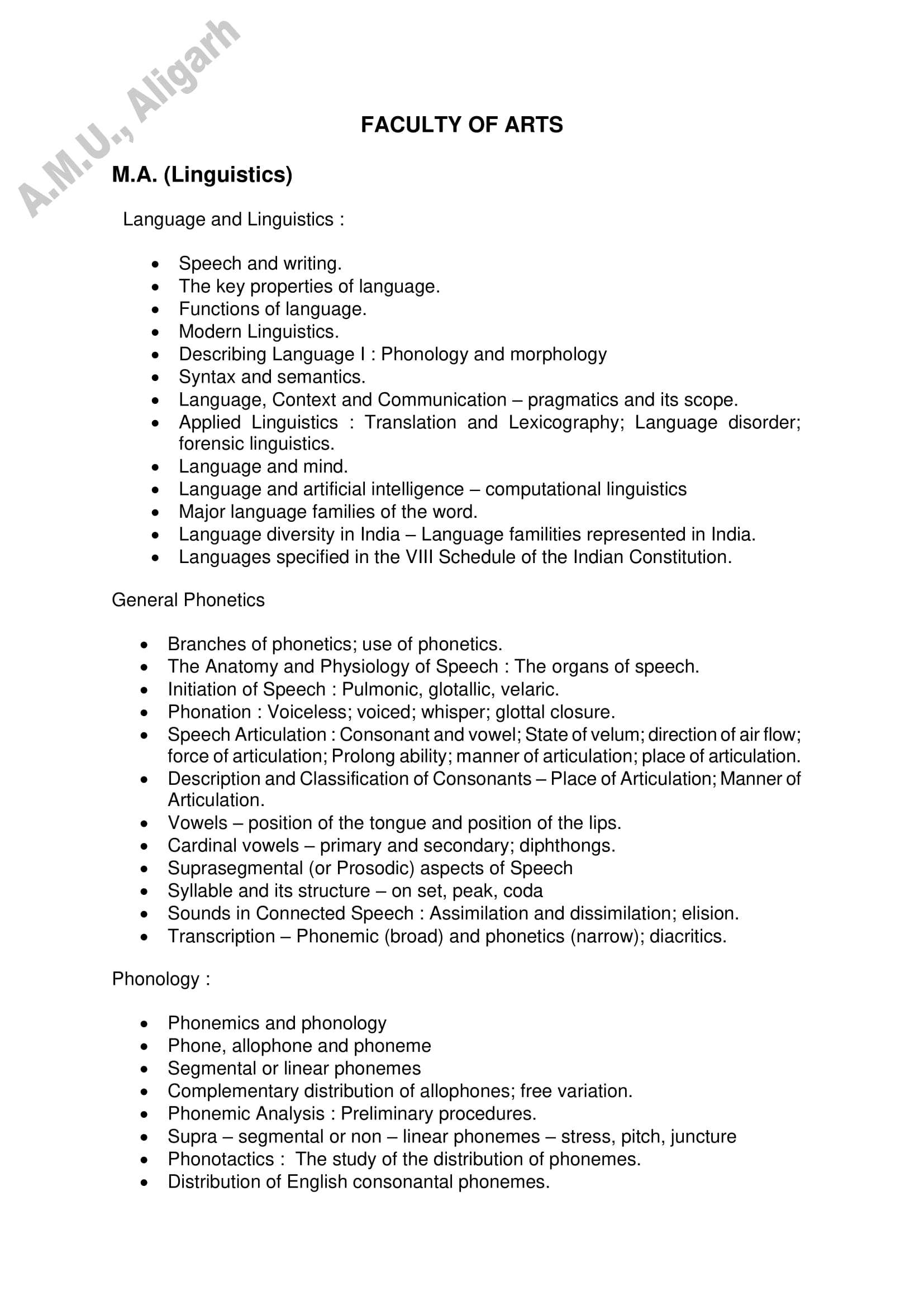
M.A. (Linguistics)
Language and Linguistics :
• Speech and writing.
• The key properties of language.
• Functions of language.
• Modern Linguistics.
• Describing Language I : Phonology and morphology
• Syntax and semantics.
• Language, Context and Communication – pragmatics and its scope.
• Applied Linguistics : Translation and Lexicography; Language disorder;
forensic linguistics.
• Language and mind.
• Language and artificial intelligence – computational linguistics
• Major language families of the word.
• Language diversity in India – Language familities represented in India.
• Languages specified in the VIII Schedule of the Indian Constitution.
General Phonetics
• Branches of phonetics; use of phonetics.
• The Anatomy and Physiology of Speech : The organs of speech.
• Initiation of Speech : Pulmonic, glotallic, velaric.
• Phonation : Voiceless; voiced; whisper; glottal closure.
• Speech Articulation : Consonant and vowel; State of velum; direction of air flow;
force of articulation; Prolong ability; manner of articulation; place of articulation.
• Description and Classification of Consonants – Place of Articulation; Manner of
Articulation.
• Vowels – position of the tongue and position of the lips.
• Cardinal vowels – primary and secondary; diphthongs.
• Suprasegmental (or Prosodic) aspects of Speech
• Syllable and its structure – on set, peak, coda
• Sounds in Connected Speech : Assimilation and dissimilation; elision.
• Transcription – Phonemic (broad) and phonetics (narrow); diacritics.
Phonology :
• Phonemics and phonology
• Phone, allophone and phoneme
• Segmental or linear phonemes
• Complementary distribution of allophones; free variation.
• Phonemic Analysis : Preliminary procedures.
• Supra – segmental or non – linear phonemes – stress, pitch, juncture
• Phonotactics : The study of the distribution of phonemes.
• Distribution of English consonantal phonemes.
Page 2
• English diphtongs – closing and centering.
• The theory of `distinctive features.
• The concept of `neutralization’ and `archiphoneme’
Introductory Morphology :
• Morphology – its definition and scope.
• Morph, allomorph and morpheme
• Morpheme and word
• Conditioning of allomorphs.
• Affixes – prefixes, suffixes and infixes.
• Base, root and stem.
• Inflection and derivation.
• Word formation – compounding
• Mophological Process : Affixation, internal change, reduplication, suppletion
and zero modification.
• Morphophonemics – the phonological structure of morphemes.
• Morphemic Analysis – Segmentation and grouping; Nida’s principles for
identification of morphemes.
• Identifying plural morphemes of English and Identifying past tense morphemes
of English.
Introductory Syntax :
• Syntax and morphology
• Modern approaches to syntax
• Constituent and construction
• Types of construction – endocentric and exocentric
• Immediate constituent analysis.
• Syntactic Devices : Coordination or conjoining, subordination or embedding,
substitution.
• Function words and content words :
• Grammatical categories and parts of speech.
• Models of Grammatical Description : Item and arrangement; item and process;
word and paradigm.
• Aims of grammer
• Levels of grammatical adequacy
• Phrase structure Grammar : Context free and context sensitive phrase structure
grammer.
• Introduction to transformational generative grammar.
Basic Elements of Semantics
• Semantics and its scope.
• Types of Meaning
• Componential Analysis
• Semantic Oppositions
Page 3
whole relations.
• Homonymy and Polysemy.
• Semantic Structure of Sentences : Arguments and predicates – predication
analysis.
• Selectional restrictions.
• Figurative use of language.
• Approaches to the study of meaning.
• Semantics and pragmatics.
Historical Linguistics :
• Historical linguistics – its definition and scope.
• Historical Linguistics versus descriptive linguistics.
• Genealogical classification of languages.
• Major language families of the world.
• Languages of the Indo-European family.
• Typological classification of language.
• Phonological change : Phonetic and phonemic change.
• Types of sound change – assimilation, dissimilation and some other types of
sound change.
• Types of semantic change – narrowing and widening of meaning.
• Analogical change.
• Borrowing I : Lexical and phonological
• Borrowing II : Cultural and intimate.
Language Teaching :
• Linguistics and language teaching – role of linguistics in language teaching.
• Principles of language teaching.
• Native and Foreign language teaching.
• Language skills.
• Methods of Language teaching.
• Selection, graduation and presentation of the teaching materials.
• Contrastive analysis.
• Contrasting languages at phonological, grammatical and lexical levels.
• Error Analysis : Mistakes, lapses and errors; transfer errors and analogical
errors.
• Stages in Error Analysis : Recognition, description and explanation of errors.
• Language Testing : Subjective and objective tests; types of objective tests;
open ended and multiple choice tests.
• Audio visual aids in language teaching.
• The language laboratory and language teaching.
Language and Literature
• Characteristics of the language of literature.
• Linguistics and critical approaches to the study of literature.
Page 4
• The Term `Style’ : Various senses and definitions of the term `style’ – linguistics
and non linguistics definitions of style.
• Style as the choice between alternative expressions.
• Style as deviation from the norm.
• Phonological Analysis of Poems.
• Stylistic Devices I : Alliteration, Consonance, assonance, rhyme.
• Stylistic Devices II : Foregrounding, parallelism, repletion, antithesis.
• Phonological and lexical cohesion.
Language and Society :
• The relationship of language and Society – Sociolinguistics and its scope.
• Alternative approaches to the social study of language.
• The concept of speech community; verbal repertoire.
• Language variation – describing the varieties of language.
• The social parameters of variation.
• Ethnography of communication; communicative competence.
• Language diversity – bilingualism and multilingualism.
• The concept of `diglossia’.
• Languages in contact – borrowing
• Pedgin and creole; code switching and code mixing.
• Language policy and language planning.
• Corpus and status planning.
• Language standization and modernization.
• Language diversity in India – issues and problems.
Document Details
| Board / Org | Default |
| Exam | Admission Tests |
| Type | Syllabus |
| Pages | 4 |
| Updated | 30 Apr 2026 |