aglasem.com
Schools Admission Mock Test Playground
ClassChoose class
StateSelect state

AMU Entrance Exam Syllabus for M.A. in Political Science, Public Administration and Human Rights
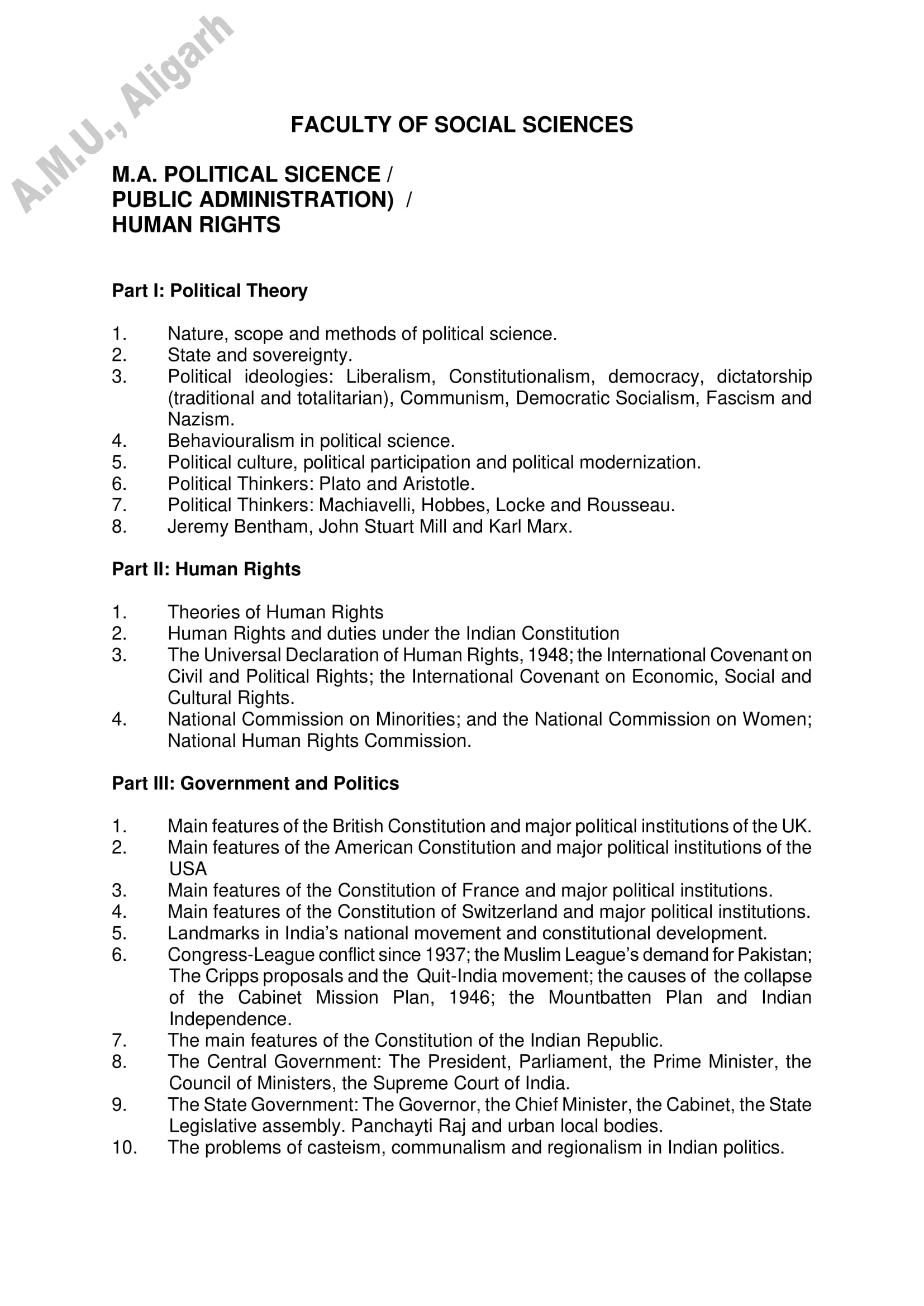
Aligarh Muslim University (AMU) Admission Test Syllabus is give here for M.A. in Political Science, Public Administration and Human Rights. You can also download AMU Entrance Syllabus PDF for M.A. in Political Science, Public Administration and Human Rights.
AMU Entrance Exam Syllabus for M.A. in Political Science, Public Administration and Human Rights - Page 1 of 2

About AMU Entrance Exam Syllabus for M.A. in Political Science, Public Administration and Human Rights

AMU Entrance Exam Syllabus for M.A. in Political Science, Public Administration and Human Rights is available here for free download. Published by Default for Admission Tests, this syllabus can be viewed online or downloaded as a PDF (2 pages). Candidates preparing for Admission Tests can use AMU Entrance Exam Syllabus for M.A. in Political Science, Public Administration and Human Rights to understand the exam pattern, the type of questions asked, and the overall difficulty level.

Frequently Asked Questions

How can I download AMU Entrance Exam Syllabus for M.A. in Political Science, Public Administration and Human Rights?

Open this page and click the Download button to save AMU Entrance Exam Syllabus for M.A. in Political Science, Public Administration and Human Rights as a PDF. It is completely free on AglaSem Docs.

Is AMU Entrance Exam Syllabus for M.A. in Political Science, Public Administration and Human Rights free to download?

Yes. AMU Entrance Exam Syllabus for M.A. in Political Science, Public Administration and Human Rights can be viewed online and downloaded as a PDF free of cost on AglaSem Docs.

How many pages does AMU Entrance Exam Syllabus for M.A. in Political Science, Public Administration and Human Rights have?

AMU Entrance Exam Syllabus for M.A. in Political Science, Public Administration and Human Rights contains 2 pages, which you can read online or download together as a single PDF.

Where can I find more Admission Tests study material?

You can find more Admission Tests question papers, sample papers, syllabus, and answer keys on AglaSem Docs.

AMU Entrance Exam Syllabus for M.A. in Political Science, Public Administration and Human Rights – Text

Read the full text of this syllabus below — useful to quickly search, copy and reference the content online without downloading the PDF.

📄 View text version (2 pages)

Page 1

FACULTY OF SOCIAL SCIENCES M.A. POLITICAL SICENCE / PUBLIC ADMINISTRATION) / HUMAN RIGHTS Part I: Political Theory 1. Nature, scope and methods of political science. 2. State and sovereignty. 3. Political ideologies: Liberalism, Constitutionalism, democracy, dictatorship (traditional and totalitarian), Communism, Democratic Socialism, Fascism and Nazism. 4. Behaviouralism in political science. 5. Political culture, political participation and political modernization. 6. Political Thinkers: Plato and Aristotle. 7. Political Thinkers: Machiavelli, Hobbes, Locke and Rousseau. 8. Jeremy Bentham, John Stuart Mill and Karl Marx. Part II: Human Rights 1. Theories of Human Rights 2. Human Rights and duties under the Indian Constitution 3. The Universal Declaration of Human Rights, 1948; the International Covenant on Civil and Political Rights; the International Covenant on Economic, Social and Cultural Rights. 4. National Commission on Minorities; and the National Commission on Women; National Human Rights Commission. Part III: Government and Politics 1. Main features of the British Constitution and major political institutions of the UK. 2. Main features of the American Constitution and major political institutions of the USA 3. Main features of the Constitution of France and major political institutions. 4. Main features of the Constitution of Switzerland and major political institutions. 5. Landmarks in India’s national movement and constitutional development. 6. Congress-League conflict since 1937; the Muslim League’s demand for Pakistan; The Cripps proposals and the Quit-India movement; the causes of the collapse of the Cabinet Mission Plan, 1946; the Mountbatten Plan and Indian Independence. 7. The main features of the Constitution of the Indian Republic. 8. The Central Government: The President, Parliament, the Prime Minister, the Council of Ministers, the Supreme Court of India. 9. The State Government: The Governor, the Chief Minister, the Cabinet, the State Legislative assembly. Panchayti Raj and urban local bodies. 10. The problems of casteism, communalism and regionalism in Indian politics.

Page 2

Part IV: Public Administration 1. Nature and scope of public administration; difference between private and public administration. 2. Main features and basic themes of New Public Administration. 3. Principles of bureaucratic organization; line, staff and auxiliary agencies. 4. Public services in India: All India, Central and State; the constitution and role of the Union Public Service Commission. 5. The problems of recruitment for public services in India. 6. The mechanisms of parliamentary control over public administration in India. 7. Judicial Control over pubic administration. 8. The budgetary process at the Central level. 9. Development planning at central, state and district levels. 10. The problem of corruption in public services. Part V: International Relations 1. Nature and scope of the study of International Relations. 2. International politics and foreign policy: main features. 3. International relations since 1945: The Cold War, Détente and post-Cold War phases. 4. Main features and current developments in the foreign policy of the USA. 5. Main features and current developments in the foreign policy of China. 6. Main features and current developments in the foreign policy of India. 7. Basic concepts of International Law (Peace). 8. Basic concepts of International Law (War). 9. The United Nations: The Charter, the Security Council, the General Assembly; International Court of Justice; the Specialized Agencies: The UNESCO, ILO, IBRD, IMF and WTO. 10. Regional Organizations: OAS, EU, ASEAN, SAARC and OIC.

Document Details

Board / OrgDefault
ExamAdmission Tests
TypeSyllabus
Pages2
Updated30 Apr 2026

More for Admission Tests

Answer Key 📄Question Paper 📘Syllabus