AMU Entrance Exam Syllabus for M.A. in Psychology
Finished viewing? Save it for later —
Download AMU Entrance Exam Syllabus for M.A. in Psychology (PDF · 3 pages)About AMU Entrance Exam Syllabus for M.A. in Psychology
AMU Entrance Exam Syllabus for M.A. in Psychology is available here for free download. Published by Default for Admission Tests, this syllabus can be viewed online or downloaded as a PDF (3 pages). Candidates preparing for Admission Tests can use AMU Entrance Exam Syllabus for M.A. in Psychology to understand the exam pattern, the type of questions asked, and the overall difficulty level.
Frequently Asked Questions
How can I download AMU Entrance Exam Syllabus for M.A. in Psychology?
Open this page and click the Download button to save AMU Entrance Exam Syllabus for M.A. in Psychology as a PDF. It is completely free on AglaSem Docs.
Is AMU Entrance Exam Syllabus for M.A. in Psychology free to download?
Yes. AMU Entrance Exam Syllabus for M.A. in Psychology can be viewed online and downloaded as a PDF free of cost on AglaSem Docs.
How many pages does AMU Entrance Exam Syllabus for M.A. in Psychology have?
AMU Entrance Exam Syllabus for M.A. in Psychology contains 3 pages, which you can read online or download together as a single PDF.
Where can I find more Admission Tests study material?
You can find more Admission Tests question papers, sample papers, syllabus, and answer keys on AglaSem Docs.
AMU Entrance Exam Syllabus for M.A. in Psychology – Text
Read the full text of this syllabus below — useful to quickly search, copy and reference the content online without downloading the PDF.
📄 View text version (3 pages)
Page 1
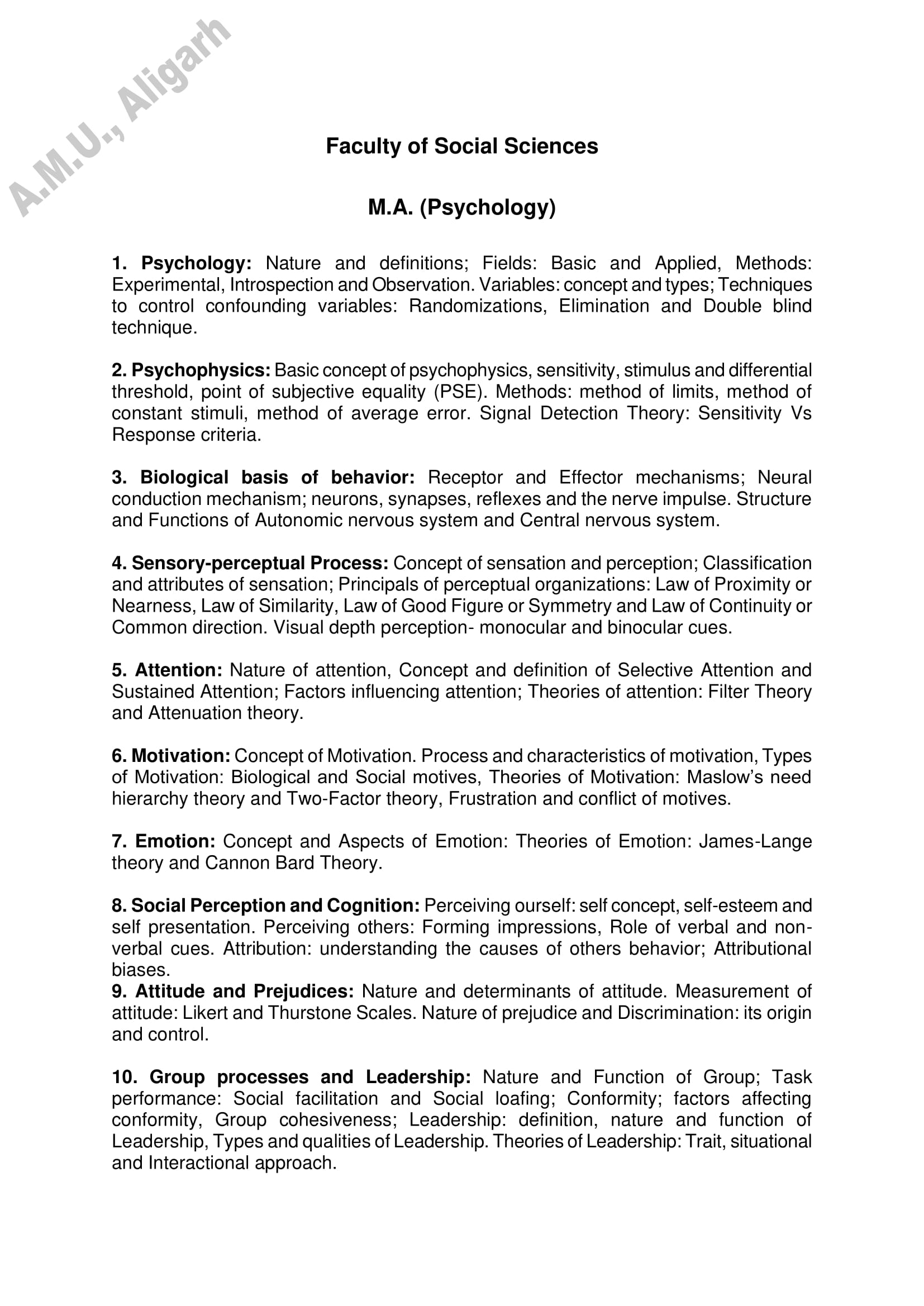
M.A. (Psychology)
1. Psychology: Nature and definitions; Fields: Basic and Applied, Methods:
Experimental, Introspection and Observation. Variables: concept and types; Techniques
to control confounding variables: Randomizations, Elimination and Double blind
technique.
2. Psychophysics: Basic concept of psychophysics, sensitivity, stimulus and differential
threshold, point of subjective equality (PSE). Methods: method of limits, method of
constant stimuli, method of average error. Signal Detection Theory: Sensitivity Vs
Response criteria.
3. Biological basis of behavior: Receptor and Effector mechanisms; Neural
conduction mechanism; neurons, synapses, reflexes and the nerve impulse. Structure
and Functions of Autonomic nervous system and Central nervous system.
4. Sensory-perceptual Process: Concept of sensation and perception; Classification
and attributes of sensation; Principals of perceptual organizations: Law of Proximity or
Nearness, Law of Similarity, Law of Good Figure or Symmetry and Law of Continuity or
Common direction. Visual depth perception- monocular and binocular cues.
5. Attention: Nature of attention, Concept and definition of Selective Attention and
Sustained Attention; Factors influencing attention; Theories of attention: Filter Theory
and Attenuation theory.
6. Motivation: Concept of Motivation. Process and characteristics of motivation, Types
of Motivation: Biological and Social motives, Theories of Motivation: Maslow’s need
hierarchy theory and Two-Factor theory, Frustration and conflict of motives.
7. Emotion: Concept and Aspects of Emotion: Theories of Emotion: James-Lange
theory and Cannon Bard Theory.
8. Social Perception and Cognition: Perceiving ourself: self concept, self-esteem and
self presentation. Perceiving others: Forming impressions, Role of verbal and non-
verbal cues. Attribution: understanding the causes of others behavior; Attributional
biases.
9. Attitude and Prejudices: Nature and determinants of attitude. Measurement of
attitude: Likert and Thurstone Scales. Nature of prejudice and Discrimination: its origin
and control.
10. Group processes and Leadership: Nature and Function of Group; Task
performance: Social facilitation and Social loafing; Conformity; factors affecting
conformity, Group cohesiveness; Leadership: definition, nature and function of
Leadership, Types and qualities of Leadership. Theories of Leadership: Trait, situational
and Interactional approach.
Page 2
Causes of Abnormal Behaviour: Biological, Psychological and Social. Approaches to
study of abnormal behavior: Frued-level of consciousness, structure of personality,
Psycho-sexual development. Defence mechanism. Jung-Personal and Collective
unconsciousness, personality types. Adler-Striving for security, style of life.
12. Anxiety Disorders: Obsessive compulsive disorder and Generalized anxiety
disorder; their symptoms and etiology; Somatoform Disorder: Hypochondriasis
symptoms and major characteristics, conversion disorder: symptoms-sensory, motor,
visceral; Mood disorders: general characteristics of depression and mania: chronic
mood disorders: etiology- psychological and biological; Schizophrenia: clinical
symptoms and etiology of Schizophrenia.
13. Mental Retardation and Developmental Disabilities: Concept of mental
retardation, levels and organic factors in mental retardation; Developmental
disabilities: Autism: clinical picture and causal factor; Learning disabilities: Clinical
picture and causal factor, Child Abuse: Causal factor and prevention.
14. Descriptive and Inferential Statistics: Classification and tabulation of data:
frequency distribution; Measures of central tendency and variability: computation of
mean, median and mode. Meaning, uses and calculation of Standard deviation and
variance. Graphical presentation of data. Correlation: meaning, assumption and types.
Normal probability curve: nature, meaning, properties and uses, deviation from normal
probability curve. Population and sampling: nature and types.
15. Learning: Nature, Types and measurement of learning, Theories of Learning:
Classical conditioning, Basic processes-Extinction, Spontaneous recovery,
generalization and discrimination. Application of Classical conditioning: Phobias, drug
dependence and taste aversion. Instrumental Conditioning: Operant conditioning,
Avoidance conditioning and Escape conditioning. Transfer of Training: Methods-
Specific and non-specific Transfer.
16. Memory and Forgetting: Information processing model of memory: Sensory
memory, Short term memory and Long term memory. Forgetting: concept and Theories
of forgetting: Decay theory, Interference theory, Two factor theory of forgetting:
response competition and unlearning with experimental evidences, Motivation theory of
forgetting: repression with experimental studies. Techniques for improving memory:
Study habits, Mnemonic devices.
17. Measurement: Nature and significance of measurement, Distinction between
assessment and measurement. Levels of measurement: Nominal, Ordinal, Interval and
Ratio. Techniques of attitude measurement-Likert scale, Semantic differential scale,
Thurstone scale and Guttman scale.
18. Psychological Tests: Definition of Psychological test, Brief history of Psychological
testing: test administration. Types of test: Group Vs Individual, Typical Vs Maximum
performance tests, Objective Vs Projective tests, Speed Vs Power tests, limited
response Vs Free response tests; Characteristics of tests:
Reliability- concept of reliability and methods for determining reliability-Test-Retest-
Same test, Parallel forms; Internal consistency- Split-half, Cronbach alpha. Validity:
Page 3
and construct validity. Factors influencing Reliability and Validity. Standardization and
Norms. Applications of testing: assessment in educational setup, occupational setup,
clinical setup and counseling.
19. Personality: Nature and definitions of personality: Western and Eastern
perspective. Personality as a set of traits and as types. Biological basis of Personality:
Role of genes and endocrine glands. Role of physical environment: Natural
environment, Constructed environment and behavioural setting. Role of social and
cultural environments: early social experiences and impact of parenting style. Nature-
Nurture controversy: Historical background, relative importance of nature and nurture in
personality development. Methods of personality assessment: Testing and observational
method. Major theoretical approaches to the study of personality: Psychoanalytic
approach (Freud’s view), Type approach (Jung’s view), New Fruedian approach,
(Horney’s views), Trait Approach (Allport’s view).
20. Self-Concept: Nature and development of self-concept. Theories of self
comparison: Central theory of self regulation: Self-Discrepancy theory, Measurement of
self-concept, changes in self-concept. Self-esteem: development and consequences of
self-esteem.
21. Fatigue: Determinants of Fatigue: Physiological, Psychological and Industrial
Fatigue. Causes of Fatigue; controlling fatigue effects.
Document Details
| Board / Org | Default |
| Exam | Admission Tests |
| Type | Syllabus |
| Pages | 3 |
| Updated | 30 Apr 2026 |