GSEB HSC Model Question Paper for Biology - Set 3
Finished viewing? Save it for later —
Download GSEB HSC Model Question Paper for Biology - Set 3 (PDF · 19 pages)About GSEB HSC Model Question Paper for Biology - Set 3
GSEB HSC Model Question Paper for Biology - Set 3 is available here for free download. Published by Gujarat Board for Class 12, this sample paper can be viewed online or downloaded as a PDF (19 pages). Candidates preparing for Class 12 can use GSEB HSC Model Question Paper for Biology - Set 3 to understand the exam pattern, the type of questions asked, and the overall difficulty level.
Frequently Asked Questions
How can I download GSEB HSC Model Question Paper for Biology - Set 3?
Open this page and click the Download button to save GSEB HSC Model Question Paper for Biology - Set 3 as a PDF. It is completely free on AglaSem Docs.
Is GSEB HSC Model Question Paper for Biology - Set 3 free to download?
Yes. GSEB HSC Model Question Paper for Biology - Set 3 can be viewed online and downloaded as a PDF free of cost on AglaSem Docs.
How many pages does GSEB HSC Model Question Paper for Biology - Set 3 have?
GSEB HSC Model Question Paper for Biology - Set 3 contains 19 pages, which you can read online or download together as a single PDF.
Where can I find more Class 12 study material?
You can find more Class 12 question papers, sample papers, syllabus, and answer keys on AglaSem Docs.
GSEB HSC Model Question Paper for Biology - Set 3 – Text
Read the full text of this sample paper below — useful to quickly search, copy and reference the content online without downloading the PDF.
📄 View text version (19 pages)
Page 1
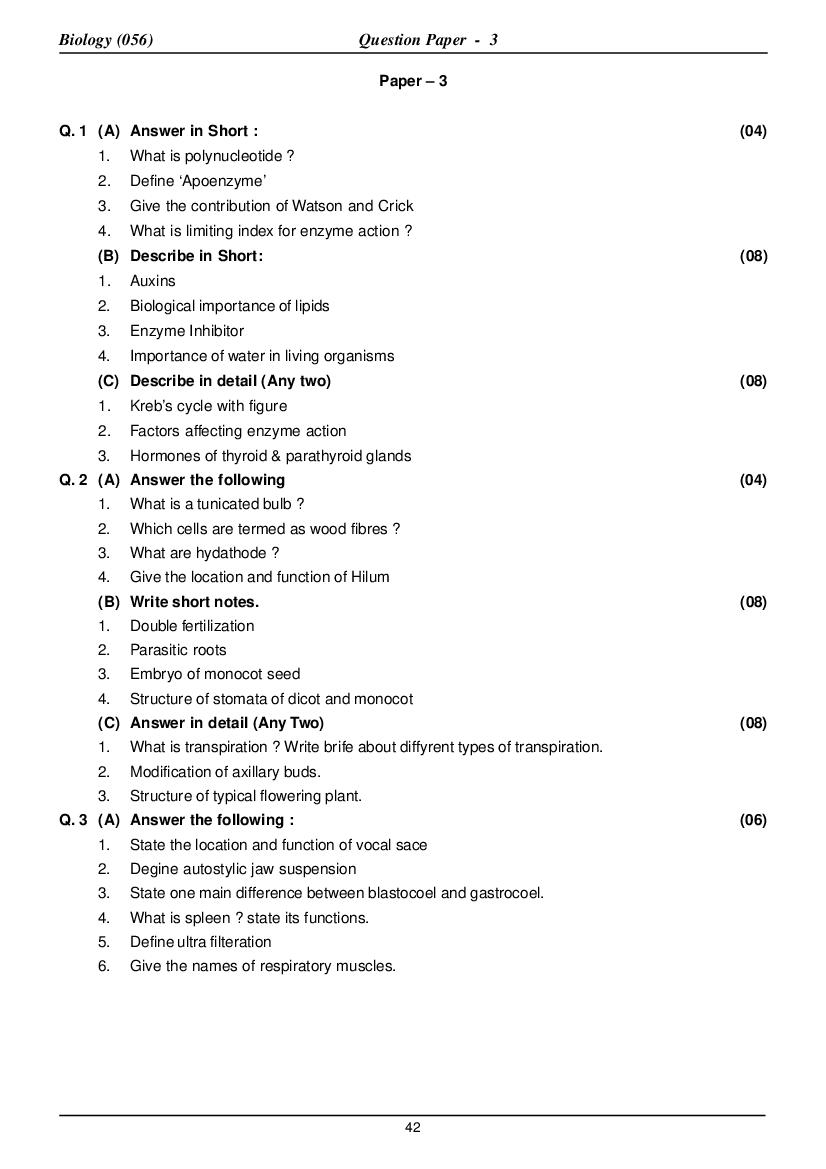
Paper – 3
Q. 1 (A) Answer in Short : (04)
1. What is polynucleotide ?
2. Define ‘Apoenzyme’
3. Give the contribution of Watson and Crick
4. What is limiting index for enzyme action ?
(B) Describe in Short: (08)
1. Auxins
2. Biological importance of lipids
3. Enzyme Inhibitor
4. Importance of water in living organisms
(C) Describe in detail (Any two) (08)
1. Kreb’s cycle with figure
2. Factors affecting enzyme action
3. Hormones of thyroid & parathyroid glands
Q. 2 (A) Answer the following (04)
1. What is a tunicated bulb ?
2. Which cells are termed as wood fibres ?
3. What are hydathode ?
4. Give the location and function of Hilum
(B) Write short notes. (08)
1. Double fertilization
2. Parasitic roots
3. Embryo of monocot seed
4. Structure of stomata of dicot and monocot
(C) Answer in detail (Any Two) (08)
1. What is transpiration ? Write brife about diffyrent types of transpiration.
2. Modification of axillary buds.
3. Structure of typical flowering plant.
Q. 3 (A) Answer the following : (06)
1. State the location and function of vocal sace
2. Degine autostylic jaw suspension
3. State one main difference between blastocoel and gastrocoel.
4. What is spleen ? state its functions.
5. Define ultra filteration
6. Give the names of respiratory muscles.
42
Page 2
(B) Answer in Short (06)
1. ‘‘The oviduct of female is long and coiled’’ give scientific reason.
2. Amphicoelous vertebra
3. Describe internal structure of pancreas of frog.
(C) Attempt any two (08)
1. What is portal system ? Describe renal portal system with diagram.
2. Explain the dorsal view of frog’s brain
3. Structure of nephron of frog.
Q. 4 (A) Answer in following (04)
1. How is sickle cell anemia caused ?
2. what are plasmagenes ?
3. Define crossing over.
4. What is Non-disjunction ?
(B) Answer the following (03)
1. Disorders of polysomy of x-sex chromosomes.
(C) Explain the following : (Any two) (08
1. Sex determination in Drosophila
2. Protein Syntherin
3. Link age in Drosophila melanogaster
(D) Draw neat & labelled diagram of following. (Any one) (05)
(or)
(i) Urinogenital System of female frog (ii) Arterial system of frog
Q. 5 (A) Answer the following : (06)
1. State the importance of ozonosphere.
2. Which type of person is called HIV carrier ?
3. Define – antigen
4. Give the composition of Biogas.
5. What is energy plantation ?
6. What is Red Data book ?
(B) Answer the following (08)
1. Write a note on preventive measures for cancer.
2. Describe Air resources
3. Use of yeast in industries.
4. Explain the food – chain & food – web.
(C) Attempt any two (06)
1. Describe causes and treatment for mental illness.
2. Diagnosis & Treatment of Hepatitis.
3. Explain energy flow in ecosystem.
43
Page 3
ANSWER
A. (1) Polynucleotide :-
A chained & molecule formed when several nucleotides bind to each other by their sugar and
phosphate components by phosphodiester bonds, is called polynucleotide.
(2) Apoenzyme :-
protien part present in enzyme is called Apoenzyme.
(3) limiting Index for enzyme action
The number of substrate molecule with which an enzyme can act depends on the molecular
structure of substrate. This number of substrate molecule is known as limiting index for enzyme
action
(4) Watson & crick :-
They proposed the model of DNA
Q. 1. B Write in short
Note on Auxins:-
• The chemical substance produced by apical meristem of plants, which have considerable impact
on growth & development of the plants are called growth hormones.
• Auxin is growth promoting hormone. Chemically auxin is indole acetic acid (IAA), it also include
substances such as indole acetoniteryl (IAN) & indole acetaldehyde (IAAL).
• Auxin accelarates rapid cell division.
• Auxin induces seed gamination, development of roots, & in producing seedless varieties of fruits.
• It induces flowering in plants, such as pineapple.
• Auxins prevents immature fruit fall & destroys weeds.
(2) Biological importance of lipids :
Lipids are the foodstuffs of highest calorific value. One gram of lipid, on oxidation, gives 9.3 k. cal.
of energy. Being insoluble in water it is stored in the body as reserve food which can be utilized
through the metabolic process as and when required. It forms an insulating layer which helps
maintain the body temperature. Lipids such as wax form a protective layer on the outer surface of
the aerial plant organs. The myelin sheath around the medullated nerve fibre contains lipid that
prevents the passage of nerve impulse in the adjacent nerve fibres. Lipid is a solvent for fat-
soluble vitamins A, D and E. It is also a structural component of several cell organelles. The
presence of lipid is inevitable for the activity of certain enzymes, e.g., glucose phosphatase.
Steroid hormones and vitamins D and E are synthesised from the derivatives of lipids.
(3) Enzyme Inhibhitors :
Some substances inhibit the activity of enzyme. They are known as inhibitors. Such inhibitors get
bound to the active site of the enzyme, or modify its active site.Thus, te enzyme becomes inactive.
Inhibitors which are structurally similar to the substrate bind to the active site of the enzyme just
like the substrate. This is why sulpha drugs are used to destroy bacteria. Bacteria require folic
acid (a vitamin) for their growth. The folic acid contains paraamino benzoic acid. If the paraamino
benzoic acid is replaced by sulphanilamide (a component of sulpha drug) the folic acid is not
formed and hence bacteria cannot grow. Sometimes metallic ions such as CU++, Zn++, Co++,
inhibit the enzyme action because these ions get linked with -SH and -COOH groups.
44
Page 4
(4) Water and its importance in living organisms :
Compared to other fluids, water is the best solvent. Several components essential for the
maintenance of life, such as glucose, amino acids, hormones as well as excretory products are
readily souble in water and hence can be easily circulated and transported. Important respiratory
gases like oxygen and carbon dioxide are also transported through water.
Water has a characteristically high specific heat and latent heat. Due to this property, any
changes in the temperature of the surrounding atmosphere by loss or gain of heat by water does
not affect the temperature of water. SInce water has a high latent heat, water in lakes and sea
does not freeze easily. Water molecules have high cohesive force and hence plants can absorb
water which can reach the leaves at great heights. Unicellular organisms absorb water from the
surrounding medium through osmosis. The density of water is highest at 4oC. Similarly, its viscosity
is also high. This property of water enables planktonic organisms to float and move about freely
on the surface of water. They do not encounter any mechanical shocks in water. Water has a high
capacity to condut heat, hence heat is equally distributed in all the parts of the body of an organism.
Q. 1 C Draw Kreb’s cycle & explain in brief :-
1. Kreb’s cycle is known as citric
acid cycle, It is also known as TCA
cycle.
• In kreb’s cycle 5 times 2 H+ are
released, which in turn binds to
different hydrogen acceptors such
as NAD, NADP & FAD.
• Oxidative phosphorylation (ETS)
occurs with the help of enzymes
present in mitochondria.
• The H+ ions liberated in kreb’s
cycle binds to NAD & NADP and
also FAD & reduce them to
NA DH 2 , NADPH 2 & FADH 2
respectively.
• At the end of kreb’s cycle 15 ATP
are produced. As, two times this
cycle occurs, 30 ATP molecules
are produced during oxidation of
one molecule of glucose.
Kreb’s cycle T.C.A cycle
Q. 1 C
2. Factors affecting enzyme action.
. There are various factors affecting enzyme action. They are as follows;
a) Temperature :-
• Enzymes gets denatured at high temperature.
45
Page 5
• Intially as temperature increases the rate of enzyme action increases, but it has its limitation.
• The optimum temperature for activity of enzyme is 37 oC + 1oC, & The activity declines at
temperature higher or lower than it.
b. PH :-
• Enzymes are active between PH range of 4-9,
• Some enzyme are active in acid medium Eg. Pepsin.
• Some enzyme are active in alkaline medium. Eg. Trypsin.
C. Concentration of enzyme :-
• Rate of reaction increases with increase in the enzyme concentration.
• The numbers of substrate molecules with which an enzyme can act depends upon the molecular
structure of substrate. The number of substrate molecules is called limiting index of enzyme
action
D. Substrate concentration:-
• If the substrate conc. is increased upto a certain limit, keeping the enzyme concentration constant,
the rate of enzyme action also increases.
E. Product concentration :-
• The increase in concentration of products, decreases the rate of enzyme action
• The products of digestion in alimentary canal are absorbed in blood, & hence rate of reaction
remains unaffected.
F. Effect of radiation :
• If enzymes are exposed to radiations such as ultraviolet & others rays , peroxidase is produced
which oxidizes the enzymes & makes them inactive.
G. Effect of chemical drugs :-
Several drugs (antibiotics) & other chemical inhibits the enzymes action.
3. Thyroid Hormones : The thyroid gland produces mainly iodine containing compounds as its
hormonal secretion. The most important of these is the thyroxine.The general metabolism of the
body is highly influenced by this hormone because it is concerned with energy transformation in
the body.
The thyroid hormone increases the cytochrome-C content of the cells acnd, consequently,
ATP generation is brought under its active control. This action has long-term effects on cellular
metabolism. Thyroxine is produced from tyrosine.
The thyroid gland swell up significantly when the supply of iodine through diet is insufficient
and theis leads to a disproportionate swelling of the throat region. The disease is known as
“Goitre. Due to the lack of thyroxine, biological reacations of the body are stowed down
considerably. Pulse beat becomes weak. Blood pressure is reduced. Physical as well as
mental fatigue sets in quickly. On the otherhand, due to an excess of the hormone, the pulse
beat increasesin intensity. Blood pressure rises, the body weight decreases and tempermantally
a person becomes very irritable.
If this gland is hypofuncitonal right from bvirth, the child suffers from mental retardation and
the facial features develop irratically leading to disfiguration.
Hormones of Parathyroid: This gland located at dorsal side of the thyroid gland is very
small and divided into four parts. The hormone termed as parathormone is secreted from
46
Page 6
parathyroid. The secretion of parathyroid is mainly concerned with the transportaion of calcium
between blood and bones and the control of the metabolism of calcium and phosphorus in the
body.
The hormone calcitonin is secreted by para-follicular cells of thyroid in mammals and it also
regulates the metabolism of calcium and phosphorous along with parathormone. It regulates the
formation of osteobtasts (bone forming cells) and osteoclasts (bone resorption cells).
Q. 2. A
1. Tunicated bulb :
• In modification for food storage several leaves stores food to become fleshy. All these are covered
by a leaf & encircles (clover) the entire bulb. This is called tunicated bulb.
Eg. Onion
2. Selerenchyma cells associated with xylem are termed as wood fibres
3. Hydathodes :-
• In certain plants special glands are present through which water exudes out as water droplets,
they are called hydathodes.
Eg:- process of guttation by colcasia leaf & fern.
4. Location & function of Hilum :-
• Along the inner margin of bean seed, there is a long white scar, this is called hilum.
• Function :- The seed is attached to the inner margin of fruit by means of hilum.
Q. 2. B. 2 Marks each
Double Fertilization :-
• In Angiosperm, two functional male gametes which are
haploid (n) in nature are produced by pollen sac.
• One of the male gamete fuses with the egg cell present
in ordary & forms diploid zygote (Zn)
• The other male gamete fuses with the diploid secondary
nuclens to form triploid (3n) endasoerm nuclens.
• Since two male gametes participate in fertilization
process in Angiosperm it is called double fertilization
2. Parasitic Roots :-
• Some plants are dependent on other plants for their
requirement of water, mineral and food. Such Plants are
called parasitic plants.
• These plants may be partial parasites or total parasite.
• Such plants produces roots which penetrates into the
host plant for absorbtion of water & minerals as well as
food.
• Such roots are called parasitic roots.
• Eg :- Cuscuta is total parasite
Loranthus is partial parasite on host plant.
47
Page 7
3. Embryo of monocot seed:- (Maize seed)
• Embryo of maize grain is located beneath the endosperm.
• All the parts enclosed completely in a shield shaped sculetlum which is called as cotyledon.
• The cells of epithelial layer secrete digestive enzymes during seed germination which digest the
nutrients in the endosperm & absorb them.
• These nutrients helps in the development & growth of seedling.
• Embryo consists of a radicle & plumule which are partially covered & protected by coleorhiza &
coleoptile.
4. Stomata - Structure and Comparision :
A stomata is a pore-like structure in the epidermis and is guarded by a pair of guard cells. It is
surrounded by epidermal cells. The guard cellis in dicot leaves are bean-or kidney-shaped having
thickened concave wall and thin convex wall. The guard cells in monocot leaves are dumb-bell-
shaped and the two subsidiary (accessorry) cells are conical. The guard cells contain chloroplasts.
Its thickened wall is non-elastic while the thin wall is elastic in nature. The stomata are found on
the surface (epidermal) layer of stem, leaves, flowers and fruits. THe intercelluar spaces in these.
organs communicate with the atmosphere directly through stomata.
In dicot leaves the guard cells are bean shaped and the epidermal cells are irregular in shape
while in monocot leaves the guard cells are dumb bell shaped and subsidiary cells are conical
shaped. The epidermal cells are rectangular having wavy margin.
• A pare called stomatal pore guarded by kidney shaped guard cells, in dicot stomata.
• The kidney shaped guard-cell having thickened concerne wall & thin conner wall.
• The guard cells contain chloroplast & during day time guard cells performs photoeynthesa.
• The guard cells are surrounded by innumerable epidermal cells.
• The epidermal cells are irregular in shape.
48
Page 8
Q. 2. C.
Transpiration :-
• Loss of water by plants through its aerial organs in the form of water vapour is called transpiration.
Different types of Transpiration :-
• Stomatal Transpiration :-
Stomata are found on both the surface of leaf.
• Loss of water in the form of vapour through small aperture called stomata is called stomatal
transpiration.
• Cuticular Transpiration :-
• Transpiration occuring through the surface of epidermal cells of leaves & other aerial organs is
known as cuticular or epidermal transpiration
• Nearly 8-9% of total transpiration occures by this type.
3. Lenticelar transpiration :-
• In some plants, the stem shows the presence of lenticels.
• Lenticels are present on aerial organs or even on underground plant organ.
• Lenticels are transpiration as well as respiratory in function.
Lenticular Transpiration
2. Modification of axillary buds :-
• In plants certain organs are modified to perform certain special functions. Such modifications for
special functions are called adaptation.
• Bulbil (Diosorea) :-
• When an axillary bud becomes fleshy by
storing food & performs the function of
vegelative propogation. These are called bulbil.
• In Amorphophalus, potato, ginger, turmeric are
underground food storing stems.
• The buds from their surface develop & give rise to new plants.
• In Cynadorn (grass) & Hydrocotyl the axillary buds in the lower most leaves develop into thin &
long branch. Such slender & reproduction branches are called runner.
• In fern, axillary buds grow into long & slender branches, which when comes in contact with soil,
produce new plant. Such branches are called stolon.
3. Structure of typical flowering plant.
• The body of typical flowering Plant is mainly divided into two main parts.
(1) Root system (2) shoot system.
49
Page 9
• Root System :-
• The root is descending axis of a plant which grows in the direction of water, soil & gravitational
force and against the direction of air & sunlight.
• Roots are of two types.
Tap Root System
• Shoot System :
• Stem is ascending axis of plant which develops from the hypocotyl & plumule of embryo axis &
grows in the direction of air & sunlight and against the soil.
• It bears nodes, internodes, leaves, apical & axillary buds, flower & fruit.
• Leaf:- Leaf is dorsoventrally flat organ having limited growth & life span.
• Bud :-
• Condensed shoot axis located at definate places of stem is called bud.
• Buds are two types (1) apical bud & (2) axillary bud.
• Apical bud helps in linear growth.
• Axillary buds helps in formation of lareral branches In many plants buds develops into flower.
• Flower :- Flower is reproductive organ of plant
body. Flower is modified shoot developed for
sexual reproduction.
• The leaf from the axil of which a flower develops
is called bract.
• Flower have various parts like calyx, corollo
Androecium & gynoerium.
• Androerium is male reproductive organ.
• glynoecium is female reproductive organ of a
flower.
• Typical flowering Plant
Q. 3 A
1. Location & function of Vocal Sacs:-
• In male frog on posterio lateral side of head region near gloltis.
• Function :- Produce croaking sound during breeding season.
2. Autostylic Suspension :
The posterior ends of the mandibular arch are articulated with the quadrate cartilages of the
upper jaw in such a way that the lower jaw can move freely and open the mouth widely and fully.
50
Page 10
This type of attachment of the lower jaw with the upper jaw is called autostylic suspension.
3. Blastocoel Gastrocoel
• Cavity found during Cavity found during
blastula stage gastrula stage
• Helps the embryo to Forms future digestive
float on the surface water System.
4. Spleen :- Located near rectum.
• Function : (1) Produces W B C. (2) degrades worn out RBC (3) engulfs pathogenic micro-organism
5. Ultra filteration :-
• filteration of blood in glomerulus of uriniferous tubules of kidney due to difference of pressure of
blood in afferent & efferent arterioles.
• Function :- Removes metabolic waste.
6. Respiratory muscles :- They are of two types
• (1) petrohyoid muscles
(2) sternohyoid muscles.
Both the muscles are attached to hyoid apparatus
Q. 3 B.
1. Oviduct of female is long & coiled give reason.
• Ovary Produces egg called, as primary occyles (2n) These are diploid in nature and are released
in coelomic cavity by rupturing of ovary wall.
• These primary oocytes (2n) enters into oviduct which are long & coiled. The long duct gives
sufficient time for final maturation of primary oocytes & to undergo meiosis.
• Lower part of oviduct is wide called as ovisac, in which the haploid eggs are stored.
2. Amphicoelous Vertebra :
The centrum of 8th vertebra has concave
facet at both the ends. hence the vertebra
is called amphicoelus vertebra. Its neural
spine is laterally flattened and directly more
dorsally than posteriorly. Its transverse
processes are short and slender.
3. T.S. of Pancreas :-
• Internally pancreas are formed of large number of lobules called acini
• Each acini has lumen called pancreatic capillary which opens into common bile duct.
• T. S. also shows presence of arteries, veins, capillaries & nerve fibres
• There are cells called islets of Langerhans, which contains alpha cells & beta cells.
1. Lobules
2. Islet of Langerhans
3. Pancreatic capillary
4. Blood capillary
5. Pancreatic duct
T.S of pancreas.
51
Page 11
Q. 3 C. 4 Marks each.
• Portal System :
• In vertebrates some veins which enter some other organs instead of opening into vena cava.
Such veins are called portal veins & the system as Portal System.
• Portal System is of two types
• Renal portal System :-
• The capillaries receiving de-
oxygenated blood from hind limb of
frog joins together & forms femoral &
scitic vein.
• The femoral divides into two branches
(1) external iliac & inner pelvic.
• external iliac and sciatic veins joins
& forms a large renal portal vein
• The renal portal veins opens into
kidneys Two pelvic veins joins to form
anterior abdominal vein.
Q. 3 C. 2. Brain of Frog
• Brain & spinal cord together form the central nervous
System.
• Brain is well protected in the lumen of cranium. Brain is
covered by two coats, outer thick dura matter & an inner
thin pia matter.
Dorsal view :
• Dorsal view of brain shows three regions (1) fore brain
(2) mid brain (3) hind brain
• Fore brain consists of all factory lobes & two cerebral
henisphere & diancephalon.
• Mid brain consists of two optic lobes & the hind brain
includes medulla oblongata.
3. Structure of Nephron :-
• Each kidney consists of 2,500 excretory units called nephrons.
• Each Nephron has a cup shaped structure called Bowmans capsule.
• Into this cup shaped Bowman’s capsule, enter the afferent renal arterole & divides into capillaries,
which in turn Unite to form efferent renal arterole .
• Mass of capillaries & Bowman’s capsule together is known as Malpighian body.
• Bowman’s capsule leads into tubule through a short neck. The tube is long, & coiled structure.
52
Page 12
• The major part of tubule is lined by a single layer of epithelial cells.
• There are several collecting tubules which run horizontally along the dorsal side in the kidney &
communicate with Bidder’s canal.
• The uriniferous tubules, collecting tubules, the bidder canal & ureiter are supported by connective
tissue.
Q. 4. A
1. Sickle cell anemia is caused due to disorder in
• Structure of hemoglobin in RBC cells, due to genetic defect.
2. Plasmagenes :-
• DNA present in the cytoplasm which is responsible for inheritance of certain characters are
called plasmagenes.
3. Crossing over :-
• exchange of genes between the homologus chromosomes which results in variations due to
change in genetic configuration of gametes is called crossing over.
4. Non –disjunction :-
• During gamete formation meiotic division occurs, at this time one or more chromosome enter the
same gamete, while the other gamete do not get any chromosome;
Homologus chromosomes fail to separate is called Non – disjunction.
53
Page 13
Q. 4 B
• Due to polysomy of X- sex chromosome, disorders like super female & klinefelter syndrome
occurs.
• Super female :- XXX or XXXX.
This disorder occurs in female due to polysomy of 23rd pair in x-chromosome. XXX or XXX.
• Characters :-
• Such females are sterile
• Mentally retarded
• Lacks Secondary sexual characters
• Reproductive organs are under developed
• Klinefelter syndrome In males:-
Such males have polysomy in sex- chromosome.
Characters :-
• Such males are sterile
• Mentally retarded
• Testis poorly developed
Absence of facial hairs
• Physically deformed.
Q. 4 C.
Sex Determination in Drosophila :
A scientist by the name of Bridges studied sex determination in Drosophila melanogaster, a fruit fly,
and proposed the gene balance theory. In this fruit fly, there are 3 sets of autosomal chromosomes
and one pair of sex chromosomes. The male fruit fly has chromosomal constitution as XO or XY
and femal has XX. In spite of this, in this fly the autosomes also play an important role in sex
determination. Here the X-chromosome has more female determining factors white the autosomes
carry the male determining genes, Therefore, whether a fruit fly will be male or female is dependent
upon the ratio of X-chromosomes and autosomes. Y-chromosome does not play a role in this
event. A clear understanding of the mechanisms of sex determination Drosophila melanogaster
is igiven in the table.
No. of X-Chromosomes Autosomal number X/A Sex
(X = 1) (A = 1) Ratio
XX or XXY 2A 1 Normal female
XXX 2A 1.5 Super female
XO or XY 2A 0.5 Normal male
XX 2A 0.66 Intersex
XO or XY 3a 0.33 Super male
XXX 3A 1 Triploid female (3n)
From the table shown, it is clear that if the ratio of X/A = 1, then it is a normal female, if the
ratio is 0.5, then it is a normal male; a ratio less than o.5 suggests that it is a super male and a ratio
greater than 0.5 and less than 1, then it is an intersex fly.
54
Page 14
A ratio greater than 1, is a super female. This phenomenon has been observed in this fly.
Besides this, it has also been observed that the male fruit fly with XY/2A constitution is fertile,
while that with XO/2A is sterile. In this way, the Y-chromosome is not responsible for maleness,
but it is necessary for fertility.
Q. 4 C
Protein Synthesis :
Protein synthesis is a very complex process in eukaryotes which can be divided into following
three stages for better undrstanding : (1) Transcription (2) Translocation and (3) Translation.
(1) Transcription : As seen earlier, the process of m-RNA formation from the DNA-template is
known as transcription.
(2) Translocation : The process by whilch the newly synthessied m-RNA is separated from
DNA template and passes from the nucleus to the cytoplasm and arranges itself on ribosomes, is
known as translocation. According to certain views, r-RNA plays an important role in this process.
(3) Translation : The process by which the necessary amino acids are joined in a specific
sequences to synthesize a polypeptide molecualar chain with the help of the triplate condon on the m-
RNA is termed as translatio. This event is carried out in three phases :
1. Initiation 2. Elongation and 3. Termination.
1. Initiation : Amino acids are inactive in the cytoplasm, so that they cannot take part in protein
synthesis. That is why amino acids must be activated by providing energy from ATP. An enzyme, a
special type of synthetase, is required to catalyse for the activation of each amino acid. Each of this
enzyme identifies its own specific amino acids and joins it with t-RNA after finding t-RNA for the
transport of amino acids. Thus amino-acid t-RNA complex is formed.
2. Elongation : In this process the
sequence of nucleotides on m-RNA have
been translated and accordingly amino acids
are arranged sequentially in polypenptide
chain. The formation of polypeptide chain
always begins with the amino acid,
methoinine, whose code is AUG. In
prokaryotes and eukaryotes, the start signal
received by m-RNA for the initiation of
polypeptide chain is recognised by two
different t-RNA, which are respectively
formylmethionine t-RNA, (f-met - t-RNA) and
non-formyl-methonine t-RNA (met-tRNAmet). Translation of Genetics code
This t-RNA carrying AUG reaches firstly on ribosomes of m-RNA and arranges AUG there. Afterwards
the other corresponding amino acids brought by t-RNA are arranged sequentially. Every two adjacent
55
Page 15
amino acids join each other by peptide bond, and thus the process of the formation of polypeptide
chain has been continued.
3. Termination : When the process of addition of amino acids take place at a definite region
consisting of nonsense codons UAA, UAG or UGA of m-RNA, then this process is stopped after
completion. Thus, UAA, UAG and UGA codons are known as stop signals or releasing factors releases
polypeptide chain from the ribosomes.
The first amino acid of any released polypeptide chain is methionine (AUG codeon), so AUG is
known as initiator codon. It is also known as repeat codon due to same reasons. Initally methionine is
removed with the help of enzyme diformylase, then several amino acids of one or both ends of the
polypeptide chain are removed with the help of several enzymes and the remaining polypeptide chain
joins alone or with other chain to produce protein.
Q. 4 C. Linkage in Drosophila melanogaster: In one variety of Drosophila (fruit fly), the gene responsible
for body colour is linked to the gene for wing length. In Drosophila, the gene g is responsible for
the black body colour and the gene G for grey colour. The gene G is dominant. Similarly the gene
is responsible for the development of normal, long wings, while the gene l causes development
of short and vestigeal wings. The gene L is dominant.
When a Drosophila with grey body and normal long wing (GGLL) is crossed with a fly having
black body and short vestigeal (ggll) at the F1 generation, all offsprings have grey bodies and
long wings. If the male of this F1 generation is test crossed with homozygous recessive female
the offsprings in F2 generation of two varieties. (in a 1:1 ratio). This differs F2 from the expected
Mendalian ratio (1:1: 1:1). These offsprings show characters typical of the parental (P) generation,
because the genes G and L remain linked and the gene g and l remain linked together. The test
cross progeny shows parental phenotypes.
56
Page 16
Q. 4 D(1)
D (2)
57
Page 17
Q. 5 A 1 Mark each.
1. Ozonosphere :-
• Ozonosphere helps in the absorbtion of harmful solar radiation. So that living organisms are well
protected.
2. HIV carrier :-
• These are persons which transmits the disease to other person. They areHIV positive but do not
show the symptoms of AIDS.
3. Antigens :-
• Foreign protein (virus or bacteria) that induce production of antibody in living organisms is known
as antigens.
4. Composition of biogas :- (1) 50 to 70 % methane (2) 30% to 40% Co 2 (3) along with H2, N2, &
H2S.
5. Energy Plantation :-
• Plantation of selected trees for the purpose of energy is termed as energy plantation.
6. Red Data Book :-
• It is the book in which names of endangered plant species are mentioned & published.
Q. 5 B
1. Preventive measures of cancer :-
• The body should not be exposed excessively to intense sunlight or wind.
• Women should breast feed their babies to minimize the chances of breast cancer.
• Avoid tobacco consumption.
• care should be taken so that tissue or organ of the body should not be exposed to carcinogens.
• Avoid spicy & adulterated food.
2. Air reasources
• Transparent covering of gases around the earth is called as atmosphere.
• The main layers of air from the earth’s surface include troposphere strqtosphere, mesospbere,
& thermosphere in sequence.
• The outermost layer of almosphere is known as exosphere.
• Atmosphere comprises of mixture of several gases. Nitrogen – 78% , Oxygen = 21%, while
remaing 1% comprises of CO2, hydrogen & other gases.
• The major portion of toposphare helps to maintains life as it consists of O2, CO2 & N 2, gases.
• Ozone layer of stratosphere absorbs harmful solar radiation
• living organisms can survive on earth’s surface.
3. Use of yeast in industries :-Louis Pasteur showed that beer , yogurt and buttermilk are
produced as a result of fermentation, This occurs due to the unicellular fungus, the yeast. Till the
end of nineteenth century the yeast was used in bakery industry, in breweries for manufacture of
beer, wine etc., and in the preparation of fermented loaf for preparing idli, dosa, jalebi, pizza etc.
But these days different species of yeast are used for the production of many items on commercial
basis in various countries. There are mainly two types of yeast : (1) Baker’s yeast used in bakery
industry and (2) Brewer’s yeast for the production of alcoholic beverages. Yeast is cultivated on
58
Page 18
molasses. Yeast is used for fermenting the loaf for preparing bread. Special type of fungus is
used to impart pleasant flavour to the edibles. Yeast can be cultivated on various organic
substances such as starch, glucose, sucrose, lactose etc., in addition to molasses. Molasses is
the residual product after obtaining the main products in sugar and jaggery industries.
•
4. Food chain & Food webs :-
• In any ecosystem each living organisms depend on other for its food & nutrition.
• The chain formed with respect to food & nutrition is called food chain.
• There are several food chain in an ecosystem.
• These are interlinked in various ways which forms webs. This is known as food web.
• Grass - grasshoper – rat – kite – (Food chain)
Food web
Rabtrits
Grass → Inseits → Auts → Kites, Eagle or Unlture
↓
Rats → Snake
Q. 5 C.
(i) Causes & Treatment for mental illness :-
• Causes :-
(1) Congenital diseases (2) Disorder of physical growth
(3) Excess anxiety (4) mental shock
(5) mental struggle (6) social conflicts
(7) continuous noise
Treatment :-
• medical therapies
• chemotherapy & psychotherapy sittings should be given
• hypnotism therapy.
• electric shock therapy.
(ii). Diagnosis of hepatitits : The patient of hepatitits shows manifestation of this disease as described
above. In addition, it can be ascertained whether the person has received blood in near past
through blood transfusion or taken narcotic drugs through injections. The disease can also be
diagnosed by the estimation of serum bilirubin, SGPT (Serum glutamic pyruvic transaminase)
and testing the antigen-antibody system of HB.
Treatment of hepatitis: The patient should be given fat-free diet or food containing negligibnle
amount of fat. The patient must take full rest. The person can be protected from hepatitis-B by
the HB-vaccination. The disease being highly contagious, the patient should be shifted to hospital.
Great care shoul be taken about the instruments and other accessories that have come in contact
with the blood of the HB-patient.
(iii) Energy flow in ecosystem :-
• The two main & important processes occurring in any ecosystem are (1) energy flow (2) Bio-
geochemical cycles
59
Page 19
Energy Flow :-
• All living organisms requires energy to carry out all life activities.
• They get this energy from the food they eat.
• Plants have capacity to manufacture their own food (glucose) by process of photosynthesis.
• The sugar produced due to photosynthesis is called Total primary productivity.
• Plant use energy for their metabolic activities & remaining enters into animals via food chain.
• Herbivores which feeds on plants are called as primary consumers C1. This further enters into
secondary consumers C2 & tertiary consumers C3.
• Every level, of organisms utilize energy & therefore energy level, goes on decreasing.
Flowof Energy
Energy level goes on decreasing
**********************************************
60
Document Details
| Board / Org | Gujarat Board |
| Exam | Class 12 |
| Type | Sample Paper |
| Pages | 19 |
| Updated | 22 Jul 2026 |