Uttarakhand D.El.Ed 2026-27 Sample Paper
Finished viewing? Save it for later —
Download Uttarakhand D.El.Ed 2026-27 Sample Paper (PDF · 36 pages)About Uttarakhand D.El.Ed 2026-27 Sample Paper
Uttarakhand D.El.Ed 2026-27 Sample Paper is available here for free download. Published by Uttarakhand Board for Uttarakhand D.El.Ed, this sample paper can be viewed online or downloaded as a PDF (36 pages). Candidates preparing for Uttarakhand D.El.Ed can use Uttarakhand D.El.Ed 2026-27 Sample Paper to understand the exam pattern, the type of questions asked, and the overall difficulty level.
Frequently Asked Questions
How can I download Uttarakhand D.El.Ed 2026-27 Sample Paper?
Open this page and click the Download button to save Uttarakhand D.El.Ed 2026-27 Sample Paper as a PDF. It is completely free on AglaSem Docs.
Is Uttarakhand D.El.Ed 2026-27 Sample Paper free to download?
Yes. Uttarakhand D.El.Ed 2026-27 Sample Paper can be viewed online and downloaded as a PDF free of cost on AglaSem Docs.
How many pages does Uttarakhand D.El.Ed 2026-27 Sample Paper have?
Uttarakhand D.El.Ed 2026-27 Sample Paper contains 36 pages, which you can read online or download together as a single PDF.
Where can I find more Uttarakhand D.El.Ed study material?
You can find more Uttarakhand D.El.Ed question papers, sample papers, syllabus, and answer keys on AglaSem Docs.
Uttarakhand D.El.Ed 2026-27 Sample Paper – Text
Read the full text of this sample paper below — useful to quickly search, copy and reference the content online without downloading the PDF.
📄 View text version (36 pages)
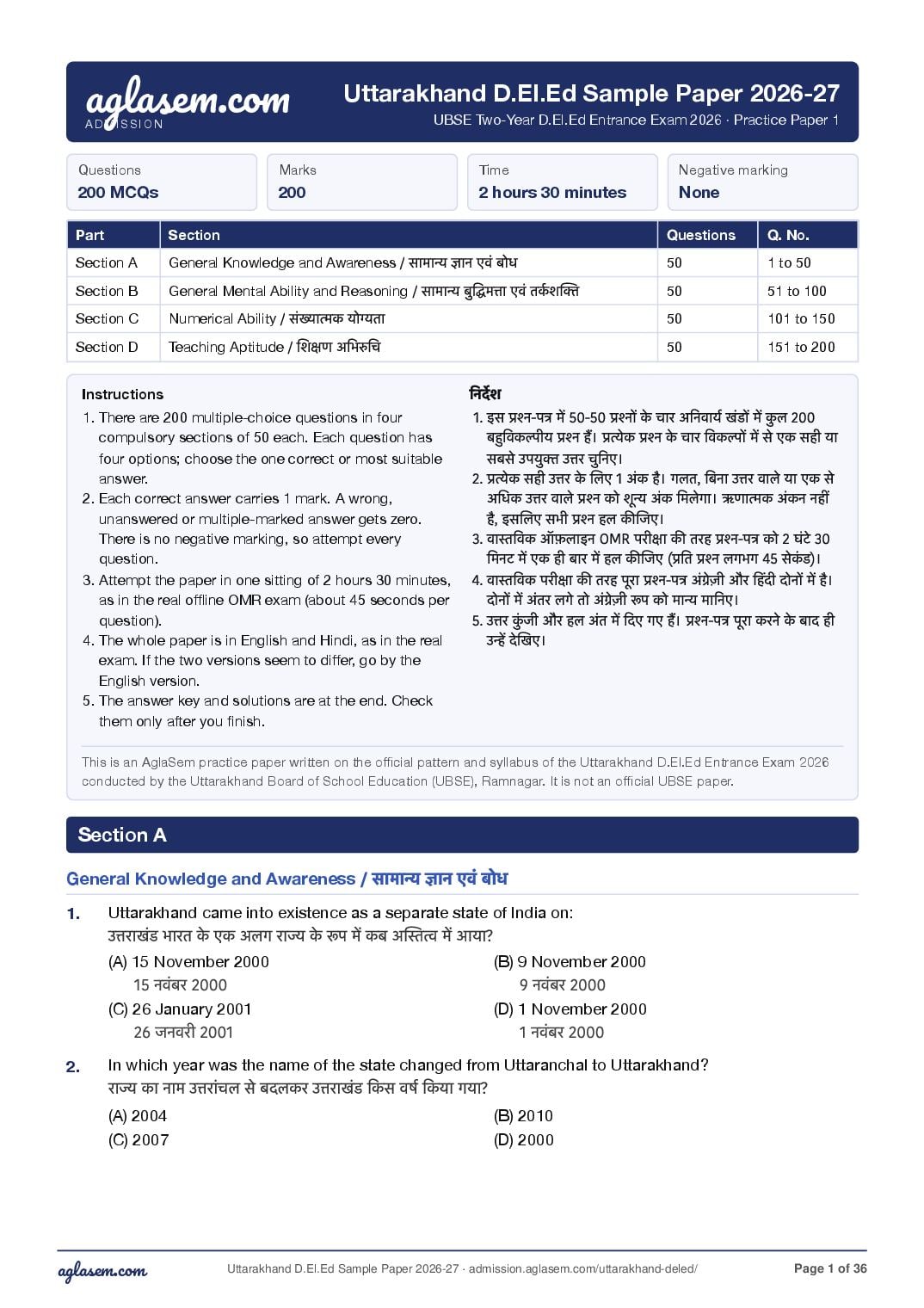
Page 1
Uttarakhand D.El.Ed Sample Paper 2026-27
UBSE Two-Year D.El.Ed Entrance Exam 2026 · Practice Paper 1
Questions Marks Time Negative marking
200 MCQs 200 2 hours 30 minutes None
Part Section Questions Q. No.
Section A General Knowledge and Awareness / सामान्य ज्ञान एवं बोध 50 1 to 50
Section B General Mental Ability and Reasoning / सामान्य बुद्धिमत्ता एवं तर्क शक्ति 50 51 to 100
Section C Numerical Ability / संख्यात्मक योग्यता 50 101 to 150
Section D Teaching Aptitude / शिक्षण अभिरुचि 50 151 to 200
Instructions निर्देश
1. There are 200 multiple-choice questions in four 1. इस प्रश्न-पत्र में 50-50 प्रश्नों के चार अनिवार्य खंडों में कु ल 200
compulsory sections of 50 each. Each question has बहुविकल्पीय प्रश्न हैं। प्रत्येक प्रश्न के चार विकल्पों में से एक सही या
four options; choose the one correct or most suitable सबसे उपयुक्त उत्तर चुनिए।
answer. 2. प्रत्येक सही उत्तर के लिए 1 अंक है। गलत, बिना उत्तर वाले या एक से
2. Each correct answer carries 1 mark. A wrong, अधिक उत्तर वाले प्रश्न को शून्य अंक मिलेगा। ऋणात्मक अंकन नहीं
unanswered or multiple-marked answer gets zero. है, इसलिए सभी प्रश्न हल कीजिए।
There is no negative marking, so attempt every 3. वास्तविक ऑफ़लाइन OMR परीक्षा की तरह प्रश्न-पत्र को 2 घंटे 30
question. मिनट में एक ही बार में हल कीजिए (प्रति प्रश्न लगभग 45 सेकं ड)।
3. Attempt the paper in one sitting of 2 hours 30 minutes, 4. वास्तविक परीक्षा की तरह पूरा प्रश्न-पत्र अंग्रेज़ी और हिं दी दोनों में है।
as in the real offline OMR exam (about 45 seconds per दोनों में अंतर लगे तो अंग्रेज़ी रूप को मान्य मानिए।
question). 5. उत्तर कुं जी और हल अंत में दिए गए हैं। प्रश्न-पत्र पूरा करने के बाद ही
4. The whole paper is in English and Hindi, as in the real उन्हें देखिए।
exam. If the two versions seem to differ, go by the
English version.
5. The answer key and solutions are at the end. Check
them only after you finish.
This is an AglaSem practice paper written on the official pattern and syllabus of the Uttarakhand D.El.Ed Entrance Exam 2026
conducted by the Uttarakhand Board of School Education (UBSE), Ramnagar. It is not an official UBSE paper.
Section A
General Knowledge and Awareness / सामान्य ज्ञान एवं बोध
1. Uttarakhand came into existence as a separate state of India on:
उत्तराखंड भारत के एक अलग राज्य के रूप में कब अस्तित्व में आया?
(A) 15 November 2000 (B) 9 November 2000
15 नवंबर 2000 9 नवंबर 2000
(C) 26 January 2001 (D) 1 November 2000
26 जनवरी 2001 1 नवंबर 2000
2. In which year was the name of the state changed from Uttaranchal to Uttarakhand?
राज्य का नाम उत्तरांचल से बदलकर उत्तराखंड किस वर्ष किया गया?
(A) 2004 (B) 2010
(C) 2007 (D) 2000
Uttarakhand D.El.Ed Sample Paper 2026-27 · admission./uttarakhand-deled/ Page 1 of 36
Page 2
उत्तराखंड उच्च न्यायालय कहाँ स्थित है?
(A) Almora (B) Nainital
अल्मोड़ा नैनीताल
(C) Haridwar (D) Dehradun
हरिद्वार देहरादू न
4. How many districts are there in Uttarakhand?
उत्तराखंड में कितने ज़िले हैं?
(A) 12 (B) 15
(C) 11 (D) 13
5. The state bird of Uttarakhand is the:
उत्तराखंड का राज्य पक्षी है:
(A) Himalayan Monal (B) Indian Peafowl
हिमालयी मोनाल भारतीय मोर
(C) Hill Myna (D) Snow Partridge
पहाड़ी मैना हिम तीतर
6. Which flower, found in the high Himalaya, is the state flower of Uttarakhand?
ऊँ चे हिमालय में मिलने वाला कौन-सा फू ल उत्तराखंड का राज्य पुष्प है?
(A) Lotus (B) Brahma Kamal
कमल ब्रह्म कमल
(C) Burans (D) Phyonli
बुरांश फ्योंली
7. The state animal of Uttarakhand is the:
उत्तराखंड का राज्य पशु है:
(A) Barking Deer (B) Snow Leopard
काकड़ हिम तेंदुआ
(C) Alpine Musk Deer (D) Himalayan Tahr
कस्तूरी मृग हिमालयी थार
8. The Bhagirathi and the Alaknanda meet to form the Ganga at:
भागीरथी और अलकनंदा कहाँ मिलकर गंगा बनाती हैं?
(A) Devprayag (B) Rishikesh
देवप्रयाग ऋषिके श
(C) Karnaprayag (D) Rudraprayag
कर्णप्रयाग रुद्रप्रयाग
9. The Alaknanda and the Mandakini rivers meet at:
अलकनंदा और मंदाकिनी नदियों का संगम कहाँ होता है?
(A) Nandprayag (B) Rudraprayag
नंदप्रयाग रुद्रप्रयाग
(C) Devprayag (D) Vishnuprayag
देवप्रयाग विष्णुप्रयाग
10. The Gangotri glacier, the source of the Bhagirathi, lies in which district?
भागीरथी का उद्गम गंगोत्री हिमनद किस ज़िले में स्थित है?
(A) Tehri Garhwal (B) Chamoli
टिहरी गढ़वाल चमोली
(C) Uttarkashi (D) Pithoragarh
उत्तरकाशी पिथौरागढ़
Uttarakhand D.El.Ed Sample Paper 2026-27 · admission./uttarakhand-deled/ Page 2 of 36
Page 3
कौन-सी नदी उत्तराखंड और नेपाल के बीच अधिकांश सीमा बनाती है?
(A) Kali (Sharda) (B) Ramganga
काली (शारदा) रामगंगा
(C) Tons (D) Kosi
टोंस कोसी
12. The Tehri Dam is built on which river?
टिहरी बाँध किस नदी पर बना है?
(A) Alaknanda (B) Ramganga
अलकनंदा रामगंगा
(C) Yamuna (D) Bhagirathi
यमुना भागीरथी
13. India's first national park, set up in 1936 as Hailey National Park, is now known as:
1936 में हेली नेशनल पार्क के रूप में स्थापित भारत का पहला राष्ट्रीय उद्यान अब किस नाम से जाना जाता है?
(A) Rajaji National Park (B) Jim Corbett National Park
राजाजी राष्ट्रीय उद्यान जिम कॉर्बेट राष्ट्रीय उद्यान
(C) Govind National Park (D) Gangotri National Park
गोविं द राष्ट्रीय उद्यान गंगोत्री राष्ट्रीय उद्यान
14. The Valley of Flowers National Park is in which district of Uttarakhand?
फू लों की घाटी राष्ट्रीय उद्यान उत्तराखंड के किस ज़िले में है?
(A) Pithoragarh (B) Chamoli
पिथौरागढ़ चमोली
(C) Bageshwar (D) Uttarkashi
बागेश्वर उत्तरकाशी
15. The highest peak lying entirely within India, situated in Uttarakhand, is:
पूरी तरह भारत के भीतर स्थित सबसे ऊँ ची चोटी, जो उत्तराखंड में है, कौन-सी है?
(A) Trishul (B) Panchachuli
त्रिशूल पंचाचूली
(C) Nanda Devi (D) Kamet
नंदा देवी कामेट
16. Gaura Devi led the women of Reni village in the Chipko movement in 1974. Reni is in which district?
1974 में गौरा देवी ने चिपको आं दोलन में रैणी गाँव की महिलाओं का नेतृत्व किया। रैणी किस ज़िले में है?
(A) Tehri Garhwal (B) Chamoli
टिहरी गढ़वाल चमोली
(C) Uttarkashi (D) Almora
उत्तरकाशी अल्मोड़ा
17. The Coolie Begar movement of 1921 at the Uttarayani fair in Bageshwar was led by:
1921 में बागेश्वर के उत्तरायणी मेले में कु ली बेगार आं दोलन का नेतृत्व किसने किया?
(A) Badri Datt Pandey (B) Govind Ballabh Pant
बद्री दत्त पांडे गोविं द बल्लभ पंत
(C) Shri Dev Suman (D) Chandra Singh Garhwali
श्रीदेव सुमन चंद्र सिं ह गढ़वाली
Uttarakhand D.El.Ed Sample Paper 2026-27 · admission./uttarakhand-deled/ Page 3 of 36
Page 4
श्रीदेव सुमन की 1944 में जेल में 84 दिन के अनशन के बाद मृत्यु हुई। वे किसके विरुद्ध संघर्ष कर रहे थे?
(A) the Katyuri kings (B) the Tehri princely rule
कत्यूरी राजा टिहरी रियासत का शासन
(C) Gorkha rule in Garhwal (D) the Chand kings of Kumaon
गढ़वाल में गोरखा शासन कु माऊँ के चंद राजा
19. Veer Chandra Singh Garhwali is remembered for refusing to fire on unarmed protesters at Peshawar in:
वीर चंद्र सिं ह गढ़वाली को पेशावर में निहत्थे आं दोलनकारियों पर गोली चलाने से इनकार करने के लिए याद किया जाता है। यह घटना
किस वर्ष हुई?
(A) 1930 (B) 1942
(C) 1921 (D) 1919
20. The Uttarakhand Kranti Dal, which led the demand for a separate state, was founded in:
अलग राज्य की माँग का नेतृत्व करने वाले उत्तराखंड क्रांति दल की स्थापना कब हुई?
(A) 1969 (B) 1994
(C) 1989 (D) 1979
21. Chholiya, a sword dance performed in wedding processions, is a folk dance mainly of:
विवाह की बारात में किया जाने वाला तलवार नृत्य छोलिया मुख्य रूप से कहाँ का लोकनृत्य है?
(A) the Terai (B) Kumaon
तराई कु माऊँ
(C) Rawain (D) Jaunsar-Bawar
रवाईं जौनसार-बावर
22. Aipan, the traditional folk art of Kumaon, is mainly drawn on:
कु माऊँ की पारंपरिक लोककला ऐपण मुख्य रूप से कहाँ बनाई जाती है?
(A) floors and walls (B) silk cloth
फ़र्श और दीवारों पर रेशमी कपड़े पर
(C) copper plates (D) palm leaves
ताँबे की थालियों पर ताड़ के पत्तों पर
23. Harela, a festival of Uttarakhand, is mainly associated with:
उत्तराखंड का पर्व हरेला मुख्य रूप से किससे जुड़ा है?
(A) the first snowfall (B) the rice harvest
पहली बर्फ़ बारी धान की कटाई
(C) worship of cattle (D) greenery and sowing
पशुओं की पूजा हरियाली और बुआई
24. The Nanda Devi Raj Jat Yatra is held about once in every:
नंदा देवी राजजात यात्रा लगभग कितने समय में एक बार आयोजित होती है?
(A) 12 years (B) 6 years
12 वर्ष 6 वर्ष
(C) 3 years (D) year
3 वर्ष हर वर्ष
25. India's first agricultural university, set up in 1960, is located at:
1960 में स्थापित भारत का पहला कृ षि विश्वविद्यालय कहाँ स्थित है?
(A) Roorkee (B) Pantnagar
रुड़की पंतनगर
(C) Ranichauri (D) Bharsar
रानीचौरी भरसार
Uttarakhand D.El.Ed Sample Paper 2026-27 · admission./uttarakhand-deled/ Page 4 of 36
Page 5
भारतीय सेना के अधिकारियों के प्रशिक्षण के लिए 1932 में देहरादू न में कौन-सी संस्था स्थापित हुई?
(A) Indian Military Academy (B) Survey of India
भारतीय सैन्य अकादमी भारतीय सर्वेक्षण विभाग
(C) Forest Research Institute (D) Wadia Institute
वन अनुसंधान संस्थान वाडिया संस्थान
27. In 2010 Uttarakhand became the first state to make which language its second official language?
2010 में उत्तराखंड किस भाषा को अपनी द्वितीय राजभाषा बनाने वाला पहला राज्य बना?
(A) Garhwali (B) Kumaoni
गढ़वाली कु माऊँ नी
(C) Sanskrit (D) Urdu
संस्कृ त उर्दू
28. How many Lok Sabha seats does Uttarakhand have?
उत्तराखंड में लोकसभा की कितनी सीटें हैं?
(A) 4 (B) 6
(C) 3 (D) 5
29. The Kedarnath temple is located in which district?
के दारनाथ मंदिर किस ज़िले में स्थित है?
(A) Rudraprayag (B) Uttarkashi
रुद्रप्रयाग उत्तरकाशी
(C) Chamoli (D) Tehri Garhwal
चमोली टिहरी गढ़वाल
30. The Chand rulers of Kumaon shifted their capital from Champawat to:
कु माऊँ के चंद शासकों ने अपनी राजधानी चंपावत से कहाँ स्थानांतरित की?
(A) Pithoragarh (B) Bageshwar
पिथौरागढ़ बागेश्वर
(C) Nainital (D) Almora
नैनीताल अल्मोड़ा
31. The Constitution of India was adopted by the Constituent Assembly on:
संविधान सभा ने भारत का संविधान कब अंगीकृ त किया?
(A) 9 December 1946 (B) 15 August 1947
9 दिसंबर 1946 15 अगस्त 1947
(C) 26 January 1950 (D) 26 November 1949
26 जनवरी 1950 26 नवंबर 1949
32. The Fundamental Duties were added to the Constitution by which Amendment?
मौलिक कर्तव्य संविधान में किस संशोधन द्वारा जोड़े गए?
(A) 42nd Amendment, 1976 (B) 73rd Amendment, 1992
42वाँ संशोधन, 1976 73वाँ संशोधन, 1992
(C) 86th Amendment, 2002 (D) 44th Amendment, 1978
86वाँ संशोधन, 2002 44वाँ संशोधन, 1978
33. Which Article of the Constitution abolishes untouchability?
संविधान का कौन-सा अनुच्छेद अस्पृश्यता का अंत करता है?
(A) Article 21 (B) Article 14
अनुच्छेद 21 अनुच्छेद 14
(C) Article 17 (D) Article 32
अनुच्छेद 17 अनुच्छेद 32
Uttarakhand D.El.Ed Sample Paper 2026-27 · admission./uttarakhand-deled/ Page 5 of 36
Page 6
पंचायती राज संस्थाओं को संवैधानिक दर्जा किससे मिला?
(A) 74th Amendment Act, 1992 (B) 61st Amendment Act, 1988
74वाँ संशोधन अधिनियम, 1992 61वाँ संशोधन अधिनियम, 1988
(C) 52nd Amendment Act, 1985 (D) 73rd Amendment Act, 1992
52वाँ संशोधन अधिनियम, 1985 73वाँ संशोधन अधिनियम, 1992
35. Who is the ex-officio Chairman of the Rajya Sabha?
राज्यसभा का पदेन सभापति कौन होता है?
(A) The President (B) The Speaker
राष्ट्रपति लोकसभा अध्यक्ष
(C) The Prime Minister (D) The Vice-President
प्रधानमंत्री उपराष्ट्रपति
36. Who was the first President of the Indian National Congress (1885)?
भारतीय राष्ट्रीय कांग्रेस (1885) के पहले अध्यक्ष कौन थे?
(A) Surendranath Banerjee (B) Dadabhai Naoroji
सुरेंद्रनाथ बनर्जी दादाभाई नौरोजी
(C) W.C. Bonnerjee (D) A.O. Hume
डब्ल्यू. सी. बनर्जी ए. ओ. ह्यूम
37. The Jallianwala Bagh massacre at Amritsar took place in:
अमृतसर में जलियाँवाला बाग हत्याकांड किस वर्ष हुआ?
(A) 1905 (B) 1919
(C) 1920 (D) 1942
38. The Quit India resolution of August 1942 was passed at the Congress session in:
अगस्त 1942 का भारत छोड़ो प्रस्ताव कांग्रेस के किस अधिवेशन में पारित हुआ?
(A) Lahore (B) Calcutta
लाहौर कलकत्ता
(C) Lucknow (D) Bombay
लखनऊ बंबई
39. The National Disaster Management Authority (NDMA) of India is chaired by the:
भारत के राष्ट्रीय आपदा प्रबंधन प्राधिकरण (NDMA) का अध्यक्ष कौन होता है?
(A) Chief Justice of India (B) Prime Minister
भारत के मुख्य न्यायाधीश प्रधानमंत्री
(C) Home Minister (D) President
गृह मंत्री राष्ट्रपति
40. The Indian Standard Time is based on which longitude?
भारतीय मानक समय किस देशांतर पर आधारित है?
(A) 68°07′ E (B) 77°00′ E
(C) 82°30′ E (D) 88°30′ E
41. Which strait separates India from Sri Lanka?
कौन-सा जलडमरूमध्य भारत को श्रीलंका से अलग करता है?
(A) Strait of Malacca (B) Strait of Hormuz
मलक्का जलडमरूमध्य होर्मुज जलडमरूमध्य
(C) Palk Strait (D) Bering Strait
पाक जलडमरूमध्य बेरिं ग जलडमरूमध्य
Uttarakhand D.El.Ed Sample Paper 2026-27 · admission./uttarakhand-deled/ Page 6 of 36
Page 7
कपास की खेती के लिए कौन-सी मिट्टी सबसे उपयुक्त है?
(A) Desert soil (B) Laterite soil
मरुस्थलीय मिट्टी लैटेराइट मिट्टी
(C) Peaty soil (D) Black soil
पीट मिट्टी काली मिट्टी
43. The ozone layer, which absorbs harmful ultraviolet rays, lies mainly in the:
हानिकारक पराबैंगनी किरणों को सोखने वाली ओज़ोन परत मुख्य रूप से कहाँ होती है?
(A) thermosphere (B) mesosphere
ताप मंडल मध्य मंडल
(C) stratosphere (D) troposphere
समताप मंडल क्षोभ मंडल
44. The SI unit of force is the:
बल का SI मात्रक है:
(A) pascal (B) joule
पास्कल जूल
(C) newton (D) watt
न्यूटन वाट
45. The hormone insulin is produced by the:
इं सुलिन हार्मोन किसके द्वारा बनाया जाता है?
(A) liver (B) kidneys
यकृ त वृक्क
(C) thyroid gland (D) pancreas
थायरॉइड ग्रंथि अग्न्याशय
46. Rickets in children is caused by the deficiency of:
बच्चों में रिके ट्स रोग किसकी कमी से होता है?
(A) Vitamin K (B) Vitamin D
विटामिन K विटामिन D
(C) Vitamin C (D) Vitamin A
विटामिन C विटामिन A
47. Bt cotton is a genetically modified crop that carries a gene taken from a:
बीटी कपास एक आनुवंशिक रूप से संशोधित फ़सल है, जिसमें किससे लिया गया जीन होता है?
(A) insect (B) virus
कीट विषाणु
(C) fungus (D) bacterium
कवक जीवाणु
48. Which computer memory loses its contents when the power is switched off?
बिजली बंद होने पर कौन-सी कं प्यूटर मेमोरी अपना डेटा खो देती है?
(A) ROM (B) Hard disk
हार्ड डिस्क
(C) Pen drive (D) RAM
पेन ड्राइव
49. India's first satellite, Aryabhata, was launched in:
भारत का पहला उपग्रह आर्यभट किस वर्ष प्रक्षेपित किया गया?
(A) 1975 (B) 1984
(C) 1969 (D) 1980
Uttarakhand D.El.Ed Sample Paper 2026-27 · admission./uttarakhand-deled/ Page 7 of 36
Page 8
मानव विकास सूचकांक (HDI) रिपोर्ट हर वर्ष कौन प्रकाशित करता है?
(A) World Bank (B) UNDP
विश्व बैंक
(C) WHO (D) IMF
Section B
General Mental Ability and Reasoning / सामान्य बुद्धिमत्ता एवं तर्क शक्ति
51. Doctor : Hospital :: Teacher : ?
डॉक्टर : अस्पताल :: शिक्षक : ?
(A) Chalk (B) School
चॉक विद्यालय
(C) Lesson (D) Student
पाठ विद्यार्थी
52. 3 : 27 :: 5 : ?
3 : 27 :: 5 : ?
(A) 125 (B) 150
(C) 25 (D) 100
53. Choose the odd one out:
विषम को चुनिए:
(A) Apple (B) Potato
सेब आलू
(C) Mango (D) Banana
आम के ला
54. Choose the odd number:
विषम संख्या चुनिए:
(A) 225 (B) 169
(C) 290 (D) 121
55. Choose the odd letter group:
विषम अक्षर-समूह चुनिए:
(A) HJL (B) RTW
(C) MOQ (D) BDF
56. Choose the odd one out:
विषम को चुनिए:
(A) Square (B) Triangle
वर्ग त्रिभुज
(C) Pentagon (D) Cube
पंचभुज घन
57. If CAT is written as DBU in a code, how is DOG written in that code?
किसी कू ट भाषा में CAT को DBU लिखा जाता है। उसी कू ट में DOG को कै से लिखा जाएगा?
(A) CNF (B) FQI
(C) EPG (D) EPH
Uttarakhand D.El.Ed Sample Paper 2026-27 · admission./uttarakhand-deled/ Page 8 of 36
Page 9
then PEN = ?
यदि अक्षरों को वर्णमाला में उनकी स्थिति-संख्या देकर जोड़ने पर BOOK = 43 हो, तो PEN = ?
(A) 37 (B) 33
(C) 35 (D) 39
59. In a code language, 'sky is blue' is written as 'la mo pi' and 'sea is blue' is written as 'pi ro mo'. What is
the code for 'sky'?
किसी कू ट भाषा में 'sky is blue' को 'la mo pi' और 'sea is blue' को 'pi ro mo' लिखा जाता है। 'sky' का कू ट क्या है?
(A) pi (B) la
(C) ro (D) mo
60. If + means ×, × means −, − means ÷ and ÷ means +, then 12 + 3 × 16 − 4 ÷ 2 = ?
यदि + का अर्थ ×, × का अर्थ −, − का अर्थ ÷ और ÷ का अर्थ + हो, तो 12 + 3 × 16 − 4 ÷ 2 = ?
(A) 34 (B) 38
(C) 32 (D) 30
61. Ravi is the father of Meena. Meena is the sister of Amit. Amit is the son of Sita. How is Sita related to
Ravi?
रवि, मीना के पिता हैं। मीना, अमित की बहन है। अमित, सीता का पुत्र है। सीता का रवि से क्या संबंध है?
(A) Mother (B) Wife
माँ पत्नी
(C) Sister (D) Daughter
बहन पुत्री
62. Pointing to a girl in a photograph, Rohan said, "She is the daughter of my grandfather's only son." How
is the girl related to Rohan?
एक तस्वीर में एक लड़की की ओर इशारा करते हुए रोहन ने कहा, "यह मेरे दादाजी के इकलौते पुत्र की पुत्री है।" लड़की का रोहन से
क्या संबंध है?
(A) Sister (B) Aunt
बहन बुआ
(C) Cousin (D) Niece
चचेरी बहन भतीजी
63. Kunal is the brother of Priya. Priya is the daughter of Mohan. Mohan is the husband of Geeta. How is
Kunal related to Geeta?
कु णाल, प्रिया का भाई है। प्रिया, मोहन की पुत्री है। मोहन, गीता के पति हैं। कु णाल का गीता से क्या संबंध है?
(A) Son (B) Brother
पुत्र भाई
(C) Husband (D) Nephew
पति भतीजा
64. Find the next number: 2, 6, 12, 20, 30, ?
अगली संख्या ज्ञात कीजिए: 2, 6, 12, 20, 30, ?
(A) 44 (B) 40
(C) 42 (D) 36
65. Find the next number: 3, 7, 15, 31, 63, ?
अगली संख्या ज्ञात कीजिए: 3, 7, 15, 31, 63, ?
(A) 125 (B) 129
(C) 127 (D) 126
Uttarakhand D.El.Ed Sample Paper 2026-27 · admission./uttarakhand-deled/ Page 9 of 36
Page 10
अगला अक्षर ज्ञात कीजिए: A, C, F, J, O, ?
(A) U (B) S
(C) V (D) T
67. Find the next term: AZ, BY, CX, DW, ?
अगला पद ज्ञात कीजिए: AZ, BY, CX, DW, ?
(A) FV (B) VE
(C) EU (D) EV
68. Find the next number: 5, 11, 23, 47, ?
अगली संख्या ज्ञात कीजिए: 5, 11, 23, 47, ?
(A) 94 (B) 95
(C) 93 (D) 96
69. Find the wrong number in the series: 2, 5, 10, 17, 26, 38, 50
श्रेणी में गलत संख्या ज्ञात कीजिए: 2, 5, 10, 17, 26, 38, 50
(A) 17 (B) 26
(C) 50 (D) 38
70. Which letter is 7th to the right of the 12th letter from the left in the English alphabet?
अंग्रेज़ी वर्णमाला में बाएँ से 12वें अक्षर के दाएँ 7वाँ अक्षर कौन-सा है?
(A) S (B) E
(C) T (D) R
71. If the English alphabet is written in reverse order, which letter will be 10th from the left?
यदि अंग्रेज़ी वर्णमाला को उलटे क्रम में लिखा जाए, तो बाएँ से 10वाँ अक्षर कौन-सा होगा?
(A) R (B) J
(C) Q (D) P
72. Arrange in dictionary order and choose the word that comes third: Science, School, Scheme, Scale
शब्दकोश क्रम में लगाइए और तीसरे स्थान पर आने वाला शब्द चुनिए: Science, School, Scheme, Scale
(A) Science (B) Scale
(C) School (D) Scheme
73. Meera walks 4 km towards north, then turns right and walks 3 km. How far is she from the starting
point?
मीरा 4 km उत्तर की ओर चलती है, फिर दाएँ मुड़कर 3 km चलती है। वह आरंभिक बिं दु से कितनी दू र है?
(A) 6 km (B) 5 km
(C) 7 km (D) 1 km
74. A man is facing north. He turns 90° clockwise, then 180° anticlockwise and then 45° clockwise. Which
direction is he facing now?
एक व्यक्ति उत्तर की ओर मुँह करके खड़ा है। वह 90° दक्षिणावर्त, फिर 180° वामावर्त और फिर 45° दक्षिणावर्त घूमता है। अब
उसका मुँह किस दिशा में है?
(A) North-west (B) North-east
उत्तर-पश्चिम उत्तर-पूर्व
(C) South-west (D) South-east
दक्षिण-पश्चिम दक्षिण-पूर्व
Uttarakhand D.El.Ed Sample Paper 2026-27 · admission./uttarakhand-deled/ Page 10 of 36
Page 11
सुबह-सुबह मोहन की परछाईं ठीक उसके दाईं ओर पड़ती है। उसका मुँह किस दिशा में है?
(A) North (B) West
उत्तर पश्चिम
(C) East (D) South
पूर्व दक्षिण
76. 1 January 2025 was a Wednesday. What day of the week was 1 January 2026?
1 जनवरी 2025 को बुधवार था। 1 जनवरी 2026 को सप्ताह का कौन-सा दिन था?
(A) Thursday (B) Wednesday
गुरुवार बुधवार
(C) Tuesday (D) Friday
मंगलवार शुक्रवार
77. On which day of the week did 15 August 1947 fall?
15 अगस्त 1947 को सप्ताह का कौन-सा दिन था?
(A) Thursday (B) Friday
गुरुवार शुक्रवार
(C) Monday (D) Saturday
सोमवार शनिवार
78. If 5 March of a year is a Monday, what day of the week will 2 April of the same year be?
यदि किसी वर्ष 5 मार्च को सोमवार हो, तो उसी वर्ष 2 अप्रैल को कौन-सा दिन होगा?
(A) Tuesday (B) Saturday
मंगलवार शनिवार
(C) Monday (D) Sunday
सोमवार रविवार
79. What is the angle between the hour hand and the minute hand of a clock at 3:40?
3:40 बजे घड़ी की घंटे की सुई और मिनट की सुई के बीच कितना कोण होगा?
(A) 150° (B) 130°
(C) 140° (D) 120°
80. The mirror image of a clock shows the time 4:20. What is the actual time?
दर्पण में एक घड़ी का प्रतिबिं ब 4:20 का समय दिखाता है। वास्तविक समय क्या है?
(A) 7:40 (B) 8:40
(C) 4:40 (D) 7:20
81. A is 5 years older than B. Five years ago, A was twice as old as B. What is B's present age?
A, B से 5 वर्ष बड़ा है। पाँच वर्ष पहले A की आयु B की आयु की दोगुनी थी। B की वर्तमान आयु क्या है?
(A) 15 years (B) 5 years
15 वर्ष 5 वर्ष
(C) 20 years (D) 10 years
20 वर्ष 10 वर्ष
82. In a row of 40 students, Rita is 12th from the left end. What is her position from the right end?
40 विद्यार्थि यों की एक पंक्ति में रीता बाएँ छोर से 12वें स्थान पर है। दाएँ छोर से उसका स्थान क्या है?
(A) 27th (B) 30th
27वाँ 30वाँ
(C) 29th (D) 28th
29वाँ 28वाँ
Uttarakhand D.El.Ed Sample Paper 2026-27 · admission./uttarakhand-deled/ Page 11 of 36
Page 12
निम्नलिखित में से किस समूह को ऐसे तीन वृत्तों से सबसे अच्छी तरह दर्शाया जा सकता है जो सभी एक-दू सरे को काटते हों?
(A) Mango, Fruit, Food (B) Dog, Cat, Animal
आम, फल, भोजन कु त्ता, बिल्ली, जानवर
(C) Teachers, Women, Graduates (D) Pen, Pencil, Eraser
शिक्षक, महिलाएँ , स्नातक पेन, पेंसिल, रबर
84. In a class of 50 students, 30 like tea, 25 like coffee and 10 like both. How many students like neither tea
nor coffee?
50 विद्यार्थि यों की एक कक्षा में 30 को चाय, 25 को कॉफ़ी और 10 को दोनों पसंद हैं। कितने विद्यार्थि यों को न चाय पसंद है, न
कॉफ़ी?
(A) 15 (B) 10
(C) 0 (D) 5
85. Statements: All pens are books. All books are tables.
Conclusions: I. All pens are tables. II. Some tables are pens.
कथन: सभी पेन किताबें हैं। सभी किताबें मेज़ें हैं।
निष्कर्ष: I. सभी पेन मेज़ें हैं। II. कु छ मेज़ें पेन हैं।
(A) Only II follows (B) Neither I nor II follows
के वल II निकलता है न I निकलता है, न II
(C) Both I and II follow (D) Only I follows
I और II दोनों निकलते हैं के वल I निकलता है
86. Statements: Some boys are players. No player is lazy.
Conclusions: I. Some boys are not lazy. II. All boys are lazy.
कथन: कु छ लड़के खिलाड़ी हैं। कोई खिलाड़ी आलसी नहीं है।
निष्कर्ष: I. कु छ लड़के आलसी नहीं हैं। II. सभी लड़के आलसी हैं।
(A) Neither I nor II follows (B) Both I and II follow
न I निकलता है, न II I और II दोनों निकलते हैं
(C) Only I follows (D) Only II follows
के वल I निकलता है के वल II निकलता है
87. Assertion (A): Leaves of most plants look green.
Reason (R): Leaves contain the green pigment chlorophyll.
अभिकथन (A): अधिकतर पौधों की पत्तियाँ हरी दिखती हैं।
कारण (R): पत्तियों में हरा वर्णक क्लोरोफ़िल होता है।
(A) Both A and R are true, and R explains A
A और R दोनों सही हैं और R, A की व्याख्या करता है
(B) A is true, but R is false
A सही है, पर R गलत है
(C) A is false, but R is true
A गलत है, पर R सही है
(D) Both A and R are true, but R does not explain A
A और R दोनों सही हैं, पर R, A की व्याख्या नहीं करता
Uttarakhand D.El.Ed Sample Paper 2026-27 · admission./uttarakhand-deled/ Page 12 of 36
Page 13
Reason (R): Ice is denser than water.
अभिकथन (A): बर्फ़ पानी पर तैरती है।
कारण (R): बर्फ़ पानी से अधिक सघन होती है।
(A) A is false, but R is true
A गलत है, पर R सही है
(B) A is true, but R is false
A सही है, पर R गलत है
(C) Both A and R are true, and R explains A
A और R दोनों सही हैं और R, A की व्याख्या करता है
(D) Both A and R are true, but R does not explain A
A और R दोनों सही हैं, पर R, A की व्याख्या नहीं करता
89. Different views of the same die show that the faces next to 1 are 2, 3, 4 and 6. Which number is
opposite 1?
एक ही पासे की अलग-अलग स्थितियाँ दिखाती हैं कि 1 के बगल वाले फलक 2, 3, 4 और 6 हैं। 1 के विपरीत कौन-सी संख्या है?
(A) 5 (B) 6
(C) 4 (D) 2
90. A cube painted red on all faces is cut into 27 equal small cubes. How many small cubes have exactly
two faces painted?
सभी फलकों पर लाल रंग से रंगे एक घन को 27 बराबर छोटे घनों में काटा जाता है। कितने छोटे घनों के ठीक दो फलक रंगे होंगे?
(A) 6 (B) 1
(C) 8 (D) 12
91. A cube painted on all faces is cut into 64 equal small cubes. How many small cubes have exactly one
face painted?
सभी फलकों पर रंगे एक घन को 64 बराबर छोटे घनों में काटा जाता है। कितने छोटे घनों का के वल एक फलक रंगा होगा?
(A) 16 (B) 32
(C) 24 (D) 8
92. A square sheet of paper is folded in half, and then folded in half again. One hole is punched through all
the layers, away from the folds. How many holes will there be when the sheet is opened?
कागज़ की एक वर्गाकार शीट को आधा मोड़ा जाता है और फिर दोबारा आधा मोड़ा जाता है। मोड़ से दू र सभी परतों में एक छेद किया
जाता है। शीट खोलने पर कितने छेद होंगे?
(A) 2 (B) 8
(C) 4 (D) 3
93. In triangle ABC, a straight line is drawn from A to a point D on BC. How many triangles are there in the
figure?
त्रिभुज ABC में A से BC पर स्थित बिं दु D तक एक सीधी रेखा खींची गई है। आकृ ति में कितने त्रिभुज हैं?
(A) 2 (B) 5
(C) 4 (D) 3
94. In each row, the third number is formed from the first two by the same rule.
Row 1: 2, 3, 13 Row 2: 4, 5, 41 Row 3: 6, 1, ?
प्रत्येक पंक्ति में तीसरी संख्या पहली दो संख्याओं से एक ही नियम से बनती है।
पंक्ति 1: 2, 3, 13 पंक्ति 2: 4, 5, 41 पंक्ति 3: 6, 1, ?
(A) 35 (B) 37
(C) 36 (D) 7
Uttarakhand D.El.Ed Sample Paper 2026-27 · admission./uttarakhand-deled/ Page 13 of 36
Page 14
लुप्त संख्या ज्ञात कीजिए: 6 (42) 7, 5 (30) 6, 9 (?) 4
(A) 36 (B) 45
(C) 13 (D) 32
96. If the small letter 'p' is rotated through 180° in its own plane, it will look like:
यदि छोटे अक्षर 'p' को उसी तल में 180° घुमाया जाए, तो वह किसके जैसा दिखेगा?
(A) q (B) p
(C) b (D) d
97. There are 3 roads from town A to town B and 4 roads from town B to town C. In how many ways can a
person go from A to C through B?
नगर A से नगर B तक 3 सड़कें और नगर B से नगर C तक 4 सड़कें हैं। कोई व्यक्ति B होते हुए A से C तक कितने तरीकों से जा
सकता है?
(A) 9 (B) 4
(C) 12 (D) 7
98. Five friends P, Q, R, S and T sit in a row facing north. R is in the middle. P is at the left end. Q is to the
immediate right of P. T is not at the right end. Who is at the right end?
पाँच मित्र P, Q, R, S और T उत्तर की ओर मुँह करके एक पंक्ति में बैठे हैं। R बीच में है। P बाएँ छोर पर है। Q, P के ठीक दाईं ओर
है। T दाएँ छोर पर नहीं है। दाएँ छोर पर कौन है?
(A) R (B) T
(C) Q (D) S
99. A train was scheduled to leave at 10:15 am. It left 25 minutes late. Sunil reached the station 10 minutes
after the train had left. At what time did he reach?
एक रेलगाड़ी को सुबह 10:15 बजे चलना था। वह 25 मिनट देर से चली। सुनील रेलगाड़ी के जाने के 10 मिनट बाद स्टेशन पहुँचा। वह
किस समय पहुँचा?
(A) 10:50 am (B) 10:40 am
सुबह 10:50 सुबह 10:40
(C) 10:25 am (D) 10:30 am
सुबह 10:25 सुबह 10:30
100. If MONDAY is coded as NPOEBZ, how is FRIDAY coded?
यदि MONDAY को NPOEBZ लिखा जाता है, तो FRIDAY को कै से लिखा जाएगा?
(A) GSJEBZ (B) ESHCZX
(C) GSKEBZ (D) GSJEZB
Section C
Numerical Ability / संख्यात्मक योग्यता
101. The HCF of 144 and 180 is:
144 और 180 का महत्तम समापवर्तक (HCF) है:
(A) 72 (B) 36
(C) 18 (D) 12
102. The LCM of 15, 20 and 24 is:
15, 20 और 24 का लघुत्तम समापवर्त्य (LCM) है:
(A) 360 (B) 240
(C) 60 (D) 120
Uttarakhand D.El.Ed Sample Paper 2026-27 · admission./uttarakhand-deled/ Page 14 of 36
Page 15
वह छोटी-से-छोटी संख्या कौन-सी है जिसे 12, 16 और 18 से भाग देने पर हर बार 5 शेष बचे?
(A) 149 (B) 144
(C) 293 (D) 155
104. The product of two numbers is 2160 and their HCF is 12. Their LCM is:
दो संख्याओं का गुणनफल 2160 और उनका HCF 12 है। उनका LCM है:
(A) 216 (B) 120
(C) 150 (D) 180
105. The unit digit of 7²³ is:
7²³ का इकाई अंक है:
(A) 7 (B) 9
(C) 3 (D) 1
106. 3/4 + 5/6 − 7/12 = ?
3/4 + 5/6 − 7/12 = ?
(A) 1 (B) 7/12
(C) 11/12 (D) 5/6
107. 0.25 × 0.04 = ?
0.25 × 0.04 = ?
(A) 1.0 (B) 0.001
(C) 0.1 (D) 0.01
108. ₹1,800 is divided among A, B and C in the ratio 2 : 3 : 4. C's share is:
₹1,800 को A, B और C में 2 : 3 : 4 के अनुपात में बाँटा जाता है। C का हिस्सा है:
(A) ₹400 (B) ₹900
(C) ₹800 (D) ₹600
109. If a : b = 3 : 4 and b : c = 6 : 5, then a : b : c is:
यदि a : b = 3 : 4 और b : c = 6 : 5 हो, तो a : b : c है:
(A) 9 : 12 : 10 (B) 9 : 10 : 12
(C) 3 : 4 : 5 (D) 18 : 24 : 25
110. The fourth proportional to 4, 9 and 12 is:
4, 9 और 12 का चतुर्थानुपाती है:
(A) 27 (B) 18
(C) 24 (D) 36
111. 35% of a number is 147. The number is:
किसी संख्या का 35% 147 है। वह संख्या है:
(A) 490 (B) 420
(C) 441 (D) 400
112. The price of sugar rises by 25%. By what percentage must a family reduce its consumption so that its
expenditure stays the same?
चीनी के मूल्य में 25% की वृद्धि होती है। एक परिवार को अपनी खपत में कितने प्रतिशत की कमी करनी चाहिए ताकि खर्च पहले
जितना ही रहे?
(A) 25% (B) 30%
(C) 15% (D) 20%
Uttarakhand D.El.Ed Sample Paper 2026-27 · admission./uttarakhand-deled/ Page 15 of 36
Page 16
₹800 में खरीदी गई एक वस्तु ₹920 में बेची जाती है। लाभ प्रतिशत है:
(A) 13.5% (B) 18%
(C) 15% (D) 12%
114. By selling a watch for ₹1,140 a shopkeeper loses 5%. At what price should he sell it to gain 10%?
एक घड़ी को ₹1,140 में बेचने पर दुकानदार को 5% हानि होती है। 10% लाभ कमाने के लिए उसे घड़ी किस मूल्य पर बेचनी चाहिए?
(A) ₹1,300 (B) ₹1,380
(C) ₹1,254 (D) ₹1,320
115. The marked price of a coat is ₹2,500. Two successive discounts of 20% and 10% are given. The selling
price is:
एक कोट का अंकित मूल्य ₹2,500 है। उस पर 20% और 10% की दो क्रमागत छू ट दी जाती हैं। विक्रय मूल्य है:
(A) ₹1,800 (B) ₹1,700
(C) ₹1,750 (D) ₹1,875
116. A shopkeeper marks his goods 40% above the cost price and then allows a discount of 25%. What is
his result?
एक दुकानदार अपने सामान पर क्रय मूल्य से 40% अधिक मूल्य अंकित करता है और फिर 25% छू ट देता है। उसका परिणाम क्या
है?
(A) 15% profit (B) 5% loss
15% लाभ 5% हानि
(C) 5% profit (D) 10% profit
5% लाभ 10% लाभ
117. The average of five numbers is 28. When one number is removed, the average of the remaining four
becomes 25. The removed number is:
पाँच संख्याओं का औसत 28 है। एक संख्या हटाने पर शेष चार का औसत 25 हो जाता है। हटाई गई संख्या है:
(A) 30 (B) 45
(C) 40 (D) 35
118. The average age of 30 students is 12 years. When the teacher's age is included, the average becomes
13 years. The teacher's age is:
30 विद्यार्थि यों की औसत आयु 12 वर्ष है। शिक्षक की आयु जोड़ने पर औसत 13 वर्ष हो जाता है। शिक्षक की आयु है:
(A) 40 years (B) 43 years
40 वर्ष 43 वर्ष
(C) 42 years (D) 45 years
42 वर्ष 45 वर्ष
119. The simple interest on ₹6,000 at 8% per annum for 3 years is:
₹6,000 पर 8% वार्षि क दर से 3 वर्ष का साधारण ब्याज है:
(A) ₹1,520 (B) ₹1,400
(C) ₹1,600 (D) ₹1,440
120. The compound interest on ₹10,000 at 10% per annum for 2 years, compounded annually, is:
₹10,000 पर 10% वार्षि क दर से 2 वर्ष का चक्रवृद्धि ब्याज (वार्षि क संयोजन) है:
(A) ₹2,200 (B) ₹2,000
(C) ₹2,100 (D) ₹2,010
Uttarakhand D.El.Ed Sample Paper 2026-27 · admission./uttarakhand-deled/ Page 16 of 36
Page 17
is:
₹5,000 पर 10% वार्षि क दर से 2 वर्ष के चक्रवृद्धि ब्याज और साधारण ब्याज का अंतर है:
(A) ₹25 (B) ₹500
(C) ₹100 (D) ₹50
122. A can finish a piece of work in 12 days and B in 18 days. Working together, they will finish it in:
A किसी काम को 12 दिन में और B 18 दिन में पूरा कर सकता है। दोनों मिलकर उसे कितने दिनों में पूरा करेंगे?
(A) 7.2 days (B) 15 days
7.2 दिन 15 दिन
(C) 7 days (D) 6.5 days
7 दिन 6.5 दिन
123. 8 men can build a wall in 15 days. In how many days can 12 men build the same wall?
8 व्यक्ति एक दीवार 15 दिन में बना सकते हैं। 12 व्यक्ति वही दीवार कितने दिनों में बनाएँ गे?
(A) 20 (B) 9
(C) 12 (D) 10
124. Pipe A can fill a tank in 10 hours and pipe B can empty it in 15 hours. If both are opened together on an
empty tank, it will be full in:
नल A एक टंकी को 10 घंटे में भरता है और नल B उसे 15 घंटे में खाली करता है। खाली टंकी पर दोनों नल एक साथ खोलने पर टंकी
कितने समय में भरेगी?
(A) 30 hours (B) 12 hours
30 घंटे 12 घंटे
(C) 25 hours (D) 6 hours
25 घंटे 6 घंटे
125. A speed of 54 km/h is equal to:
54 km/h की चाल बराबर है:
(A) 12 m/s (B) 20 m/s
(C) 18 m/s (D) 15 m/s
126. A train 150 m long runs at 54 km/h. How long does it take to pass a pole?
150 m लंबी एक रेलगाड़ी 54 km/h की चाल से चल रही है। वह एक खंभे को पार करने में कितना समय लेगी?
(A) 9 seconds (B) 12 seconds
9 सेकं ड 12 सेकं ड
(C) 15 seconds (D) 10 seconds
15 सेकं ड 10 सेकं ड
127. A 200 m long train crosses a 250 m long platform in 30 seconds. The speed of the train is:
200 m लंबी एक रेलगाड़ी 250 m लंबे प्लेटफ़ॉर्म को 30 सेकं ड में पार करती है। रेलगाड़ी की चाल है:
(A) 60 km/h (B) 54 km/h
(C) 45 km/h (D) 48 km/h
128. A bus goes from Haldwani to Almora at 60 km/h and returns by the same road at 40 km/h. Its average
speed for the whole journey is:
एक बस हल्द्वानी से अल्मोड़ा 60 km/h की चाल से जाती है और उसी सड़क से 40 km/h की चाल से लौटती है। पूरी यात्रा में उसकी
औसत चाल है:
(A) 48 km/h (B) 52 km/h
(C) 45 km/h (D) 50 km/h
Uttarakhand D.El.Ed Sample Paper 2026-27 · admission./uttarakhand-deled/ Page 17 of 36
Page 18
यदि 3x − 7 = 2x + 5 हो, तो x = ?
(A) 2 (B) −12
(C) 12 (D) −2
130. The sum of three consecutive even numbers is 78. The largest of them is:
तीन क्रमागत सम संख्याओं का योग 78 है। इनमें सबसे बड़ी संख्या है:
(A) 28 (B) 26
(C) 30 (D) 24
131. A father is three times as old as his son. After 10 years he will be twice as old as his son. What is the
son's present age?
एक पिता की आयु अपने पुत्र की आयु की तीन गुनी है। 10 वर्ष बाद उसकी आयु पुत्र की आयु की दोगुनी होगी। पुत्र की वर्तमान आयु
क्या है?
(A) 15 years (B) 8 years
15 वर्ष 8 वर्ष
(C) 12 years (D) 10 years
12 वर्ष 10 वर्ष
132. √1764 = ?
√1764 = ?
(A) 42 (B) 48
(C) 44 (D) 38
133. The cube root of 2744 is:
2744 का घनमूल है:
(A) 16 (B) 18
(C) 14 (D) 12
134. (2⁵ × 2³) ÷ 2⁶ = ?
(2⁵ × 2³) ÷ 2⁶ = ?
(A) 16 (B) 8
(C) 4 (D) 2
135. The complement of an angle of 38° is:
38° के कोण का पूरक कोण है:
(A) 142° (B) 62°
(C) 52° (D) 48°
136. The angles of a triangle are in the ratio 2 : 3 : 4. The largest angle is:
किसी त्रिभुज के कोण 2 : 3 : 4 के अनुपात में हैं। सबसे बड़ा कोण है:
(A) 60° (B) 90°
(C) 80° (D) 100°
137. The area of a circle of radius 7 cm is (take π = 22/7):
7 cm त्रिज्या वाले वृत्त का क्षेत्रफल है (π = 22/7 लीजिए):
(A) 308 cm² (B) 616 cm²
(C) 44 cm² (D) 154 cm²
138. The perimeter of a square is 48 cm. Its area is:
एक वर्ग का परिमाप 48 cm है। उसका क्षेत्रफल है:
(A) 576 cm² (B) 144 cm²
(C) 192 cm² (D) 96 cm²
Uttarakhand D.El.Ed Sample Paper 2026-27 · admission./uttarakhand-deled/ Page 18 of 36
Page 19
12 cm लंबाई, 8 cm चौड़ाई और 5 cm ऊँ चाई वाले घनाभ का आयतन है:
(A) 520 cm³ (B) 480 cm³
(C) 384 cm³ (D) 400 cm³
140. The volume of a cylinder of radius 7 cm and height 10 cm is (take π = 22/7):
7 cm त्रिज्या और 10 cm ऊँ चाई वाले बेलन का आयतन है (π = 22/7 लीजिए):
(A) 3080 cm³ (B) 1540 cm³
(C) 1440 cm³ (D) 440 cm³
141. The volume of a sphere of radius 3 cm is:
3 cm त्रिज्या वाले गोले का आयतन है:
(A) 12π cm³ (B) 27π cm³
(C) 36π cm³ (D) 108π cm³
142. The 20th term of the arithmetic progression 7, 11, 15, 19, ... is:
समांतर श्रेढ़ी 7, 11, 15, 19, ... का 20वाँ पद है:
(A) 87 (B) 83
(C) 79 (D) 80
143. The sum of the first 20 natural numbers is:
प्रथम 20 प्राकृ त संख्याओं का योग है:
(A) 210 (B) 220
(C) 190 (D) 200
144. Two dice are thrown together. The probability that the sum of the numbers is 7 is:
दो पासे एक साथ फें के जाते हैं। संख्याओं का योग 7 आने की प्रायिकता है:
(A) 5/36 (B) 1/6
(C) 1/12 (D) 7/36
145. One card is drawn at random from a well-shuffled pack of 52 cards. The probability that it is a king is:
52 पत्तों की अच्छी तरह फें टी गई गड्डी से एक पत्ता यादृच्छया निकाला जाता है। उसके बादशाह होने की प्रायिकता है:
(A) 1/13 (B) 1/4
(C) 1/52 (D) 4/13
Study the table and answer the next four questions. / तालिका का अध्ययन कीजिए और अगले चार प्रश्नों के
उत्तर दीजिए।
Students enrolled in five primary schools of a block / एक विकासखंड के पाँच प्राथमिक विद्यालयों में नामांकित विद्यार्थी
School / विद्यालय Boys / लड़के Girls / लड़कियाँ
P 120 130
Q 150 110
R 90 150
S 140 140
T 100 120
146. Which school has the highest total enrolment?
किस विद्यालय में कु ल नामांकन सबसे अधिक है?
(A) P (B) R
(C) Q (D) S
Uttarakhand D.El.Ed Sample Paper 2026-27 · admission./uttarakhand-deled/ Page 19 of 36
Page 20
विद्यालय R के विद्यार्थि यों में कितने प्रतिशत लड़कियाँ हैं?
(A) 37.5% (B) 62.5%
(C) 60% (D) 65%
148. What is the ratio of the total number of boys to the total number of girls in the five schools?
पाँचों विद्यालयों में कु ल लड़कों और कु ल लड़कियों की संख्या का अनुपात क्या है?
(A) 12 : 13 (B) 11 : 13
(C) 13 : 12 (D) 6 : 7
149. What is the average number of girls per school?
प्रति विद्यालय लड़कियों की औसत संख्या क्या है?
(A) 125 (B) 130
(C) 135 (D) 120
150. The median of the data 7, 3, 9, 5, 11 is:
आँ कड़ों 7, 3, 9, 5, 11 की माध्यिका है:
(A) 7 (B) 9
(C) 6 (D) 5
Section D
Teaching Aptitude / शिक्षण अभिरुचि
151. Teaching is most effective when it is:
शिक्षण सबसे प्रभावी तब होता है जब वह:
(A) teacher-centred (B) examination-centred
शिक्षक-कें द्रित हो परीक्षा-कें द्रित हो
(C) textbook-centred (D) learner-centred
पाठ्यपुस्तक-कें द्रित हो शिक्षार्थी-कें द्रित हो
152. The main aim of teaching is to:
शिक्षण का मुख्य उद्देश्य है:
(A) keep the class silent and orderly at all times
कक्षा को हर समय शांत और व्यवस्थित रखना
(B) bring desirable changes in learners
शिक्षार्थि यों में वांछित परिवर्तन लाना
(C) finish the syllabus on time
पाठ्यक्रम समय पर पूरा करना
(D) prepare pupils only for exams
विद्यार्थि यों को के वल परीक्षा के लिए तैयार करना
153. A teacher who accepts individual differences among pupils will most likely:
विद्यार्थि यों के बीच वैयक्तिक भिन्नताओं को स्वीकार करने वाला शिक्षक सबसे अधिक संभवतः:
(A) seat weak pupils at the back
कमज़ोर विद्यार्थि यों को पीछे बिठाएगा
(B) teach every child in the same way
हर बच्चे को एक ही तरह पढ़ाएगा
(C) pay attention only to bright pupils
के वल तेज़ विद्यार्थि यों पर ध्यान देगा
(D) use varied methods to suit learners
शिक्षार्थि यों के अनुसार विविध विधियाँ अपनाएगा
Uttarakhand D.El.Ed Sample Paper 2026-27 · admission./uttarakhand-deled/ Page 20 of 36
Page 21
abstract ideas is in the:
जीन पियाजे के अनुसार, जो बच्चा मूर्त वस्तुओं के बारे में तार्कि क रूप से सोच सकता है पर अभी अमूर्त विचारों के बारे में नहीं, वह
किस अवस्था में है?
(A) concrete operational stage (B) formal operational stage
मूर्त संक्रियात्मक अवस्था औपचारिक संक्रियात्मक अवस्था
(C) sensorimotor stage (D) pre-operational stage
संवेदी-गामक अवस्था पूर्व-संक्रियात्मक अवस्था
155. The concept of the 'Zone of Proximal Development' was given by:
'समीपस्थ विकास क्षेत्र' (ZPD) की अवधारणा किसने दी?
(A) Lev Vygotsky (B) Jean Piaget
लेव वाइगोत्स्की जीन पियाजे
(C) B.F. Skinner (D) Ivan Pavlov
बी. एफ. स्किनर इवान पावलोव
156. Howard Gardner is best known for the theory of:
हॉवर्ड गार्डनर किस सिद्धांत के लिए सबसे अधिक जाने जाते हैं?
(A) operant conditioning (B) multiple intelligences
क्रियाप्रसूत अनुबंधन बहु-बुद्धि
(C) moral development (D) classical conditioning
नैतिक विकास शास्त्रीय अनुबंधन
157. A child has a mental age of 10 years and a chronological age of 8 years. The child's IQ is:
एक बच्चे की मानसिक आयु 10 वर्ष और वास्तविक आयु 8 वर्ष है। बच्चे की बुद्धिलब्धि (IQ) है:
(A) 80 (B) 120
(C) 125 (D) 100
158. A child who learns best from pictures, charts and diagrams has which learning style?
जो बच्चा चित्रों, चार्टों और आरेखों से सबसे अच्छा सीखता है, उसकी अधिगम शैली कौन-सी है?
(A) Visual (B) Kinaesthetic
दृश्य गतिसंवेदी
(C) Auditory (D) Verbal
श्रव्य शाब्दिक
159. Motivation that comes from a child's own interest in the task itself is called:
कार्य में बच्चे की अपनी रुचि से उत्पन्न होने वाली अभिप्रेरणा कहलाती है:
(A) intrinsic motivation (B) forced motivation
आं तरिक अभिप्रेरणा बलपूर्वक अभिप्रेरणा
(C) extrinsic motivation (D) negative motivation
बाह्य अभिप्रेरणा नकारात्मक अभिप्रेरणा
160. Attention of young learners in a class is best held by:
कक्षा में छोटे बच्चों का ध्यान सबसे अच्छी तरह किससे बनाए रखा जा सकता है?
(A) copying from the blackboard
श्यामपट्ट से नकल करवाने से
(B) short, varied and active tasks
छोटे, विविध और सक्रिय कार्यों से
(C) frequent threats of punishment
बार-बार दंड की धमकी से
(D) one long lecture each period
हर कालांश में एक लंबे भाषण से
Uttarakhand D.El.Ed Sample Paper 2026-27 · admission./uttarakhand-deled/ Page 21 of 36
Page 22
बच्चे के अधिगम में अभिभावकों को शामिल करने का सबसे अच्छा तरीका है:
(A) meeting them only after results
के वल परिणाम के बाद उनसे मिलना
(B) calling them only to complain
उन्हें के वल शिकायत के लिए बुलाना
(C) regular two-way talks with parents
अभिभावकों से नियमित दो-तरफ़ा बातचीत
(D) leaving everything about learning to the school
अधिगम से जुड़ा सब कु छ विद्यालय पर छोड़ देना
162. Under the RTE Act, 2009, at least three-fourths of the members of a School Management Committee
must be:
RTE अधिनियम, 2009 के अनुसार विद्यालय प्रबंधन समिति (SMC) के कम-से-कम तीन-चौथाई सदस्य होने चाहिए:
(A) local government officials (B) parents or guardians
स्थानीय सरकारी अधिकारी माता-पिता या अभिभावक
(C) members of voluntary groups (D) teachers of the school
स्वैच्छिक संगठनों के सदस्य विद्यालय के शिक्षक
163. When a pupil comes to a teacher with a personal problem, the teacher acting as a counsellor should
first:
जब कोई विद्यार्थी अपनी व्यक्तिगत समस्या लेकर शिक्षक के पास आए, तो परामर्शदाता के रूप में शिक्षक को सबसे पहले:
(A) give advice at once
तुरंत सलाह देनी चाहिए
(B) listen patiently to the pupil
विद्यार्थी की बात धैर्य से सुननी चाहिए
(C) report the matter to the principal at once
तुरंत प्रधानाचार्य को मामले की सूचना देनी चाहिए
(D) tell the whole class
पूरी कक्षा को बताना चाहिए
164. Critical thinking in pupils is best developed by:
विद्यार्थि यों में आलोचनात्मक चिं तन सबसे अच्छी तरह कै से विकसित होता है?
(A) giving only one-word answer drills
के वल एक-शब्द उत्तर का अभ्यास कराकर
(B) dictating notes on each topic
हर विषय पर नोट्स लिखवाकर
(C) asking open-ended 'why' and 'how' questions
'क्यों' और 'कै से' वाले खुले प्रश्न पूछकर
(D) making them learn the textbook answers by heart
पाठ्यपुस्तक के उत्तर रटवाकर
165. Which kind of thinking is most closely linked with creativity?
किस प्रकार का चिं तन सृजनात्मकता से सबसे अधिक जुड़ा है?
(A) Rote thinking (B) Divergent thinking
रटंत चिं तन अपसारी चिं तन
(C) Concrete thinking (D) Convergent thinking
मूर्त चिं तन अभिसारी चिं तन
Uttarakhand D.El.Ed Sample Paper 2026-27 · admission./uttarakhand-deled/ Page 22 of 36
Page 23
राष्ट्रीय बाल अधिकार संरक्षण आयोग (NCPCR) की स्थापना किसके अंतर्गत हुई?
(A) JJ Act, 2015 (B) POCSO Act, 2012
JJ अधिनियम, 2015 POCSO अधिनियम, 2012
(C) RTE Act, 2009 (D) CPCR Act, 2005
RTE अधिनियम, 2009 CPCR अधिनियम, 2005
167. The Protection of Children from Sexual Offences (POCSO) Act was passed in:
लैंगिक अपराधों से बालकों का संरक्षण (POCSO) अधिनियम किस वर्ष पारित हुआ?
(A) 2005 (B) 2016
(C) 2012 (D) 2009
168. Section 17 of the RTE Act, 2009 prohibits:
RTE अधिनियम, 2009 की धारा 17 किसका निषेध करती है?
(A) group work in the classroom
कक्षा में समूह कार्य
(B) physical punishment and mental harassment
शारीरिक दंड और मानसिक उत्पीड़न
(C) giving homework to children
बच्चों को गृहकार्य देना
(D) continuous and comprehensive assessment of pupils
विद्यार्थि यों का सतत और व्यापक मूल्यांकन
169. The RTE Act, 2009 provides free and compulsory education to children in the age group of:
RTE अधिनियम, 2009 किस आयु वर्ग के बच्चों को निःशुल्क और अनिवार्य शिक्षा देता है?
(A) 5 to 15 years (B) 3 to 6 years
5 से 15 वर्ष 3 से 6 वर्ष
(C) 6 to 18 years (D) 6 to 14 years
6 से 18 वर्ष 6 से 14 वर्ष
170. Article 21A (Right to Education) was added to the Constitution by the:
अनुच्छेद 21A (शिक्षा का अधिकार) संविधान में किसके द्वारा जोड़ा गया?
(A) 42nd Amendment, 1976 (B) 93rd Amendment, 2005
42वाँ संशोधन, 1976 93वाँ संशोधन, 2005
(C) 86th Amendment, 2002 (D) 73rd Amendment, 1992
86वाँ संशोधन, 2002 73वाँ संशोधन, 1992
171. Under the RTE Act, private unaided schools must admit children from weaker and disadvantaged
groups in the entry class up to at least:
RTE अधिनियम के अनुसार निजी गैर-सहायता प्राप्त विद्यालयों को प्रवेश कक्षा में दुर्बल और वंचित वर्गों के बच्चों को कम-से-कम
कितनी सीटों पर प्रवेश देना होता है?
(A) 10% of seats (B) 15% of seats
10% सीटें 15% सीटें
(C) 25% of seats (D) 20% of seats
25% सीटें 20% सीटें
Uttarakhand D.El.Ed Sample Paper 2026-27 · admission./uttarakhand-deled/ Page 23 of 36
Page 24
कक्षा में लैंगिक समानता सबसे अच्छी तरह तब बढ़ती है जब शिक्षक:
(A) always seats girls and boys in separate rows
लड़कियों और लड़कों को हमेशा अलग पंक्तियों में बिठाए
(B) gives girls and boys equal chances
लड़कियों और लड़कों को समान अवसर दे
(C) gives cleaning work only to girls
सफ़ाई का काम के वल लड़कियों को दे
(D) lets only boys lead the games
खेलों का नेतृत्व के वल लड़कों को दे
173. In micro-teaching, a student-teacher:
सूक्ष्म-शिक्षण में छात्राध्यापक:
(A) practises one skill in a short lesson
एक छोटे पाठ में एक कौशल का अभ्यास करता है
(B) teaches a full class for a whole day
पूरे दिन पूरी कक्षा को पढ़ाता है
(C) writes lesson plans without teaching
बिना पढ़ाए के वल पाठ-योजना लिखता है
(D) only watches senior teachers teach
के वल वरिष्ठ शिक्षकों को पढ़ाते देखता है
174. Which of the following is an audio-visual teaching aid?
निम्नलिखित में से कौन-सा दृश्य-श्रव्य शिक्षण साधन है?
(A) Blackboard (B) Television
श्यामपट्ट टेलीविज़न
(C) Radio (D) Wall chart
रेडियो दीवार चार्ट
175. Communication in a classroom is most effective when it is:
कक्षा में संप्रेषण सबसे प्रभावी तब होता है जब वह:
(A) two-way (B) only by gestures
दो-तरफ़ा हो के वल इशारों में हो
(C) one-way (D) only written
एक-तरफ़ा हो के वल लिखित हो
176. Which of the following is a barrier to effective communication?
निम्नलिखित में से कौन-सा प्रभावी संप्रेषण में बाधा है?
(A) Feedback from listeners (B) Noise and distraction
श्रोताओं से प्रतिपुष्टि शोर और ध्यान भटकना
(C) Eye contact with pupils (D) Simple, clear language
विद्यार्थि यों से आँ ख मिलाना सरल, स्पष्ट भाषा
177. Values such as honesty and kindness are best developed in children through:
ईमानदारी और दया जैसे मूल्य बच्चों में सबसे अच्छी तरह किसके द्वारा विकसित होते हैं?
(A) written tests on values (B) strict punishment for lies
मूल्यों पर लिखित परीक्षाओं से झूठ बोलने पर कड़े दंड से
(C) long lectures on morals (D) the teacher's own example
नैतिकता पर लंबे भाषणों से शिक्षक के अपने उदाहरण से
Uttarakhand D.El.Ed Sample Paper 2026-27 · admission./uttarakhand-deled/ Page 24 of 36
Page 25
कक्षा में 'सकारात्मक अनुशासन' का अर्थ है:
(A) giving punishments in front of the whole school
पूरे विद्यालय के सामने दंड देना
(B) guiding behaviour with respect and clear rules
सम्मान और स्पष्ट नियमों से व्यवहार का मार्गदर्शन
(C) letting pupils do whatever they like
विद्यार्थि यों को मनमर्ज़ी करने देना
(D) using physical punishment to control pupils
विद्यार्थि यों को शारीरिक दंड से नियंत्रित करना
179. In cooperative learning, pupils:
सहयोगात्मक अधिगम में विद्यार्थी:
(A) study alone without talking to others
दू सरों से बात किए बिना अके ले पढ़ते हैं
(B) listen silently while the teacher reads
शिक्षक के पढ़ते समय चुपचाप सुनते हैं
(C) compete with each other for the top rank
सर्वोच्च स्थान के लिए आपस में प्रतिस्पर्धा करते हैं
(D) work in small groups towards a shared goal
एक साझा लक्ष्य के लिए छोटे समूहों में काम करते हैं
180. An inclusive classroom is one in which:
समावेशी कक्षा वह है जिसमें:
(A) only high scorers are admitted
के वल अधिक अंक वाले बच्चों को प्रवेश मिलता है
(B) slow learners are sent home early
धीमे सीखने वालों को जल्दी घर भेज दिया जाता है
(C) children with disabilities study in separate rooms
दिव्यांग बच्चे अलग कमरों में पढ़ते हैं
(D) all children learn together in one class
सभी बच्चे एक ही कक्षा में साथ सीखते हैं
181. A pupil keeps disturbing the class. The teacher's best first step is to:
एक विद्यार्थी बार-बार कक्षा में बाधा डालता है। शिक्षक का सबसे अच्छा पहला कदम है:
(A) scold the pupil in front of everyone
सबके सामने विद्यार्थी को डाँटना
(B) send the pupil out of the classroom
विद्यार्थी को कक्षा से बाहर भेज देना
(C) ignore the pupil for the whole year
पूरे वर्ष विद्यार्थी की उपेक्षा करना
(D) talk to the pupil alone to find the cause
कारण जानने के लिए विद्यार्थी से अके ले में बात करना
Uttarakhand D.El.Ed Sample Paper 2026-27 · admission./uttarakhand-deled/ Page 25 of 36
Page 26
प्राचीन भारत की गुरु-शिष्य परंपरा में मुख्य रूप से किस पर बल था?
(A) large classes taught through lectures
भाषण द्वारा बड़ी कक्षाओं को पढ़ाने पर
(B) a close personal bond of teacher and pupil
गुरु और शिष्य के निकट व्यक्तिगत संबंध पर
(C) payment of fees before every lesson
हर पाठ से पहले शुल्क देने पर
(D) learning only for written examinations
के वल लिखित परीक्षाओं के लिए सीखने पर
183. Under Section 28 of the RTE Act, 2009, which activity is not allowed for a school teacher?
RTE अधिनियम, 2009 की धारा 28 के अनुसार विद्यालय शिक्षक के लिए कौन-सा कार्य वर्जि त है?
(A) Parent-teacher meetings (B) Continuous assessment
अभिभावक-शिक्षक बैठक सतत मूल्यांकन
(C) Private tuition (D) In-service training
निजी ट्यूशन सेवाकालीन प्रशिक्षण
184. 'Assessment for learning' mainly means:
'अधिगम के लिए आकलन' का मुख्य अर्थ है:
(A) checking during teaching to improve learning
अधिगम सुधारने के लिए शिक्षण के दौरान जाँच
(B) issuing certificates to successful pupils
सफल विद्यार्थि यों को प्रमाण-पत्र देना
(C) a final examination at the end of the year
वर्ष के अंत में अंतिम परीक्षा
(D) ranking pupils according to their marks
अंकों के अनुसार विद्यार्थि यों को श्रेणी देना
185. 'Assessment as learning' is best seen when pupils:
'अधिगम के रूप में आकलन' सबसे अच्छी तरह तब दिखता है जब विद्यार्थी:
(A) are graded only by an outside examiner after the term
सत्र के बाद के वल किसी बाहरी परीक्षक द्वारा ग्रेड पाते हैं
(B) copy model answers from a guide
गाइड से आदर्श उत्तर नकल करते हैं
(C) take a board examination
बोर्ड परीक्षा देते हैं
(D) reflect on and check their own learning
अपने अधिगम पर स्वयं चिं तन और जाँच करते हैं
186. Summative assessment is usually done:
योगात्मक आकलन सामान्यतः कब किया जाता है?
(A) at the start of every lesson (B) only before admission
हर पाठ के आरंभ में के वल प्रवेश से पहले
(C) at the end of a unit or term (D) while the pupil is answering
इकाई या सत्र के अंत में विद्यार्थी के उत्तर देते समय
Uttarakhand D.El.Ed Sample Paper 2026-27 · admission./uttarakhand-deled/ Page 26 of 36
Page 27
आकलन में पोर्टफ़ोलियो है:
(A) a single end-of-year test paper
वर्ष के अंत का एक प्रश्न-पत्र
(B) the teacher's attendance register
शिक्षक का उपस्थिति रजिस्टर
(C) a list of pupils ranked by marks
अंकों के क्रम में विद्यार्थि यों की सूची
(D) a collection of a pupil's work over time
समय के साथ विद्यार्थी के कार्यों का संग्रह
188. According to the constructivist view, learners:
रचनावादी दृष्टिकोण के अनुसार शिक्षार्थी:
(A) learn only through rewards
के वल पुरस्कार से सीखते हैं
(B) build knowledge through experience
अनुभव से ज्ञान का निर्माण करते हैं
(C) receive knowledge passively from the teacher
शिक्षक से निष्क्रिय रूप से ज्ञान ग्रहण करते हैं
(D) learn only by repetition
के वल दोहराव से सीखते हैं
189. Experiential learning means learning by:
अनुभवात्मक अधिगम का अर्थ है:
(A) listening to lectures (B) watching others only
भाषण सुनकर सीखना के वल दू सरों को देखकर सीखना
(C) doing and reflecting (D) reading notes only
करके और चिं तन करके सीखना के वल नोट्स पढ़कर सीखना
190. Art-integrated learning, recommended by NEP 2020, means:
NEP 2020 द्वारा अनुशंसित कला-समेकित अधिगम का अर्थ है:
(A) allowing art only in the last period
कला की अनुमति के वल अंतिम कालांश में देना
(B) grading pupils only on their drawings
विद्यार्थि यों को के वल चित्रों पर ग्रेड देना
(C) teaching drawing as a separate subject only
चित्रकला को के वल अलग विषय के रूप में पढ़ाना
(D) using art forms to teach concepts of all subjects
सभी विषयों की अवधारणाएँ कला-रूपों से पढ़ाना
191. DIKSHA is:
दीक्षा (DIKSHA) क्या है?
(A) a national digital platform for school education
स्कू ली शिक्षा के लिए एक राष्ट्रीय डिजिटल मंच
(B) a mid-day meal scheme for schools
विद्यालयों के लिए मध्याह्न भोजन योजना
(C) a scholarship scheme for girl students of Classes 9 to 12
कक्षा 9 से 12 की छात्राओं के लिए एक छात्रवृत्ति योजना
(D) a board that conducts examinations
परीक्षा आयोजित करने वाला एक बोर्ड
Uttarakhand D.El.Ed Sample Paper 2026-27 · admission./uttarakhand-deled/ Page 27 of 36
Page 28
निष्ठा (NISHTHA) किसके लिए एक राष्ट्रीय कार्यक्रम है?
(A) distributing free bicycles to school pupils
विद्यार्थि यों को निःशुल्क साइकिल वितरण के लिए
(B) admission to higher education
उच्च शिक्षा में प्रवेश के लिए
(C) training of teachers and school heads
शिक्षकों और विद्यालय प्रमुखों के प्रशिक्षण के लिए
(D) building toilets in schools
विद्यालयों में शौचालय निर्माण के लिए
193. SWAYAM is a government platform that offers:
स्वयं (SWAYAM) एक सरकारी मंच है जो प्रदान करता है:
(A) school uniforms (B) loans to students
स्कू ल वर्दि याँ विद्यार्थि यों को ऋण
(C) free online courses (D) textbook printing
निःशुल्क ऑनलाइन पाठ्यक्रम पाठ्यपुस्तकों की छपाई
194. The PRASHAST mobile app is used in schools for:
प्रशस्त (PRASHAST) मोबाइल ऐप विद्यालयों में किसके लिए उपयोग होता है?
(A) early screening of disabilities
दिव्यांगता की प्रारंभिक पहचान के लिए
(B) marking teacher attendance
शिक्षक उपस्थिति दर्ज करने के लिए
(C) online fee payment
ऑनलाइन शुल्क भुगतान के लिए
(D) booking school transport
स्कू ल परिवहन की बुकिं ग के लिए
195. NEP 2020 replaces the 10 + 2 school structure with:
NEP 2020 ने 10 + 2 विद्यालयी ढाँचे के स्थान पर कौन-सा ढाँचा दिया है?
(A) 4 + 4 + 4 (B) 5 + 3 + 3 + 4
(C) 5 + 5 + 2 (D) 3 + 5 + 4
196. NEP 2020 says the medium of instruction should be the home language or mother tongue at least up to:
NEP 2020 के अनुसार शिक्षण का माध्यम कम-से-कम किस कक्षा तक घर की भाषा या मातृभाषा होनी चाहिए?
(A) Grade 10 (B) Grade 3
कक्षा 10 कक्षा 3
(C) Grade 5 (D) Grade 12
कक्षा 5 कक्षा 12
197. The National Curriculum Framework for Foundational Stage (NCF-FS) 2022 covers children of age:
बुनियादी चरण के लिए राष्ट्रीय पाठ्यचर्या रूपरेखा (NCF-FS) 2022 किस आयु के बच्चों के लिए है?
(A) 0 to 3 years (B) 6 to 14 years
0 से 3 वर्ष 6 से 14 वर्ष
(C) 3 to 8 years (D) 8 to 11 years
3 से 8 वर्ष 8 से 11 वर्ष
198. The Rights of Persons with Disabilities (RPwD) Act, 2016 recognises how many types of disabilities?
दिव्यांगजन अधिकार (RPwD) अधिनियम, 2016 कितने प्रकार की दिव्यांगताओं को मान्यता देता है?
(A) 18 (B) 14
(C) 7 (D) 21
Uttarakhand D.El.Ed Sample Paper 2026-27 · admission./uttarakhand-deled/ Page 28 of 36
Page 29
सरकारी विद्यालयों में पीएम पोषण योजना पहले किस नाम से जानी जाती थी?
(A) Mid-Day Meal Scheme (B) Sarva Shiksha Abhiyan
मध्याह्न भोजन योजना सर्व शिक्षा अभियान
(C) Samagra Shiksha (D) Operation Blackboard
समग्र शिक्षा ऑपरेशन ब्लैकबोर्ड
200. Samagra Shiksha (2018) brought which schemes together into one programme?
समग्र शिक्षा (2018) ने किन योजनाओं को एक कार्यक्रम में मिलाया?
(A) SSA, RMSA and Teacher Education
SSA, RMSA और शिक्षक शिक्षा
(B) SWAYAM, DIKSHA and NISHTHA
SWAYAM, DIKSHA और NISHTHA
(C) Operation Blackboard and Navodaya
ऑपरेशन ब्लैकबोर्ड और नवोदय
(D) DPEP, NREGA and Mid-Day Meal
DPEP, NREGA और मध्याह्न भोजन
Uttarakhand D.El.Ed Sample Paper 2026-27 · admission./uttarakhand-deled/ Page 29 of 36
Page 30
1 B 2 C 3 B 4 D 5 A 6 B 7 C 8 A 9 B 10 C
11 A 12 D 13 B 14 B 15 C 16 B 17 A 18 B 19 A 20 D
21 B 22 A 23 D 24 A 25 B 26 A 27 C 28 D 29 A 30 D
31 D 32 A 33 C 34 D 35 D 36 C 37 B 38 D 39 B 40 C
41 C 42 D 43 C 44 C 45 D 46 B 47 D 48 D 49 A 50 B
51 B 52 A 53 B 54 C 55 B 56 D 57 D 58 C 59 B 60 A
61 B 62 A 63 A 64 C 65 C 66 A 67 D 68 B 69 D 70 A
71 C 72 C 73 B 74 A 75 D 76 A 77 B 78 C 79 B 80 A
81 D 82 C 83 C 84 D 85 C 86 C 87 A 88 B 89 A 90 D
91 C 92 C 93 D 94 B 95 A 96 D 97 C 98 D 99 A 100 A
101 B 102 D 103 A 104 D 105 C 106 A 107 D 108 C 109 A 110 A
111 B 112 D 113 C 114 D 115 A 116 C 117 C 118 B 119 D 120 C
121 D 122 A 123 D 124 A 125 D 126 D 127 B 128 A 129 C 130 A
131 D 132 A 133 C 134 C 135 C 136 C 137 D 138 B 139 B 140 B
141 C 142 B 143 A 144 B 145 A 146 D 147 B 148 A 149 B 150 A
151 D 152 B 153 D 154 A 155 A 156 B 157 C 158 A 159 A 160 B
161 C 162 B 163 B 164 C 165 B 166 D 167 C 168 B 169 D 170 C
171 C 172 B 173 A 174 B 175 A 176 B 177 D 178 B 179 D 180 D
181 D 182 B 183 C 184 A 185 D 186 C 187 D 188 B 189 C 190 D
191 A 192 C 193 C 194 A 195 B 196 C 197 C 198 D 199 A 200 A
Solutions
General Knowledge and Awareness / सामान्य ज्ञान एवं बोध
1. (B) Uttarakhand (then Uttaranchal) was carved out of Uttar Pradesh on 9 November 2000. Chhattisgarh was formed
on 1 November and Jharkhand on 15 November 2000.
2. (C) The name Uttaranchal was officially changed to Uttarakhand with effect from 1 January 2007.
3. (B) The Uttarakhand High Court has been at Nainital since the state was formed in 2000.
4. (D) Uttarakhand has 13 districts: 7 in the Garhwal division and 6 in the Kumaon division.
5. (A) The Himalayan Monal (Monal pheasant) is the state bird of Uttarakhand.
6. (B) Brahma Kamal (Saussurea obvallata) is the state flower. Burans (rhododendron) is the state tree.
7. (C) The Alpine musk deer (kasturi mrig) is the state animal of Uttarakhand.
8. (A) The two rivers meet at Devprayag (Tehri Garhwal); below this confluence the river is called the Ganga.
9. (B) Rudraprayag is the confluence of the Alaknanda and the Mandakini. Nandprayag is with the Nandakini and
Vishnuprayag with the Dhauliganga.
10. (C) The Bhagirathi rises at Gaumukh, the snout of the Gangotri glacier, in Uttarkashi district.
11. (A) The Kali river, called the Sharda in the plains, marks the India-Nepal border along eastern Uttarakhand.
12. (D) The Tehri Dam stands on the Bhagirathi near its meeting with the Bhilangana in Tehri Garhwal district.
13. (B) Hailey National Park (1936) was later renamed Corbett National Park after the naturalist Jim Corbett. Project
Tiger began here in 1973.
Uttarakhand D.El.Ed Sample Paper 2026-27 · admission./uttarakhand-deled/ Page 30 of 36
Page 31
Site.
15. (C) Nanda Devi (7,816 m) is the highest peak wholly inside India. Kangchenjunga is higher but lies on the India-
Nepal border.
16. (B) In March 1974 Gaura Devi and the women of Reni village (Chamoli) hugged trees to stop their felling.
17. (A) Badri Datt Pandey, called 'Kumaon Kesari', led the January 1921 protest at Bageshwar where the coolie begar
registers were thrown into the Saryu.
18. (B) Shri Dev Suman fought for the people's rights in the princely state of Tehri Garhwal and died in Tehri jail on 25
July 1944.
19. (A) On 23 April 1930 Havildar Chandra Singh Garhwali and his soldiers refused to fire on unarmed Pathan
protesters at Peshawar.
20. (D) The Uttarakhand Kranti Dal was formed at Mussoorie on 25 July 1979.
21. (B) Chholiya is the traditional sword-and-shield dance of the Kumaon region, performed in wedding processions.
22. (A) Aipan designs are drawn with rice paste (biswar) on a red ochre (geru) base on floors, doorsteps and walls.
23. (D) Harela marks the start of the rainy season; seeds are sown in small baskets and the green shoots are offered
and worn.
24. (A) The Raj Jat is a long Himalayan pilgrimage from Nauti (Chamoli) to Homkund, held about once in 12 years.
25. (B) G.B. Pant University of Agriculture and Technology, Pantnagar (Udham Singh Nagar), opened in 1960 as India's
first agricultural university.
26. (A) The Indian Military Academy, Dehradun, was established in 1932. The Forest Research Institute dates from
1906.
27. (C) Uttarakhand declared Sanskrit its second official language in 2010; Hindi is the first.
28. (D) Uttarakhand has 5 Lok Sabha seats, 3 Rajya Sabha seats and 70 elected Vidhan Sabha seats.
29. (A) Kedarnath, on the Mandakini, is in Rudraprayag district. Badrinath is in Chamoli; Gangotri and Yamunotri are in
Uttarkashi.
30. (D) The Chand dynasty first ruled from Champawat and later made Almora their capital in the 16th century.
31. (D) The Constitution was adopted on 26 November 1949 (Constitution Day) and came into force on 26 January
1950.
32. (A) The 42nd Amendment (1976) added Part IV-A (Article 51A) with the Fundamental Duties, on the advice of the
Swaran Singh Committee.
33. (C) Article 17 abolishes untouchability and forbids its practice in any form.
34. (D) The 73rd Amendment added Part IX on Panchayats. The 74th dealt with urban local bodies, the 61st lowered
the voting age and the 52nd was the anti-defection law.
35. (D) Under Article 64 the Vice-President of India is the ex-officio Chairman of the Rajya Sabha.
36. (C) The first session at Bombay in December 1885 was presided over by W.C. Bonnerjee. A.O. Hume helped found
the Congress.
37. (B) General Dyer's troops fired on a peaceful gathering at Jallianwala Bagh on 13 April 1919.
38. (D) The All India Congress Committee passed the Quit India resolution at Bombay (Gowalia Tank) on 8 August
1942.
39. (B) Under the Disaster Management Act, 2005, the Prime Minister is the ex-officio chairperson of the NDMA.
40. (C) IST is taken from the 82°30′ E meridian, which passes near Mirzapur in Uttar Pradesh.
41. (C) The Palk Strait lies between Tamil Nadu and the Jaffna peninsula of Sri Lanka.
42. (D) Black (regur) soil holds moisture well and is rich in lime and iron, which suits cotton; it is also called black
cotton soil.
43. (C) Most atmospheric ozone is in the stratosphere, about 15 to 35 km above the Earth.
44. (C) Force is measured in newtons (1 N = 1 kg m/s²). Joule is energy, watt is power and pascal is pressure.
45. (D) Insulin is made by the beta cells of the islets of Langerhans in the pancreas; it lowers blood sugar.
Uttarakhand D.El.Ed Sample Paper 2026-27 · admission./uttarakhand-deled/ Page 31 of 36
Page 32
47. (D) The insect-killing gene comes from the soil bacterium Bacillus thuringiensis, hence the name 'Bt'.
48. (D) RAM is volatile memory; ROM, hard disks and pen drives keep data without power.
49. (A) Aryabhata was launched on 19 April 1975 from the Soviet Union. ISRO itself was set up in 1969.
50. (B) The UN Development Programme publishes the Human Development Report with the HDI, which combines
health, education and income.
General Mental Ability and Reasoning / सामान्य बुद्धिमत्ता एवं तर्क शक्ति
51. (B) A doctor works in a hospital; a teacher works in a school (person : place of work).
52. (A) 3³ = 27, so 5³ = 125.
53. (B) Mango, apple and banana are fruits; potato is a vegetable (a stem tuber).
54. (C) 121 = 11², 169 = 13², 225 = 15²; 290 is not a perfect square.
55. (B) BDF, HJL and MOQ move +2, +2. RTW moves +2, +3.
56. (D) Triangle, square and pentagon are two-dimensional figures; a cube is a three-dimensional solid.
57. (D) Each letter moves one step forward: C→D, A→B, T→U. So D→E, O→P, G→H gives EPH.
58. (C) B2 + O15 + O15 + K11 = 43. P16 + E5 + N14 = 35.
59. (B) 'is blue' is common to both and takes 'mo pi'. So 'sky' = 'la' and 'sea' = 'ro'.
60. (A) The expression becomes 12 × 3 − 16 ÷ 4 + 2 = 36 − 4 + 2 = 34.
61. (B) Ravi is the father of Meena and Amit; Sita is Amit's mother. So Sita is Ravi's wife.
62. (A) The only son of Rohan's grandfather is Rohan's father. His daughter is Rohan's sister.
63. (A) Priya is the daughter of Mohan and Geeta; Kunal is Priya's brother, so he is Geeta's son.
64. (C) The differences are 4, 6, 8, 10, so the next difference is 12: 30 + 12 = 42. (Also n × (n+1).)
65. (C) Each term is (previous × 2) + 1: 63 × 2 + 1 = 127.
66. (A) The gaps grow by one: +2, +3, +4, +5, +6. O is 15th, and 15 + 6 = 21, which is U.
67. (D) The first letter moves forward (A, B, C, D, E) and the second moves backward (Z, Y, X, W, V).
68. (B) Each term is (previous × 2) + 1: 47 × 2 + 1 = 95.
69. (D) The terms are n² + 1: 2, 5, 10, 17, 26, 37, 50. So 38 should be 37.
70. (A) The 12th letter from the left is L. Seven places to its right is the 19th letter, S.
71. (C) In reverse order the 10th letter from the left is the (27 − 10) = 17th letter of the normal order, Q.
72. (C) Dictionary order: Scale, Scheme, School, Science. The third word is School.
73. (B) The two walks are at right angles, so the distance is √(4² + 3²) = √25 = 5 km.
74. (A) North → 90° clockwise = East → 180° anticlockwise = West → 45° clockwise = North-west.
75. (D) In the morning the sun is in the east, so shadows fall to the west. If west is on his right, he is facing south.
76. (A) 2025 is not a leap year; 365 days = 52 weeks + 1 day, so the day moves one step to Thursday.
77. (B) Counting odd days: 1600 years give 0, 300 years give 1, 46 years (11 leap years) give 57 = 1, and 1 January to
15 August 1947 gives 227 = 3 odd days. Total 5 odd days = Friday.
78. (C) From 5 March to 2 April is 26 + 2 = 28 days, which is exactly 4 weeks. So it is also a Monday.
79. (B) Angle = |30H − 5.5M| = |90 − 220| = 130°.
80. (A) Actual time = 11:60 − 4:20 = 7:40.
81. (D) A = B + 5. Five years ago: (B + 5 − 5) = 2(B − 5), so B = 2B − 10 and B = 10. Check: A = 15; five years ago 10
and 5.
82. (C) Position from right = 40 − 12 + 1 = 29.
83. (C) A person can be a teacher, a woman and a graduate at the same time, and each can also exist without the
others, so all three circles overlap. Mango ⊂ Fruit ⊂ Food are nested circles; pen, pencil and eraser do not overlap; dog
and cat are separate circles inside Animal.
Uttarakhand D.El.Ed Sample Paper 2026-27 · admission./uttarakhand-deled/ Page 32 of 36
Page 33
85. (C) All pens are books and all books are tables, so all pens are tables (I). Reversing 'All pens are tables' gives
'Some tables are pens' (II). Both follow.
86. (C) The boys who are players cannot be lazy, so some boys are not lazy (I). Nothing supports II.
87. (A) Both statements are true, and the presence of chlorophyll is the reason why leaves look green.
88. (B) Ice floats because it is LESS dense than water, so A is true and R is false.
89. (A) A face has four neighbours and one opposite face. The only number not next to 1 is 5, so 5 is opposite 1.
90. (D) Two-face cubes sit on the edges (not corners): 12 edges × (3 − 2) = 12.
91. (C) One-face cubes sit in the middle of each face: 6 × (4 − 2)² = 6 × 4 = 24.
92. (C) Two folds make 4 layers, so one punch makes 4 holes.
93. (D) The triangles are ABD, ADC and the whole triangle ABC.
94. (B) Rule: (first)² + (second)². 4 + 9 = 13, 16 + 25 = 41, 36 + 1 = 37.
95. (A) The middle number is the product of the outer numbers: 6 × 7 = 42, 5 × 6 = 30, 9 × 4 = 36.
96. (D) A half turn moves the stem from bottom-left to top-right and the bowl to the bottom-left, which gives 'd'.
97. (C) For each of the 3 roads to B there are 4 roads on to C: 3 × 4 = 12 ways.
98. (D) Seats 1 to 5 from the left: P, Q, R, then T cannot be in seat 5, so T is in seat 4 and S is in seat 5.
99. (A) The train left at 10:15 + 25 min = 10:40 am. Sunil came 10 minutes later, at 10:50 am.
100. (A) Each letter moves one step forward: F→G, R→S, I→J, D→E, A→B, Y→Z.
Numerical Ability / संख्यात्मक योग्यता
101. (B) 144 = 2⁴ × 3², 180 = 2² × 3² × 5. HCF = 2² × 3² = 36.
102. (D) 15 = 3 × 5, 20 = 2² × 5, 24 = 2³ × 3. LCM = 2³ × 3 × 5 = 120.
103. (A) LCM of 12, 16, 18 = 144. Required number = 144 + 5 = 149.
104. (D) HCF × LCM = product, so LCM = 2160 ÷ 12 = 180.
105. (C) Unit digits of powers of 7 repeat as 7, 9, 3, 1. 23 = 4 × 5 + 3, so the unit digit is the 3rd in the cycle, 3.
106. (A) With LCM 12: 9/12 + 10/12 − 7/12 = 12/12 = 1.
107. (D) 25 × 4 = 100, and there are 4 decimal places in all: 0.0100 = 0.01.
108. (C) Total parts = 9; one part = 1800 ÷ 9 = 200. C gets 4 × 200 = ₹800.
109. (A) Make b equal: a : b = 9 : 12 and b : c = 12 : 10. So a : b : c = 9 : 12 : 10.
110. (A) 4 : 9 = 12 : x gives x = (9 × 12) ÷ 4 = 27.
111. (B) Number = 147 × 100 ÷ 35 = 420.
112. (D) Reduction = 25 ÷ (100 + 25) × 100 = 20%.
113. (C) Profit = 120. Profit % = 120 ÷ 800 × 100 = 15%.
114. (D) Cost price = 1140 ÷ 0.95 = ₹1,200. For 10% gain, SP = 1200 × 1.10 = ₹1,320.
115. (A) 2500 × 0.80 = 2000; 2000 × 0.90 = ₹1,800.
116. (C) Take CP = 100. MP = 140; SP = 140 × 0.75 = 105. So he makes a 5% profit.
117. (C) Sum of 5 = 140; sum of 4 = 100. Removed number = 140 − 100 = 40.
118. (B) Teacher's age = 31 × 13 − 30 × 12 = 403 − 360 = 43 years.
119. (D) SI = P × R × T ÷ 100 = 6000 × 8 × 3 ÷ 100 = ₹1,440.
120. (C) Amount = 10000 × 1.1 × 1.1 = 12,100. CI = 12,100 − 10,000 = ₹2,100.
121. (D) For 2 years, CI − SI = P × (R/100)² = 5000 × 0.01 = ₹50.
122. (A) One day's work = 1/12 + 1/18 = 5/36. Time = 36/5 = 7.2 days.
123. (D) Men × days is constant: 8 × 15 = 120 = 12 × d, so d = 10 days.
124. (A) Net filling per hour = 1/10 − 1/15 = 1/30. So the tank fills in 30 hours.
Uttarakhand D.El.Ed Sample Paper 2026-27 · admission./uttarakhand-deled/ Page 33 of 36
Page 34
126. (D) 54 km/h = 15 m/s. Time = 150 ÷ 15 = 10 seconds.
127. (B) Distance = 200 + 250 = 450 m in 30 s = 15 m/s = 15 × 18/5 = 54 km/h.
128. (A) For equal distances, average speed = 2xy ÷ (x + y) = 2 × 60 × 40 ÷ 100 = 48 km/h.
129. (C) 3x − 2x = 5 + 7, so x = 12.
130. (A) Let them be x − 2, x, x + 2. Then 3x = 78, x = 26. The numbers are 24, 26, 28; the largest is 28.
131. (D) 3s + 10 = 2(s + 10), so s = 10. Check: father 30; after 10 years 40 and 20.
132. (A) 42 × 42 = 1764.
133. (C) 14 × 14 × 14 = 196 × 14 = 2744.
134. (C) 2⁵⁺³⁻⁶ = 2² = 4.
135. (C) Complementary angles add to 90°: 90 − 38 = 52°.
136. (C) Sum = 180°; 9 parts, one part = 20°. Largest = 4 × 20 = 80°.
137. (D) Area = πr² = 22/7 × 49 = 154 cm².
138. (B) Side = 48 ÷ 4 = 12 cm. Area = 12² = 144 cm².
139. (B) Volume = l × b × h = 12 × 8 × 5 = 480 cm³.
140. (B) Volume = πr²h = 22/7 × 49 × 10 = 1540 cm³.
141. (C) Volume = 4/3 × π × r³ = 4/3 × π × 27 = 36π cm³.
ₙ
142. (B) a = a + (n − 1)d = 7 + 19 × 4 = 83.
143. (A) Sum = n(n + 1) ÷ 2 = 20 × 21 ÷ 2 = 210.
144. (B) Favourable pairs: (1,6), (2,5), (3,4), (4,3), (5,2), (6,1) = 6 out of 36. Probability = 6/36 = 1/6.
145. (A) There are 4 kings: 4/52 = 1/13.
146. (D) Totals: P 250, Q 260, R 240, S 280, T 220. S has the most.
147. (B) Girls in R = 150 out of 240. 150 ÷ 240 × 100 = 62.5%.
148. (A) Boys = 120 + 150 + 90 + 140 + 100 = 600. Girls = 130 + 110 + 150 + 140 + 120 = 650. 600 : 650 = 12 : 13.
149. (B) Total girls = 650; 650 ÷ 5 = 130.
150. (A) In order: 3, 5, 7, 9, 11. The middle value is 7.
Teaching Aptitude / शिक्षण अभिरुचि
151. (D) Modern pedagogy (NEP 2020, NCF) puts the learner's needs, interests and active participation at the centre.
152. (B) Teaching aims at desirable change in the learner's knowledge, skills, attitudes and behaviour; the syllabus and
exams are only means.
153. (D) Children differ in ability, interest and pace, so the teacher varies methods, materials and pace (differentiated
instruction).
154. (A) The concrete operational stage (about 7 to 11 years) brings logical thinking about real objects; abstract
reasoning comes in the formal operational stage.
155. (A) Vygotsky described the ZPD as the gap between what a child can do alone and what the child can do with
guidance (scaffolding).
156. (B) Gardner proposed that intelligence has several forms, such as linguistic, logical-mathematical, spatial, musical
and interpersonal.
157. (C) IQ = (Mental age ÷ Chronological age) × 100 = (10 ÷ 8) × 100 = 125.
158. (A) Visual learners understand best through what they see: pictures, maps, charts and diagrams.
159. (A) Intrinsic motivation comes from inside the learner (interest, curiosity, joy); extrinsic motivation depends on
rewards or fear.
160. (B) Young children have a short attention span; changing activities and involving them actively keeps attention.
161. (C) Regular, two-way parent-teacher communication builds trust and lets home and school support the child
together.
Uttarakhand D.El.Ed Sample Paper 2026-27 · admission./uttarakhand-deled/ Page 34 of 36
Page 35
school.
163. (B) Counselling begins with patient, non-judgemental listening, so that the child feels safe and the teacher
understands the problem.
164. (C) Open-ended questions make pupils analyse, compare, give reasons and judge evidence, which is the core of
critical thinking.
165. (B) Divergent thinking produces many different and original ideas or solutions, which is the mark of creativity.
166. (D) The NCPCR was constituted in 2007 under the Commissions for Protection of Child Rights (CPCR) Act, 2005;
states set up SCPCRs under the same Act.
167. (C) The POCSO Act was enacted in 2012 to protect children from sexual abuse and exploitation.
168. (B) Section 17 says no child shall be subjected to physical punishment or mental harassment.
169. (D) The Act gives every child of 6 to 14 years the right to free and compulsory elementary education.
170. (C) The 86th Constitutional Amendment Act, 2002 inserted Article 21A and the duty in Article 51A(k).
171. (C) Section 12(1)(c) requires at least 25% of the entry-class seats for children from weaker sections and
disadvantaged groups.
172. (B) Equal opportunity in tasks, leadership, sports and answering questions breaks gender stereotypes.
173. (A) Micro-teaching is a scaled-down lesson (about 5 to 10 minutes, a few pupils) to practise one teaching skill at a
time, followed by feedback.
174. (B) Television gives both sound and pictures. A chart and a blackboard are visual aids; a radio is an audio aid.
175. (A) Two-way communication gives the teacher feedback from pupils and lets pupils ask and respond.
176. (B) Noise and distraction block the message; clear language, feedback and eye contact help communication.
177. (D) Children learn values mostly by watching and copying the conduct of adults they respect (modelling).
178. (B) Positive discipline teaches self-control through respect, clear expectations, encouragement and logical
consequences, never through fear.
179. (D) Cooperative learning uses small groups in which each member helps the others to reach a common learning
goal.
180. (D) Inclusive education means children with and without disabilities, from all backgrounds, learn together with the
support they need.
181. (D) Disruptive behaviour usually has a cause (boredom, difficulty, home problems); a private talk helps the teacher
understand and solve it.
182. (B) In the Guru-Shishya tradition the disciple lived and learned closely with the guru, with respect, service and
individual guidance.
183. (C) Section 28 bars teachers from private tuition or private teaching activity.
184. (A) Assessment for learning is formative: it happens during teaching and its feedback is used to improve teaching
and learning.
185. (D) In assessment as learning, pupils use self-assessment and reflection to monitor and direct their own learning.
186. (C) Summative assessment sums up what has been learnt at the end of a unit, term or year.
187. (D) A portfolio collects samples of a pupil's work over a period and shows growth and progress.
188. (B) Constructivism holds that learners actively construct new understanding by linking experiences with what they
already know.
189. (C) In experiential learning, pupils learn through hands-on experience and reflection on it.
190. (D) Art-integrated learning uses music, drama, painting, craft and other arts as a medium to teach concepts
across subjects.
191. (A) DIKSHA (Digital Infrastructure for Knowledge Sharing) provides e-content for teachers and students; it is the
'one nation, one digital platform' for school education.
192. (C) NISHTHA (National Initiative for School Heads' and Teachers' Holistic Advancement) is an integrated teacher-
training programme.
Uttarakhand D.El.Ed Sample Paper 2026-27 · admission./uttarakhand-deled/ Page 35 of 36
Page 36
194. (A) PRASHAST is a pre-assessment holistic screening tool that helps schools spot possible disabilities in children
early.
195. (B) The new structure is Foundational (5), Preparatory (3), Middle (3) and Secondary (4), covering ages 3 to 18.
196. (C) NEP 2020 recommends the home language/mother tongue as the medium at least till Grade 5, and preferably
till Grade 8.
197. (C) The Foundational Stage covers ages 3 to 8: three years of pre-school and Grades 1 and 2.
198. (D) The RPwD Act, 2016 raised the number of recognised disabilities from 7 (1995 Act) to 21.
199. (A) The national Mid-Day Meal Scheme was renamed PM POSHAN (Pradhan Mantri Poshan Shakti Nirman) in
2021.
200. (A) Samagra Shiksha merged Sarva Shiksha Abhiyan, Rashtriya Madhyamik Shiksha Abhiyan and the Teacher
Education scheme.
Uttarakhand D.El.Ed Sample Paper 2026-27 · admission./uttarakhand-deled/ Page 36 of 36
Document Details
| Board / Org | Uttarakhand Board |
| Exam | Uttarakhand D.El.Ed |
| Type | Sample Paper |
| Pages | 36 |
| Language | english |
| Updated | 27 Oct 2026 |