GSEB HSC Model Question Paper for Biology - Set 4
Finished viewing? Save it for later —
Download GSEB HSC Model Question Paper for Biology - Set 4 (PDF · 24 pages)About GSEB HSC Model Question Paper for Biology - Set 4
GSEB HSC Model Question Paper for Biology - Set 4 is available here for free download. Published by Gujarat Board for Class 12, this sample paper can be viewed online or downloaded as a PDF (24 pages). Candidates preparing for Class 12 can use GSEB HSC Model Question Paper for Biology - Set 4 to understand the exam pattern, the type of questions asked, and the overall difficulty level.
Frequently Asked Questions
How can I download GSEB HSC Model Question Paper for Biology - Set 4?
Open this page and click the Download button to save GSEB HSC Model Question Paper for Biology - Set 4 as a PDF. It is completely free on AglaSem Docs.
Is GSEB HSC Model Question Paper for Biology - Set 4 free to download?
Yes. GSEB HSC Model Question Paper for Biology - Set 4 can be viewed online and downloaded as a PDF free of cost on AglaSem Docs.
How many pages does GSEB HSC Model Question Paper for Biology - Set 4 have?
GSEB HSC Model Question Paper for Biology - Set 4 contains 24 pages, which you can read online or download together as a single PDF.
Where can I find more Class 12 study material?
You can find more Class 12 question papers, sample papers, syllabus, and answer keys on AglaSem Docs.
GSEB HSC Model Question Paper for Biology - Set 4 – Text
Read the full text of this sample paper below — useful to quickly search, copy and reference the content online without downloading the PDF.
📄 View text version (24 pages)
Page 1
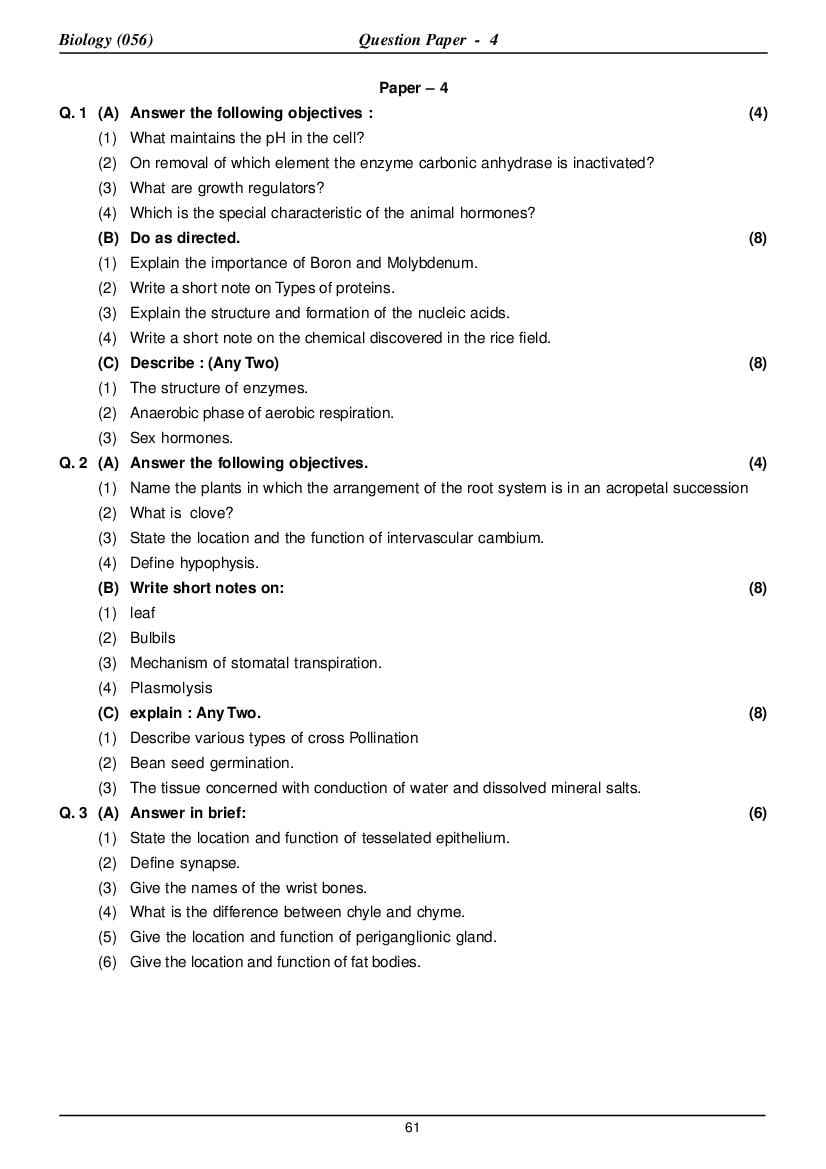
Paper – 4
Q. 1 (A) Answer the following objectives : (4)
(1) What maintains the pH in the cell?
(2) On removal of which element the enzyme carbonic anhydrase is inactivated?
(3) What are growth regulators?
(4) Which is the special characteristic of the animal hormones?
(B) Do as directed. (8)
(1) Explain the importance of Boron and Molybdenum.
(2) Write a short note on Types of proteins.
(3) Explain the structure and formation of the nucleic acids.
(4) Write a short note on the chemical discovered in the rice field.
(C) Describe : (Any Two) (8)
(1) The structure of enzymes.
(2) Anaerobic phase of aerobic respiration.
(3) Sex hormones.
Q. 2 (A) Answer the following objectives. (4)
(1) Name the plants in which the arrangement of the root system is in an acropetal succession
(2) What is clove?
(3) State the location and the function of intervascular cambium.
(4) Define hypophysis.
(B) Write short notes on: (8)
(1) leaf
(2) Bulbils
(3) Mechanism of stomatal transpiration.
(4) Plasmolysis
(C) explain : Any Two. (8)
(1) Describe various types of cross Pollination
(2) Bean seed germination.
(3) The tissue concerned with conduction of water and dissolved mineral salts.
Q. 3 (A) Answer in brief: (6)
(1) State the location and function of tesselated epithelium.
(2) Define synapse.
(3) Give the names of the wrist bones.
(4) What is the difference between chyle and chyme.
(5) Give the location and function of periganglionic gland.
(6) Give the location and function of fat bodies.
61
Page 2
(B) write short notes on : (6)
(1) significance of fertilization.
(2) Blastula.
(3) Lymph – composition and its importance.
(C) Describe any two. (8)
(1) Transport of CO2 through blood.
(2) Significance of portal system.
(3) What is serial homology ? Explain this phenomenon with reference to the limb bones.
Q. 4 (A) Answer to the point (4)
(1) What is splicing?
(2) Give the scientific contribution of Linus Pauling.
(3) What is the inheritance of Y-linked genes?
(4) What is Cis and Trans arrangement of genes?
(B) Explain : Genetic Code. (3)
(C) Answer the following: Any Two. (8)
(1) Giving suitable example explain the decesive role of ovum in cytoplasmic inheritance.
(2) Write a brief account of semiconservative concept of DNA replication. (diagram is essential).
(3) Describe any three errors of metabolism which occur due to mutation in genes.
(D) Draw a neat labeled diagram. (Any one) (5)
(1) systemic venous system of frog.
(2) Internal structure of heart of frog.
Q. 5 (A) Give short answers (6)
(1) What is biosphere?
(2) Define energy farming?
(3) State the laboratory test for AIDS. Which test is more reliable?
(4) Define : Fossil Fuels.?
(5) Write the full form of SPET.
(6) What is Allergen ?
(B) Answer as per instructions Explain: (8)
(1) Why is a blood bank indispensable?
(2) Who is superior Man or nature?
(3) Explain the three steps of organic reaction that takes place during the production of biogas.
(4) Explain the preventive measures against AIDS.
(D) Answer as per instructions : Any Two (6)
(1) Explain hybridoma technique. (diagram essential)
(2) Describe the effect of water pollution on health.
(3) Describe the production of steroids and antibiotics.
62
Page 3
ANSWER
A. 1 (A) Answer the following objectives.
(1) What maintains the pH in the cell ?
The buffer system within the cell cytoplasm maintains the pH in the cell.
(2) On removal of which element the enzyme carbonic anhydrase is inactivated?
On removal of Zn element the enzyme carbonic anhydrase is inactivated.
(3) What are growth regulators?
The chemical substances produced by the plants in small quantity which have considerable
impact on growth and development of the plants are termed as growth regulators.
(4) Which is the special characteristic of the animal hormones?
The special characteristic of the animal hormones is that “A hormone belonging to the individual
of one species may be similar to the corresponding hormone of the individual of other species.”
(B) Do as directed.
(1) Explain the importance of Boron and Molybdenum.
The importance of Boron and Molybdenum is as under.
Boron:
– It is associated with the transport of sugars in plants.
– It plays an important role in the production of fruits and flowers, cell division and certain other
processes.
Molybdenum :
– It helps in the fixation of nitrogen which in turn helps in Growth.
– It forms a component of intestinal enzyme in animals.
(2) Write a short note on Types and properties of proteins.
The types and properties of proteins are as under.
Types :
– There are thousands of proteins in any particular species of living organisms. The protein structure
of different species differ from each other. 20 amino acids play an important role in forming
different types of proteins just as different alphabets in any language forms large number of words
in different combinations. The words in different combinations combine to form different sentences.
These 20 amino acids forms a very large number of polypeptides and proteins such as :
Primary protein :
– When polypeptide chains is linear and filamentous the protein structure is said to be a primary
protein.
Secondary protein :
– When there are different types of bonds in different number and location in polypeptide chain
forming folds and loops, then the protein structure is said to be a secondary protein.
Tertiary or quarternary protein :
– Two or more polypeptide chains are interconnected to form tertiary or quarternary protein.
(3) Explain the formation and structure of nucleic acid. (diagram not necessary).
There are two types of nucleic acids Deoxyribonucleic acid (DNA) & Ribonucleic acid (RNA).
Both the nucleic acids are formed of polynucleotide chain. Polynuclotide chain is formed of many
63
Page 4
nucleotides. Nucleotide is formed when nucleoside binds with a phosphate moity, A nucleoside in
formed when a pentose suger binds with a nitrogen base. The nucleotides bind with each other
by a phosphodiester bonds to form polynucleotide chain. DNA has two polynucleotide chain
where as RNA has single polynucleotide chain.
Structure:
– Watson & crick discovered in 19th century a complete & précised model of DNA (in 1953).
– The molecular model shows two polynucleotide chains arranged parallel to each other, running in
opposite directions.
– The two chains are connected with each other by weak hydrogen bonds in a definite manner and
are spirally twisted & appear like a spiral ladder.
– The purine base of one nucleotide of one polynucleotide chain is linked to the pyrimidine base of
other nucleotide of the opposite polynucleotide chain ie Adenine of one chain is linked with Thymine
of the opposite chain by two weak hydrogen bonds known as p bond Guahine of one chain is
linked with cytosine of the opposite chain by three weak hydrogen bonds called s bond. Thus the
purine and pyrimidine bases are in equal propor tion in each molecule of DNA.
– The length of one complete spiral of DNA is 34 Ao while the width is 20 Ao.
– It the sequence of nitrogen base on one polynucleotide chain of DNA is A C G T C A G T A, then
the sequence of nitrogen base on the corresponding chain will be T G C A G T C A T. Uracil is
absent in DNA.
– RNA has Adenine, Guanine as purine bases and cytosine and uracil as pyrimidine bases.
(4) Write a short note on the chemical discovered in the rice field.
The chemical discovered in the rice field is Gibberellin.
– Two Japanese scientists observed in the rice field some rice plants had unusal height.
– These plants were infected by a fungus called Gibberella.
– This fungus Gibberella contains some growth promoting chemical identified and named as
gibberellin.
– There are different types of gibberellins
– All these types are able to induce the secretions of enzyme amylase that converts the starch in
to sugar.
– The germination of seed becomes possible by the utilization of this sugar.
– This hormone accelerates the rate of cell-division and cell elongation, as a result of which the
internodes become longer causing the increase in the height of the plant.
– It removes the dormacy of seeds and buds and is also helpful in inducing flowering and obtaining
seedless varities of fruits.
(C) Describe : Any Two.
(1) The structure of enzymes.
Structure:
– In some enzymes, along with protein, a nonprotein part is linked. The protein part is called
64
Page 5
apoenzyme and the non-protein part is called prosthetic group.
– Among the prosthetic groups metallic ions such as zinc, iron, magnesium, sodium or cobalt or
any organic substance may be present.
– The prosthetic groups may also be known as co-enzyme or co-factors.
– Organic substance like Nicotinamide adenine dinucleotide (NDA), Nicotinamide adenine
dinucleotide phosphate (NADP), Flavin mono nucleotide (FMN) flavin adenine dinucleotide (FAD),
etc are co-enzymes.
– The co-factors are the metallic ions which renders the enzyme active and makes it effective.
– Some co-enzymes have vitamins as part of their molecules.
– Deficiency of vitamins causes a reduction in the activity of such enzymes which leads to certain
disorders in body functions.
– Sometime enzymes occur in inactive form & becomes active only in the presence of certain
chemical or medium eg, Pepsinogen present in the gastric juice secreted by the stomach of the
vertebrates is converted into active pepsin only in presence of dilute Hcl in the stomach.
– The presence of certain metallic ions is necessary for the activation of some enzyme, eg. Removal
of Zn from enzyme carbonic anhydrase causes inactivation of that enzyme.
– Sometimes more than one metallic ion is required for the activation of the enzyme eg. Enzyme
enolase is activated in the presence of magnesium, manganese and zinc.
(2) Anaerobic phase of aerobic respiration.
– Callular respiration whether occurs aerobically or anaerobically starts with glycolysis in which O 2 is not
utilized . Hence it is called anaerobic phase of aerobic respiration. It is common for both the processes.
– Glycolysis occurs in cytoplasm.
– Necessary enzymes are obtained from cytoplasm itself.
– Glucose an energy rich compound (potentialenrgy) is inactive which is required to be activated
for being phosphorylated for which ATP is utilized
– The process is divided in to two sub-phases. Phosphorylation and Dephosphorylation.
– In phosphorylation ATP molecules are used and in dephosphorylation ATP molecules are
synthesised.
65
Page 6
The process of glycolysis can be briefly shown as follows:
Glucose (6C)
++
Mg ¯ ATP® ADP + P
Glucose – 6 – phosphate (6C)
¯
Fructose – 6 –phosphate (6C)
Phosphorylation
¯ ATP ® ADP + P
Fructose – 1 –6 disphosphate (6C)
¯
DiHydroxyacetone
←→ Phosphoglyc
Phosphate (3C) eraldehyde
(DHAP) (PGAL) 3C
¯ H3 PO 4
1,3 – Diphosphoglyceric acid
¯ ADP + P ® ATP
3 – Phosphoglyceric acid
Dephosphorylation
¯ ¯
+
2H 2 – Phosphoglyceric acid
¯ ¯ ® H2O
To main 2 – Phosphoenol pyruvic acid
Line of ¯ ADP + P ® ATP
ETS (NAD) Pyruvic acid 3C
Glycolysis
C 6 H12 O 6 → 2 CH 3 − CO − COOH + 4 H + + 2 ATP
The equation for glycolysis can be given as follows:
Glucose Pyruvic acid
Phosphorylation :
– A molecule of phosphate (phosphoric acid) released from ATP combines with glucose to form
glucose 6 – phosphate. (glucose monophosphate). Here glucose & phosphate are linked where
th
phosphate joins with glucose at the 6 carbon atom of glucose – 6 – phosphate is converteed in
to its isomer fructose – 6 – phosphate.
– Fructose – 6 phosphate in turn is phosphorylated by another ATP and converted in to fructose 1-
6-disphosphate
– A type of lyase – an enzyme aldolase split the fructose –1-6 diphosphate into two molecules of
triose phosphate (viz, a molecule of dihydroxyacetone phosphate and a molecule of
phosphoglyceraldehyele)
– DHAP & PGAL can be interconverted DHAP is unable to participate directly in the process. It is
used only after it is converted into PGAL.
66
Page 7
– A molecule of H3PO4 joins with PGAL to convert the later into 1-3 –Diphosphoglyceric acid
+
(DPGA) with the liberation of 2H+ ions. (In aerobic respiration the 2H ions, so released go to the
main line of ETS)
Dephosphorylation :
– In this DPGA reacts with ADP to form phosphoglyceric acid PGA and ATP.
– The PGA loses a molecule of water and getis converted into phophoenol pyruvic acid.
– Phosphoenol pyruvic acid reacts with ADP to form pyruvic acid.
– During these process twice 2H+ and twice 2 ATP (ie 4 ATP) are formed.
– During phosphorylation 2 ATP molecules are used therefore in glycolysis the net gain of ATP is 4-
2 = 2 ATP and 2 molecules of pyruvic acid are formed from one molecule of glucose.
(3) Sex – Hormones.
– The sex-glands not only produce sex-cells ie gametes but they also secrete hormones called
sex-hormones.
– Testes and ovaries, therefore are known as endocrinal glands.
– The sex-hormones influences the production of sex-cells, manifestation of sexual characters
and behaviour of the organisms.
Testes: It is a male reproductive organ.
– It produces hormones collectively called androgens, chief among them is testosterone.
– FSH of the pituitary gland and testosterone of the testis influence the production of the sperms as
well as development and maturation of the spermatozoa. (male sex-cells) in the seminiferous
tubules.
– Testosterone is produced by the interstitial cells called the leydig cells.
– The function of the leydig cell is dependent on the interstitial cell stimulating hormone (ICSH) of
the pituitary gland.
– Testosterone being a male sex-hormone stimulates the male reproductive organs and accessory
(dormant) sexual characters. Similarly, a strong muscular body facial and other body hair (chest)
and other masculine features are characteristics dependent on the male sex-hormone the
testosterone.
Ovary: It is a female reproductive organ .
– It is partially an endocrinal gland. It secretes the female sex hormone called estrogen.
– The development of oviducts (fallopian tubes) uterus, vagina, mammary glands (breasts) etc is
mainly due to the influence of estrogen. Feminine gracefulness, development of breasts etc are
manifestation of the action of estrogen.
– During woman hood (adulthood) another hormone called progesterone helps in preparing the
uterus for conception and induces conditions favourable for the nurture (breast feeding) of an infant.
– The development of ova in the ovary is brought about by the combined action of FSH, LH and
LTH. Similarly the functional development of ovarian follicles, producing estrogen depends upon
FSH and LH.
– After ovulation, ie release of ovum, the subsequent elaboration of progesterone is facilitated by
formation of corpus luteum.
– A total lack of gonads (sex glands) leads to the absence of sex hormones resulting in infertility
and the absence of secondary sexual characters.
– It the sex-glands are destroyed or if they undergo degeneration after puberty then appreciable
changes do not occur with regard to secondary sexual characters.
67
Page 8
– Conversely, degeneration of gonads prior to puberty results in conspicuous alteration in sexuality,
secondary sexual characters and sexual development.
A. 2 (A) Answer the following objectives :
(1) Name the plants in which the arrangement of root is in acropetal succession.
Plants like Datura and Vinca have the arrangement of root in acropetal succession.
(2) What is clove ?
In garlic each of the axillary bud in the axil of the scaly leaves has stored food material in one of
its scaly leaves. Each such bud is enclosed in a tough, scaly membranous leaf and is known as
a clove.
(3) State the location and function of intervascular cambium.
Location of intervascular cambium: it is found on the lateral sides of the growing stem and root
Function It is responsible for the formation of secondary tissues which increases the diameter of
the stem & the root.
(4) Define hypophysis:
The terminal cell of the suspensor which is closely associated beneath the octant is called
hypophysis cell.
(B) Write short notes on :
(1) leaf :
– It is an important part of the plant
– It always develops from the node of the stem.
– It may be scaly or usually green, dorsoventrally flattened having limited growth and life span.
– The green colour is due to chloroplast in most of its cells.
– A typical leaf consists of a leaf base, petiole stipules and the lamina.
– The leaf is said to be petiolated or sessile on the basis of presence or absence of petiole eg leaf
of sunflower is petiolated and that of maze is sessile.
– The leaf may be simple or compound.
Normal functions of leaf :
– Due to large number of chloroplasts in leaves they are able to synthesize organic food through
photosynthesis.
– They lose a large amount of water through stomata by a process called transpiration.
– They also perform gaseous exchange through stomata for respiration.
(2) Bulbils :
– When an exillary bud or a floral bud becomes fleshy by storing food and performs the function of
vegetative propagation instead of developing into a branch or a flower, it is called a bulbil.
– In diascorea, the axillary bud stores food and becomes fleshy and hard.
– It detaches from the parent plant and germinates under favourable condition and gives rise to a
new plant.
– In agave the floral buds develop in bunches on a long floral axis.
– Some of these floral buds store food and become fleshy instead of developing into flowers.
68
Page 9
– In both of these plants vegetative propagation takes place when the plant is passing through the
active phase of growth during favourable conditions for perpetuation of life.
(3) Mechanism of stomatal transpiration.
– Due to the effect of atmospheric temperature the relative humidity in the atmosphere decreases
during the day time.
– At this time the internal environment in the leaf is saturated with moisture
– According to the simple law of diffusion the water vapour thus diffuses from the leaf through
stomata into the atmosphere.
– Since the amount of water in the cells decreases, the cells obtain water from the adjacent xylem
elements to compensate the loss.
– This is a continuous process during day time while at night it occurs almost negligibly.
– Through the process of photosynthesis the guard cells synthesize glucose during the day time
as they contain chloroplasts and a major part of glucose is converted into starch.
– The CO2 produced as a result of respiration as well as that which is in close vicinity of the
stomata is used in the process of photosynthesis.
– As a result of reduction in the quantity of CO2 the PH increases in the guard cells which therefore
becomes alkaline.
– Due to this the permeability of their walls increases and the water from the surrounding epidermal
cells is absorbed by them.
– The guard cells, thus, become turgid and cause the opening of the stoma.
– Photosynthesis does not occur after sunset, for want of light, as a result CO2 is not utilized and
it accumulates in the environment.
– As a result the PH decreases in the guard cells thus becomes acidic to some extent.
– So the guard cells lose their turgidity and close the stomata
– The stomata thus remain closed at night.
(4) Plasmolysis : The solution of relatively higher concentration is called a hypertonic solution while
the one having relaively lower concentration is called a hypotonic solution. The solution having
relatively similiar concentration is called an isotonic solution. When the coloured cells of the
epidermis of Tradescantia leaf are kept in hypertonic sugar solution and observed after some
time under the microscope, the cytoplasm is seen to have shrunk and separated from most part
of the cell wall. This phenomenon of shrinking of protoplasm is known as plasmolysis. This process
can also be easily observed in the coloured cells of petals of rose, tomato peel etc., as the
cytoplasm is colourful.
–
(C) Explain any two :
(1) Cross Pollination:-
Wind pollination: Several plants such as cocounut palm, date palm, Indian hemp, maize and
several species of grass show wind pollination. The wind pollinated flowers are unisexual.
They are generally dull in colour and lack showiness, odour and nectar. Their pollen grains
69
Page 10
are very small, round, smooth and very light in weight and are produced in a very large
number. The pollen grains do not absorb moisture easily and hence do not become heavy.
This is suitable for wind pollination. The pollen grains of Pinus are winged ( an adaptation for
wind pollinatioin).
Water Pollination:- This type of pollination occurs on the surface of water on inside the water, In
Vallisnaria plant, it occurs on the surface of water. In this plant the male flowers get detached
from the plant and float on the surface. The female flowers have long and slender peduncle.
The flowers reach the surface when the coiled pednucles become straight and elongated.
The male flowers surround the female flowers. At this time the anthers burst andthe sticky
pollen grains stick to the stigma of pistil. After this type of pollination the spirally coiled
peduncle contracts and pulls the female flower under water.
Insect Pollination:- This is very common type of pollination in plants. Most ofthe insect pollinated
angiospermic plantshave large, beautifully coloured and attractive flowers with pleasant odour
and sweet nectar. Their arrangement is also such as to attarct the insects. The flowers, if
small, are in clusters. The pollen grains are round, smooth and sticky or having spiny or
hairy surface. such pollen grains stick to the hairy surface of the body parts of the insects
such as honey bees, moths, butterflies etc. and are carried to other flowers thereby causing
pollination.
Pollination by birds:- Some small birds with long beak are in search of nutritive food like nectar or
honey from the flowers. Such birds visit the flowers and unknowingly cause pollination.
Bombax, Aloe, Yellow oleander etc. are bird pollinated plants. Such plants have bell or funnel
shaped corolla and nectar in the flowers. The petals have attractive colours such as red,
yellow, blue etc.
Pollination by bats:- The bat is a nocturnal, flying mammal. It visits large flowers having strong
odour. It flies swiftly at night and carries pollen grains with itself to quite a long distance.
Kigelia is a tree that shows pollination of its flowers by bats.
(2) Bean seed germination (diagram is necessary)
– The seed is sown in the loose and moist soil it imbibes water through the micropyule due to which
it becomes active and enlarged.
– As the entire seed swells, the cells obtain energy from the stored nutrients by the process of
respiration.
– The radicle develops first, which elongates and emerges through the micropyle.
Germination of Bean Seed.
– The radicle elongates in the direction of soil and water and gravitational force and forms the
primary root.
– On continuous absorption of water the seed swells more and more which results in bursting of
70
Page 11
seedcoats.
– The hypocotyl grows and elongates into a loop-like structure and emerges from the soil.
– The hypocotyl lies in connection with the radicle at one end and the plumule at the other end.
– The primary root gradually develops from the radicle and produces branches and sub-branches
and forms normal tap root system.
– The hypocotyl grows straight and erect thereby pulling out the cotyledons with the enclosed and
well protected plumule from the seed coats.
– The two cotyledons become separated from each other owing to the reduction of nutrients there
in, while the plumule develops and produces the first leaf beneath the apical bud.
– Subsequently the leaves develop with the growth of the seedling.
– The shoot between the two cotyledons and the primary root is called hypocotyl, where as that
beneath the cotyledons and the first leaf is called epicotyl.
– The two cotyledons come out above the soil during the seed germination of bean seed, thus the
bean seed germination is called epigeal germination.
(3) The tissue concerned with conduction of water and dissolved mineral salts.
The tissue concerned with conduction of water and dissolved mineral salts is termed as xylem.
– Most of the components of this tissue have their walls lignified, hence they provide more
mechanical strength.
– The components of xylem are as under:
(1) Tracheids :
– They are fundamental components of xylem.
– They are unicellular, long and cylindrical structures tapering at both ends.
– Their highly lignified walls are not uniform, The thickenings forms the secondary layer of the
cell wall.
– The thickenings in the wall are of different types such as spiral annular, reticulate, scalariform
pitted or bordered pitted.
– The tracheids formed earlier shows annular or spiral thickening, but those formed later show
the other types of thickenings.
– The tracheids are the dead cells found in pteridophytes, gymnosperms and primitive
angiosperms.
(2) Trachea :
– The tracheid cells are arranged one above the other in a linear manner lose their partition
walls and form a continuous tubular structure for conduction of water & dissolved mineral salts.
– Trachea show various types of thickenings in their walls.
– The conducting capacity of trachea is better because of their larger lumen.
– Due to lignin thickenings the trachea provides mechanical strength and rigidity.
– They are found in certain pteridophytes, certain higher gymnosperms and in angiosperms.
– They are absent in several aquatic angiosperms, saprophytic and parastic plants and fleshy
plants.
(3) Xylem parenchyma
– The living parenchymatous cells associated with xylem are known as xylem parenchyma
– The cells associated with primary xylern are thick walled.
71
Page 12
– They may contain starch grains, oil droplets and certain other cell inclusions and are believed
to help in lateral conduction.
– They are also known as wood parenchyma.
(4) Xylem sclerenchyma (wood fibres) :
– The fibrous cells associated with xylem are called xylem sclerenchyma.
– They are believed to have originated along with tracheids.
– Their walls are more thickened and hence smaller than tracheids with narrower lumen.
– They provide mechanical strength and rigidity to the organs.
A. 3 (A) Answer in brief
(1) State the location and function of tessellated epithelium.
Tesselated epithelium are seen in the wall of blood vessels.
As this tissue is very thin, it is concerned with diffusion and filteration processes.
(2) Define “Synapse”.
The nerve endings of the axon of one neuron and the nerve endings of the dendron of other
neuron are not directly and physically connected with each other, but keep extremely minute
gaps between the points of contact and form a functional contact, such an arrangement of
interconnection is called a synapse.
(3) Give the names of wrist bones
The wrist bones are called carpals. They are six in number arranged in tow rows. The proximal
72
Page 13
row consists of a radial, an inter, mediale and an ulnare, while distal row consists of a trapezium,
a trapezoid and capitatohametum.
(4) What is the difference between chyle and chyme.
Digestion is completed in the small intestine when the food is converted into alkaline fluid
form which is called chyle.
The food which enters from stomach to duodenum is partially digested and becomes acidic
which is called chyme.
(5) Give the location and function of periganglionic gland.
In the neural canal, near the intervertebral foramen, there is a dorsally located periganglionic
gland, gland of swammerdam, which secretes white and bright calcareous material. This secretion
hardens and renders tensile strength to the root of spinal nerve.
(6) Give the location and function of adipose tissue.
In both male and female frogs several fat bodies are attached to the anterior ends of kidneys.
Fat body formed of adipose tissue having lot of stored fat in its cells. This fat provides energy
for survival during hibernation and aestivation.
(B) Write short note on: Significance of fertilization.
Generally the unfertilized egg does not develop into embryo and produce a new animal Fertilization
is, Therefore, essential.
The haploid egg and the haploid sperm produced during gametogenesis meet and fuse with
each other in the process of fertilization and establish the diploid state in the zygote.
The specific diploid number of chromosomes of the species is maintained. The maturation of
the egg cell is completed only after the entry of the sperm in it.
The process of fertilization adds new vigour and activeness in the egg cell which becomes
active for embryo development.
– The fertilization brings about the combination of characters of both the parents in the offsprings.
– The grey crescent formed in this process determines the future anterior posterior axis and the
axis of bilateral symmetry in the spherical zygote.
(2) Blastula (figure is not required)
– A very small cavity arises in the animal hemisphere as a result of cleavages. It is called
segmehtation cavity which makes its first appearance at the end of 8 celled stage of the embryo.
– With the continuation of further cleavages this cavity becomes more and more distinct and
enlarged. It is now called blastocoel which is filled with some fluid. Thus, the embryo becomes
hollow.
– Its roof is formed of 2-3 layers of micromeres and the floor is formed of megameres. The embryo
having blastocoel is called blastula. The zygote floats on the surface of water with the animal
hemisphere and animal pole on the apper side due to its telolecithal form.
– The blastocoel being formed in the embryo in the animal hemisphere. It further adds to the stability
of the embryo in keeping the animal pole above.
– Externalyblastula stage shows only micromeres and megameres and internally the blastocoel in
addition to the above cells. Thus a fate map of prospective areas can be drawn even in the
blastula stage of the embryo. Prof vogt experimented on the frog embryo using improved staining
technique and found some more prospective areas.
73
Page 14
(3) Lymph- composition and importance.
– When the blood is flowing through the blood capillaries, some of its consituetnts ooze out through
the thin walls of the capillaries and flow around the tissue cells in the intercellular spaces.
– Certain types of WBC such as lymphocytes and basophils traverse through the cells of the walls
of the blood capillaries and come out along with the fluid part. This fluid and the WBC there in
seperated from the blood flow amidst the tissue cells and known as lymph.
– The lymph is a colourless, alkaline fluid containing only certain types of WBC and totally devoid
of RBC.
– It contains more water and metabolic wastes and less amount of protein as compared to that in
the blood plasma.
– Even fibrogen is less in lymph than in blood plasma.
– The lymph has the property of clotting as is in blood. The lymph acts as a fluid agent for the
exchange of nutrients, respiratory gases as well as soluble metabolic wastes between the blood
and the tissue cells.
– All the parts of the body of frog possess a complex network of thin walled lymph vessels formed
by their union with each other. Lymph provides an important fluid medium for the physiological
process like nutrition, respiration, excretion etc.
(C) Describe any two of the following :
(1) Transport of CO2 through blood.
– CO2 set free as a result of tissue respiration is transported through blood in different forms which
is a complex process. Transport of CO2 coming from body tissues.-
– A very small amount of CO2 coming from tissues dissolves in the water of blood plasma, while
major part enters in RBC which is transported as physical solution to the respiratory surface.
– A considerable amount of CO2 entering the blood reacts with plasma proteins of blood plasma in
the presence of sodium and haemoglobin in RBC in the presence of potassium to form carbamino
proteins (NaPr) and carbamino haemoglobin (KHb) respectively.
– These carbamino compound are transported through blood to the respiratory surface where CO2
is separated and diffused out. A major part of CO2 is transported in the form of bicarbonates as
follows.-
– CO2 reacts with water (H2O) in the blood plasma as well as RBC to form H2CO3.
– In blood plasma some of the H2CO3 formed combines with carbamino protein compound (Napr)
and forms NaHCO3 and HPr, while some H2CO 3 combines with buffer Na2HPO 4 and forms
NaH2PO4 and NaHCo3
– In RBC, CO2 and H2O combine and form H2CO3 with the help of the enzyme carbonic an hydrase.
The acidity in the RBC increases due to formation of H2CO3.
– To neutralize this, the formed H2 CO3 combines with carbamino haemoglobin compound (KHb) to
form KHCO3 and HHb with the formation of H2CO3. To neutralize this, the formed H2CO3 combines
with the formation of KHCO3 the alkalinity increases in RBC. Hence the osmotic pressure increases,
as such the RBC imbibe water from the blood plasma and swell. Continuation of this process
may cause haemolysis.
–
– The cell membrane of RBC is permeable to anions only the Cl dissociate from Nacl in blood
–
plasma and enter the RBC to react with KHCO 3 and form KCl and HCO 3. This is called chloride
74
Page 15
– +
shift. The HCO 3 ions come out of RBC and react with Na ions to form NaHCO3 in the blood
plasma.
– Thus with chiefly NaHCO3 in the blood plasma and KCl and HHb in the RBC, the blood reaches
the respiratory surface.
(2) Significance of Portal System -
The veins drain blood from different organs and collect different substances from them to be
carried towards the heart, while the portal vein capillaries in Certain definate organs to come in
direct contact with maximum number of cells, thereby providing them a large surface area for
absorption of material from the blood.
– Significance of Renal portal system -
– The hind limbs of frog are the most active organs. Hence the blood coming from them contains a
considerably large amount of metabolic wastes. The blood comes into the kidneys through the
renal portal system.
– The cells of the uriniferous tubules are able to absorb the metabolic wastes from these capillaries
and render the blood free from harmful wastes.
Significance of Hepatic portal system
– The surplus glucose from that absorbed by the blood from the digestive tract is absorbed by the
hepatic cells and converted and stored as glycogen which is consumed for obtaining energy
during aestivation and hibernation.
– Bacteria and other microbes that have entered the blood through the rectum or any other part of
the body are engulfed and destroyed by the hepatic cells.
– The poisonous and badly smelling substances etc. produced as a result of incomplete oxidation
of proteinous substances in the large intestine by bacteria are removed by hepatic cells.
– The hepatic cells first convert them into ammonia and then into Urea by combining with CO2.
– The surplus amino acids from those absorbed by the blood from the intestine undergo deamination
after getting absorbed by the liver cells.
– The amino group (-NH2) so separated is converted into glucose and stored in liver in the form of
glycogen.
(3) What is serial homology ?
Explain this phenomenon with reference to the limb bones.
– Hind limb bones include a femur, atibiofibula, tarsals, calcar, metatarsals and phalanges, which
are all cartilage bones.
– The hind limbs being used for jumping and swimming they are much longer than the fore limbs.
– Hence all of their bones are relatively longer and stronger.
– Just as the fore limb bones are distributed in the five regions, brachium, antebrachium, wrist palm
and fingers, the hind limb bones are also distributed in the five regions, thigh, shank, ankle, sole
and toes.
– The number or structure of the bones of the corresponding regions of the two types of limbs
show marking similarity such a phenomenon of corresponding similarity is called serial homology
which is also exhibited in the vertebral column and the girdles of frog.
75
Page 16
A. 4 (A) Answer to the point
(1) What is splicing ?
During the formation of mRNA, only the transcribed portion of exon gets separated and are
joined together to form a straight mRNA chain. This is called splicing.
(2) Give the scientific contribution of Linus pauling.
Linus pauling first described sickle cell anaemia disorder.
(3) What is the inheritance of Y-linked genes.
Certain genes are located only on the Y-chromosome, of which many are involved in the
mechanisms of sex determination and differentiation.
– In man the growth of hair on the ears rims and beard and development of testes are controlled by
genes located on the Y-chromosome and hence they are expressed only in the male. Such genes
are termed as holandric genes, such characters are transmitted from the father to the son.
(4) What is Cis and Trans arrangment o genes ?
Cis linkage is the term used it both dominant genes are linked on one chromosome and both
recessive genes on other homologus chromosome.
– In trans linkage is the term used, if one dominant gene and one recessive gene on one chromosome
and a recessive and other dominant genes are linked on other homologus chromosomes.
(B) The Genetic Code: The various nucleotides of DNA template are arranged in a definite linear
sequence along the length of a DNA strand. Each nucleotide is recognised by its nitrogenous
base. This sequence of nucleotides forms a definite chem,ical code which determines the specific
sequence of amino acids to be arranged on the ribosomes for the purpose of protein synthesis.
There are only four types of nitrogenous bases (A,C, G & T) in the DNA molecule. The
genetic code comprises of a definite order or arrangement of these four bases. If each base
76
Page 17
represents as a code for one amino acid, then they can represent only four amino acids. In the
same way, if two similar or different nitrogen bases form a duplex code, then a maximum of 16
amino acids can be coded, which are not sufficient for 20 amino acids. Hence the code must
consist of a sequence of more than 2 nitrogenous bases. If a sequence of three same or
different nitrogen bases from the genetic code, then 64 possible triplet codons can be fromed
from the different combinations of the 4 nitrogen bases. These numbers are sufficiently enough
to represent 20 amino acids. Nirenburg and his co-workers experimentally proved that each
amino acid is represented by one or more triplet condons. There is a single triplet genetic code
(AUG and UGG) for the amino acid methionine and tryptophan. Three genetic condons are for
iso-luecine. There are six genetic condons for the leucine, serine and arginine, while there are
two or four genetic condons for other amino acids. Hence, major amino acids consist more than
one genetic condon and these genetic condons are known as degenerate condons. The degenerate
condons do not overlap each other and also one genetic code does not represent more than one
amino acid. So that the chances of genetic mutation decreases due to these degenerate condons.
(C) Answer the following
(1) Giving suitable example, explain the decesive role of ovum in cytoplasmic inheritance.
– Carl correns and his co-workers suggested the possibility of inheritance pattern of plastids may
be regulated by cytoplasm.
– Correns explained this phenomena based on experiments carried out in the ‘4’-O cloak plant,
Mirabilis jalapa.
– When a pollen of a flower on the branch (male) with completely green or pale or variegated
leaves were used to pollinate the flower on the branch (female) of a completely green variety, the
offsprings always developed a completely green leaf phenotype.
P Carpel of a flower on completly X pollen of a flower on green
green branch (female) ↓ pale or variegated (male)
F1 only completely green variety
– When a pollen of flower on a branch (male) with completely green leaves was allowed to pollinate
the carpel of the flower on the branches (female) having green, pale or variegated, leaves, the
offepring always showed all three mixed characters (green, pale or varieg ated) variety braches.
P carpel of flower on branch with X pollen of flower on branch with completely green
green pale or variegated leaves ↓ leaves
F1 offspring with green, pale, variegated leaves.
– The offspring obtained by various crosses as mentioned above, has shown “maternal effect”,
because ovum has a large quantity of cytoplasm as compared to pollen. Thus it is possible to
regulate the characters due to the presence of plastids DNA for its pattern of inheritance. shown
in the figure the central circle represents the type of branch that produces flower which are
pollinated. Intermediate circle represents branch from which pollen is used and other circle shows
progeny.
77
Page 18
(2) Write a brief account of semi conservative concept of DNA replication (diagram is essential)
When a cell divides a similar DNA is (genetic maerial) transferred from the parent cell to the
daughter cell produced by this division. Each cell must therefore replicate its DNA content. Through
replication from the parent DNA a new DNA strand is synthesised DNA is a double helix, formed
of 2 strands held together with weak hydrogen bonds and basic protein.
– To begin replication special “helicases” enzyme opens up the segments along the DNA double
helix.
– The energy is obtained from ATP for this process. Each DNA separated strand acts as a template.
– New DNA synthesised on a specific sequence of Nitrogenous bases of the template
– The RNA polymerase creates a short strand, a RNA primer which is complementory for each
related DNA strand. Once the primer is in position the enzyme DNA polymerase starts the process
of DNA replication.
– One of the new strands called the leading strand grows in the 5’ ® 3’ direction DNA polymerase
78
Page 19
is able to add new nucleotides continuously to form the complementary daughter strand in the 5’
® 3’ direction. New nucleotide monomers are added continuously and join one by one to the 3’
end of the growing new strand by phosphodiester linkages.
– The new strand of DNA produced anti parallel to the other parental DNA strand is known as
lagging strand, which also grows in 5’ ® 3’ direction.
– The DNA polymerases are unable to join nucleotides continuously in the growing direction of the
new strand, hence the DNA on lagging strand cannot be synthesised straight. But the daughter
DNA for this template is there fore synthesised discontinuously in short pieces called OKAZAKI
FRAGMETS.
– The nucleotides of RNA primer are also removed one by one. The newly produced okazaki
fragments are joined with each other by the help of DNA ligase enzyme, to form 5’ ® 3’ DNA
strand, which remains close and parallel to the original antiparallel 3’ ® 5’ DNA strand.
– Thus each parental DNA strand synthesizes a complete molecule of DNA by forming its own
new counter strand. Hence each new DNA among the two DNA produced by one parental DNA,
comprises of one parental DNA strand and other newly synthesised strand in this way the
production of each DNA molecule maintains the semi conservative concept.
(3) Describe any three errors of metabolism which occur due to mutation in genes.
Abnormalities arise from changes in chromosomal structure and number, so also changes in the
structure of the genes cause several defects in metabolism. Due to breakage in the chromosome
and their irregular reconstitution eg.: Ionising radiation such as x-rays and several chemicals.
Phenyl ketonuria (pku): Generally the amino acid phenyl alanine in found in the normal diet with
the help of the liver phenyl alanine hydroxylase it is converted to the amino acid tyrosine. In the
disorder phenyl ketonuria, due to the alteration of a homozygous recessive gene the enzyme
phenyl alanine hydroxylase is not produced. As a result, this disorders arises. This homozygous
recessive gene has been fermed as the pk gene. In this disorder therefore, phenylalanine is
converted to phenyl pyruvic acid, which increases in concentration in the blood. This has an
adverse effect on the nervous system and reduces the intelligence.
Alkaptonuria:-
An autosomal recessive gene is associated with this disorder. This disorder results from the
absence of an enzyme homogentisic acid dehydrogenase. The urine turms black because of the
presence of homogentesic acid .
Albinism
Due to a deficiency of the enzyme tyrosinase, tyrosine is not converted to melanin. The skin and
hair remain white and pigmentless. The iris of the eyes are also blue in colour. In such cases, the
individuals are extremely sensitive and cannot with stand much light.
79
Page 20
– The following chart explains the metabolic disorders
(D) Draw neat and labeled diagram (anyone)
(1) Systemic venous system of frog (2) Internal structure of heart of frog
(D) (1) Systemic venous system of frog :
80
Page 21
(D) (2) Internal structure of heart of frog :
Heart of frog (Internal Structure)
A. 5 (A) Give short answers :
(1) What is biosphere?
The layer which forms a cloak or covering around the earth surface has been termed as the
biosphere.
(2) What is energy farming?
Selective plantation of trees for the purpose of energy has been termed as energy plantation.
(3) State the laboratory tests for AIDS which test is more reliable?
AIDS can be diagnosed by the following tests.
(1) ELISA test ® means enzyme linked immuno absorbent assay.
(2) Western Blot test (W.B.test). By this test can be ascertained most reliably whether a person
is infected by HIV or not. This test is quite expensive it is a sure test.
(4) Define fossil fuels.
The energy sources like minerals, coal, petroleum and natural gas are called fossil fuels.
(5) Write the fullform of SPET.
Single photo emission tomography.
(6) What is Allergen?
Substances which are responsible for the production of an allergy are called allergens.
(B) Answer as per instructions
(1) Why is a blood bank indispensable?
Blood transfusion is the term used when a person, who has suffered blood loss and requires
81
Page 22
blood during an accident or due to haemorrhage in digestive tract, during abortion or during
surgical operation is given the blood.
– Lack of blood can be fatal and if blood is not given immediately, the patient can die.
– Blood transfusion is not possible with out matching of the blood.
– Quite a few persons die due to Lack of blood transfusion.
– A blood bank collects blood from donors, tests the same and stores (preserves) the same
groupwise, and makes blood available for transfusion whenever needed.
– Blood bank not only tests the blood group but also ensures that the blood available for transfusion
is infection free.
– It also maintains records of name, address, Telephone number, blood group etc of donors so that
they could be contacted when blood is required in an emergency.
(2) Who is superior man or nature?
There are several imbalances and ill effects on environment caused by man it is experienced
that man is capable of changing the environment but he cannot alter the natural laws as man
cannot change his basic requirements.
– Of today man goes to the height of mountain, at deep bottom of seas or fly to space or other
planets, his basic needs for the continuity of his life and life maintenance are not going to change.
– Thus, it has become a moral responsibility of man to protect environment for the benefit of his
own and other organisms.
– It is necessary to do it also to protect our own species.
(3) Explain the three steps of organic reaction that take place during the production of biogas.
Biogas is produced by anaerobic fermentation of any biomass. Biogas is composed of 50 to 70%
methane 30 –40% carbon dioxide alongwith smaller amounts of hydrogen, nitrogen and hydrogen
sulphide.
– Anerobic micro-organism carry out the organic degradation of organic polymers and produce
suitable monomers.
– In this process, digestive enzymes of cellulose, protein and lipids play a role.
– Micro organisms do not degrade the lignin, therefore inorganic salts and lignin remain precipitated.
– In the second step, monomers are converted to organic acids by micro-organisms.
– Lastly, this acid is converted into methane by particular methanogenic anaerobic bacteria.
– Decomposition of cellulose takes a longer time, hence the production of biogas takes place after
some time.
– The use of dung as raw material for biogas is much better use of dung and profitable than using
it only as fertilizer or fuel.
(4) Preventive measures against AIDS.
– The injection syringe used once for the AIDS patient should in no case be used for any one else
– Sexual contact with many persons should be strictly avoided.
– The blood transfusion should be avoided unless inevitable.
– Even when the blood transfusion is un avoidable the blood of professional donors should in no
case be used.
– The blood of voluntary donor should also be used only after its through examination.
82
Page 23
– When the surgical operation is pre-planned the patient should deposit his or her own blood in the
blood bank well in advance and should insist to use the same at the time of operation.
– Only disposable syringe and injection needle should be used for getting oneself injected. The evil
of consuming narcotic drugs should be checked right in its initial stage.
– To prevent the transmission of AIDS in the future generation the HIV positive women should strictly
avoid pregnancy and take precautionary measures to avoid the spread of AIDS in other persons.
(C) Answers as per instructions (any two)
(1) Explain hybridoma technique (diagram essential)
– This is the most modern technique by which
special type of monoclonal antibodies
against the harmful effects of cancerous
cells as well as against the substance
invading the body.
– An antigen is injected in the body of mice.
After a few days the spleen of such mice is
taken out in which the lymphocytes have
produced against the injected antigen.
– Lymphocytes are fused with cancerous
cells in the presence of fusogen.
– The cell, so formed by the fusion of two such
cells, is known as hybridoma, which is
capable of cell division.
– Such hybridoma cell can produce only one
specific type of antibody which is known
as monoclonal antibody.
– These cells are cultivated to increases in number.
– These cells are, then tested individually for their ability of antibody production .
– The selected hybridoma cells are allowed to multiply in the culture medium and, thus, the necessary
amount of antibody can be obtained.
(2) Describe the effects of water pollution on health.
Just as clean air is an essential requirement so also pure, clean water is essential for a good
healthy life.
– When drinking water from certain sources get mixed and contaminated with dirty and polluted
water it becomes infested with diseases causing bacteria, fungi and several other diseases
causing organisms. Hence this causes an epidemic of disease like cholera, dysentery, typhoid
jaundice and skin diseases.
– During monsoon large quantities of pesticides and chemical fertilizers, toxic chemicals contaminate
rivers, causes severe toxic effects to various body organs.
– Effluents from industries, causes damage to organ like brain, liver, kidney, alimentary canal.
– Mercury, when converted to methyl mercury becomes toxic which affects the chromosome
separation.
– DDT when enters in the body, effects on the nervous system and sex hormones.
83
Page 24
– In addition to that it accumulates in human tissues and increases the chances of formation of
tumours induction of cancer and also induce body malformation.
(3) Describe the production of steroids and antibiotics
Steroids originate from plants as well as animals.
– Steroids of plant origin can be obtained cheaper and by less expensive techniques. Hence steroids
like those of animal origin can be transformed from the steroids of plant origin by using the fungus
Rhizopus stolonifer through the process of hydroxylation and dehydrogenation.
– Such steroids are used as anti-inflammatory and a cancer drugs, for developing immunity against
asthma, organ transplantation as well as for family planning.
– Some of the microorganisms can produce certain chemical substances which inhibit the growth
of other organisms or kill them altogether such chemical substances are called antibiotics.
– Walks man was the first to use the term antibiotics.
– Alexander Flemmings discovered the antibiotics penicillin from the fungus penicillin.
– Walksman and woodruff discovered Actinomycin and streptothricin.
– Various fermentation techniques are employed in order to increases the production of different
new antibiotics.
– The treatment by these antibiotics is certainly reliable and almost safe.
– Three groups of micro-organisms made use of for a large scale production of antibiotics are
eubacteriales Actinomycetales and fungi
– The advanced Countries like America and Japan have paid attention to improvise the genes of
the microorganisms useful for antibiotic production.
84
Document Details
| Board / Org | Gujarat Board |
| Exam | Class 12 |
| Type | Sample Paper |
| Pages | 24 |
| Updated | 22 Jul 2026 |