UGC NET Drama Theatre Question Paper 2018
Finished viewing? Save it for later —
Download UGC NET Drama Theatre Question Paper 2018 (PDF · 48 pages)About UGC NET Drama Theatre Question Paper 2018
UGC NET Drama Theatre Question Paper 2018 is available here for free download. Published by NTA for UGC National Eligibility Test, this question paper can be viewed online or downloaded as a PDF (48 pages). Candidates preparing for UGC National Eligibility Test can use UGC NET Drama Theatre Question Paper 2018 to understand the exam pattern, the type of questions asked, and the overall difficulty level.
Frequently Asked Questions
How can I download UGC NET Drama Theatre Question Paper 2018?
Open this page and click the Download button to save UGC NET Drama Theatre Question Paper 2018 as a PDF. It is completely free on AglaSem Docs.
Is UGC NET Drama Theatre Question Paper 2018 free to download?
Yes. UGC NET Drama Theatre Question Paper 2018 can be viewed online and downloaded as a PDF free of cost on AglaSem Docs.
How many pages does UGC NET Drama Theatre Question Paper 2018 have?
UGC NET Drama Theatre Question Paper 2018 contains 48 pages, which you can read online or download together as a single PDF.
Where can I find more UGC National Eligibility Test study material?
You can find more UGC National Eligibility Test question papers, sample papers, syllabus, and answer keys on AglaSem Docs.
UGC NET Drama Theatre Question Paper 2018 – Text
Read the full text of this question paper below — useful to quickly search, copy and reference the content online without downloading the PDF.
📄 View text version (48 pages)
Page 1
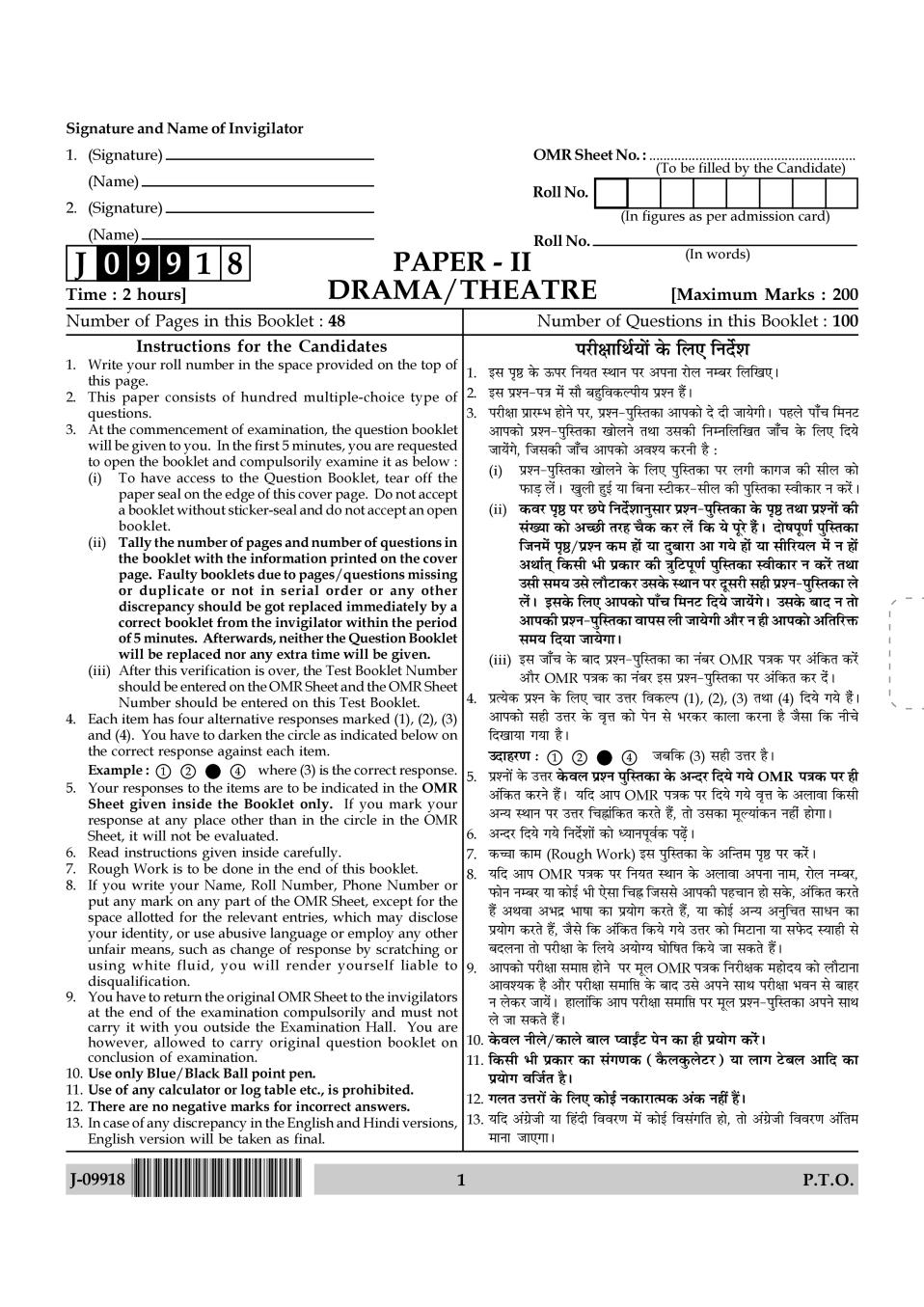
1. (Signature) OMR Sheet No. : ..........................................................
(To be filled by the Candidate)
(Name)
Roll No.
2. (Signature)
(In figures as per admission card)
(Name) Roll No.
(In words)
J 0 9 9 1 8 PAPER - II
Time : 2 hours] DRAMA/THEATRE [Maximum Marks : 200
Number of Pages in this Booklet : 48 Number of Questions in this Booklet : 100
Instructions for the Candidates ¬⁄UˡÊÊÁÕ¸ÿÙ¢ ∑§ Á‹∞ ÁŸŒ¸‡Ê
1. Write your roll number in the space provided on the top of
1. ß‚ ¬ÎDU ∑§ ™§¬⁄U ÁŸÿà SÕÊŸ ¬⁄U •¬ŸÊ ⁄UÙ‹U Ÿê’⁄U Á‹Áπ∞–
this page.
2. This paper consists of hundred multiple-choice type of 2. ß‚ ¬˝‡Ÿ-¬òÊ ◊¢ ‚ÊÒ ’„ÈÁfl∑§À¬Ëÿ ¬˝‡Ÿ „Ò¥–
questions. 3. ¬⁄UˡÊÊ ¬˝Ê⁄êU÷ „ÙŸ ¬⁄U, ¬˝‡Ÿ-¬ÈÁSÃ∑§Ê •Ê¬∑§Ù Œ ŒË ¡ÊÿªË– ¬„‹U ¬UÊ°ø Á◊Ÿ≈U
3. At the commencement of examination, the question booklet •Ê¬∑§Ù ¬˝‡Ÿ-¬ÈÁSÃ∑§Ê πÙ‹Ÿ ÃÕÊ ©‚∑§Ë ÁŸêŸÁ‹Áπà ¡Ê°ø ∑§ Á‹∞ ÁŒÿ
will be given to you. In the first 5 minutes, you are requested ¡Êÿ¢ª, Á¡‚∑§Ë ¡Ê°ø •Ê¬∑§Ù •fl‡ÿ ∑§⁄UŸË „Ò —
to open the booklet and compulsorily examine it as below :
(i) ¬˝‡Ÿ-¬ÈÁSÃ∑§Ê πÙ‹Ÿ ∑§ Á‹∞ ¬ÈÁSÃ∑§Ê ¬⁄U ‹ªË ∑§Êª¡ ∑§Ë ‚Ë‹ ∑§Ê
(i) To have access to the Question Booklet, tear off the
paper seal on the edge of this cover page. Do not accept »§Ê«∏ ‹¢U– πÈ‹Ë „È߸ ÿÊ Á’ŸÊ S≈UË∑§⁄U-‚Ë‹U ∑§Ë ¬ÈÁSÃ∑§Ê SflË∑§Ê⁄U Ÿ ∑§⁄¢U–
a booklet without sticker-seal and do not accept an open (ii) ∑§fl⁄U ¬ÎDU ¬⁄U ¿U¬ ÁŸŒ¸‡ÊÊŸÈ‚Ê⁄U ¬˝‡Ÿ-¬ÈÁSÃ∑§Ê ∑§ ¬ÎDU ÃÕÊ ¬˝‡ŸÙ¢ ∑§Ë
booklet. ‚¢ÅÿÊ ∑§Ù •ë¿UË Ã⁄U„ øÒ∑§ ∑§⁄U ‹¢U Á∑§ ÿ ¬Í⁄U „Ò¢U– ŒÙ·¬Íáʸ ¬ÈÁSÃ∑§Ê
(ii) Tally the number of pages and number of questions in Á¡Ÿ◊¢ ¬ÎDU/¬˝‡Ÿ ∑§◊ „Ù¢ ÿÊ ŒÈ’Ê⁄UÊ •Ê ªÿ „Ù¢ ÿÊ ‚ËÁ⁄Uÿ‹U ◊¢ Ÿ „Ù¢
the booklet with the information printed on the cover •ÕʸØ Á∑§‚Ë ÷Ë ¬˝∑§Ê⁄U ∑§Ë òÊÈÁ≈U¬Íáʸ ¬ÈÁSÃ∑§Ê SflË∑§Ê⁄U Ÿ ∑§⁄¢U ÃÕÊ
page. Faulty booklets due to pages/questions missing
or duplicate or not in serial order or any other ©‚Ë ‚◊ÿ ©‚ ‹Uı≈UÊ∑§⁄U ©‚∑§ SÕÊŸ ¬⁄U ŒÍ‚⁄UË ‚„Ë ¬˝‡Ÿ-¬ÈÁSÃ∑§Ê ‹
discrepancy should be got replaced immediately by a ‹¢– U ß‚∑§ Á‹∞ •Ê¬∑§Ù ¬Ê°ø Á◊Ÿ≈U ÁŒÿ ¡Êÿ¢ª– ©‚∑§ ’ÊŒ Ÿ ÃÙ
correct booklet from the invigilator within the period •Ê¬∑§Ë ¬˝‡Ÿ-¬ÈÁSÃ∑§Ê flʬ‚ ‹Ë ¡ÊÿªË •ı⁄U Ÿ „Ë •Ê¬∑§Ù •ÁÃÁ⁄UQ§
of 5 minutes. Afterwards, neither the Question Booklet ‚◊ÿ ÁŒÿÊ ¡ÊÿªÊ–
will be replaced nor any extra time will be given. (iii) ß‚ ¡Ê°ø ∑§ ’ÊŒ ¬˝‡Ÿ-¬ÈÁSÃ∑§Ê ∑§Ê Ÿ¥’⁄U OMR ¬òÊ∑§ ¬⁄U •¢Á∑§Ã ∑§⁄¢U
(iii) After this verification is over, the Test Booklet Number
should be entered on the OMR Sheet and the OMR Sheet
•Uı⁄U OMR ¬òÊ∑§ ∑§Ê Ÿ¥’⁄U ß‚ ¬˝‡Ÿ-¬ÈÁSÃ∑§Ê ¬⁄U •¢Á∑§Ã ∑§⁄U Œ¢–
Number should be entered on this Test Booklet. 4. ¬˝àÿ∑§ ¬˝‡Ÿ ∑§ Á‹∞ øÊ⁄U ©ûÊ⁄U Áfl∑§À¬ (1), (2), (3) ÃÕÊ (4) ÁŒÿ ªÿ „Ò¢–
4. Each item has four alternative responses marked (1), (2), (3) •Ê¬∑§Ù ‚„Ë ©ûÊ⁄U ∑§ flÎûÊ ∑§Ù ¬Ÿ ‚ ÷⁄U∑§⁄U ∑§Ê‹Ê ∑§⁄UŸÊ „Ò ¡Ò‚Ê Á∑§ ŸËø
and (4). You have to darken the circle as indicated below on ÁŒπÊÿÊ ªÿÊ „Ò–
the correct response against each item. ©ŒÊ„⁄UáÊ — ¡’Á∑§ (3) ‚„Ë ©ûÊ⁄U „Ò–
Example : where (3) is the correct response. 5. ¬˝‡ŸÊ¥ ∑§ ©ûÊ⁄U ∑§fl‹ ¬˝‡Ÿ ¬ÈÁSÃ∑§Ê ∑§ •ãŒ⁄U ÁŒÿ ªÿ OMRU ¬òÊ∑§ ¬⁄U „Ë
5. Your responses to the items are to be indicated in the OMR
•¥Á∑§Ã ∑§⁄UŸ „Ò¥– ÿÁŒ •Ê¬ OMRU ¬òÊ∑§ ¬⁄U ÁŒÿ ªÿ flÎûÊ ∑§ •‹ÊflÊ Á∑§‚Ë
Sheet given inside the Booklet only. If you mark your
response at any place other than in the circle in the OMR •ãÿ SÕÊŸ ¬⁄U ©ûÊ⁄U ÁøqÊ¢Á∑§Ã ∑§⁄Uà „Ò¥, ÃÙ ©‚∑§Ê ◊ÍÀUÿÊ¢∑§Ÿ Ÿ„Ë¢ „٪ʖ
Sheet, it will not be evaluated. 6. •ãŒ⁄U ÁŒÿ ªÿ ÁŸŒ¸‡ÊÙ¢ ∑§Ù äÿÊŸ¬Ífl¸∑§ ¬…∏¢U–
6. Read instructions given inside carefully. 7. ∑§ìÊÊ ∑§Ê◊ (Rough Work) ß‚ ¬ÈÁSÃ∑§Ê ∑§ •ÁãÃ◊ ¬ÎDU ¬⁄U ∑§⁄¢U–
7. Rough Work is to be done in the end of this booklet. 8. ÿÁŒ •Ê¬ OMR ¬òÊ∑§ ¬⁄U ÁŸÿà SÕÊŸ ∑§ •‹ÊflÊ •¬ŸÊ ŸÊ◊, ⁄UÊ‹ Ÿê’⁄U,
8. If you write your Name, Roll Number, Phone Number or
put any mark on any part of the OMR Sheet, except for the
»§ÊŸ Ÿê’⁄U ÿÊ ∑§Ê߸ ÷Ë ∞‚Ê Áøq Á¡‚‚ •Ê¬∑§Ë ¬„øÊŸ „Ê ‚∑§, •¥Á∑§Ã ∑§⁄UÃ
space allotted for the relevant entries, which may disclose „Ò¥ •ÕflÊ •÷Œ˝ ÷Ê·Ê ∑§Ê ¬˝ÿʪ ∑§⁄Uà „Ò¥, ÿÊ ∑§Ê߸ •ãÿ •ŸÈÁøà ‚ÊœŸ ∑§Ê
your identity, or use abusive language or employ any other ¬˝ÿʪ ∑§⁄Uà „Ò¥, ¡Ò‚ Á∑§ •¥Á∑§Ã Á∑§ÿ ªÿ ©ûÊ⁄U ∑§Ê Á◊≈UÊŸÊ ÿÊ ‚»§Œ SÿÊ„Ë ‚
unfair means, such as change of response by scratching or ’Œ‹ŸÊ ÃÊ ¬⁄UˡÊÊ ∑§ Á‹ÿ •ÿÊÇÿ ÉÊÊÁ·Ã Á∑§ÿ ¡Ê ‚∑§Ã „Ò¥–
using white fluid, you will render yourself liable to 9. •Ê¬∑§Ù ¬⁄UˡÊÊ ‚◊Ê# „ÙŸ §¬⁄U ◊Í‹ OMR ¬òÊ∑§ ÁŸ⁄UˡÊ∑§ ◊„ÙŒÿ ∑§Ù ‹Uı≈UÊŸÊ
disqualification. •Êfl‡ÿ∑§ „Ò •ı⁄U ¬⁄UˡÊÊ ‚◊ÊÁ# ∑§ ’ÊŒ ©‚ •¬Ÿ ‚ÊÕ ¬⁄UˡÊÊ ÷flŸ ‚ ’Ê„⁄U
9. You have to return the original OMR Sheet to the invigilators Ÿ ‹∑§⁄U ¡Êÿ¢– „Ê‹Ê¥Á∑§ •Ê¬ ¬⁄UˡÊÊ ‚◊ÊÁ# ¬⁄U ◊Í‹ ¬˝‡Ÿ-¬ÈÁSÃ∑§Ê •¬Ÿ ‚ÊÕ
at the end of the examination compulsorily and must not
carry it with you outside the Examination Hall. You are ‹ ¡Ê ‚∑§Ã „Ò¥–
however, allowed to carry original question booklet on 10. ∑§fl‹ ŸË‹/∑§Ê‹ ’Ê‹U åflÊßZ≈U ¬Ÿ ∑§Ê „Ë ¬˝ÿʪ ∑§⁄¢U–
conclusion of examination. 11. Á∑§‚Ë ÷Ë ¬˝∑§Ê⁄U ∑§Ê ‚¢ªáÊ∑§ (∑Ò§‹∑ȧ‹≈U⁄U) UÿÊ ‹Êª ≈U’‹ •ÊÁŒ ∑§Ê
10. Use only Blue/Black Ball point pen. ¬˝ÿÙª flÁ¡¸Ã „Ò–
11. Use of any calculator or log table etc., is prohibited.
12. ª‹Ã ©ûÊ⁄UÊ¥ ∑§ Á‹∞ ∑§Ê߸ Ÿ∑§Ê⁄UÊà◊∑§ •¥∑§ Ÿ„Ë¥ „Ò¥–
12. There are no negative marks for incorrect answers.
13. In case of any discrepancy in the English and Hindi versions, 13. ÿÁŒ •¥ª˝¡Ë ÿÊ Á„¥ŒË Áflfl⁄UáÊ ◊¥ ∑§Ê߸ Áfl‚¥ªÁà „Ê, ÃÊ •¥ª˝¡Ë Áflfl⁄UáÊ •¥ÁÃ◊
English version will be taken as final. ◊ÊŸÊ ¡Ê∞ªÊ–
J-09918 !J-09918-PAPER-II! 1 P.T.O.
Page 2
PAPER - II
Note : This paper contains hundred (100) objective type questions of two (2) marks each. All
questions are compulsory.
1 . Match the items in List - I with those in List - II :
List - I List - II
(a) SÂriputra Prakaraàa (i) Bhavabhuti
(b) Pratijna YaugandharÂyaàa (ii) VishÂkhdatta
ɺ
(c) MÂlati MÂdhava (iii) Ashvaghosh
(d) Mudra - RÂkshas (iv) BhÂsa
Code :
(a) (b) (c) (d)
(1) (iii) (iv) (i) (ii)
(2) (iv) (i) (ii) (iii)
(3) (i) (ii) (iii) (iv)
(4) (ii) (iii) (iv) (i)
2. Assertion (A) : In Barong traditional dance and dance-drama form, masks are theatrical
manifestation of different creatures and not related to rituals of the region.
Reason (R) : The Barong in its narrow usage means a large body mask found in Bali.
Code :
(1) Both (A) and (R) are true.
(2) Both (A) and (R) are false.
(3) (A) is true, but (R) is false.
(4) (A) is false, but (R) is true.
3. Arrange the following characters of the play Sakharam Binder in the order of their
appearance :
(1) Sakharam, Laxmi, Dawood, Champa
(2) Sakharam, Champa, Laxmi, Dawood
(3) Sakharam, Dawood, Champa, Laxmi
(4) Dawood, Sakharam, Champa, Laxmi
4. Pick the odd one out in context of Tennessee Williams plays :
(1) Misalliance (2) Cat on a Hot Tin Roof
(3) Summer and Smoke (4) Sweet Bird of Youth
J-09918 !J-09918-PAPER-II! 2 Paper-II
Page 3
¬˝‡Ÿ¬òÊ - II
ÁŸŒ¸‡Ê — ß‚ ¬˝‡Ÿ¬òÊ ◊¥ ‚ÊÒ (100) ’„È-Áfl∑§À¬UËÿ ¬˝‡Ÿ „Ò¥– ¬˝àÿ∑§ ¬˝‡Ÿ ∑§ ŒÙ (2) •¢∑§ „Ò¥– ‚÷Ë ¬˝‡Ÿ •ÁŸflÊÿ¸ „Ò¥–
1. ‚ÍøË - I ∑§Ë ◊ŒÊ¥ ∑§Ê ‚ÍøË - II ∑§Ë ◊ŒÊ¥ ‚ ‚È◊Á‹Ã ∑§⁄¥U —
‚ÍøË - I ‚ÍøË - II
(a) ‚ÊÁ⁄U¬ÈòÊ ¬˝∑§⁄UáÊ (i) ÷fl÷ÍÁÃ
(b) ¬˝ÁÃôÊÊ ÿÊÒªãœ⁄UÊÿáÊ (ii) Áfl‡ÊÊπŒûÊ
(c) ◊Ê‹ÃË ◊Êœfl (iii) •‡flÉÊÊ·
(d) ◊ÈŒ˝Ê ⁄UÊˇÊ‚ (iv) ÷Ê‚
∑ͧ≈U —
(a) (b) (c) (d)
(1) (iii) (iv) (i) (ii)
(2) (iv) (i) (ii) (iii)
(3) (i) (ii) (iii) (iv)
(4) (ii) (iii) (iv) (i)
2. •Á÷∑§ÕŸ (A) : ’Ò⁄UÊ¥ª ¬˝∑§Ê⁄U ∑§ ¬Ê⁄Uê¬Á⁄U∑§ ŸÎàÿ •ÊÒ⁄U ŸÎàÿ-ŸÊÁ≈U∑§Ê M§¬ ◊¥ ◊ÈπÊÒ≈U ÁflÁ÷㟠¡ËflÊ¥ ∑§Ê ŸÊ≈U∑§Ëÿ
¬˝∑§≈UË∑§⁄UáÊ „Ò •ÊÒ⁄U fl •¬Ÿ ˇÊòÊ ∑§ •ŸÈc∆UÊŸÊ¥ ‚ ‚¥’¥ÁœÃ Ÿ„Ë¥ „Ò–
∑§Ê⁄UáÊ (R) : •¬Ÿ ‚¥∑§Ëáʸ ©¬ÿʪ ◊¥ ’Ò⁄UÊ¥ª ∑§Ê •Õ¸ ’Ê‹Ë ◊¥ ¬ÊÿÊ ¡ÊŸ flÊ‹Ê ∞∑§ Áfl‡ÊÊ‹ “’ÊÚ«UË ◊ÊS∑§” „Ò–
∑ͧ≈U —
(1) (A) •ÊÒ⁄U (R) ŒÊŸÊ¥ ‚„Ë „Ò¥–
(2) (A) •ÊÒ⁄U (R) ŒÊŸÊ¥ ª‹Ã „Ò¥–
(3) (A) ‚„Ë „Ò, ‹Á∑§Ÿ (R) ª‹Ã „Ò–
(4) (A) ª‹Ã „Ò, ‹Á∑§Ÿ (R) ‚„Ë „Ò–
3. ŸÊ≈U∑§ ‚πÊ⁄UÊ◊ ’Êߥ«U⁄U ∑§ ÁŸêŸÁ‹Áπà øÁ⁄UòÊÊ¥ ∑§Ê ©Ÿ∑§ ¬˝SÃÈà „ÊŸ ∑§ ∑˝§◊ ◊¥ √ÿflÁSÕà ∑§ËÁ¡ÿ —
(1) ‚πÊ⁄UÊ◊, ‹ˇ◊Ë, ŒÊ™§Œ, øê¬Ê
(2) ‚πÊ⁄UÊ◊, øê¬Ê, ‹ˇ◊Ë, ŒÊ™§Œ
(3) ‚πÊ⁄UÊ◊, ŒÊ™§Œ, øê¬Ê, ‹ˇ◊Ë
(4) ŒÊ™§Œ, ‚πÊ⁄UÊ◊, øê¬Ê, ‹ˇ◊Ë
4. ≈UÁŸ‚Ÿ ÁflÁ‹ÿê‚ ∑§ ŸÊ≈U∑§Ê¥ ∑§ ‚¥Œ÷¸ ◊¥ Áfl·◊ ∑§Ê øÈŸ¥ —
(1) Á◊‚∞‹Êÿ¥‚ (2) ∑Ò§≈U •ÊÚŸ ∞ „ÊÚ≈U Á≈UŸ M§»§
(3) ‚◊⁄U ∞¥«U S◊Ê∑§ (4) SflË≈U ’«¸U •ÊÚ»§ ÿÍÕ
J-09918 !J-09918-PAPER-II! 3 Paper-II
Page 4
(1) Vishnu (2) Indra (3) Brahma (4) Shiva
6. Match the items in List - I with those in List - II :
List - I List - II
(a) Lakon khol (i) Indonesia
(b) Jingxi (ii) Japan
(c) Topeng (iii) Cambodia
(d) Shinpa (iv) China
Code :
(a) (b) (c) (d)
(1) (ii) (iii) (iv) (i)
(2) (iii) (iv) (i) (ii)
(3) (i) (ii) (iii) (iv)
(4) (iv) (iii) (ii) (i)
7. Assertion (A) : According to Suresh Awasti ‘‘Folk Drama is the richest and deepest rooted
element of Traditional culture of any country.’’
Reason (R) : Whether it is on festive and ceremonial occasions or other familiar, common
events in life cycle of community, there emerges a theatrical performance
integrating song, dance, myth and tale into one composite art.
Code :
(1) Both (A) and (R) false.
(2) (A) false and (R) true.
(3) (A) true and (R) false.
(4) Both (A) and (R) true.
8. Choose the correct sequence of the following books of Dramatic / Performance theory in Ascending
order :
(1) Towards a Poor Theatre, Poetics, Theatre of the Oppressed, Small Organum for the Theatre
(2) Poetics, Small Organum for the Theatre, Towards a Poor Theatre, Theatre of the Oppressed
(3) Theatre of the Oppressed, Towards a Poor Theatre, Small Organum for the Theatre, Poetics
(4) Small Organum for the Theatre, Poetics, Towards a Poor Theatre, Theatre of the Oppressed
J-09918 !J-09918-PAPER-II! 4 Paper-II
Page 5
(1) ÁflcáÊÈ (2) ߥŒ˝ (3) ’˝rÊÊ (4) Á‡Êfl
6. ‚ÍøË - I ∑§Ë ◊ŒÊ¥ ∑§Ê ‚ÍøË - II ∑§ ‚ÊÕ ‚È◊Á‹Ã ∑§⁄¥U —
‚ÍøË - I ‚ÍøË - II
(a) ‹Ê∑§ÊŸ πÊ‹ (i) ßã«UÊŸÁ‡ÊÿÊ
(b) Á¡ãª‚Ë (ii) ¡Ê¬ÊŸ
(c) ≈Uʬ㪠(iii) ∑§ê’ÊÁ«UÿÊ
(d) Á‡Ê¥¬Ê (iv) øËŸ
∑ͧ≈U —
(a) (b) (c) (d)
(1) (ii) (iii) (iv) (i)
(2) (iii) (iv) (i) (ii)
(3) (i) (ii) (iii) (iv)
(4) (iv) (iii) (ii) (i)
7. •Á÷∑§ÕŸ (A) : ‚È⁄U‡Ê •flSÕË ∑§ •ŸÈ‚Ê⁄,U ““‹Ê∑§ ŸÊ≈K Á∑§‚Ë Œ‡Ê ∑§Ë ¬Ê⁄Uê¬Á⁄U∑§ ‚¥S∑ΧÁà ∑§Ê ‚flʸÁœ∑§ ‚◊Îh
∞fl¥ ª„⁄UË ¡«∏¥ ¡◊Ê øÈ∑§Ê •flÿfl „ÊÃÊ „Ò–””
∑§Ê⁄UáÊ (R) : Á∑§‚ ‚◊ÈŒÊÿ ∑§ ¡ËflŸ ø∑˝§ ◊¥ øÊ„ ÿ„ Á∑§‚Ë ©à‚fl •ÕflÊ ‚◊Ê⁄UÊ„ ∑§Ê ÿÊ •ãÿ ∑§Ê߸ ¬Á⁄UÁøÃ
•Ê◊ •fl‚⁄U „Ê, fl„Ê° ∑§Ê߸ Ÿ ∑§Ê߸ ⁄¥Uª◊¥øËÿ ¬˝SÃÈÁà „ÊÃË „Ò Á¡‚◊¥ ªËÃ, ŸÎàÿ, Á◊Õ∑§ •ÊÒ⁄U ∑§ÕÊ
‚Áê◊Á‹Ã M§¬ ‚ ∞∑§ ¬Íáʸ ∑§‹Ê ∑§Ê M§¬ ¬˝ŒÊŸ ∑§⁄Uà „Ò¥–
∑ͧ≈U —
(1) (A) •ÊÒ⁄U (R) ŒÊŸÊ¥ ª‹Ã „Ò¥–
(2) (A) ª‹Ã „Ò •ÊÒ⁄U (R) ‚„Ë „Ò¥–
(3) (A) ‚„Ë „Ò •ÊÒ⁄U (R) ª‹Ã „Ò–
(4) (A) •ÊÒ⁄U (R) ŒÊŸÊ¥ ‚„Ë „Ò¥–
8. ŸÊ≈U∑§Ëÿ ¬˝SÃÈÁà Á‚hʥà ∑§ ’Ê⁄U ◊¥ ÁŸêŸÁ‹Áπà ¬ÈSÃ∑§Ê¥ ∑§ ‚„Ë •Ê⁄UÊ„Ë ∑˝§◊ ∑§Ê øÈÁŸ∞ —
(1) ≈ÈUfl«¸˜U‚ ∞ ¬È•⁄U ÁÕ∞≈U⁄U, ¬ÊÚ∞Á≈UÄ‚, ÁÕ∞≈U⁄U •ÊÚ»§ Œ •Ê¬˝S«U, S◊ÊÚ‹ •Êª¸Ÿ◊ »§Ê⁄U Œ ÁÕ∞≈U⁄U
(2) ¬ÊÚ∞Á≈UÄ‚, S◊ÊÚ‹ •Êª¸Ÿ◊ »§Ê⁄U Œ ÁÕ∞≈U⁄U, ≈ÈUfl«¸˜U‚ ∞ ¬È•⁄U ÁÕ∞≈U⁄U, ÁÕ∞≈U⁄U •ÊÚ»§ Œ •Ê¬˝S«U
(3) ÁÕ∞≈U⁄U •ÊÚ»§ Œ •Ê¬˝S«U, ≈ÈUfl«˜¸U‚ ∞ ¬È•⁄U ÁÕ∞≈U⁄U, S◊ÊÚ‹ •Êª¸Ÿ◊ »§Ê⁄U Œ ÁÕ∞≈U⁄U, ¬ÊÚ∞Á≈UÄ‚
(4) S◊ÊÚ‹ •Êª¸Ÿ◊ »§Ê⁄U Œ ÁÕ∞≈U⁄U, ¬ÊÚ∞Á≈UÄ‚, ≈ÈUfl«˜¸U‚ ∞ ¬È•⁄U ÁÕ∞≈U⁄U, ÁÕÿ≈U⁄U •ÊÚ»§ Œ •Ê¬˝S«U
J-09918 !J-09918-PAPER-II! 5 Paper-II
Page 6
(1) Vasavadatta (2) Sharvilaka (3) Udayana (4) Padmavati
10. Abhimanyu’s horses were killed by :
(1) Kripa (2) Kritavarma (3) Drona (4) Ashwathama
11. Match the items in List - I with those of in List - II :
List - I List - II
(a) Mohit Chattopadhyaya (i) Wedding Album
(b) Kallakuri Narayana Rao (ii) Kelu Janamejaya
(c) Adya Ranga Charya (iii) Vara Vikrayam
(d) Girish Karnad (iv) Will Shakespeare
Code :
(a) (b) (c) (d)
(1) (i) (ii) (iii) (iv)
(2) (iv) (i) (ii) (iii)
(3) (iv) (ii) (iii) (i)
(4) (iv) (iii) (ii) (i)
12. Assertion (A) : Tolstoi considers the works of Shakespeare, Goethe, Hugo and his own
naturalistic peasant tragedy, ‘ The Power of Darkness’ as the example of False
Art.
Reason (R) : They violate the criteria laid down for the True Art which according to him is
universal, moral, affective but not excessive in emotional and scenographic detail.
Code :
(1) Both (A) and (R) are true.
(2) (A) is false; (R) is true.
(3) Both (A) and (R) are false.
(4) (A) is true; (R) is false.
13. Give the correct sequence of following ‘Vruttis’ according to NÂtyashÂstra.
(1) Àrabhaòi, BhÂratÍ , SÂttvatÍ, KaishikÍ
(2) BhÂratÍ , SÂttvatÍ , KaishikÍ, Àrabhaòi
(3) SÂttavatÍ, KaishikÍ , Àrabhaòi, BhÂratÍ
(4) KaishikÍ, Àrabhaòi, BhÂratÍ , SÂttavatÍ
J-09918 !J-09918-PAPER-II! 6 Paper-II
Page 7
(1) flÊ‚flÊŒûÊÊ (2) ‡ÊÁfl¸‹∑§ (3) ©ŒÿŸ (4) ¬Œ˜◊ÊflÃË
10. •Á÷êÊãÿÈ ∑§ •‡flÊ¥ ∑§Ë „àÿÊ Á∑§‚Ÿ ∑§Ë?
(1) ∑Χ¬Ê (2) ∑ΧÃfl◊ʸ (3) Œ˝ÊáÊ (4) •‡flàÕÊ◊Ê
11. ‚ÍøË - I ∑§Ë ◊ŒÊ¥ ∑§Ê ‚ÍøË - II ∑§ ‚ÊÕ ‚È◊Á‹Ã ∑§⁄¥U —
‚ÍøË - I ‚ÍøË - II
(a) ◊ÊÁ„à ø^ʬÊäÿÊÿ (i) flÁ«¥Uª ∞‹’◊
(b) ∑§ÊÀ‹Ê∑ȧ⁄UË ŸÊ⁄UÊÿáÊ ⁄UÊfl (ii) ∑§‹Í ¡ã◊¡ÿ
(c) •ÊŒ˜ÿ ⁄¥UªÊ øÊÿ¸ (iii) flÊ⁄UÊ Áfl∑˝§ÿ◊
(d) Áª⁄UË‡Ê ∑§ŸÊ¸«U (iv) Áfl‹ ‚Ä‚¬Ë•⁄U
∑ͧ≈U —
(a) (b) (c) (d)
(1) (i) (ii) (iii) (iv)
(2) (iv) (i) (ii) (iii)
(3) (iv) (ii) (iii) (i)
(4) (iv) (iii) (ii) (i)
12. •Á÷∑§ÕŸ (A) : ‡ÊÄ‚Á¬ÿ⁄U, ÇÿÈÕ, sÍªÊ ∑§Ë ⁄UøŸÊ•Ê¥ ∑§Ê •ÊÒ⁄U Sflÿ¥ •¬Ÿ mÊ⁄UÊ ⁄UøË ªß¸ ¬˝∑ΧÁÃflÊŒË Œ„ÊÃË òÊÊ‚ŒË
“Œ ¬ÊÚfl⁄U •ÊÚ»§ «UÊ∑¸§Ÿ‚” ∑§Ê “Á◊âÿÊ ∑§‹Ê” ∑§ ©ŒÊ„⁄UáÊ ∑§ M§¬ ◊¥ ◊ÊŸÃ „Ò¥–
∑§Ê⁄UáÊ (R) : ©Ÿ∑§ •ŸÈ‚Ê⁄U “‚ëøË ∑§‹Ê” fl„ „Ò, ¡Ê ‚Êfl¸÷ÊÒÁ◊∑§, ŸÒÁÃ∑§ •ÊÒ⁄U ÷ÊflŸÊà◊∑§ „ÊÃË „Ò, Á∑¥§ÃÈ
‚¥flŒŸ‡ÊË‹ÃÊ •ÊÒ⁄U ÁøòÊÊ¥∑§Ÿ-∑§Ê҇ʋ Áfl·ÿ∑§ Áflfl⁄UáÊ ◊¥ •ÁÇÊÿÊà◊∑§ Ÿ„Ë¥ „ÊÃË– •ÊÒ⁄U, ߟ∑§Ë
⁄UøŸÊ∞° ß‚ ◊ʬŒá«U ∑§Ê ©À‹¥ÉÊŸ ∑§⁄UÃË „Ò¥–
∑ͧ≈U —
(1) (A) •ÊÒ⁄U (R) ŒÊŸÊ¥ ‚„Ë „Ò¥–
(2) (A) ª‹Ã „Ò; (R) ‚„Ë „Ò–
(3) (A) •ÊÒ⁄U (R) ŒÊŸÊ¥ ª‹Ã „Ò¥–
(4) (A) ‚„Ë „Ò; (R) ª‹Ã „Ò–
13. ŸÊ≈K ‡ÊÊSòÊ ∑§ •ŸÈ‚Ê⁄U ÁŸêŸÁ‹Áπà flÎÁûÊÿÊ¥ ∑§Ê ‚„Ë ∑˝§◊ ’ÃÊß∞ —
(1) •Ê⁄U÷≈UË, ÷Ê⁄UÃË, ‚ÊûflÁÃ, ∑Ò§Á‡Ê∑§Ë
(2) ÷Ê⁄UÃË, ‚ÊûflÁÃ, ∑Ò§Á‡Ê∑§Ë, •Ê⁄U÷≈UË
(3) ‚ÊûflÃË, ∑Ò§Á‡Ê∑§Ë, •Ê⁄U÷≈UË, ÷Ê⁄UÃË
(4) ∑Ò§Á‡Ê∑§Ë, •Ê⁄U÷≈UË, ÷Ê⁄UÃË, ‚ÊûflÁÃ
J-09918 !J-09918-PAPER-II! 7 Paper-II
Page 8
(1) Dholak (2) Mridangam (3) Chikara (4) Pung
15. The play ‘Bapu’ is written by :
(1) Premanand Gajvi (2) Rameshwar Prem
(3) Nand Kishore Acharya (4) Ajay Shukla
16. Match the items in List - I with those in List - II :
List - I List - II
(a) Play Directing - Analysis, (i) Charles McGaw
communication and style
(b) Theatrical Design and Production (ii) Toby Cole and Helen Krich Chinoy
(c) Directing the Play (iii) J. Michael Gillette
(d) Acting is Believing (iv) Francis Hodge-Michael McLain
Code :
(a) (b) (c) (d)
(1) (ii) (iii) (iv) (i)
(2) (iv) (iii) (i) (ii)
(3) (iii) (iv) (ii) (i)
(4) (iv) (iii) (ii) (i)
17. Assertion (A) : The well-rounded actor of Sanskrit plays was expected to go beyond external
representation of character through correct execution of movement, speech and
ornamentation (i.e. Ângika, vÂchika and ÂhÂrya).
Reason (R) : NÂtyashastra states that there is something invisible (sattva) about performance,
an intangible quality, that transcends externals and reaches the hearts and minds
of the spectators - the process which has to do with conveying sentiments and
emotions (sÂttvika) of the play.
Code :
(1) Both (A) and (R) are false.
(2) (A) is true ; (R) is false.
(3) Both (A) and (R) are true.
(4) (A) is false ; (R) is true.
J-09918 !J-09918-PAPER-II! 8 Paper-II
Page 9
(1) …UÊ‹∑§ (2) ◊ÎŒ¥ª◊ (3) Áø∑§Ê⁄UÊ (4) ¬È¥ª
15. ŸÊ≈U∑§ “’ʬ͔ ∑§Ê Á∑§‚Ÿ Á‹πÊ „Ò?
(1) ¬˝◊ÊãÊ㌠ª¡flË (2) ⁄UÊ◊‡fl⁄U ¬˝◊
(3) ŸãŒ Á∑§‡ÊÊ⁄U •ÊøÊÿ¸ (4) •¡ÿ ‡ÊÈÄ‹
16. ‚ÍøË - I ∑§Ë ◊ŒÊ¥ ∑§Ê ‚ÍøË - II ∑§Ë ◊ŒÊ¥ ‚ ‚È◊Á‹Ã ∑§⁄¥U —
‚ÍøË - I ‚ÍøË - II
(a) å‹ «UÊÿ⁄UÁÄ≈¥Uª-∞ŸÊÁ‹Á‚‚, (i) øÊÀ‚¸ ◊ÒªÊÚ
∑§êÿÈÁŸ∑§‡ÊŸ ∞¥«U S≈UÊß‹
(b) ÁÕ∞Á≈˛U∑§‹ Á«U¡Êߟ ∞¥«U ¬˝Ê«Ućʟ (ii) ≈UÊÚ’Ë ∑§Ê‹ •ÊÒ⁄U „‹Ÿ Á∑˝§‡Ê ÁøŸÊÚÿ
(c) «UÊÿ⁄UÁÄ≈¥Uª Œ å‹ (iii) ¡. ◊Êß∑§‹ Á¡‹≈U
(d) ∞ÁÄ≈¥Uª ß¡ Á’Á‹Áfl¥ª (iv) »˝§Ê¥Á‚‚ „ÊÚ¡-◊Êß∑§‹ ◊Ò∑§‹ÒŸ
∑ͧ≈U —
(a) (b) (c) (d)
(1) (ii) (iii) (iv) (i)
(2) (iv) (iii) (i) (ii)
(3) (iii) (iv) (ii) (i)
(4) (iv) (iii) (ii) (i)
17. •Á÷∑§ÕŸ (A) : ‚¥S∑Χà ŸÊ≈U∑§ ∑§Ê ¬˝ŒÁ‡Ê¸Ã ∑§⁄UŸ flÊ‹ ’„È•ÊÿÊ◊Ë Ÿ≈U ∑§Ê •¥ª ‚¥øÊ‹Ÿ, flÊáÊË ∞fl¥ •‹¥∑§⁄U
(•Õʸà •Ê¥Áª∑§, flÊÁø∑§ •ÊÒ⁄U •Ê„Êÿ¸) mÊ⁄UÊ øÁ⁄UòÊ ∑§ ’Ês M§¬ ∑§Ë ÁŸÁ◊¸ÃË ‚ ∑§„Ë¥ •Áœ∑§
ŒˇÊÃÊ ¬˝Êåà ∑§⁄UŸË ¬«∏UÃË „Ò–
∑§Ê⁄UáÊ (R) : ŸÊ≈K‡ÊÊSòÊ ∑§ •ŸÈ‚Ê⁄U ŸÊ≈K ¬˝Œ‡Ê¸Ÿ ◊¥ ∑§Ê߸ ∞‚Ê •ŒÎ‡ÿ Ãàfl (‚ûfl) „ÊÃÊ „Ò, ∞‚Ë •S¬Î‡ÿ
ªÈáÊflûÊÊ „ÊÃË „Ò, ¡Ê Á∑§ ’Ês M§¬ ‚ ¬⁄U Œ‡Ê¸∑§Ê¥ ∑§ NŒÿ ∑§Ê, ◊ŸÊ-◊ÁSÃc∑§ ∑§Ê ¿ÍU ‹ÃË „Ò - ∞∑§
∞‚Ë ¬˝Á∑˝§ÿÊ, ¡Ê Á∑§ ¬Ê∆U ◊¥ ÁŸÁ„à ‚¥flŒŸÊ•Ê¥ (‚ÊÁûfl∑§) ‚ ‚¥’¥ÁœÃ „ÊÃË „Ò–
∑ͧ≈U —
(1) (A) •ÊÒ⁄U (R) ŒÊŸÊ¥ ª‹Ã „Ò¥–
(2) (A) ‚„Ë „Ò; (R) ª‹Ã „Ò–
(3) (A) •ÊÒ⁄U (R) ŒÊŸÊ¥ ‚„Ë „Ò¥–
(4) (A) ª‹Ã „Ò, (R) ‚„Ë „Ò–
J-09918 !J-09918-PAPER-II! 9 Paper-II
Page 10
East to West of India.
(1) Timki, Bhungal, Pena, Khol. (2) Timki, Pena, Khol, Bhungal.
(3) Bhungal, Khol, Pena, Timki. (4) Pena, Khol, Timki, Bhungal.
19. Trace the odd one out :
(1) Andha yug (2) Agra Bazar (3) Charan Das Chor (4) Mitti ki gadi
20. In ‘A Street Car Named Desire’, the female protagonist is nervous and exhausted, comes to visit
her sister. Finding no one home on her arrival, she explores the small apartment, searches for
liquor and takes a drink to quiet her nerves. Whom are we referring to ?
(1) Laura Wingfield (2) Alma (3) Hedda (4) Blanche DuBois
21. Match the items in List - I with those in List - II :
List - I List - II
(a) Bhojya-Rasa ; NÂtya-Rasa (i) Bhatta NÂyaka
(b) Tada -Rupa - AnusandhÂna (ii) Bharatamuni
(c) Chitra - Turaga - NyÂya (iii) Bhatta LoÓÓaòa
(d) SÂdhÂraàikaraàa (iv) Shri Shankuka
Code :
(a) (b) (c) (d)
(1) (i) (ii) (iii) (iv)
(2) (ii) (iii) (iv) (i)
(3) (iii) (iv) (i) (ii)
(4) (iv) (i) (ii) (iii)
22. Assertion (A) : The two epics Ramayana and Mahabharata are closely connected.
Reason (R) : An abbreviated account of the story of Rama is actually contained in the
Mahabharata, having a number of verses in common.
Code :
(1) Both (A) and (R) are true.
(2) Both (A) and (R) are false.
(3) (A) is true, but (R) is false.
(4) (A) is false, but (R) is true.
J-09918 !J-09918-PAPER-II! 10 Paper-II
Page 11
∑§ËÁ¡ÿ —
(1) Á≈U◊∑§Ë, ÷Í¥ª‹, ¬ŸÊ, πÊ‹ (2) Á≈U◊∑§Ë, ¬ŸÊ, πÊ‹, ÷Í¥ª‹
(3) ÷Í¥ª‹, πÊ‹, ¬ŸÊ, Á≈U◊∑§Ë (4) ¬ŸÊ, πÊ‹, Á≈U◊∑§Ë, ÷Í¥ª‹
19. Áfl·◊ ∑§Ê ¬ÃÊ ‹ªÊßÿ —
(1) •¥œÊ ÿȪ (2) •Êª⁄UÊ ’Ê¡Ê⁄U (3) ø⁄UáÊ ŒÊ‚ øÊ⁄U (4) Á◊^Ë ∑§Ë ªÊ«∏Ë
20. “∞ S≈˛UË≈U ∑§Ê⁄U Ÿê«U Á«U¡Êÿ⁄U” ŸÊ≈U∑§ ◊¥ •œË⁄U •ÊÒ⁄U Õ∑§Ë „È߸ ◊Á„‹Ê ¬˝Ê≈UªÊÁŸS≈U •¬ŸË ’„Ÿ ‚ Á◊‹Ÿ ©‚∑§ ÉÊ⁄U ¬⁄U
•ÊÃË „Ò– ÿ„Ê° ¬„È°øŸ ¬⁄U ©‚∑§ ÉÊ⁄U ◊¥ Á∑§‚Ë ∑§Ê Ÿ ¬Ê∑§⁄U fl„ ¿UÊ≈U •¬Ê≈¸U◊¥≈U ◊¥ ‡Ê⁄UÊ’ ∑§Ë Ã‹Ê‡Ê ∑§⁄UÃË „Ò •ÊÒ⁄U •¬ŸË
•œË⁄UÃÊ ŒÍ⁄U ∑§⁄UŸ ∑§ Á‹∞ ©‚∑§Ê ‚flŸ ∑§⁄UÃË „Ò– ß‚◊¥ „◊ Á∑§‚∑§Ë •Ê⁄U ߥÁªÃ ∑§⁄U ⁄U„ „Ò¥?
(1) ‹ÊÚ⁄UÊ Áfl¥ª»§ËÀ«U (2) •À◊Ê (3) „aÊ (4) é‹Êã‡Ê «ÈU’Êÿ
21. ‚ÍøË - I ∑§Ë ◊ŒÊ¥ ∑§Ê ‚ÍøË - II ∑§Ë ◊ŒÊ¥ ‚ ‚È◊Á‹Ã ∑§⁄¥U —
‚ÍøË - I ‚ÍøË - II
(a) ÷Êíÿ-⁄U‚; ŸÊ≈K ⁄U‚ (i) ÷^ ŸÊÿ∑§
(b) ÃŒ˜-M§¬-•ŸÈ‚¥œÊŸ (ii) ÷⁄Uà ◊ÈÁŸ
(c) ÁøòÊ-ÃÈ⁄Uª-ãÿÊÿ (iii) ÷^ ‹ÊÀ‹≈U
(d) ‚ÊœÊ⁄UáÊË∑§⁄UáÊ (iv) üÊË ‡Ê¥∑ȧ∑§
∑ͧ≈U —
(a) (b) (c) (d)
(1) (i) (ii) (iii) (iv)
(2) (ii) (iii) (iv) (i)
(3) (iii) (iv) (i) (ii)
(4) (iv) (i) (ii) (iii)
22. •Á÷∑§ÕŸ (A) : ŒÊ ◊„Ê∑§Ê√ÿ - ⁄UÊ◊ÊÿáÊ •ÊÒ⁄U ◊„Ê÷Ê⁄Uà ∞∑§-ŒÍ‚⁄U ∑§ ‚ÊÕ •àÿ¥Ã ÁŸ∑§≈U M§¬ ‚ ¡È«∏ „È∞ „Ò¥–
∑§Ê⁄UáÊ (R) : ⁄UÊ◊ ∑§Ë ∑§ÕÊ ∑§Ê ‚¥ÁˇÊåà Áflfl⁄UáÊ flÊSÃfl ◊¥ ◊„Ê÷Ê⁄Uà ◊¥ ÁŒÿÊ ªÿÊ „Ò, Á¡‚◊¥ ∑ȧ¿U ‚◊ÊŸ ‡‹Ê∑§
÷Ë „Ò¥–
∑ͧ≈U —
(1) (A) •ÊÒ⁄U (R) ŒÊŸÊ¥ ‚„Ë „Ò¥–
(2) (A) •ÊÒ⁄U (R) ŒÊŸÊ¥ ª‹Ã „Ò¥–
(3) (A) ‚„Ë „Ò, ‹Á∑§Ÿ (R) ª‹Ã „Ò–
(4) (A) ª‹Ã „Ò, ‹Á∑§Ÿ (R) ‚„Ë „Ò–
J-09918 !J-09918-PAPER-II! 11 Paper-II
Page 12
location from South to North :
(1) Rasaranjani, Asmita, Lokadharmi, Adishakti Theatre Lab.
(2) Lokadharmi, Adishakti Theatre Lab, Rasaranjani, Asmita.
(3) Asmita, Rasaranjani, Lokadharmi, Adishakti Theatre Lab.
(4) Adishakti Theatre Lab, Lokadharmi, Rasaranjani, Asmita.
24. Pick the odd one out :
(1) Antony and Cleopatra (2) Timon of Athens
(3) Saint Joan (4) Titus Andronicus
25. Wood-work of a building like frames of windows, doors, columns etc., and carving decorative
motifs :
(1) Darukarma (2) Avalita (3) Akampa (4) Citrajalagavaksa
26. Match the items in List - I with those in List - II :
List - I List - II
(a) Moghul Tamasha (i) Manipur
(b) Bhaand Pather (ii) Maharashtra
(c) Bharud (iii) Orissa
(d) Nupi Pala (iv) Kashmir
Code :
(a) (b) (c) (d)
(1) (ii) (iii) (iv) (i)
(2) (iii) (i) (ii) (iv)
(3) (iii) (iv) (ii) (i)
(4) (iii) (ii) (i) (iv)
27. Assertion (A) : The actor must not commit the lines to his memory lest he is mistaken for a
parrot.
Reason (R) : He must not make full use of his voice as the acoustics of the house have to be
considered.
Code :
(1) Both (A) and (R) false.
(2) Both (A) and (R) true.
(3) (A) true and (R) false.
(4) (A) false and (R) true.
J-09918 !J-09918-PAPER-II! 12 Paper-II
Page 13
√ÿflÁSÕà ∑§ËÁ¡ÿ —
(1) ⁄ÊU‚⁄¥UÁ¡ŸË, •ÁS◊ÃÊ, ‹Ê∑§œ◊˸, •ÊÁŒ‡ÊÁÄà ÁÕÿ≈U⁄U ‹Ò’–
(2) ‹Ê∑§œ◊˸, •ÊÁŒ‡ÊÁÄà ÁÕÿ≈U⁄U ‹Ò’, ⁄UÊ‚⁄¥UÁ¡ŸË, •ÁS◊ÃÊ–
(3) •ÁS◊ÃÊ, ⁄UÊ‚⁄¥UÁ¡ŸË, ‹Ê∑§œ◊˸, •ÊÁŒ‡ÊÁÄà ÁÕÿ≈U⁄U ‹Ò’–
(4) •ÊÁŒ‡ÊÁÄà ÁÕÿ≈U⁄U ‹Ò’, ‹Ê∑§œ◊˸, ⁄UÊ‚⁄¥UÁ¡ŸË, •ÁS◊ÃÊ–
24. Áfl·◊ ∑§Ê øÈÁŸ∞ —
(1) ∞¥≈UŸË ∞¥«U ÁÄ‹•Ê¬≈˛UÊ (2) Á≈U◊ÊŸ •ÊÚ»§ ∞Õã‚
(3) ‚Ò¥≈U ¡ÊÚŸ (4) ≈UÊß≈U‚ ∞¥Œ˝ÊÁŸ∑§‚
25. Á∑§‚Ë ÷flŸ ∑§ ∑§Êc∆U ∑§◊¸ ÿÕÊ Áπ«∏∑§Ë, Œ⁄UflÊ¡Ê¥ ∑§Ë øÊÒπ≈UÊ¥, πê÷Ê¥ •ÊÁŒ ÃÕÊ •‹¥∑Χà ‚¡Êfl≈UË Á«U¡Êߟʥ ∑§Ê
©à∑§ËáʸŸ „Ò —
(1) ŒÊM§∑§◊¸ (2) •flÁ‹Ã (3) •∑§ê¬ (4) ÁøòÊ¡Ê‹ªflÊˇÊ
26. ‚ÍøË - I ∑§Ë ◊ŒÊ¥ ∑§Ê ‚ÍøË - II ∑§ ‚ÊÕ ‚È◊Á‹Ã ∑§ËÁ¡ÿ —
‚ÍøË - I ‚ÍøË - II
(a) ◊Ȫ‹ Ã◊ʇÊÊ (i) ◊ÁáʬÈ⁄U
(b) ÷Ê¥«∏ ¬ÊÕ⁄U (ii) ◊„Ê⁄UÊc≈˛U
(c) ÷ÊM§«U (iii) •ÊÁ«∏‡ÊÊ
(d) ŸÈ¬Ë ¬Ê‹Ê (iv) ∑§‡◊Ë⁄U
∑ͧ≈U —
(a) (b) (c) (d)
(1) (ii) (iii) (iv) (i)
(2) (iii) (i) (ii) (iv)
(3) (iii) (iv) (ii) (i)
(4) (iii) (ii) (i) (iv)
27. •Á÷∑§ÕŸ (A) : •Á÷ŸÃÊ ∑§Ê •¬Ÿ ‚¥flÊŒ ∑§Ê •ˇÊ⁄U‡Ê— Ÿ„Ë¥ ⁄U≈UŸÊ øÊÁ„ÿ ÃÊÁ∑§ ©‚ ∑§Ê߸ ⁄U≈UãÃÈ ÃÊÃÊ Ÿ ‚◊¤Ê
’Ò∆U–
∑§Ê⁄UáÊ (R) : ©‚ •¬ŸË •ÊflÊ¡ ∑§Ê ¬ÍáʸM§¬áÊ ©¬ÿʪ Ÿ„Ë¥ ∑§⁄UŸÊ øÊÁ„∞ ÃÊÁ∑§ ∑§ˇÊ ∑§Ë äflÊÁŸ∑§ÃÊ ∑§Ê ÷Ë
ÁfløÊ⁄U Á∑§ÿÊ ¡Ê ‚∑§–
∑ͧ≈U —
(1) (A) •ÊÒ⁄U (R) ŒÊŸÊ¥ ª‹Ã „Ò¥–
(2) (A) •ÊÒ⁄U (R) ŒÊŸÊ¥ ‚„Ë „Ò¥–
(3) (A) ‚„Ë „Ò, •ÊÒ⁄U (R) ª‹Ã „Ò–
(4) (A) ª‹Ã „Ò, •ÊÒ⁄U (R) ‚„Ë „Ò–
J-09918 !J-09918-PAPER-II! 13 Paper-II
Page 14
ages :
(1) Menander, Christopher Marlowe, Maxwell Anderson, Peter Handke
(2) Christopher Marlowe, Peter Handke, Menander, Maxwell Anderson
(3) Maxwell Anderson, Menander, Christopher Marlowe, Peter Handke
(4) Peter Handke, Maxwell Anderson, Menander, Christopher Marlowe
29. Trace the odd one out :
(1) Apasmara (2) Alasya (3) Mada (4) Vepathu
30. Sankaradeva created the following Indian traditional theatre form :
(1) Gollakalapam (2) Bhamakalapam (3) Ankiya nat (4) Natapalla
31. Match the items in List - I with those in List - II.
List - I List - II
(a) Madhya Pradesh School of Drama (i) Bansi Koul
(b) Kooth - P- Pattarai (ii) N. Muthuswamy
(c) NINASAM (iii) K.V. Akshara
(d) Rang Vidushak (iv) Sanjay Upadhaya
Code :
(a) (b) (c) (d)
(1) (iii) (ii) (i) (iv)
(2) (iv) (iii) (ii) (i)
(3) (iv) (ii) (iii) (i)
(4) (iv) (i) (ii) (iii)
32. Assertion (A) : In Shaw’s eyes, a character who was an idealist in Ibsen was sure to be a villain
and that a leading lady who rejected the ideal of womanliness was bound to
seem an unwomanly woman.
Reason (R) : Shaw thought of Ibsen as a great teacher and critic of society, intent upon attacking
what Shaw considered to be our slavery to ideals and idealism.
Code :
(1) Both (A) and (R) are false.
(2) (A) is true; (R) is false.
(3) Both (A) and (R) are true.
(4) (A) is false; (R) is true.
J-09918 !J-09918-PAPER-II! 14 Paper-II
Page 15
(1) ◊ŸãŒ⁄U, Á∑§S≈UÊ»§⁄U ◊ʋʸ, ◊ÒÄ‚fl‹ ∞¥«U⁄U‚Ÿ, ¬Ë≈U⁄U „Òã«U∑§
(2) Á∑˝§S≈UÊ»§⁄U ◊ʋʸ, ¬Ë≈U⁄U „Òã«U∑§, ◊ŸãŒ⁄U, ◊ÒÄ‚fl‹ ∞¥«U⁄U‚Ÿ
(3) ◊ÒÄ‚fl‹ ∞¥«U⁄U‚Ÿ, ◊ŸãŒ⁄U, Á∑˝§S≈UÊ»§⁄U ◊ʋʸ, ¬Ë≈U⁄U „Òã«U∑§
(4) ¬Ë≈U⁄U „Òã«U∑§, ◊ÒÄ‚fl‹ ∞¥«U⁄U‚Ÿ, ◊ŸãŒ⁄U, Á∑˝§S≈UÊ»§⁄U ◊ʋʸ
29. Áfl·◊ ∑§Ê øÈÁŸ∞ —
(1) •¬S◊Ê⁄U (2) •Ê‹Sÿ (3) ◊Œ (4) fl¬ÕÈ
30. ‡Ê¥∑§⁄UŒfl Ÿ ÁŸêŸÁ‹Áπà ◊¥ ‚ Á∑§‚ ÷Ê⁄UÃËÿ ¬Ê⁄Uê¬Á⁄U∑§ ⁄¥Uª◊¥ø ¬˝SÃÈÁà ∑§Ê ÁŸ◊ʸáÊ Á∑§ÿÊ?
(1) ªÊÀ‹Ê ∑§‹Ê¬◊ (2) ÷Ê◊Ê ∑§‹Ê¬◊ (3) •Ê¥Á∑§ÿÊ Ÿ≈U (4) Ÿ≈U¬Ê‹Ê
31. ‚ÍøË - I ∑§Ë ◊ŒÊ¥ ∑§Ê ‚ÍøË - II ∑§ ‚ÊÕ ‚È◊Á‹Ã ∑§⁄¥U —
‚ÍøË - I ‚ÍøË - II
(a) ◊äÿ ¬˝Œ‡Ê S∑ͧ‹ •ÊÚ»§ «˛UÊ◊Ê (i) ’¥‚Ë ∑§ÊÒ‹
(b) ∑Í§Õ - ¬Ë - ¬^⁄U߸ (ii) ∞Ÿ. ◊ÈÕÍSflÊ◊Ë
(c) ŸËŸÊ‚◊ (iii) ∑§.flË. •ˇÊ⁄UÊ
(d) ⁄¥Uª ÁflŒÍ·∑§ (iv) ‚¥¡ÿ ©¬ÊäÿÊÿ
∑ͧ≈U —
(a) (b) (c) (d)
(1) (iii) (ii) (i) (iv)
(2) (iv) (iii) (ii) (i)
(3) (iv) (ii) (iii) (i)
(4) (iv) (i) (ii) (iii)
32. •Á÷∑§ÕŸ (A) : ‡ÊÊÚ ∑§ •ŸÈ‚Ê⁄U, ßUé‚Ÿ ∑§ ŸÊ≈U∑§ ◊¥ ¡Ê •ÊŒ‡Ê¸flÊŒË øÁ⁄UòÊ „ÊÃÊ „Ò, fl„ ÁŸÁ‡øà M§¬ ‚ π‹ŸÊÿ∑§
„Ë „ÊÃÊ „Ò •ÊÒ⁄U ◊ÈÅÿ SòÊË øÁ⁄UòÊ, Á¡‚Ÿ SòÊËàfl ∑§ •ÊŒ‡Ê¸ ∑§Ê •SflË∑§Ê⁄U Á∑§ÿÊ ÕÊ, fl„Ë
SòÊËàfl⁄UÁ„à SòÊË ∑§ M§¬ ◊¥ ¬˝ÃËà „ÊŸÊ Ãÿ ÕÊ–
∑§Ê⁄UáÊ (R) : ‡ÊÊÚ ∑§Ê ◊ÊŸŸÊ ÕÊ Á∑§ ßé‚Ÿ ∞∑§ ◊„ÊŸ Á‡ÊˇÊ∑§ ∞fl¥ ‚◊Ê¡ ∑§ ‚◊ˡÊ∑§ Õ, ¡Ê Á∑§, ‡ÊÊÚ ∑§Ë ŒÎÁc≈U
◊¥, •ÊŒ‡ÊÊZ •ÊÒ⁄U •ÊŒ‡Ê¸flÊÁŒÃÊ ¬⁄U ¬˝„Ê⁄U ∑§⁄UŸ ∑§ Á‹∞ ‚ŒÒfl Ãà¬⁄U ⁄U„à Ֆ
∑ͧ≈U —
(1) (A) •ÊÒ⁄U (R) ŒÊŸÊ¥ ª‹Ã „Ò¥–
(2) (A) ‚„Ë „Ò; (R) ª‹Ã „Ò–
(3) (A) •ÊÒ⁄U (R) ŒÊŸÊ¥ ‚„Ë „Ò¥–
(4) (A) ª‹Ã „Ò; (R) ‚„Ë „Ò–
J-09918 !J-09918-PAPER-II! 15 Paper-II
Page 16
(1) Bharata, Abhinavagupta, Shri Shankuka, Bhatt NÂyaka
(2) Bharata, Shri Shankuka, Bhatt NÂyaka, Abhinavagupta
(3) Bharata, Bhatt NÂyaka, Abhinavagupta, Shri Shankuk
(4) Bharata, Shri Shankuka, Abhinavagupta, Bhatt NÂyaka
34. Trace the odd one out in the context of geographical origin :
(1) Naqal (2) Mutiyettu (3) Theyyam (4) Kathakali
35. ‘Rangadhara’ theatre group belongs to :
(1) Chennai (2) Trivendram (3) Hyderabad (4) Mysore
36. Match the items in List - I with those in List - II :
List - I List - II
(a) Seven against Thebes (i) Euripides
(b) Plutus (ii) Aeschylus
(c) Philoctetes (iii) Aristophanes
(d) Bacchae (iv) Sophocles
Code :
(a) (b) (c) (d)
(1) (iii) (iv) (i) (ii)
(2) (iv) (i) (ii) (iii)
(3) (i) (ii) (iii) (iv)
(4) (ii) (iii) (iv) (i)
37. Assertion (A) : Rather than serving as a reflection of life in ancient India, Sanskrit drama served
as a model of ideal human behaviour.
Reason (R) : Sanskrit drama is a drama of protest or revolt but never a theatre of elevated
ideals.
Code :
(1) Both (A) and (R) are true.
(2) (A) is true ; (R) is false.
(3) Both (A) and (R) are false.
(4) (A) is false ; (R) is true.
J-09918 !J-09918-PAPER-II! 16 Paper-II
Page 17
(1) ÷⁄UÃ, •Á÷ŸflªÈåÃ, üÊË ‡Ê¥∑ȧ∑§, ÷^ ŸÊÿ∑§
(2) ÷⁄UÃ, üÊË ‡Ê¥∑ȧ∑§, ÷^ ŸÊÿ∑§, •Á÷ŸflªÈåÃ
(3) ÷⁄UÃ, ÷^ ŸÊÿ∑§, •Á÷ŸflªÈåÃ, üÊË ‡Ê¥∑ȧ∑§
(4) ÷⁄UÃ, üÊË ‡Ê¥∑ȧ∑§, •Á÷ŸflªÈåÃ, ÷^ ŸÊÿ∑§
34. ÷ÊÒªÊÁ‹∑§ ©Œ˜÷fl ∑§ ‚¥Œ÷¸ ◊¥ Áfl·◊ ∑§Ê øÈÁŸ∞ —
(1) ŸÄ∑§Ê‹ (2) ◊ÈÁ«Uÿ≈ÈU (3) âʃÿ◊ (4) ∑§Õ∑§‹Ë
35. “⁄¥UªœÊ⁄UÊ” ŸÊ≈K ‚¥SÕÊ ∑§„Ê° ÁSÕà „Ò?
(1) øãŸß¸ (2) ÁòÊflãŒ˝◊ (3) „ÒŒ⁄UÊ’ÊŒ (4) ◊Ò‚Í⁄U
36. ‚ÍøË - I ∑§Ë ◊ŒÊ¥ ∑§Ê ‚ÍøË - II ∑§Ë ◊ŒÊ¥ ‚ ‚È◊Á‹Ã ∑§⁄¥U —
‚ÍøË - I ‚ÍøË - II
(a) ‚flŸ •ªãS≈U ÕÁ’‚ (i) ÿÍÁ⁄UÁ¬Á«U‚
(b) å‹È≈U‚ (ii) ∞S∑§Êß‹‚
(c) Á»§‹ÊÄ≈UÁ≈U‚ (iii) ∞Á⁄US≈UÊ»§ÁŸ‚
(d) ’Ò∑§ (iv) ‚Ê»§ÊÁÄ‹‚
∑ͧ≈U —
(a) (b) (c) (d)
(1) (iii) (iv) (i) (ii)
(2) (iv) (i) (ii) (iii)
(3) (i) (ii) (iii) (iv)
(4) (ii) (iii) (iv) (i)
37. •Á÷∑§ÕŸ (A) : ‚¥S∑Χà ŸÊ≈U∑§ ∑§Ê ¬˝ÊøËŸ ÷Ê⁄UÃËÿ ¡ËflŸ ∑§ ¬˝ÁÃÁ’ê’ ∑§ M§¬ ◊¥ Ÿ„Ë¥, ’ÁÀ∑§ •ÊŒ‡Ê¸ ◊ÊŸfl
√ÿfl„Ê⁄U ∑§Ë ¬˝ÁÃ∑ΧÁà ∑§ M§¬ ◊¥ ŒπŸÊ øÊÁ„∞–
∑§Ê⁄UáÊ (R) : ‚¥S∑Χà ŸÊ≈U∑§ ¬˝ÁÃ⁄UÊœ ∑§Ê, Áflå‹fl ÿÊ ÁflŒ˝Ê„ ∑§Ê ŸÊ≈U∑§ ◊ÊŸÊ ªÿÊ „Ò, Ÿ Á∑§ ©ëøÃ◊ •ÊŒ‡ÊÊZ ∑§Ë
¬˝SÃÈÁà ∑§⁄UŸ flÊ‹ ⁄¥Uª◊¥ø ∑§ M§¬ ◊¥–
∑ͧ≈U —
(1) (A) •ÊÒ⁄U (R) ŒÊŸÊ¥ ‚„Ë „Ò¥–
(2) (A) ‚„Ë „Ò; (R) ª‹Ã „Ò–
(3) (A) •ÊÒ⁄U (R) ŒÊŸÊ¥ ª‹Ã „Ò¥–
(4) (A) ª‹Ã „Ò; (R) ‚„Ë „Ò–
J-09918 !J-09918-PAPER-II! 17 Paper-II
Page 18
(1) Alkap, Akhyana, Bidesia, Maach (2) Maach, Bidesia, Akhyana, Alkap
(3) Akhyana, Maach, Bidesia, Alkap (4) Alkap, Bidesia, Maach, Akhyana
39. Trace the odd one out :
(1) Shamanand Jalan (2) Jabbar Patel
(3) Dharmavir Bharati (4) Satyadev Dubey
40. The transmission of light of varying hues to the eye and the brain’s interpretation of the ratio of the
light mixture as a specific hue :
(1) Additive colour mixing
(2) Complementary colour mixing
(3) Colour media
(4) Colour frame
41. Match the items in List - I with those in List - II :
List - I List - II
(a) The interlude which gives an account of what happened (i) AßkÂvatara
between the acts or gives a summary of the main points
in the dramatic compositions of certain kinds.
(b) This interlude occurs during the exposition - in the (ii) Praveshaka
‘mukha’ type of sandhi.
(c) It is the name given to the rounding off of meaning done (iii) Vishkambhaka
by invisible persons, off the stage which itself is
empty at such an interlude.
(d) The interlude which is introduced between the acts or (iv) ChulikÂ
within the act to promote action connected with the
seed of meaning.
Code :
(a) (b) (c) (d)
(1) (iii) (iv) (i) (ii)
(2) (iv) (i) (ii) (iii)
(3) (i) (ii) (iii) (iv)
(4) (ii) (iii) (iv) (i)
J-09918 !J-09918-PAPER-II! 18 Paper-II
Page 19
(1) •‹∑§Ê¬, •ÊÅÿÊŸ, Á’ŒÁ‚ÿÊ, ◊Êø (2) ◊Êø, Á’ŒÁ‚ÿÊ, •ÊÅÿÊŸ, •‹∑§Ê¬
(3) •ÊÅÿÊŸ, ◊Êø, Á’ŒÁ‚ÿÊ, •‹∑§Ê¬ (4) •‹∑§Ê¬, Á’ŒÁ‚ÿÊ, ◊Êø, •ÊÅÿÊŸ
39. Áfl·◊ ∑§Ê ¬ÃÊ ‹ªÊßÿ —
(1) ‡Ê◊ÊãÊ㌠¡Ê‹ÊŸ (2) ¡é’Ê⁄U ¬≈U‹
(3) œ◊¸flË⁄U ÷Ê⁄UÃË (4) ‚àÿŒfl ŒÍ’
40. •Ê°πÊ¥ ¬⁄U ÁflÁflœ fláÊʸ÷Ê‚Ê¥ ∑§ ¬˝∑§Ê‡Ê ∑§Ê ‚¥øÊ⁄UáÊ •ÊÒ⁄U ¬˝∑§Ê‡Ê-Á◊üÊáÊ ∑§ •ŸÈ¬Êà ∑§ ’Ê⁄U ◊¥ ∞∑§ ÁflÁ‡Êc≈U fláÊʸ÷Ê‚ ∑§
M§¬ ◊¥ ◊ÁSÃc∑§ ∑§Ë √ÿÊÅÿÊ —
(1) ÿʪÊà◊∑§ ⁄¥Uª-Á◊üÊáÊ (∞Á«UÁ≈Ufl ∑§‹⁄U Á◊ÁÄ‚¥ª)
(2) ¬Í⁄U∑§ ⁄¥Uª-Á◊üÊáÊ (∑§ÊÚê‹Ë◊ã≈U⁄UË ∑§‹⁄U Á◊ÁÄ‚¥ª)
(3) ⁄¥Uª ◊Êäÿ◊ (∑§‹⁄U ◊ËÁ«UÿÊ)
(4) ⁄¥Uª ⁄UøŸÊ (∑§‹⁄U »˝§◊)
41. ‚ÍøË - I ∑§Ë ◊ŒÊ¥ ∑§Ê ‚ÍøË - II ∑§Ë ◊ŒÊ¥ ‚ ‚È◊Á‹Ã ∑§⁄¥U —
‚ÍøË - I ‚ÍøË - II
(a) •Õʸ¬ˇÊ¬∑§ ∑§Ê ∞∑§ ¬˝∑§Ê⁄U, ¡Ê •¥∑§Ê¥ ∑§ ’Ëø (i) •¥∑§ÊflÃÊ⁄U
ÉÊÁ≈Uà flÎÃʥà ∑§Ë ¡ÊŸ∑§Ê⁄UË ŒÃÊ „Ò ÿÊ Á∑§ã„Ë¥ ¬˝∑§Ê⁄UÊ¥ ∑§Ë ŸÊ≈U∑§Ëÿ
⁄UøŸÊ•Ê¥ ◊¥ fl„ ¬˝◊Èπ Á’ãŒÈ•Ê¥ ∑§Ê ‚Ê⁄UÊ¥‡Ê ¬˝ŒÊŸ ∑§⁄UÃÊ „Ò–
(b) ÿ„ •Õʸ¬ˇÊ¬∑§ ∑§ÕÊ ∑§ ©Œ˜ÉÊÊ≈UŸ ∑§ ŒÊÒ⁄UÊŸ ◊Èπ ‚¥Áœ ◊¥ (ii) ¬˝fl‡Ê∑§
ÉÊÁ≈Uà „ÊÃÊ „Ò–
(c) ÿ„ ŸÊ◊ ◊¥ø ‚ ¬⁄U ÁSÕà •ŒÎ‡ÿ mÊ⁄UÊ Á∑§∞ ª∞ •Õ¸ ‚¥∑§Ã ∑§Ê (iii) Áflc∑¥§÷∑§
ÁŒÿÊ ªÿÊ „Ò •ÊÒ⁄ ß‚ ¬˝∑§Ê⁄U ∑§ •Õʸ¬ˇÊ¬∑§ ◊¥ ◊¥ø Sflÿ¥ Á⁄UÄÃ
⁄U„ÃÊ „Ò–U
(d) fl„, •Õʸ¬ˇÊ¬∑§, ¡Ê ŒÊ •¥∑§Ê¥ ∑§ ’Ëø ÿÊ ∞∑§ •¥∑§ ◊¥ ¬˝Áflc≈U (iv) øÍÁ‹∑§Ê
„ÊŸ flÊ‹ ’Ë¡ ∑§ ∑§Êÿ¸ ÿÊ ¬˝ÿÊ¡Ÿ ∑§Ê ©¬¬ÊŒ∑§ „ÊÃÊ „Ò–
∑ͧ≈U —
(a) (b) (c) (d)
(1) (iii) (iv) (i) (ii)
(2) (iv) (i) (ii) (iii)
(3) (i) (ii) (iii) (iv)
(4) (ii) (iii) (iv) (i)
J-09918 !J-09918-PAPER-II! 19 Paper-II
Page 20
qualities of Cantonese opera production on the main land.
Reason (R) : In the 1940s and early 50 Cantonese opera performance became racy and vulgar
as a result of commercialization.
Code:
(1) Both (A) and (R) are true.
(2) Both (A) and (R) are false.
(3) (A) is true, but (R) is false.
(4) (A) is false, but (R) is true.
43. Give the correct sequence of the following plays of D L Roy in a chronological order :
(1) ChandraGupta, Shahjahan, Nurjahan, Rana Pratap
(2) Rana Pratap, Shahjahan, Nurjahan, ChandraGupta
(3) Rana Pratap, Nurjahan, Shahjahan, ChandraGupta
(4) Rana Pratap, ChandraGupta, Nurjahan, Shahjahan
44. Pick the odd one out :
(1) Dame (2) Scapino (3) Scaramouche (4) Columbine
45. That which tells us, that on this earth there are various countries with different dresses, different
languages and different customs :
(1) Kakshyavibhaga (2) Vritti
(3) Lokadharmi (4) Pravrtti
46. Match the items in List - I with those in List - II :
List - I List - II
(a) Nibhatkhin (i) China
(b) Huaju (ii) India
(c) Bandinata (iii) Bali
(d) Gambuh (iv) Myanmar
Code :
(a) (b) (c) (d)
(1) (iv) (iii) (ii) (i)
(2) (i) (ii) (iii) (iv)
(3) (iii) (ii) (i) (iv)
(4) (iv) (i) (ii) (iii)
J-09918 !J-09918-PAPER-II! 20 Paper-II
Page 21
∑§‹Êà◊∑§ ªÈáÊflûÊÊ•Ê¥ ∑§ ‚¥flœ¸Ÿ ∑§Ë ŸËÁÃÿÊ¥ ÃÒÿÊ⁄U ∑§Ë¥–
∑§Ê⁄UáÊ (R) : 1940 ∑§ Œ‡Ê∑§ ◊¥ •ÊÒ⁄U 1950 ∑§ ¬˝Ê⁄UÁê÷∑§ Œ‡Ê∑§ ◊¥ ∑§ã≈UÊŸË¡ •Ê¬⁄UÊ ¬˝SÃÈÁà flÊÁáÊíÿË∑§⁄UáÊ ∑§
∑§Ê⁄UáÊ ∑§Ê◊È∑§ •ÊÒ⁄U •‡‹Ë‹ ’Ÿ ªß¸–
∑ͧ≈U —
(1) (A) •ÊÒ⁄U (R) ŒÊŸÊ¥ ‚„Ë „Ò¥–
(2) (A) •ÊÒ⁄U (R) ŒÊŸÊ¥ ª‹Ã „Ò¥–
(3) (A) ‚„Ë „Ò, ‹Á∑§Ÿ (R) ª‹Ã „Ò–
(4) (A) ª‹Ã „Ò, ‹Á∑§Ÿ (R) ‚„Ë „Ò–
43. «UË ∞‹ ⁄UÊÚÿ ∑§ ÁŸêŸÁ‹Áπà ŸÊ≈U∑§Ê¥ ∑§Ê ©Ÿ∑§ ‚„Ë ∑§Ê‹ ∑˝§◊ÊŸÈ‚Ê⁄U √ÿflÁSÕà ∑§ËÁ¡ÿ —
(1) ø¥Œ˝ªÈåÃ, ‡ÊÊ„¡„Ê¥, ŸÍ⁄U¡„Ê¥, ⁄UÊáÊÊ ¬˝Ãʬ
(2) ⁄UÊáÊÊ ¬˝Ãʬ, ‡ÊÊ„¡„Ê¥, ŸÍ⁄U¡„Ê¥, ø¥Œ˝ ªÈåÃ
(3) ⁄UÊáÊÊ ¬˝Ãʬ, ŸÍ⁄U¡„Ê¥, ‡ÊÊ„¡„Ê¥, øãŒ˝ ªÈåÃ
(4) ⁄UÊáÊÊ ¬˝Ãʬ, ø¥Œ˝ªÈåÃ, ŸÍ⁄U¡„Ê¥, ‡ÊÊ„¡„Ê¥
44. Áfl·◊ ∑§Ê øÈÁŸ∞ —
(1) «U◊ (2) S∑Ò§Á¬ŸÊ (3) S∑§Ê⁄UÊ◊Ê‡Ê (4) ∑§Ê‹ê’Êߟ
45. Á∑§‚◊¥ ÿ„ ‚¥∑§Ã Á∑§ÿÊ ªÿÊ „Ò Á∑§ ß‚ œ⁄UÃË ¬⁄U •Ÿ∑§ ¬˝∑§Ê⁄U ∑§ Œ‡Ê „Ò¥ Á¡Ÿ∑§ ¬Ê‡ÊÊ∑§, ÷Ê·Ê∞° ÃÕÊ ⁄UËÁÃ-Á⁄UflÊ¡
Á÷ãŸ-Á÷㟠„Ò¥?
(1) ∑§ˇÿÊÁfl÷ʪ (2) flÎÁûÊ
(3) ‹Ê∑§œ◊˸ (4) ¬˝flÎÁûÊ
46. ‚ÍøË - I ∑§Ë ◊ŒÊ¥ ∑§Ê ‚ÍøË - II ∑§ ‚ÊÕ ‚È◊Á‹Ã ∑§ËÁ¡ÿ —
‚ÍøË - I ‚ÍøË - II
(a) ÁŸ÷≈UÁπŸ (i) øËŸ
(b) „È•Ê¡È (ii) ÷Ê⁄UÃ
(c) ’¥ŒËŸ≈UÊ (iii) ’Ê‹Ë
(d) ªê’Í„ (iv) êÿ¥◊Ê⁄U
∑ͧ≈U —
(a) (b) (c) (d)
(1) (iv) (iii) (ii) (i)
(2) (i) (ii) (iii) (iv)
(3) (iii) (ii) (i) (iv)
(4) (iv) (i) (ii) (iii)
J-09918 !J-09918-PAPER-II! 21 Paper-II
Page 22
public in mid-thirties.’’
Reason (R) : Many felt that the content of this Theatre and the actual productions needed
revitalizations.
Code :
(1) (A) true and (R) false.
(2) (A) false and (R) true.
(3) Both (A) and (R) false.
(4) Both (A) and (R) true.
48. Choose the correct sequence of the following theatre personalities in context of their geographical
origin from West to East :
(1) Henry Irving, Joshua Logan, Staneiwski, Carlo Goldoni
(2) Joshua Logan, Henry Irving, Staniewski, Carlo Goldoni
(3) Joshua Logan, Henry Irving, Carlo Goldoni, Staniewski
(4) Henry Irving, Carlo Goldoni, Joshua Logan, Staniewski
49. Pick the odd one out in context of distinctive features of Pathya, Varna (accent) :
(1) Mandra (2) Udatta (3) Svarita (4) Kampita
50. The shadow puppet theatre of Kerala is __________.
(1) Ravana chayya (2) Tholu Pava Koothu
(3) Pava Kathakali (4) Thol Bommalatta
51. Match the items in List - I with those in List - II :
List - I List - II
(a) Tulasi Dutt (i) Shaida
(b) Hari Krishna (ii) Jauhar
(c) Narayan Prasad (iii) Betab
(d) Radhe Shyam (iv) Kathavachak
Code :
(a) (b) (c) (d)
(1) (iv) (iii) (ii) (i)
(2) (i) (ii) (iii) (iv)
(3) (i) (iii) (iv) (ii)
(4) (ii) (iv) (iii) (i)
J-09918 !J-09918-PAPER-II! 22 Paper-II
Page 23
¬˝÷ÊÁflà Ÿ„Ë¥ ∑§⁄U ¬ÊÿÊ–””
∑§Ê⁄UáÊ (R) : •Ÿ∑§ ‹ÊªÊ¥ ∑§Ê ÿ„ ◊ÊŸŸÊ „Ò Á∑§ ß‚ ⁄¥Uª◊¥ø ∑§Ë Áfl·ÿ-flSÃÈ •ÊÒ⁄U flÊSÃÁfl∑§ ¬˝SÃÈÁà ◊¥ Á»§⁄U ‚
¬˝ÊáÊ »Í¥§∑§Ÿ ∑§Ë •Êfl‡ÿ∑§ÃÊ ÕË–
∑ͧ≈U —
(1) (A) ‚„Ë „Ò •ÊÒ⁄U (R) ª‹Ã „Ò–
(2) (A) ª‹Ã „Ò •ÊÒ⁄U (R) ‚„Ë „Ò–
(3) (A) •ÊÒ⁄U (R) ŒÊŸÊ¥ ª‹Ã „Ò¥–
(4) (A) •ÊÒ⁄U (R) ŒÊŸÊ¥ ‚„Ë „Ò¥–
48. ⁄¥Uª◊¥ø ∑§Ë ÁŸêŸÁ‹Áπà ¬˝ÁÃ÷Ê•Ê¥ ∑§Ê ¬Á‡ø◊ ‚ ‹∑§⁄U ¬Ífl¸ Ã∑§ ◊¥ ÷ÊÒªÊÁ‹∑§ ©Œ˜ª◊ ∑§ •ŸÈ‚Ê⁄U ©Ÿ∑§ ‚„Ë ∑˝§◊ ∑§Ê
øÈÁŸ∞ —
(1) „ãÊ⁄UË ß⁄UÁfl¥ª, ¡Ê‡ÊÈ•Ê ‹ÊªŸ, S≈UŸË√S∑§Ë, ∑§Ê‹Ê¸ ªÊÀŒÊŸË
(2) ¡Ê‡ÊÈ•Ê ‹ÊªŸ, „Ÿ⁄UË ß⁄UÁfl¥ª, S≈UŸË√S∑§Ë, ∑§Ê‹Ê¸ ªÊÀŒÊŸË
(3) ¡Ê‡ÊÈ•Ê ‹ÊªŸ, „Ÿ⁄UË ß⁄UÁfl¥ª, ∑§Ê‹Ê¸ ªÊÀŒÊŸË, S≈UŸË√S∑§Ë
(4) „Ÿ⁄UË ß⁄UÁfl¥ª, ∑§Ê‹Ê¸ ªÊÀŒÊŸË, ¡Ê‡ÊÈ•Ê ‹ÊªŸ, S≈UŸË√S∑§Ë
49. ¬Ê∆K, fláʸ ∑§Ë ÁflÁ‡Êc≈U Áfl‡Ê·ÃÊ•Ê¥ ∑§ ‚¥Œ÷¸ ◊¥ Áfl·◊ ∑§Ê øÈÁŸ∞ —
(1) ◊ãŒ˝ (2) ©ŒÊûÊ (3) SflÁ⁄Uà (4) ∑§Áê¬Ã
50. ∑§⁄U‹ ∑§Ë ¬˝ÁÿUÊÿÊ ¬ÈÃ‹Ë ⁄¥Uª◊¥ø „Ò —
(1) ⁄UÊfláÊ ¿UÊÿÊ (2) ÕÊ‹ ¬Êfl ∑ȧ≈˜U≈ÍU
(3) ¬Êfl ∑§Õ∑§‹Ë (4) ÕÊ‹ ’Ê◊‹ûÊÊ
51. ‚ÍøË - I ∑§Ë ◊ŒÊ¥ ∑§Ê ‚ÍøË - II ∑§ ‚ÊÕ ‚È◊Á‹Ã ∑§⁄¥U —
‚ÍøË - I ‚ÍøË - II
(a) ÃÈ‹‚Ë ŒûÊ (i) ‡ÊÒŒÊ
(b) „Á⁄U ∑ΧcáÊ (ii) ¡ÊÒ„⁄U
(c) ŸÊ⁄UÊÿáÊ ¬˝‚ÊŒ (iii) ’ÃÊ’
(d) ⁄UÊœ ‡ÿÊ◊ (iv) ∑§ÕÊflÊø∑§
∑ͧ≈U —
(a) (b) (c) (d)
(1) (iv) (iii) (ii) (i)
(2) (i) (ii) (iii) (iv)
(3) (i) (iii) (iv) (ii)
(4) (ii) (iv) (iii) (i)
J-09918 !J-09918-PAPER-II! 23 Paper-II
Page 24
but developed organically from the text.
Reason (R) : He believed that originality of interpretation is that which grows organically
from a sound knowledge of the text.
Code :
(1) Both (A) and (R) false.
(2) Both (A) and (R) true.
(3) (A) true and (R) is false.
(4) (A) false and (R) is true.
53. Give the correct sequence of the following items of Bharata’s Purvaranga to be performed not
before the spectators :
(1) ÀsÂrita, SaØghoòn , VaktrapÂài, MargÂsÂrita, Parighaòòan .
(2) MargÂsÂrita, ÀsÂrita, ParighaòòanÂ, VaktrapÂài, SaØghoònÂ.
(3) SaØghoònÂ, MargÂsÂrita, ÀsÂrita, ParighaòòanÂ, VaktrapÂài.
(4) VaktrapÂài, ParighaòòanÂ, SaØghoònÂ, MargÂsÂrita, ÀsÂrita.
54. Pick the odd one out in the context Makeup and Costume in of Kutiyattam :
(1) Pacca (2) Minukku (3) Jabba (4) Pazhappu
55. The Present Director of Karnataka Nataka Rangayana is :
(1) B. Jayashree (2) Bhagirathi Bai Kadam
(3) Arundhati Nag (4) Usha Ganguly
56. Match the items in List - I with those in List - II :
List - I List - II
(a) Sean O’Casey (i) The Adding Machine
(b) Eugene O’Neill (ii) Masses and Man
(c) Elmer Rice (iii) The Plough and the stars
(d) Earnst Toller (iv) The Great God Brown
Code :
(a) (b) (c) (d)
(1) (iii) (iv) (i) (ii)
(2) (iv) (i) (ii) (iii)
(3) (i) (ii) (iii) (iv)
(4) (ii) (iii) (iv) (i)
J-09918 !J-09918-PAPER-II! 24 Paper-II
Page 25
‹ªÃË ÕË, ’ÁÀ∑§ •Ê‹π ∑§ ◊Êäÿ◊ ‚ ¡ÒÁfl∑§ M§¬ ‚ Áfl∑§Á‚à ∑§Ë ¡ÊÃË ÕË–
∑§Ê⁄UáÊ (R) : ©Ÿ∑§Ë ÿ„ ◊ÊãÿÃÊ ÕË Á∑§ √ÿÊÅÿÊ ∑§Ë ◊ÊÒÁ‹∑§ÃÊ fl„ „ÊÃË „Ò, ¡Ê •Ê‹π ∑§Ë •ë¿UË ‚◊¤Ê •ÊÒ⁄U
ôÊÊŸ ∑§ ◊Êäÿ◊ ‚ ¡ÒÁfl∑§ M§¬ ‚ ¬À‹Áflà „Ê–
∑ͧ≈U —
(1) (A) •ÊÒ⁄U (R) ŒÊŸÊ¥ ª‹Ã „Ò¥–
(2) (A) •ÊÒ⁄U (R) ŒÊŸÊ¥ ‚„Ë „Ò¥–
(3) (A) ‚„Ë „Ò •ÊÒ⁄U (R) ª‹Ã „Ò–
(4) (A) ª‹Ã „Ò •ÊÒ⁄U (R) ‚„Ë „Ò–
53. ÷⁄UÃ-∑§ÁÕà ¬Ífl¸ ⁄¥Uª ∑§ Œ‡Ê¸∑§Ê¥ ∑§ ‚Ê◊Ÿ ¬˝ŒÁ‡Ê¸Ã Ÿ„Ë¥ „ÊŸ flÊ‹ •¥ªÊ¥ ∑§Ê ‚„Ë ∑˝§◊ ’ÃÊß∞ —
(1) •Ê‚ÊÁ⁄UÃ, ‚¥ÉÊÊ≈UŸÊ, flÄòʬÊÁáÊ, ◊ʪʸ‚ÊÁ⁄UÃ, ¬Á⁄UÉÊ^ŸÊ
(2) ◊ʪʸ‚ÊÁ⁄UÃ, •Ê‚ÊÁ⁄UÃ, ¬Á⁄UÉÊ^ŸÊ, flÄòʬÊÁáÊ, ‚¥ÉÊÊ≈UŸÊ
(3) ‚¥ÉÊÊ≈UŸÊ, ◊ʪʸ‚ÊÁ⁄UÃ, •Ê‚ÊÁ⁄UÃ, ¬Á⁄UÉÊ^ŸÊ, flÄòʬÊÁáÊ
(4) flÄòʬÊÁáÊ, ¬Á⁄UÉÊ^ŸÊ, ‚¥ÉÊÊ≈UŸÊ, ◊ʪʸ‚ÊÁ⁄UÃ, •Ê‚ÊÁ⁄UÃ
54. ∑ȧÁ≈˜U ÿÊ^◊ ◊¥ ⁄¥Uª÷Í·Ê •ÊÒ⁄U fl‡Ê÷Í·Ê ∑§ ‚¥Œ÷¸ ◊¥ Áfl·◊ ∑§Ê øÈÁŸ∞ —
(1) ¬ëø (2) Á◊ŸÈÄ∑ȧ (3) ¡é’ (4) ¬¡å¬È
55. ∑§ŸÊ¸≈U∑§ ŸÊ≈U∑§ ⁄¥UªÊÿÊáÊ ∑§ flø◊ÊŸ ÁŸŒ¸‡Ê∑§ „Ò¥ —
(1) ’Ë. ¡ÿüÊË (2) ÷ʪË⁄UÕË ’Ê߸ ∑§Œ◊
(3) •M§ŸœÃË ŸÊª (4) ©·Ê ªÊ¥ªÈ‹Ë
56. ‚ÍøË - I ∑§Ë ◊ŒÊ¥ ∑§Ê ‚ÍøË - II ∑§Ë ◊ŒÊ¥ ‚ ‚È◊Á‹Ã ∑§ËÁ¡∞ —
‚ÍøË - I ‚ÍøË - II
(a) Á‚∞Ÿ •Ê” ∑Ò§¡Ë (i) Œ ∞Á«¥Uª ◊‡ÊËŸ
(b) ÿÍ¡Ÿ •Ê” ŸË‹ (ii) ◊Ê‚¡ ∞¥«U ◊ÒŸ
(c) ∞À◊⁄U ⁄UÊß‚ (iii) Œ å‹Ê™§ ∞¥«U Œ S≈UÊ‚¸
(d) •Ÿ¸S≈U ≈UÊÚ‹⁄ (iv) Œ ª˝≈U ªÊÚ«U ’˝Ê©Ÿ
∑ͧ≈U —
(a) (b) (c) (d)
(1) (iii) (iv) (i) (ii)
(2) (iv) (i) (ii) (iii)
(3) (i) (ii) (iii) (iv)
(4) (ii) (iii) (iv) (i)
J-09918 !J-09918-PAPER-II! 25 Paper-II
Page 26
use the stage direction. ‘All the characters make the exit’ to mark the end of the
act, even if one or two characters are left on the stage towards the end.
Reason (R) : The early Sanskrit stage had a ‘drop curtain’ which was to be used to end an act
of a drama.
Code :
(1) (A) is true ; (R) is false.
(2) Both (A) and (R) are false.
(3) (A) is false ; (R) is true.
(4) Both (A) and (R) are true.
58. Indicate the correct sequence in the context of geographical origin of musical instruments use in
theatre from East to West :
(1) daegeum, Fue, chanda, jinghu (2) daegeum, Fue, jinghu, chanda
(3) Fue, daegeum, jinghu, chanda (4) Fue, jinghu, chanda, daegeum
59. Trace the odd one out :
(1) Invitation to theatre
(2) Krishna Theatre in India
(3) Traditional Indian Theatre : Multiple streams
(4) Religion and Theatre
60. A process that creates apparent depth in a set by angling the horizontal line :
(1) Functional Model
(2) Vanishing Point
(3) Forced Perspective
(4) Perspective-view base line
J-09918 !J-09918-PAPER-II! 26 Paper-II
Page 27
‚◊ʬŸ ∑§Ê ‚¥∑§Ã ŒŸ ∑§ Á‹∞ “‚÷Ë øÁ⁄UòÊÊ¥ ∑§Ê ÁŸc∑˝§◊áÊ” ∞‚Ê ⁄¥Uª ÁŸŒ¸‡Ê •¬Ÿ ŸÊ≈U∑§Ê¥ ◊¥ ÁŒÿÊ
„Ò, øÊ„ ŸÊ≈U∑§ ∑§ •¥Ã ◊¥ ⁄¥Uª◊¥ø ¬⁄U ∑§fl‹ ∞∑§ ÿÊ ŒÊ „Ë øÁ⁄UòÊ ÄÿÊ¥ Ÿ ’ø „Ê¥–
∑§Ê⁄UáÊ (R) : ¬˝ÊøËŸ ‚¥S∑Χà ⁄¥Uª◊¥ø ¬⁄U ∞∑§ ÿflÁŸ∑§Ê „È•Ê ∑§⁄UÃÊ ÕÊ, Á¡‚∑§Ê ©¬ÿʪ •¥∑§ ‚◊ʬŸ ∑§Ë ‚ÍøŸÊ
ŒŸ ∑§ Á‹∞ “«˛Uʬ ∑§≈¸UŸ” ∑§ M§¬ ◊¥ Á∑§ÿÊ ¡ÊÃÊ ÕÊ–
∑ͧ≈U —
(1) (A) ‚„Ë „Ò; (R) ª‹Ã „Ò–
(2) (A) •ÊÒ⁄U (R) ŒÊŸÊ¥ ª‹Ã „Ò¥–
(3) (A) ª‹Ã „Ò; (R) ‚„Ë „Ò–
(4) (A) •ÊÒ⁄U (R) ŒÊŸÊ¥ ‚„Ë „Ò¥–
58. ÁŸêŸÁ‹Áπà ‚¥ªËà flÊl ÿ¥òÊÊ¥ ∑§Ê ¬Ífl¸ ‚ ¬Á‡ø◊ Ã∑§ ∑§ ©Ÿ∑§ ÷ÊÒªÊÁ‹∑§ ©Œ˜ª◊ ∑§ ‚„Ë ∑˝§◊ ◊¥ √ÿflÁSÕà ∑§ËÁ¡ÿ —
(1) ŒÇÿÍ◊, çÿÍ, øã«UÊ, Á¡¥ªÍ (2) ŒÇÿÍ◊, çÿÍ, Á¡¥ªÍ, øã«UÊ
(3) çÿÍ, ŒÇÿÍ◊, Á¡¥ªÍ, øã«UÊ (4) çÿÍ, Á¡¥ªÍ, øã«UÊ, ŒÇÿÍ◊
59. Áfl·◊ ∑§Ê ¬ÃÊ ‹ªÊßÿ —
(1) ßÁãfl≈U‡ÊŸ ≈ÍU ÁÕÿ≈U⁄U
(2) ∑ΧcáÊÊ ÁÕÿ≈U⁄U ߟ ßÁã«UÿÊ
(3) ≈˛UÁ«U‡ÊŸ‹ ßÁã«UÿŸ ÁÕÿ≈U⁄U— ◊À≈Uˬ‹ S≈˛UËê‚
(4) Á⁄UÁ‹Á¡ÿŸ ∞á«U ÁÕÿ≈U⁄U
60. fl„ ¬˝Á∑˝§ÿÊ, ¡Ê ÁˇÊÁáËÿ ⁄UπÊ ∑§ ∑§ÊáÊ mÊ⁄UÊ ŒÎ‡ÿ ⁄UøŸÊ ◊¥ •Ê÷Ê‚Ë ª„ŸÃÊ ©à¬ãŸ ∑§⁄UÃË „Ò —
(1) ∑§Êÿʸà◊∑§ ¬˝ÁÃŒ‡Ê¸ (»§ã∑§‡ÊŸ‹ ◊ÊÚ«U‹)
(2) ‹Ê¬ Á’ãŒÈ (flÒÁŸÁ‡Ê¥ª ¬ÊÚߥ≈U)
(3) •ÁÃ-¬˝ÿàŸÁ‚h ¬Á⁄UŒÎ‡ÿ (»§ÊS«¸U ¬‚¸¬ÁÄ≈Ufl)
(4) ¬Á⁄UŒÎ‡ÿ-ŒÎÁc≈U •ÊœÊ⁄U ⁄UπÊ (¬‚¸¬ÁÄ≈Ufl-√ÿÍ ’‚ ‹Êߟ)
J-09918 !J-09918-PAPER-II! 27 Paper-II
Page 28
List - I List - II
(a) Devidas (i) Bhaand Paather
(b) Gopala Ata (ii) Jatra
(c) Gopal Das(Ude) (iii) Ankiya Nat
(d) Mohammad Subhaan Bhagat (iv) Yakshagana
Code :
(a) (b) (c) (d)
(1) (i) (ii) (iii) (iv)
(2) (ii) (iii) (iv) (i)
(3) (iii) (ii) (i) (iv)
(4) (iv) (iii) (ii) (i)
62. Assertion (A) : It is commonly believed that folk drama is completely shapeless, that it is without
any scheme of scene-sequence and structural pattern, and that it has no
presentational principles and stage conventions.
Reason (R) : But a close study of this genre of drama will show that these open air-
performances have a structure and manifest the unities that distinguish any artistic
production.
Code :
(1) Both (A) and (R) false.
(2) Both (A) and (R) true.
(3) (A) false and (R) true.
(4) (A) true and (R) false.
63. Choose the correct sequence of the Fresnel Spotlight assembly from back to front :
(1) Screw feed crank, Socket and Lamp, Reflector, Lens
(2) Screw feed crank, Reflector, Socket and Lamp, Lens
(3) Reflector, Socket and Lamp, Screw feed crank, Lens
(4) Screw feed crank, Lens, Socket and Lamp, Reflector
64. Pick the odd one out :
(1) Dhirodatta (2) Dhiragambhira (3) Dhiralalita (4) DhiraprashÂnta
65. Sakhi-Kundhe nat is a puppet theatre form of __________.
(1) Assam (2) Andhra Pradesh (3) Punjab (4) Orissa
J-09918 !J-09918-PAPER-II! 28 Paper-II
Page 29
‚ÍøË - I ‚ÍøË - II
(a) Œflˌʂ (i) ÷Ê¥«U ¬ÊÕ⁄U
(b) ªÊ¬Ê‹Ê •Ê≈UÊ (ii) ¡ÊòÊÊ
(c) ªÊ¬Ê‹ ŒÊ‚ (©«∏) (iii) •¥Á∑§ÿÊ Ÿ≈U
(d) ◊Ê„ê◊Œ ‚È÷ÊŸ ÷ªÃ (iv) ÿˇÊªÊŸ
∑ͧ≈U —
(a) (b) (c) (d)
(1) (i) (ii) (iii) (iv)
(2) (ii) (iii) (iv) (i)
(3) (iii) (ii) (i) (iv)
(4) (iv) (iii) (ii) (i)
62. •Á÷∑§ÕŸ (A) : ‚Ê◊Êãÿ× ÿ„ ◊ÊŸÊ ¡ÊÃÊ „Ò Á∑§ ‹Ê∑§ ŸÊ≈U∑§ ¬Íáʸ× ÁŸ⁄UÊ∑§Ê⁄U „Ò, ÿÊÁŸ ß‚◊¥ ∑§Ê߸ ŒÎ‡ÿ-•ŸÈ∑˝§◊
ÿÊ¡ŸÊ •ÊÒ⁄U ‚¥⁄UøŸÊà◊∑§ ¬Ò≈UŸ¸ Ÿ„Ë¥ „Ò •ÊÒ⁄U ß‚∑§Ë ¬˝SÃÈÁà ∑§Ê ∑§Ê߸ Á‚hÊãà ÃÕÊ ◊¥ø ¬⁄Uê¬⁄UÊ Ÿ„Ë¥
„Ò–
∑§Ê⁄UáÊ (R) : ¬⁄UãÃÈ ß‚ ŸÊ≈K ‡ÊÒ‹Ë ∑§Ê ‚ÉÊŸ •äÿÿŸ ∑§⁄UŸ ‚ ¬ÃÊ ø‹ÃÊ „Ò Á∑§ ߟ •Ê¬Ÿ ∞•⁄U ¬˝SÃÈÁÃÿÊ¥
∑§Ë ∞∑§ ‚¥⁄UøŸÊ „Ò ÃÕÊ ß‚◊¥ ∞∑§ÊÁãflÁà „Ò ¡Ê Á∑§‚Ë ÷Ë ∑§‹Ê ¬˝SÃÈÁà ∑§Ë ∞∑§ Áfl‡Ê·ÃÊ „Ò–
∑ͧ≈U —
(1) (A) •ÊÒ⁄U (R) ª‹Ã „Ò¥–
(2) (A) •ÊÒ⁄U (R) ‚„Ë „Ò¥–
(3) (A) ª‹Ã „Ò •ÊÒ⁄U (R) ‚„Ë „Ò–
(4) (A) ‚„Ë „Ò •ÊÒ⁄U (R) ª‹Ã „Ò–
63. »˝§‚Ÿ‹ S¬ÊÚ≈U‹Êß≈U •‚ê’‹Ë (⁄UøŸÊ) ∑§ ¬Ë¿U ‚ •Êª ∑§Ë •Ê⁄U ∑§ ‚„Ë ∑˝§◊ ∑§Ê øÈÁŸ∞ —
(1) S∑Í˝§ »§Ë«U ∑Ò˝¥§∑§, ‚ÊÚ∑§≈U ∞fl¥ ‹Òê¬, Á⁄Uç‹Ä≈U⁄U, ‹ã‚
(2) S∑Í˝§ »§Ë«U ∑˝Ò¥§∑§, Á⁄Uç‹Ä≈U⁄U, ‚ÊÚ∑§≈U ∞fl¥ ‹Òê¬, ‹ã‚
(3) Á⁄Uç‹Ä≈U⁄U, ‚ÊÚ∑§≈U ∞fl¥ ‹Òê¬, S∑˝Í§ »§Ë«U ∑Ò˝¥§∑§, ‹ã‚
(4) S∑Í˝§ »§Ë«U ∑˝Ò¥§∑§, ‹ã‚, ‚ÊÚ∑§≈U ∞fl¥ ‹Òê¬, Á⁄Uç‹Ä≈U⁄U
64. Áfl·◊ ∑§Ê øÈÁŸ∞ —
(1) œË⁄UÊŒÊûÊ (2) œË⁄U-ª¥÷Ë⁄U (3) œË⁄U-‹Á‹Ã (4) œË⁄U-¬˝‡ÊÊ¥Ã
65. ‚πË-∑È¥§œ Ÿ≈UU __________ ∑§Ë ⁄¥Uª◊¥øËÿ ¬˝SÃÈÁà „Ò–
(1) •‚◊ (2) •Ê¥œ˝ ¬˝Œ‡Ê (3) ¬¥¡Ê’ (4) •ÊÁ«U‡ÊÊ
J-09918 !J-09918-PAPER-II! 29 Paper-II
Page 30
List - I List - II
(a) Bhulbhulaiya (i) Twelfth night
(b) Dil farosh (ii) Merchant of Venice
(c) Khun-e-Nahag (iii) Hamlet
(d) Bazm-e-phani (iv) Romeo and Juliet
Code :
(a) (b) (c) (d)
(1) (iv) (iii) (ii) (i)
(2) (i) (ii) (iii) (iv)
(3) (ii) (iii) (iv) (i)
(4) (iii) (iv) (i) (ii)
67. Assertion (A) : Vakhtangov’s value lay in dissociating the Stanislavsky System as a technique
for the actor from the Stanislavsky method of production.
Reason (R) : His own way certainly proved that the ‘Method’ did not produce only realistic
acting, but that the process of ‘Inner justification’ was a necessary technique in
a creative process regardless of the style desired.
Code :
(1) Both (A) and (R) false.
(2) (A) true and (R) false.
(3) Both (A) and (R) true.
(4) (A) false and (R) true.
68. Give the correct sequence of following ‘Sandhis’ - Junctures of Plot construction- according to
NÂtyashÂstra.
(1) garbha, mukha, vimarsha, nirvabaàa, pratimukha
(2) vimarsha, pratimukha, nirvahaàa, mukha, garbha
(3) pratimukha, vimarsha, mukha, nirvahaàa, garbha
(4) mukha, pratimukha, garbha, vimarsha, nirvahaàa
69. Pick the odd one out in the context of Mahabharata :
(1) Chaitra Parva (2) Sabha Parva (3) Shanti Parva (4) Udyoga Parva
J-09918 !J-09918-PAPER-II! 30 Paper-II
Page 31
‚ÍøË - I ‚ÍøË - II
(a) ÷Í‹ ÷ÍÀʃÿÊ (i) ≈˜flÀçÕ ŸÊ߸≈U
(b) ÁŒ‹ »§⁄UÊ‡Ê (ii) ◊ø¸ã≈U •ÊÚ»§ flÁŸ‚
(c) πÍŸ-∞ Ÿ„ª (iii) „◊‹≈U
(d) ’ï◊-∞ »§ŸË (iv) ⁄UÊÁ◊•Ê ∞á«U ¡ÍÁÀÊ∞≈U
∑ͧ≈U —
(a) (b) (c) (d)
(1) (iv) (iii) (ii) (i)
(2) (i) (ii) (iii) (iv)
(3) (ii) (iii) (iv) (i)
(4) (iii) (iv) (i) (ii)
67. •Á÷∑§ÕŸ (A) : flÅÃÊãªÊfl ∑§Ê ÿʪŒÊŸ S≈ÒUÁŸ‚‹√S∑§Ë ¬hÁÃ, ¡Ê •Á÷ŸÃÊ ¬˝Á‡ÊˇÊáÊ ∑§Ë Ã∑§ŸË∑§ „Ò, ©‚‚
S≈ÒUÁŸ‚ÀÊ√S∑§Ë ∑§Ë ⁄¥UªÃ¥òÊ ∑§Ë ‡ÊÒ‹Ë ∑§Ê ¬ÎÕ∑§ ∑§⁄UŸÊ „Ò–
∑§Ê⁄UáÊ (R) : ©Ÿ∑§ Sflÿ¥ ∑§ Ã⁄UË∑§ Ÿ ÁŸ‡øÿ „Ë ÿ„ Á‚h Á∑§ÿÊ Á∑§ ÿ„ “¬hÁÔ Ÿ ∑§fl‹ ÿÕÊÕ¸flÊŒË
•Á÷Ÿÿ ©à¬ãŸ ∑§⁄UÃË „Ò, ’ÁÀ∑§ ∞∑§ ‚ΡŸÊà◊∑§ ¬˝Á∑˝§ÿÊ ◊¥ •Ê¥ÃÁ⁄U∑§ •ÊÒÁøàÿ ∞∑§ •Êfl‡ÿ∑§
Ã∑§ŸË∑§ ÷Ë „Ò, øÊ„ flÊ¥Á¿Uà ‡ÊÒ‹Ë ∑§Ê߸ ÷Ë „Ê–
∑ͧ≈U —
(1) (A) •ÊÒ⁄U (R) ŒÊŸÊ¥ ª‹Ã „Ò¥–
(2) (A) ‚„Ë „Ò •ÊÒ⁄U (R) ª‹Ã „Ò–
(3) (A) •ÊÒ⁄U (R) ŒÊŸÊ¥ ‚„Ë „Ò¥–
(4) (A) ª‹Ã „Ò •ÊÒ⁄U (R) ‚„Ë „Ò–
68. ŸÊ≈K ‡ÊÊSòÊ ∑§ •ŸÈ‚Ê⁄U ÁŸêŸÁ‹Áπà ‚¥ÁœÿÊ¥ ∑§Ê ‚„Ë ∑˝§◊ ’ÃÊß∞ —
(1) ª÷¸, ◊Èπ, Áfl◊‡Ê¸, ÁŸfl¸„áÊ, ¬˝ÁÃ◊Èπ
(2) Áfl◊‡Ê¸, ¬˝ÁÃ◊Èπ, ÁŸfl¸„áÊ, ◊Èπ, ª÷¸
(3) ¬˝ÁÃ◊Èπ, Áfl◊‡Ê¸, ◊Èπ, ÁŸfl¸„áÊ, ª÷¸
(4) ◊Èπ, ¬˝ÁÃ◊Èπ, ª÷¸, Áfl◊‡Ê¸, ÁŸfl¸„áÊ
69. ◊„Ê÷Ê⁄Uà ∑§ ‚¥Œ÷¸ ◊¥ Áfl·◊ ∑§Ê øÈÁŸ∞ —
(1) øÒòÊ ¬fl¸ (2) ‚÷Ê ¬fl¸ (3) ‡ÊÊ¥Áà ¬fl¸ (4) ©lʪ ¬fl¸
J-09918 !J-09918-PAPER-II! 31 Paper-II
Page 32
(1) India (2) Poland (3) Greece (4) Italy
71. Match the items in List - I with those in List - II :
List - I List - II
(a) Bloom (i) The entire body of work by a given playwright.
(b) Buskin (ii) The low-heeled slipper or sandal worn by the actors in Greek
comedy.
(c) Canon (iii) The thick-soled, laced, leather boot worn by actors in Greek
tragedy.
(d) Soccus (iv) Reflection from a mirror or highly polished surface on stage.
Code :
(a) (b) (c) (d)
(1) (iv) (iii) (ii) (i)
(2) (iii) (iv) (ii) (i)
(3) (iv) (iii) (i) (ii)
(4) (ii) (iii) (iv) (i)
72. Assertion (A) : Though drama is an art-form, Bharatamuni did not separate it from religious
background and atmosphere.
Reason (R) : Bharatamuni expects the drama not only to please and entertain but also to
influence and uplift the minds of spectators.
Code :
(1) (A) is true ; (R) is false.
(2) Both (A) and (R) are false.
(3) (A) is false ; (R) is true.
(4) Both (A) and (R) are true.
73. Indicate the correct sequence in the context of geographical origin from North to South :
(1) Bhagati, Gondhala, Kuchipudi, Kattaikkutu
(2) Kattaikkutu, Kuchipudi, Gondhala, Bhagati
(3) Bhagati, Kuchipudi, Kattaikkutu, Gondhala
(4) Gondhala, Bhagati, Kuchipudi, Kattaikkutu
J-09918 !J-09918-PAPER-II! 32 Paper-II
Page 33
(1) ÷Ê⁄Uà (2) ¬Ê‹Ò¥«U (3) ÿÍŸÊŸ (ª˝Ë‚) (4) ß≈U‹Ë
71. ‚ÍøË - I ∑§Ë ◊ŒÊ¥ ∑§Ê ‚ÍøË - II ∑§Ë ◊ŒÊ¥ ‚ ‚È◊Á‹Ã ∑§⁄¥U —
‚ÍøË - I ‚ÍøË - II
(a) é‹Í◊ (i) ŸÊ≈U∑§∑§Ê⁄U ∑§Ë ‚◊ª˝ ∑ΧÁÃÿÊ¥ ∑§Ê ‚¥ª˝„–
(b) ™¥§ø Ë ∑§ ¡Íà (ii) ª˝Ë∑§ ∑§ÊÚ◊«UË ◊¥ •Á÷ŸÃÊ•Ê¥ mÊ⁄UÊ ¬„Ÿ ¡ÊŸ flÊ‹ ∑§◊ „Ë‹ flÊ‹ S‹Ë¬⁄U
(’S∑§ËŸ) ÿÊU ‚Òã«U‹–
(c) ∑Ò§ŸŸ (iii) ª˝Ë∑§ ∑§ÊÚ◊«UË ◊¥ •Á÷ŸÃÊ•Ê¥ mÊ⁄UÊ ¬„Ÿ ¡ÊŸ flÊ‹ ◊Ê≈U ‚Ê‹, ‹Ò‚ ∑§ ø◊«∏ ∑§
¡ÍÖ
(d) ‚Ê∑§‚ (iv) ◊¥ø ¬⁄U Œ¬¸áÊ ÿÊ ¬ÊÚÁ‹‡Ê ∑§Ë ªß¸ ‚Ä ‚ ¬⁄UÊfløŸ–
∑ͧ≈U —
(a) (b) (c) (d)
(1) (iv) (iii) (ii) (i)
(2) (iii) (iv) (ii) (i)
(3) (iv) (iii) (i) (ii)
(4) (ii) (iii) (iv) (i)
72. •Á÷∑§ÕŸ (A) : ŸÊ≈U∑§ ∞∑§ ∑§‹Ê-∑ΧÁà „Êà „È∞ ÷Ë ÷⁄Uà ◊ÈÁŸ ©‚ œÊÁ◊¸∑§ ¬Îc∆U÷ÍÁ◊ ∞fl¥ flÊÃÊfl⁄UáÊ ‚ •‹ª Ÿ„Ë¥
∑§⁄UÖ
∑§Ê⁄UáÊ (R) : ÷⁄Uà ◊ÈÁŸ ∑§Ë ŒÎÁc≈U ◊¥ ŸÊ≈U∑§ ∑§fl‹ ◊ŸÊ⁄¥U¡Ÿ ∑§Ê ‚ÊœŸ „Ë Ÿ„Ë¥, ’ÁÀ∑§ Œ‡Ê¸∑§Ê¥ ∑§ ◊ŸÊ-◊ÁSÃc∑§
∑§Ê ¿ÍUŸ flÊ‹Ê •ÊÒ⁄U ©‚ ©ãŸÃ ∑§⁄UŸ flÊ‹Ê ÷Ë „ÊŸÊ øÊÁ„∞–
∑ͧ≈U —
(1) (A) ‚„Ë „Ò; (R) ª‹Ã „Ò–
(2) (A) •ÊÒ⁄U (R) ŒÊŸÊ¥ ª‹Ã „Ò¥–
(3) (A) ª‹Ã „Ò; (R) ‚„Ë „Ò–
(4) (A) •ÊÒ⁄U (R) ŒÊŸÊ¥ ‚„Ë „Ò¥–
73. ÁŸêŸÁ‹Áπà ∑§Ê ©ûÊ⁄U ‚ ŒÁˇÊáÊ Ã∑§ ∑§ ©Ÿ∑§ ÷ÊÒªÊÁ‹∑§ ©Œ˜ª◊ ∑§ ‚„Ë ∑˝§◊ ◊¥ √ÿflÁSÕà ∑§ËÁ¡ÿ —
(1) ÷ªÁÃ, ªÊ¥œ‹, ∑ȧÁø¬È«UË, ∑§≈UÊ߸ ∑ȧ^Â
(2) ∑§≈UÊ߸ ∑ȧ^Â, ∑ȧÁø¬È«UË, ªÊ¥œ‹, ÷ªÁÃ
(3) ÷ªÁÃ, ∑ȧÁø¬È«Ë, ∑§≈UÊ߸ ∑ȧ^Â, ªÊ¥œ‹
(4) ªÊ¥œ‹, ÷ªÁÃ, ∑ȧÁø¬ÈÁ«U, ∑§≈UÊ߸ ∑ȧ^Â
J-09918 !J-09918-PAPER-II! 33 Paper-II
Page 34
(1) Enact (2) Theatre India
(3) Sangit Natak (4) Tulane Drama Review
75. Jean Cocteau’s play which is based on Ancient Greek Models :
(1) Mourning Becomes Electra (2) The Infernal Machine
(3) Dionysus in 69 (4) Antigone’s claim
76. Match the items in List - I with those in List - II :
List - I List - II
(a) A wooden frame with cross bracing (i) Rangashirah
involving six pieces, two horizontals,
two verticals and two diagonals.
(b) It denotes the surface of the stage. (ii) Mattavarài
(c) It is considered to be the main acting (iii) ShaÅ-dÂruka
area.
(d) It is constructed on the both sides of (iv) Raßgapeetha
the stage with four pillars.
Code :
(a) (b) (c) (d)
(1) (i) (iii) (ii) (iv)
(2) (ii) (iv) (iii) (i)
(3) (iii) (i) (iv) (ii)
(4) (iv) (ii) (i) (iii)
77. Assertion (A) : Shahir has enthralled the masses with dramatic narrations of the story of Shivaji’s
fight with Afzal Khan.
Reason (R) : The dramatic narrations, called PavÂd , are kinds of heroic poetry from Andhra
Pradesh.
Code :
(1) Both (A) and (R) are true.
(2) Both (A) and (R) are false.
(3) (A) is true, but (R) is false.
(4) (A) is false, but (R) is true.
J-09918 !J-09918-PAPER-II! 34 Paper-II
Page 35
(1) ߟÄ≈U (2) ÁÕÿ≈U⁄U ߥÁ«UÿÊ
(3) ‚¥ªËà ŸÊ≈U∑§ (4) ÃÈ‹Ÿ «˛UÊ◊Ê Á⁄U√ÿÍ
75. íÿÊ¥ ∑§ÊÄÃÊ ∑§Ê fl„ ŸÊ≈U∑§, ¡Ê ¬˝ÊøËŸ ª˝Ë∑§ ◊ÊÚ«UÀ‚ ¬⁄U •ÊœÊÁ⁄Uà „Ò —
(1) ◊ÊÒÁŸZª Á’∑§ê‚ ß‹Ä≈˛UÊ (2) Œ ß㻧Ÿ¸‹ ◊‡ÊËŸ
(3) «UÊÿÊÁŸ‚‚ ߟ 69 (4) ∞¥≈U˪ŸË¡ Ä‹Ò◊
76. ‚ÍøË - I ∑§Ë ◊ŒÊ¥ ∑§Ê ‚ÍøË - II ∑§Ë ◊ŒÊ¥ ‚ ‚È◊Á‹Ã ∑§⁄¥U —
‚ÍøË - I ‚ÍøË - II
(a) ÿ„ ‹∑§«∏Ë ∑§ ŒÊ π«∏, ŒÊ •Ê«∏, ŒÊ ÁÃ⁄U¿U «¥U«U (i) ⁄¥UªÁ‡Ê⁄U—
‹ªÊ ∑§⁄U ’ŸÊÿÊ ªÿÊ øÊÒπ≈U „Ò–
(b) ÿ„ ⁄¥Uª ◊¥ø ∑§Ë ™§¬⁄UË ¬⁄Uà ÿÊ ‚Ä ∑§Ê ‚ÍÁøà (ii) ◊ûÊflÊ⁄UáÊË
∑§⁄UÃÊ „Ò–
(c) ÿ„ •Á÷Ÿÿ ∑§Ê ◊ÈÅÿ ˇÊòÊ ◊ÊŸÊ ¡ÊÃÊ „Ò– (iii) ·æ˜§ŒÊM§∑§
(d) ß‚∑§Ê ◊¥ø ∑§ ŒÊŸÊ¥ •Ê⁄U øÊ⁄U SÃê÷Ê¥ ∑§ ‚ÊÕ (iv) ⁄¥Uª¬Ë∆U
ÁŸ◊ʸáÊ Á∑§ÿÊ ¡ÊÃÊ „Ò–
∑ͧ≈U —
(a) (b) (c) (d)
(1) (i) (iii) (ii) (iv)
(2) (ii) (iv) (iii) (i)
(3) (iii) (i) (iv) (ii)
(4) (iv) (ii) (i) (iii)
77. •Á÷∑§ÕŸ (A) : ‡ÊÊÁ„⁄U Ÿ •»§$¡‹ πÊŸ ∑§ ‚ÊÕ Á‡ÊflÊ¡Ë ∑§ ÿÈh ∑§Ë ∑§„ÊŸË ∑§ ŸÊ≈U∑§Ëÿ •ÊÅÿÊŸÊ¥ ‚ ¡ŸÃÊ ∑§Ê
‚ê◊ÊÁ„à Á∑§ÿÊ–
∑§Ê⁄UáÊ (R) : ¬flÊ«UÊ ŸÊ◊∑§ ŸÊ≈U∑§Ëÿ •ÊÅÿÊŸ •Ê¥œ˝ ¬˝Œ‡Ê ∑§Ê flË⁄U ⁄U‚ ¬˝œÊŸ ∑§Ê√ÿ „Ò–
∑ͧ≈U —
(1) (A) •ÊÒ⁄U (R) ŒÊŸÊ¥ ‚„Ë „Ò¥–
(2) (A) •ÊÒ⁄U (R) ŒÊŸÊ¥ ª‹Ã „Ò¥–
(3) (A) ‚„Ë „Ò, ‹Á∑§Ÿ (R) ª‹Ã „Ò–
(4) (A) ª‹Ã „Ò, ‹Á∑§Ÿ (R) ‚„Ë „Ò–
J-09918 !J-09918-PAPER-II! 35 Paper-II
Page 36
(1) Ashad ka Ek din, Andha yug, Charandas Chor, Kanyadan
(2) Andha yug, Ashad ka Ek din, Charandas Chor, Kanyadan
(3) Andha yug, Ashad ka Ek din, Kanyadan, Charandas Chor
(4) Andha yug, Charandas Chor, Ashad ka Ek din, Kanyadan
79. Pick the odd one out :
(1) Thoraxic Method
(2) Intercostal-Diaphragmatic Method
(3) Abdominal Method
(4) Clavicular Method
80. Where two acts are joined by the characters at the end of the preceding act introducing the beginning
of the following act :
(1) Pravesaka (2) Asravya (3) Ankavatara (4) Ankasya
81. Match the items in List - I with those in List - II :
List - I List - II
(a) Alkap (i) Punjab
(b) Burra katha (ii) Himachal Pradesh
(c) Naqal (iii) West Bengal
(d) Kariyala (iv) Andhra Pradesh
Code :
(a) (b) (c) (d)
(1) (iv) (iii) (ii) (i)
(2) (iii) (iv) (i) (ii)
(3) (ii) (iii) (iv) (i)
(4) (i) (iii) (ii) (iv)
J-09918 !J-09918-PAPER-II! 36 Paper-II
Page 37
(1) •Ê·Ê…∏ ∑§Ê ∞∑§ ÁŒŸ, •¥œÊ ÿȪ, ø⁄Uáʌʂ øÊ⁄U, ∑§ãÿʌʟ
(2) •¥œÊ ÿȪ, •Ê·Ê…∏ ∑§Ê ∞∑§ ÁŒŸ, ø⁄Uáʌʂ øÊ⁄U, ∑§ãÿʌʟ
(3) •¥œÊ ÿȪ, •Ê·Ê…∏ ∑§Ê ∞∑§ ÁŒŸ, ∑§ãÿʌʟ, ø⁄Uáʌʂ øÊ⁄U
(4) •¥œÊ ÿȪ, ø⁄Uáʌʂ øÊ⁄U, •Ê·Ê…∏ ∑§Ê ∞∑§ ÁŒŸ, ∑§ãÿʌʟ
79. Áfl·◊ ∑§Ê øÈÁŸ∞ —
(1) flˇÊËÿ ¬hÁà (ÕÊ⁄UÚÁ‚∑§ ◊ÒÕ«∏)
(2) •¥Ã⁄U-Ã≈UflÃ˸ ©Œ⁄U ¬≈U‹Ëÿ ¬hÁà (ߥ≈U⁄U ∑§ÊS≈U‹ «UÊÿ»˝§ÊÇ◊ÊÁ≈U∑§ ◊ÒÕ«∏)
(3) ©Œ⁄UËÿ åÊhÁà (∞é«UÊÁ◊Ÿ‹ ◊ÒÕ«∏)
(4) •ˇÊ∑§Ëÿ ¬hÁà (Ä‹flË∑ȧ‹⁄U ◊ÒÕ«∏)
80. ÿ„ Á¬¿U‹ •¥∑§ ∑§ •¥ÁÃ◊ ø⁄UáÊ ◊¥ ¬˝ÿÈÄà øÁ⁄UòÊÊ¥ mÊ⁄UÊ •ª‹ •¥∑§ ∑§ ∑§Êÿ¸ ∑§Ë ‚ÍøŸÊ ŒÃ „È∞ ŒÊ •¥∑§Ê¥ ∑§Ê ¡Ê«∏Ÿ ∑§Ê
∑§Ê◊ ∑§⁄UÃÊ „Ò —
(1) ¬˝fl‡Ê∑§ (2) •üÊÊ√ÿ (3) •¥∑§ÊflÃÊ⁄U (4) •¥∑§ÊSÿ
81. ‚ÍøË - I ∑§Ë ◊ŒÊ¥ ∑§Ê ‚ÍøË - II ∑§ ‚ÊÕ ‚È◊Á‹Ã ∑§ËÁ¡ÿ —
‚ÍøË - I ‚ÍøË - II
(a) •‹∑§Ê¬ (i) ¬¥¡Ê’
(b) ’È⁄Uʸ ∑§ÕÊ (ii) Á„◊Êø‹ ¬˝Œ‡Ê
(c) ŸÄ∑§Ê‹ (iii) ¬Á‡ø◊ ’¥ªÊ‹
(d) ∑§Á⁄UÿÊ‹Ê (iv) •Ê¥œ˝ ¬˝Œ‡Ê
∑ͧ≈U —
(a) (b) (c) (d)
(1) (iv) (iii) (ii) (i)
(2) (iii) (iv) (i) (ii)
(3) (ii) (iii) (iv) (i)
(4) (i) (iii) (ii) (iv)
J-09918 !J-09918-PAPER-II! 37 Paper-II
Page 38
Reason (R) : During the twentieth century nine Noble Prizes for literature have gone to
dramatists.
Code :
(1) Both (A) and (R) false.
(2) (A) false and (R) true.
(3) Both (A) and (R) true.
(4) (A) true and (R) false.
83. Choose the correct sequence of ‘Elements of an action’ in logical progression as described/
enumerated by Stanislavsky :
(1) Magic ‘if’, Imagination, Given circumstances, Concentration of Attention
(2) Given circumstances, Magic ‘if’, Imagination, Concentration of Attention
(3) Magic ‘if’, Given circumstances, Imagination, Concentration of Attention
(4) Given circumstances, Imagination, Concentration of Attention, Magic ‘if’
84. Pick the odd one out in context of four kinds of Nepathya or Aharya abhinaya :
(1) AlankÂra (2) Aßgavartan (3) Angarachan (4) Pusta
85. A modern form of drama incorporating Chinese folk dance and Western ballet techniques is
__________.
(1) Sandae-guk (2) Wayang Wong
(3) Wuju (4) Gombeyatta
J-09918 !J-09918-PAPER-II! 38 Paper-II
Page 39
∑§Ê⁄UáÊ (R) : ’Ë‚flË¥ ‚ŒË ◊¥ ‚ÊÁ„àÿ ∑§ Á‹ÿ ŸÊÒ ŸÊ’‹ ¬È⁄US∑§Ê⁄U ŸÊ≈U∑§∑§Ê⁄UÊ¥ ∑§Ê ¬˝Êåà „È•Ê ÕÊ–
∑ͧ≈U —
(1) (A) •ÊÒ⁄U (R) ŒÊŸÊ¥ ª‹Ã „Ò¥–
(2) (A) ª‹Ã „Ò •ÊÒ⁄U (R) ‚„Ë „Ò–
(3) (A) •ÊÒ⁄U (R) ŒÊŸÊ¥ ‚„Ë „Ò¥–
(4) (A) ‚„Ë „Ò •ÊÒ⁄U (R) ª‹Ã „Ò–
83. S≈UÁŸ‚‹ÊflS∑§Ë mÊ⁄UÊ ’ËÊ∞ ª∞ “Á∑˝§ÿÊ ∑§ ÃàflÊ¥” ∑§ ÿÈÁÄÂ¥ªÃ ‚„Ë ∑˝§Á◊∑§ ∑˝§◊ ∑§Ê øÈÁŸ∞ —
(1) ¡ÊŒÈ߸ “ÿÁŒ” (◊ÒÁ¡∑§ “ß»§”), ∑§À¬ŸÊ (ß◊Á¡Ÿ‡ÊŸ), ŒË ªß¸ ¬Á⁄UÁSÕÁÃÿÊ° (ªËflŸ ‚⁄U∑ȧ◊S≈UÊã‚¡), äÿÊŸ ∑§Ë
∞∑§Êª˝ÃÊ (∑§ÊÚã‚ã≈˛U‡ÊŸ •ÊÚ»§ •≈Uã‡ÊŸ)
(2) ŒË ªß¸ ¬Á⁄UÁSÕÁÃÿÊ°, ¡ÊŒÈ߸ “ÿÁŒ”, ∑§À¬ŸÊ, äÿÊŸ ∑§Ë ∞∑§Êª˝ÃÊ
(3) ¡ÊŒÈ߸ “ÿÁŒ”, ŒË ªß¸ ¬Á⁄UÁSÕÁÃÿÊ°, ∑§À¬ŸÊ, äÿÊŸ ∑§Ë ∞∑§Êª˝ÃÊ
(4) ŒË ªß¸ ¬Á⁄UÁSÕÁÃÿÊ°, ∑§À¬ŸÊ, äÿÊŸ ∑§Ë ∞∑§Êª˝ÃÊ, ¡ÊŒÈ߸ “ÿÁŒ”
84. Ÿ¬âÿ ÿÊ •Ê„Êÿ¸ •Á÷Ÿÿ ∑§ øÊ⁄U ¬˝∑§Ê⁄UÊ¥ ∑§ ‚¥Œ÷¸ ◊¥ Áfl·◊ ∑§Ê øÈÁŸ∞ —
(1) •‹¥∑§Ê⁄U (2) •¥ªfløŸÊ (3) •¥ª⁄UøŸÊ (4) ¬ÈSÃ
85. fl„ ŸÊ≈U∑§ ∑§Ë ∑§ÊÒŸ ‚Ë •ÊœÈÁŸ∑§ ¬˝SÃÈÁà „Ò Á¡‚◊¥ øËŸË ‹Ê∑§ ŸÎàÿ ÃÕÊ ¬Á‡ø◊Ë ’‹ Ã∑§ŸË∑§ ∑§Ê Á◊üÊáÊ „Ò?
(1) ‚¥ŒÊ߸-ªÈ∑§ (Sandae-guk) (2) flÊÿ¥ª flÊ¥ª (Wayang Wong)
(3) flÈ¡È (Wuju) (4) ªÊê’ÿÊûÊÊ (Gombeyatta)
J-09918 !J-09918-PAPER-II! 39 Paper-II
Page 40
List - I List - II
(a) Mohan Agashe (i) Tughlaq
(b) Manohar Singh (ii) Nat Samrat
(c) Sulabha Deshpande (iii) Silence, the court is in session
(d) Dr. Sri Ram Lagoo (iv) Ghasiram Kotwal
Code :
(a) (b) (c) (d)
(1) (i) (ii) (iii) (iv)
(2) (ii) (iii) (iv) (i)
(3) (iii) (iv) (ii) (i)
(4) (iv) (i) (iii) (ii)
87. Assertion (A) : Gordon Craig dreamed of a theatre that would appeal to the emotions through
movement alone. There would be no play or plot, but simply the correlated
movements of sound, light and moving masses.
Reason (R) : He wanted the audience to have a kinetic experience.
Code :
(1) Both (A) and (R) true.
(2) (A) false and (R) true.
(3) (A) true and (R) false.
(4) Both (A) and (R) false.
88. Give the correct sequence of following ‘arthaprakrutis’ [components of plot] according to
NÂòyashÂstra.
(1) PatÂka, KÂrya, Prakari, Bindu, Bija
(2) KÂrya, Bija, Prakari, Bindu, PatÂkÂ
(3) Prakari, Bindu, PatÂkÂ, KÂrya, Bija
(4) Bija, Bindu, PatÂkÂ, Prakari, KÂrya
J-09918 !J-09918-PAPER-II! 40 Paper-II
Page 41
‚ÍøË - I ‚ÍøË - II
(a) ◊Ê„Ÿ •ªÊ‡Ê (i) ÃȪ‹∑§
(b) ◊ŸÊ„⁄U Á‚¥„ (ii) Ÿ≈U ‚◊˝Ê≈U
(c) ‚È‹÷Ê Œ‡Ê¬Ê¥«U (iii) πÊ◊ʇÊ, •ŒÊ‹Ã ¡Ê⁄UË „Ò¥ (‚Êß‹ã‚, Œ ∑§Ê≈¸U ß¡ ߟ ‚‡ÊŸ)
(d) «UÊ. üÊË ⁄UÊ◊ ‹ÊªÍ (iv) ÉÊÊ‚Ë⁄UÊ◊ ∑§ÊÃflÊ‹
∑ͧ≈U —
(a) (b) (c) (d)
(1) (i) (ii) (iii) (iv)
(2) (ii) (iii) (iv) (i)
(3) (iii) (iv) (ii) (i)
(4) (iv) (i) (iii) (ii)
87. •Á÷∑§ÕŸ (A) : ªÊÚ«¸UŸ ∑˝Ò§ª Ÿ ∞∑§ ∞‚ ⁄¥Uª◊¥ø ∑§Ë ∑§À¬ŸÊ ∑§Ë, ¡Ê ∑§fl‹ ‚¥ø‹Ÿ ∑§ ¡Á⁄U∞ ‚¥flŒŸÊ•Ê¥ ∑§Ê
©¡Êª⁄U ∑§⁄UªÊ– ß‚◊¥ ∑§Ê߸ ŸÊ≈U∑§ ÿÊ ∑§ÕÊŸ∑§ Ÿ„Ë¥ „ʪÊ, ’ÁÀ∑§ ∑§fl‹ äflÁŸ, ¬˝∑§Ê‡Ê ∞fl¥
•Á÷ŸÃÊ•Ê¥ ∑§ ‚◊Í„ ∑§ ‚„-‚¥’¥ÁœÃ ‚¥ø‹Ÿ „Ê¥ª–
∑§Ê⁄UáÊ (R) : fl„ øÊ„Ã Õ Á∑§ Œ‡Ê¸∑§ ªÁÇÊË‹ÃÊ ∑§Ê •ŸÈ÷fl ∑§⁄¥U–
∑ͧ≈U —
(1) (A) •ÊÒ⁄U (R) ŒÊŸÊ¥ ‚„Ë „Ò¥–
(2) (A) ª‹Ã „Ò •ÊÒ⁄U (R) ‚„Ë „Ò–
(3) (A) ‚„Ë „Ò •ÊÒ⁄U (R) ª‹Ã „Ò–
(4) (A) •ÊÒ⁄U (R) ŒÊŸÊ¥ ª‹Ã „Ò¥–
88. ŸÊ≈K ‡ÊÊSòÊ ∑§ •ŸÈ‚Ê⁄U ÁŸêŸÁ‹Áπà “•Õ¸-¬˝∑ΧÁÃÿÊ¥” ∑§Ê ‚„Ë ∑˝§◊ ’ÃÊß∞ —
(1) ¬ÃÊ∑§Ê, ∑§Êÿ¸, ¬˝∑§⁄UË, Á’ãŒÈ, ’Ë¡
(2) ∑§Êÿ¸, ’Ë¡, ¬˝∑§⁄UË, Á’ãŒÈ, ¬ÃÊ∑§Ê
(3) ¬˝∑§⁄UË, Á’ãŒÈ, ¬ÃÊ∑§Ê, ∑§Êÿ¸, ’Ë¡
(4) ’Ë¡, Á’ãŒÈ, ¬ÃÊ∑§Ê, ¬˝∑§⁄UË, ∑§Êÿ¸
J-09918 !J-09918-PAPER-II! 41 Paper-II
Page 42
(1) Wayang golek (2) Bunraku (3) Dandanata (4) Kkoktu kakshi
90. The book ‘Stages of Life : Indian Theatre Autobiographies’ is written by :
(1) Phillip. B. Zarrilli (2) Erin. B. Mee (3) Kathryn Hansen (4) Ralph Yarrow
91. Match the items in List - I with those in List - II :
List - I List - II
(a) Anagnorisis (i) The alley way running between two houses representing a
street scene in Roman comedy.
(b) Angiportum (ii) A stage that is divided into sections, each of which can be
raised or lowered individually by a hydraulic lift.
(c) Arras setting (iii) A set that uses a cyclorama rather than scenery.
(d) Asphaleian System (iv) The discovery or recognition scene, an important element in
classical drama.
Code :
(a) (b) (c) (d)
(1) (iv) (i) (ii) (iii)
(2) (iv) (i) (iii) (ii)
(3) (ii) (iv) (iii) (i)
(4) (iii) (ii) (iv) (i)
92. Assertion (A) : In the bhÂàa type of rupaka, the convention of ÂkÂshbhÂshita acquires a greater
importance.
Reason (R) : BhÂna is usually a one-act and played entirely by one character only.
Code :
(1) (A) is true; (R) is false.
(2) Both (A) and (R) are true.
(3) Both (A) and (R) are false.
(4) (A) is false; (R) is true.
J-09918 !J-09918-PAPER-II! 42 Paper-II
Page 43
(1) flÊÿÊ¥ª ªÊ‹∑§ (2) ’ÈŸ⁄UÊ∑ͧ (3) «¥U«UŸÊ≈UÊ (4) ∑§Ê∑§ÃÈ ∑§ÊˇÊË
90. ¬ÈSÃ∑§ “S≈U¡¡ •ÊÚ»§ ‹Ê߸»§ — ߥÁ«UÿŸ ÁÕ∞≈U⁄U •ÊÚ≈UÊ’Êÿʪ˝ÊÁ»§¡” ∑§ ‹π∑§ „Ò¥ —
(1) Á»§Á‹¬ ’Ë. ¡Á⁄UÀ‹Ë (2) ∞Á⁄UŸ ’Ë. ◊Ë (3) ∑Ò§Õ⁄UËŸ „Òã‚Ÿ (4) ⁄UÊÀ¬ ÿ⁄UÊ
91. ‚ÍøË - I ∑§Ë ◊ŒÊ¥ ‚ ‚ÍøË - II ∑§Ë ◊ŒÊ¥ ‚ ‚È◊Á‹Ã ∑§⁄¥U —
‚ÍøË - I ‚ÍøË - II
(a) ¬˝àÿÁ÷ôÊÊŸ (∞ŸÇŸÊÁ⁄UÁ‚‚) (i) ⁄UÊ◊Ÿ ∑§ÊÚ◊«UË ◊¥ ŒÊ ÉÊ⁄UÊ¥ ∑§ ’Ëø ªÈ¡⁄UÃÊ ∞∑§ ‚¥∑§Ëáʸ ◊ʪ¸, ¡Ê ‚«∏∑§ ∑§
ŒÎ‡ÿ ∑§Ê ¬˝ÁÃÁŸÁœàfl ∑§⁄UÃÊ „Ò–
(b) ∞¥¡Ë¬Êø◊ (ii) ∞∑§ ◊¥ø, ¡Ê •Ÿ∑§ ÷ʪʥ ◊¥ ’¥≈UÊ „Ò, Á¡‚◊¥ ∞∑§ „Êß«˛UÊÁ‹∑§ Á‹ç≈U mÊ⁄UÊ
¬˝àÿ∑§ ÷ʪ ∑§Ê “flÒÿÁÄÃ∑§ M§¬ ‚ ™°§øÊ ÿÊ ŸËøÊ Á∑§ÿÊ ¡Ê ‚∑§ÃÊ „Ò–
(c) ∑§Ê◊ŒÊ⁄U ¬⁄UŒÊ √ÿflSÕÊ (iii) ◊¥ø ‚í¡Ê ◊¥ ŒÎ‡ÿÊfl‹Ë ∑§ ’¡Ê∞ ªªÁŸ∑§Ê ∑§Ê ©¬ÿʪ–
(∞⁄UÊ‚ ‚Á≈¥Uª)
(d) •‚»§ÊÁ‹ÿŸ Á‚S≈U◊ (iv) πÊ¡ ÿÊ ¬„øÊŸ ¡ÃÊŸ flÊ‹Ê ŒÎ‡ÿ, ¡Ê ‡ÊÊSòÊËÿ ŸÊ≈U∑§ ◊¥ ∞∑§ ◊„àfl¬Íáʸ
Ãàfl „Ò–
∑ͧ≈U —
(a) (b) (c) (d)
(1) (iv) (i) (ii) (iii)
(2) (iv) (i) (iii) (ii)
(3) (ii) (iv) (iii) (i)
(4) (iii) (ii) (iv) (i)
92. •Á÷∑§ÕŸ (A) : ÷ÊáÊ ŸÊ◊∑§ M§¬∑§ ◊¥ •Ê∑§Ê‡Ê÷ÊÁ·Ã ∑§Ë ŸÊ≈K M§Á…∏ ∑§Ê ‚’‚ •Áœ∑§ ◊„àfl ÁŒÿÊ ¡ÊÃÊ „Ò–
∑§Ê⁄UáÊ (R) : ÷ÊáÊ ¬˝Êÿ— ∞∑§ •¥∑§ ∑§Ê „Ë „ÊÃÊ „Ò •ÊÒ⁄U ©‚∑§Ë ‚◊ª˝ ¬˝SÃÈÁà ∑§fl‹ ∞∑§ „Ë øÁ⁄UòÊ mÊ⁄UÊ ∑§Ë ¡ÊÃË
„Ò–
∑ͧ≈U —
(1) (A) ‚„Ë „Ò; (R) ª‹Ã „Ò–
(2) (A) •ÊÒ⁄U (R) ŒÊŸÊ¥ ‚„Ë „Ò¥–
(3) (A) •ÊÒ⁄U (R) ŒÊŸÊ¥ ª‹Ã „¥Ò–
(4) (A) ª‹Ã „Ò; (R) ‚„Ë „Ò–
J-09918 !J-09918-PAPER-II! 43 Paper-II
Page 44
(1) Chhau, Yonggamnori, Caicha xi, Kabuki
(2) Kabuki, Chhau, Caicha xi, Yonggamnori
(3) Yonggamnori, Chhau, Caicha xi, Kabuki
(4) Chhau, Caicha xi, Yonggamnori, Kabuki
94. Trace the odd man out :
(1) Bal Gandharva (2) Amol Palekar
(3) Burra Subramanya Sastri (4) Jai Shanker Sundari
95. A short piece or skit, complete in itself, that is presented within a longer work, such as revue,
vaudeville or burlesque performance :
(1) Picaresque (2) Extravaganza
(3) Slapstick (4) Sketch
96. Match the items in List - I with those in List - II :
List - I List - II
(a) It has for its subject-matter a (i) Utshrushtikanka (Anka)
well-known story and the hero
of its is a celebrated king of
exalted character.
(b) It has three acts and twelve heroes. (ii) IhÂmruga
(c) It has the divine hero engaged in (iii) SamavakÂra
fight for divine lady.
(d) It has such characters which are (iv) NÂòaka
either vanquished or injured in war
and it contains women’s lamentations.
Code :
(a) (b) (c) (d)
(1) (iv) (iii) (ii) (i)
(2) (i) (iv) (iii) (ii)
(3) (ii) (i) (iv) (iii)
(4) (iii) (ii) (i) (iv)
J-09918 !J-09918-PAPER-II! 44 Paper-II
Page 45
(1) ¿UÊ™§, ÿʥǪÊ◊ŸÊ⁄UË, ∑§Êß∑§Ê ¡Ë, ∑§Ê’È∑§Ë
(2) ∑§Ê’È∑§Ë, ¿UÊ™§, ∑§Êß∑§Ê ¡Ë, ÿʥǪÊ◊ŸÊ⁄UË
(3) ÿʥǪÊ◊ŸÊ⁄UË, ¿UÊ™§, ∑§Êß∑§Ê ¡Ë, ∑§Ê’È∑§Ë
(4) ¿UÊ™§, ∑§Êß∑§Ê ¡Ë, ÿʥǪÊ◊ŸÊ⁄UË, ∑§Ê’È∑§Ë
94. Áfl·◊ ∑§Ê ¬ÃÊ ‹ªÊßÿ —
(1) ’Ê‹ ª¥œfl¸ (2) •◊Ê‹ ¬Ê‹∑§⁄U
(3) ’È⁄Uʸ ‚È’˝◊áÿ ‡ÊÊSòÊË (4) ¡ÿ ‡Ê¥∑§⁄U ‚ÈãŒ⁄UË
95. •¬Ÿ •Ê¬ ◊¥ ¬Íáʸ fl„ ∞∑§ ‹ÉÊÈ •¥‡Ê ÿÊ ÁS∑§≈U, ¡Ê •Áœ∑§ ‹¥’Ë ∑ΧÁà ∑§ ÷ËÃ⁄U ¬˝SÃÈà Á∑§∞ ¡Êà „Ò¥, ¡Ò‚-⁄U√ÿÍ,
flÊÚ«UÁfl‹ ÿÊ ’‹¸S∑§ ¬˝SÃÈÁÃÿÊ° —
(1) ÿÊÿÊfl⁄ (Á¬∑§Ê⁄US∑§)U (2) •ÁÇÊÿË ŸÊ≈U∑§ (∞ÄS≈˛UÊflªã¡Ê)
(3) ÉÊÁ≈UÿÊ ¬˝„‚Ÿ (S‹¬ÁS≈U∑§) (4) ‚ÊÁ„Áàÿ∑§ ŸÊÁ≈U∑§Ê (S∑§ø)
96. ‚ÍøË - I ∑§Ë ◊ŒÊ¥ ∑§Ê ‚ÍøË - II ∑§Ë ◊ŒÊ¥ ‚ ‚È◊Á‹Ã ∑§⁄¥U —
‚ÍøË - I ‚ÍøË - II
(a) ß‚∑§Ë ∑§ÕÊflSÃÈ ¬˝ÅÿÊà „ÊÃË „Ò (i) ©à‚ÎÁc≈U∑§Ê¥∑§ (•¥∑§)
•ÊÒ⁄U ©ŒÊûÊ øÁ⁄UòÊ flÊ‹Ê ¬˝Á‚h
ŸÎ¬ ©‚∑§Ê ŸÊÿ∑§ „ÊÃÊ „Ò–
(b) ß‚◊¥ ÃËŸ •¥∑§ •ÊÒ⁄U ’Ê⁄U„ ŸÊÿ∑§ „Êà „Ò¥– (ii) ߸„Ê◊Ϊ
(c) ß‚∑§Ê ŸÊÿ∑§ ÁŒ√ÿ ∑§ÊÁ≈U ∑§Ê „ÊÃÊ (iii) ‚◊fl∑§Ê⁄U
„Ò, ¡Ê •‹èÿ ÁŒ√ÿ SòÊË ∑§Ë ¬˝ÊÁåÃ
∑§ Á‹∞ ‚¥ÉÊ·¸ ∑§⁄UÃÊ „Ò–
(d) ß‚◊¥ ¬˝ÿÈÄà øÁ⁄UòÊ ÿÈh ◊¥ ÿÊ ÃÊ ÉÊÊÿ‹ (iv) ŸÊ≈U∑§
„Êà „Ò¥ ÿÊ Áfl¡ÿË „Êà „Ò¥ •ÊÒ⁄U ß‚◊¥ ŒÈ—π
‚¥Ãåà ŸÊÁ⁄UÿÊ¥ ∑§Ê Áfl‹Ê¬ ⁄U„ÃÊ „Ò–
∑ͧ≈U —
(a) (b) (c) (d)
(1) (iv) (iii) (ii) (i)
(2) (i) (iv) (iii) (ii)
(3) (ii) (i) (iv) (iii)
(4) (iii) (ii) (i) (iv)
J-09918 !J-09918-PAPER-II! 45 Paper-II
Page 46
dance movements have fluency in live and plays emphasize romantic love.
Reason (R) : Kunque, started as a musical practice and gradually developed into a theatre
genre.
Code :
(1) Both (A) and (R) are true.
(2) Both (A) and (R) are false.
(3) (A) is true ; (R) is false.
(4) (A) is false, but (R) is true.
98. Give the correct sequence of the following theatre groups in the context of their geographical
location from North to South :
(1) The Company, Theatre Academy, Theatre Unit, Darpana Academy of Performing Arts
(2) The Company, Darpana Academy of Performing Arts, Theatre Unit, Theatre Academy
(3) The Company, Theatre Unit, Theatre Academy, Darpana Academy of Performing Arts
(4) Theatre Unit, Theatre Academy, The Company, Darpana Academy of Performing Arts
99. Pick the odd one out :
(1) Scaenae frons (2) Scaenae ductilis (3) Siparium (4) Skene
100. The play Amrta-Manthana can be classified as a :
(1) Dima (2) Samavakara (3) Nataka (4) Vithi
-oOo-
J-09918 !J-09918-PAPER-II! 46 Paper-II
Page 47
ŸÎàÿ ‚¥ø‹Ÿ œÊ⁄UÊ-¬˝flÊÁ„ÃÊ ‚ ÿÈÄà „ÊÃÊ „Ò •ÊÒ⁄U ŸÊ≈U∑§ Sfl¿¥UŒ ¬˝◊ ¬⁄U ’‹ ŒÃ „Ò¥–
∑§Ê⁄UáÊ (R) : ∑§ã∑§fl ∑§Ê ¬˝Ê⁄Uê÷ ∞∑§ ‚¥ªËÃ◊ÿË ⁄UøŸÊ ∑§ M§¬ ◊¥ ¬˝Ê⁄Uê÷ „È•Ê, ¡Ê ∑˝§◊‡Ê— Áfl∑§Á‚à „Êà „È∞
⁄¥Uª◊¥ø ∑§Ë ∞∑§ ÁflœÊ ∑§ M§¬ ◊¥ ©÷⁄UÊ–
∑ͧ≈U —
(1) (A) •ÊÒ⁄U (R) ŒÊŸÊ¥ ‚„Ë „Ò¥–
(2) (A) •ÊÒ⁄U (R) ŒÊŸÊ¥ ª‹Ã „Ò¥–
(3) (A) ‚„Ë „Ò; (R) ª‹Ã „Ò–
(4) (A) ª‹Ã „Ò, ‹Á∑§Ÿ (R) ‚„Ë „Ò–
98. ÁŸêŸÁ‹Áπà ⁄¥Uª◊¥ø ‚¥SÕÊ•Ê¥ ∑§Ê ©Ÿ∑§Ë ÷ÊÒªÊÁ‹∑§ •flÁSÕÁà ∑§ ‚¥Œ÷¸ ◊¥ ©ûÊ⁄U ‚ ŒÁˇÊáÊ ∑§Ë •Ê⁄U ∑§ ‚„Ë ∑˝§◊ ◊¥
√ÿflÁSÕà ∑§ËÁ¡ÿ —
(1) Œ ∑¥§¬ŸË, ÁÕÿ≈U⁄U ∞∑Ò§«U◊Ë, ÁÕÿ≈U⁄U ÿÍÁŸ≈U, Œ¬¸áÊ ∞∑Ò§«U◊Ë •ÊÚ»§ ¬⁄U»§ÊÚÁ◊Zª •Ê≈˜¸U‚
(2) Œ ∑§ê¬ŸË, Œ¬¸áÊ ∞∑Ò§«U◊Ë •ÊÚ»§ ¬⁄U»§ÊÚÁ◊Zª •Ê≈¸U˜‚, ÁÕÿ≈U⁄U ÿÍÁŸ≈U, ÁÕÿ≈U⁄U ∞∑Ò§«U◊Ë
(3) Œ ∑¥§¬ŸË, ÁÕÿ≈U⁄U ÿÍÁŸ≈U, ÁÕÿ≈U⁄U ∞∑Ò§«U◊Ë, Œ¬¸áÊ ∞∑Ò§«U◊Ë •ÊÚ»§ ¬⁄U»§ÊÚÁ◊Zª •Ê≈˜¸U‚
(4) ÁÕÿ≈U⁄U ÿÍÁŸ≈U, ÁÕÿ≈U⁄U ∞∑Ò§«U◊Ë, Œ ∑¥§¬ŸË, Œ¬¸áÊ ∞∑Ò§«U◊Ë •ÊÚ»§ ¬⁄U»§ÊÚÁ◊¸ª •Ê≈¸˜U‚
99. Áfl·◊ ∑§Ê øÈÁŸ∞ —
(1) S∑§ËŸ »˝§Êã‚ (2) S∑§ËŸ «UÁÄ≈U‹‚ (3) Á‚¬ÊÁ⁄Uÿ◊ (4) S∑§ËŸ
100. ŸÊ≈U∑§ “•◊ÎÃ-◊¥ÕŸ” ∑§Ê Á∑§‚◊¥ flªË¸∑Χà Á∑§ÿÊ ¡Ê ‚∑§ÃÊ „Ò?
(1) Á«U◊ (2) ‚◊fl∑§Ê⁄U (3) ŸÊ≈U∑§ (4) flËÕË
-oOo-
J-09918 !J-09918-PAPER-II! 47 Paper-II
Page 48
J-09918 !J-09918-PAPER-II! 48 Paper-II
Document Details
| Board / Org | NTA |
| Exam | UGC National Eligibility Test |
| Type | Question Paper |
| Pages | 48 |
| Updated | 30 Apr 2026 |