Finished viewing? Save it for later —
Download NCERT Book Class 7 Science (Curiosity) Chapter 7 Heat Transfer in Nature (PDF · 16 pages)About NCERT Book Class 7 Science (Curiosity) Chapter 7 Heat Transfer in Nature
NCERT Book Class 7 Science (Curiosity) Chapter 7 Heat Transfer in Nature is available here for free download. Published by NCERT for Class 7, this books can be viewed online or downloaded as a PDF (16 pages). Candidates preparing for Class 7 can use NCERT Book Class 7 Science (Curiosity) Chapter 7 Heat Transfer in Nature to understand the exam pattern, the type of questions asked, and the overall difficulty level.
Frequently Asked Questions
How can I download NCERT Book Class 7 Science (Curiosity) Chapter 7 Heat Transfer in Nature?
Open this page and click the Download button to save NCERT Book Class 7 Science (Curiosity) Chapter 7 Heat Transfer in Nature as a PDF. It is completely free on AglaSem Docs.
Is NCERT Book Class 7 Science (Curiosity) Chapter 7 Heat Transfer in Nature free to download?
Yes. NCERT Book Class 7 Science (Curiosity) Chapter 7 Heat Transfer in Nature can be viewed online and downloaded as a PDF free of cost on AglaSem Docs.
How many pages does NCERT Book Class 7 Science (Curiosity) Chapter 7 Heat Transfer in Nature have?
NCERT Book Class 7 Science (Curiosity) Chapter 7 Heat Transfer in Nature contains 16 pages, which you can read online or download together as a single PDF.
Where can I find more Class 7 study material?
You can find more Class 7 question papers, sample papers, syllabus, and answer keys on AglaSem Docs.
NCERT Book Class 7 Science (Curiosity) Chapter 7 Heat Transfer in Nature – Text
Read the full text of this books below — useful to quickly search, copy and reference the content online without downloading the PDF.
📄 View text version (1 page)
Page 1
7 in Nature
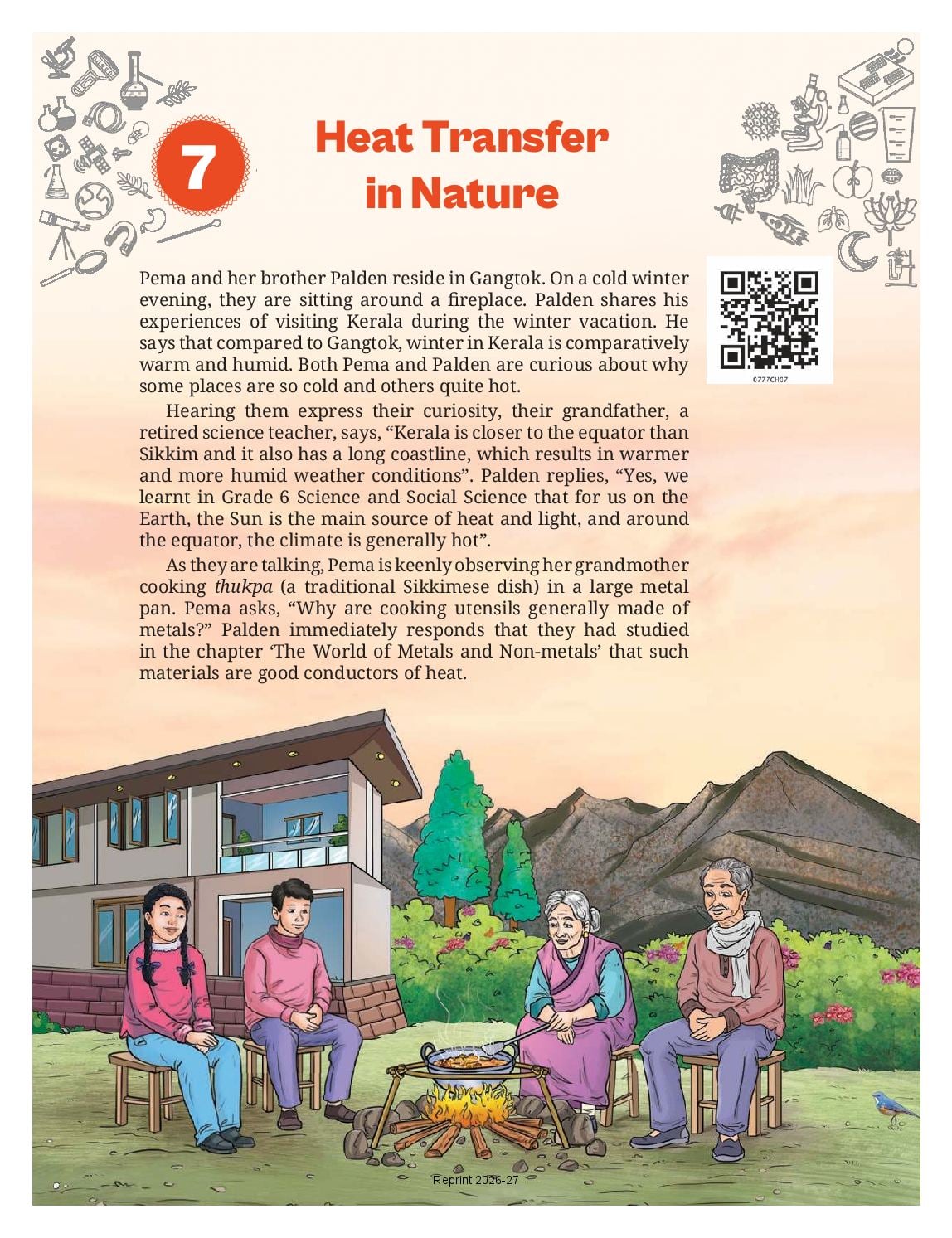
Pema and her brother Palden reside in Gangtok. On a cold winter
evening, they are sitting around a fireplace. Palden shares his
experiences of visiting Kerala during the winter vacation. He
says that compared to Gangtok, winter in Kerala is comparatively
warm and humid. Both Pema and Palden are curious about why
some places are so cold and others quite hot.
Hearing them express their curiosity, their grandfather, a
retired science teacher, says, “Kerala is closer to the equator than
Sikkim and it also has a long coastline, which results in warmer
and more humid weather conditions”. Palden replies, “Yes, we
learnt in Grade 6 Science and Social Science that for us on the
Earth, the Sun is the main source of heat and light, and around
the equator, the climate is generally hot”.
As they are talking, Pema is keenly observing her grandmother
cooking thukpa (a traditional Sikkimese dish) in a large metal
pan. Pema asks, “Why are cooking utensils generally made of
metals?” Palden immediately responds that they had studied
in the chapter ‘The World of Metals and Non-metals’ that such
materials are good conductors of heat.
Showing the first page only. Download the PDF above for the complete document.
Document Details
| Board / Org | NCERT |
| Exam | Class 7 |
| Type | Books |
| Pages | 16 |
| Language | english |
| Updated | 24 Sep 2026 |