UGC NET Prakrit Question Paper 2018
Finished viewing? Save it for later —
Download UGC NET Prakrit Question Paper 2018 (PDF · 24 pages)About UGC NET Prakrit Question Paper 2018
UGC NET Prakrit Question Paper 2018 is available here for free download. Published by NTA for UGC National Eligibility Test, this question paper can be viewed online or downloaded as a PDF (24 pages). Candidates preparing for UGC National Eligibility Test can use UGC NET Prakrit Question Paper 2018 to understand the exam pattern, the type of questions asked, and the overall difficulty level.
Frequently Asked Questions
How can I download UGC NET Prakrit Question Paper 2018?
Open this page and click the Download button to save UGC NET Prakrit Question Paper 2018 as a PDF. It is completely free on AglaSem Docs.
Is UGC NET Prakrit Question Paper 2018 free to download?
Yes. UGC NET Prakrit Question Paper 2018 can be viewed online and downloaded as a PDF free of cost on AglaSem Docs.
How many pages does UGC NET Prakrit Question Paper 2018 have?
UGC NET Prakrit Question Paper 2018 contains 24 pages, which you can read online or download together as a single PDF.
Where can I find more UGC National Eligibility Test study material?
You can find more UGC National Eligibility Test question papers, sample papers, syllabus, and answer keys on AglaSem Docs.
UGC NET Prakrit Question Paper 2018 – Text
Read the full text of this question paper below — useful to quickly search, copy and reference the content online without downloading the PDF.
📄 View text version (24 pages)
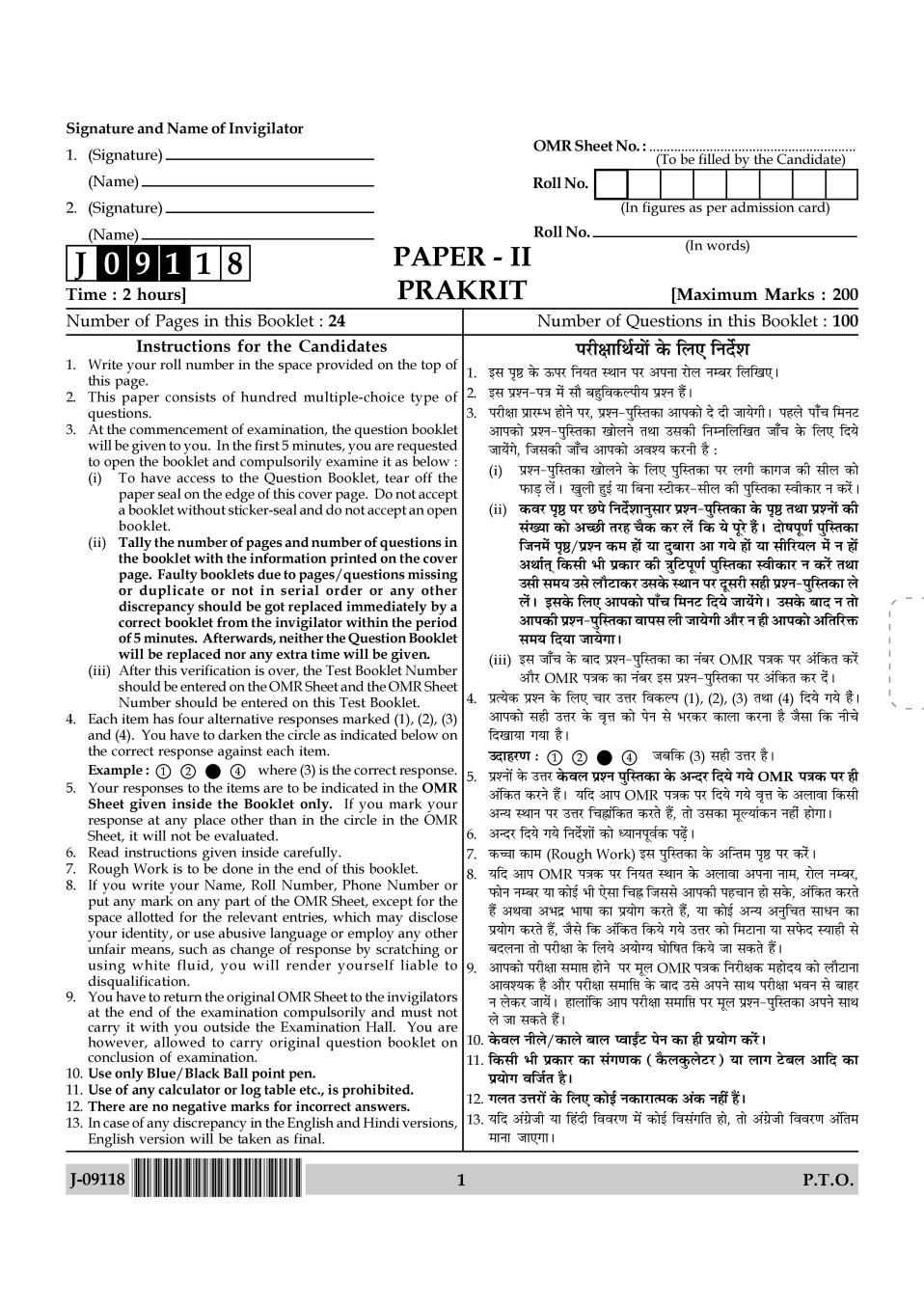
Page 1
OMR Sheet No. : ..........................................................
1. (Signature) (To be filled by the Candidate)
(Name) Roll No.
2. (Signature) (In figures as per admission card)
(Name) Roll No.
(In words)
J 0 9 1 1 8 PAPER - II
Time : 2 hours] PRAKRIT [Maximum Marks : 200
Number of Pages in this Booklet : 24 Number of Questions in this Booklet : 100
Instructions for the Candidates ¬⁄UˡÊÊÁÕ¸ÿÙ¢ ∑§ Á‹∞ ÁŸŒ¸‡Ê
1. Write your roll number in the space provided on the top of
1. ß‚ ¬ÎDU ∑§ ™§¬⁄U ÁŸÿà SÕÊŸ ¬⁄U •¬ŸÊ ⁄UÙ‹U Ÿê’⁄U Á‹Áπ∞–
this page.
2. This paper consists of hundred multiple-choice type of 2. ß‚ ¬˝‡Ÿ-¬òÊ ◊¢ ‚ÊÒ ’„ÈÁfl∑§À¬Ëÿ ¬˝‡Ÿ „Ò¥–
questions. 3. ¬⁄UˡÊÊ ¬˝Ê⁄êU÷ „ÙŸ ¬⁄U, ¬˝‡Ÿ-¬ÈÁSÃ∑§Ê •Ê¬∑§Ù Œ ŒË ¡ÊÿªË– ¬„‹U ¬UÊ°ø Á◊Ÿ≈U
3. At the commencement of examination, the question booklet •Ê¬∑§Ù ¬˝‡Ÿ-¬ÈÁSÃ∑§Ê πÙ‹Ÿ ÃÕÊ ©‚∑§Ë ÁŸêŸÁ‹Áπà ¡Ê°ø ∑§ Á‹∞ ÁŒÿ
will be given to you. In the first 5 minutes, you are requested ¡Êÿ¢ª, Á¡‚∑§Ë ¡Ê°ø •Ê¬∑§Ù •fl‡ÿ ∑§⁄UŸË „Ò —
to open the booklet and compulsorily examine it as below :
(i) ¬˝‡Ÿ-¬ÈÁSÃ∑§Ê πÙ‹Ÿ ∑§ Á‹∞ ¬ÈÁSÃ∑§Ê ¬⁄U ‹ªË ∑§Êª¡ ∑§Ë ‚Ë‹ ∑§Ê
(i) To have access to the Question Booklet, tear off the
paper seal on the edge of this cover page. Do not accept »§Ê«∏ ‹¢U– πÈ‹Ë „È߸ ÿÊ Á’ŸÊ S≈UË∑§⁄U-‚Ë‹U ∑§Ë ¬ÈÁSÃ∑§Ê SflË∑§Ê⁄U Ÿ ∑§⁄¢U–
a booklet without sticker-seal and do not accept an open (ii) ∑§fl⁄U ¬ÎDU ¬⁄U ¿U¬ ÁŸŒ¸‡ÊÊŸÈ‚Ê⁄U ¬˝‡Ÿ-¬ÈÁSÃ∑§Ê ∑§ ¬ÎDU ÃÕÊ ¬˝‡ŸÙ¢ ∑§Ë
booklet. ‚¢ÅÿÊ ∑§Ù •ë¿UË Ã⁄U„ øÒ∑§ ∑§⁄U ‹¢U Á∑§ ÿ ¬Í⁄U „Ò¢U– ŒÙ·¬Íáʸ ¬ÈÁSÃ∑§Ê
(ii) Tally the number of pages and number of questions in Á¡Ÿ◊¢ ¬ÎDU/¬˝‡Ÿ ∑§◊ „Ù¢ ÿÊ ŒÈ’Ê⁄UÊ •Ê ªÿ „Ù¢ ÿÊ ‚ËÁ⁄Uÿ‹U ◊¢ Ÿ „Ù¢
the booklet with the information printed on the cover •ÕʸØ Á∑§‚Ë ÷Ë ¬˝∑§Ê⁄U ∑§Ë òÊÈÁ≈U¬Íáʸ ¬ÈÁSÃ∑§Ê SflË∑§Ê⁄U Ÿ ∑§⁄¢U ÃÕÊ
page. Faulty booklets due to pages/questions missing
or duplicate or not in serial order or any other ©‚Ë ‚◊ÿ ©‚ ‹Uı≈UÊ∑§⁄U ©‚∑§ SÕÊŸ ¬⁄U ŒÍ‚⁄UË ‚„Ë ¬˝‡Ÿ-¬ÈÁSÃ∑§Ê ‹
discrepancy should be got replaced immediately by a ‹¢– U ß‚∑§ Á‹∞ •Ê¬∑§Ù ¬Ê°ø Á◊Ÿ≈U ÁŒÿ ¡Êÿ¢ª– ©‚∑§ ’ÊŒ Ÿ ÃÙ
correct booklet from the invigilator within the period •Ê¬∑§Ë ¬˝‡Ÿ-¬ÈÁSÃ∑§Ê flʬ‚ ‹Ë ¡ÊÿªË •ı⁄U Ÿ „Ë •Ê¬∑§Ù •ÁÃÁ⁄UQ§
of 5 minutes. Afterwards, neither the Question Booklet ‚◊ÿ ÁŒÿÊ ¡ÊÿªÊ–
will be replaced nor any extra time will be given. (iii) ß‚ ¡Ê°ø ∑§ ’ÊŒ ¬˝‡Ÿ-¬ÈÁSÃ∑§Ê ∑§Ê Ÿ¥’⁄U OMR ¬òÊ∑§ ¬⁄U •¢Á∑§Ã ∑§⁄¢U
(iii) After this verification is over, the Test Booklet Number
should be entered on the OMR Sheet and the OMR Sheet
•Uı⁄U OMR ¬òÊ∑§ ∑§Ê Ÿ¥’⁄U ß‚ ¬˝‡Ÿ-¬ÈÁSÃ∑§Ê ¬⁄U •¢Á∑§Ã ∑§⁄U Œ¢–
Number should be entered on this Test Booklet. 4. ¬˝àÿ∑§ ¬˝‡Ÿ ∑§ Á‹∞ øÊ⁄U ©ûÊ⁄U Áfl∑§À¬ (1), (2), (3) ÃÕÊ (4) ÁŒÿ ªÿ „Ò¢–
4. Each item has four alternative responses marked (1), (2), (3) •Ê¬∑§Ù ‚„Ë ©ûÊ⁄U ∑§ flÎûÊ ∑§Ù ¬Ÿ ‚ ÷⁄U∑§⁄U ∑§Ê‹Ê ∑§⁄UŸÊ „Ò ¡Ò‚Ê Á∑§ ŸËø
and (4). You have to darken the circle as indicated below on ÁŒπÊÿÊ ªÿÊ „Ò–
the correct response against each item. ©ŒÊ„⁄UáÊ — ¡’Á∑§ (3) ‚„Ë ©ûÊ⁄U „Ò–
Example : where (3) is the correct response. 5. ¬˝‡ŸÊ¥ ∑§ ©ûÊ⁄U ∑§fl‹ ¬˝‡Ÿ ¬ÈÁSÃ∑§Ê ∑§ •ãŒ⁄U ÁŒÿ ªÿ OMRU ¬òÊ∑§ ¬⁄U „Ë
5. Your responses to the items are to be indicated in the OMR
•¥Á∑§Ã ∑§⁄UŸ „Ò¥– ÿÁŒ •Ê¬ OMRU ¬òÊ∑§ ¬⁄U ÁŒÿ ªÿ flÎûÊ ∑§ •‹ÊflÊ Á∑§‚Ë
Sheet given inside the Booklet only. If you mark your
response at any place other than in the circle in the OMR •ãÿ SÕÊŸ ¬⁄U ©ûÊ⁄U ÁøqÊ¥Á∑§Ã ∑§⁄Uà „Ò¥, ÃÙ ©‚∑§Ê ◊ÍÀUÿÊ¢∑§Ÿ Ÿ„Ë¢ „٪ʖ
Sheet, it will not be evaluated. 6. •ãŒ⁄U ÁŒÿ ªÿ ÁŸŒ¸‡ÊÙ¢ ∑§Ù äÿÊŸ¬Ífl¸∑§ ¬…∏¢U–
6. Read instructions given inside carefully. 7. ∑§ìÊÊ ∑§Ê◊ (Rough Work) ß‚ ¬ÈÁSÃ∑§Ê ∑§ •ÁãÃ◊ ¬ÎDU ¬⁄U ∑§⁄¢U–
7. Rough Work is to be done in the end of this booklet. 8. ÿÁŒ •Ê¬ OMR ¬òÊ∑§ ¬⁄U ÁŸÿà SÕÊŸ ∑§ •‹ÊflÊ •¬ŸÊ ŸÊ◊, ⁄UÊ‹ Ÿê’⁄U,
8. If you write your Name, Roll Number, Phone Number or
put any mark on any part of the OMR Sheet, except for the
»§ÊŸ Ÿê’⁄U ÿÊ ∑§Ê߸ ÷Ë ∞‚Ê Áøq Á¡‚‚ •Ê¬∑§Ë ¬„øÊŸ „Ê ‚∑§, •¥Á∑§Ã ∑§⁄UÃ
space allotted for the relevant entries, which may disclose „Ò¥ •ÕflÊ •÷Œ˝ ÷Ê·Ê ∑§Ê ¬˝ÿʪ ∑§⁄Uà „Ò¥, ÿÊ ∑§Ê߸ •ãÿ •ŸÈÁøà ‚ÊœŸ ∑§Ê
your identity, or use abusive language or employ any other ¬˝ÿʪ ∑§⁄Uà „Ò¥, ¡Ò‚ Á∑§ •¥Á∑§Ã Á∑§ÿ ªÿ ©ûÊ⁄U ∑§Ê Á◊≈UÊŸÊ ÿÊ ‚»§Œ SÿÊ„Ë ‚
unfair means, such as change of response by scratching or ’Œ‹ŸÊ ÃÊ ¬⁄UˡÊÊ ∑§ Á‹ÿ •ÿÊÇÿ ÉÊÊÁ·Ã Á∑§ÿ ¡Ê ‚∑§Ã „Ò¥–
using white fluid, you will render yourself liable to 9. •Ê¬∑§Ù ¬⁄UˡÊÊ ‚◊Ê# „ÙŸ §¬⁄U ◊Í‹ OMR ¬òÊ∑§ ÁŸ⁄UˡÊ∑§ ◊„ÙŒÿ ∑§Ù ‹Uı≈UÊŸÊ
disqualification. •Êfl‡ÿ∑§ „Ò •ı⁄U ¬⁄UˡÊÊ ‚◊ÊÁ# ∑§ ’ÊŒ ©‚ •¬Ÿ ‚ÊÕ ¬⁄UˡÊÊ ÷flŸ ‚ ’Ê„⁄U
9. You have to return the original OMR Sheet to the invigilators Ÿ ‹∑§⁄U ¡Êÿ¢– „Ê‹Ê¥Á∑§ •Ê¬ ¬⁄UˡÊÊ ‚◊ÊÁ# ¬⁄U ◊Í‹ ¬˝‡Ÿ-¬ÈÁSÃ∑§Ê •¬Ÿ ‚ÊÕ
at the end of the examination compulsorily and must not
carry it with you outside the Examination Hall. You are ‹ ¡Ê ‚∑§Ã „Ò¥–
however, allowed to carry original question booklet on 10. ∑§fl‹ ŸË‹/∑§Ê‹ ’Ê‹U åflÊßZ≈U ¬Ÿ ∑§Ê „Ë ¬˝ÿʪ ∑§⁄¢U–
conclusion of examination. 11. Á∑§‚Ë ÷Ë ¬˝∑§Ê⁄U ∑§Ê ‚¢ªáÊ∑§ (∑Ò§‹∑ȧ‹≈U⁄U) UÿÊ ‹Êª ≈U’‹ •ÊÁŒ ∑§Ê
10. Use only Blue/Black Ball point pen. ¬˝ÿÙª flÁ¡¸Ã „Ò–
11. Use of any calculator or log table etc., is prohibited.
12. ª‹Ã ©ûÊ⁄UÊ¥ ∑§ Á‹∞ ∑§Ê߸ Ÿ∑§Ê⁄UÊà◊∑§ •¥∑§ Ÿ„Ë¥ „Ò¥–
12. There are no negative marks for incorrect answers.
13. In case of any discrepancy in the English and Hindi versions, 13. ÿÁŒ •¥ª˝¡Ë ÿÊ Á„¥ŒË Áflfl⁄UáÊ ◊¥ ∑§Ê߸ Áfl‚¥ªÁà „Ê, ÃÊ •¥ª˝¡Ë Áflfl⁄UáÊ •¥ÁÃ◊
English version will be taken as final. ◊ÊŸÊ ¡Ê∞ªÊ–
J-09118 !J-09118-PAPER-II! 1 P.T.O.
Page 2
PAPER - II
Note : This paper contains hundred (100) objective type questions of two (2) marks each.
All questions are compulsory.
1. Prakrit is known as the language of this group :
(1) Dravidian (2) Old Indo-Aryan
(3) Middle Indo-Aryan (4) New Indo-Aryan
2. The development of the period of Prakrit is :
(1) 1500 BCE - 500 BCE (2) 600 BCE - 1000 CE
(3) 800 BCE - 600 BCE (4) 1200 CE - 1700 CE
3. `
Asokan Inscriptional Prakrit is known to be the Prakrit of this period :
(1) Second phase (2) First phase (3) Third phase (4) Modern phase
4. The language of a fisherman is prescribed in ancient dramas is :
(1) MÂgadhÍ (2) PrÂcy (3) `
SaurasenÍ (4) MahÂrÂîòrÍ
5. The word ‘arthapatiÉ’ is changed into MÂgadhÍ as :
`
(1) astavadÍ (2) arthavadÍ (3) astavadÍ (4) aîòavadÍ
6. Intervocalic ‘ë’ is changed into MÂgadhÍ as :
(1) s (2) s̀ (3) î (4) h
7. In MÂgadhÍ conjunct ‘îò’ is changed into :
(1) sòa (2) òòa (3) òòha (4) òha
8. The verbal form ‘tiîòhati’ is changed into MÂgadhÍ as :
(1) tiòòhadi (2) tiòòadi (3) ciòòhai (4) ciîòhadi
9. The language of the s̀vetÂmbara canonical texts is :
(1) `
SaurasenÍ (2) ArdhamÂgadhÍ (3) MÂgadhÍ (4) DÂkîiàÂtyÂ
10. Nominative singular of masculine ‘a’ base is changed into ‘e’ in this Prakrit :
(1) `
SaurasenÍ (2) ÀvantÍ (3) ArdhamÂgadhÍ (4) MahÂrÂîòrÍ
J-09118 !J-09118-PAPER-II! 2 Paper-II
Page 3
¬˝‡Ÿ¬òÊ - II
ŸÊ≈U — ß‚ ¬˝‡Ÿ-¬òÊ ◊¥ ‚ÊÒ (100) ’„È-Áfl∑§À¬Ëÿ ¬˝‡Ÿ „Ò¥– ¬˝àÿ∑§ ¬˝‡Ÿ ∑§ ŒÊ (2) •¥∑§ „Ò¥– ‚÷Ë ¬˝‡Ÿ •ÁŸflÊÿ¸ „Ò¥–
1. ¬˝Ê∑Χà ∑§Ê ß‚ ÷Ê·Ê ‚◊Í„ ∑§ •ãê¸Ã ¡ÊŸÊ ¡ÊÃÊ „Ò —
(1) Œ˝Áfl«∏ ÷Ê·Ê (2) ¬˝ÊøËŸ ÷Ê⁄UÃËÿ •Êÿ¸ ÷Ê·Ê
(3) ◊äÿ÷Ê⁄UÃËÿ •Êÿ¸ ÷Ê·Ê (4) •ÊœÈÁŸ∑§ ÷Ê⁄UÃËÿ •Êÿ¸ ÷Ê·Ê
2. ¬˝Ê∑Χà ∑§ Áfl∑§Ê‚ ∑§Ê ÿȪ ÿ„ „Ò —
(1) 1500 ߸.¬Í. - 500 ߸.¬Í. (2) 600 ߸.¬Í. - 1000 ߸SflË
(3) 800 ߸.¬Í. - 600 ߸.¬Í. (4) 1200 ߸SflË - 1700 ߸SflË
3. •‡ÊÊ∑§ ∑§ •Á÷‹πÊ¥ ∑§Ë ¬˝Ê∑Χà ∑§Ê ß‚ ÿȪ ∑§Ë ¬˝Ê∑Χà ∑§ M§¬ ◊¥ ¡ÊŸÊ ¡ÊÃÊ „Ò —
(1) ÁmÃËÿ ÿȪ˟ (2) ¬˝Õ◊ ÿȪ˟ (3) ÃÎÃËÿ ÿȪ˟ (4) •ÊœÈÁŸ∑§ ÿȪ˟
4. ¬˝ÊøËŸ ŸÊ≈U∑§Ê¥ ◊¥ œËfl⁄U ∑§Ë ÷Ê·Ê ÿ„ ÁŸœÊ¸Á⁄Uà „Ò —
(1) ◊ʪœË (2) ¬˝ÊëÿÊ (3) ‡ÊÊÒ⁄U‚ŸË (4) ◊„Ê⁄UÊc≈˛UË
5. “•Õ¸¬Á×” ‡ÊéŒ ∑§Ê ◊ʪœË ◊¥ ß‚ ¬˝∑§Ê⁄U ¬Á⁄UfløŸ „ÊÃÊ „Ò —
(1) •‡ÃflŒË (2) •Õ¸flŒË (3) •SÃflŒË (4) •c≈UflŒË
6. Sfl⁄U-◊äÿflÃ˸ “·” ∑§Ê ◊ʪœË ◊¥ ß‚ M§¬ ‚ ¬Á⁄UfløŸ „ÊÃÊ „Ò —
(1) ‚ (2) ‡Ê (3) · (4) „
7. ◊ʪœË ◊¥ ‚¥ÿÈÄà “c≈U” ∑§Ê ¬Á⁄UfløŸ ÿ„ „ÊÃÊ „Ò —
(1) S≈U (2) ^ (3) _ (4) ∆U
8. “ÁÃc∆UÁÔ Á∑˝§ÿÊM§¬ ∑§Ê ◊ʪœË ◊¥ ÿ„ ¬Á⁄UfløŸ „ÊÃÊ „Ò —
(1) ÁÃ_ÁŒ (2) ÁÃ^ÁŒ (3) Áø_ß (4) Áøc∆UÁŒ
9. ‡flÃÊê’⁄U •Êª◊ ª˝¥ÕÊ¥ ∑§Ë ÷Ê·Ê „Ò —
(1) ‡ÊÊÒ⁄U‚ŸË (2) •œ¸◊ʪœË (3) ◊ʪœË (4) ŒÊÁˇÊáÊÊàÿÊ
10. “•” ∑§Ê⁄UÊãà ¬ÈÁÀ‹¥ª ‡ÊéŒ ¬˝Õ◊Ê ∞∑§fløŸ ◊¥ ß‚ ¬˝Ê∑Χà ◊¥ “∞” ∑§Ê⁄UÊãà „ÊÃÊ „Ò —
(1) ‡ÊÊÒ⁄U‚ŸË (2) •ÊflãÃË (3) •œ¸◊ʪœË (4) ◊„Ê⁄UÊc≈˛UË
J-09118 !J-09118-PAPER-II! 3 Paper-II
Page 4
(1) SÂtavÂhana (2) KumÂrapÂla (3) `
Yasovarm (4) SamarÂditya
12. ‘RÂvaàavaho’ is the other name of this text :
(1) KaØsavaho (2) Setubandha (3) GauÅavaho (4) Davvasaßgaho
13. The kuvalayamÂlÂkah belongs to this type of narrative form :
(1) SaßkÍràakath (2) KhanÅakathÂ
(3) ParihÂsakath (4) Divya-MÂnuîikathÂ
14. Mainly this ‘Rasa’ is found in the Mçacchakatikam :
(1) `
SÂnta Rasa (2) VÍra Rasa (3) S` raßgÂra Rasa (4) Karuàa Rasa
15. Number of chapters (AdhikÂras) of the ÀkhyÂnamaàikosa
` is :
(1) Thirty nine (2) Forty one (3) Fifty three (4) Forty eight
16. Kavi Dhanesvarasöri
` has composed the text :
(1) PaumacariyaØ (2) ManoramÂkahÂ
(3) SurasundrÍcariyaØ (4) SupÂsanÂhacariyaØ
17. The setubandha was composed by :
(1) Vimalasöri (2) Kavi Hall (3) Pravarsena (4) Kalidas
18. The GauÅavaho was composed by :
(1) `
RÂjasekhara (2) VÂkpatirÂja (3) Pravarasena (4) BhojarÂja
19. Identify the Prakrit Khanda Kavya text from the following :
(1) LÍlÂvaÍ (2) UsÂàiruddha (3) VajjÂlagga (4) CandalehÂ
20. The DhörtÂkhyÂna text is a :
(1) Satiric Prakrit work (2) Romantic story
(3) Dramatic work (4) Poetics work
21. VeerasenÂcÂrya is the author of :
(1) Parikarma TÍk (2) ëatkhaàÅÂgama (3) MahÂbandha (4) Dhaval TÍkÂ
J-09118 !J-09118-PAPER-II! 4 Paper-II
Page 5
(1) ‚ÊÃflÊ„Ÿ (2) ∑ȧ◊Ê⁄U¬Ê‹ (3) ÿ‡ÊÊfl◊ʸ (4) ‚◊⁄UÊÁŒàÿ
12. “⁄UÊfláÊfl„Ê” ß‚ ª˝ãÕ ∑§Ê •¬⁄U ŸÊ◊ „Ò —
(1) ∑¥§‚fl„Ê (2) ‚ÃȒ㜠(3) ª©«Ufl„Ê (4) Œ√fl‚¥ª„Ê
13. “∑ȧfl‹ÿ◊Ê‹Ê∑§„Ê” ß‚ ¬˝∑§Ê⁄U ∑§Ë ∑§ÕÊ „Ò —
(1) ‚¥∑§Ëáʸ∑§ÕÊ (2) πá«U∑§ÕÊ
(3) ¬Á⁄U„Ê‚∑§ÕÊ (4) ÁŒ√ÿ-◊ÊŸÈ·Ë ∑§ÕÊ
14. ◊Îë¿U∑§Á≈U∑§◊˜ ª˝ãÕ ∑§Ê ¬˝œÊŸ ⁄U‚ „Ò —
(1) ‡ÊÊãà ⁄U‚ (2) flË⁄U ⁄U‚ (3) oÎ¥ªÊ⁄U ⁄U‚ (4) ∑§L§áÊ ⁄U‚
15. “•ÊÅÿÊŸ◊ÁáÊ∑§Ê‡Ê” ª˝ãÕ ◊¥ ßß •äÿÊÿ (•Áœ∑§Ê⁄U) „Ò¥ —
(1) ©ãÃÊÁ‹‚ (2) ß∑§ÃÊÁ‹‚ (3) ÁÃ⁄U¬Ÿ (4) •«∏ÃÊ‹Ë‚
16. ∑§Áfl œŸ‡fl⁄U‚ÍÁ⁄U Ÿ ÿ„ ª˝ãÕ Á‹πÊ „Ò —
(1) ¬©◊øÁ⁄Uÿ¥ (2) ◊ŸÊ⁄U◊Ê∑§„Ê
(3) ‚È⁄U‚ÈãŒ⁄UËøÁ⁄Uÿ¥ (4) ‚ȬʂŸÊ„øÁ⁄Uÿ¥
17. ‚ÃȒ㜠∑§ ‹π∑§ „Ò¥ —
(1) Áfl◊‹‚ÍÁ⁄U (2) ∑§Áfl „Ê‹ (3) ¬˝fl⁄U‚Ÿ (4) ∑§ÊÁ‹ŒÊ‚
18. “ª©«Ufl„Ê” ߟ∑§ mÊ⁄UÊ ⁄UÁøà „Ò —
(1) ⁄UÊ¡‡Êπ⁄U (2) flÊ∑˜§¬ÁÃ⁄UÊ¡ (3) ¬˝fl⁄U‚Ÿ (4) ÷Ê¡⁄UÊ¡
19. •œÊÁ‹Áπà ◊¥ ‚ ¬˝Ê∑Χà πá«U∑§Ê√ÿ ª˝ãÕ ∑§Ê ¬„øÊŸ¥ —
(1) ‹Ë‹Êfl߸ (2) ©‚ÊÁáÊL§h (3) flí¡Ê‹Çª (4) ø㌋„Ê
20. “œÍÃʸÅÿÊŸ” ß‚ ¬˝∑§Ê⁄U ∑§Ê ª˝ãÕ „Ò —
(1) √ÿ¥ªÊà◊∑§ ¬˝Ê∑Χà ª˝ãÕ (2) ¬˝áÊÿ∑§ÕÊ
(3) ŸÊ≈U∑§Ëÿ ª˝ãÕ (4) ∑§Ê√ÿ‡ÊÊSòÊËÿ ª˝ãÕ
21. flË⁄U‚ŸÊøÊÿ¸ ß‚∑§ ‹π∑§ „Ò¥ —
(1) ¬Á⁄U∑§◊¸ ≈UË∑§Ê (2) ·≈˜πá«Uʪ◊ (3) ◊„ʒ㜠(4) œfl‹Ê ≈UË∑§Ê
J-09118 !J-09118-PAPER-II! 5 Paper-II
Page 6
(1) Manyakheta (2) Shravanabelagola
(3) Amaravati (4) Girnar
23. The Tiloyapaààatti composed by :
(1) Guàadhara (2) S` ivÂrya (3) Vaòòakera (4) Yativraîabha
24. The ‘ PrasnavyÂkaraàa
` ’ Âgama deals mainly with :
(1) JÍva - AjÍva (2) Bandha-Mokîa (3) Puàya-PÂpa (4) Àsrava-SaØvara
`
25. Out of the following four texts, the SaurasenÍ Àgamas are correctly shown in which code ?
(a) SamayasÂra (b) KasÂyapÂhuda (c) Àyaro (d) MölÂcÂra
Code :
(1) (b) + (c) + (a) (2) (a) + (c) + (b) (3) (a) + (b) + (d) (4) (d) + (c) + (a)
26. The ‘PaààavaàÂ’ text is included in this group of texts :
(1) PaiààÂiÙ (2) UpÂßga (3) Aßga (4) Mölasötra
27. Àrya Skandil was a leader of the ÀgamavÂcan (conference) held at :
(1) KÂsÍ (2) Mathur (3) VallabhÍ (4) Udaigiri
28. The correct answer of this query AßgÂàaØ kiØ sÂro ? is this text :
(1) ÀcÂrÂßga (2) VipÂkasötra (3) UvÂsagadasÂo (4) SöyagaÅo
29. The MahÂbandha (Mahadhavala) Àgama was published before 1960 A.D. from :
(1) Nagpur (2) Kashi (3) Ahmedabad (4) Vaishali
`
30. This pair of texts of SaurasenÍ Agama literature is correct :
(1) UttarÂdhyayanasötra, AîòapÂhuda (2) VipÂkasötra, RayanasÂra
(3) ÛiyamsÂra, PaßcÂstikÂya (4) PravacanasÂra, ÀcÂrÂßgasötra
31. The ‘Dhaval TÍkÂ’ is a commentary of this text :
(1) MahÂbandha (2) KasÂyapÂhuÅa (3) MölÂrÂdhan (4) ChakkhaßÅÂgama
32. The title of the first chapter of the UttarÂ-dhayanasötra is :
(1) CittasambhötÍya (2) KesÍgotamÍya (3) ViàayasuyaÙ (4) NamipavvajjÂ
J-09118 !J-09118-PAPER-II! 6 Paper-II
Page 7
(1) ◊Êãÿπ≈U (2) üÊfláÊ’‹ªÊ‹Ê
(3) •◊⁄UÊflÃË (4) Áª⁄UŸÊ⁄U
23. “ÁËÊÿ¬ááÊÁûÊ” ∑§ ⁄UøŸÊ∑§Ê⁄U „Ò¥ —
(1) ªÈáÊœ⁄U (2) Á‡ÊflÊÿ¸ (3) fl^∑§⁄U (4) ÿÁÃflη÷
24. “¬˝‡Ÿ√ÿÊ∑§⁄UáÊ” •Êª◊ ¬˝◊Èπ M§¬ ‚ ß‚ Áfl·ÿ ∑§Ë √ÿÊÅÿÊ ∑§⁄UŸÊ „Ò —
(1) ¡Ëfl-•¡Ëfl (2) ’ãœ-◊ÊˇÊ (3) ¬Èáÿ-¬Ê¬ (4) •Êdfl-‚¥fl⁄U
25. ÁŸêŸÁ‹Áπà øÊ⁄U ª˝ãÕÊ¥ ◊¥ ‚ ‡ÊÊÒ⁄U‚ŸË •Êª◊ ª˝ãÕ Á∑§‚ ∑ͧ≈U ◊¥ ‚„Ë „Ò¥?
(a) ‚◊ÿ‚Ê⁄U (b) ∑§‚Êÿ¬Ê„È«U (c) •ÊÿÊ⁄UÊ (d) ◊Í‹ÊøÊ⁄U
∑ͧ≈U —
(1) (b) + (c) + (a) (2) (a) + (c) + (b) (3) (a) + (b) + (d) (4) (d) + (c) + (a)
26. “¬ááÊfláÊÊ” ª˝ãÕ •Êª◊Ê¥ ∑§ ß‚ ‚◊Í„ ◊¥ ‚Áê◊Á‹Ã „Ò —
(1) ¬ßááÊÊߥ (2) ©¬Ê¥ª (3) •¥ª (4) ◊Í‹‚ÍòÊ
27. •Êÿ¸ S∑§Á㌋ ß‚ •Êª◊ flÊøŸÊ ∑§ ¬˝◊Èπ Õ —
(1) ∑§Ê‚Ë (2) ◊ÕÈ⁄UÊ (3) flÀ‹÷Ë (4) ©ŒÿÁªÁ⁄U
28. “•¥ªÊáÊ¥ Á∑¥§ ‚Ê⁄UÊ?” ß‚ Á¡ôÊÊ‚Ê ∑§Ê ‚„Ë ©ûÊ⁄U ÿ„ ª˝ãÿ „Ò —
(1) •ÊøÊ⁄UÊ¥ª (2) Áfl¬Ê∑§‚ÍòÊ (3) ©flÊ‚ªŒ‚Ê•Ê (4) ‚Íÿª«UÊ
29. ◊„ʒ㜠(◊„Êœfl‹) •Êª◊ ª˝ãÕ 1960 ߸. ∑§ ¬Ífl¸ ÿ„Ê° ‚ ¬˝∑§ÊÁ‡Êà „È•Ê ÕÊ —
(1) ŸÊª¬È⁄U (2) ∑§Ê‡ÊË (3) •„◊ŒÊ’ÊŒ (4) flÒ‡ÊÊ‹Ë
30. ‡ÊÊÒ⁄U‚ŸË •Êª◊ ‚ÊÁ„àÿ ∑§Ê ÿ„ ª˝ãÕ ÿÈÇ◊ ‚„Ë „Ò —
(1) ©ûÊ⁄UÊäÿÿŸ‚ÍòÊ, •c≈U¬Ê„È«U (2) Áfl¬Ê∑§‚ÍòÊ, ⁄UÿáÊ‚Ê⁄U
(3) ÁáÊÿ◊‚Ê⁄U, ¬¥øÊÁSÃ∑§Êÿ (4) ¬˝fløŸ‚Ê⁄U, •ÊøÊ⁄UÊ¥ª‚ÍòÊ
31. “œfl‹Ê ≈UË∑§Ê” ß‚ ª˝ãÕ ∑§Ë ≈UË∑§Ê „Ò —
(1) ◊„ʒ㜠(2) ∑§‚Êÿ¬Ê„È«U (3) ◊Í‹Ê⁄UÊœŸÊ (4) ¿UÄπá«Uʪ◊
32. ©ûÊ⁄UÊäÿÿŸ‚ÍòÊ ∑§ ¬˝Õ◊ •äÿÿŸ ∑§Ê ŸÊ◊ „Ò —
(1) ÁøûÊ‚ê÷ÍÃËÿ (2) ∑§‚˪ÊÃ◊Ëÿ (3) ÁfláÊÿ‚Èÿ¥ (4) ŸÁ◊¬√flí¡Ê
J-09118 !J-09118-PAPER-II! 7 Paper-II
Page 8
(1) MölÂcÂra (2) BhÂvapÂhuÅa (3) PaßcÂstikÂya (4) MahÂbandha
34. The name of the dynasty of emperor Aïoka is :
(1) Nanda dynasty (2) Maurya dynasty (3) Kaniîka dynasty (4) Gupta dynasty
35. The meaning of the word ‘pÂsaÙÅa’ used in the Girnar Version of Aïokan Inscription is :
(1) Hypocrisy (2) Showy (3) Unnatural (4) Sect
36. The line on ‘bamhaàa-samaàÂnaÙ sÂdhu dÂnaÙ’ used in the Girnar Version is found in the :
(1) Ninth (2) Twelfth (3) Seventh (4) Second
37. The line ‘dhammacaraàe pi na bhavati asÍlasa’ is inscribed in this inscription of Aïoka :
(1) Seventh (2) Third (3) Fifth (4) Fourth
38. In this inscription of Aïoka teaching of service to parents has been mentioned :
(1) Fourth (2) Twelfth (3) Third (4) Fifth
39. In this inscription of Aïoka the appointment of women Presidents and women ministers has been
mentioned :
(1) Thirteenth (2) Twelfth (3) Ninth (4) Seventh
40. The period of emperor Kharvela is :
(1) Fifth century BCE (2) Second century CE
(3) First century CE (4) Second century BCE
41. The word ‘Bharadhavasa’ is mentioned in this line of HÂthÍgumph inscription :
(1) Twelfth (2) Tenth (3) Eighth (4) Ninth
42. Conducting an assembly of the sages in KumÂrÍ hill has been mentioned by Emperor KhÂravela in
this line of the Inscription :
(1) Second (2) Fifth (3) Fourteenth (4) Twelfth
43. On which line of the HÂthÍgumph inscription the childhood - plays have been mentioned :
(1) Fourth (2) Twelfth (3) Second (4) Fifth
J-09118 !J-09118-PAPER-II! 8 Paper-II
Page 9
(1) ◊Í‹ÊøÊ⁄U (2) ÷Êfl¬Ê„È«U (3) ¬¥øÊÁSÃ∑§Êÿ (4) ◊„Ê’¥œ
34. ‚◊˝Ê≈U •‡ÊÊ∑§ ∑§ fl¥‡Ê ∑§Ê ŸÊ◊ „Ò —
(1) ŸãŒfl¥‡Ê (2) ◊ÊÒÿ¸fl¥‡Ê (3) ∑§ÁŸc∑§fl¥‡Ê (4) ªÈåÃfl¥‡Ê
35. ‚◊˝Ê≈U •‡ÊÊ∑§ ∑§ Áª⁄UŸÊ⁄U-Á‡Ê‹Ê‹π ◊¥ ©¬‹éœ ““¬Ê‚¥«U”” ‡ÊéŒ ∑§Ê •Õ¸ „Ò —
(1) ¬Êπá«U (2) ÁŒπÊfl≈UË (3) •¬˝Ê∑ΧÁÃ∑§ (4) ‚ê¬˝ŒÊÿ
36. “’ê„áÊ‚◊áÊÊŸ¥ ‚ÊœÈ ŒÊŸ¥” ¬Œ ∑§Ê ¬˝ÿʪ Áª⁄UŸÊ⁄U ∑§ ß‚ Á‡Ê‹Ê‹π ◊¥ ©¬‹éœ „Ò —
(1) ŸÊÒflÊ° (2) ’Ê⁄U„flÊ° (3) ‚ÊÃflÊ° (4) ÁmÃËÿ
37. “œê◊ø⁄UáÊ Á¬ Ÿ ÷flÁà •‚Ë‹‚” ¬¥ÁÄà •‡ÊÊ∑§ ∑§ ß‚ Á‡Ê‹Ê‹π ◊¥ ©à∑§Ëáʸ „Ò —
(1) ‚åÃ◊ (2) ÃÎÃËÿ (3) ¬¥ø◊ (4) øÃÈÕ¸
38. •‡ÊÊ∑§ ∑§ ß‚ •Á÷‹π ◊¥ ◊ÊÃÊ-Á¬ÃÊ ∑§Ë ‚flÊ ∑§⁄UŸ ∑§Ë Á‡ÊˇÊÊ ŒË ªß¸ „Ò —
(1) øÃÈÕ¸ (2) mÊŒ‡Ê (3) ÃÎÃËÿ (4) ¬¥ø◊
39. ‚◊˝Ê≈U •‡ÊÊ∑§ ∑§ ß‚ •Á÷‹π ◊¥ SòÊË-•äÿˇÊ ∞fl¥ SòÊË ◊„Ê◊Êàÿ ∑§Ë ÁŸÿÈÁÄà ∑§Ê ©À‹π „Ò —
(1) Ã⁄U„fl¥ (2) ’Ê⁄U„fl¥ (3) ŸÊÒfl¥ (4) ‚ÊÃfl¥
40. ‚◊˝Ê≈U πÊ⁄Ufl‹ ∑§Ê ‚◊ÿ ÿ„ „Ò —
(1) ¬¥ø◊ ‚ŒË ߸.¬Í. (2) ÁmÃËÿ ‚ŒË ߸.
(3) ¬˝Õ◊ ‚ŒË ߸. (4) ÁmÃËÿ ‚ŒË ߸.¬Í.
41. „ÊÕ˪È껧Ê-Á‡Ê‹Ê‹π ∑§Ë ß‚ ¬¥ÁÄà ◊¥ “÷⁄Uœfl‚” ∑§Ê ©À‹π Á◊‹ÃÊ „Ò —
(1) ’Ê⁄U„flË¥ (2) Œ‡Ê◊Ë (3) •Ê∆UflË¥ (4) ŸÊÒflË¥
42. ‚◊˝Ê≈˜U πÊ⁄Ufl‹ ∑§ ∑ȧ◊Ê⁄UË ¬fl¸Ã ¬⁄U ‚ʜȕʥ ∑§Ê ‚ê◊‹Ÿ ’È‹ÊŸ ∑§Ê ©À‹π Á‡Ê‹Ê‹π ∑§Ë ß‚ ¬¥ÁÄà ◊¥ Á∑§ÿÊ „Ò —
(1) ÁmÃËÿ (2) ¬¥ø◊ (3) øÃÈŒ¸‡Ê (4) mÊŒ‡Ê
43. „ÊÕ˪È껧Ê-•Á÷‹π ◊¥ ∑ȧ◊Ê⁄U∑˝§Ë«UÊ ∑§Ê fláʸŸ Á∑§‚ ¬¥ÁÄà ◊¥ ©¬‹éœ „Ò?
(1) øÃÈÕ¸ (2) mÊŒ‡Ê (3) ÁmÃËÿ (4) ¬¥ø◊
J-09118 !J-09118-PAPER-II! 9 Paper-II
Page 10
(1) KarpöramaájarÍ, SißgÂramaájarÍ, Kavidarpaàa
(2) NÂmamÂlÂ, Amarakoîa, ÀnandasundarÍ
(3) Mçcchakaòika, KarpöramaájarÍ, Kavidarpaàa
(4) ÀnandasundarÍ, SißgÂramaájarÍ, CandalehÂ
45. Match each author from Part - I and his work from Part - II and identify the correct answer :
Part - I Part - II
(a) Candaleh (i) ` `
Visvesvara
(b) ÀnandasundarÍ (ii) Nayacandra
(c) SißgÂramaájarÍ (iii) Ghanas` yama
(d) RambhÂmaájarÍ (iv) RudradÂsa
Code :
(1) (a) + (iv)
(2) (b) + (i)
(3) (c) + (ii)
(4) (d) + (iii)
46. ‘Vala a sundara ar raaàaßkura JalapaÅivaddhÂ’ this line is quoted from this text.
(1) KarpöramaájarÍ (2) AvimÂraka
(3) `
AbhijáÂnasÂkuntalam (4) Mçcchakaòikam
47. The KarpöramaájarÍ is known as :
(1) NÂòaka (2) Prakaraàa (3) Prahasana (4) Saòòaka
48. In Mçcchakaòikam -
‘Tado mae paÅhamaØ saØtappidavvaØ. haáje, geàha edaØ raaàÂvaliØ, this statement is given
by :
(1) Radanik (2) Basantasen (3) Madanik (4) Vidöîaka
J-09118 !J-09118-PAPER-II! 10 Paper-II
Page 11
(1) ∑§¬Í¸⁄U◊¥¡⁄UË, Á‚¥ªÊ⁄U◊¥¡⁄UË, ∑§ÁflŒ¬¸áÊ
(2) ŸÊ◊◊Ê‹Ê, •◊⁄U∑§Ê·, •ÊŸãŒ‚ÈãŒ⁄UË
(3) ◊Îë¿U∑§Á≈U∑§, ∑§¬Í¸⁄U◊¥¡⁄UË, ∑§ÁflŒ¬¸áÊ
(4) •ÊŸãŒ‚ÈãŒ⁄UË, Á‚¥ªÊ⁄U◊¥¡⁄UË, ø㌋„Ê
45. ¬˝Õ◊ ÷ʪ ‚ ¬˝àÿ∑§ ‹π∑§ •ÊÒ⁄U ÁmÃËÿ ÷ʪ ‚ ©Ÿ∑§Ë ⁄UøŸÊ•Ê¥ ∑§Ê Á◊‹ÊŸ ∑§ËÁ¡∞ •ÊÒ⁄U ‚„Ë ©ûÊ⁄U ¬„øÊÁŸ∞ —
÷ʪ - I ÷ʪ - II
(a) ø㌋„Ê (i) Áfl‡fl‡fl⁄U
(b) •ÊŸãŒ‚ÈãŒ⁄UË (ii) ŸÿøãŒ˝
(c) Á‚¥ªÊ⁄U◊Ü¡⁄UË (iii) ÉÊŸ‡ÿÊ◊
(d) ⁄Uê÷Ê◊Ü¡⁄UË (iv) L§Œ˝ŒÊ‚
∑ͧ≈U —
(1) (a) + (iv)
(2) (b) + (i)
(3) (c) + (ii)
(4) (d) + (iii)
46. “fl‹•Ê • ‚ÈãŒ⁄U •⁄UÊ ⁄U•áÊ¥∑ȧ⁄U¡Ê‹¬Á«UflhÊ” ÿ„ ¬¥ÁÄà ߂ ª˝ãÕ ‚ ©hÎà „Ò —
(1) ∑§¬Í¸⁄U◊Ü¡⁄UË (2) •Áfl◊Ê⁄U∑§
(3) •Á÷ôÊÊŸ‡ÊÊ∑ȧãË◊˜ (4) ◊Îë¿U∑§Á≈U∑§◊˜
47. ∑§¬Í¸⁄U◊¥¡⁄UË „Ò —
(1) ŸÊ≈U∑§ (2) ¬˝∑§⁄UáÊ (3) ¬˝„‚Ÿ (4) ‚^∑§
48. ◊Îë¿U∑§Á≈U∑§◊˜ ◊¥ -
“ÃŒÊ ◊∞ ¬…U◊¥ ‚¥ÃÁ嬌√fl¥– „Ü¡, ªá„ ∞Œ¥ ⁄U•áÊÊflÁ‹¥–” ÿ„ ∑§ÕŸ ߟ∑§ mÊ⁄UÊ ∑§„Ê ªÿÊ „Ò —
(1) ⁄UŒÁŸ∑§Ê (2) ’‚ãÂŸÊ (3) ◊ŒÁŸ∑§Ê (4) ÁflŒÍ·∑§
J-09118 !J-09118-PAPER-II! 11 Paper-II
Page 12
I II
(a) Chandakosa ` (i) VirahÂßka
(b) GahÂlakkhaàa (ii) Ratnasekhar
` suri
(c) Svayambhö Chanda (iii) NanditÂÅhya
(d) VçttajÂtisamuccaya (iv) Svayambhö
Choose the correct answer :
(a) (b) (c) (d)
(1) (iv) (i) (ii) (iii)
(2) (iii) (iv) (i) (ii)
(3) (ii) (iii) (iv) (i)
(4) (i) (ii) (iii) (iv)
50. Ebba àedaØ, turagassa sigghattaàe kiØ pucchÍanti’ this statement used by :
(1) Kuraßgik (2) VaitÂlika (3) Vicakîaà (4) Vidöîaka
51. The PÂiyalacchÍnÂmamÂl is composed by :
(1) Hemachandra (2) DhanapÂla (3) Jinaprabha (4) `
Visvanatha
52. In MçcchakaòikaØ -
‘Ko taØ guàÂravindaØ sÍlamiaßkaØ Jaào àa JÂàÂsi’ this statement is given by :
(1) Basantasen `
(2) Sakara (3) Candanaka (4) VÍraka
53. RayaàÂvalÍ is the text of this kind :
(1) Kavya (2) Drama (3) `
Kosa (4) Chanda
54. RayaàÂvalÍ is composed in this language :
(1) PÂli (2) Apabhramɺ sa ` (3) Sanskrit (4) Prakrit
55. This is not a correct pair :
(1) Jinabhadra - RayaàÂvalÍ (2) Virahaßka - VçttajÂtisamuccaya
(3) DhanapÂla - PÂiyalacchÍnÂmamÂl (4) `
Ratnasekhar suri - Chandakosa
`
56. ‘OhÂrio pavahaào Vaccai majjheàa rÂamaggassa’ this line occurs in this work :
(1) KarpöramaájarÍ (2) RambhÂmaájarÍ (3) Mçcchakaòikam (4) MudrÂrÂkîasa
57. The Prakrit paißgalaØ was composed in this century :
(1) 11th CE (2) 13th CE (3) 14th CE (4) 12th CE
J-09118 !J-09118-PAPER-II! 12 Paper-II
Page 13
I II
(a) ¿UãŒ∑§Ê‡Ê (i) Áfl⁄U„Ê¥∑§
(b) ªÊ„Ê‹ÄπáÊ (ii) ⁄UàŸ‡Êπ⁄U‚ÍÁ⁄U
(c) Sflÿê÷Í ¿U㌠(iii) ŸÁãŒÃÊ…˜ÿ
(d) flÎûÊ¡ÊÁÂ◊Èëøÿ (iv) Sflÿê÷Í
‚„Ë ©ûÊ⁄U ∑§Ê øÈÁŸ∞ —
(a) (b) (c) (d)
(1) (iv) (i) (ii) (iii)
(2) (iii) (iv) (i) (ii)
(3) (ii) (iii) (iv) (i)
(4) (i) (ii) (iii) (iv)
50. “∞é’ áÊŒ¥ ÃÈ⁄UªS‚ Á‚ÇÉÊûÊáÊ Á∑¥§ ¬Èë¿UË•¥ÁÔ ÿ„ ∑§ÕŸ ߟ∑§ mÊ⁄UÊ ¬˝ÿÈÄà Á∑§ÿÊ ªÿÊ —
(1) ∑ȧ⁄UÁX∑§Ê (2) flÒÃÊÁ‹∑§ (3) ÁfløˇÊáÊÊ (4) ÁflŒÍ·∑§
51. ¬Êßÿ‹ë¿UËŸÊ◊◊Ê‹Ê ßŸ∑§ mÊ⁄UÊ Á‹πË ªÿË „Ò —
(1) „◊øãŒ˝ (2) œŸ¬Ê‹ (3) Á¡Ÿ¬˝÷ (4) Áfl‡flŸÊÕ
52. ◊Îë¿U∑§Á≈U∑§◊˜ ◊¥ -
“∑§Ê Ã¥ ªÈáÊÊ⁄UÁfl㌥ ‚Ë‹Á◊•¥∑¥§ ¡áÊÊ áÊ ¡ÊáÊÊÁ‚” ÿ„ ∑§ÕŸ ߟ∑§ mÊ⁄UÊ ∑§„Ê ªÿÊ „Ò —
(1) ’‚ãÂŸÊ (2) ‡Ê∑§Ê⁄U (3) ø㌟∑§ (4) flË⁄U∑§
53. ⁄UÿáÊÊfl‹Ë ß‚ ÁflœÊ ∑§Ë ⁄UøŸÊ „Ò —
(1) ∑§Ê√ÿ (2) ŸÊ≈U∑§ (3) ∑§Ê‡Ê (4) ¿UãŒ
54. ⁄UÿáÊÊfl‹Ë ß‚ ÷Ê·Ê ◊¥ ÁŸ’h „Ò —
(1) ¬ÊÁ‹ (2) •¬÷˝¥‡Ê (3) ‚¥S∑Χà (4) ¬˝Ê∑ΧÃ
55. ÿ„ ÿÈÇ◊ ‚„Ë Ÿ„Ë¥ „Ò —
(1) Á¡Ÿ÷Œ˝ - ⁄UÿáÊÊfl‹Ë (2) Áfl⁄U„Ê¥∑§ - flÎûÊ¡ÊÁÂ◊Èëøÿ
(3) œŸ¬Ê‹ - ¬Êßÿ‹ë¿UËŸÊ◊◊Ê‹Ê (4) ⁄UàŸ‡Êπ⁄U ‚ÍÁ⁄U - ¿UãŒ∑§Ê‡Ê
56. “•Ê„ÊÁ⁄U•Ê ¬fl„áÊÊ flëøß ◊í¤ÊáÊ ⁄UÊ•◊ǪS‚” ÿ„ ¬¥ÁÄà ߂ ª˝ãÕ ◊¥ ©¬‹éœ „Ò —
(1) ∑§¬Í¸⁄U◊Ü¡⁄UË (2) ⁄Uê÷Ê◊Ü¡⁄UË (3) ◊Îë¿U∑§Á≈U∑§◊˜ (4) ◊ÈŒ˝Ê⁄UÊˇÊ‚
57. ¬˝Ê∑Χìҥª‹◊˜ ß‚ ‡ÊÃÊéŒË ◊¥ Á‹πË ªÿË „Ò —
(1) 11 flË¥ ‡ÊÃË ß¸. (2) 13 flË¥ ‡ÊÃË ß¸. (3) 14 flË¥ ‡ÊÃË ß¸. (4) 12 flË¥ ‡ÊÃË ß¸.
J-09118 !J-09118-PAPER-II! 13 Paper-II
Page 14
` is found, the text is :
(1) AlaßkÂra dappaàa (2) VçttajÂtisamuccaya
(3) Kavidarpaàa (4) GÂhÂlakkhaàa
59. In MçcchakaòikaØ :
‘ Es` e mhi tulidatulide laßkÂàa alÍe gaaàa gacchante’, this statement used by :
(1) Bhikîu (2) VÍraka (3) Vidöîaka (4) `
Sakara
60. The number of the GÂthÂs in GahÂlakkhaàa is :
(1) 82 (2) 72 (3) 90 (4) 92
61. The word ‘SarvajáaÉ’ is changed into MahÂrÂîòrÍ as :
(1) Savvaàào (2) Savvaààö (3) Savaààö (4) Savvajjö
62. In MahÂrÂîòrÍ the preceding vowel of the conjunct consonants becomes thus :
(1) short (2) long (3) prolated (4) elided
63. Root bhö is substituted in MahÂrÂîòri as :
(1) raho, rahuva, rahava (2) kho, khuva, khava
(3) ho, huva, hava (4) saho, sahuva, sahava
64. Changing of à into n is found in this Prakrit :
(1) `
SÂkÂrÍ (2) ÄhakkÍ (3) MahÂrÂîòrÍ (4) PaiïÂcÍ
65. The word ‘hçdaya’ is developed into PaisÂcÍ
` as :
(1) hiyaya (2) hitapaka (3) hidao (4) hidayo
66. This is an ApabhraÙsa
` term of the word ‘tçàa’ optionally’:
(1) tin (2) tan (3) tçàu (4) tÂna
67. This is an example of quantitative change :
(1) s̀ayy > sejj (2) puîkara > pokkhara
(3) lat > lay (4) deva > deva
68. This is not an example of palatalization :
(1) Sacca٠(2) kicc (3) gajja (4) sakka
J-09118 !J-09118-PAPER-II! 14 Paper-II
Page 15
(1) •‹VÊ⁄U Œå¬áÊ (2) flÎûÊ¡ÊÁÂ◊Èëøÿ
(3) ∑§ÁflŒ¬¸áÊ (4) ªÊ„Ê‹ÄπáÊ
59. ◊Îë¿U∑§Á≈U∑§◊˜ ◊¥ -
“∞‡Ê Áê„ ÃÈÁ‹ŒÃÈÁ‹Œ ‹VÊáÊ •‹Ë∞ ª•áÊ ªë¿UãÔ ÿ„ ∑§ÕŸ ߟ∑§ mÊ⁄UÊ ∑§„Ê ªÿÊ „Ò —
(1) Á÷ˇÊÈ (2) flË⁄U∑§ (3) ÁflŒÍ·∑§ (4) ‡Ê∑§Ê⁄U
60. ªÊ„Ê‹ÄπáÊ ◊¥ ªÊÕÊ•Ê¥ ∑§Ë ‚¥ÅÿÊ ÿ„ „Ò¥ —
(1) 82 (2) 72 (3) 90 (4) 92
61. “‚fl¸ôÊ—” ‡ÊéŒ ∑§Ê ◊„Ê⁄UÊc≈˛UË ¬˝Ê∑Χà ◊¥ ÿ„ ¬Á⁄UfløŸ „ÊÃÊ „Ò —
(1) ‚√flááÊÊ (2) ‚√flááÊÍ (3) ‚flááÊÍ (4) ‚√flí¡Í
62. ◊„Ê⁄UÊc≈˛UË ◊¥ ‚¥ÿÈÄà √ÿ¥¡Ÿ ∑§ ¬Ífl¸ Sfl⁄U ∑§Ë ÁSÕÁà ∞‚Ë „ÊÃË „Ò —
(1) OSfl (2) ŒËÉʸ (3) ‹Èåà (4) ‹Ê¬
63. ÷Í œÊÃÈ ∑§Ê ◊„Ê⁄UÊc≈˛UË ◊¥ ÿ„ •ÊŒ‡Ê „ÊÃÊ „Ò —
(1) ⁄U„Ê, ⁄U„Èfl, ⁄U„fl (2) πÊ, πÈfl, πfl
(3) „Ê, „Èfl, „fl (4) ‚„Ê, ‚„Èfl, ‚„fl
64. “áÊ” ∑§ SÕÊŸ ¬⁄U “Ÿ” ◊¥ ¬Á⁄UfløŸ „ÊŸÊ ß‚ ¬˝Ê∑Χà ◊¥ ¬ÊÿÊ ¡ÊÃÊ „Ò —
(1) ‡ÊÊ∑§Ê⁄UË (2) …UP§Ë (3) ◊„Ê⁄UÊc≈˛UË (4) ¬Ò‡ÊÊøË
65. “NŒÿ” ‡ÊéŒ ∑§Ê ¬Ò‡ÊÊøË ◊¥ ÿ„ Áfl∑§Ê‚ „È•Ê „Ò —
(1) Á„ÿÿ (2) Á„ì∑§ (3) Á„Œ•Ê (4) Á„ŒÿÊ
66. •¬÷˝‡Ê¥ ◊¥ “ÃÎáÊ” ‡ÊéŒ ∑§Ê Áfl∑§À¬ ‚ ÿ„ M§¬ „Ò —
(1) ÁÃŸÊ (2) ÃŸÊ (3) ÃÎáÊÈ (4) ÃÊŸ
67. ÿ„ ªÈáÊÊà◊∑§ ¬Á⁄UfløŸ ∑§Ê ©ŒÊ„⁄UáÊ „Ò —
(1) ‡ÊƒÿÊ > ‚í¡Ê (2) ¬Èc∑§⁄U > ¬ÊÄπ⁄U
(3) ‹ÃÊ > ‹ÿÊ (4) Œfl > Œfl
68. ÿ„ ÃÊ‹√ÿË∑§⁄UáÊ ∑§Ê ©ŒÊ„⁄UáÊ Ÿ„Ë¥ „Ò —
(1) ‚ëø¥ (2) Á∑§ëøÊ (3) ªí¡ (4) ‚P§
J-09118 !J-09118-PAPER-II! 15 Paper-II
Page 16
(1) KarpöramaájarÍ (2) MçcchakaòikaØ (3) MudrÂrÂkîasa (4) CandalehÂ
70. The subject matter of Kavidarpaàa is :
(1) AlaØkÂra (2) Kosa ` (3) Kavya (4) Chanda
71. In Prakrit Sandhi does not occur in this case :
(1) a + Â (2) Â + u (3) i+a (4) a+i
72. This vowel does not occur in Prakrit :
(1) Í (2) au (3) e (4) o
73. In Prakrit Visarga after ‘a’ sound becomes :
(1) Â (2) i (3) o (4) ö
74. In Prakrit Genitive Plural of the word ‘mÂlÂ’ becomes :
(1) mÂlÂsu (2) mÂlÂe (3) mÂleàa, mÂleàaÙ (4) mÂlÂàa, mÂlÂàaÙ
75. The author of KahÂrayaàa Kosa is :
(1) Guàacandra (2) Somaprabhasöri (3) `
Mahesvarasöri (4) Jinaharîagaài
76. This is the correct group of Aßga-Àgamas :
(1) ÀyÂro, SöyagaÅo, PavayaàasÂro
(2) UvÂsagadasÂo, DasveÂliyam, UttarajjhayaàÂài
(3) PaàhavÂgaraàÂiÙ, BhagavaÍ, AntagaÅadasÂo
(4) ÀyÂro, SamavÂyÂßga, MölÂcÂra
77. Match the Unit - I and II for the correct answer :
Unit - I Unit - II
(a) BhagavaÍ - SuttaÙ (i) Cheda Sötra
(b) JÍvÂjÍvÂbhigama (ii) Aßga - Àgama
(c) VavahÂrasuttaÙ (iii) Mölasötra
(d) UttarajjhayaàaÙ (iv) UpÂßga-Àgama
Choose the correct answer :
(1) (a) + (iv)
(2) (b) + (i)
(3) (c) + (ii)
(4) (d) + (iii)
J-09118 !J-09118-PAPER-II! 16 Paper-II
Page 17
(1) ∑§¬Í¸⁄U◊Ü¡⁄UË (2) ◊Îë¿U∑§Á≈U∑§◊˜ (3) ◊ÈŒ˝Ê⁄UÊˇÊ‚ (4) ø㌋„Ê
70. ∑§ÁflŒ¬¸áÊ ∑§Ë Áfl·ÿflSÃÈ ÿ„ „Ò —
(1) •‹VÊ⁄U (2) ∑§Ê‡Ê (3) ∑§Ê√ÿ (4) ¿UãŒ
71. ¬˝Ê∑Χà ◊¥ ß‚ ◊¥ ‚Á㜠Ÿ„Ë¥ „ÊÃË —
(1) • + •Ê (2) •Ê + © (3) ß+• (4) •+ß
72. ÿ„ Sfl⁄U ¬˝Ê∑Χà ◊¥ Ÿ„Ë¥ „Ò —
(1) ߸ (2) •ÊÒ (3) ∞ (4) •Ê
73. ¬˝Ê∑Χà ◊¥ “•” äflÁŸ ‚ ¬⁄U ÁSÕà Áfl‚ª¸ ∑§Ê ÿ„ „ÊÃÊ „Ò —
(1) •Ê (2) ß (3) •Ê (4) ™§
74. ¬˝Ê∑Χà ◊¥ “◊Ê‹Ê” ‡ÊéŒ ∑§ ·c∆UË ’„ÈfløŸ ∑§Ê ÿ„ M§¬ „Ò —
(1) ◊Ê‹Ê‚È (2) ◊Ê‹Ê∞ (3) ◊Ê‹áÊ, ◊Ê‹áÊ¥ (4) ◊Ê‹ÊáÊ, ◊Ê‹ÊáÊ¥
75. ∑§„Ê⁄UÿáÊ ∑§Ê‚ ∑§ ⁄UøŸÊ∑§Ê⁄U „Ò¥ —
(1) ªÈáÊøãŒ˝ (2) ‚Ê◊¬˝÷‚ÍÁ⁄U (3) ◊„‡fl⁄U‚ÍÁ⁄U (4) Á¡Ÿ„·¸ªÁáÊ
76. •¥ª •Êª◊Ê¥ ∑§Ê ÿ„ ‚„Ë ‚◊Í„ „Ò —
(1) •ÊÿÊ⁄UÊ, ‚Íÿª«UÊ, ¬flÿáÊ‚Ê⁄UÊ
(2) ©flÊ‚ªŒ‚Ê•Ê¥, Œ‚fl•ÊÁ‹ÿ¥, ©ûÊ⁄Uí¤ÊÿáÊÊÁáÊ
(3) ¬á„flʪ⁄UáÊÊߥ, ÷ªfl߸, •¥Ãª«UŒ‚Ê•Ê
(4) •ÊÿÊ⁄UÊ, ‚◊flÊÿÊ¥ª, ◊Í‹ÊøÊ⁄U
77. ß∑§Ê߸ ¬˝Õ◊ ∞fl¥ ÁmÃËÿ ∑§Ê ‚„Ë ©ûÊ⁄U ∑§ Á‹∞ Á◊‹ÊŸ ∑§ËÁ¡∞ —
ß∑§Ê߸ - ¬˝Õ◊ ß∑§Ê߸ - ÁmÃËÿ
(a) ÷ªfl߸ ‚ÈûÊ¥ (i) ¿UŒ‚ÍòÊ
(b) ¡ËflÊ¡ËflÊÁ÷ª◊ (ii) •¥ª-•Êª◊
(c) flfl„Ê⁄U‚ÈûÊ¥ (iii) ◊Í‹-‚ÍòÊ
(d) ©ûÊ⁄Uí¤ÊÿáÊ¥ (iv) ©¬Ê¥ª-•Êª◊
‚„Ë ©ûÊ⁄U ∑§Ê øÿŸ ∑§ËÁ¡∞ —
(1) (a) + (iv)
(2) (b) + (i)
(3) (c) + (ii)
(4) (d) + (iii)
J-09118 !J-09118-PAPER-II! 17 Paper-II
Page 18
` -GotamÍya of Uttaradhyayana.
(1) GuàaïÍla (2) Tinduka (3) `
SÂlibhadra (4) DurgilÂ
79. The UttarÂdhyayna Sötra has this number of chapters :
(1) 36 (2) 38 (3) 40 (4) 42
80. SattacchaÂàam gandho laggai hiae ............. !’’
,
this portion of verse the ‘SattacchaÂàam’ term reffered to :
(1) Seven types of shadow
(2) Touching seven leaves
(3) Tree with the bunch of seven leaves
(4) Leaves with hole
81. The inherent meaning of the word ‘samaàa’ as mentioned in the pravacanasÂra is :
(1) AnaÙtavÍrio (2) Sama-suha-dukkho
(3) dhammassa kattÂro (4) àeyaÙ loyÂloyaÙ
82. The name of vidöîaka of KarpöramaájarÍ is :
(1) Maitreya (2) CaàÅapÂla (3) BhairavÂnanda (4) Kapiájala
83. Total number of mÂtrÂs are found in ‘‘GÂhÂ’’ chanda :
(1) 41 (2) 37 (3) 35 (4) 57
84. Identify the correct pair :
(1) Jo jÂàadi so àÂàam - ìivÂrya
(2) Tamh Savve vi àay micchÂdiòòhÍ - Kundakunda
(3) TikkÂle cadupÂà - Siddhasena
(4) DhammeÙ viàu àa atthu SÂhijjai - Kavi Puîpadanta
85. As reffered in the UttarÂdhyayanasötra, kesÍ
` Kumar was the :
(1) Deva (2) TÍrthaßkara (3) S` ramaàa (4) Sarvajáa
86. The number of sub chapters ( Uddesaka
` ’s) of ‘‘Lokavicaya’’ chapters of ÀcÂrÂßga is :
(1) 6 (2) 7 (3) 9 (4) 10
J-09118 !J-09118-PAPER-II! 18 Paper-II
Page 19
(1) ªÈáʇÊË‹ (2) ÁÃãŒÈ∑§ (3) ‡ÊÊÁ‹÷Œ˝ (4) ŒÈÁª¸‹Ê
79. ©ûÊ⁄UÊäÿÿŸ ‚ÍòÊ ◊¥ •äÿÿŸ „Ò —
(1) 36 (2) 38 (3) 40 (4) 42
80. ““‚ûÊë¿U•ÊáÊ¥ ªãœÊ ‹Çªß Á„•∞ .............. !’’
ªÊÕÊ¥‡Ê ◊¥ “‚ûÊ¿U•ÊáÊ¥” ¬Œ ‚ •Á÷¬˝Ã „Ò —
(1) ‚Êà ¬˝∑§Ê⁄U ∑§Ë ¿UÊÿÊ
(2) ‚Êà ¬ûÊÊ¥ ∑§Ê S¬‡Ê¸ ∑§⁄UŸÊ
(3) ‚Êà ¬ûÊÊ¥ ∑§ ªÈë¿U flÊ‹Ê flΡÊ
(4) Á¿UŒ˝ ‚Á„à ¬ûÊ
81. ¬˝fløŸ‚Ê⁄U ◊¥ ‚◊áÊ ‡ÊéŒ ∑§Ê •Õ¸ ß‚◊¥ ÁŸÁ„à „Ò —
(1) •áÊ¥Ãfl⁄UflËÁ⁄U•Ê (2) ‚◊‚È„ŒÈÄπÊ
(3) œê◊S‚ ∑§ûÊÊ⁄UÊ (4) áÊÿ¥ ‹ÊÿÊ‹Êÿ¥
82. ∑§¬Í¸⁄U◊Ü¡⁄UË ◊¥ ÁflŒÍ·∑§ ∑§Ê ŸÊ◊ ÿ„ „Ò —
(1) ◊ÒòÊÿ (2) øá«U¬Ê‹ (3) ÷Ò⁄Uflʟ㌠(4) ∑§Á¬Ü¡‹
83. ““ªÊ„Ê”” ¿U㌠◊¥ ∑ȧ‹ Á◊‹Ê∑§⁄U ßÃŸË ◊ÊòÊÊ∞° „ÊÃË „Ò¥ —
(1) 41 (2) 37 (3) 35 (4) 57
84. ‚„Ë ÿÈÇ◊ ¬„øÊÁŸÿ —
(1) ¡Ê ¡ÊáÊÁŒ ‚Ê áÊÊáÊ¥ - Á‡ÊflÊÿ¸
(2) Ãê„Ê ‚√fl Áfl áÊÿÊ Á◊ë¿UÊÁŒ_Ë - ∑ȧãŒ∑ȧãŒ
(3) ÁÃÄ∑§Ê‹ øŒÈ¬ÊáÊÊ - Á‚h‚Ÿ
(4) œê◊¥ ÁfláÊÈ áÊ •àÕÈ ‚ÊÁ„í¡ß - ∑§Áfl ¬Èc¬ŒãÃ
85. ©ûÊ⁄UÊäÿÿŸ‚ÍòÊ ◊¥ ©ÁÀ‹Áπà ∑§‡ÊË ∑ȧ◊Ê⁄U Õ —
(1) Œfl (2) ÃËÕZ∑§⁄U (3) üÊ◊áÊ (4) ‚fl¸ôÊ
86. •ÊøÊ⁄UÊ¥ª ∑§ ‹Ê∑§Áfløÿ •äÿÿŸ ∑§ ©Œ˜Œ‡Ê∑§Ê¥ ∑§Ë ‚¥ÅÿÊ „Ò —
(1) 6 (2) 7 (3) 9 (4) 10
J-09118 !J-09118-PAPER-II! 19 Paper-II
Page 20
this substance :
(1) KÂla Dravya (2) Dharma Dravya (3) JÍva Dravya (4) ` Dravya
ÀkÂsa
88. The subject matter of JáÂnÂdhikÂra of PravacansÂra is :
(1) MahÂvrata (2) Dravya-Guàa Vivecana
(3) Àtma - JáÂna Swaröpa (4) Karma SiddhÂnta
89. ÀcÂrya Haribhadra Söri belongs to this period :
(1) Fifth Century C.E. (2) Seventh Century C.E.
(3) Eighth Century C.E. (4) Eleventh Century C.E.
90. This pair is not correct :
(1) VasudevahiàÅÍ - SaßghadÂsa DharmadÂsagaài
(2) KumÂra vÂlapaÅiboha - Somaprabha Söri
(3) JinadattÂkhyana - Jinaharîa Söri
(4) ÀkkhÂàayamaàikosa - Nemicandra Söri
91. The number of works in ApabhraÙïa of MahÂkavi puîpadanta is :
(1) Two (2) Three (3) Five (4) Six
92. ‘‘Aha paÅivaààavirohe rÂhavavammahasareàa mÂàabbhahie’’. This portion of verse occurs in
this work :
(1) KuvalayamÂlÂkah (2) Setubandha
(3) GauÅavaho (4) PaumacariaÙ
93. This statement is not true :
(1) Setubandha is an epic
(2) Setubandha has been written in MahÂrÂîòri Prakrit
(3) The story of setubandha is related to churning of the ocean
(4) Setubandha has been written by Praversena.
94. Simili of a person without PuruîÂrtha is given in KuvalayamÂlÂkah as :
(1) Lotus (2) Campaka flower (3) Rose (4) Sugarcane flower
J-09118 !J-09118-PAPER-II! 20 Paper-II
Page 21
(1) ∑§Ê‹ Œ˝√ÿ (2) œ◊¸ Œ˝√ÿ (3) ¡Ëfl Œ˝√ÿ (4) •Ê∑§Ê‡Ê Œ˝√ÿ
88. ¬˝fløŸ‚Ê⁄U ∑§ ôÊÊŸÊÁœ∑§Ê⁄U ∑§Ê fláÿ¸-Áfl·ÿ „Ò —
(1) ◊„Êfl˝Ã (2) Œ˝√ÿªÈáÊ ÁflfløŸ
(3) •Êà◊Ê-ôÊÊŸ SflM§¬ (4) ∑§◊¸ Á‚hÊãÃ
89. •ÊøÊÿ¸ „Á⁄U÷Œ˝ ‚ÍÁ⁄U ß‚ ‡ÊÃÊéŒË ∑§ ⁄UøŸÊ∑§Ê⁄U „Ò¥ —
(1) ¬Ê°øflË¥ ߸SflË ‡ÊÃÊéŒË (2) ‚ÊÃflË¥ ߸SflË ‡ÊÃÊéŒË
(3) •Ê∆UflË¥ ߸SflË ‡ÊÃÊéŒË (4) ÇÿÊ⁄U„flË¥ ߸SflË ‡ÊÃÊéŒË
90. ÿ„ ÿÈÇ◊ ‚„Ë Ÿ„Ë¥ „Ò —
(1) fl‚ÈŒflÁ„á«UË - ‚¥Éʌʂ œ◊¸ŒÊ‚ªÁáÊ
(2) ∑ȧ◊Ê⁄UflÊ‹¬Á«U’Ê„ - ‚Ê◊¬˝÷ ‚ÍÁ⁄U
(3) Á¡ŸŒûÊÊÅÿÊŸ - Á¡Ÿ„·¸ ‚ÍÁ⁄U
(4) •ÄπÊáÊÿ◊ÁáÊ∑§Ê‚ - ŸÁ◊øãŒ˝ ‚ÍÁ⁄U
91. ◊„Ê∑§Áfl ¬Èc¬Œãà ∑§Ë •¬◊˝¥‡Ê ⁄UøŸÊ∞° „Ò¥ —
(1) ŒÊ (2) ÃËŸ (3) ¬Ê°ø (4) ¿U—
92. ““•„ ¬Á«UflááÊÁfl⁄UÊ„ ⁄UÊ„flflê◊„‚⁄UáÊ ◊ÊáÊé÷Á„∞–”” ÿ„ ¬lÊ¥‡Ê ß‚ ª˝ãÕ ◊¥ „Ò —
(1) ∑ȧfl‹ÿ◊Ê‹Ê∑§„Ê (2) ‚ÃÈ’ãœ
(3) ª©«Ufl„Ê (4) ¬©◊øÁ⁄Uÿ¥
93. ÿ„ ∑§ÕŸ ‚àÿ Ÿ„Ë¥ „Ò —
(1) ‚ÃȒ㜠∞∑§ ◊„Ê∑§Ê√ÿ „Ò–
(2) ‚ÃȒ㜠∑§Ë ÷Ê·Ê ◊„Ê⁄UÊc≈˛UË ¬˝Ê∑Χà „Ò–
(3) ‚ÃȒ㜠∑§Ë ∑§ÕÊ ‚◊ÈŒ˝-◊ãÕŸ ‚ ‚ê’ÁãœÃ „Ò–
(4) ‚ÃȒ㜠¬˝fl⁄U‚Ÿ ∑§Ë ⁄UøŸÊ „Ò–
94. ∑ȧfl‹ÿ◊Ê‹Ê∑§„Ê ◊¥ ¬ÈL§·ÊÕ¸ ‚ ⁄UÁ„à √ÿÁÄà ∑§Ë ß‚ ‚ ©¬◊Ê ŒË ªß¸ „Ò —
(1) ∑§◊‹ ¬Èc¬ (2) øê¬Ê ¬Èc¬ (3) ªÈ‹Ê’ ¬Èc¬ (4) ߸π ¬Èc¬
J-09118 !J-09118-PAPER-II! 21 Paper-II
Page 22
(1) Asceticism (2) Jain Temple (3) House-hold life (4) SthÂnaka
96. A.N. Upadhye is the editor of this text :
(1) PravacanasÂra (2) VasudevahiàÅÍ
(3) Jayadhaval TÍk (4) SaòkhaàÅÂgama
97. This is not included into the Mölasötra :
(1) UttarÂdhyayana (2) `
DasavaikÂlika (3) `
ÀcÂradas (4) `
Àvasyaka
98. ‘‘Cicc abhinikkhanto, egantamahiòòhio bhayavaÙ’’ from the above portion of the verse the
meaning of ‘bhayavaÙ’ is :
(1) Sudharm (2) Gautama
(3) Nami Rajarîi (4) TÍrthaßkara NeminÂtha
99. He is an established author as a commentator and narrator :
(1) Jinabhadra Gaài (2) JinadÂsagaài Mahattara
(3) SanghadÂsa Gaài (4) Uddyotana Söri
100. This is the work of MahÂkavi Puîpadanta :
(1) SanatkumÂracariu (2) BhavisayattakahÂ
(3) VilÂsavaÍkah (4) Jasaharacariu
-oOo-
J-09118 !J-09118-PAPER-II! 22 Paper-II
Page 23
(1) ‚¥ãÿÊ‚ (2) ¡ÒŸ ◊¥ÁŒ⁄U (3) ªÎ„SÕÊüÊ◊ (4) SÕÊŸ∑§
96. •Ê.Ÿ. ©¬Êäÿ ß‚ ª˝ãÕ ∑§ ‚ê¬ÊŒ∑§ „Ò¥ —
(1) ¬˝fløŸ‚Ê⁄U (2) fl‚ÈŒflÁ„á«UË
(3) ¡ÿœfl‹Ê ≈UË∑§Ê (4) ·≈˜πá«Uʪ◊
97. ÿ„ ◊Í‹‚ÍòÊ ◊¥ ¬Á⁄UªÁáÊà Ÿ„Ë¥ „Ò —
(1) ©ûÊ⁄UÊäÿÿŸ (2) Œ‡ÊflÒ∑§ÊÁ‹∑§ (3) •ÊøÊ⁄UŒ‡ÊÊ (4) •Êfl‡ÿ∑§
98. ““ÁøëøÊ •Á÷ÁŸÄπãÃÊ, ∞ªãÃ◊Á„Á≈˜∆U•Ê ÷ÿfl¥”” ©¬ÿȸÄà ªÊÕÊ¥‡Ê ◊¥ “÷ÿfl¥” ¬Œ ‚ ÿ„ •Õ¸ •Á÷¬˝Ã „Ò —
(1) ‚Èœ◊ʸ (2) ªÊÒÃ◊
(3) ŸÁ◊ ⁄UÊ¡Á·¸ (4) ÃËÕZ∑§⁄U ŸÁ◊ŸÊÕ
99. ÷Êcÿ∑§Ê⁄U ∞fl¥ ∑§ÕÊ∑§Ê⁄U ∑§ M§¬ ◊¥ ◊Êãÿ ⁄UøŸÊ∑§Ê⁄U „Ò¥ —
(1) Á¡Ÿ÷Œ˝ ªÁáÊ (2) Á¡ŸŒÊ‚ªÁáÊ ◊„ûÊ⁄U
(3) ‚¥Éʌʂ ªÁáÊ (4) ©gÿÊß ‚ÍÁ⁄U
100. ◊„Ê∑§Áfl ¬Èc¬Œãà ∑§Ë ⁄UøŸÊ ÿ„ „Ò —
(1) ‚Ÿà∑ȧ◊Ê⁄UøÁ⁄U© (2) ÷Áfl‚ÿûÊ∑§„Ê
(3) Áfl‹Ê‚fl߸∑§„Ê (4) ¡‚„⁄UøÁ⁄U©
-oOo-
J-09118 !J-09118-PAPER-II! 23 Paper-II
Page 24
J-09118 !J-09118-PAPER-II! 24 Paper-II
Document Details
| Board / Org | NTA |
| Exam | UGC National Eligibility Test |
| Type | Question Paper |
| Pages | 24 |
| Updated | 30 Apr 2026 |