NCERT Book Class 8 Social Science (Geography) Chapter 3 Agriculture
Finished viewing? Save it for later —
Download NCERT Book Class 8 Social Science (Geography) Chapter 3 Agriculture (PDF · 16 pages)About NCERT Book Class 8 Social Science (Geography) Chapter 3 Agriculture
NCERT Book Class 8 Social Science (Geography) Chapter 3 Agriculture is available here for free download. Published by NCERT for Class 8, this books can be viewed online or downloaded as a PDF (16 pages). Candidates preparing for Class 8 can use NCERT Book Class 8 Social Science (Geography) Chapter 3 Agriculture to understand the exam pattern, the type of questions asked, and the overall difficulty level.
Frequently Asked Questions
How can I download NCERT Book Class 8 Social Science (Geography) Chapter 3 Agriculture?
Open this page and click the Download button to save NCERT Book Class 8 Social Science (Geography) Chapter 3 Agriculture as a PDF. It is completely free on AglaSem Docs.
Is NCERT Book Class 8 Social Science (Geography) Chapter 3 Agriculture free to download?
Yes. NCERT Book Class 8 Social Science (Geography) Chapter 3 Agriculture can be viewed online and downloaded as a PDF free of cost on AglaSem Docs.
How many pages does NCERT Book Class 8 Social Science (Geography) Chapter 3 Agriculture have?
NCERT Book Class 8 Social Science (Geography) Chapter 3 Agriculture contains 16 pages, which you can read online or download together as a single PDF.
Where can I find more Class 8 study material?
You can find more Class 8 question papers, sample papers, syllabus, and answer keys on AglaSem Docs.
NCERT Book Class 8 Social Science (Geography) Chapter 3 Agriculture – Text
Read the full text of this books below — useful to quickly search, copy and reference the content online without downloading the PDF.
📄 View text version (1 page)
Page 1
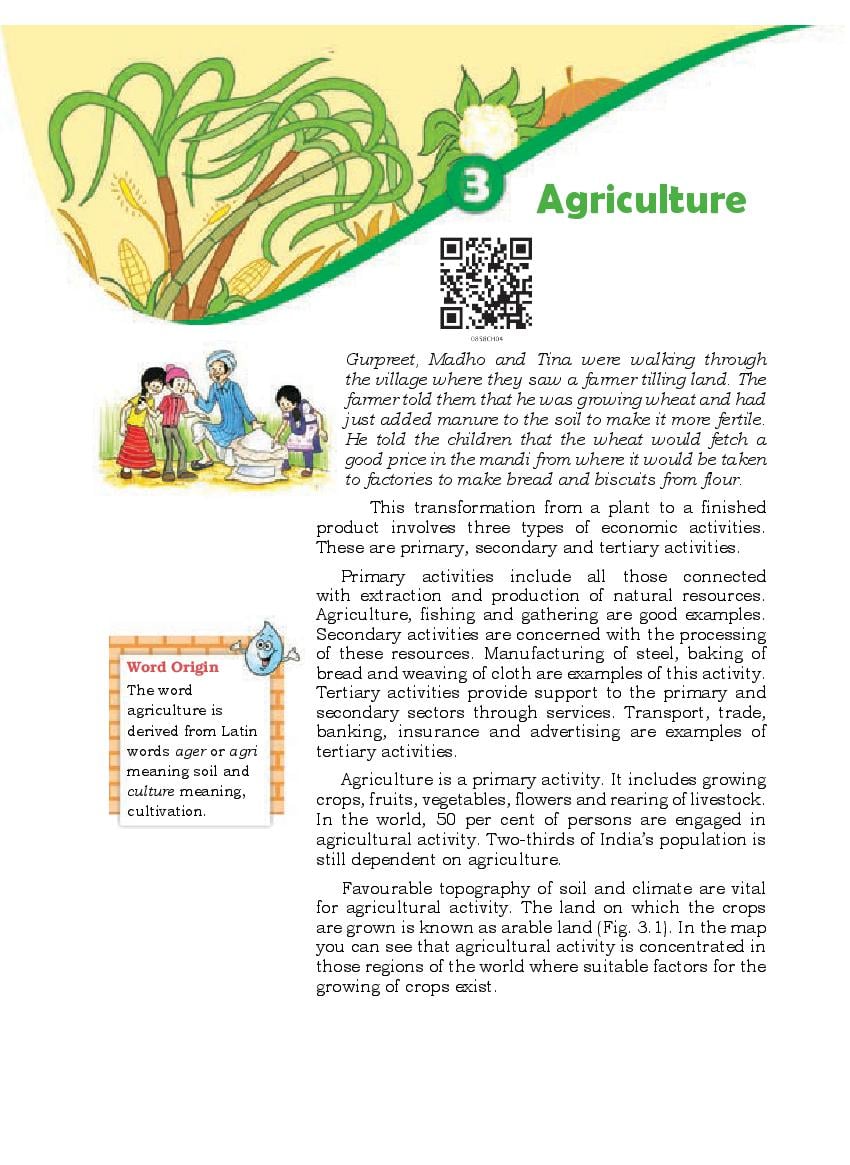
Gurpreet, Madho and Tina were walking through
the village where they saw a farmer tilling land. The
farmer told them that he was growing wheat and had
just added manure to the soil to make it more fertile.
He told the children that the wheat would fetch a
good price in the mandi from where it would be taken
to factories to make bread and biscuits from flour.
This transformation from a plant to a finished
product involves three types of economic activities.
These are primary, secondary and tertiary activities.
Primary activities include all those connected
with extraction and production of natural resources.
Agriculture, fishing and gathering are good examples.
Secondary activities are concerned with the processing
of these resources. Manufacturing of steel, baking of
Word Origin bread and weaving of cloth are examples of this activity.
The word Tertiary activities provide support to the primary and
agriculture is secondary sectors through services. Transport, trade,
derived from Latin banking, insurance and advertising are examples of
words ager or agri tertiary activities.
meaning soil and
Agriculture is a primary activity. It includes growing
culture meaning,
crops, fruits, vegetables, flowers and rearing of livestock.
cultivation.
In the world, 50 per cent of persons are engaged in
agricultural activity. Two-thirds of India’s population is
still dependent on agriculture.
Favourable topography of soil and climate are vital
for agricultural activity. The land on which the crops
are grown is known as arable land (Fig. 3.1). In the map
you can see that agricultural activity is concentrated in
those regions of the world where suitable factors for the
growing of crops exist.
Chapter-3.indd 22 8/17/2022 11:34:55 AM
Showing the first page only. Download the PDF above for the complete document.
Document Details
| Board / Org | NCERT |
| Exam | Class 8 |
| Type | Books |
| Pages | 16 |
| Updated | 30 Apr 2026 |