MBOSE Class 11 Question Paper 2022 for Biology
Finished viewing? Save it for later —
Download MBOSE Class 11 Question Paper 2022 for Biology (PDF · 4 pages)About MBOSE Class 11 Question Paper 2022 for Biology
MBOSE Class 11 Question Paper 2022 for Biology is available here for free download. Published by Meghalaya Board for Class 11, this question paper can be viewed online or downloaded as a PDF (4 pages). Candidates preparing for Class 11 can use MBOSE Class 11 Question Paper 2022 for Biology to understand the exam pattern, the type of questions asked, and the overall difficulty level.
Frequently Asked Questions
How can I download MBOSE Class 11 Question Paper 2022 for Biology?
Open this page and click the Download button to save MBOSE Class 11 Question Paper 2022 for Biology as a PDF. It is completely free on AglaSem Docs.
Is MBOSE Class 11 Question Paper 2022 for Biology free to download?
Yes. MBOSE Class 11 Question Paper 2022 for Biology can be viewed online and downloaded as a PDF free of cost on AglaSem Docs.
How many pages does MBOSE Class 11 Question Paper 2022 for Biology have?
MBOSE Class 11 Question Paper 2022 for Biology contains 4 pages, which you can read online or download together as a single PDF.
Where can I find more Class 11 study material?
You can find more Class 11 question papers, sample papers, syllabus, and answer keys on AglaSem Docs.
MBOSE Class 11 Question Paper 2022 for Biology – Text
Read the full text of this question paper below — useful to quickly search, copy and reference the content online without downloading the PDF.
📄 View text version (4 pages)
Page 1
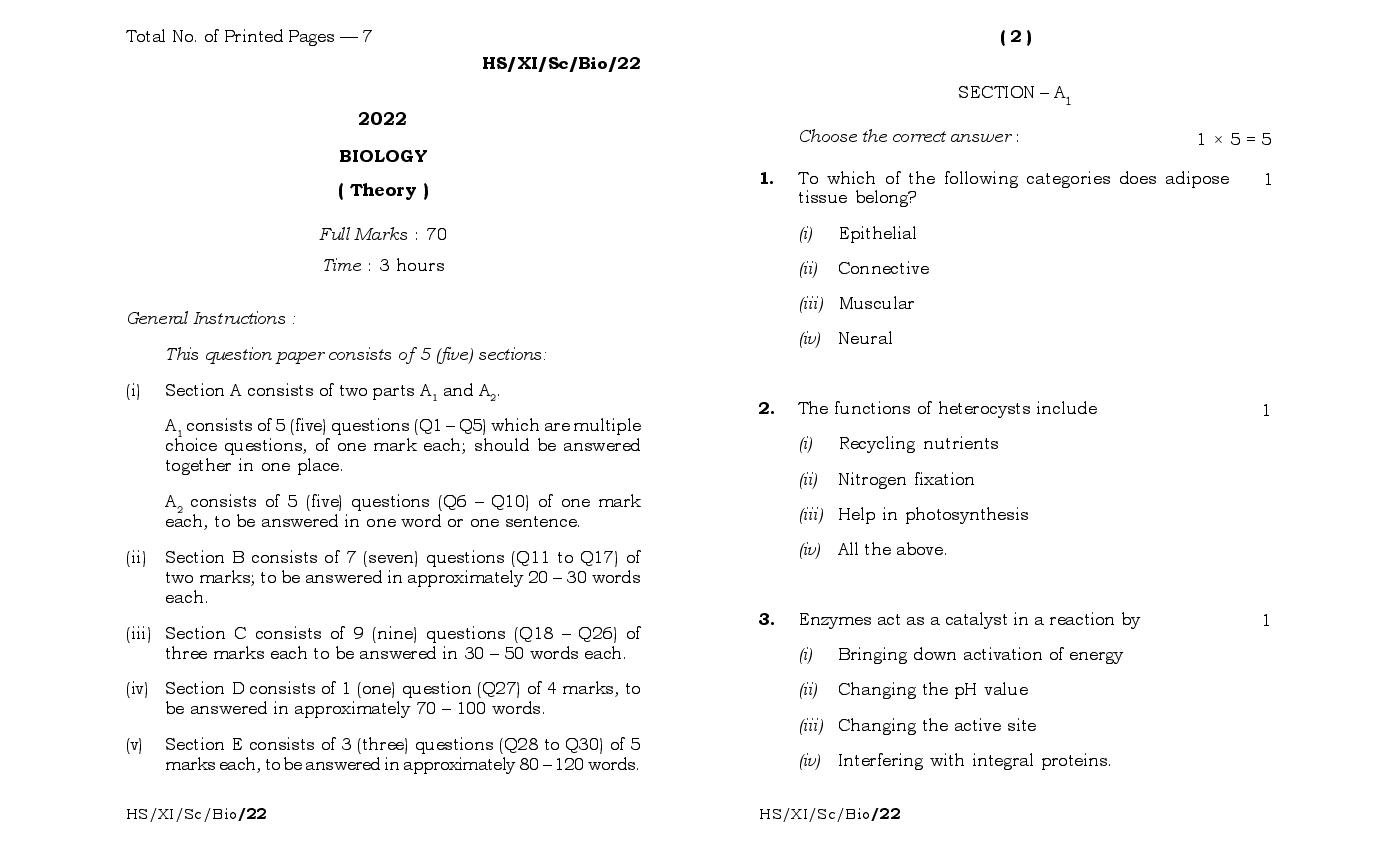
SECTION – A1
2022
Choose the correct answer : 1 5=5
BIOLOGY
1. To which of the following categories does adipose 1
( Theory ) tissue belong?
Full Marks : 70 (i) Epithelial
Time : 3 hours (ii) Connective
(iii) Muscular
General Instructions :
(iv) Neural
This question paper consists of 5 (five) sections:
(i) Section A consists of two parts A1 and A2.
2. The functions of heterocysts include 1
A1 consists of 5 (five) questions (Q1 – Q5) which are multiple
choice questions, of one mark each; should be answered (i) Recycling nutrients
together in one place.
(ii) Nitrogen fixation
A2 consists of 5 (five) questions (Q6 – Q10) of one mark
each, to be answered in one word or one sentence. (iii) Help in photosynthesis
(ii) Section B consists of 7 (seven) questions (Q11 to Q17) of (iv) All the above.
two marks; to be answered in approximately 20 – 30 words
each.
3. Enzymes act as a catalyst in a reaction by 1
(iii) Section C consists of 9 (nine) questions (Q18 – Q26) of
three marks each to be answered in 30 – 50 words each. (i) Bringing down activation of energy
(iv) Section D consists of 1 (one) question (Q27) of 4 marks, to (ii) Changing the pH value
be answered in approximately 70 – 100 words.
(iii) Changing the active site
(v) Section E consists of 3 (three) questions (Q28 to Q30) of 5
marks each, to be answered in approximately 80 – 120 words. (iv) Interfering with integral proteins.
HS/XI/Sc/Bio/22 HS/XI/Sc/Bio/22
Page 2
4. Plasmolysis occurs when 1 SECTION – B
(i) Water enters into the cell ( Short answer – I) 2 7 = 14
(ii) Water concentration is equal
11. Either
(iii) Water moves out of the cell
(iv) None of the above. Name the phylum to which Starfish and Sponge belong.
1+1=2
Or
5. Animals in which the cells are arranged in two What are the diagnostic characteristics of chordates? 2
embryonic layers are called 1
(i) Monoblastic
12. Draw a labelled diagram of myelinated neurons. 2
(ii) Diploblastic
(iii) Triploblastic 13. Draw a labelled diagram of chloroplast. 2
(iv) Coelomate.
14. What is the nature of cell walls in diatoms? 2
SECTION – A2
15. Define enzyme. Give one example. 1+1=2
( Very short answer ) 1 5=5
16. What are trichomes? 2
6. What are parasites? 1
7. Define bilateral symmetry. 1 17. Either
8. Write the floral formula of Solanaceae family. 1 Write the functions of mitochondria. 2
Or
9. Define osmoregulation. 1
What is Respiratory quotient? Write the value of R.Q.
10. What is Glomerulonephritis? 1
for protein. 1+1=2
HS/XI/Sc/Bio/22 HS/XI/Sc/Bio/22
Page 3
SECTION –– C 25. What is chiasmata? What is the significance of meiosis?
( Short answer – II ) 3 9 = 27 1+2=3
26. Briefly describe the simple epithelial tissues. 3
18. Either
Explain the mechanism of breathing in humans. Or
3
Or Describe the mechanism of digestion of carbohydrates. 3
Differentiate between prokaryotic and eukaryotic cells. 3
19. Briefly describe the different structures of protein. 3
SECTION – D
20. What are hormones? Name the different endocrine 27. Define oxygen dissociation curve. Discuss the factors
glands in human. 1+ 2=3 affecting Oxygen dissociation curve. 1+3=4
21. Write the composition of mammalian blood. What are
the main functions of different blood cells. 1½ + 1½ = 3
SECTION – E
( Long answer type ) 5 3 = 15
22. What do you understand by photoperiodism and
vernalisation? 1½ + 1½ = 3
28. Either
Describe the different types of vascular bundles in
23. What are the steps involved in formation of a root plants with the help of labelled diagrams. 3+2=5
nodule? 3
Or
Name the five main groups of natural plant growth
24. What role does root pressure play in water movements regulators. Write the physiological effects of any two
in plants? 3 of them. 1+2+2=5
HS/XI/Sc/Bio/22 HS/XI/Sc/Bio/22
Page 4
29. Either
Mention the characteristics of phylum Mollusca. 5
Or
Draw a labelled diagram of human eye. Differentiate
between rods and cones. 3+2=5
30. Either
Describe the non-cyclic photophosphorylation in
plants. 5
Or
Name the different types of muscles. With a labelled
diagram, briefly describe the structure of skeletal
muscle. 1+4=5
Document Details
| Board / Org | Meghalaya Board |
| Exam | Class 11 |
| Type | Question Paper |
| Pages | 4 |
| Updated | 30 Apr 2026 |