MBOSE Class 11 Question Paper 2022 for Chemistry
Finished viewing? Save it for later —
Download MBOSE Class 11 Question Paper 2022 for Chemistry (PDF · 5 pages)About MBOSE Class 11 Question Paper 2022 for Chemistry
MBOSE Class 11 Question Paper 2022 for Chemistry is available here for free download. Published by Meghalaya Board for Class 11, this question paper can be viewed online or downloaded as a PDF (5 pages). Candidates preparing for Class 11 can use MBOSE Class 11 Question Paper 2022 for Chemistry to understand the exam pattern, the type of questions asked, and the overall difficulty level.
Frequently Asked Questions
How can I download MBOSE Class 11 Question Paper 2022 for Chemistry?
Open this page and click the Download button to save MBOSE Class 11 Question Paper 2022 for Chemistry as a PDF. It is completely free on AglaSem Docs.
Is MBOSE Class 11 Question Paper 2022 for Chemistry free to download?
Yes. MBOSE Class 11 Question Paper 2022 for Chemistry can be viewed online and downloaded as a PDF free of cost on AglaSem Docs.
How many pages does MBOSE Class 11 Question Paper 2022 for Chemistry have?
MBOSE Class 11 Question Paper 2022 for Chemistry contains 5 pages, which you can read online or download together as a single PDF.
Where can I find more Class 11 study material?
You can find more Class 11 question papers, sample papers, syllabus, and answer keys on AglaSem Docs.
MBOSE Class 11 Question Paper 2022 for Chemistry – Text
Read the full text of this question paper below — useful to quickly search, copy and reference the content online without downloading the PDF.
📄 View text version (5 pages)
Page 1
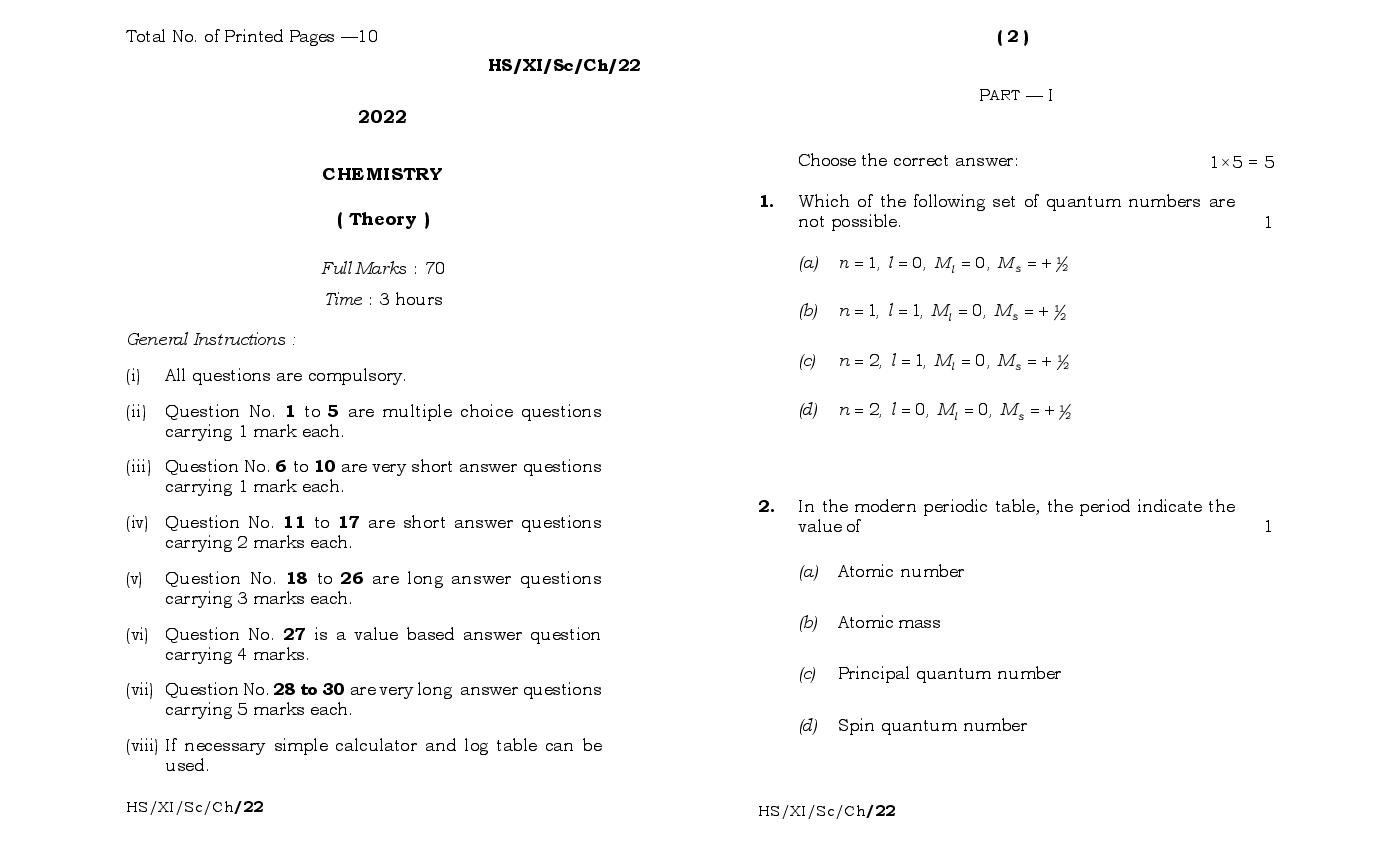
HS/XI/Sc/Ch/22
PART –– I
2022
Choose the correct answer: 1 5 = 5
CHEMISTRY
1. Which of the following set of quantum numbers are
( Theory ) not possible. 1
Full Marks : 70 (a) n 1, l 0, M l 0, M s 12
Time : 3 hours
(b) n 1, l 1, M l 0, M s 12
General Instructions :
(c) n 2, l 1, M l 0, M s 12
(i) All questions are compulsory.
(ii) Question No. 1 to 5 are multiple choice questions (d) n 2, l 0, M l 0, M s 12
carrying 1 mark each.
(iii) Question No. 6 to 10 are very short answer questions
carrying 1 mark each.
2. In the modern periodic table, the period indicate the
(iv) Question No. 11 to 17 are short answer questions value of 1
carrying 2 marks each.
(v) Question No. 18 to 26 are long answer questions (a) Atomic number
carrying 3 marks each.
(b) Atomic mass
(vi) Question No. 27 is a value based answer question
carrying 4 marks.
(c) Principal quantum number
(vii) Question No. 28 to 30 are very long answer questions
carrying 5 marks each.
(d) Spin quantum number
(viii) If necessary simple calculator and log table can be
used.
HS/XI/Sc/Ch/22 HS/XI/Sc/Ch/22
Page 2
3. A Thermodynamic state function is a quantity 1 PART –– II
(a) Used to determine heat changes
6. Define Modern Periodic Law 1
(b) Whose value is independent of path
(c) Used to determine pressure volume work 7. Distinguish between a (sigma) and a (pi) bond. 1
(d) Whose value depends on temperature only
8. What is disproportionation reaction? 1
4. Which one of the alkaline earth metal carbonates is 9. Name the different allotropes of carbon. 1
thermally the most stable? 1
(a) MgCO3 10. Why is the small drops of mercury form spherical bead
instead of spreading on the surface. 1
(b) CaCO3
(c) SrCO3
PART –– III
(d) BaCO3
11. A compound contain 4.07% hydrogen, 24.27% carbon
and 71.65% chlorine. Its molar mass is 98.96g. What
5. The reaction: 1 are its empirical and molecular formula? 2
CH3CH2I KOH(aq) CH3CH2OH KI
is classified as 12. The threshold frequency vo for a metal is 7.0 1014 s 1 .
Calculate the kinetic energy of an electron emitted
(a) Electrophilic substitution
when radiation of frequency v 1.0 1015 s 1 hits the
(b) Nucleophilic substitution metal. 2
(c) Elimination 13. Explain why cations are smaller and anions larger in
radii than their parent atoms? 2
(d) Addition
HS/XI/Sc/Ch/22 HS/XI/Sc/Ch/22
Page 3
14. Derive equation, PART –– IV
pV = nRT
Where the symbols carry usual meaning. 2 18. Either
(a) Write the electronic configuration of Cu(At no. 29) 1
(b) Account for the stability of completely filled and
15. Either
half filled subshells 2
Which out of NH3 and NF3 has higher dipole moments Or
and why? 2
Give the postulates of Bohr’s model of hydrogen
Or atom. 3
Define hydrogen bond. Is it weaker or stronger than
the van der Waals forces? 2
19. Define hybridisation? Explain the structure of C2H4
molecule on basis of hybridisation. 3
16. What causes the temporary and permanent hardness 20. Derive the relationship between Cp and Cv for an ideal
of water? 2 gas. 3
21. (a) State Le Chatelier’s principle. 1
17. Either
What are electrophiles and nucleophiles? Explain with (b) For the equilibrium 2
example. 2 2NOCl(g) 2NO(g) Cl2 (g)
Or
the value of the equilibrium constant K c is
Define Hyperconjugation with suitable example. 2 3.75 10 6 at 1069K. Calculate Kp for the reaction
at this temperature?
HS/XI/Sc/Ch/22 HS/XI/Sc/Ch/22
Page 4
22. Either 25. (a) Define functional group isomerism with example. 1
(a) On the basis of molecular Hydride classify the
following compound as electron deficient, electron (b) Differentiate between distillation under reduced
precise and electron rich hydrides. 2 pressure and steam distillation. 2
B2H6, CH4, H2O and NH3.
(b) What are amphoteric oxide? Give example. 1
26. Either
Or
(c) Starting from Borax, how Boric acid is prepared? (a) Define ozonolysis with example. 2
Give balance chemical equation. 2
(d) What happen when Al is treated with dilute NaOH (b) How benzene is prepared from phenol? Give
solution? 1 chemical equation. 1
Or
23. (a) Calculate the oxidation number of sulphur (s) in (c) What are ortho-para directing group? Explain
with example 1
½ 2 = 1
(i) H 2S 4O 6
(ii) Na2S2O3 (d) Write the product of the following reaction
(b) Balance the following redox reaction by any
Mo O
method. 2 (i) CH4 O2
2 3
1
Cr2O72 SO2 (g) Cr 3 (aq) SO42 (aq) (acid medium)
Anhyd. A lCl
(ii) 6Cl 2 dark,
3
1
cold
24. (a) Name the different isotopes of Hydrogen. 1
(b) Calculate the mass of a photon with wavelength
3.6A0. 2
HS/XI/Sc/Ch/22 HS/XI/Sc/Ch/22
Page 5
PART – V 29. (a) Give Chemical equation to show
(i) The amphoteric nature of H2O 1 12
27. As an individual who is responsible for protecting the (ii) The oxidising property of H2O2 1 12
environment, what measure would you take to reduce
environmental pollution in your locality. 4
(b) What is “dead burnt plaster”? 1
28. Either (c) List out two uses of quicklime. 1
(a) Derive the relation
ΔG ΔH TΔS 0 2
30. (a) What is hydrogenation reaction? Give example. 1
(b) What are extensive and intensive properties of a
(b) What is heterolytic cleavage? 1
system? Cite example. 2
(c) Draw the newman projection formula of Ethane. 1
(c) What is bond dissociation enthalpy (hexa H ) 1
(d) Give the mechanism of addition of
Or
HBr to CH3 C C CH3 2
(d) The combustion of one mole of benzene takes H CH3
place at 298 K and 1 atm. After combustion,
CO2(g) and H2O(l) are produced and 3267.0 kJ of
heat is liberated. Calculate the standard enthalpy
of formation (Δ f H ) of benzene Standard enthalpy
of formation of CO2 (g ) and H2O(1) are –393.5 kJ/
mol and –285.83 kJ/mol respectively. 3
(e) How temperature affects the spontaneity of a
chemical reaction? 2
HS/XI/Sc/Ch/22 HS/XI/Sc/Ch/22
Document Details
| Board / Org | Meghalaya Board |
| Exam | Class 11 |
| Type | Question Paper |
| Pages | 5 |
| Updated | 30 Apr 2026 |