UGC NET 2021 Question Paper Tribal and Religion Language Literature
Finished viewing? Save it for later —
Download UGC NET 2021 Question Paper Tribal and Religion Language Literature (PDF · 59 pages)About UGC NET 2021 Question Paper Tribal and Religion Language Literature
UGC NET 2021 Question Paper Tribal and Religion Language Literature is available here for free download. Published by NTA for UGC NET, this question paper can be viewed online or downloaded as a PDF (59 pages). Candidates preparing for UGC NET can use UGC NET 2021 Question Paper Tribal and Religion Language Literature to understand the exam pattern, the type of questions asked, and the overall difficulty level.
Frequently Asked Questions
How can I download UGC NET 2021 Question Paper Tribal and Religion Language Literature?
Open this page and click the Download button to save UGC NET 2021 Question Paper Tribal and Religion Language Literature as a PDF. It is completely free on AglaSem Docs.
Is UGC NET 2021 Question Paper Tribal and Religion Language Literature free to download?
Yes. UGC NET 2021 Question Paper Tribal and Religion Language Literature can be viewed online and downloaded as a PDF free of cost on AglaSem Docs.
How many pages does UGC NET 2021 Question Paper Tribal and Religion Language Literature have?
UGC NET 2021 Question Paper Tribal and Religion Language Literature contains 59 pages, which you can read online or download together as a single PDF.
Where can I find more UGC NET study material?
You can find more UGC NET question papers, sample papers, syllabus, and answer keys on AglaSem Docs.
UGC NET 2021 Question Paper Tribal and Religion Language Literature – Text
Read the full text of this question paper below — useful to quickly search, copy and reference the content online without downloading the PDF.
📄 View text version (59 pages)
Page 1
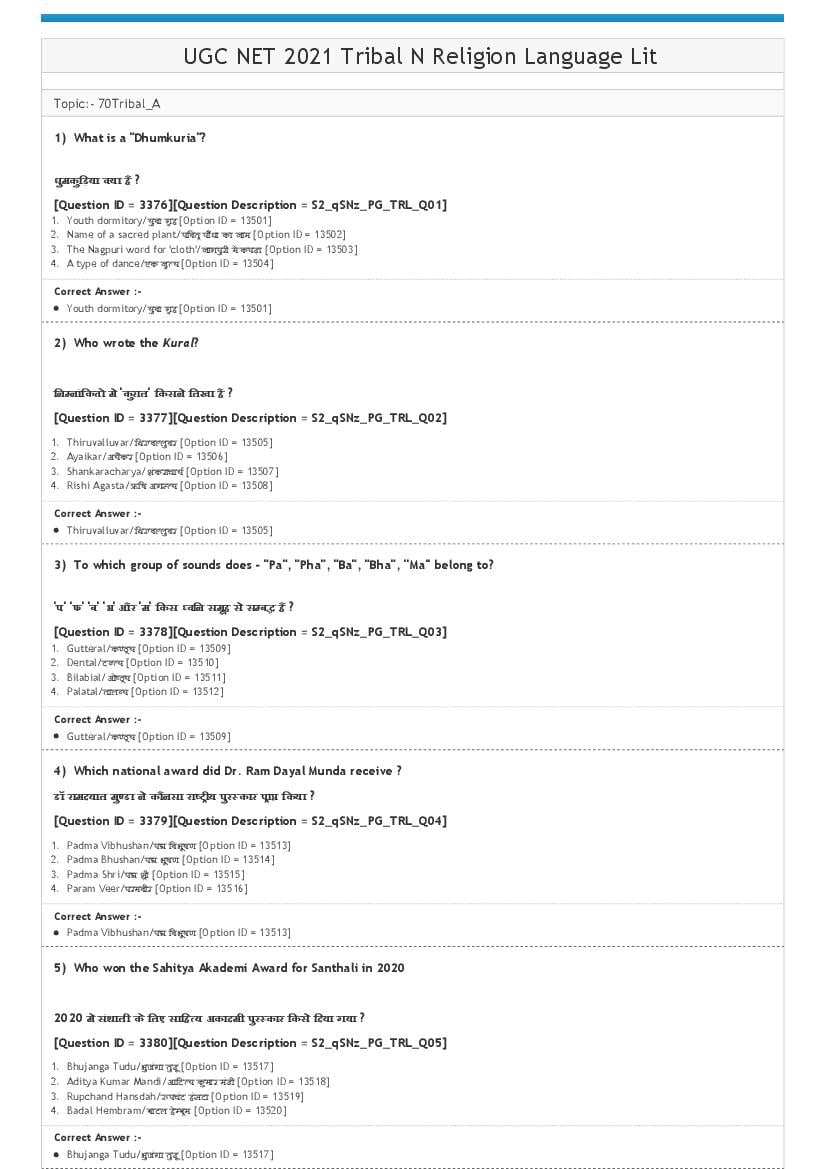
Topic:‐ 70Tribal_A
1) What is a "Dhumkuria"?
धुमकुिड़या या है ?
[Question ID = 3376][Question Description = S2_qSNz_PG_TRL_Q01]
1. Youth dormitory/युवा गृह [Option ID = 13501]
2. Name of a sacred plant/पिवत पौधा का नाम [Option ID = 13502]
3. The Nagpuri word for 'cloth'/नागपुरी म कपड़ा [Option ID = 13503]
4. A type of dance/एक नृ य [Option ID = 13504]
Youth dormitory/युवा गृह [Option ID = 13501]
2) Who wrote the Kural?
िन नांिकत म 'कुराल' िकसने िलखा है ?
[Question ID = 3377][Question Description = S2_qSNz_PG_TRL_Q02]
1. Thiruvalluvar/िथ व लुवर [Option ID = 13505]
2. Ayaikar/अयैकर [Option ID = 13506]
3. Shankaracharya/शंकराचाय [Option ID = 13507]
4. Rishi Agasta/ऋिष अग य [Option ID = 13508]
Thiruvalluvar/िथ व लुवर [Option ID = 13505]
3) To which group of sounds does ‐ "Pa", "Pha", "Ba", "Bha", ''Ma'' belong to?
'प' 'फ' 'ब' 'भ' और 'म' िकस विन समूह से स ब ह?
[Question ID = 3378][Question Description = S2_qSNz_PG_TRL_Q03]
1. Gutteral/क य [Option ID = 13509]
2. Dental/द य [Option ID = 13510]
3. Bilabial/ओ य [Option ID = 13511]
4. Palatal/ताल य [Option ID = 13512]
Gutteral/क य [Option ID = 13509]
4) Which national award did Dr. Ram Dayal Munda receive ?
डॉ रामदयाल मु डा ने कौनसा रा ीय पुर कार पा िकया ?
[Question ID = 3379][Question Description = S2_qSNz_PG_TRL_Q04]
1. Padma Vibhushan/प िवभूषण [Option ID = 13513]
2. Padma Bhushan/प भूषण [Option ID = 13514]
3. Padma Shri/प शी [Option ID = 13515]
4. Param Veer/परमवीर [Option ID = 13516]
Padma Vibhushan/प िवभूषण [Option ID = 13513]
5) Who won the Sahitya Akademi Award for Santhali in 2020
2020 म संथाली के िलए सािह य अकादमी पुर कार िकसे िदया गया ?
[Question ID = 3380][Question Description = S2_qSNz_PG_TRL_Q05]
1. Bhujanga Tudu/भुजग
ं ा तुडू [Option ID = 13517]
2. Aditya Kumar Mandi/आिद य कुमार मंडी [Option ID = 13518]
3. Rupchand Hansdah/ पचंद हंसदा [Option ID = 13519]
4. Badal Hembram/बादल हे बम [Option ID = 13520]
Bhujanga Tudu/भुजग
ं ा तुडू [Option ID = 13517]
Page 2
2018 म िकस संथाली लेखक को प शी से स मािनत िकया गया ?
[Question ID = 3381][Question Description = S2_qSNz_PG_TRL_Q06]
1. Arjun Charan Hembram/अजुन चरण हे बम [Option ID = 13521]
2. Bogla Soren/भोगला सोरेन [Option ID = 13522]
3. Ram Chandra Murmu/राम च द मुमू [Option ID = 13523]
4. Digambar Hansda/िदग बर हंसदा [Option ID = 13524]
Arjun Charan Hembram/अजुन चरण हे बम [Option ID = 13521]
7) Which of the following laws did NOT impact tribal society negatively?
िन निलिखत म से कौन कानून जनजातीय समाज पर नकारा मक पभाव नह डालता है ?
[Question ID = 3382][Question Description = S2_qSNz_PG_TRL_Q07]
1. The Permanent Settlement Act (1773)/ थायी बंदोब त अिधिनयम (1773) [Option ID = 13525]
2. The Bengal Land‐revenue sales Act, 1859/बंगाल भू राज व िवकय अिधिनयम, (1859) [Option ID = 13526]
3. Chotanagpur Tenancy Act (1908)/छोटानागपुर िकराया कानून (1908) [Option ID = 13527]
4. Both Option 1 and Option 2/1 एवं 2 दोन [Option ID = 13528]
The Permanent Settlement Act (1773)/ थायी बंदोब त अिधिनयम (1773) [Option ID = 13525]
8) Who is the author of "Sahityadarpan" ?
"सािह य दपण" के लेखक कौन ह ?
[Question ID = 3383][Question Description = S2_qSNz_PG_TRL_Q08]
1. Mammat/म मट [Option ID = 13529]
2. Bhamah/भामह [Option ID = 13530]
3. Vishwanath/िव नाथ [Option ID = 13531]
4. Dandi/द डी [Option ID = 13532]
Mammat/म मट [Option ID = 13529]
9) What do students of Semantics study?
अथ िव ान के छात या अ ययन करगे ?
[Question ID = 3384][Question Description = S2_qSNz_PG_TRL_Q09]
1. Geography/भूगोल [Option ID = 13533]
2. History/इितहास [Option ID = 13534]
3. Deterioration of Meaning/अथ संकोचन [Option ID = 13535]
4. Different aspects of Meaning/अथ के अ य पहलु [Option ID = 13536]
Geography/भूगोल [Option ID = 13533]
10) Who among the following has created a script for tribal languages?
जनजातीय भाषाओं के िलए एक िलिप क रचना िकसने क ?
[Question ID = 3385][Question Description = S2_qSNz_PG_TRL_Q10]
1. Fr. J. B. Hoffman, S.J./डॉ जे. बी. हॉ मैन, एस. जे. [Option ID = 13537]
2. Fr. Agapit Tirkey, S.J./डॉ िपट िटक , एस. जे. [Option ID = 13538]
3. Neelam Toppo/नीलम टो पो [Option ID = 13539]
4. Dr. Narayan Oraon/डॉ नारायण उराँव [Option ID = 13540]
Fr. J. B. Hoffman, S.J./डॉ जे. बी. हॉ मैन, एस. जे. [Option ID = 13537]
11) Which of the following statements is the correct definition of Nirguna ?
िन नांिकत कथन म से कौन िनगुण क सही प रभाषा है ?
[Question ID = 3386][Question Description = S2_qSNz_PG_TRL_Q11]
Page 3
2. It is the concept of a formless Guru/यह एक िनराकार गु क संक पना है [Option ID = 13542]
3. It is the concept of Spirituality/यह अ या म क संक पना है [Option ID = 13543]
4. None of these/उपयु म से कोई नह [Option ID = 13544]
It is the concept of a formless God/यह एक िनराकार ब ह क संक पना है [Option ID = 13541]
12) Which book did Raja Upendranath Singhdeo write on Aryan and Tribal music ?
आयन और जनजातीय संगीत पर राजा उपे दनाथ िसंहदेव ने कौन सी पु तक िलखी है ?
[Question ID = 3387][Question Description = S2_qSNz_PG_TRL_Q12]
1. "Rashmirathi"/रि मरथी [Option ID = 13545]
2. "List of Monuments in the Chotanagpur Division"/"िल ट ऑफ़ मॉ युम स इन छोटानागपुर िडवीजन" [Option ID = 13546]
3. "Descriptive Ethnology of Bengal"/"िडि कि टव इ नोलॉजी ऑफ़ बंगाल" [Option ID = 13547]
4. "Chotanagpur Tal Manjari"/"छोटानागपुर ताल म जरी" [Option ID = 13548]
"Rashmirathi"/रि मरथी [Option ID = 13545]
13) Which one of the following is a work of Tamil Grammar that is said to be the earliest extant work of Tamil Literature ?
कौन सा आरंिभक तिमल गामर तिमल सािह य म िव मान है ?
[Question ID = 3388][Question Description = S2_qSNz_PG_TRL_Q13]
1. Tolkappiyam/तोलकाि पयम [Option ID = 13549]
2. Patinenmalkanakku/पितनेनमेलकनकु [Option ID = 13550]
3. Patinenkilkanakku/पितनेनिकलकनकु [Option ID = 13551]
4. Cillappatikaram/सेलापदीकारम [Option ID = 13552]
Tolkappiyam/तोलकाि पयम [Option ID = 13549]
14) What does "Sakam orec" mean to the Santals?
संताल म 'सकम ओरेक' का मतलब या है :
[Question ID = 3389][Question Description = S2_qSNz_PG_TRL_Q14]
1. Marriage ceremony/िववाह [Option ID = 13553]
2. Death ceremony/मृ यु [Option ID = 13554]
3. Engagement ceremony/मंगनी [Option ID = 13555]
4. Divorce ceremony/तलाक [Option ID = 13556]
Marriage ceremony/िववाह [Option ID = 13553]
15) Which one of the following is the oldest text of Sanskrit Grammar?
सं कृत सवािधक पाचीन याकरण पु तक कौन सी है ?
[Question ID = 3390][Question Description = S2_qSNz_PG_TRL_Q15]
1. Panini's "Astadhyayi"/पािणिन 'अ अ यायी' [Option ID = 13557]
2. Yaska's "Nirukta"/य का 'िन ा' [Option ID = 13558]
3. Vasubandhu's "Abhidharmakosabhasya"/वसुव धु 'अभीधमकोसभा य" [Option ID = 13559]
4. Patanjali's "Mahabhasya"/पतंजिल का 'महाभा य' [Option ID = 13560]
Panini's "Astadhyayi"/पािणिन 'अ अ यायी' [Option ID = 13557]
16) Which one of the following does NOT belong to the Austro‐Asiatic linguistic group?
िन नांिकत कौन अ ो एिशयािटक भाषा समूह क नह है ?
[Question ID = 3391][Question Description = S2_qSNz_PG_TRL_Q16]
1. Munda/मु डा [Option ID = 13561]
2. Ho/हो [Option ID = 13562]
3. Korwa/कोरवा [Option ID = 13563]
4. Kurux/कुड़
ँ ख़ [Option ID = 13564]
Munda/मु डा [Option ID = 13561]
Page 4
िन निलिखत म से कौन सा पाचीन सं कृत ग थ 1028 तोत का संकलन है ?
[Question ID = 3392][Question Description = S2_qSNz_PG_TRL_Q17]
1. Sama Veda/सामवेद [Option ID = 13565]
2. Rig Veda/ऋ वेद [Option ID = 13566]
3. Brahamans/बा ण [Option ID = 13567]
4. Aryankas/आर यक [Option ID = 13568]
Sama Veda/सामवेद [Option ID = 13565]
18) Which of the following works did Varahamihira write?
िन निलिखत म से िकस कृित के रचनाकार वाराहिमिहर ह ?
[Question ID = 3393][Question Description = S2_qSNz_PG_TRL_Q18]
1. Panchsidhantika/पंचिस ांितका [Option ID = 13569]
2. Mudrarakshasa/मुदारा स [Option ID = 13570]
3. Kathasaritasagar/कथास रतसागर [Option ID = 13571]
4. Upanishad/उपिनषद [Option ID = 13572]
Panchsidhantika/पंचिस ांितका [Option ID = 13569]
19) Who wrote the Kathasaritsagar?
"कथास रतसागर" क रचना िकसने क है ?
[Question ID = 3394][Question Description = S2_qSNz_PG_TRL_Q19]
1. Somdeva/सोमदेव [Option ID = 13573]
2. Varharmihara/वाराहिमिहर [Option ID = 13574]
3. Rani Kriti/रिव कृित [Option ID = 13575]
4. Visakadatta/िवशाखद [Option ID = 13576]
Somdeva/सोमदेव [Option ID = 13573]
20) Who wrote the "Ramcharita"?
"रामच रत" क रचना िकसने क है ?
[Question ID = 3395][Question Description = S2_qSNz_PG_TRL_Q20]
1. Chand Bardoi/चं द बरदायी [Option ID = 13577]
2. Banabhatta/बाणाभ [Option ID = 13578]
3. Sandhyakara Nandi/सं याकर नंदी [Option ID = 13579]
4. Kalhana/क हण [Option ID = 13580]
Chand Bardoi/चं द बरदायी [Option ID = 13577]
21) The "Brihat Samhita" was written by ?
'बृहत संिहता' क रचना िकसने क थी ?
[Question ID = 3396][Question Description = S2_qSNz_PG_TRL_Q21]
1. Somdeva/सोमदेव [Option ID = 13581]
2. Varharmihara/वाराहिमिहर [Option ID = 13582]
3. Kalidasa/कािलदास [Option ID = 13583]
4. Ayaikar/अय कर [Option ID = 13584]
Somdeva/सोमदेव [Option ID = 13581]
22) Which Sufi Dargah is at Ajmer?
अजमेर म िकस सूफ संत का दरगाह है ?
[Question ID = 3397][Question Description = S2_qSNz_PG_TRL_Q22]
Page 5
2. Qutubuddin Bakhtiyar Kaki/कुतुबु ीन बि तयार काक [Option ID = 13586]
3. Moinuddin Chisti/मुइनु ीन िच ती [Option ID = 13587]
4. Khwaja Bahuddin/ वाजा बराउ ीन [Option ID = 13588]
Baba Farid/बाबा फरीद [Option ID = 13585]
23) Which ancient Sanskrit text deals with the origin of the Universe, death and birth, the material and the spiritual world?
िन निलिखत म से कौन सा पाचीन सं कृत ग थ ब ांड क उ पि , ज म और मृ यु तथा भौितक और आ याि मक जगत से संबंिधत है ?
[Question ID = 3398][Question Description = S2_qSNz_PG_TRL_Q23]
1. Rig Veda/ऋ वेद [Option ID = 13589]
2. Atharva Veda/अथव वेद [Option ID = 13590]
3. Aryankas/आर यक [Option ID = 13591]
4. Upanishads/उपिनषद [Option ID = 13592]
Rig Veda/ऋ वेद [Option ID = 13589]
24) Which work of Sangam Literature, composed by Jain Monks talks about the transient nature of life and youth?
संगम सािह य क िन निलिखत म से िकस कृित का संकलन जैन िभ ु ओ ं ारा िकया गया है िजसमे जीवन और यौवन क न रता का वणन है ?
[Question ID = 3399][Question Description = S2_qSNz_PG_TRL_Q24]
1. Nanmanikkatiga/नानमिण कितगा [Option ID = 13593]
2. Naaladiyar/नालिदयार [Option ID = 13594]
3. Inna Narpathu/इ न नरपथु [Option ID = 13595]
4. Iniyavai Narpathu/इिनयावै नरपथु [Option ID = 13596]
Nanmanikkatiga/नानमिण कितगा [Option ID = 13593]
25) Which of the following was the basic premise of the Bhakti Movement?
िन निलिखत म से कौन सा भि आंदोलन का मूल आधार था ?
[Question ID = 3400][Question Description = S2_qSNz_PG_TRL_Q25]
1. Bhakti or single minded, uninterrupted and extreme devotion to God as the only means of salvation/भि या ई र के पित एकागिच होकर अिवरत और चरम िन ा
ही मो का एक मात साधन है [Option ID = 13597]
2. Bhakti or single‐minded, uninterrupted and extreme devotion to God with the help of Brahmins was the only means of salvation/भि या बा ण क
सहायता से ई र के पित एकागिच होकर अिवरत और चरम िन ा ही मो का एक मात साधन है [Option ID = 13598]
3. Both Option 1 and Option 2/उपयु 1 और 2 दोन [Option ID = 13599]
4. None of these/उपयु म से कोई नह [Option ID = 13600]
Bhakti or single minded, uninterrupted and extreme devotion to God as the only means of salvation/भि या ई र के पित एकागिच होकर अिवरत और चरम िन ा
ही मो का एक मात साधन है [Option ID = 13597]
26) Who is the author of "Ram Charita Manasa" ?
'रामच रत मानस' का लेखक कौन है ?
[Question ID = 3401][Question Description = S2_qSNz_PG_TRL_Q26]
1. Tulsidas/तुलसीदास [Option ID = 13601]
2. Valmiki/वा मीिक [Option ID = 13602]
3. Vyas/ यास [Option ID = 13603]
4. Surdas/सूरदास [Option ID = 13604]
Tulsidas/तुलसीदास [Option ID = 13601]
27) Who wrote "Meghadootam"?
"मेघदूतम" क रचना िकसने क थी ?
[Question ID = 3402][Question Description = S2_qSNz_PG_TRL_Q27]
1. Bhawabhuti/भवभूित [Option ID = 13605]
2. Kalidasa/कािलदास [Option ID = 13606]
3. Sudraka/सूरदास [Option ID = 13607]
4. Atikal Ilango/अिटकल इलग [Option ID = 13608]
Page 6
28) Who is the author of "Mudrarakshasa"?
"मुदारा स" के लेखक कौन है ?
[Question ID = 3403][Question Description = S2_qSNz_PG_TRL_Q28]
1. Somdeva/सोमदेव [Option ID = 13609]
2. Ravi Kriti/रिवकृित [Option ID = 13610]
3. Varharmihara/वाराहिमिहर [Option ID = 13611]
4. Visakadatta/िवशाखद [Option ID = 13612]
Somdeva/सोमदेव [Option ID = 13609]
29) When was Meerabai born?
मीराबाई का ज म कब हआ ?
[Question ID = 3404][Question Description = S2_qSNz_PG_TRL_Q29]
1. 1446 A D E/1446 ई वी [Option ID = 13613]
2. 1456 A D E/1456 ई वी [Option ID = 13614]
3. 1498 A D E/1498 ई वी [Option ID = 13615]
4. 1520 A D E/1520 ई वी [Option ID = 13616]
1446 A D E/1446 ई वी [Option ID = 13613]
30) What is the equivalent word for "Motif" in Hindi ?
िह दी म "MOTIF" (मोिटफ) के िलए समक श द या है ?
[Question ID = 3405][Question Description = S2_qSNz_PG_TRL_Q30]
1. Lokokti/लोकोि [Option ID = 13617]
2. Kathanak Purti/कथानक पूित [Option ID = 13618]
3. Lok Tatwa/लोक त व [Option ID = 13619]
4. Lok Vishwas/लोक िव ास [Option ID = 13620]
Lokokti/लोकोि [Option ID = 13617]
31) Who wrote the book "Religion and Customs of the Oraons"?
"रेिलजन एंड क ट स ऑफ़ द उराँव" नामक िकताब िकसने िलखी ?
[Question ID = 3406][Question Description = S2_qSNz_PG_TRL_Q31]
1. B. Malinowski/बी. मलुनॉ क [Option ID = 13621]
2. Ranjit Toppo/रंजीत टोपे [Option ID = 13622]
3. P. Dehon/पी. डेहॉन [Option ID = 13623]
4. C. Lakra/सी. लकरा [Option ID = 13624]
B. Malinowski/बी. मलुनॉ क [Option ID = 13621]
32) Which of the following is not a "Ho" group?
िन निलिखत म से कौन "हो" समूह नह है ?
[Question ID = 3407][Question Description = S2_qSNz_PG_TRL_Q32]
1. Korwa group/कोरवा समूह [Option ID = 13625]
2. Munda‐Manki / Group/मु डा‐म क / समूह [Option ID = 13626]
3. Kadar Group/कदर समूह [Option ID = 13627]
4. Kajomesin group/कैजोमेिसन समूह [Option ID = 13628]
Korwa group/कोरवा समूह [Option ID = 13625]
33) Which among the following languages is closely associated with Odia?
िन निलिखत म से कौन सी भाषा "उिड़या" के सि नकट है ?
[Question ID = 3408][Question Description = S2_qSNz_PG_TRL_Q33]
Page 7
2. Nepali/नेपाली [Option ID = 13630]
3. Maithili/मैिथली [Option ID = 13631]
4. Punjabi/पंजाबी [Option ID = 13632]
Assamese / Bengali/असमी / बंगाली [Option ID = 13629]
34) Into how many parts is Kabir's Bijak primarily divided?
कबीर के "बीजक" को पाथिमक तौर पे िकतने भाग म बाँटा गया है ?
[Question ID = 3409][Question Description = S2_qSNz_PG_TRL_Q34]
1. 3/3 [Option ID = 13633]
2. 4/4 [Option ID = 13634]
3. 10/10 [Option ID = 13635]
4. 9/9 [Option ID = 13636]
3/3 [Option ID = 13633]
35) Sursagar is written in which language?
"सूरसागर" िकस भाषा म िलखा गया है ?
[Question ID = 3410][Question Description = S2_qSNz_PG_TRL_Q35]
1. Awadhi/अवधी [Option ID = 13637]
2. Brajbhasa/बजभाषा [Option ID = 13638]
3. Rajasthani/राज थानी [Option ID = 13639]
4. Hindi/िह दी [Option ID = 13640]
Awadhi/अवधी [Option ID = 13637]
36) Who among the following wrote the Rajatarangini ‐ a historical chronicle?
िन नांिकत म से िकसने "राजतरंिगणी ‐ एक ऐितहािसक ग थ" क रचना क ?
[Question ID = 3411][Question Description = S2_qSNz_PG_TRL_Q36]
1. Megasthenese/मेगा थनीज [Option ID = 13641]
2. Al‐Baruni/अल‐ब नी [Option ID = 13642]
3. Kalhana/क हण [Option ID = 13643]
4. Hiuen Tsang/हेन सांग [Option ID = 13644]
Megasthenese/मेगा थनीज [Option ID = 13641]
37) What kind of 'devotional poet' would Kabirdas be classified as?
कवी कबीरदास को आप िकस पकार के भि किव के प म विणत करगे ?
[Question ID = 3412][Question Description = S2_qSNz_PG_TRL_Q37]
1. Modern/आधुिनक [Option ID = 13645]
2. Prem Margi/पम े माग [Option ID = 13646]
3. Sagun/सगुण [Option ID = 13647]
4. Nirgun/िनगुण [Option ID = 13648]
Modern/आधुिनक [Option ID = 13645]
38) Who first wrote the "Mahabharata" in Odia?
उिड़या म 'महाभारत' क रचना सवपथम िकसने क ?
[Question ID = 3413][Question Description = S2_qSNz_PG_TRL_Q38]
1. Arjun Das/अजुन दास [Option ID = 13649]
2. Jaydev/जयदेव [Option ID = 13650]
3. Jagnath Das/जग नाथ दास [Option ID = 13651]
4. Sarala Das/सरला दास [Option ID = 13652]
Arjun Das/अजुन दास [Option ID = 13649]
Page 8
2017 म भुजंगा तुडू को कौन सा रा ीय पुर कार िदया गया था ?
[Question ID = 3414][Question Description = S2_qSNz_PG_TRL_Q39]
1. Param Veer Chakra/परमवीर चक [Option ID = 13653]
2. Nobel Prize for Literature/सािह य का नोबल पुर कार [Option ID = 13654]
3. Sahitya Akademic Award/सािह य अकादमी पुर कार [Option ID = 13655]
4. Pulitzer Prize/पुिल जर पुर कार [Option ID = 13656]
Param Veer Chakra/परमवीर चक [Option ID = 13653]
40) Which Santhali Writer was awarded the Padma Shri in 2012?
िकस संताली लेखक को 2012 ई. म प शी स मान िदया गया ?
[Question ID = 3415][Question Description = S2_qSNz_PG_TRL_Q40]
1. Gobinde Chandra Majhi/गोिव द चंद माझी [Option ID = 13657]
2. Rabilal Tudu/रबीलाल तुडू [Option ID = 13658]
3. Rupchand Hansda/ पचंद हंसदा [Option ID = 13659]
4. Digambar Hansda/िदग बर हाँसदा [Option ID = 13660]
Gobinde Chandra Majhi/गोिव द चंद माझी [Option ID = 13657]
41) What is Linguistics?
A. The scientific study of language
B. Learning as many languages as one can
C. Is about prescribing what grammar is correct
D. The analysis of language form, language meaning and language in context
E. The study of postage stamps
Choose the correct answer from the options given below:
भाषा ‐ िव ान या है ?
A. भाषा वै ािनक अ ययन
B. िजतनी हो सक उतनी भाषाएं सीखना
C. कौन सा याकरण सही है इसके िनधारण के बारे म
D. भाषाओं के व प, अथ और स दभ का िव ष
े ण
E. डाक ‐ िटकट का अ ययन
नीचे िदए गए िवक प म से सही उ र का चयन क िजए :
[Question ID = 3416][Question Description = S2_qSNz_PG_TRL_Q41]
1. A and B only/केवल A और B [Option ID = 13661]
2. B and C only/केवल B और C [Option ID = 13662]
3. C and E only/केवल C और E [Option ID = 13663]
4. A and D only/केवल A और D [Option ID = 13664]
A and B only/केवल A और B [Option ID = 13661]
42) According to Jagdish Trigunayat:
A. There is a tradition of remembering as well as forgetting songs.
B. People do not forget the songs played in an atmosphere of fun and inebriety even when they are away from it.
C. The Munda tribe is not the only tribe that is not poetic.
D. If someone sings a new song, other youngsters immediately learn it.
Choose the correct answer from the options given below:
जगदीश ितगुणायत के अनुसार
Page 9
B. म ती तथा नशे के वातावरण म वहां से अलग होने पर भी गीत को नह भूलते ह
C. मु डा जाित ही किवतामय नह है
D. िकसी के ारा यिद कोई नया गीत गाया जाता है, तो दूसरे नौजवान उसे तुरत
ं सीख लेते ह
नीचे िदए गए िवक प म से सही उ र का चयन क िजए :
[Question ID = 3417][Question Description = S2_qSNz_PG_TRL_Q42]
1. A and C only/केवल A और C [Option ID = 13665]
2. A and B only/केवल A और B [Option ID = 13666]
3. C and D only/केवल C और D [Option ID = 13667]
4. A and D only/केवल A और D [Option ID = 13668]
A and C only/केवल A और C [Option ID = 13665]
43) Which are the fields of linguistics?
A. Phonetics, Syntax, Semantics
B. Morphology, Phonology, Pragmatics
C. Morphology, Literary Theory, Grammar
D. History, Anthropology, Chemistry
E. Biology, Geology, Psychology
Choose the correct answer from the options given below:
िन नांिकत भाषा ेत से कौन ‐ कौन ह ?
A. फोनेिट स, िसनटै स, सेमि ट स
B. मोरफोलोजी, फोनोलॉजी, पैगमेिट स
C. मोरफोलॉजी, सािह य िस ांत, याकरण
D. इितहास, अ थोपोलोजी, केमे टी
E. बायोलॉजी, िजयोलॉजी, साइकोलॉजी
नीचे िदए गए िवक प म से सही उ र का चयन क िजए :
[Question ID = 3418][Question Description = S2_qSNz_PG_TRL_Q43]
1. A and B only/केवल A और B [Option ID = 13669]
2. B and C only/केवल B और C [Option ID = 13670]
3. C and D only/केवल C और D [Option ID = 13671]
4. D and E only/केवल D और E [Option ID = 13672]
A and B only/केवल A और B [Option ID = 13669]
44) According to Dr Bhuvaneshwar Anuj:
A. Birsa lived in Ulihaatu and was enrolled in the Rumchu school in, a neighbouring village.
B. Dombari Pahadi in Salga village and Sayeel Rakab, were to, became the epicentre of the Munda movement, later on.
C. Birsa registered in the Burju school for primary education.
D. Birsa Munda used to take his aunt's goats out to graze.
Choose the correct answer from the options given below:
डॉ. भुवने र अनुज के अनुसार
A. िबरसा उिलहानु म रहकर िनकट के एक गाँव के मचू कूल म अपना नामांकन करा िलया
B. सालगा गाम म डो बारी पहाड़ी तथा सइल ‐ रकब, आंदोलन का के द बना
C. िबरसा ने उपर पाईमरी िश ा के िलए बुजु कूल म अपना नाम िलखवाया
D. िबरसा मु डा अपनी चाची क बक रयाँ चराया करते थे
नीचे िदए गए िवक प म से सही उ र का चयन क िजए :
[Question ID = 3419][Question Description = S2_qSNz_PG_TRL_Q44]
Page 10
2. B and C only/केवल B और C [Option ID = 13674]
3. C and D only/केवल C और D [Option ID = 13675]
4. A and C only/केवल A और C [Option ID = 13676]
A and B only/केवल A और B [Option ID = 13673]
45) According to Dr Virottam:
A. After the decline of the Asur tribe, the influence of the Mundas increased
B. The local tribes were not impressed by the advent of the Buddhist Bhikkhus or the Jain Śrāvakas.
C. The common people were not under pressure from the increasing number of estate owners and landlords.
D. When other tribes and Aryans entered the region, changes set in, in the way people lived, and in their mores and
customs.
Choose the correct answer from the options given below:
डॉ. बी. वीरो म के अनुसार
A. असुर के पभाव के बाद झारखंड म मु डाओं क पधानता बढ़ी
B. जैन बौ काल म शावक एवं िभ ु ओ ं के पवेश से यहाँ क जनजाितयां पभािवत नह हई
C. जागीरदार तथा जमीदार क बढ़ती टोली के कारण सामा य जन पर कोई िवशेष दबाव नह पड़ा
D. जब अ य जनजाितय तथा आय ‐ जाितय का पवेश हआ तो रहन ‐ सहन और सामािजक रीित ‐ रवाज म नये प रवतन हए
नीचे िदए गए िवक प म से सही उ र का चयन क िजए :
[Question ID = 3420][Question Description = S2_qSNz_PG_TRL_Q45]
1. A and B only/केवल A और B [Option ID = 13677]
2. B and C only/केवल B और C [Option ID = 13678]
3. C and D only/केवल C और D [Option ID = 13679]
4. A and D only/केवल A और D [Option ID = 13680]
A and B only/केवल A और B [Option ID = 13677]
46) According to Dr. Chaturbhuj Sahu:
A. Societal culture is not manifested adequately in the community work of the society.
B. Culture is the creation of all members of the society equally and it is their ancestral property.
C. Jharkhandi culture does not discriminate between caste and creed.
D. In the absence of the preservation of nature, nature does not inspire us.
Choose the correct answer from the options given below:
डॉ. चतुभज
ू साह के अनुसार
A. समाज के सामूिहक काय म समाज क सं कृित उतनी ही तगड़ी, उतनी ही भरी ‐ पूरी और गुण संप न नह होगी
B. सं कृित समान प से समाज के सभी लोग ारा बनायी गयी चीज होती है, सभी लोग क पु तैनी संपि है
C. झारखंडी सं कृित म जाित ‐ पाित का भेदभाव, मानव ‐ मानव म ऊँच ‐ नीच क भावना आिद ‐ आिद नह है
D. पकृितक यव था के संर ण के अभाव म भी िनरंतर जीव त एवं पेरणादायी नह रहती आयी है
नीचे िदए गए िवक प म से सही उ र का चयन क िजए :
[Question ID = 3421][Question Description = S2_qSNz_PG_TRL_Q46]
1. A and B only/केवल A और B [Option ID = 13681]
2. B and C only/केवल B और C [Option ID = 13682]
3. C and D only/केवल C और D [Option ID = 13683]
4. A and C only/केवल A और C [Option ID = 13684]
A and B only/केवल A और B [Option ID = 13681]
47) According to Dr Chaturbhuj Sahu:
A. The Karma festival is an important festival of the tribals as well as of the non‐tribals
B. The Karma festival is celebrated in the time between the difficult task of transplanting paddy in the fields and the
tedious, harvesting period.
Page 11
D. There is no folk song related to the platonic love and transcendental love between siblings.
Choose the correct answer from the options given below:
डॉ. चतुभज
ू साह के अनुसार
A. करमा यौहार जनजाितय के साथ ‐ साथ गैर ‐ जनजाितय का भी एक मह वपूण यौहार है
B. करमा पव धान रोपनी के किठन प रशम और कटनी क परेशािनय के म य अवकाश काल का सूचक है
C. यिद खाने ‐ पीने म तथा संयम बरतने म गड़बड़ी होती है तो ''जावा'' अित सु दर उगता है
D. भाई ‐ बहन के बीच शुभ यार और अलौिकक यार से संबंिधत कोई लोकगीत नह है
नीचे िदए गए िवक प म से सही उ र का चयन क िजए :
[Question ID = 3422][Question Description = S2_qSNz_PG_TRL_Q47]
1. B and C only/केवल B और C [Option ID = 13685]
2. A and B only/केवल A और B [Option ID = 13686]
3. C and D only/केवल C और D [Option ID = 13687]
4. A and C only/केवल A और C [Option ID = 13688]
B and C only/केवल B और C [Option ID = 13685]
48) According to Jagdish Trigunayat:
A. Primitive tribes are simple and natural.
B. The harmony between dance and songs does not remain alive in many forms.
C. The harmony between dance and songs remains alive in many forms.
D. Primitive tribes do not associate reminiscences of interesting incidents in dance songs.
Choose the correct answer from the options given below:
जगदीश ितगुणायत के अनुसार
A. आिदम जनजाितयाँ सरल और वाभािवक ह
B. नृ य और गीत का सम वय अनेक प म जीिवत नह रहता है
C. नृ य और गीत का सम वय अनेक प म जीिवत ‐ रहता है
D. आिदम जनजाितयाँ नृ य गीत म रोमांचक घटनाओं क मृितयां नह जोड़ता है
नीचे िदए गए िवक प म से सही उ र का चयन क िजए :
[Question ID = 3423][Question Description = S2_qSNz_PG_TRL_Q48]
1. A and B only/केवल A और B [Option ID = 13689]
2. C and D only/केवल C और D [Option ID = 13690]
3. A and C only/केवल A और C [Option ID = 13691]
4. B and D only/केवल B और D [Option ID = 13692]
A and B only/केवल A और B [Option ID = 13689]
49) According to Dr Umesh Kumar Verma:
A. Jharkhand does not have an abundance of tribal art, education and music.
B. The Tribals folk arts of Jharkhand are the cultural and historical heritage of tribal society.
C. The Natural and spontaneous art of the tribes is not a significant part of their daily lives.
D. Tribes of Jharkhand have made the maximum possible effort to keep their cultural heritage intact.
Choose the correct answer from the options given below:
डॉ. उमेश कुमार वमा के अनुसार :
A. झारख ड जनजातीय कला, िश ा तथा संगीत का िवपुल भ डार नह है
B. झारखंड क जनजातीय लोककलाय आिदवासी समाज का सां कृितक तथा ऐितहािसक धरोहर है
C. जनजाितय क कला सरल तथा सहज कला उनके दैिनक जीवन के मह वपूण अंग नह ह
D. झारख ड क जनजाितय ने अपनी सां कृितक थाती को अ ु ण बनाए रखने का मरसक पयास िकया है
Page 12
[Question ID = 3424][Question Description = S2_qSNz_PG_TRL_Q49]
1. B and D only/केवल B और D [Option ID = 13693]
2. A and B only/केवल A और B [Option ID = 13694]
3. C and D only/केवल C और D [Option ID = 13695]
4. A and C only/केवल A और C [Option ID = 13696]
B and D only/केवल B और D [Option ID = 13693]
50) According to Dr Umesh Kumar Verma:
A. The density of Population in Chotanagpur and Santhal Pargana is higher than that of North Jharkhand.
B. Most of the inhabitants of Chotanagpur and Santhal Pargana depend on agriculture for their livelihood.
C. Chotanagpur has plateaus, hills and forests as a result of which there is a shortage of agricultural lands.
D. The Jharkhand plateau does not contain a majority of the tribal population.
Choose the correct answer from the options given below:
डॉ. उमेश कुमार वमा के अनुसार
A. छोटा नागपुर एवं संताल परगना का जनघन व उ री झारख ड के जनघन व क अपे ा अिधक है
B. छोटा नागपुर एवं संताल परगना के अिधकांश िनवािसय क आजीिवका कृिष पर िनभर करती है
C. छोटानागपुर पठार पहािड़य तथा जंगल से भरा पड़ा है; िजसके कारण यहाँ कृिष यो य भूिम अिधक नह है
D. झारख ड के पठारी ेत म जनजातीय आबादी अ यिधक नह है
नीचे िदए गए िवक प म से सही उ र का चयन क िजए :
[Question ID = 3425][Question Description = S2_qSNz_PG_TRL_Q50]
1. A and C only/केवल A और C
[Option ID = 13697]
2. B and D only/केवल B और D
[Option ID = 13698]
3. A and B only/केवल A और B
[Option ID = 13699]
4. B and C only/केवल B और C
[Option ID = 13700]
A and C only/केवल A और C
[Option ID = 13697]
51) According to Jagdish Trigunayat:
A. Close relations were established between the primitive tribes and Aryans not only in the maternal and the ideological
arenas but also through marriage practises etc as well.
B. Indian literature is replete with stories of material relations of the Nagas and the Suparnas with the Aryans
C. Since ancient times, the Savar people have not been working as servers in the Jagannath Temple at Puri.
D. Bhima did not marry the Naga girl, Ulupi nor the demon girl Hidimba.
Choose the correct answer from the options given below:
जगदीश ितगुणायत के अनुसार
A. व तु ओ ं और िवचार के ेत म ही नह िववाह आिद के ारा भी आिदम जाितय से आय का घिन संबंध थािपत होता रहा है
B. नाग और सवण के साथ आय के िववाह संबंध क कहािनय से भारतीय सािह य भरा पड़ा है ,
C. पूरी के जग नाथ मंिदर म पाचीन काल से सबर जाित के लोग सेवक का काम नह करते आ रहे ह
D. भीम ने नाग क या उलूपी से और रा स क या िहिड बा से िववाह नह िकया था
नीचे िदए गए िवक प म से सही उ र का चयन क िजए :
[Question ID = 3426][Question Description = S2_qSNz_PG_TRL_Q51]
Page 13
2. B and C only/केवल B और C [Option ID = 13702]
3. B and D only/केवल B और D [Option ID = 13703]
4. A and B only/केवल A और B [Option ID = 13704]
A and C only/केवल A और C [Option ID = 13701]
52) What are the physical differences between human beings and chimpanzees?
A. Chimpanzees walk with the help of arms and legs whereas, humans walk on two legs.
B. Chimpanzees can speak like humans.
C. The brain of the Chimpanzee is underdeveloped whereas, the human brain is developed.
D. Chimpanzees walk on two legs.
E. The toes of the chimpanzee touch the ground.
Choose the correct answer from the options given below:
मनु य तथा वनमानुष म शारी रक अंतर या है ?
A. वनमानुष बाह एवं पैर क सहायता से गमन करता है जब िक मानव ि पािदत गमन करता है
B. वनमानुष मानव क भांित बोल सकता है
C. वनमानुष का मि त क अ पिवकिसत होता है जब िक मानव मि त क िवकिसत होता है
D. वनमानुष दो पैर से चलता है
E. वनमानुष क एड़ी जमीन पर बैठता है
नीचे िदए गए िवक प म से सही उ र का चयन क िजए :
[Question ID = 3427][Question Description = S2_qSNz_PG_TRL_Q52]
1. A and B only/केवल A और B [Option ID = 13705]
2. B and C only/केवल B और C [Option ID = 13706]
3. A and C only/केवल A और C [Option ID = 13707]
4. D and E only/केवल D और E [Option ID = 13708]
A and B only/केवल A और B [Option ID = 13705]
53) According to Dr Buwaneshwar Anuj:
A. The Birsa movement gradually stopped being a mass movement.
B. Since the beginning, the Birsa movement has been a reform movement.
C. Veer Singh Munda proclaimed the declaration of Birsa publicly in Veer Barki, Katui, and Gopal.
D. Birsas's movement based on religious groups was not affected by the Sardar movement.
Choose the correct answer from the options given below:
डॉ. भुवने र 'अनुज' के अनुसार
A. िबरसा आंदोलन धीरे ‐ धीरे जन आंदोलन का प धारण करने से पीछे हट गये
B. आर भ से अब तक िबरसा का आंदोलन िसफ सुधारवादी िस ांत के आधार पर चल रहा था
C. वीर िसंह मु डा ने िबरसा क घोषणा का पचार वीरबांक , कतुई और गोपोल म िकया
D. िनद ष और धािमक रंग से सरादोर आंदोलन क श आत, सरदार आंदोलन के पभाव से िबरसा के उपदेश का वर नह बदला
नीचे िदए गए िवक प म से सही उ र का चयन क िजए :
[Question ID = 3428][Question Description = S2_qSNz_PG_TRL_Q53]
1. A and C only/केवल A और C [Option ID = 13709]
2. C and D only/केवल C और D [Option ID = 13710]
3. B and C only/केवल B और D [Option ID = 13711]
4. A and B only/केवल A और B [Option ID = 13712]
A and C only/केवल A और C [Option ID = 13709]
54) According to Dr Bhuwaneshwar Anuj:
A. Apprehensive of political harassment, Birsa's family moved to Chalakad.
Page 14
C. Birsa's consciousness was not awakened by his interaction with Anand Panda.
D. While residing in Chaibasa, Birsa could not acquire higher primary education.
Choose the correct answer from the options given below:
डॉ. भुवने र अनुज के अनुसार
A. झंझट के भी के कारण िबरसा के माता ‐ िपता तथा प रवार के अ य लोग चलकद चले गये
B. चलकद म सुमना मु डा को आशय िदया गया, िक तु िबरसा अपनी जीिवका क खोज म कंडरे गाँव गये
C. आनंद पा डे के संपक म आने से िबरसा के मन म नयी चेतना का संचार नह होने लगा
D. िबरसा ने चाईवासा म रह कर उ च पाथिमक तर क िश ा पा क थी
नीचे िदए गए िवक प म से सही उ र का चयन क िजए :
[Question ID = 3429][Question Description = S2_qSNz_PG_TRL_Q54]
1. A and B only/केवल A और B [Option ID = 13713]
2. C and D only/केवल C और D [Option ID = 13714]
3. B and C only/केवल B और C [Option ID = 13715]
4. A and D only/केवल A और D [Option ID = 13716]
A and B only/केवल A और B [Option ID = 13713]
55) According to Dr Giridhari Gaunjhoo Giriraj and Shakuntala Mishra:
A. Fields and Khalihāns are made on mountains in Jharkhand.
B. "Akhara" and "Dhumkuriya" are located in the centre of the village.
C. Villages are situated in the "Khalihān ".
D. Instruments (for songs) are not placed in the "Dhumkuriya".
Choose the correct answer from the options given below:
डॉ. िग रधारी ग झू िग रराज एवं शकुत
ं ला िमश के अनुसार
A. झारखंड म पहाड़ पर खेत ‐ खिलहान बनाते ह
B. गाँव के बीच अखड़ा और धुमकुिड़या होता है
C. खिलहान म गाँव बसाते ह
D. धुमकुिड़या म गाजे ‐ बाजे नह रखा जाता है
नीचे िदए गए िवक प म से सही उ र का चयन क िजए :
[Question ID = 3430][Question Description = S2_qSNz_PG_TRL_Q55]
1. A and B only/केवल A और B [Option ID = 13717]
2. B and D only/केवल B और D [Option ID = 13718]
3. C and D only/केवल B और C [Option ID = 13719]
4. A and C only/केवल A और C [Option ID = 13720]
A and B only/केवल A और B [Option ID = 13717]
56) According to Dr Bhuwaneshwar Anuj:
A. "Sugga" and "Koot" stories fall under the category of Nagpuri prosody.
B. Children learn from the "Sugga" and the "Koot" stories.
C. The children do not learn any moral lessons.
D. Actually, these stories are indicators of a feminine tendency.
Choose the correct answer from the options given below:
डॉ. भुवने र अनुज के अनुसार
A. नागपुरी लघु छंद कथा के अंतगत सु गा और कूट कथा आती है
B. सु गा और कूट कथा म ब च को िश ा िमलती है
C. ब च म नैितक पृ भूिम मजबूत नह होती है
Page 15
नीचे िदए गए िवक प म से सही उ र का चयन क िजए :
[Question ID = 3431][Question Description = S2_qSNz_PG_TRL_Q56]
1. A and B only/केवल A और B [Option ID = 13721]
2. C and D only/केवल C और D [Option ID = 13722]
3. B and C only/केवल B और C [Option ID = 13723]
4. B and D only/केवल B और D [Option ID = 13724]
A and B only/केवल A और B [Option ID = 13721]
57) According to Dr Krishnadev Upadhyay:
A. The most important feature of a folk tale is that its writer is unknown.
B. Many many legends of Heer ‐ Ranjha, Dhola ‐ Maru, Vijaymal, Sorathi, Nadakwa Banjaara, Gopichandra and Raja
Bhartrihari are famous in North‐India
C. But who has created these works is not hidden in the darkness.
D. It is not very difficult to find out who wrote which legend and in which era.
Choose the correct answer from the options given below:
डॉ. कृ णदेव उपा याय के अनुसार :
A. लोक ‐ कथाओं क सबसे बड़ी िवशेषता यह है िक इसका रचियता अ ात होता है
B. हीर ‐ राँझा, ढोला ‐ मा , िवजयमल, सोरठी, नवकथा बनजारा, गोपीचंद और राजा मरथरी आिद क अनेक गाथाएँ उ री भारत म पिस ह
C. पर तु इनक रचना िकसने क यह अंधकार के गत म िछपा हआ नह है
D. िकस काल म िकस गाथा क रचना िकस यि ने क इसका पता लगाना अ यंत किठन नह है
नीचे िदए गए िवक प म से सही उ र का चयन क िजए :
[Question ID = 3432][Question Description = S2_qSNz_PG_TRL_Q57]
1. C and D only/केवल C और D [Option ID = 13725]
2. B and C only/केवल B और C [Option ID = 13726]
3. A and B only/केवल A और B [Option ID = 13727]
4. A and C only/केवल C और D [Option ID = 13728]
C and D only/केवल C और D [Option ID = 13725]
58) What is "Kohbar"?
A. The meaning of "Kohbar" is the cave of the Banyan tree.
B. It does not have beautiful pictures.
C. Its pictures are not very attractive.
D. The colours of the rainbow are not present in these pictures.
E. "Khoh" means room or cave.
Choose the correct answer from the options given below:
कोहबर या है ?
A. कोहबर का अथ है बर का खोह
B. इसम खूबसूरत िचत का अभाव रहता है
C. इसके िचत बहत आकषक नह होते ह
D. इन िचत म इ द धनुषी छटा िदखाई नह देती है
E. खोह माने कमरा या गुफा होता है
नीचे िदए गए िवक प म से सही उ र का चयन क िजए :
[Question ID = 3433][Question Description = S2_qSNz_PG_TRL_Q58]
1. A and B only/केवल A और B [Option ID = 13729]
2. B and C only/केवल B और C [Option ID = 13730]
3. C and D only/केवल C और D [Option ID = 13731]
4. A and E only/केवल A और E [Option ID = 13732]
Page 16
59) What type of land is Jharkhand?
A. No tribe from outside the region, has settled in Jharkhand.
B. The evolution of the Aadiwaasi Sadan is not visible.
C. Jharkhand is the most ancient plateau in the world.
D. The Jharkhand plateau is one hundred and fifty million to three hundred million years old.
E. Primitive man did not live in Jharkhand.
Choose the correct answer from the options given below:
ं है ?
झारख ड िकस पकार का भूखड
A. झारख ड म आकर कोई जाित नह बसी है
B. आिदवासी सदान का िवकास कम िदखाई नह देता है
C. झारखंड िव का सवािधक पाचीनतम भू‐ ख ड है
D. झारख ड का भूख ड डेढ़ से तीन अरब वष पुराना है
E. झारख ड आिद मानव का वास थल नह रहा है
नीचे िदए गए िवक प म से सही उ र का चयन क िजए :
[Question ID = 3434][Question Description = S2_qSNz_PG_TRL_Q59]
1. A and B only/केवल A और B [Option ID = 13733]
2. B and C only/केवल B और C [Option ID = 13734]
3. C and D only/केवल C और D [Option ID = 13735]
4. D and E only/केवल D और E [Option ID = 13736]
A and B only/केवल A और B [Option ID = 13733]
60) What is known as "Jado Patia"?
A. There is no prestige/respect in society.
B. "Jado Patia" exists in special areas of Santhal society.
C. These painters are believed to be Pujaris.
D. This is not a pat painting.
E. This is not understood as a picture of wisdom.
Choose the correct answer from the options given below:
जादो पिटया िकसे कहा जाता है ?
A. समाज म मान ‐ स मान नह होता है
B. जादो पिटया संताल समाज के िवशेष ेत म पचिलत है ,
C. ऐसे िचतकार पुजारी माने जाते ह
D. यह प ‐ पिटंग नह है
E. इसे चतुराई का िचत नह माना जाता है
नीचे िदए गए िवक प म से सही उ र का चयन क िजए :
[Question ID = 3435][Question Description = S2_qSNz_PG_TRL_Q60]
1. A and B only/केवल A और B [Option ID = 13737]
2. B and C only/केवल B और C [Option ID = 13738]
3. C and D only/केवल C और D [Option ID = 13739]
4. D and E only/केवल D और E [Option ID = 13740]
A and B only/केवल A और B [Option ID = 13737]
61) What is the nature of the "Sarahul" festival?
A. There is no preparation for the advent of "Sarahul"
B. The marriage ceremony of the forest is observed during "Sarahul".
C. "Sarahul" is a nature festival.
Page 17
E. "Sarahul" is celebrated on the third day of "Chaitra" (The first Hindu month)
Choose the correct answer from the options given below:
सरहल िकस पकार का पव है ?
A. सरहल के आगमन का कोई तैयारी नह होती है
B. सरहल म जंगल का शादी उ सव मनाया जाता है
C. सरहल पूरी तरह से पाकृितक पव है
D. आिदवासी समाज वष भर सरहल मनाता है
E. चैत तृतीया को कदीय सरहल होता है
नीचे िदए गए िवक प म से सही उ र चुन :
[Question ID = 3436][Question Description = S2_qSNz_PG_TRL_Q61]
1. A and B only/केवल A और B [Option ID = 13741]
2. B and C only/केवल B और C [Option ID = 13742]
3. C and E only/केवल C और E [Option ID = 13743]
4. D and E only/केवल D और E [Option ID = 13744]
A and B only/केवल A और B [Option ID = 13741]
62) According to Dr Krishnadev Upadhyay:
A. Labour songs are those songs that are sung while working.
B. Labour songs are songs sung when people dance.
C. Labour songs sing of a woman's distress because of separation.
D. Songs sung while grinding grains or planting paddy are labour songs.
Choose the correct answer from the options given below:
डॉ. कृ णदेव उपा याय के अनुसार
A. शमगीत वे गाते ह जो िकसी काम को करते समय गाये जाते ह
B. शम गीत उस समय के गीत ह जब लोग नाचते ह
C. शम गीत म िवरहनी क याकुलता का वणन होता है
D. च क िपसते समय धान के ेत म रोपने समय, के गीत शम गीत क शेणी म आते ह
नीचे िदए गए िवक प म से सही उ र का चयन क िजए :
[Question ID = 3437][Question Description = S2_qSNz_PG_TRL_Q62]
1. A and C only/केवल A और C [Option ID = 13745]
2. C and D only/केवल C और D [Option ID = 13746]
3. B and C only/केवल B और C [Option ID = 13747]
4. A and D only/केवल A और D [Option ID = 13748]
A and C only/केवल A और C [Option ID = 13745]
63) According to Dr Aditya Prasad Sinha:
A. The Sauriya Pahariya and the Maal Pahariya reside mainly in North Chotanagpur.
B. The Sauriya Pahariya and the Maal Pahariya are minority tribes of Dravidian descent.
C. The economic and social status of the Maal Pahariya is better than that of the Sauriya Pahariya.
D. Sauriya do not live on the mountains.
Choose the correct answer from the options given below:
डॉ. आिद य पसाद िस हा के अनुसार :
A. सौ रया पहािड़या और माल पहािड़या मु यतः उ री छोटा नागपुर म बसते ह
B. सौ रया पहािड़या और माल पहािड़या दिवड़ मूल के अ पसं यक आिद जनजाित है
C. सौ रया पहािड़या क अपे ा माल पहािड़या क आिथक और सामािजक ि थित अ छी है
Page 18
नीचे िदए गए िवक प म से सही उ र का चयन क िजए :
[Question ID = 3438][Question Description = S2_qSNz_PG_TRL_Q63]
1. A and C only/केवल A और C [Option ID = 13749]
2. C and D only/केवल C और D [Option ID = 13750]
3. B and D only/केवल B और D [Option ID = 13751]
4. B and C only/केवल B और C [Option ID = 13752]
A and C only/केवल A और C [Option ID = 13749]
64) According to Dr Krishnadev Upadhyay:
A. In India, an Apsara (a beautiful woman) is visualised as a transcendental, divine and angelic person. People get enticed
by her transcendental beauty.
B. A fairy is known as a Pari in colloquial language and fairies/paris live in 'Paristaan'. Stories about fairies are not popular in
India, Arabia and Europe.
C. Stories of fairies helping humans are common.
D. They do not bestow wealth and prosperity on the people they are fond of.
Choose the correct answer from the options given below:
डा. कृ णदेव उपा याय के अनुसार :
A. भारत वष म अ सरा क क पना अलौिकक िद य तथा अमानवीय यि के प म क गई है इनम अलौिकक सुदं रता होती है, िजसे देखकर लोक मोिहत हो
जाते
B. फेयरी को साधारण बोल ‐ चाल क भाषा म 'परी' कहा जाता है तथा इनके िनवास थान को परी तान भारत अरब तथा यूरोप म इन प रय क कथाय पिस
नह ह
C. प रय ारा मनु य के उपकार करने क अनेक कथाएँ पचिलत ह
D. िजन यि य पर इनक कृपा होती है उनको ये धन ‐ धा य से प रपूण नह करती ह
नीचे िदए गए िवक प म से सही उ र का चयन क िजए :
[Question ID = 3439][Question Description = S2_qSNz_PG_TRL_Q64]
1. A and C only/केवल A और C [Option ID = 13753]
2. A and B only/केवल A और B [Option ID = 13754]
3. C and D only/केवल C और D [Option ID = 13755]
4. B and C only/केवल B और C [Option ID = 13756]
A and C only/केवल A और C [Option ID = 13753]
65) According to Dr Bhuwaneshwar Anuj:
A. There is a classical influence in folk‐songs.
B. Folk songs paint a beautiful picture of human life.
C. Nagpuri songs do not include agricultural songs.
D. Nagpuri folk‐songs are about social harmony.
Choose the correct answer from the options given below:
डॉ. भुवने र अनुज के अनुसार :
A. लोक गीत म शा तीय बंधन है
B. लोक गीत म लोक जीवन का सु दर िचतण अंिकत है
C. नागपुरी गीत म कृिष गीत का अभाव है
D. नागपुरी लोक गीत म सामािजक समरसता के गुण िमलते ह
नीचे िदए गए िवक प म से सही उ र का चयन क िजए :
[Question ID = 3440][Question Description = S2_qSNz_PG_TRL_Q65]
1. A and C only/केवल A और C [Option ID = 13757]
2. B and D only/केवल B और D [Option ID = 13758]
3. C and D only/केवल C और D [Option ID = 13759]
4. B and C only/केवल B और C [Option ID = 13760]
Page 19
66) Match List I with List II
List I List II
A. Siddhu I. 1815
B. Veer Telanga Khadiya II. 1806
C. Thakur Vishwanath Shahi III. 1817
D. Sheikh Bhikhari IV. 1819
Choose the correct answer from the options given below:
िन निलिखत शहीद को उनके ज मितिथ के साथ सुमेिलत क िजए :
सूची ‐I को सूची ‐II से सुमेिलत क िजए :
सूची ‐I सूची ‐II
A. िस ू I. 1815 इ.
B. वीर तेलग
ं ा खिड़या II. 1806 इ.
C. ठाकुर िव नाथ शाही III. 1817 इ.
D. शेख ‐ िभखारी IV. 1819 इ.
नीचे िदए गए िवक प म से सही उ र चुिनए :
[Question ID = 3441][Question Description = S2_qSNz_PG_TRL_Q66]
1. A ‐ IV, B ‐ II, C ‐ III, D ‐ I [Option ID = 13761]
2. A ‐ I, B ‐ II, C ‐ III, D ‐ IV [Option ID = 13762]
3. A ‐ III, B ‐ IV, C ‐ I, D ‐ II [Option ID = 13763]
4. A ‐ II, B ‐ I, C ‐ IV, D ‐ III [Option ID = 13764]
A ‐ IV, B ‐ II, C ‐ III, D ‐ I [Option ID = 13761]
67) Match the ornaments popular in the Jharkhand Region in List I with associated body parts in List II
List I List II
Ornaments Body Parts
A. Girdle I. Waist
B. Bangle (Lahti)II. Hand
C. Taraki III. Ear
D. Chhuchhi IV. Nose
Choose the correct answer from the options given below:
सूची ‐I को सूची ‐II से सुमेिलत क िजए :
िन निलिखत झारखंड ेत म पचिलत आभूषण को शरीर के अंग के साथ सुमेिलत क िजए :
सूची ‐I सूची ‐II
(आभूषण) (शरीर के अंग)
A. करधनी I. कमर
B. लहठी II. हाथ
C. तरक III. कान
D. छुछी IV. नाक
नीचे िदए गए िवक प म से सही उ र चुिनए :
[Question ID = 3442][Question Description = S2_qSNz_PG_TRL_Q67]
1. A ‐ IV, B ‐ II, C ‐ I, D ‐ III [Option ID = 13765]
2. A ‐ II, B ‐ III, C ‐ I, D ‐ IV [Option ID = 13766]
3. A ‐ I, B ‐ II, C ‐ III, D ‐ IV [Option ID = 13767]
4. A ‐ III, B ‐ II, C ‐ I, D ‐ IV [Option ID = 13768]
A ‐ IV, B ‐ II, C ‐ I, D ‐ III [Option ID = 13765]
68) Match the magazines in List I with their editors in List II
List I List II
Magazines Editors
A. Nagpuri I. Yogendranath Tiwari
B. Jai Jharkhand II. Dr. B. P. Keshari
C. Shankhnaad III. Ranjeet Senapati
D. Dahar IV. Ishwari Prasad
Page 20
सूची ‐I को सूची ‐II से सुमेिलत क िजए :
िन निलिखत स पादक के ारा पकािशत पितका का मान सुमेिलत क िजए :
सूची ‐I सूची ‐II
A. नागपुरी I. योगे दनाथ ितवारी
B. जय झारखंड II. डॉ. बी. पी. केशरी
C. शंखनाद III. रामजीत सेनापित
D. डहर IV. ई री पसाद
नीचे िदए गए िवक प म से सही उ र चुिनए :
[Question ID = 3443][Question Description = S2_qSNz_PG_TRL_Q68]
1. A ‐ I, B ‐ II, C ‐ III, D ‐ IV [Option ID = 13769]
2. A ‐ IV, B ‐ I, C ‐ III, D ‐ II [Option ID = 13770]
3. A ‐ I, B ‐ IV, C ‐ II, D ‐ III [Option ID = 13771]
4. A ‐ IV, B ‐ II, C ‐ III, D ‐ I [Option ID = 13772]
A ‐ I, B ‐ II, C ‐ III, D ‐ IV [Option ID = 13769]
69) Match the revolts of the Jharkhand Independence movement in List I with their respective periods in List II
List I List II
Revolt Period
A. Pahadiya RevolutionI. 1788 ‐ 1789 C. E.
B. Sanyasi Revolution II. 1763 ‐ 1800 C.E.
C. Choeed Revolution III. 1798 ‐ 1799 C. E.
D. Kol Revolution IV. 1831 ‐ 1833 C. E.
Choose the correct answer from the options given below:
सूची ‐I को सूची ‐II से सुमेिलत क िजए :
िन निलिखत झारखंडी आजादी के िवदोिहय को काल से सुमेिलत क िजए :
सूची ‐I सूची ‐II
A. पहािड़या िवदोह I. 1780 ‐ 1790 ई.
B. स यासी िवदोह II. 1763 ‐ 1800 ई.
C. चोआड़ िवदोह III. 1798 ‐ 1799 ई.
D. कोल िवदोह IV. 1831 ‐ 1833 ई.
नीचे िदए गए िवक प म से सही उ र चुिनए :
[Question ID = 3444][Question Description = S2_qSNz_PG_TRL_Q69]
1. A ‐ I, B ‐ II, C ‐ III, D ‐ IV [Option ID = 13773]
2. A ‐ IV, B ‐ I, C ‐ II, D ‐ III [Option ID = 13774]
3. A ‐ III, B ‐ II, C ‐ IV, D ‐ I [Option ID = 13775]
4. A ‐ I, B ‐ IV, C ‐ II, D ‐ III [Option ID = 13776]
A ‐ I, B ‐ II, C ‐ III, D ‐ IV [Option ID = 13773]
70) Match a Khariya woman's ornaments in List I with the body parts they adorn in List II
List I List II
Ornaments Parts of the body
A. Hasali I. Wrist
B. Bahuta II. Neck
C. Chura PattaIII. Arm
D. Mundari IV. Fingers
Choose the correct answer from the options given below:
सूची ‐I को सूची ‐II से सुमेिलत क िजए :
ख रया ि तय के आभूषण को उनके पहनने वाले अंग के साथ सुमेिलत क िजए :
सूची ‐I सूची ‐II
(आभूषण) (अंग)
A. हसली I. कलाई
B. बहटा II. गला
C. चूरा पला III. बाँह
Page 21
नीचे िदए गए िवक प म से सही उ र चुिनए :
[Question ID = 3445][Question Description = S2_qSNz_PG_TRL_Q70]
1. A ‐ III, B ‐ IV, C ‐ II, D ‐ I [Option ID = 13777]
2. A ‐ II, B ‐ III, C ‐ I, D ‐ IV [Option ID = 13778]
3. A ‐ I, B ‐ IV, C ‐ II, D ‐ III [Option ID = 13779]
4. A ‐ IV, B ‐ II, C ‐ III, D ‐ I [Option ID = 13780]
A ‐ III, B ‐ IV, C ‐ II, D ‐ I [Option ID = 13777]
71) Match the texts in List I with their authors in List II
List I List II
Books Authors
A. Ranga Lathi I. A. K. Jha
B. Malik Puthil II. Shiv Nath Pramanik
C. Sair Sagrathh III. Vishwanath Dasoundhi Raj
D. Maichhgandha IV. Vishwanath Nagar
Choose the correct answer from the options given below:
सूची ‐I को सूची ‐II से सुमेिलत क िजए :
िन निलिखत रचनाओं को उनके रचनाकार के साथ सुमेिलत क िजए :
सूची ‐I सूची ‐II
(रचनाएँ ) (रचनाकार)
A. र गा लाठी I. ए. के. झा
B. मािटक पुथइल II. िसवनाथ पमािणक
C. सइर सगरठ III. िव नाथ दास धी राज
D. मइछगंधा IV. िव नाथ नागर
नीचे िदए गए िवक प म से सही उ र चुिनए :
[Question ID = 3446][Question Description = S2_qSNz_PG_TRL_Q71]
1. A ‐ IV, B ‐ III, C ‐ I, D ‐ II [Option ID = 13781]
2. A ‐ III, B ‐ II, C ‐ IV, D ‐ I [Option ID = 13782]
3. A ‐ II, B ‐ I, C ‐ III, D ‐ IV [Option ID = 13783]
4. A ‐ I, B ‐ IV, C ‐ II, D ‐ III [Option ID = 13784]
A ‐ IV, B ‐ III, C ‐ I, D ‐ II [Option ID = 13781]
72) Match List I with List II
List I List II
Poems Poets
A. Parem Bada chuilam NemainI. Dr Damyanti Sinku
B. Lako Bodra II. Kamal Lochan Kodah
C. Jonom Has III. Ghanshyam Gagrai
D. Rumul Ken Birsa IV. Sagar Pat Pingua
Choose the correct answer from the options given below:
सूची ‐I को सूची ‐II से सुमेिलत क िजए :
' हो' किवताओं को उनके किव के साथ सुमेिलत क िजए :
सूची ‐I सूची ‐II
(किवताएँ) (किव)
A. पेरमे बाड़ा चुइलाम नेमाञ I. डॉ. दमयंती िसंकू
B. लको बोदरा II. कमललोचन कोड़ाट
C. जोनोम हसः III. घन याम गागराई
D. युल केन िबरसा IV. सागर पाट िपंगव ु ा
नीचे िदए गए िवक प म से सही उ र चुिनए :
[Question ID = 3447][Question Description = S2_qSNz_PG_TRL_Q72]
1. A ‐ III, B ‐ II, C ‐ I, D ‐ IV [Option ID = 13785]
2. A ‐ I, B ‐ III, C ‐ IV, D ‐ II [Option ID = 13786]
3. A ‐ II, B ‐ I, C ‐ IV, D ‐ III [Option ID = 13787]
4. A ‐ IV, B ‐ II, C ‐ III, D ‐ I [Option ID = 13788]
Page 22
73) Match the various folk dances of Jharkhand in List I with the Tribes in List II
List I List II
Folk Dances Name of the tribes
A. Donged dance I. Oraon
B. He‐ro dance II. Khadiya
C. Kinbhar dance III. Santhal
D. Dhudiya danceIV. Ho
Choose the correct answer from the options given below:
सूची ‐I को सूची ‐II से सुमेिलत क िजए :
झारखंड के िविभ न लोकनृ य को उनके जाितगत नाम के साथ सुमेिलत क िजए;
सूची ‐I सूची ‐II
(लोकनृ य) (जाितगत नाम)
A. द गेड़ नृ य I. उराँव
B. हे‐ रो नृ य II. खिड़या
C. िकनभर नृ य III. संताल
D. धुिड़या नृ य IV. हो
नीचे िदए गए िवक प म से सही उ र चुिनए :
[Question ID = 3448][Question Description = S2_qSNz_PG_TRL_Q73]
1. A ‐ II, B ‐ I, C ‐ III, D ‐ IV [Option ID = 13789]
2. A ‐ I, B ‐ II, C ‐ IV, D ‐ III [Option ID = 13790]
3. A ‐ III, B ‐ IV, C ‐ II, D ‐ I [Option ID = 13791]
4. A ‐ IV, B ‐ III, C ‐ I, D ‐ II [Option ID = 13792]
A ‐ II, B ‐ I, C ‐ III, D ‐ IV [Option ID = 13789]
74) Match the Nagpuri folk ragas in List I with the times that they are sung in List II
List I List II
Name of the Rag Time
A. Jhingphulia RagI. Midnight
B. Adhratiya Rag II. Evening
C. Bhinsariya Rag III. Before sunrise
D. Behaniya Rag IV. Last watch (Pahar) of night
Choose the correct answer from the options given below:
सूची ‐I को सूची ‐II से सुमेिलत क िजए :
नागपुरी लोकगीत के राग को गाये जाने वाले पहर के साथ सुमेिलत क िजए :
सूची ‐I सूची ‐II
(राग) (पहर)
A. िझंगफुिलया राग I. म य राित
B. अधरितया राग II. सं या समय
C. िभनस रया राग III. सूय दय के पूव
D. िबहािनया राग IV. राित का अंितम पहर
नीचे िदए गए िवक प म से सही उ र चुिनए :
[Question ID = 3449][Question Description = S2_qSNz_PG_TRL_Q74]
1. A ‐ II, B ‐ I, C ‐ IV, D ‐ III [Option ID = 13793]
2. A ‐ I, B ‐ IV, C ‐ III, D ‐ II [Option ID = 13794]
3. A ‐ III, B ‐ II, C ‐ I, D ‐ IV [Option ID = 13795]
4. A ‐ IV, B ‐ III, C ‐ II, D ‐ I [Option ID = 13796]
A ‐ II, B ‐ I, C ‐ IV, D ‐ III [Option ID = 13793]
75) Match the authors in List I with the languages they write in, in List II
List I List II
Authors Languages
A. Sahani Upendra Pal I. Santhali
B. Raghunath Murmu II. Ho
C. Lakshman Solanki III. Nagpuri
Page 23
Choose the correct answer from the options given below:
सूची ‐I को सूची ‐II से सुमेिलत क िजए :
िन निलिखत लेखक को उनके भाषा के साथ सुमेिलत क िजए :
सूची ‐I सूची ‐II
(लेखक) (भाषाएं)
A. सा वी उपद पाल I. संथाली
B. रघुनाथ मुमू II. हो
C. ल मण सोलंक III. नागपुरी
D. अनंत कुमार िपंगना IV. मु डारी
नीचे िदए गए िवक प म से सही उ र चुिनए :
[Question ID = 3450][Question Description = S2_qSNz_PG_TRL_Q75]
1. A ‐ II, B ‐ IV, C ‐ III, D ‐ I [Option ID = 13797]
2. A ‐ III, B ‐ I, C ‐ IV, D ‐ II [Option ID = 13798]
3. A ‐ IV, B ‐ II, C ‐ I, D ‐ III [Option ID = 13799]
4. A ‐ I, B ‐ III, C ‐ II, D ‐ IV [Option ID = 13800]
A ‐ II, B ‐ IV, C ‐ III, D ‐ I [Option ID = 13797]
76) Arrange the following movements in chronological sequence from the earliest to the most recent:
A. Chotanagpur Tenancy Act
B. Kol Insurrection
C. Sardar Larari
D. Birsaite Movement
Choose the correct answer from the options given below:
िन निलिखत आ दोलन को सबसे पुराने से सबसे हाल तक के कालानुकिमक कम म यवि थत क िजए :
A. छोटानागपुर िकराया अिधिनयम
B. कोल िव लव
C. सरदार तसारी
D. िबरसाई आंदोलन
नीचे िदए गए िवक प म से सही उ र का चयन क िजए :
[Question ID = 3451][Question Description = S2_qSNz_PG_TRL_Q76]
1. A, B, C, D [Option ID = 13801]
2. B, C, D, A [Option ID = 13802]
3. C, D, A, B [Option ID = 13803]
4. D, A, B, C [Option ID = 13804]
A, B, C, D [Option ID = 13801]
77) Arrange the marriage ceremonies of the tribals of Jarkhand in sequence.
A. Neg Jhara
B. Puna Pahi
C. Pello Pahi
D. Lota Pani
E. Konha Pahi
Choose the correct answer from the options given below
झारख ड क जनजाितय के िववाहो सव को शण
े ीब क िजए :
A. नेग झारा
B. पुना पाही
C. पेलो पाही
Page 24
E. को हा पाही
नीचे िदए गए िवक प म से सही उ र चुन :
[Question ID = 3452][Question Description = S2_qSNz_PG_TRL_Q77]
1. B, D, C, E, A [Option ID = 13805]
2. A, B, C, D, E [Option ID = 13806]
3. C, D, E, A, B [Option ID = 13807]
4. D, E, A, B, C [Option ID = 13808]
B, D, C, E, A [Option ID = 13805]
78) Arrange the annual tribal festivals of Jharkhand in a sequence.
A. Faggun
B. Sehrai
C. Mudma Jatra
D. Karam
E. Sukan Buru
Choose the correct answer from the options given below
झारखंड म जनजातीय उ सव के वािषक आयोजन का पता लगाएँ :
A. फागुन
B. सोहराई
C. मुडमा जाता
D. कोरम
E. सुकन बुसु
नीचे िदए गए िवक प म से सही उ र चुन :
[Question ID = 3453][Question Description = S2_qSNz_PG_TRL_Q78]
1. E, D, C, B, A [Option ID = 13809]
2. D, C, B, A, E [Option ID = 13810]
3. A, D, C, B, E [Option ID = 13811]
4. B, C, D, E, A [Option ID = 13812]
E, D, C, B, A [Option ID = 13809]
79) Arrange the following Ho literary works chronologically.
A. Jaidev Abhinav's "Sarjomba Dumba"
B. Sukumar Haldar's "Ho Folk Songs"
C. Gopi Nath Sen's "Songs of Hos"
D. W. G. Archer's "Ho Durang"
E. Kanu Ram Deogam's "Ho‐folklore in English Translation"
Choose the correct answer from the options given below
िन निलिखत 'हो' सािहि यक रचनाएँ कब पकािशत हई :
A. जयदेव अिभनव का ''सरजो बा डु बा''
B. सुकम
ु ार हलदर का ''हो फोक सॉ स''
C. गोपीनाथ सेन का ''सॉं स ऑफ हो''
D.ड लू डी. आथर का '' हो दुरग
ं ''
E. कानू राम देवराम का ''हो फोक ‐ लोर इन इंि लश'' टांसलेशन
नीचे िदए गए िवक प म से सही उ र चुन :
[Question ID = 3454][Question Description = S2_qSNz_PG_TRL_Q79]
1. B, E, C, D, A [Option ID = 13813]
2. A, B, C, D, E [Option ID = 13814]
Page 25
4. C, D, E, A, B [Option ID = 13816]
B, E, C, D, A [Option ID = 13813]
80) Arrange the following publications of Kudukh Folk Literature chronologically.
A. W. G. Archer's "The Blue Grove"
B. Rev. F. Hahn's "Kudukh Folk‐Lore"
C. Rev. F. Hahn, W. G. Archer & Dharamdas Lakra's "Leel ‐ Kho ‐ Ra ‐ Kho ‐ Khel"
D. W. G. Archer's "The Dove and the Leopard"
E. A. Gringard's "Kudukh Folk‐Lore"
Choose the correct answer from the options given below
कु दुख लोक सािह य के पकाशन के कालकम का पता लगाइए :
A. ड लू जी, आथर का ''द लू गोन''
B. रेव. एफ. हान का ''कुदख
ु फोक लोर''
C. रेव. एफ हान, ड लू जी. आथर और धमदास लाकरा का ''लील ‐ खो ‐ रा ‐ खा ‐ खी''
D. ड लू जी. आथर का ''द डव एंड द लेपड''
E. ए. गीनगाडस का ''कु दुख फोकलोर''
नीचे िदए गए िवक प म से सही उ र चुन :
[Question ID = 3455][Question Description = S2_qSNz_PG_TRL_Q80]
1. A, B, C, D, E [Option ID = 13817]
2. B, E, D, C, A [Option ID = 13818]
3. C, D, E, B, A [Option ID = 13819]
4. D, E, A, B, C [Option ID = 13820]
A, B, C, D, E [Option ID = 13817]
81) Arrange the following folklorists in order of their contributions as per Dr B. P. Keshari
A. Richard Temple
B. Sir William Jones
C. Col. James Ted
D. William Thoms
E. John Aubre
Choose the correct answer from the options given below
डॉ. बी. पी. केशरी के अनुसार लोक ‐ कथा ‐ अ ययन म िकसने योगदान िदए ?
A. रचड टे पल
B. सर िविलयम ज स
C. कनल जे स टॉड
D. िविलयम थॉ स
E. जॉन औउबे
नीचे िदए गए िवक प म से सही उ र का चयन क िजए :
[Question ID = 3456][Question Description = S2_qSNz_PG_TRL_Q81]
1. C, D, E, B, A [Option ID = 13824]
2. A, B, C, D, E [Option ID = 13821]
3. B, C, D, E, A [Option ID = 13822]
4. E, B, C, D, A [Option ID = 13823]
A, B, C, D, E [Option ID = 13821]
82) Arrange the martyrdom of Jharkhandi heroes chronologically, from the earliest to the most recent
A. Telanga Kharia
Page 26
C. Tilak Manjhi
D. Neelambar Pitambar
E. Albert Ekka
Choose the correct answer from the options given below
झारख डी वीर क शहादत को कालकमानुसार अिभिलिखत कर :
A. तेलग
ं ा ख रया
B. बुधु भगत
C. ितलक माँझी
D. नीला बर पीता बर
E. अ बट ए का
नीचे िदए गए िवक प म से सही उ र का चयन क िजए :
[Question ID = 3457][Question Description = S2_qSNz_PG_TRL_Q82]
1. A, B, C, D, E [Option ID = 13825]
2. B, C, D, E, A [Option ID = 13826]
3. D, E, A, B, C [Option ID = 13827]
4. C, B, D, A, E [Option ID = 13828]
A, B, C, D, E [Option ID = 13825]
83) Arrange the chronology of the Nagbanshi Rajas, from the earliest to the most recent, according to the "Nagbansawali"
A. Madhu Singh
B. Pratap Rai
C. Fani Mukut Rai
D. Durjan Sal
E. Pratap Karn
Choose the correct answer from the options given below
'नागवंशावली' के अनुसार नागवंशी राजाओं के कालकम का पता लगाएं :
A. मधु िसंह
B. पताप राय
C. फिण मुकटु राय
D. दुजन साल
E. पताप कण
नीचे िदए गए िवक प म से सही उ र का चयन क िजए :
[Question ID = 3458][Question Description = S2_qSNz_PG_TRL_Q83]
1. A, B, C, D, E [Option ID = 13829]
2. C, B, E, A, D [Option ID = 13830]
3. B, C, D, E, A [Option ID = 13831]
4. D, E, A, C, B [Option ID = 13832]
A, B, C, D, E [Option ID = 13829]
84) The earliest evidence of political organization in the Chotanagpur region is from a Munda system that dates back to 600
BCE. Arrange the following chronologically
A. Raja
B. Pathi
C. Munda
D. Manki
E. Village
Page 27
छोटा नागपुर ेत म राजनैितक सं थान का सवपथम सा य ईसा पूव 600 वष पुराने मु डा तंत से है सही शेणी क रचना कर :
A. राजा
B. प ी
C. मु डा
D. मानक
E. गाँव
नीचे िदए गए िवक प म से सही उ र का चयन क िजए :
[Question ID = 3459][Question Description = S2_qSNz_PG_TRL_Q84]
1. A, B, C, D, E [Option ID = 13833]
2. B, C, D, E, A [Option ID = 13834]
3. E, C, B, D, A [Option ID = 13835]
4. C, D, E, B, A [Option ID = 13836]
A, B, C, D, E [Option ID = 13833]
85) Arrange the following works of Santali literature chronologically
A. Nunku Soren's "Muhile Chechet Dai"
B. P. O. Boading's "Hod‐Kahani Ko"
C. W. G. Archer's "Hod‐Sereng"
D. R. R. K. Rapaz's "Handmawak A to"
E. Balkishore Basuki's "Kukmu"
Choose the correct answer from the options given below:
कालकमानुसार संथाली सािह य के िवकास एवं संवृि का पता लगाइए :
A. नुनकू सोरेन का '' मुिहलेचच
े टै डाई''
B. पी. ओ. बोिडं स का ''हॉड कहानी को''
C. ड लू जी. आचस का ''हॉड सेरग''
D. आर. आर. के. रापाज का ''है डमावाक आटो''
E. बालिकशोर बासुक का ''कु मू''
नीचे िदए गए िवक प म से सही उ र का चयन क िजए :
[Question ID = 3460][Question Description = S2_qSNz_PG_TRL_Q85]
1. A, B, C, D, E [Option ID = 13837]
2. B, C, D, E, A [Option ID = 13838]
3. C, D, E, A, B [Option ID = 13839]
4. B, C, D, A, E [Option ID = 13840]
A, B, C, D, E [Option ID = 13837]
86) Given below are two statements, one is labelled as Assertion A and the other is labelled as Reason R
Assertion A: Art is a systematically and aesthetically organised expression.
Reason R: An organised and aesthetic expression is art.
In light of the above statements, choose the most appropriate answer from the options given below :
नीचे दो कथन िदए गए ह : एक अिभकथन (Assertion A) के प म और दूसरा उसके कारण (Reason R) के पम:
अिभकथन (A) : स पूण कला यवि थत तथा स दय भािवत अिभ यि है
कारण (R) : सम त यवि थत तथा स दय भािवत अिभ यि ही कला है
उपरो कथन के आलोक म, नीचे िदए िवक प म से सही उ र का चयन क िजए :
[Question ID = 3461][Question Description = S2_qSNz_PG_TRL_Q86]
Page 28
2. Both A and R are correct but R is NOT the correct explanation of A/(A) और (R) दोन सही ह पर तु (R), (A) क सही या या नह है [Option ID = 13842]
3. A is correct but R is not correct/(A) सही है पर तु (R) सही नह है [Option ID = 13843]
4. A is not correct but R is correct/(A) सही नह है पर तु (R) सही है [Option ID = 13844]
Both A and R are correct and R is the correct explanation of A/(A) और (R) दोन सही ह और (R), (A) क सही या या है [Option ID = 13841]
87) Given below are two statements, one is labelled as Assertion A and the other is labelled as Reason R
Assertion A: Human beings composed literature in order to express and stabilise their emotions.
Reason R: The sense of expression comes with knowledge, but knowledge does not have the intensity of emotions.
In light of the above statements, choose the most appropriate answer from the options given below :
नीचे दो कथन िदए गए ह : एक अिभकथन (Assertion A) के प म और दूसरा उसके कारण (Reason R) के पम:
अिभकथन (A) : मानव ारा अपने भाव को अिभ य करने और उ ह ि थरता देने क भावना से सािह य का ज म हआ
कारण (R) : अिभ यि क भावना ान से भी होती है पर तु ान म भावना क तीवता नह होती
उपरो कथन के आलोक म, नीचे िदए िवक प म से सही उ र का चयन क िजए :
[Question ID = 3462][Question Description = S2_qSNz_PG_TRL_Q87]
1. Both A and R are correct and R is the correct explanation of A/(A) और (R) दोन सही ह और (R), (A) क सही या या है [Option ID = 13845]
2. Both A and R are correct but R is NOT the correct explanation of A/(A) और (R) दोन सही ह पर तु (R), (A) क सही या या नह है [Option ID = 13846]
3. A is correct but R is not correct/(A) सही है पर तु (R) सही नह है [Option ID = 13847]
4. A is not correct but R is correct/(A) सही नह है पर तु (R) सही है [Option ID = 13848]
Both A and R are correct and R is the correct explanation of A/(A) और (R) दोन सही ह और (R), (A) क सही या या है [Option ID = 13845]
88) Given below are two statements, one is labelled as Assertion A and the other is labelled as Reason R
Assertion A: Language is a medium of communication.
Reason R: We understand the experiences and thoughts of each other through the medium of language.
In light of the above statements, choose the most appropriate answer from the options given below :
नीचे दो कथन िदए गए ह : एक अिभकथन (Assertion A) के प म और दूसरा उसके कारण (Reason R) के पम:
अिभकथन (A) : भाषा संपेषण का साधन और मा यम है
कारण (R) : भाषा के मा यम से हम एक दूसरे के अनुभव , िवचार से अवगत होते ह
उपरो कथन के आलोक म, नीचे िदए िवक प म से सही उ र का चयन क िजए :
[Question ID = 3463][Question Description = S2_qSNz_PG_TRL_Q88]
1. Both A and R are correct and R is the correct explanation of A/(A) और (R) दोन सही ह और (R), (A) क सही या या है [Option ID = 13849]
2. Both A and R are correct but R is NOT the correct explanation of A/(A) और (R) दोन सही ह पर तु (R), (A) क सही या या नह है [Option ID = 13850]
3. A is correct but R is not correct/(A) सही है पर तु (R) सही नह है [Option ID = 13851]
4. A is not correct but R is correct/(A) सही नह है पर तु (R) सही है [Option ID = 13852]
Both A and R are correct and R is the correct explanation of A/(A) और (R) दोन सही ह और (R), (A) क सही या या है [Option ID = 13849]
89) Given below are two statements, one is labelled as Assertion A and the other is labelled as Reason R
Assertion A: Music is the most melodious genre of culture.
Reason R: An Akhara is the centre of all games.
In light of the above statements, choose the correct answer from the options given below :
नीचे दो कथन िदए गए ह : एक अिभकथन (Assertion A) के प म और दूसरा उसके कारण (Reason R) के पम:
अिभकथन (A) : सं कृित क मधुरतम िव ा है संगीत
कारण (R) : अखडा खेल ‐ कूद का कद है
उपरो कथन के आलोक म, नीचे िदए िवक प म से सही उ र का चयन क िजए :
[Question ID = 3464][Question Description = S2_qSNz_PG_TRL_Q89]
Page 29
2. Both A and R are true but R is NOT the correct explanation of A/(A) और (R) दोन सही ह पर तु (R), (A) क सही या या नह है [Option ID = 13854]
3. A is true but R is false/(A) सही है पर तु (R) सही नह है [Option ID = 13855]
4. A is false but R is true/(A) सही नह है पर तु (R) सही है [Option ID = 13856]
Both A and R are true and R is the correct explanation of A/(A) और (R) दोन सही ह और (R), (A) क सही या या है [Option ID = 13853]
90) Given below are two statements, one is labelled as Assertion A and the other is labelled as Reason R
Assertion A: The nature, culture and language of Jharkhand society are the same.
Reason R: Jharkhand society is composed of the Aadiwaasis and the Sadaans.
In light of the above statements, choose the correct answer from the options given below :
नीचे दो कथन िदए गए ह : एक अिभकथन (Assertion A) के प म और दूसरा उसके कारण (Reason R) के पम:
अिभकथन (A) : झारखंडी समाज क पकृित, सं कृित और भाषा एक है
कारण (R) : झारखंडी समाज क संरचना आिदवासी सदान क संभािगता से हई है
उपरो कथन के आलोक म, नीचे िदए िवक प म से सही उ र का चयन क िजए :
[Question ID = 3465][Question Description = S2_qSNz_PG_TRL_Q90]
1. Both A and R are true and R is the correct explanation of A/(A) और (R) दोन सही ह और (R), (A) क सही या या है [Option ID = 13857]
2. Both A and R are true but R is NOT the correct explanation of A/(A) और (R) दोन सही ह पर तु (R), (A) क सही या या नह है [Option ID = 13858]
3. A is true but R is false/(A) सही है पर तु (R) सही नह है [Option ID = 13859]
4. A is false but R is true/(A) सही नह है पर तु (R) सही है [Option ID = 13860]
Both A and R are true and R is the correct explanation of A/(A) और (R) दोन सही ह और (R), (A) क सही या या है [Option ID = 13857]
Topic:‐ 70Tribal_B
1) Read the given passage and answer the questions that follow:
All along the three epochs of Satayuga‐Treta‐Dvapar, Vedic hymns and mantras were composed by learned sages from time to time and the same used to be
orally recived and heard. Among the creators of these hymns and mantras, there were sage mendicants, Kings, Sudras and also women. It appears that from
the very beginning, there were two streams of Vedic Sages – First, Rik and the second, Mantra. Mantra belonged to the Atharva branch. The Sages Angira
and Angiras of Atharva belonged to the same Gotra. Atharvavarna, Angiras, Bhrigu, Jamdagni Atri, Vashistha, Bhardwaj, Gautam, Kashyap, Agastya, Kanva and
Angira were among the most ancient aphorists, who were probably heads of major Aryan and Deva families.
The first hymns were composed during the Chakshuk Manu period in the Satayuga. Thereafter, Adityas and Bhrigus continuously created hymns and
mantras in Devlok. The Aryans too, added to the mantras and hymns after their arrival in India. Thus, the creation of the Vedas continued for around 1400
years from 2493 BCE in the Chakshuka Manu period to 1100 BCE in the Yudhishthira period.
िन निलिखत प र छेद को पढ़कर नीचे िदए गए प के उ र दीिजए :
सतयुग ‐ तत
े ा ‐ ापर इन तीन युग म िनरंतर वैिदक ऋचाएं और म त समय ‐ समय पर मेधावी ऋिषय ारा बनते रहे, जो मौिलक प म पढ़े ‐ सुने जाते थे इन ऋचाओं और मंतो के िनमाण ऋिष
भाजक भी थे, राजा भी थे, शूद भी थे और ि तयां भी थ ऐसा पतीत होता है िक आर भ ही से वैिदक ऋिषय क दो धाराएं चलती थ ‐ एक ऋक दूसरी म त म त अथव शाखा के थे अथव के ऋिष अंिगरा
और अंिगरस गौती थे सबसे पाचीन सू कार म अथव ण, अंिगरस, भृगु, जामदि न अित, विश , भार ाज, गौतम, क यप, अग य, क व और अंिगरा के; जो संभवतः आय और देव के प मुख कुटु ब के
मुिखया थे
सतयुग म च ुष मनु काल म प थम ऋचाएँ बनी इसके बाद देवलोक म आिदल और भृ ग ु ओ ं ने ऋचाएँ तथा म त का िनरंतर िनमाण िकया भारत म आने पर आय ने भी उससे वृि क इस पकार वेद का
िनमाण च ुष मनु से युिधि र काल तक ई. ई. 2493 से 1100 ई.ई. तक लगभग 1400 वष तक िनर तर होता रहा
What is the appropriate title for this passage?
इस अनु छेद का उपयु शीषक या है ?
[Question ID = 3466][Question Description = S2_qSNz_PG_TRL_Q91]
1. Composition of Vedic Hymns and Mantras/वैिदक ऋचाएं और म त का िनमाण
[Option ID = 13861]
2. Composition of Cosmic Tales/लौिकक कथाओं का िनमाण
[Option ID = 13862]
3. Sage Clan/ऋिष कुल
Page 30
4. Varna System/वण यव था
[Option ID = 13864]
Composition of Vedic Hymns and Mantras/वैिदक ऋचाएं और म त का िनमाण
[Option ID = 13861]
2) Read the given passage and answer the questions that follow:
All along the three epochs of Satayuga‐Treta‐Dvapar, Vedic hymns and mantras were composed by learned sages from time to time and the same used to be
orally recived and heard. Among the creators of these hymns and mantras, there were sage mendicants, Kings, Sudras and also women. It appears that from
the very beginning, there were two streams of Vedic Sages – First, Rik and the second, Mantra. Mantra belonged to the Atharva branch. The Sages Angira
and Angiras of Atharva belonged to the same Gotra. Atharvavarna, Angiras, Bhrigu, Jamdagni Atri, Vashistha, Bhardwaj, Gautam, Kashyap, Agastya, Kanva and
Angira were among the most ancient aphorists, who were probably heads of major Aryan and Deva families.
The first hymns were composed during the Chakshuk Manu period in the Satayuga. Thereafter, Adityas and Bhrigus continuously created hymns and
mantras in Devlok. The Aryans too, added to the mantras and hymns after their arrival in India. Thus, the creation of the Vedas continued for around 1400
years from 2493 BCE in the Chakshuka Manu period to 1100 BCE in the Yudhishthira period.
िन निलिखत प र छेद को पढ़कर नीचे िदए गए प के उ र दीिजए :
सतयुग ‐ तत
े ा ‐ ापर इन तीन युग म िनरंतर वैिदक ऋचाएं और म त समय ‐ समय पर मेधावी ऋिषय ारा बनते रहे, जो मौिलक प म पढ़े ‐ सुने जाते थे इन ऋचाओं और मंतो के िनमाण ऋिष
भाजक भी थे, राजा भी थे, शूद भी थे और ि तयां भी थ ऐसा पतीत होता है िक आर भ ही से वैिदक ऋिषय क दो धाराएं चलती थ ‐ एक ऋक दूसरी म त म त अथव शाखा के थे अथव के ऋिष अंिगरा
और अंिगरस गौती थे सबसे पाचीन सू कार म अथव ण, अंिगरस, भृगु, जामदि न अित, विश , भार ाज, गौतम, क यप, अग य, क व और अंिगरा के; जो संभवतः आय और देव के प मुख कुटु ब के
मुिखया थे
सतयुग म च ुष मनु काल म प थम ऋचाएँ बनी इसके बाद देवलोक म आिदल और भृ ग ु ओ ं ने ऋचाएँ तथा म त का िनरंतर िनमाण िकया भारत म आने पर आय ने भी उससे वृि क इस पकार वेद का
िनमाण च ुष मनु से युिधि र काल तक ई. ई. 2493 से 1100 ई.ई. तक लगभग 1400 वष तक िनर तर होता रहा
In which form were the hymns and mantras available?
वैिदक ऋचाएं और मंत िकस प म पा थे ?
[Question ID = 3467][Question Description = S2_qSNz_PG_TRL_Q92]
1. Written form/िलिखत प म
[Option ID = 13865]
2. Oral form/मौिखक प म
[Option ID = 13866]
3. As plays/नाटक प म
[Option ID = 13867]
4. In Standard Language form/मानक भाषा प म
[Option ID = 13868]
Written form/िलिखत प म
[Option ID = 13865]
3) Read the given passage and answer the questions that follow:
All along the three epochs of Satayuga‐Treta‐Dvapar, Vedic hymns and mantras were composed by learned sages from time to time and the same used to be
orally recived and heard. Among the creators of these hymns and mantras, there were sage mendicants, Kings, Sudras and also women. It appears that from
the very beginning, there were two streams of Vedic Sages – First, Rik and the second, Mantra. Mantra belonged to the Atharva branch. The Sages Angira
and Angiras of Atharva belonged to the same Gotra. Atharvavarna, Angiras, Bhrigu, Jamdagni Atri, Vashistha, Bhardwaj, Gautam, Kashyap, Agastya, Kanva and
Angira were among the most ancient aphorists, who were probably heads of major Aryan and Deva families.
The first hymns were composed during the Chakshuk Manu period in the Satayuga. Thereafter, Adityas and Bhrigus continuously created hymns and
mantras in Devlok. The Aryans too, added to the mantras and hymns after their arrival in India. Thus, the creation of the Vedas continued for around 1400
years from 2493 BCE in the Chakshuka Manu period to 1100 BCE in the Yudhishthira period.
Page 31
सतयुग ‐ तत
े ा ‐ ापर इन तीन युग म िनरंतर वैिदक ऋचाएं और म त समय ‐ समय पर मेधावी ऋिषय ारा बनते रहे, जो मौिलक प म पढ़े ‐ सुने जाते थे इन ऋचाओं और मंतो के िनमाण ऋिष
भाजक भी थे, राजा भी थे, शूद भी थे और ि तयां भी थ ऐसा पतीत होता है िक आर भ ही से वैिदक ऋिषय क दो धाराएं चलती थ ‐ एक ऋक दूसरी म त म त अथव शाखा के थे अथव के ऋिष अंिगरा
और अंिगरस गौती थे सबसे पाचीन सू कार म अथव ण, अंिगरस, भृगु, जामदि न अित, विश , भार ाज, गौतम, क यप, अग य, क व और अंिगरा के; जो संभवतः आय और देव के प मुख कुटु ब के
मुिखया थे
सतयुग म च ुष मनु काल म प थम ऋचाएँ बनी इसके बाद देवलोक म आिदल और भृ ग ु ओ ं ने ऋचाएँ तथा म त का िनरंतर िनमाण िकया भारत म आने पर आय ने भी उससे वृि क इस पकार वेद का
िनमाण च ुष मनु से युिधि र काल तक ई. ई. 2493 से 1100 ई.ई. तक लगभग 1400 वष तक िनर तर होता रहा
How many streams of Vedic sages were there?
वैिदक ऋिषय को िकतनी धाराएं चलती थ ?
[Question ID = 3468][Question Description = S2_qSNz_PG_TRL_Q93]
1. Five streams/पाँच धाराएँ
[Option ID = 13869]
2. Four streams/चार धाराएँ
[Option ID = 13870]
3. Three streams/तीन धाराएँ
[Option ID = 13871]
4. Two streams/दो धाराएँ
[Option ID = 13872]
Five streams/पाँच धाराएँ
[Option ID = 13869]
4) Read the given passage and answer the questions that follow:
All along the three epochs of Satayuga‐Treta‐Dvapar, Vedic hymns and mantras were composed by learned sages from time to time and the same used to be
orally recived and heard. Among the creators of these hymns and mantras, there were sage mendicants, Kings, Sudras and also women. It appears that from
the very beginning, there were two streams of Vedic Sages – First, Rik and the second, Mantra. Mantra belonged to the Atharva branch. The Sages Angira
and Angiras of Atharva belonged to the same Gotra. Atharvavarna, Angiras, Bhrigu, Jamdagni Atri, Vashistha, Bhardwaj, Gautam, Kashyap, Agastya, Kanva and
Angira were among the most ancient aphorists, who were probably heads of major Aryan and Deva families.
The first hymns were composed during the Chakshuk Manu period in the Satayuga. Thereafter, Adityas and Bhrigus continuously created hymns and
mantras in Devlok. The Aryans too, added to the mantras and hymns after their arrival in India. Thus, the creation of the Vedas continued for around 1400
years from 2493 BCE in the Chakshuka Manu period to 1100 BCE in the Yudhishthira period.
िन निलिखत प र छेद को पढ़कर नीचे िदए गए प के उ र दीिजए :
सतयुग ‐ तत
े ा ‐ ापर इन तीन युग म िनरंतर वैिदक ऋचाएं और म त समय ‐ समय पर मेधावी ऋिषय ारा बनते रहे, जो मौिलक प म पढ़े ‐ सुने जाते थे इन ऋचाओं और मंतो के िनमाण ऋिष
भाजक भी थे, राजा भी थे, शूद भी थे और ि तयां भी थ ऐसा पतीत होता है िक आर भ ही से वैिदक ऋिषय क दो धाराएं चलती थ ‐ एक ऋक दूसरी म त म त अथव शाखा के थे अथव के ऋिष अंिगरा
और अंिगरस गौती थे सबसे पाचीन सू कार म अथव ण, अंिगरस, भृगु, जामदि न अित, विश , भार ाज, गौतम, क यप, अग य, क व और अंिगरा के; जो संभवतः आय और देव के प मुख कुटु ब के
मुिखया थे
सतयुग म च ुष मनु काल म प थम ऋचाएँ बनी इसके बाद देवलोक म आिदल और भृ ग ु ओ ं ने ऋचाएँ तथा म त का िनरंतर िनमाण िकया भारत म आने पर आय ने भी उससे वृि क इस पकार वेद का
िनमाण च ुष मनु से युिधि र काल तक ई. ई. 2493 से 1100 ई.ई. तक लगभग 1400 वष तक िनर तर होता रहा
Who were the Atharva Sages?
अथव के ऋिष कौन ‐ कौन थे ?
[Question ID = 3469][Question Description = S2_qSNz_PG_TRL_Q94]
1. Angira and Angiras/अंिगरा और अंिगरस
[Option ID = 13873]
2. Bhardwajas and Gautamas/भार ाज गण और गौतम गण
[Option ID = 13874]
3. Vamdev and Bhardwaj/वामदेव तथा भार ाज
[Option ID = 13875]
Page 32
[Option ID = 13876]
Angira and Angiras/अंिगरा और अंिगरस
[Option ID = 13873]
5) Read the given passage and answer the questions that follow:
All along the three epochs of Satayuga‐Treta‐Dvapar, Vedic hymns and mantras were composed by learned sages from time to time and the same used to be
orally recived and heard. Among the creators of these hymns and mantras, there were sage mendicants, Kings, Sudras and also women. It appears that from
the very beginning, there were two streams of Vedic Sages – First, Rik and the second, Mantra. Mantra belonged to the Atharva branch. The Sages Angira
and Angiras of Atharva belonged to the same Gotra. Atharvavarna, Angiras, Bhrigu, Jamdagni Atri, Vashistha, Bhardwaj, Gautam, Kashyap, Agastya, Kanva and
Angira were among the most ancient aphorists, who were probably heads of major Aryan and Deva families.
The first hymns were composed during the Chakshuk Manu period in the Satayuga. Thereafter, Adityas and Bhrigus continuously created hymns and
mantras in Devlok. The Aryans too, added to the mantras and hymns after their arrival in India. Thus, the creation of the Vedas continued for around 1400
years from 2493 BCE in the Chakshuka Manu period to 1100 BCE in the Yudhishthira period.
िन निलिखत प र छेद को पढ़कर नीचे िदए गए प के उ र दीिजए :
सतयुग ‐ तत
े ा ‐ ापर इन तीन युग म िनरंतर वैिदक ऋचाएं और म त समय ‐ समय पर मेधावी ऋिषय ारा बनते रहे, जो मौिलक प म पढ़े ‐ सुने जाते थे इन
ऋचाओं और मंतो के िनमाण ऋिष भाजक भी थे, राजा भी थे, शूद भी थे और ि तयां भी थ ऐसा पतीत होता है िक आर भ ही से वैिदक ऋिषय क दो धाराएं चलती
थ ‐ एक ऋक दूसरी म त म त अथव शाखा के थे अथव के ऋिष अंिगरा और अंिगरस गौती थे सबसे पाचीन सू कार म अथवण, अंिगरस, भृग,ु जामदि न
अित, विश , भार ाज, गौतम, क यप, अग य, क व और अंिगरा के; जो संभवतः आय और देव के पमुख कुटु ब के मुिखया थे
सतयुग म च ुष मनु काल म पथम ऋचाएँ बनी इसके बाद देवलोक म आिदल और भृ ग ु ओ ं ने ऋचाएँ तथा म त का िनरंतर िनमाण िकया भारत म आने पर आय
ने भी उससे वृि क इस पकार वेद का िनमाण च ुष मनु से युिधि र काल तक ई. ई. 2493 से 1100 ई.ई. तक लगभग 1400 वष तक िनर तर होता रहा
During which period were the Vedas created?
वेद का िनमाण कब से कब तक हआ है ?
[Question ID = 3470][Question Description = S2_qSNz_PG_TRL_Q95]
1. 2493 B.C.E. to 1200 B.C.E./ई. पू . 2493 से 1200 ई. पू . तक
[Option ID = 13877]
2. 2493 B.C.E. to 1100 B.C.E./ई. पू . 2493 से 1100 ई. पू . तक
[Option ID = 13878]
3. 2493 B.C.E. to 1300 B.C.E./2493 ई. से 1300 ई.तक
[Option ID = 13879]
4. 2493 B.C.E. to Chakshuk Manu period/2493 ई. से चा ुष मनु काल तक
[Option ID = 13880]
2493 B.C.E. to 1200 B.C.E./ई. पू . 2493 से 1200 ई. पू . तक
[Option ID = 13877]
Topic:‐ 70Tribal_C
1) Read the given passage carefully and answer the questions that follow:
In modern times, the word civilisation is used synonymously with culture. There is always an illusion between culture and
civilisation. In order to distinguish between them, civilisation is assumed to be the development of external measures and
atmosphere, and culture is assumed to be the development of internal ideals and values. The making of weapons and other
measures can be included within civilisation but if we assume civilisation to be social harmony and sobriety of conduct, then
divisive weapons cannot be included within the word 'civilisation'. Nature, deformities and culture can help us understand
the personality of human beings. Nature can be defined as something which is not created by humans. Nature is something
that has been given to human beings. One may as well consider it to be the creation of God.
िन निलिखत प र छेद को पढ़कर नीचे िदए गए प के उ र दीिजए :
Page 33
समझा जाता है भेद करने के िलए स यता को बाहरी साधन और प रवेश का िवकास माना जाता है तथा सं कृित को आतं रक आदश और मू य का िवकास मानते
ह अ त आिद साधन का िनमाण स यता के अंतगत माना जा सकता है िक तु आचार क शालीनता तथा सामािजक सदभाव को यिद स यता माने तो बैष यमूलक
अ त को स यता के अंतगत भी नह माना जा सकता पकृित, िवकृित और सं कृित इन तीन श द के अनुसार मनु य के कृित व को अिधक अ छी तरह समझा जा
सकता है पकृित उसे कह सकते ह जो मनु य क कृित नह है वह मनु य को िनसग से पा होती है चाह तो उसे ई र क कृित मान सकते ह
What is the appropriate title of this passage?
इस अनु छेद का उपयु शीषक या है ?
[Question ID = 3471][Question Description = S2_qSNz_PG_TRL_Q96]
1. Culture and Society/सं कृित और समाज [Option ID = 13881]
2. Social Harmony/सामािजक स ाव [Option ID = 13882]
3. Deformation/िवकृित [Option ID = 13883]
4. Culture and Civilisation/सं कृित और स यता [Option ID = 13884]
Culture and Society/सं कृित और समाज [Option ID = 13881]
2) Read the given passage carefully and answer the questions that follow:
In modern times, the word civilisation is used synonymously with culture. There is always an illusion between culture and
civilisation. In order to distinguish between them, civilisation is assumed to be the development of external measures and
atmosphere, and culture is assumed to be the development of internal ideals and values. The making of weapons and other
measures can be included within civilisation but if we assume civilisation to be social harmony and sobriety of conduct, then
divisive weapons cannot be included within the word 'civilisation'. Nature, deformities and culture can help us understand
the personality of human beings. Nature can be defined as something which is not created by humans. Nature is something
that has been given to human beings. One may as well consider it to be the creation of God.
िन निलिखत प र छेद को पढ़कर नीचे िदए गए प के उ र दीिजए :
सं कृित के समान आधुिनक िवचार म एक स यता श द पचिलत हो गया है स यता और सं कृित के बीच पायः भाि त रहती है अनेक बार दोन को समानाथक
समझा जाता है भेद करने के िलए स यता को बाहरी साधन और प रवेश का िवकास माना जाता है तथा सं कृित को आतं रक आदश और मू य का िवकास मानते
ह अ त आिद साधन का िनमाण स यता के अंतगत माना जा सकता है िक तु आचार क शालीनता तथा सामािजक सदभाव को यिद स यता माने तो बैष यमूलक
अ त को स यता के अंतगत भी नह माना जा सकता पकृित, िवकृित और सं कृित इन तीन श द के अनुसार मनु य के कृित व को अिधक अ छी तरह समझा जा
सकता है पकृित उसे कह सकते ह जो मनु य क कृित नह है वह मनु य को िनसग से पा होती है चाह तो उसे ई र क कृित मान सकते ह
What is culture?
सं कृित या है ?
[Question ID = 3472][Question Description = S2_qSNz_PG_TRL_Q97]
1. Culture is the development of internal ideals and values/सं कृित आंत रक आदश और मू य का िवकास है [Option ID = 13885]
2. Culture is the creation of God/सं कृित ई र क कृित है [Option ID = 13886]
3. Culture is nature itself/सं कृित ही पकृित है [Option ID = 13887]
4. Culture is the development of external measures/सं कृित बाहरी साधन का िवकास है [Option ID = 13888]
Culture is the development of internal ideals and values/सं कृित आंत रक आदश और मू य का िवकास है [Option ID = 13885]
3) Read the given passage carefully and answer the questions that follow:
In modern times, the word civilisation is used synonymously with culture. There is always an illusion between culture and
civilisation. In order to distinguish between them, civilisation is assumed to be the development of external measures and
atmosphere, and culture is assumed to be the development of internal ideals and values. The making of weapons and other
measures can be included within civilisation but if we assume civilisation to be social harmony and sobriety of conduct, then
divisive weapons cannot be included within the word 'civilisation'. Nature, deformities and culture can help us understand
the personality of human beings. Nature can be defined as something which is not created by humans. Nature is something
that has been given to human beings. One may as well consider it to be the creation of God.
िन निलिखत प र छेद को पढ़कर नीचे िदए गए प के उ र दीिजए :
सं कृित के समान आधुिनक िवचार म एक स यता श द पचिलत हो गया है स यता और सं कृित के बीच पायः भाि त रहती है अनेक बार दोन को समानाथक
समझा जाता है भेद करने के िलए स यता को बाहरी साधन और प रवेश का िवकास माना जाता है तथा सं कृित को आतं रक आदश और मू य का िवकास मानते
ह अ त आिद साधन का िनमाण स यता के अंतगत माना जा सकता है िक तु आचार क शालीनता तथा सामािजक सदभाव को यिद स यता माने तो बैष यमूलक
अ त को स यता के अंतगत भी नह माना जा सकता पकृित, िवकृित और सं कृित इन तीन श द के अनुसार मनु य के कृित व को अिधक अ छी तरह समझा जा
Page 34
What is civilisation?
स यता या है ?
[Question ID = 3473][Question Description = S2_qSNz_PG_TRL_Q98]
1. Civilisation is the development of culture/स यता सं कृित का िवकास है [Option ID = 13889]
2. Civilisation is the development of external measures and atmosphere/स यता बाहरी साधन और प रवेश के िवलास है [Option ID = 13890]
3. Civilisation is a gift of nature/स यता पकृित पद है [Option ID = 13891]
4. Civilisation is the development of internal ideals and values/स यता आतं रक आदश और मू य का िवकास है [Option ID = 13892]
Civilisation is the development of culture/स यता सं कृित का िवकास है [Option ID = 13889]
4) Read the given passage carefully and answer the questions that follow:
In modern times, the word civilisation is used synonymously with culture. There is always an illusion between culture and
civilisation. In order to distinguish between them, civilisation is assumed to be the development of external measures and
atmosphere, and culture is assumed to be the development of internal ideals and values. The making of weapons and other
measures can be included within civilisation but if we assume civilisation to be social harmony and sobriety of conduct, then
divisive weapons cannot be included within the word 'civilisation'. Nature, deformities and culture can help us understand
the personality of human beings. Nature can be defined as something which is not created by humans. Nature is something
that has been given to human beings. One may as well consider it to be the creation of God.
िन निलिखत प र छेद को पढ़कर नीचे िदए गए प के उ र दीिजए :
सं कृित के समान आधुिनक िवचार म एक स यता श द पचिलत हो गया है स यता और सं कृित के बीच पायः भाि त रहती है अनेक बार दोन को समानाथक
समझा जाता है भेद करने के िलए स यता को बाहरी साधन और प रवेश का िवकास माना जाता है तथा सं कृित को आतं रक आदश और मू य का िवकास मानते
ह अ त आिद साधन का िनमाण स यता के अंतगत माना जा सकता है िक तु आचार क शालीनता तथा सामािजक सदभाव को यिद स यता माने तो बैष यमूलक
अ त को स यता के अंतगत भी नह माना जा सकता पकृित, िवकृित और सं कृित इन तीन श द के अनुसार मनु य के कृित व को अिधक अ छी तरह समझा जा
सकता है पकृित उसे कह सकते ह जो मनु य क कृित नह है वह मनु य को िनसग से पा होती है चाह तो उसे ई र क कृित मान सकते ह
What is nature?
पकृित या है ?
[Question ID = 3474][Question Description = S2_qSNz_PG_TRL_Q99]
1. Nature is not the creation of a human being. It is obtained from nature/पकृित मनु य क कृित नह है वह िनसग से पा होती है [Option ID = 13893]
2. Nature is a social thing/पकृित सामािजक व तु है [Option ID = 13894]
3. Nature is culture itself/पकृित ही सं कृित है [Option ID = 13895]
4. Nature is human‐made/पकृित मनु य िनिमत है [Option ID = 13896]
Nature is not the creation of a human being. It is obtained from nature/पकृित मनु य क कृित नह है वह िनसग से पा होती है [Option ID = 13893]
5) Read the given passage carefully and answer the questions that follow:
In modern times, the word civilisation is used synonymously with culture. There is always an illusion between culture and
civilisation. In order to distinguish between them, civilisation is assumed to be the development of external measures and
atmosphere, and culture is assumed to be the development of internal ideals and values. The making of weapons and other
measures can be included within civilisation but if we assume civilisation to be social harmony and sobriety of conduct, then
divisive weapons cannot be included within the word 'civilisation'. Nature, deformities and culture can help us understand
the personality of human beings. Nature can be defined as something which is not created by humans. Nature is something
that has been given to human beings. One may as well consider it to be the creation of God.
िन निलिखत प र छेद को पढ़कर नीचे िदए गए प के उ र दीिजए :
सं कृित के समान आधुिनक िवचार म एक स यता श द पचिलत हो गया है स यता और सं कृित के बीच पायः भाि त रहती है अनेक बार दोन को समानाथक
समझा जाता है भेद करने के िलए स यता को बाहरी साधन और प रवेश का िवकास माना जाता है तथा सं कृित को आतं रक आदश और मू य का िवकास मानते
ह अ त आिद साधन का िनमाण स यता के अंतगत माना जा सकता है िक तु आचार क शालीनता तथा सामािजक सदभाव को यिद स यता माने तो बैष यमूलक
अ त को स यता के अंतगत भी नह माना जा सकता पकृित, िवकृित और सं कृित इन तीन श द के अनुसार मनु य के कृित व को अिधक अ छी तरह समझा जा
सकता है पकृित उसे कह सकते ह जो मनु य क कृित नह है वह मनु य को िनसग से पा होती है चाह तो उसे ई र क कृित मान सकते ह
Creation of God is termed as:
Page 35
[Question ID = 3475][Question Description = S2_qSNz_PG_TRL_Q100]
1. Deformation/िवकृित [Option ID = 13897]
2. Culture/सं कृित [Option ID = 13898]
3. Nature/पकृित [Option ID = 13899]
4. Tendency/पवृि [Option ID = 13900]
Deformation/िवकृित [Option ID = 13897]
Topic:‐ GP_20NOV_A_SH1
1) Read the given passage and answer the questions that follow
The following table presents the details about the percentage (%) distribution of students and the number of boys in six
different colleges (A‐F). There is a total of 12000 students in all the six colleges together. Based on the data in the table,
answer the questions.
College‐wise Distribution of Students
College Percentage (%) of students Number of Boys
A 12% 1000
B 9% 800
C 26% 1800
D 18% 1200
E 29% 2400
F 6% 200
तािलका म िदए गए आंकड़ के आधार पर प के उ र दीिजए :
िन नांिकत तािलका छः िविभ न महािव ालय (A ‐ F) म लड़क क सं या और िव ािथय क पितशतता ‐ िवरतण का िववरण प तुत करती है सभी
महािव ालय म िमलाकर कुल िव ािथय क सं या 12000 है
महािव ालय ‐ वार िव ािथय का िववरण
महािव ालय िव ािथय क पितशतता (%)लड़क क सं या
A 12% 1000
B 9% 800
C 26% 1800
D 18% 1200
E 29% 2400
F 6% 200
What is the total sum of the number of girls in College‐C, boys in College‐D and girls in college‐E together?
महािव ालय ‐ C म लड़िकय क , महािव ालय ‐ D म लड़क क और महािव ालय ‐ E म लड़िकय क सं या का कुल योगफल या है ?
[Question ID = 3576][Question Description = S2_qSNz_PG_GP2_Q01]
1. 3400
[Option ID = 14301]
2. 3800
[Option ID = 14302]
3. 3200
[Option ID = 14303]
4. 3600
[Option ID = 14304]
3400
[Option ID = 14301]
Page 36
The following table presents the details about the percentage (%) distribution of students and the number of boys in six
different colleges (A‐F). There is a total of 12000 students in all the six colleges together. Based on the data in the table,
answer the questions.
College‐wise Distribution of Students
College Percentage (%) of students Number of Boys
A 12% 1000
B 9% 800
C 26% 1800
D 18% 1200
E 29% 2400
F 6% 200
तािलका म िदए गए आंकड़ के आधार पर प के उ र दीिजए :
िन नांिकत तािलका छः िविभ न महािव ालय (A ‐ F) म लड़क क सं या और िव ािथय क पितशतता ‐ िवरतण का िववरण प तुत करती है सभी
महािव ालय म िमलाकर कुल िव ािथय क सं या 12000 है
महािव ालय ‐ वार िव ािथय का िववरण
महािव ालय िव ािथय क पितशतता (%)लड़क क सं या
A 12% 1000
B 9% 800
C 26% 1800
D 18% 1200
E 29% 2400
F 6% 200
What is the respective ratio of the number of boys in College‐C, the number of girls in College‐B and the total number of
students in College‐E?
महािव ालय ‐ C म लड़क क सं या, महािव ालय ‐ B म लड़िकय क सं या और महािव ालय ‐ E म कुल िव ािथय क सं या का कमशः अनुपात या है ?
[Question ID = 3577][Question Description = S2_qSNz_PG_GP2_Q02]
1. 45:7:97
[Option ID = 14305]
2. 43:9:97
[Option ID = 14306]
3. 45:7:87
[Option ID = 14307]
4. 43:9:87
[Option ID = 14308]
45:7:97
[Option ID = 14305]
3) Read the given passage and answer the questions that follow
The following table presents the details about the percentage (%) distribution of students and the number of boys in six
different colleges (A‐F). There is a total of 12000 students in all the six colleges together. Based on the data in the table,
answer the questions.
College‐wise Distribution of Students
College Percentage (%) of students Number of Boys
A 12% 1000
B 9% 800
C 26% 1800
Page 37
D 18% 1200
E 29% 2400
F 6% 200
तािलका म िदए गए आंकड़ के आधार पर प के उ र दीिजए :
िन नांिकत तािलका छः िविभ न महािव ालय (A ‐ F) म लड़क क सं या और िव ािथय क पितशतता ‐ िवरतण का िववरण प तुत करती है सभी
महािव ालय म िमलाकर कुल िव ािथय क सं या 12000 है
महािव ालय ‐ वार िव ािथय का िववरण
महािव ालय िव ािथय क पितशतता (%)लड़क क सं या
A 12% 1000
B 9% 800
C 26% 1800
D 18% 1200
E 29% 2400
F 6% 200
What is the difference between the number of boys in College‐E and the total number of students in College‐F?
महािव ालय ‐ E म लड़क क सं या और महािव ालय ‐ F म कुल िव ािथय क सं या के बीच या अंतर है ?
[Question ID = 3578][Question Description = S2_qSNz_PG_GP2_Q03]
1. 1640
[Option ID = 14309]
2. 1760
[Option ID = 14310]
3. 1720
[Option ID = 14311]
4. 1680
[Option ID = 14312]
1640
[Option ID = 14309]
4) Read the given passage and answer the questions that follow
The following table presents the details about the percentage (%) distribution of students and the number of boys in six
different colleges (A‐F). There is a total of 12000 students in all the six colleges together. Based on the data in the table,
answer the questions.
College‐wise Distribution of Students
College Percentage (%) of students Number of Boys
A 12% 1000
B 9% 800
C 26% 1800
D 18% 1200
E 29% 2400
F 6% 200
तािलका म िदए गए आंकड़ के आधार पर प के उ र दीिजए :
िन नांिकत तािलका छः िविभ न महािव ालय (A ‐ F) म लड़क क सं या और िव ािथय क पितशतता ‐ िवरतण का िववरण प तुत करती है सभी
महािव ालय म िमलाकर कुल िव ािथय क सं या 12000 है
Page 38
महािव ालय िव ािथय क पितशतता (%)लड़क क सं या
A 12% 1000
B 9% 800
C 26% 1800
D 18% 1200
E 29% 2400
F 6% 200
In which of the following colleges is the total number of students equal to the number of girls in College‐E?
िन नांिकत िकस महािव ालय म िव ािथय क कुल सं या, महािव ालय ‐ E क लड़िकय क सं या के बराबर है ?
[Question ID = 3579][Question Description = S2_qSNz_PG_GP2_Q04]
1. A
[Option ID = 14313]
2. B
[Option ID = 14314]
3. C
[Option ID = 14315]
4. D
[Option ID = 14316]
A
[Option ID = 14313]
5) Read the given passage and answer the questions that follow
The following table presents the details about the percentage (%) distribution of students and the number of boys in six
different colleges (A‐F). There is a total of 12000 students in all the six colleges together. Based on the data in the table,
answer the questions.
College‐wise Distribution of Students
College Percentage (%) of students Number of Boys
A 12% 1000
B 9% 800
C 26% 1800
D 18% 1200
E 29% 2400
F 6% 200
तािलका म िदए गए आंकड़ के आधार पर प के उ र दीिजए :
िन नांिकत तािलका छः िविभ न महािव ालय (A ‐ F) म लड़क क सं या और िव ािथय क पितशतता ‐ िवरतण का िववरण प तुत करती है सभी
महािव ालय म िमलाकर कुल िव ािथय क सं या 12000 है
महािव ालय ‐ वार िव ािथय का िववरण
महािव ालय िव ािथय क पितशतता (%)लड़क क सं या
A 12% 1000
B 9% 800
C 26% 1800
D 18% 1200
E 29% 2400
F 6% 200
Page 39
महािव ालय ‐ A म लड़िकय क सं या, महािव ालय ‐ B म िव ािथय क कुल सं या का लगभग िकतना पितशत है ?
[Question ID = 3580][Question Description = S2_qSNz_PG_GP2_Q05]
1. 50
[Option ID = 14317]
2. 35
[Option ID = 14318]
3. 45
[Option ID = 14319]
4. 40
[Option ID = 14320]
50
[Option ID = 14317]
Topic:‐ GP_20NOV_B_SH1
1) Which parenting style is the one in which parents seem cool and controlling their interactions with their children (low
warmth, high control):
िन निलिखत म से वह कौन सी पैतृक (पेरटल) शैली है िजसम माता ‐ िपता अपने ब च के साथ अपनी अंतःिकया म भाव ‐ शू य और िनयंतक पतीत होते ह :
(िन न गमजोशी, उ च िनयंतण) :
[Question ID = 3581][Question Description = S2_qSNz_PG_GP2_Q06]
1. Authoritative parents/पािधका रक माता ‐ िपता [Option ID = 14321]
2. Authoritarian parents/आिधका रक माता ‐ िपता [Option ID = 14322]
3. Permissive parents/अनु ापक माता ‐ िपता [Option ID = 14323]
4. Rejecting/Neglecting/Uninvolved parents/अ वीकार करने वाले / उपे ा करने वाले / अंतभािवत न होने वाले माता ‐ िपता [Option ID = 14324]
Authoritative parents/पािधका रक माता ‐ िपता [Option ID = 14321]
2) Which of the following assessment methods provides feedback, that is non‐evaluative, occurs before or during
instruction, and guides teachers in planning and improving instruction?
िन निलिखत िकस मू यांकन प ित म फ डबैक पदान िकया जाता है, जो गैर ‐ मू यांकन परक होती है, अनुदेशन से पूव या उसके दौरान घिटत होती है और
अनुदेशन संबंधी योजना बनाने और इसम सुधार लाने म अ यापक का मागदशन करती है :
[Question ID = 3582][Question Description = S2_qSNz_PG_GP2_Q07]
1. Summative/योगा मक [Option ID = 14325]
2. Criterion‐referenced/संदिभत कसौटी [Option ID = 14326]
3. Formative/िनमाणा मक [Option ID = 14327]
4. Norm referenced/संदिभत मानक [Option ID = 14328]
Summative/योगा मक [Option ID = 14325]
3) Given below are two statements
Statement I: Parents and teachers have a highly significant impact on the maturation aspect of cognitive development
Statement II: Schemes are an organised system of actions or thought that allow us to mentally represent or "think about" the
objects and events in our world
In light of the above statements, choose the correct answer from the options given below
नीचे दो कथन िदए गए ह :
कथन ‐ I : सं ाना मक िवकास के प रप वन पहलू पर माता ‐ िपता और िश क का बहत ही मह वपूण पभाव पड़ता है
कथन ‐ II : योजनाएं िक याओं या िवचार क संगिठत यव थाएं होती ह जो हम हमारी दुिनया क व तु ओ ं और घटनाओं को मानिसक प से पितिनिध व करने या
''सोचने'' क अनुमित देता है
उपरो कथन के आलोक म, नीचे िदए गए िवक प म से सही उ र का चयन क िजए :
[Question ID = 3583][Question Description = S2_qSNz_PG_GP2_Q08]
Page 40
2. Statement I is false but Statement II is true/कथन I अस य है, िक तु कथन II स य है [Option ID = 14332]
3. Both Statement I and Statement II are true/कथन I और II दोन स य ह [Option ID = 14329]
4. Both Statement I and Statement II are false/कथन I और II दोन अस य ह [Option ID = 14330]
Both Statement I and Statement II are true/कथन I और II दोन स य ह [Option ID = 14329]
4) Identify the types of cognitive load that make demands during learning
A. Intrinsic
B. Gestalt
C. Extraneous
D. Extinction
E. Germane
Choose the correct answer from the options given below:
उस सं ाना मक भार के पकार क पहचान कर जो अिधगम के समय मांग रखते ह :
A. आतं रक
B. ग टॉ ट
C. बा
D. िवलोप
E. संगत
नीचे िदए गए िवक प म से सही उ र का चयन क िजए :
[Question ID = 3584][Question Description = S2_qSNz_PG_GP2_Q09]
1. A, B and C only/केवल A, B और C [Option ID = 14333]
2. B, C and D only/केवल B, C और D [Option ID = 14334]
3. A, C and E only/केवल A, C और E [Option ID = 14335]
4. C, D and E only/केवल C, D और E [Option ID = 14336]
A, B and C only/केवल A, B और C [Option ID = 14333]
5) Match List I with List II
List I List II
Erik's stages of Psychosocial Approximate
Development Age
I. Young
A. Basic trust versus Basic mistrust
adulthood
II. Late
B. Initiative versus Guilt
adulthood
C. Intimacy versus Isolation III. 3 to 6 years
IV. Birth to 12‐
D. Ego integrity versus Despair
18 months
Choose the correct answer from the options given below:
सूची ‐I को सूची ‐II से सुमेिलत क िजए :
सूची ‐I सूची ‐II
(ए रक के मनोसामािजक िवकास के चरण) (सि नकट आयु )
A. मौिलक िव ास बनाम मौिलक अिव ास I. पूव वय कता
B. पहल बनाम दोष II. बाद क वय कता
C. अतरंगता बनाम एकाक करण III. 3 से 6 वष
D. अहम् स यिन ा बनाम भ नाशा IV. ज म के 12 ‐ 18 महीने
नीचे िदए गए िवक प म से सही उ र चुिनए :
Page 41
1. A ‐lV, B ‐lll, C ‐l, D ‐ll
[Option ID = 14337]
2. A ‐lll, B ‐l, C ‐ll, D ‐lV
[Option ID = 14338]
3. A ‐l, B ‐ll, C ‐lV, D ‐lll
[Option ID = 14339]
4. A ‐ll, B ‐lV, C ‐lll, D ‐l
[Option ID = 14340]
A ‐lV, B ‐lll, C ‐l, D ‐ll
[Option ID = 14337]
6) When we design the experiment in such a way that the variations caused by extraneous factors can all be combined
under the general concept of "chance", it represents which principle?
जब हम िकसी परी ण (ए सपे रमट) का िनमाण इस पकार करते ह िक बा कारक ारा उ प न िविभ नताओं (वे रएशंस) को संयोग (चांस) क सामा य
अवधारणा के अंतगत संयोिजत िकया जा सकता है, तो यह िकस िस ांत का िन पण करता है ?
[Question ID = 3586][Question Description = S2_qSNz_PG_GP2_Q11]
1. Principle of randomization/या ि छक करण का िस ांत (िपिं सपल ऑफ रे डमाइझेशन) [Option ID = 14341]
2. Principle of replication/पुनरावृि का िस ांत (िपिं सपल ऑफ रे लीकेशन) [Option ID = 14342]
3. Principle of local control/ थानीय िनयंतण का िस ांत (िपिं सपल ऑफ लोकल कंटोल) [Option ID = 14343]
4. Principle of operational control/संिकया मक िनयंतण का िस ांत (िपिं सपल ऑफ ऑपरेशन कंटोल) [Option ID = 14344]
Principle of randomization/या ि छक करण का िस ांत (िपिं सपल ऑफ रे डमाइझेशन) [Option ID = 14341]
7) Positivism as an epistemological program is characteristic of
ानमीमांसा कायकम के प म प य वाद िकसक िवशेषता है ?
[Question ID = 3587][Question Description = S2_qSNz_PG_GP2_Q12]
1. Social sciences/सामािजक िव ान [Option ID = 14345]
2. Performing Arts/पदशन कलाय [Option ID = 14346]
3. Natural sciences/पाकृितक िव ान [Option ID = 14347]
4. Legal studies/िविधक अ ययन [Option ID = 14348]
Social sciences/सामािजक िव ान [Option ID = 14345]
8) Identify the CORRECT sequence of empirical steps in the linear model of the research process
शोध पिकया के रैिखक पितमान म आनुभािवक चरण के सही अनुकम क पहचान क िजए :
[Question ID = 3588][Question Description = S2_qSNz_PG_GP2_Q13]
1. Sampling → theory → interpretation → collection → validation → hypotheses/पितचयन → िस ांत → िनवचन → संगहण → पमाणीकरण → पा क पना [Option ID
= 14349]
2. Theory → hypotheses → sampling → collection → interpretation → validation/िस ांत → पा क पना → पितचयन → संगहण → िनवचन → पमाणीकरण [Option ID
= 14350]
3. Validation → theory → hypotheses → collection → sampling → interpretation/पमाणीकरण → िस ांत → पा क पना → संगहण → पितचयन → िनवचन [Option ID =
14351]
4. Collection → sampling → hypotheses → theory → interpretation → operationalization/संगहण → पितचयन → पा क पना → िस ांत → िनवचन →
सिकया मक करण (आपरेशनलाइजेशन) [Option ID = 14352]
Sampling → theory → interpretation → collection → validation → hypotheses/पितचयन → िस ांत → िनवचन → संगहण → पमाणीकरण → पा क पना [Option ID
= 14349]
9) Which of the below mentioned approaches fall under the Quantitative Approach?
A. Simulation approach
B. Projective technique
C. Inferential approach
D. Depth interview
E. Experimental approach
Choose the correct answer from the options given below:
Page 42
A. अनुकरण अिभगम (साइमुलेशन एपोच)
B. प ेपी तकनीक (पोजेि टव टे नीक)
C. आनुमािनक अिभगम (इ फेरेनिशयल एपोच)
D. गहन सा ा कार
E. पायोिगक अिभगम
नीचे िदए गए िवक प म से सही उ र का चयन क िजए :
[Question ID = 3589][Question Description = S2_qSNz_PG_GP2_Q14]
1. A, C and E only/केवल A, C और E [Option ID = 14353]
2. B, C and E only/केवल B, C और E [Option ID = 14354]
3. B, C and D only/केवल B, C और D [Option ID = 14355]
4. A, B and C only/केवल A, B और C [Option ID = 14356]
A, C and E only/केवल A, C और E [Option ID = 14353]
10) Match List I with List II
List I List II
A. Ex post facto I. Finding a solution for an immediate problem facing a society or an industrial/business
Research organisation
B. Applied Research II. Related to some abstract idea(s) or theory
C. Conceptual Research III. Development of hypotheses rather than their testing
D. Exploratory Research IV. No control over variables, reports only what has happened or what is happening
Choose the correct answer from the options given below:
सूची ‐I को सूची ‐II से सुमेिलत क िजए :
सूची ‐I सूची ‐II
A. काय र I. िकसी समाज अथवा औ ोिगक / यावसाियक संगठन के सम
शोध उपि थत ता कािलक सम या का समाधान ढूंढना
B. अनुपयु
II. िकसी अपूत िवचार (िवचार ) अथवा िस ांत से स बंिधत
शोध
C.
संप यया मक III. परी ण के थान पर पा क पना का िवकास
शोध
D. सम वेषी IV. चर पर कोई िनयंतण नह , केवल उसी क जानकारी देता है जो हो चुका
शोध है अथवा हो रहा है
नीचे िदए गए िवक प म से सही उ र चुिनए :
[Question ID = 3590][Question Description = S2_qSNz_PG_GP2_Q15]
1. A ‐lV, B ‐l, C ‐lll, D ‐ll [Option ID = 14357]
2. A ‐III, B ‐II, C ‐I, D ‐IV [Option ID = 14358]
3. A ‐IV, B ‐I, C ‐II, D ‐III [Option ID = 14359]
4. A ‐I, B ‐III, C ‐II, D ‐IV [Option ID = 14360]
A ‐lV, B ‐l, C ‐lll, D ‐ll [Option ID = 14357]
11) Peer‐to‐peer communication is
समक से समक का स पेषण है :
[Question ID = 3591][Question Description = S2_qSNz_PG_GP2_Q16]
1. Horizontal/ िै तज
[Option ID = 14361]
2. Convoluted/संविलत
[Option ID = 14362]
3. Non‐transactional/गैर ‐ सं यवहा रक
[Option ID = 14363]
4. Authoritarian/अिधकारवादी
[Option ID = 14364]
Horizontal/ िै तज
[Option ID = 14361]
Page 43
A. Its formal nature
B. Distortion
C. Misunderstanding
D. Source anonymity
E. Conformity
Choose the correct answer from the options given below:
जनपवाद स पेषण क मु य चुनौितयां ह ?
A. इसक औपचा रक पवृि
B. िव पण
C. गलतफहमी
D. सोत अनाम व
E. अनु पता
नीचे िदए गए िवक प म से सही उ र का चयन क िजए :
[Question ID = 3592][Question Description = S2_qSNz_PG_GP2_Q17]
1. A, B and C only/केवल A, B और C [Option ID = 14365]
2. B, C and D only/केवल B, C और D [Option ID = 14366]
3. C, D and E only/केवल C, D और E [Option ID = 14367]
4. A, C and D only/केवल A, C और D [Option ID = 14368]
A, B and C only/केवल A, B और C [Option ID = 14365]
13) Given below are two statements, one is labelled as Assertion A and the other is labelled as Reason R
Assertion A: Students do not form part of the media audience
Reason R: Due to the all‐pervasive digital technology, students have become interactive media users
In light of the above statements, choose the correct answer from the options given below
नीचे दो कथन िदए गए ह : एक अिभकथन (Assertion A) के प म और दूसरा उसके कारण (Reason R) के पम:
अिभकथन (A) : िव ाथ , मीिडया ‐ शोता के भाग नह ह
कारण (R) : सव ‐ यापक िडिजटल पौ ोिगक के फल व प िव ाथ अ तः िकयाशील मीिडया पयोगकता बन गए ह
उपरो कथन के आलोक म, नीचे िदए िवक प म से सही उ र का चयन क िजए :
[Question ID = 3593][Question Description = S2_qSNz_PG_GP2_Q18]
1. Both A and R are true and R is the correct explanation of A/(A) और (R) दोन स य ह और (R), (A) क सही या या है [Option ID = 14369]
2. Both A and R are true but R is NOT the correct explanation of A/(A) और (R) स य सही ह पर तु (R), (A) क सही या या नह है [Option ID = 14370]
3. A is true but R is false/(A) स य है, लेिकन (R) अस य है [Option ID = 14371]
4. A is false but R is true/(A) अस य है, लेिकन (R) स य है [Option ID = 14372]
Both A and R are true and R is the correct explanation of A/(A) और (R) दोन स य ह और (R), (A) क सही या या है [Option ID = 14369]
14) Identify the CORRECT sequence of the following communication forms:
A. Mass
B. Public
C. Group
D. Inter‐personal
E. Intra‐personal
Choose the correct answer from the options given below
िन नांिकत स पेषण ‐ व प के सही अनुकम क पहचान क िजए :
A. जन ‐ समूह
B. जनता
Page 44
D. अंतर ‐ वैयि क
E. अ तः ‐ वैयि क
नीचे िदए गए िवक प म से सही उ र का चयन क िजए :
[Question ID = 3594][Question Description = S2_qSNz_PG_GP2_Q19]
1. A, D, E, B, C [Option ID = 14373]
2. D, E, B, C, A [Option ID = 14374]
3. E, D, C, B, A [Option ID = 14375]
4. B, C , A, D, E [Option ID = 14376]
A, D, E, B, C [Option ID = 14373]
15) Match List I with List II
List I List II
Types of noise in communicationCharacteristic feature
A. Physical I. Barriers within the sender or receiver
B. Physiological II. Wandering thoughts
C. Psychological III. Use of jargon
D. Semantic IV. Mechanical distortion
Choose the correct answer from the options given below:
सूची ‐I को सूची ‐II से सुमेिलत क िजए :
सूची ‐I सूची ‐II
(स पेषण म शोर के पकार) (अिभला िणक िवशेषताएं)
A. शारी रक I. पेषक या गहणकता के म य अवरोध
B. शरीर िकया मक II. भमणशील िवचार
C. मनोिव ािनक III. िविश ‐ श दावली का पयोग
D. श दाथिव ान IV. याि तक िव पण
नीचे िदए गए िवक प म से सही उ र चुिनए :
[Question ID = 3595][Question Description = S2_qSNz_PG_GP2_Q20]
1. A ‐IV, B ‐I, C ‐II, D ‐III [Option ID = 14377]
2. A ‐I, B ‐II, C ‐III, D ‐IV [Option ID = 14378]
3. A ‐III, B ‐IV, C ‐I, D ‐II [Option ID = 14379]
4. A ‐II, B ‐III, C ‐IV, D ‐I [Option ID = 14380]
A ‐IV, B ‐I, C ‐II, D ‐III [Option ID = 14377]
16) The incomes of Ravi and Kavita are in the ratio 2:3 and their expenditures are in the ratio 3:5. If each saves ₹ 100,
then Ravi's income is
रिव और किवता क आय 2 : 3 के अनुपात म है और उनके यय का अनुपात 3 : 5 है अगर प येक ₹ 100 बचत करते ह तो रिव क आय है :
[Question ID = 3596][Question Description = S2_qSNz_PG_GP2_Q21]
1. ₹ 200
[Option ID = 14381]
2. ₹ 600
[Option ID = 14382]
3. ₹ 400
[Option ID = 14383]
4. ₹ 100
[Option ID = 14384]
₹ 200
[Option ID = 14381]
17) The new cost of a mobile which has been discounted by 15% is ₹ 3230. What was the cost of the mobile originally?
15 पितशत क छूट के साथ मोबाइल का नया मू य ₹ 3230 है मोबाइल का पारंिभक मू य या था ?
[Question ID = 3597][Question Description = S2_qSNz_PG_GP2_Q22]
1. ₹ 3675
[Option ID = 14385]
2. ₹ 3650
Page 45
3. ₹ 3600
[Option ID = 14387]
4. ₹ 3800
[Option ID = 14388]
₹ 3675
[Option ID = 14385]
18) The product of two positive consecutive odd integers is 1 less than six times their sum. One of the integers is
दो घना मक कमागत िवषय पूणाक का गुणनफल, उनके योगफल के 6 ‐ गुणा से 1 कम है दोन म से एक पूणाक है :
[Question ID = 3598][Question Description = S2_qSNz_PG_GP2_Q23]
1. 7
[Option ID = 14389]
2. 9
[Option ID = 14390]
3. 15
[Option ID = 14391]
4. 13
[Option ID = 14392]
7
[Option ID = 14389]
19) Given below are two statements
Statement I: A number that has factors other than 1 and itself is called a composite number
Statement II: 23 is the only odd prime number
In light of the above statements, choose the correct answer from the options given below
नीचे दो कथन िदए गए ह :
कथन ‐ I : एक सं या, िजसका 1 और वहसं या वयं ही अपवतक होते ह, एक यौिगक सं या या संयु सं या कही जाती है
कथन ‐ II : केवल 23 ही एकमात िवषम ढ़ सं या है
उपरो कथन के आलोक म, नीचे िदए गए िवक प म से सही उ र का चयन क िजए :
[Question ID = 3599][Question Description = S2_qSNz_PG_GP2_Q24]
1. Both Statement I and Statement II are true/कथन I और II दोन स य ह
[Option ID = 14393]
2. Both Statement I and Statement II are false/कथन I और II दोन अस य ह
[Option ID = 14394]
3. Statement I is true but Statement II is false/कथन I स य है, लेिकन कथन II अस य है
[Option ID = 14395]
4. Statement I is false but Statement II is true/कथन I अस य है, लेिकन कथन II स य है
[Option ID = 14396]
Both Statement I and Statement II are true/कथन I और II दोन स य ह
[Option ID = 14393]
20) Match List I with List II
List I List II
Three numbers Their average
A. 40, 32, 33 I. 38
B. 35, 36, 40 II. 36
C. 33, 36, 39 III. 35
D. 30, 38, 46 IV. 37
Choose the correct answer from the options given below:
सूची ‐I को सूची ‐II से सुमेिलत क िजए :
Page 46
(तीन सं याएं) (उनका औसत (सं या))
A. 40, 32, 33 I. 38
B. 35, 36, 40 II. 36
C. 33, 36, 39 III. 35
D. 30, 38, 46 IV. 37
नीचे िदए गए िवक प म से सही उ र चुिनए :
[Question ID = 3600][Question Description = S2_qSNz_PG_GP2_Q25]
1. A ‐ IV, B ‐ I, C ‐ II, D ‐ III
[Option ID = 14397]
2. A ‐ II, B ‐ IV, C ‐ I, D ‐ III
[Option ID = 14398]
3. A ‐ III, B ‐ IV, C ‐ II, D ‐ I
[Option ID = 14399]
4. A ‐ IV, B ‐ II, C ‐ III, D ‐ I
[Option ID = 14400]
A ‐ IV, B ‐ I, C ‐ II, D ‐ III
[Option ID = 14397]
21) Advertising "Testimonials" are frequent instances of this fallacy
'पमाण' का िव ापन करना िन निलिखत म से िकस दोष के बहदा होने वाले उदाहरण ह ?
[Question ID = 3601][Question Description = S2_qSNz_PG_GP2_Q26]
1. Argumentum ad ignorantiam (ignorance)/आ यूमे टम एड इ नोरेि टअम (अ ानता)
[Option ID = 14401]
2. Argumentum ad Misericordiam (appeal to pity)/आ यूमे टम एड िमज रकािडयन (दया का आगह)
[Option ID = 14402]
3. Argumentum ad Populum/आ यूमे टम एड पापूलम
[Option ID = 14403]
4. Argumentum ad Verecundiam (authority)/आ यूमे टम एड वेरक
े ि डयम (पािधकार)
[Option ID = 14404]
Argumentum ad ignorantiam (ignorance)/आ यूमे टम एड इ नोरेि टअम (अ ानता)
[Option ID = 14401]
22) If 'some women are writers is true, which of the following codes are CORRECT
A. 'All women are writers' false
B. 'All women are writers' is true
C. 'No women are writers' is false
D. 'Some women are not writers' is undetermined
Choose the correct answer from the options given below:
यिद ' कुछ मिहलाएं लेिखकाएं ह' स य है, तो िन निलिखत म से कौन से कूट सही ह ?
A. 'सभी मिहलाएं लेिखकाएं ह' अस य है
B. 'सभी मिहलाएं लेिखकाएं ह' स य है
C. 'कोई मिहला लेिखका नह ह' अस य है
D. 'कुछ मिहलाएं लेिखकाएं नह ह' अिनधा रत है
नीचे िदए गए िवक प म से सही उ र का चयन क िजए :
[Question ID = 3602][Question Description = S2_qSNz_PG_GP2_Q27]
1. A and B only/केवल A और B
[Option ID = 14405]
2. B and C only/केवल B और C
[Option ID = 14406]
3. C and D only/केवल C और D
[Option ID = 14407]
4. B and D only/केवल B और D
Page 47
A and B only/केवल A और B
[Option ID = 14405]
23) Which of the following code correctly represents the figure and mood of the argument?
No musicians are Italians
All barbers are Musicians
Therefore, No barbers are Italians
Choose the correct answer from the options given below
िन निलिखत म से कौन सा कूट तक के आकार तथा पकार का सही िन पण करता है?
कोई संगीतकार इटली का नह है
सभी नाई संगीतकार ह
अतः कोई नाई इटली का नह है
[Question ID = 3603][Question Description = S2_qSNz_PG_GP2_Q28]
1. E A E ‐ I/ई ए ई ‐ I
[Option ID = 14409]
2. E A E ‐ II/ई ए ई ‐ II
[Option ID = 14410]
3. E A E ‐ III/ई ए ई ‐ III
[Option ID = 14411]
4. E A E ‐ IV/ई ए ई ‐ IV
[Option ID = 14412]
E A E ‐ I/ई ए ई ‐ I
[Option ID = 14409]
24) If a jar is temporarily removed from its locus the non‐existence of the jar on the floor is
यिद िकसी मतबान (जार) को अ थाई पसे अपने थान (लोकस) से हटा िदया जाए तो फश पर मतबान का अनि त व है :
[Question ID = 3604][Question Description = S2_qSNz_PG_GP2_Q29]
1. Upamana (Comparison)/उपमान (तुलना) (क पे रजन)
[Option ID = 14413]
2. Arthapatti (Implication)/अथापि (िनिहताथ) (इ लीकेशन)
[Option ID = 14414]
3. Anumana (Inference)/अनुमान (इ फ़ेरस)
[Option ID = 14415]
4. Anuplabdhi (Non‐cognition)/अनुपलि ध (नन ‐ कि नशन)
[Option ID = 14416]
Upamana (Comparison)/उपमान (तुलना) (क पे रजन)
[Option ID = 14413]
25) The knowing self knows objects through the instrumentality of the Indriyas and the existence of the Indriya, is proved
by
ाता ारा व तु ओ ं को इि दय के साधन ारा जाना जाता है और इि दय का अि त व पमािणत िकया जाता है
[Question ID = 3605][Question Description = S2_qSNz_PG_GP2_Q30]
1. Arthapatti/अथापि ारा
[Option ID = 14417]
2. Anuplabdhi/अनुपलि ध ारा
[Option ID = 14418]
3. Anumana/अनुमान ारा
[Option ID = 14419]
4. Upamana/उपमान ारा
[Option ID = 14420]
Page 48
[Option ID = 14417]
26) Match List I with List II
List I List II
(Activity) (File Type)
A. Recording a song to play on an iPod I. .zip
B. Saving a video II. .mp3
C. Sending a photo to someone using your mobileIII. .mp4
D. Compressing a folder of files IV. .jpeg
Choose the correct answer from the options given below:
सूची ‐I को सूची ‐II से सुमेिलत क िजए :
सूची ‐I सूची ‐II
(िकया ‐ कलाप) (फाइल के पकार)
A. एक आई पॉड पर गीत बजाने के िलए रकॉड करता I. .जेड आई पी
B. एक वीिडयो रि त करना II. .एम पी 3
C. अपने मोबाइल का पयोग करते हए िकसी को फोटो भेजना III. .एम पी 4
D. एक फाईल के फो डर को क पेस करना IV. .जे पी इ जी
नीचे िदए गए िवक प म से सही उ र चुिनए :
[Question ID = 3606][Question Description = S2_qSNz_PG_GP2_Q31]
1. A ‐ II, B ‐ III, C ‐ I, D ‐ IV
[Option ID = 14421]
2. A ‐ IV, B ‐ III, C ‐ II, D ‐ I
[Option ID = 14422]
3. A ‐ III, B ‐ II, C ‐ IV, D ‐ I
[Option ID = 14423]
4. A ‐ II, B ‐ III, C ‐ IV, D ‐ I
[Option ID = 14424]
A ‐ II, B ‐ III, C ‐ I, D ‐ IV
[Option ID = 14421]
27) Kavita uses a Wifi adapter to connect the computer to an interactive whiteboard.
Which one of these statements is false?
किवता एक वाई ‐ फाई एडै टर का पयोग क यूटर को एक अ यो यिकयाशील ाइटबोड से जोड़ने म करती है िन नांिकत कथन म से कौन अस य है ?
[Question ID = 3607][Question Description = S2_qSNz_PG_GP2_Q32]
1. Wifi has a greater range than Bluetooth/ ाइट बोड का रज लू टूथ से यादा होता है
[Option ID = 14425]
2. Wifi signals are capable of passing through solid objects/वाई फाई के िस नल ठोस पदाथ के बीच से भी पार करने म समथ ह
[Option ID = 14426]
3. Bluetooth has a greater range than Wifi/ लूटूथ का रज वाई ‐ फाई से यादा होता है
[Option ID = 14427]
4. Bluetooth signals are capable of passing through solid objects/ लू टूथ के िस नल ठोस पदाथ के बीच से भी पार करते म समथ ह
[Option ID = 14428]
Wifi has a greater range than Bluetooth/ ाइट बोड का रज लू टूथ से यादा होता है
[Option ID = 14425]
28) Given below are two statements, one is labelled as Assertion A and the other is labelled as Reason R
Assertion A: The Internet is very beneficial to students in all aspects
Reason R: The Internet opens doorways to a wealth of information, knowledge and educational resources thereby increasing
opportunities for learning in and beyond the classroom
In light of the above statements, choose the correct answer from the options given below
नीचे दो कथन िदए गए ह : एक अिभकथन (Assertion A) के प म और दूसरा उसके कारण (Reason R) के पम:
Page 49
कारण (R) : इंटरनेट सूचनाओं, ान और शै िणक ‐ संसाधन क पचुरता का ार उ ािटत करता है िजससे क ा के अंदर या उससे परे अिधगम के बढ़ने के
अवसर पा होते ह
उपरो कथन के आलोक म, नीचे िदए िवक प म से सही उ र का चयन क िजए :
[Question ID = 3608][Question Description = S2_qSNz_PG_GP2_Q33]
1. Both A and R are true and R is the correct explanation of A/(A) और (R) दोन स य ह और (R), (A) क सही या या है
[Option ID = 14429]
2. Both A and R are true but R is NOT the correct explanation of A/(A) और (R) दोन स य ह पर तु (R), (A) क सही या या नह है
[Option ID = 14430]
3. A is true but R is false/(A) स य है, लेिकन (R) अस य है
[Option ID = 14431]
4. A is false but R is true/(A) अस य है, लेिकन (R) स य है
[Option ID = 14432]
Both A and R are true and R is the correct explanation of A/(A) और (R) दोन स य ह और (R), (A) क सही या या है
[Option ID = 14429]
29) Identify the CORRECT order of the following data transfer rates measured in bits per second (bps) ranked from largest
to smallest
A. 1500 kbps
B. 1500 Mbps
C. 1 Mbps
D. 1 Gbps
Choose the correct answer from the options given below
िब स पित सेकड (बी पी एस) म मापे गए डेटा ‐ अ तरण ‐ दर के बड़े से छोटे सही कम क पहचान क िजए :
A. 1500 के बी पी एस
B. 1500 एम बी पी एस
C. 1 एम बी पी एस
D. 1 जी बी पी एस
नीचे िदए गए िवक प म से सही उ र का चयन क िजए :
[Question ID = 3609][Question Description = S2_qSNz_PG_GP2_Q34]
1. D, B, A, C
[Option ID = 14433]
2. B, D, C, A
[Option ID = 14434]
3. B, A, D, C
[Option ID = 14435]
4. B, D, A, C
[Option ID = 14436]
D, B, A, C
[Option ID = 14433]
30) Given below are two statements
Statement I: You can add attachments of any file size to an email.
Statement II: You can only send emails from a laptop computer.
In light of the above statements, choose the correct answer from the options given below
नीचे दो कथन िदए गए ह :
कथन ‐ I : आप िकसी भी फाईल साइज को इमेल म अटैचम ट के प म जोड़ सकते ह
कथन ‐ II : आप केवल लै प ‐ टॉप क यूटर से ही इमेल भेज सकते ह
उपरो कथन के आलोक म, नीचे िदए िवक प म से सही उ र का चयन क िजए :
Page 50
1. Both Statement I and Statement II are true/कथन I और II दोन स य ह
[Option ID = 14437]
2. Both Statement I and Statement II are false/कथन I और II दोन अस य ह
[Option ID = 14438]
3. Statement I is true but Statement II is false/कथन I स य है, लेिकन कथन II अस य है
[Option ID = 14439]
4. Statement I is false but Statement II is true/कथन I अस य है, लेिकन कथन II स य है
[Option ID = 14440]
Both Statement I and Statement II are true/कथन I और II दोन स य ह
[Option ID = 14437]
31) What are essential for the formation of photochemical smog?
A. Oxides of sulphur
B. Oxides of Nitrogen
C. Volatile Organic Compounds
D. Water Vapour
E. Sunlight
Choose the correct answer from the options given below:
पकाश ‐ रासायिनक धूम ‐ कोहरे के बनने के िलए कौन से आव यक ह ?
A. स फर के ऑ साइड
B. नाइटोजन के ऑ साइड
C. बा पशील काबिनक यौिगक
D. जलवा प
E. सूय ‐ पकाश
नीचे िदए गए िवक प म से सही उ र का चयन क िजए :
[Question ID = 3611][Question Description = S2_qSNz_PG_GP2_Q36]
1. A, B and C only/केवल A, B और C
[Option ID = 14441]
2. A, B, C and D only/केवल A, B, C और D
[Option ID = 14442]
3. B, C, D and E only/केवल B, C, D और E
[Option ID = 14443]
4. B, C and E only/केवल B, C और E
[Option ID = 14444]
A, B and C only/केवल A, B और C
[Option ID = 14441]
32) What is the CORRECT sequence of occurrence of various atmospheric layers from earth's surface?
A. Thermosphere
B. Stratosphere
C. Mesosphere
D. Troposphere
Choose the correct answer from the options given below
ं लीय परत क उपि थित का सही कम या है ?
पृ वी क सतह से ऊपर िविभ न वायुमड
A. तापम डल
B. समतापम डल
C. म यम डल
Page 51
नीचे िदए गए िवक प म से सही उ र का चयन क िजए :
[Question ID = 3612][Question Description = S2_qSNz_PG_GP2_Q37]
1. D, B, A, C
[Option ID = 14445]
2. D, B, C, A
[Option ID = 14446]
3. B, D, C, A
[Option ID = 14447]
4. C, B, D, A
[Option ID = 14448]
D, B, A, C
[Option ID = 14445]
33) Which one of the following climate change proxies is not the terrestrial biotic climatic proxy?
िन निलिखत म से कौन जलवायु प रवतन पितपती, पािथव जैव जलवायु पितपती नह है ?
[Question ID = 3613][Question Description = S2_qSNz_PG_GP2_Q38]
1. Boreholes/िब ‐ िछद (बोर ‐ हो स)
[Option ID = 14449]
2. Leaf physiology/पत ‐ काियक
[Option ID = 14450]
3. Tree ring/वृ ‐ वलय
[Option ID = 14451]
4. Pollen and spore analysis/परागकण एवं बीजाणु िव ेषण
[Option ID = 14452]
Boreholes/िब ‐ िछद (बोर ‐ हो स)
[Option ID = 14449]
34) A high amount of BOD (Biochemical Oxygen Demand) in a water body represents
A. Highly Polluted Water
B. Presence of a large amount of organic materials
C. Presence of good amount dissolved oxygen
D. Severely limited aquatic life
Choose the correct answer from the options given below:
एक जलाशय म बी ओ डी (जैवरासायिनक ‐ ऑ सीजन ‐ माँग) क अिधक माता पदिशत करती है :
A. अ यिधक पदूिषत जल
B. काबिनक पदाथ क यादा माता क उपि थित
C. िवलियत ऑ सीजन क अ छी माता क उपि थित
D. अ यिधक सीिमत जलीय जीवन
नीचे िदए गए िवक प म से सही उ र का चयन क िजए :
[Question ID = 3614][Question Description = S2_qSNz_PG_GP2_Q39]
1. A, B, C and D only/A, B, C और D
[Option ID = 14453]
2. B, C and D only/केवल B, C और D
[Option ID = 14454]
3. A, C and D only/केवल A, C और D
[Option ID = 14455]
4. A, B and D only/केवल A, B और D
[Option ID = 14456]
A, B, C and D only/A, B, C और D
[Option ID = 14453]
Page 52
िन निलिखत म से कौन एक मलजल ‐ िन पण ‐ संयंत (एस टी पी) का एक घटक है ?
[Question ID = 3615][Question Description = S2_qSNz_PG_GP2_Q40]
1. UV source/यू . वी. सोत
[Option ID = 14457]
2. Ion exchanger/आयन ए सचजर
[Option ID = 14458]
3. Grit chamber/बालुकण ‐ पको
[Option ID = 14459]
4. Cyclone/साइ लॉन
[Option ID = 14460]
UV source/यू . वी. सोत
[Option ID = 14457]
36) According to the NEP‐ 2020, a Master's Programme may be of:
A. one‐year duration
B. two‐year duration
C. three‐year duration
D. four‐year duration
E. five‐year duration
Choose the correct answer from the options given below:
एन. इ. पी. ‐ 2020 के अनुसार, नातको र पा यकम हो सकता है :
A. एक वष क अविध का
B. दो वष क अविध का
C. तीन वष क अविध का
D. चार वष क अविध का
E. पाँच वष क अविध का
नीचे िदए गए िवक प म से सही उ र का चयन क िजए :
[Question ID = 3616][Question Description = S2_qSNz_PG_GP2_Q41]
1. A, B and E only/केवल A, B और E
[Option ID = 14461]
2. A, B and C only/केवल A, B और C
[Option ID = 14462]
3. B, C and E only/केवल B, C और E
[Option ID = 14463]
4. B and D only/केवल B और D
[Option ID = 14464]
A, B and E only/केवल A, B और E
[Option ID = 14461]
37) According to NEP‐2020, the Higher Education Commission of India (HECI) will be set up:
A. to replace the UGC for maintaining quality and standard in higher education institutions
B. as an umbrella institution to look into regulation accreditation, funding and academic standard
C. as a regulatory authority to maintain quality and standard
D. to maintain academic standard of higher education institutions
Choose the correct answer from the options given below:
एन. इ. पी. 2020 के अनुसार, भारत का उ च िश ा आयोग थािपत िकया जाएगा :
A. यू.जी.सी. का उ च शै िणक सं थाओं म गुणव ा एवं तर बनाए रखने के िलए पित थापन
Page 53
C. एक िविनयामक स ा के प म गुणव ा एवं तर बनाए रखने के िलए
D. उ च शै िणक सं थाओं के शै िणक तर को बनाए रखने के िलए
नीचे िदए गए िवक प म से सही उ र का चयन क िजए :
[Question ID = 3617][Question Description = S2_qSNz_PG_GP2_Q42]
1. A and B only/केवल A और B
[Option ID = 14465]
2. B, C and D only/केवल B, C और D
[Option ID = 14466]
3. A, C and D only/केवल A, C और D
[Option ID = 14467]
4. A, B, C and D/A, B, C और D
[Option ID = 14468]
A and B only/केवल A और B
[Option ID = 14465]
38) Match List I with List II
List I List II
Regulatory institutions as per NEP‐2020 Responsibilities
A. NHERC I. Academic standards
B. NAC II. Accreditation
C. HEGC III. Regulation
D. GEC IV. Financing
Choose the correct answer from the options given below:
सूची ‐I को सूची ‐II से सुमेिलत क िजए :
सूची ‐I सूची ‐II
(एन. इ. पी. के अनुसार िविनया मक सं थाय) (दािय व)
A. एन.एच.इ.आर.सी. I. शै िणक ‐ तर
B. एन.ए.सी. II. प यायन
C. एच.इ.जी.सी. III. िविनयमन
D. जी.इ.सी IV. िनिधयन
नीचे िदए गए िवक प म से सही उ र चुिनए :
[Question ID = 3618][Question Description = S2_qSNz_PG_GP2_Q43]
1. A ‐ III, B ‐ II, C ‐ I, D ‐ IV
[Option ID = 14469]
2. A ‐ II, B ‐ III, C ‐ IV, D ‐ I
[Option ID = 14470]
3. A ‐ III, B ‐ II, C ‐ IV, D ‐ I
[Option ID = 14471]
4. A ‐ IV, B ‐ II, C ‐ III, D ‐ I
[Option ID = 14472]
A ‐ III, B ‐ II, C ‐ I, D ‐ IV
[Option ID = 14469]
39) According to NEP‐2020, National Research Foundation (NRF) may be established to
एन.इ.पी. 2020 के अनुसार, रा ीय अनुस धान पित ान (एन.आर.एफ.) थािपत िकया जा सकता है :
[Question ID = 3619][Question Description = S2_qSNz_PG_GP2_Q44]
1. Promote doctoral/post‐doctoral research/डॉ टरेट और पो ट डॉ टरेट शोध के पो साहन हेतु
[Option ID = 14473]
2. Promote fundamental scientific research/आधारभूत वै ािनक शोध को पो सािहत करना
[Option ID = 14474]
3. Enable universities to establish research laboratories/िव िव ालय को शोध ‐ पयोगशालाओं क थापना के यो य बनाने म
[Option ID = 14475]
4. Enable a culture of research to permeate through universities/िव िव ालय म शोध सं कृित के या होने के िलए उ ह स म बनाना
[Option ID = 14476]
Page 54
[Option ID = 14473]
40) Given below are two statements, one is labelled as Assertion A and the other is labelled as Reason R
Assertion A: Higher education in India has limited access particularly in socio‐economically disadvantaged areas
Reason R: The research and innovation investment in India is only 0.69% of GDP
In light of the above statements, choose the most appropriate answer from the options given below
नीचे दो कथन िदए गए ह : एक अिभकथन (Assertion A) के प म और दूसरा उसके कारण (Reason R) के पम:
अिभकथन (A) : भारत म उ च ‐ िश ा क सीिमत पहच
ँ है िवशेषकर सामािजक ‐ आिथक वंिचत ेत म
कारण (R) : भारत म शोध और नवाचार िनवेश सकल घरेलु उ पाद (जी.डी.पी.) का केवल 0.69% है
उपरो कथन के आलोक म, नीचे िदए िवक प म से सही उ र का चयन क िजए :
[Question ID = 3620][Question Description = S2_qSNz_PG_GP2_Q45]
1. Both A and R are correct and R is the correct explanation of A/(A) और (R) दोन सही ह और (R), (A) क सही या या है
[Option ID = 14477]
2. Both A and R are correct but R is NOT the correct explanation of A/(A) और (R) दोन सही ह पर तु (R), (A) क सही या या नह है
[Option ID = 14478]
3. A is correct but R is not correct/(A) सही है पर तु (R) सही नह है
[Option ID = 14479]
4. A is not correct but R is correct/(A) सही नह है पर तु (R) सही है
[Option ID = 14480]
Both A and R are correct and R is the correct explanation of A/(A) और (R) दोन सही ह और (R), (A) क सही या या है
[Option ID = 14477]
Topic:‐ GP_20NOV_C_SH1
1)
Read the given passage and answer the questions that follow
Early feminist theory had emphasised the commonalities of women's oppression, neglecting profound differences between
women in terms of class, age, religion, race and nation. As its exclusionary nature became evident, the collective 'we' of
feminism was called into question. The inadequacies of feminist theorising that conflated the condition of white, middle
class women with the condition of all women were highlighted in North America by black and Latin feminists, and in Britain
by black and Asian feminists. Such critiques evoked the concepts of 'inter‐locking identities' and inter‐locking oppressions'.
Related and more radical analyses came from feminist scholars in the Third world, where quite different agendas were
called for. These critiques heightened the irrelevance of western feminism's analytical frameworks to the lives of most
women around the world and attempted to reposition feminist debate within broader social, economic and cultural
contexts of analysis advocated by scholars such as Janus. Such critiques spoke from a post‐colonial position, in which the
self‐assumed authority of western feminists to speak about or indeed for others was disputed and decentered. Influential
accounts of the tendencies of masculinist imperialist ideological formation to construct a 'monolithic Third world' woman',
discursively constituted as the universal victim of Third world patriarchy, challenged feminists to "unlearn" their privilege
and to deconstruct their own authority as intellectuals. These positions appeared to question the legitimacy of outside
intervention of any kind, whether intellectual or political. Although subsequently attempted by the Third world scholars
anxious to move beyond standpoints that threatened to mark all feminist politics as either inauthentic or unnecessary,
they were enduringly influential in highlighting the questions identity and authority in feminist studies.
नीचे िदए गए ग ांश को यानपूवक पढ़ और प के उ र द :
पारंिभक नारीवादी िस ांत म वग, आयु, धम, पजाित और रा क ि से मिहलाओं के बीच गहरी िभ नताओं को नजरअंदाज करते हए मिहलाओं के दमन क
सामा यताओं पर बल िदया गया था जब इसक अपवजक पकृित प हो गई तो नारीवाद के सामूिहक 'हम' पर प िच लग गया नारीवादी िस ांत क
अपया ताओं, िज ह ने त े , म यमवग य मिहलाओं क ि थित को सभी मिहलाओं क ि थित से िमला िदया था, को उ री अमे रका म अ ेत और लातीनी
नारीवािदय ने उजागर िकया तथा िबटेन म अ ेत और एिशयाई नारीवािदय ने उजागर िकया ऐसे आलोचक ने 'इंटरलॉिकंग आइिडंिटटीज' और 'इंटरलॉिकंग'
ऑपरेशंस' क िवचारधाराओं का पितपादन िकया इससे संबंिधत और अिधक अितवादी िव ष े ण तीसरी दुिनया के नारीवादी िव ान ारा िकया गया जहाँ िब कुल ही
िभ न एजडा क मांग हई इन आलोचक ने दुिनया क अिधकांश मिहलाओं के जीवन के संबंध म पा ा य नारीवािदय के िव ष े णा मक ढांच क अपासंिगकता को
उजागर िकया तथा जॉनस जैसे िव ान ारा समिथत िव ष े ण के यापक सामािजक, आिथक और सां कृितक संदभ के दायरे म नारीवादी बहस को पुनः थािपत
Page 55
अिधकार का िवरोध और िवके दीकरण िकया गया पु षवादी सामा यवादी पवृितय क िवचारधारा के पभावी वृ ांत म एक ''अख डा मक 'तीसरी' दुिनया क
मिहला'' संबंधी िवचार का िनमाण करने के िलए यह तक िदया गया िक तीसरी दुिनया क सभी मिहलाएं िपतृस ा से पीिड़त ह इनम नारीवािदय को अपने
िवशेषािधकार को ''भूलने'' और बुि जीिवय के प म अपने अिधकार को छोड़ने क चुनौती दी इन ि थितय से िकसी पकार के बा ह त ेप, बौि क या
राजनीितक वैधता को चुनौती िमलने लगी हालांिक कालांतर म तीसरी दुिनया के िव ान उन ि कोण से परे जाने को उ सुक थे िज ह ने संपूण नारीवादी राजनीित
को अपामािणक और अनाव यक बताया था इस पकार के नारीवादी अ ययन क पहचान और अिधकार से संबंिधत सवाल को लगातार उजागर कर रहे थे
The early feminist theory ignored among women, the issue of
पारंिभक नारीवाद के िस ांत म मिहलाओं के िन निलिखत म से िकस मु े को नजरंदाज कर िदया गया ?
[Question ID = 3621][Question Description = S2_qSNz_PG_GP2_Q46]
1. Enduring commonalities/सतत सामा यताएँ
[Option ID = 14481]
2. Significant differences/मह वपूण िभ नताय
[Option ID = 14482]
3. Inclusive factors/समावेशी कारक
[Option ID = 14483]
4. Oppressive elements/दमनकारी त व
[Option ID = 14484]
Enduring commonalities/सतत सामा यताएँ
[Option ID = 14481]
2)
Read the given passage and answer the questions that follow
Early feminist theory had emphasised the commonalities of women's oppression, neglecting profound differences between
women in terms of class, age, religion, race and nation. As its exclusionary nature became evident, the collective 'we' of
feminism was called into question. The inadequacies of feminist theorising that conflated the condition of white, middle
class women with the condition of all women were highlighted in North America by black and Latin feminists, and in Britain
by black and Asian feminists. Such critiques evoked the concepts of 'inter‐locking identities' and inter‐locking oppressions'.
Related and more radical analyses came from feminist scholars in the Third world, where quite different agendas were
called for. These critiques heightened the irrelevance of western feminism's analytical frameworks to the lives of most
women around the world and attempted to reposition feminist debate within broader social, economic and cultural
contexts of analysis advocated by scholars such as Janus. Such critiques spoke from a post‐colonial position, in which the
self‐assumed authority of western feminists to speak about or indeed for others was disputed and decentered. Influential
accounts of the tendencies of masculinist imperialist ideological formation to construct a 'monolithic Third world' woman',
discursively constituted as the universal victim of Third world patriarchy, challenged feminists to "unlearn" their privilege
and to deconstruct their own authority as intellectuals. These positions appeared to question the legitimacy of outside
intervention of any kind, whether intellectual or political. Although subsequently attempted by the Third world scholars
anxious to move beyond standpoints that threatened to mark all feminist politics as either inauthentic or unnecessary,
they were enduringly influential in highlighting the questions identity and authority in feminist studies.
नीचे िदए गए ग ांश को यानपूवक पढ़ और प के उ र द :
पारंिभक नारीवादी िस ांत म वग, आयु, धम, पजाित और रा क ि से मिहलाओं के बीच गहरी िभ नताओं को नजरअंदाज करते हए मिहलाओं के दमन क
सामा यताओं पर बल िदया गया था जब इसक अपवजक पकृित प हो गई तो नारीवाद के सामूिहक 'हम' पर प िच लग गया नारीवादी िस ांत क
अपया ताओं, िज ह ने त े , म यमवग य मिहलाओं क ि थित को सभी मिहलाओं क ि थित से िमला िदया था, को उ री अमे रका म अ ेत और लातीनी
नारीवािदय ने उजागर िकया तथा िबटेन म अ ेत और एिशयाई नारीवािदय ने उजागर िकया ऐसे आलोचक ने 'इंटरलॉिकंग आइिडंिटटीज' और 'इंटरलॉिकंग'
ऑपरेशंस' क िवचारधाराओं का पितपादन िकया इससे संबंिधत और अिधक अितवादी िव ष े ण तीसरी दुिनया के नारीवादी िव ान ारा िकया गया जहाँ िब कुल ही
िभ न एजडा क मांग हई इन आलोचक ने दुिनया क अिधकांश मिहलाओं के जीवन के संबंध म पा ा य नारीवािदय के िव ष े णा मक ढांच क अपासंिगकता को
उजागर िकया तथा जॉनस जैसे िव ान ारा समिथत िव ष े ण के यापक सामािजक, आिथक और सां कृितक संदभ के दायरे म नारीवादी बहस को पुनः थािपत
करने का पयास िकया ऐसे आलोचक ने उ र ‐ औपिनवेिशक ि थित म आवाज को मुखर िकया, िजसम पि मी नारीवािदय के दूसर के बारे म बोलने के वघोिषत
अिधकार का िवरोध और िवके दीकरण िकया गया पु षवादी सामा यवादी पवृितय क िवचारधारा के पभावी वृ ांत म एक ''अख डा मक 'तीसरी' दुिनया क
मिहला'' संबंधी िवचार का िनमाण करने के िलए यह तक िदया गया िक तीसरी दुिनया क सभी मिहलाएं िपतृस ा से पीिड़त ह इनम नारीवािदय को अपने
िवशेषािधकार को ''भूलने'' और बुि जीिवय के प म अपने अिधकार को छोड़ने क चुनौती दी इन ि थितय से िकसी पकार के बा ह त ेप, बौि क या
राजनीितक वैधता को चुनौती िमलने लगी हालांिक कालांतर म तीसरी दुिनया के िव ान उन ि कोण से परे जाने को उ सुक थे िज ह ने संपूण नारीवादी राजनीित
को अपामािणक और अनाव यक बताया था इस पकार के नारीवादी अ ययन क पहचान और अिधकार से संबंिधत सवाल को लगातार उजागर कर रहे थे
Page 56
आरंभ म नारीवादी िस ांत िन निलिखत म से िकस सम या के इद िगद घूम रहा था ?
[Question ID = 3622][Question Description = S2_qSNz_PG_GP2_Q47]
1. Feminists around the world/िव भर के नारीवादी
[Option ID = 14485]
2. North‐American middle class white women/उ री अमे रका के म यम वग क त
े मिहलाएं
[Option ID = 14486]
3. Blacks and Latinos/अ त
े और लातीनी मिहलाय
[Option ID = 14487]
4. Identified women groups in different places/िभ न ‐ िभ न थान पर िचि त मिहला समूह
[Option ID = 14488]
Feminists around the world/िव भर के नारीवादी
[Option ID = 14485]
3)
Read the given passage and answer the questions that follow
Early feminist theory had emphasised the commonalities of women's oppression, neglecting profound differences between
women in terms of class, age, religion, race and nation. As its exclusionary nature became evident, the collective 'we' of
feminism was called into question. The inadequacies of feminist theorising that conflated the condition of white, middle
class women with the condition of all women were highlighted in North America by black and Latin feminists, and in Britain
by black and Asian feminists. Such critiques evoked the concepts of 'inter‐locking identities' and inter‐locking oppressions'.
Related and more radical analyses came from feminist scholars in the Third world, where quite different agendas were
called for. These critiques heightened the irrelevance of western feminism's analytical frameworks to the lives of most
women around the world and attempted to reposition feminist debate within broader social, economic and cultural
contexts of analysis advocated by scholars such as Janus. Such critiques spoke from a post‐colonial position, in which the
self‐assumed authority of western feminists to speak about or indeed for others was disputed and decentered. Influential
accounts of the tendencies of masculinist imperialist ideological formation to construct a 'monolithic Third world' woman',
discursively constituted as the universal victim of Third world patriarchy, challenged feminists to "unlearn" their privilege
and to deconstruct their own authority as intellectuals. These positions appeared to question the legitimacy of outside
intervention of any kind, whether intellectual or political. Although subsequently attempted by the Third world scholars
anxious to move beyond standpoints that threatened to mark all feminist politics as either inauthentic or unnecessary,
they were enduringly influential in highlighting the questions identity and authority in feminist studies.
नीचे िदए गए ग ांश को यानपूवक पढ़ और प के उ र द :
पारंिभक नारीवादी िस ांत म वग, आयु, धम, पजाित और रा क ि से मिहलाओं के बीच गहरी िभ नताओं को नजरअंदाज करते हए मिहलाओं के दमन क
सामा यताओं पर बल िदया गया था जब इसक अपवजक पकृित प हो गई तो नारीवाद के सामूिहक 'हम' पर प िच लग गया नारीवादी िस ांत क
अपया ताओं, िज ह ने त े , म यमवग य मिहलाओं क ि थित को सभी मिहलाओं क ि थित से िमला िदया था, को उ री अमे रका म अ ेत और लातीनी
नारीवािदय ने उजागर िकया तथा िबटेन म अ ेत और एिशयाई नारीवािदय ने उजागर िकया ऐसे आलोचक ने 'इंटरलॉिकंग आइिडंिटटीज' और 'इंटरलॉिकंग'
ऑपरेशंस' क िवचारधाराओं का पितपादन िकया इससे संबंिधत और अिधक अितवादी िव ष े ण तीसरी दुिनया के नारीवादी िव ान ारा िकया गया जहाँ िब कुल ही
िभ न एजडा क मांग हई इन आलोचक ने दुिनया क अिधकांश मिहलाओं के जीवन के संबंध म पा ा य नारीवािदय के िव ष े णा मक ढांच क अपासंिगकता को
उजागर िकया तथा जॉनस जैसे िव ान ारा समिथत िव ष े ण के यापक सामािजक, आिथक और सां कृितक संदभ के दायरे म नारीवादी बहस को पुनः थािपत
करने का पयास िकया ऐसे आलोचक ने उ र ‐ औपिनवेिशक ि थित म आवाज को मुखर िकया, िजसम पि मी नारीवािदय के दूसर के बारे म बोलने के वघोिषत
अिधकार का िवरोध और िवके दीकरण िकया गया पु षवादी सामा यवादी पवृितय क िवचारधारा के पभावी वृ ांत म एक ''अख डा मक 'तीसरी' दुिनया क
मिहला'' संबंधी िवचार का िनमाण करने के िलए यह तक िदया गया िक तीसरी दुिनया क सभी मिहलाएं िपतृस ा से पीिड़त ह इनम नारीवािदय को अपने
िवशेषािधकार को ''भूलने'' और बुि जीिवय के प म अपने अिधकार को छोड़ने क चुनौती दी इन ि थितय से िकसी पकार के बा ह त ेप, बौि क या
राजनीितक वैधता को चुनौती िमलने लगी हालांिक कालांतर म तीसरी दुिनया के िव ान उन ि कोण से परे जाने को उ सुक थे िज ह ने संपूण नारीवादी राजनीित
को अपामािणक और अनाव यक बताया था इस पकार के नारीवादी अ ययन क पहचान और अिधकार से संबंिधत सवाल को लगातार उजागर कर रहे थे
The analytical frameworks of western feminists were critiqued by Third world scholars as:
पा ा य नारीवािदय के िव ष
े णा मक ढांच क समी ा तीसरी दुिनया के िव ान ारा िकस प म क गई ?
Page 57
1. they had different societal agendas/िभ न ‐ िभ न समाज संबध
ं ी कायकम
[Option ID = 14489]
2. radical and irrelevant/अितवादी और अपासंिगक प म
[Option ID = 14490]
3. they had to be repositioned in different contexts/िविभ न संदभ म पुनः थापन करने के िलए
[Option ID = 14491]
4. they had to fit in a discursive discourse/िववेकशील पवचन के यो य
[Option ID = 14492]
they had different societal agendas/िभ न ‐ िभ न समाज संबध
ं ी कायकम
[Option ID = 14489]
4)
Read the given passage and answer the questions that follow
Early feminist theory had emphasised the commonalities of women's oppression, neglecting profound differences between
women in terms of class, age, religion, race and nation. As its exclusionary nature became evident, the collective 'we' of
feminism was called into question. The inadequacies of feminist theorising that conflated the condition of white, middle
class women with the condition of all women were highlighted in North America by black and Latin feminists, and in Britain
by black and Asian feminists. Such critiques evoked the concepts of 'inter‐locking identities' and inter‐locking oppressions'.
Related and more radical analyses came from feminist scholars in the Third world, where quite different agendas were
called for. These critiques heightened the irrelevance of western feminism's analytical frameworks to the lives of most
women around the world and attempted to reposition feminist debate within broader social, economic and cultural
contexts of analysis advocated by scholars such as Janus. Such critiques spoke from a post‐colonial position, in which the
self‐assumed authority of western feminists to speak about or indeed for others was disputed and decentered. Influential
accounts of the tendencies of masculinist imperialist ideological formation to construct a 'monolithic Third world' woman',
discursively constituted as the universal victim of Third world patriarchy, challenged feminists to "unlearn" their privilege
and to deconstruct their own authority as intellectuals. These positions appeared to question the legitimacy of outside
intervention of any kind, whether intellectual or political. Although subsequently attempted by the Third world scholars
anxious to move beyond standpoints that threatened to mark all feminist politics as either inauthentic or unnecessary,
they were enduringly influential in highlighting the questions identity and authority in feminist studies.
नीचे िदए गए ग ांश को यानपूवक पढ़ और प के उ र द :
पारंिभक नारीवादी िस ांत म वग, आयु, धम, पजाित और रा क ि से मिहलाओं के बीच गहरी िभ नताओं को नजरअंदाज करते हए मिहलाओं के दमन क
सामा यताओं पर बल िदया गया था जब इसक अपवजक पकृित प हो गई तो नारीवाद के सामूिहक 'हम' पर प िच लग गया नारीवादी िस ांत क
अपया ताओं, िज ह ने त े , म यमवग य मिहलाओं क ि थित को सभी मिहलाओं क ि थित से िमला िदया था, को उ री अमे रका म अ ेत और लातीनी
नारीवािदय ने उजागर िकया तथा िबटेन म अ ेत और एिशयाई नारीवािदय ने उजागर िकया ऐसे आलोचक ने 'इंटरलॉिकंग आइिडंिटटीज' और 'इंटरलॉिकंग'
ऑपरेशंस' क िवचारधाराओं का पितपादन िकया इससे संबंिधत और अिधक अितवादी िव ष े ण तीसरी दुिनया के नारीवादी िव ान ारा िकया गया जहाँ िब कुल ही
िभ न एजडा क मांग हई इन आलोचक ने दुिनया क अिधकांश मिहलाओं के जीवन के संबंध म पा ा य नारीवािदय के िव ष े णा मक ढांच क अपासंिगकता को
उजागर िकया तथा जॉनस जैसे िव ान ारा समिथत िव ष े ण के यापक सामािजक, आिथक और सां कृितक संदभ के दायरे म नारीवादी बहस को पुनः थािपत
करने का पयास िकया ऐसे आलोचक ने उ र ‐ औपिनवेिशक ि थित म आवाज को मुखर िकया, िजसम पि मी नारीवािदय के दूसर के बारे म बोलने के वघोिषत
अिधकार का िवरोध और िवके दीकरण िकया गया पु षवादी सामा यवादी पवृितय क िवचारधारा के पभावी वृ ांत म एक ''अख डा मक 'तीसरी' दुिनया क
मिहला'' संबंधी िवचार का िनमाण करने के िलए यह तक िदया गया िक तीसरी दुिनया क सभी मिहलाएं िपतृस ा से पीिड़त ह इनम नारीवािदय को अपने
िवशेषािधकार को ''भूलने'' और बुि जीिवय के प म अपने अिधकार को छोड़ने क चुनौती दी इन ि थितय से िकसी पकार के बा ह त ेप, बौि क या
राजनीितक वैधता को चुनौती िमलने लगी हालांिक कालांतर म तीसरी दुिनया के िव ान उन ि कोण से परे जाने को उ सुक थे िज ह ने संपूण नारीवादी राजनीित
को अपामािणक और अनाव यक बताया था इस पकार के नारीवादी अ ययन क पहचान और अिधकार से संबंिधत सवाल को लगातार उजागर कर रहे थे
Post‐colonial, western feminists were asked to
उ र ‐ औपिनवेिशक पा ा य नारीवािदय से या कहा गया ?
[Question ID = 3624][Question Description = S2_qSNz_PG_GP2_Q49]
1. Free themselves from masculinist ideologies/पु षवादी िस ांत से वयं को मु करने के िलए
[Option ID = 14493]
2. Disengage themselves from the idea of 'Third world woman'./ वयं को तीसरी दुिनया क मिहलाओं से अलग करने के िलए
[Option ID = 14494]
Page 58
[Option ID = 14495]
4. Deconstruct their status as intellectuals/बुि जीवी के प म अपनी ि थित को समा करने के िलए
[Option ID = 14496]
Free themselves from masculinist ideologies/पु षवादी िस ांत से वयं को मु करने के िलए
[Option ID = 14493]
5)
Read the given passage and answer the questions that follow
Early feminist theory had emphasised the commonalities of women's oppression, neglecting profound differences between
women in terms of class, age, religion, race and nation. As its exclusionary nature became evident, the collective 'we' of
feminism was called into question. The inadequacies of feminist theorising that conflated the condition of white, middle
class women with the condition of all women were highlighted in North America by black and Latin feminists, and in Britain
by black and Asian feminists. Such critiques evoked the concepts of 'inter‐locking identities' and inter‐locking oppressions'.
Related and more radical analyses came from feminist scholars in the Third world, where quite different agendas were
called for. These critiques heightened the irrelevance of western feminism's analytical frameworks to the lives of most
women around the world and attempted to reposition feminist debate within broader social, economic and cultural
contexts of analysis advocated by scholars such as Janus. Such critiques spoke from a post‐colonial position, in which the
self‐assumed authority of western feminists to speak about or indeed for others was disputed and decentered. Influential
accounts of the tendencies of masculinist imperialist ideological formation to construct a 'monolithic Third world' woman',
discursively constituted as the universal victim of Third world patriarchy, challenged feminists to "unlearn" their privilege
and to deconstruct their own authority as intellectuals. These positions appeared to question the legitimacy of outside
intervention of any kind, whether intellectual or political. Although subsequently attempted by the Third world scholars
anxious to move beyond standpoints that threatened to mark all feminist politics as either inauthentic or unnecessary,
they were enduringly influential in highlighting the questions identity and authority in feminist studies.
नीचे िदए गए ग ांश को यानपूवक पढ़ और प के उ र द :
पारंिभक नारीवादी िस ांत म वग, आयु, धम, पजाित और रा क ि से मिहलाओं के बीच गहरी िभ नताओं को नजरअंदाज करते हए मिहलाओं के दमन क
सामा यताओं पर बल िदया गया था जब इसक अपवजक पकृित प हो गई तो नारीवाद के सामूिहक 'हम' पर प िच लग गया नारीवादी िस ांत क
अपया ताओं, िज ह ने त े , म यमवग य मिहलाओं क ि थित को सभी मिहलाओं क ि थित से िमला िदया था, को उ री अमे रका म अ ेत और लातीनी
नारीवािदय ने उजागर िकया तथा िबटेन म अ ेत और एिशयाई नारीवािदय ने उजागर िकया ऐसे आलोचक ने 'इंटरलॉिकंग आइिडंिटटीज' और 'इंटरलॉिकंग'
ऑपरेशंस' क िवचारधाराओं का पितपादन िकया इससे संबंिधत और अिधक अितवादी िव ष े ण तीसरी दुिनया के नारीवादी िव ान ारा िकया गया जहाँ िब कुल ही
िभ न एजडा क मांग हई इन आलोचक ने दुिनया क अिधकांश मिहलाओं के जीवन के संबंध म पा ा य नारीवािदय के िव ष े णा मक ढांच क अपासंिगकता को
उजागर िकया तथा जॉनस जैसे िव ान ारा समिथत िव ष े ण के यापक सामािजक, आिथक और सां कृितक संदभ के दायरे म नारीवादी बहस को पुनः थािपत
करने का पयास िकया ऐसे आलोचक ने उ र ‐ औपिनवेिशक ि थित म आवाज को मुखर िकया, िजसम पि मी नारीवािदय के दूसर के बारे म बोलने के वघोिषत
अिधकार का िवरोध और िवके दीकरण िकया गया पु षवादी सामा यवादी पवृितय क िवचारधारा के पभावी वृ ांत म एक ''अख डा मक 'तीसरी' दुिनया क
मिहला'' संबंधी िवचार का िनमाण करने के िलए यह तक िदया गया िक तीसरी दुिनया क सभी मिहलाएं िपतृस ा से पीिड़त ह इनम नारीवािदय को अपने
िवशेषािधकार को ''भूलने'' और बुि जीिवय के प म अपने अिधकार को छोड़ने क चुनौती दी इन ि थितय से िकसी पकार के बा ह त ेप, बौि क या
राजनीितक वैधता को चुनौती िमलने लगी हालांिक कालांतर म तीसरी दुिनया के िव ान उन ि कोण से परे जाने को उ सुक थे िज ह ने संपूण नारीवादी राजनीित
को अपामािणक और अनाव यक बताया था इस पकार के नारीवादी अ ययन क पहचान और अिधकार से संबंिधत सवाल को लगातार उजागर कर रहे थे
The passage speaks of
यह ग ांश िकससे संबंिधत है ?
[Question ID = 3625][Question Description = S2_qSNz_PG_GP2_Q50]
1. Identity issues in feminist studies/नारीवादी अ ययन म पहचान संबध
ं ी मु े
[Option ID = 14497]
2. Authority of western feminist scholars/पा ा य नारीवादी िव ान का पािधकार
[Option ID = 14498]
3. Experience of Third world feminists/तीसरी दुिनया के नारीवािदय का अनुभव
[Option ID = 14499]
4. Ideological constructs all over the world/पूरी दुिनया म वैचा रक िनिमितयां
[Option ID = 14500]
Page 59
ं ी मु े
[Option ID = 14497]
Document Details
| Board / Org | NTA |
| Exam | UGC NET |
| Type | Question Paper |
| Pages | 59 |
| Updated | 22 Jul 2026 |