Tamil Nadu 11th Std Model Question Paper 2026 Bio Chemistry
Finished viewing? Save it for later —
Download Tamil Nadu 11th Std Model Question Paper 2026 Bio Chemistry (PDF · 8 pages)About Tamil Nadu 11th Std Model Question Paper 2026 Bio Chemistry
Tamil Nadu 11th Std Model Question Paper 2026 Bio Chemistry is available here for free download. Published by Tamil Nadu Board for Class 11, this sample paper can be viewed online or downloaded as a PDF (8 pages). Candidates preparing for Class 11 can use Tamil Nadu 11th Std Model Question Paper 2026 Bio Chemistry to understand the exam pattern, the type of questions asked, and the overall difficulty level.
Frequently Asked Questions
How can I download Tamil Nadu 11th Std Model Question Paper 2026 Bio Chemistry?
Open this page and click the Download button to save Tamil Nadu 11th Std Model Question Paper 2026 Bio Chemistry as a PDF. It is completely free on AglaSem Docs.
Is Tamil Nadu 11th Std Model Question Paper 2026 Bio Chemistry free to download?
Yes. Tamil Nadu 11th Std Model Question Paper 2026 Bio Chemistry can be viewed online and downloaded as a PDF free of cost on AglaSem Docs.
How many pages does Tamil Nadu 11th Std Model Question Paper 2026 Bio Chemistry have?
Tamil Nadu 11th Std Model Question Paper 2026 Bio Chemistry contains 8 pages, which you can read online or download together as a single PDF.
Where can I find more Class 11 study material?
You can find more Class 11 question papers, sample papers, syllabus, and answer keys on AglaSem Docs.
Tamil Nadu 11th Std Model Question Paper 2026 Bio Chemistry – Text
Read the full text of this sample paper below — useful to quickly search, copy and reference the content online without downloading the PDF.
📄 View text version (8 pages)
Page 1
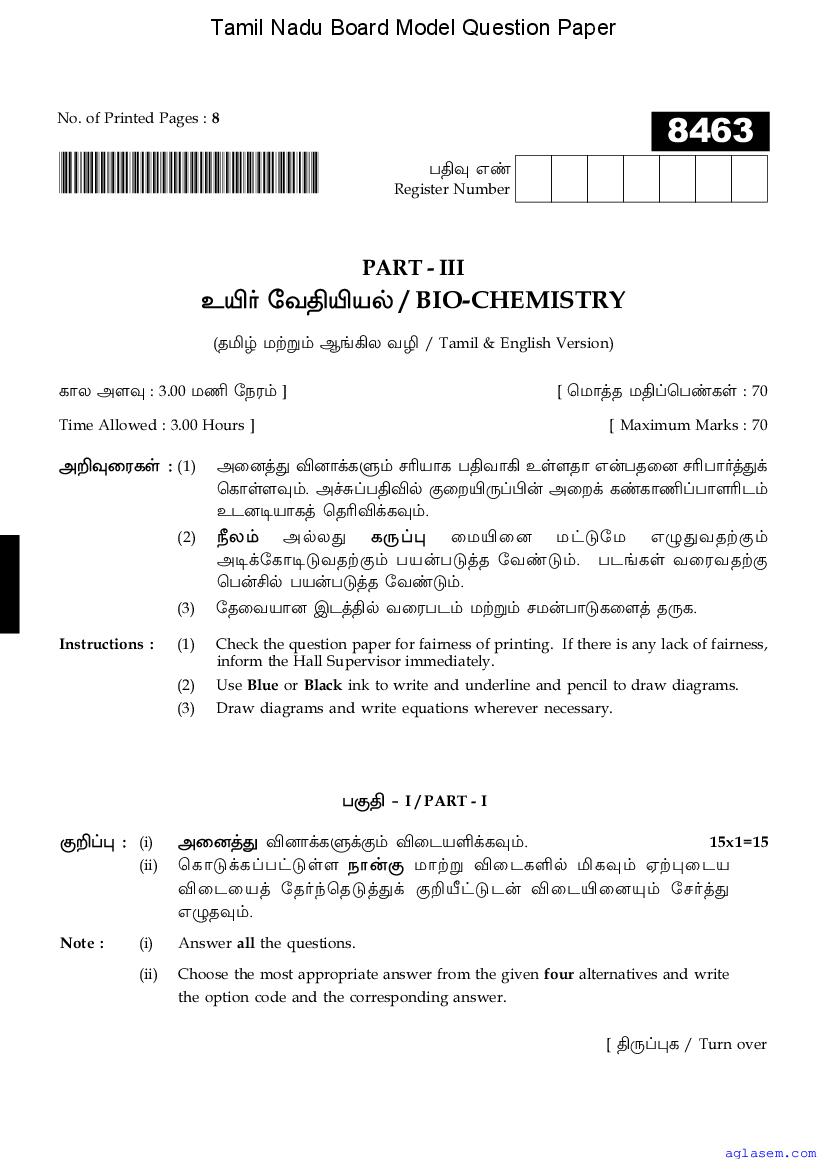
No. of Printed Pages : 8
8463
!8463IstYearBiochemistry! £vÄ Gs
Register Number
PART - III
E°º ÷Áv°¯À / BIO-CHEMISTRY
(uªÌ ©ØÖ® B[Q» ÁÈ / Tamil & English Version)
Põ» AÍÄ : 3.00 ©o ÷|µ® ] [ ö©õzu ©v¨ö£sPÒ : 70
Time Allowed : 3.00 Hours ] [ Maximum Marks : 70
AÔÄøµPÒ : (1) AøÚzx ÂÚõUPЮ \›¯õP £vÁõQ EÒÍuõ GߣuøÚ \›£õºzxU
öPõÒÍÄ®. Aa_¨£vÂÀ SøÓ°¸¨¤ß AøÓU PsPõo¨£õÍ›h®
EhÚi¯õPz öu›ÂUPÄ®.
(2) }»® AÀ»x P¸¨¦ ø©°øÚ ©mk÷© GÊxÁuØS®
AiU÷PõikÁuØS® £¯ß£kzu ÷Ásk®. £h[PÒ ÁøµÁuØS
ö£ß]À £¯ß£kzu ÷Ásk®.
(3) ÷uøÁ¯õÚ ChzvÀ Áøµ£h® ©ØÖ® \©ß£õkPøÍz u¸P.
Instructions : (1) Check the question paper for fairness of printing. If there is any lack of fairness,
inform the Hall Supervisor immediately.
(2) Use Blue or Black ink to write and underline and pencil to draw diagrams.
(3) Draw diagrams and write equations wherever necessary.
£Sv & I / PART - I
SÔ¨¦ : (i) AøÚzx ÂÚõUPÐUS® Âøh¯ÎUPÄ®. 15x1=15
(ii) öPõkUP¨£mkÒÍ |õßS ©õØÖ ÂøhPÎÀ ªPÄ® Hئøh¯
Âøhø¯z ÷uº¢öukzxU SÔ±mkhß Âøh°øÚ²® ÷\ºzx
GÊuÄ®.
Note : (i) Answer all the questions.
(ii) Choose the most appropriate answer from the given four alternatives and write
the option code and the corresponding answer.
Page 2
1. `Ǿhß BØÓø» £›©õÔUöPõÒЮ EÒÐÖ¨¦ :
(A) EmP¸ (B) ø©m÷hõPõsi›¯õ
(C) ö£µõUê÷\õ®PÒ (D) Gs÷hõ¤Íõ\ Áø»¨¤ßÚÀ
The organelle which exchanges energy with environment is __________.
(a) Nucleus (b) Mitochondria
(c) Peroxisomes (d) Endoplasmic reticulum
2. ¦÷µõ÷P›÷¯õmiU ö\À¼À GÆÁøP¯õÚ øµ÷£õ÷\õ®PÒ Põn¨£kQÓx ?
(A) 120 S (B) 80 S (C) 60 S (D) 70 S
Which type of ribosomes is present in prokaryotic cell ?
(a) 120 S (b) 80 S (c) 60 S (d) 70 S
3. £À¼Ú £»£i \ºUPøµUS GkzxUPõmk :
(A) ©õß÷Úõì (B) øí¯¾µõÛU Aª»®
(C) ìhõºa (D) ö\À¾÷»õ_
An example of a hetero polysaccharide is :
(a) Mannose (b) Hyaluronic acid
(c) Starch (d) Cellulose
4. ¦µu Aø©¨¤À α&_¸Ò Aø©¨¦ ÷\º¢u £i{ø» Gx ?
(A) ‰ßÓõ® {ø» Aø©¨¦ (B) •ußø© Aø©¨¦
(C) |õßPõ® {ø» Aø©¨¦ (D) Cµshõ® {ø» Aø©¨¦
To which hierarchical level of protein structure does α-helix belong ?
(a) Tertiary structure (b) Primary structure
(c) Quaternary structure (d) Secondary structure
5. ©Ûu Eh¼À, ö|õv ö\¯À£õmiØS EP¢u öÁ¨£{ø» :
(A) 258C (B) 378C (C) 308C (D) 408C
In human body the optimum temperature for enzymatic activity is __________.
(a) 258C (b) 378C (c) 308C (d) 408C
Page 3
6. ¤ßÁ¸ÁÚÁØÖÒ JkUS® £sø£U öPõshx Gx ?
(A) ìhõºa (B) SÐU÷Põì (C) _U÷µõì (D) öí£õ›ß
Which of the following has reducing property ?
(a) Starch (b) Glucose (c) Sucrose (d) Heparin
7. øh÷¯õ¼÷¯õ£õÀªiß J¸ :
(A) uÛzu öPõʨ¦ Aª»® (B) Gί QÎ\øµk
(C) ìöhµõ´k (D) P»¨¦ QÎ\øµk
Dioleopalmitin is a ___________.
(a) Free fatty acid (b) Simple glyceride
(c) Steroid (d) Mixed glyceride
8. DNA ©ØÖ® RNA ÂÀ Põn¨£k® ©õÖ£mh Põµ® :
(A) ø\÷hõ]ß (B) AiÛß (C) ²µõ]À (D) SÁõÛß
The differential base present in DNA and RNA is __________.
(a) Cytosine (b) Adenine (c) Uracil (d) Guanine
9. \õºPõL¨ Âvø¯¨ ¤ß£ØÖÁx :
(A) mRNA (B) DNA (C) rRNA (D) tRNA
Chargaff’s rule is obeyed by :
(a) mRNA (b) DNA (c) rRNA (d) tRNA
10. __________ SøÓ£õmhõÀ ö£À»õUµõ E¸ÁõQÓx.
(A) ÷£ß÷hõuÛU Aª»® (B) £÷¯õiß
(C) L÷£õ¼U Aª»® (D) {¯õ]ß
Pellagra occurs due to the deficiency of :
(a) Pantothenic acid (b) Biotin
(c) Folic acid (d) Niacin
Page 4
11. i›¨÷hõ÷£ß ø£÷µõ÷»ì GßÓ ö|õv°ß ö\¯À£õmiØS __________ AÁ]¯®.
(A) øÁmhªß B2 (B) øÁmhªß A
(C) øÁmhªß B3 (D) øÁmhªß B1
__________ is required for the activity of the enzyme tryptophan pyrolase.
(a) Vitamin B2 (b) Vitamin A
(c) Vitamin B3 (d) Vitamin B1
12. ¤ßÁ¸ÁÚÁØÖÒ Gx G¾®¦ E¸Áõu¼À Dk£kQÓx ?
(A) C¸®¦ (B) PõÀ]¯® (C) ÷Põ£õÀm (D) ö\¼Û¯®
Which one of the following is involved in bone formation ?
(a) Iron (b) Calcium (c) Cobalt (d) Selenium
13. ¦µu[PÎß öáÀ ªß•øÚUPÁºa] •øÓ ¤›¨¤ß Ai¨£øh :
(A) ªß_ø©÷¯ØÓ¨£mh ö£õ¸mPÒ
(B) ¦µu[PÎß J¨¥mk E¸ÁÍÄ
(C) ¦µuzvß }º öÁÖUS® vÓß
(D) ªßÞmh® ö£ØÓ ªßxPÒPÎß |PºÄ ÷ÁP®
Separation of proteins by gel electrophoresis is based on __________.
(a) Charged species
(b) Relative size of proteins
(c) Hydrophobicity of protein
(d) Mobilities or migration rates in a charged electrical particles
14. Sh¼À C¸®¦ EÔg\¨£kuÀ __________ BÀ AvP›UP¨£kQÓx.
(A) BUéõ¼U Aª»® (B) ø£iU Aª»®
(C) Põµ pH (D) AìPõº¤U Aª»®
Intestinal absorption of iron is enhanced by :
(a) Oxalic acid (b) Phytic acid
(c) Alkaline pH (d) Ascorbic acid
Page 5
15. J½°U Aª»® J¸ __________.
(A) PUFA
(B) {øÓÄØÓ öPõʨ¦ Aª»®
(C) EFA
(D) {øÓÄÓõ öPõʨ¦ Aª»®
Oleic acid is a __________.
(a) PUFA
(b) Saturated fatty acid
(c) EFA
(d) Unsaturated fatty acid
£Sv & II / PART - II
SÔ¨¦ : GøÁ÷¯Ý® BÖ ÂÚõUPÐUS Âøh¯ÎUPÄ®. ÂÚõ Gs 24 &US
Pmhõ¯©õP Âøh¯ÎUPÄ®. 6x2=12
Note : Answer any six questions. Question No. 24 is Compulsory.
16. pH – Áøµ¯ÖUPÄ®.
Define pH.
17. S÷µõ÷©õ ¦µu® £ØÔ SÔ¨¦ ÁøµP.
Write a note on Chromo protein.
18. A÷µõ÷©iU Aª÷Úõ Aª»[PÎß Aø©¨¦ ©ØÖ® ö£¯ºPøÍ GÊxP.
(H÷uÝ® Cµsk)
Write the structure and names of Aromatic Amino acids. (Any two)
19. EP¢u öÁ¨£{ø» – Áøµ¯Ö.
Define optimum temperature.
20. ì¤[÷Põ£õì÷£õ¼¨¤kPÒ £ØÔ ÂÁ›UPÄ®.
Describe Sphingophospholipids
Page 6
21. {³UÎU Aª»zvÀ EÒÍ \ºUPøµ £ØÔ _¸UP©õP ÂÍUSP.
Write shortly on sugar present in the nucleic acid.
22. øµ÷£õ¤÷ÍÂÛß E°›¯À ö\¯ÀvÓß ªUP Aø©¨¦ Gx ?
What is the biologically active form of riboflavin ?
23. Põ¨£›ß ö\¯ÀvÓÝUS ÷uøÁ¯õÚ ö|õv°ß ö£¯ºPøÍ GÊxP.
Name the enzymes which require for copper activity.
24. _U÷µõ]ß Aø©¨ø£ ÁøµP.
Draw the structure of Sucrose.
£Sv & III / PART - III
SÔ¨¦ : H÷uÝ® BÖ ÂÚõUPÐUS Âøh¯ÎUPÄ®. ÂÚõ Gs 33 &US
Pmhõ¯©õP Âøh¯ÎUPÄ®. 6x3=18
Note : Answer any six questions. Question No. 33 is Compulsory.
25. £_[PoP[PÒ £ØÔ ]Ö SÔ¨¦ ÁøµP.
Write a short note on chloroplasts.
26. {³UÎ÷¯õøhk GßÓõÀ GßÚ ?
What is Nucleotide ?
27. ¦µu[PÎß •uÀ{ø» Aø©¨¦ GÆÁõÖ E¸ÁõQÓx ?
How is primary structure of protein formed ?
28. QͺÄÖzvPÒ GßÓõÀ GßÚ ?
What are activators ?
29. ›÷£õ÷\õ©À RNA &PÒ GßÓõÀ GßÚ ? AÁØøÓ £ØÔ SÔ¨ö£ÊxP.
What are ribosomal RNAs ? Give an account on them.
30. øÁmhªß&D SøÓ£õmiß öÁΨ£õkPÒ ¯õøÁ ?
What are the deficiency manifestations of Vitamin-D ?
Page 7
31. \À£›ß E°›¯À ö\¯À£õkPÒ £ØÔ GÊxP.
Write about the biological functions of Sulphur.
32. ¥º »õ®£ºm Âvø¯ Áøµ¯Ö.
Define Beer Lambert’s Law.
33. öPõʨ¦ Aª»[PÒ ©ØÖ® AÁØÔß ÁøP¨£õk £ØÔ¯ SÔ¨¦ ÁøµP.
Write a note on fatty acids and their classification.
£Sv & IV / PART - IV
SÔ¨¦ : AøÚzx ÂÚõUPÐUS® Âøh¯ÎUPÄ®. 5x5=25
Note : Answer all the questions.
34. (A) CµzuzvÀ EÒÍ £À÷ÁÖ ÁøP¯õÚ uõ[PÀ Aø©¨¦PøÍ ÂÁ›.
AÀ»x
(B) α&_¸Ò ©ØÖ® β&uõÒ ©i¨¦ ÷ÁÖ£kzxP.
(a) Describe the different types of buffer system in blood.
OR
(b) Distinguish between α-helix and β-pleated sheets.
35. (A) {ßøím›Ýhß ¦µu[PÎß ÂøÚø¯ GÊxP.
AÀ»x
(B) öPõʨ¤À Pøµ²® øÁmhªßPÒ ©ØÖ® }›À Pøµ²® øÁmhªßPÒ
BQ¯ÁØÔß ÷ÁÖ£õkPøÍ ÂÁ›UPÄ®.
(a) Write the reaction of protein with ninhydrin.
OR
(b) Explain the comparison of fat and water soluble Vitamins.
Page 8
36. (A) ö|õv ukzuÀ ÁÈ•øÓPÎß öÁÆ÷ÁÖ ÁøPPøÍ ÂÍUSP.
AÀ»x
(B) £õ¼\õUPøµkPÎß E°›¯À ö\¯À•øÓPÒ ¯õøÁ ?
(a) Describe the different types of enzyme inhibition mechanisms.
OR
(b) What are the main biological functions of polysaccharides ?
37. (A) (i) öPõʨø£ ¤zu® GßÚ ö\´²® ? 2
(ii) ÷£õ»ßìQ Gs GßÓõÀ GßÚ ? 3
AÀ»x
(B) {³UÎU Aª»zvß •UQ¯zxÁ® ©ØÖ® ö\¯À£õkPøͨ £mi¯¼kP.
(a) (i) What does bile do to fat ? 2
(ii) What is Polenske number ? 3
OR
(b) List the significance and functions of nucleic acid.
38. (A) PõÀ]¯® EÔg\¨£kuø» £õvUS® PõµoPøÍ ÂÍUSP.
AÀ»x
(B) SDS - PAGE ö\¯À£kÁvÀ EÒÍ uzxÁzøu ÂÁ›.
(a) Explain the factors affecting absorption of Calcium.
OR
(b) Explain the principle involved in SDS - PAGE.
-oOo-
Document Details
| Board / Org | Tamil Nadu Board |
| Exam | Class 11 |
| Type | Sample Paper |
| Pages | 8 |
| Updated | 24 Sep 2026 |