DUET 2021 Question Paper MA Comparative Indian Literature
Finished viewing? Save it for later —
Download DUET 2021 Question Paper MA Comparative Indian Literature (PDF · 14 pages)About DUET 2021 Question Paper MA Comparative Indian Literature
DUET 2021 Question Paper MA Comparative Indian Literature is available here for free download. Published by NTA for DUET, this question paper can be viewed online or downloaded as a PDF (14 pages). Candidates preparing for DUET can use DUET 2021 Question Paper MA Comparative Indian Literature to understand the exam pattern, the type of questions asked, and the overall difficulty level.
Frequently Asked Questions
How can I download DUET 2021 Question Paper MA Comparative Indian Literature?
Open this page and click the Download button to save DUET 2021 Question Paper MA Comparative Indian Literature as a PDF. It is completely free on AglaSem Docs.
Is DUET 2021 Question Paper MA Comparative Indian Literature free to download?
Yes. DUET 2021 Question Paper MA Comparative Indian Literature can be viewed online and downloaded as a PDF free of cost on AglaSem Docs.
How many pages does DUET 2021 Question Paper MA Comparative Indian Literature have?
DUET 2021 Question Paper MA Comparative Indian Literature contains 14 pages, which you can read online or download together as a single PDF.
Where can I find more DUET study material?
You can find more DUET question papers, sample papers, syllabus, and answer keys on AglaSem Docs.
DUET 2021 Question Paper MA Comparative Indian Literature – Text
Read the full text of this question paper below — useful to quickly search, copy and reference the content online without downloading the PDF.
📄 View text version (14 pages)
Page 1
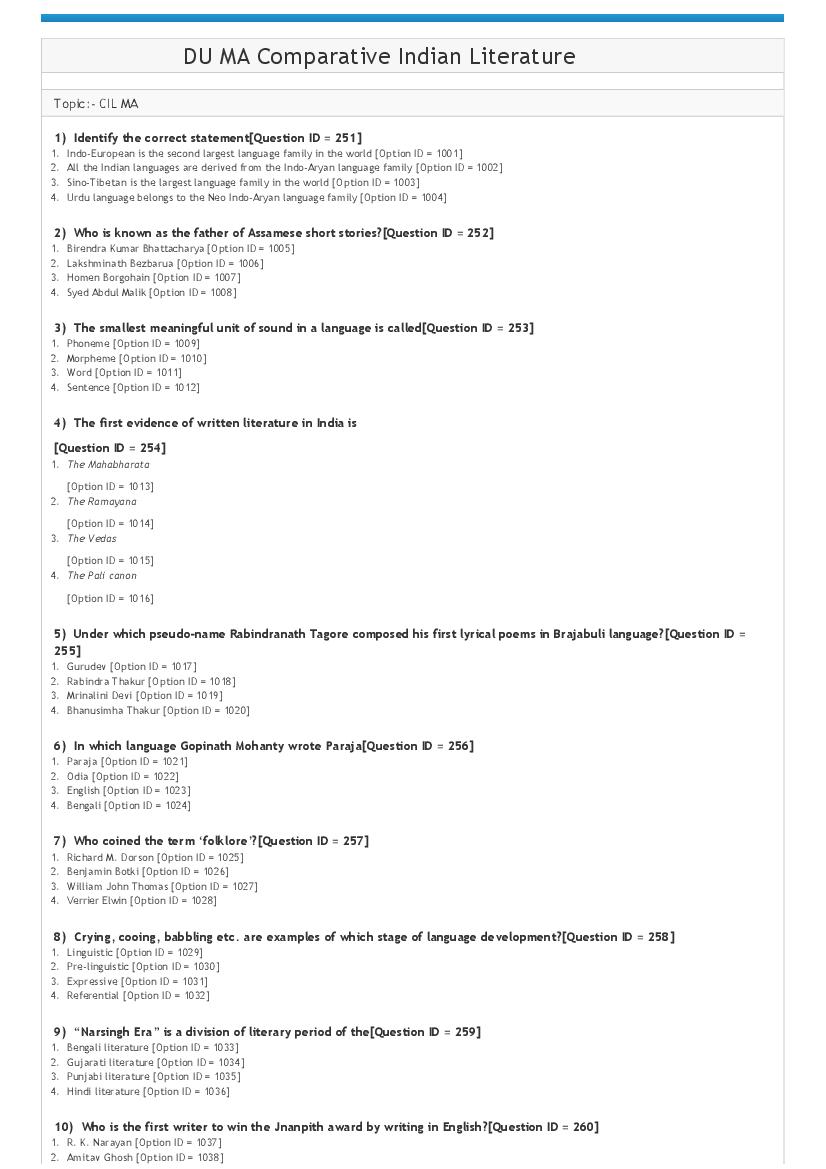
Topic:‐ CIL MA
1) Identify the correct statement[Question ID = 251]
1. Indo‐European is the second largest language family in the world [Option ID = 1001]
2. All the Indian languages are derived from the Indo‐Aryan language family [Option ID = 1002]
3. Sino‐Tibetan is the largest language family in the world [Option ID = 1003]
4. Urdu language belongs to the Neo Indo‐Aryan language family [Option ID = 1004]
2) Who is known as the father of Assamese short stories?[Question ID = 252]
1. Birendra Kumar Bhattacharya [Option ID = 1005]
2. Lakshminath Bezbarua [Option ID = 1006]
3. Homen Borgohain [Option ID = 1007]
4. Syed Abdul Malik [Option ID = 1008]
3) The smallest meaningful unit of sound in a language is called[Question ID = 253]
1. Phoneme [Option ID = 1009]
2. Morpheme [Option ID = 1010]
3. Word [Option ID = 1011]
4. Sentence [Option ID = 1012]
4) The first evidence of written literature in India is
[Question ID = 254]
1. The Mahabharata
[Option ID = 1013]
2. The Ramayana
[Option ID = 1014]
3. The Vedas
[Option ID = 1015]
4. The Pali canon
[Option ID = 1016]
5) Under which pseudo‐name Rabindranath Tagore composed his first lyrical poems in Brajabuli language?[Question ID =
255]
1. Gurudev [Option ID = 1017]
2. Rabindra Thakur [Option ID = 1018]
3. Mrinalini Devi [Option ID = 1019]
4. Bhanusimha Thakur [Option ID = 1020]
6) In which language Gopinath Mohanty wrote Paraja[Question ID = 256]
1. Paraja [Option ID = 1021]
2. Odia [Option ID = 1022]
3. English [Option ID = 1023]
4. Bengali [Option ID = 1024]
7) Who coined the term ‘folklore’?[Question ID = 257]
1. Richard M. Dorson [Option ID = 1025]
2. Benjamin Botki [Option ID = 1026]
3. William John Thomas [Option ID = 1027]
4. Verrier Elwin [Option ID = 1028]
8) Crying, cooing, babbling etc. are examples of which stage of language development?[Question ID = 258]
1. Linguistic [Option ID = 1029]
2. Pre‐linguistic [Option ID = 1030]
3. Expressive [Option ID = 1031]
4. Referential [Option ID = 1032]
9) “Narsingh Era” is a division of literary period of the[Question ID = 259]
1. Bengali literature [Option ID = 1033]
2. Gujarati literature [Option ID = 1034]
3. Punjabi literature [Option ID = 1035]
4. Hindi literature [Option ID = 1036]
10) Who is the first writer to win the Jnanpith award by writing in English?[Question ID = 260]
1. R. K. Narayan [Option ID = 1037]
2. Amitav Ghosh [Option ID = 1038]
Page 2
4. Khuswant Singh [Option ID = 1040]
11) Which of the following book was written by the British‐born Indian anthropologist Verrier Elwin?
[Question ID = 261]
1. A Philosophy for NEFA
[Option ID = 1041]
2. Structural Anthropology
[Option ID = 1042]
3. Indian Anthropology
[Option ID = 1043]
4. Explorations in Cultural Anthropology
[Option ID = 1044]
12) In which language the Indian writer Temsula Ao writes?[Question ID = 262]
1. Assamese [Option ID = 1045]
2. Ao Naga [Option ID = 1046]
3. Nepali [Option ID = 1047]
4. English [Option ID = 1048]
13) A first Language is always [Question ID = 263]
1. Learned in the environment [Option ID = 1049]
2. Acquired from the environment [Option ID = 1050]
3. Taught in the primary school [Option ID = 1051]
4. Taught in the high school [Option ID = 1052]
14) The literary movement ‘Romanticism’ was originated in the west towards the end of[Question ID = 264]
1. 16th century [Option ID = 1053]
2. 17th century [Option ID = 1054]
3. 18th century [Option ID = 1055]
4. 19th century [Option ID = 1056]
15) The classical dance form Mohinyattam was originated in the state of[Question ID = 265]
1. Kerala [Option ID = 1057]
2. Tamilnadu [Option ID = 1058]
3. Andrapradesh [Option ID = 1059]
4. Odisha [Option ID = 1060]
16) The Khasi language of Meghalaya belongs to[Question ID = 266]
1. The Indo‐European language family [Option ID = 1061]
2. The Dravidian language family [Option ID = 1062]
3. Tibeto‐Burman language family [Option ID = 1063]
4. Austro‐Asiatic language family [Option ID = 1064]
17) How many times a year the harvesting festival bihu is celebrated?
[Question ID = 267]
1. Once
[Option ID = 1065]
2. Twice
[Option ID = 1066]
3. Thrice
[Option ID = 1067]
4. Five times
[Option ID = 1068]
18) The ‘charitputhi’ and ‘buranjee’ belong to the[Question ID = 268]
1. Ancient Punjabi literature [Option ID = 1069]
2. Medieval Assamese literature [Option ID = 1070]
3. Ancient Tamil literature [Option ID = 1071]
4. Medieval Telugu literature [Option ID = 1072]
19) Who translated the Sanskrit Ramayana for the first time into a regional Language in the 12th century?[Question ID =
269]
1. Goswami Tulsidas [Option ID = 1073]
2. Krittivasa [Option ID = 1074]
3. Balarama Das [Option ID = 1075]
4. Kambar [Option ID = 1076]
20) Which of the following festivals is a harvesting festival of India?[Question ID = 270]
Page 3
2. Vasant Panchami [Option ID = 1078]
3. Dussehra [Option ID = 1079]
4. Wangala [Option ID = 1080]
21) Which of the following Tamil poet wrote Thirukkural ?
[Question ID = 271]
1. Manikkavacakar
[Option ID = 1081]
2. Thiruvalluvar
[Option ID = 1082]
3. Kapilar
[Option ID = 1083]
4. Tirutakkavetar
[Option ID = 1084]
22) The first Indian language to be given the Classical language status is[Question ID = 272]
1. Sanskrit [Option ID = 1085]
2. Tamil [Option ID = 1086]
3. Odia [Option ID = 1087]
4. Kannada [Option ID = 1088]
23) The dance format associated with the folk performance Lavni of Maharstra is known as[Question ID = 273]
1. Tamasha [Option ID = 1089]
2. Pandavi [Option ID = 1090]
3. Giddha [Option ID = 1091]
4. Garba [Option ID = 1092]
24) The first woman writer to win the Jnanpith award was[Question ID = 274]
1. Amrita Pritam [Option ID = 1093]
2. Mamoni Raisom Goswami [Option ID = 1094]
3. Ashapurna Devi [Option ID = 1095]
4. Mahadevi Verma [Option ID = 1096]
25) The time period of the five sain‐poets, popularly known as panchasakha, of Odisha, was between[Question ID = 275]
1. 1250‐1350 AD [Option ID = 1097]
2. 1350‐1450 AD [Option ID = 1098]
3. 1450‐1550 AD [Option ID = 1099]
4. 1550‐1650 AD [Option ID = 1100]
26) Which one of the following is an ancient book on Sanskrit grammar?[Question ID = 276]
1. Astadhyayi [Option ID = 1101]
2. Rajatarangini [Option ID = 1102]
3. Milinda panha [Option ID = 1103]
4. Gatha sattasai [Option ID = 1104]
27) Meghnad Badh Kavya is an epic tragic poem composed by[Question ID = 277]
1. Rabindranath tagore [Option ID = 1105]
2. Kalidasa [Option ID = 1106]
3. Michael Mahusudan Das [Option ID = 1107]
4. Bhavabhuti [Option ID = 1108]
28) Which of the following performing art forms exclusively uses weapons while performing?[Question ID = 278]
1. Kalariyapattu [Option ID = 1109]
2. Koodiyattam [Option ID = 1110]
3. Kuchipuri [Option ID = 1111]
4. Kathakali [Option ID = 1112]
29) Which of the following novels recounts the partition of India?
[Question ID = 279]
1. A House for Mr. Biswas
[Option ID = 1113]
2. Train to Pakistan
[Option ID = 1114]
3. The Room on the Roof
[Option ID = 1115]
4. The Inheritance of Loss
[Option ID = 1116]
Page 4
1. The tales of animals and fairies [Option ID = 1117]
2. The stories of the previous lives of Lord Buddha [Option ID = 1118]
3. The teachings of Lord Buddha [Option ID = 1119]
4. The rules and orders of the Buddhist sangha [Option ID = 1120]
31) How Raja Reddy and Radha Reddy are known as____
[Question ID = 281]
1. Bharata Natyam Dancers
[Option ID = 1121]
2. Kannada Folk singers
[Option ID = 1122]
3. Kuchipudi Dancers
[Option ID = 1123]
4. Telugu Folk Singers
[Option ID = 1124]
32) Who is the author of Godan?
[Question ID = 282]
1. Unnava Satyanarayana
[Option ID = 1125]
2. Premchand
[Option ID = 1126]
3. Sharatchandra
[Option ID = 1127]
4. Mahadevi Verma
[Option ID = 1128]
33) Which of the following is the nataka of Kalidasa?
[Question ID = 283]
1. Abhijnanashakuntalam
[Option ID = 1129]
2. Uttararamacharitam
[Option ID = 1130]
3. Urubhanga
[Option ID = 1131]
4. Mricchakatika
[Option ID = 1132]
34) Kumaran Asan is well known poet in _____[Question ID = 284]
1. Malayalam [Option ID = 1133]
2. Kannada [Option ID = 1134]
3. Tamil [Option ID = 1135]
4. Telugu [Option ID = 1136]
35) What is the mother tongue of a famous poet Subramania bharati.[Question ID = 285]
1. Tamil [Option ID = 1137]
2. Kannada [Option ID = 1138]
3. Malayalam [Option ID = 1139]
4. Marathi [Option ID = 1140]
36) Jorhat is known as cultural capital of ______[Question ID = 286]
1. Meghalaya [Option ID = 1141]
2. Nagaland [Option ID = 1142]
3. Manipur [Option ID = 1143]
4. Assam [Option ID = 1144]
37) Which one of the following writing is related to V. S. Khandekar?
[Question ID = 287]
1. Yayati
[Option ID = 1145]
2. Manodharma Samgeetham
[Option ID = 1146]
3. Jagori
[Option ID = 1147]
Page 5
[Option ID = 1148]
38) Ratnakara/ Ratnakkardah is the original name of _____[Question ID = 288]
1. Gautama Maharshi [Option ID = 1149]
2. Narada Maharshi [Option ID = 1150]
3. Vyasa Maharshi [Option ID = 1151]
4. Valmiki Maharshi [Option ID = 1152]
39) Lord__________ was at the center of Mirabai's poetry.[Question ID = 289]
1. Shiva [Option ID = 1153]
2. Shakti [Option ID = 1154]
3. Krishna [Option ID = 1155]
4. Brahma [Option ID = 1156]
40) Where is famous Ayyappa Swami Temple located in India?[Question ID = 290]
1. Kerala [Option ID = 1157]
2. Andhrapradesh [Option ID = 1158]
3. Karnataka [Option ID = 1159]
4. Tamil Nadu [Option ID = 1160]
41) Which of the following work was written by Rahul Sankrityayan?
[Question ID = 291]
1. Devadas
[Option ID = 1161]
2. Fasting, Feasting
[Option ID = 1162]
3. Volga Se Ganga
[Option ID = 1163]
4. Mrityunjaya
[Option ID = 1164]
42) Who is known as the father of the Bengali sonnet?[Question ID = 292]
1. Michael Madhusudan Dutt [Option ID = 1165]
2. Rabindranath Tagore [Option ID = 1166]
3. Sharat Chandra [Option ID = 1167]
4. Bankim Chandra [Option ID = 1168]
43) Bhagavatam is ____
[Question ID = 293]
1. One of the parts in Mahabharata
[Option ID = 1169]
2. One of the Puaranas
[Option ID = 1170]
3. One of the Sanskrit Kavyas
[Option ID = 1171]
4. One of the parts in Veda
[Option ID = 1172]
44) Who was the founder of Satyashodhak Samaj?[Question ID = 294]
1. Jyotiba Phule [Option ID = 1173]
2. Narayana Guru [Option ID = 1174]
3. Periyar [Option ID = 1175]
4. Vitthal Ramji Shinde [Option ID = 1176]
45) Nayanmars are the devotees of ___________[Question ID = 295]
1. Vishnu [Option ID = 1177]
2. Shiva [Option ID = 1178]
3. Brahma [Option ID = 1179]
4. Shakti [Option ID = 1180]
46) Where is Aurobindo ashram located in India?[Question ID = 296]
1. Pondicherry [Option ID = 1181]
2. Kolkata [Option ID = 1182]
3. Trivendram [Option ID = 1183]
4. Agra [Option ID = 1184]
47) Which is the most important festival of Assam?[Question ID = 297]
Page 6
2. Ganga Jatara [Option ID = 1186]
3. Jallikattu [Option ID = 1187]
4. Bihu [Option ID = 1188]
48) What are the protagonist characters in Jayadeva's Gita Govinda?
[Question ID = 298]
1. Rama and Sita
[Option ID = 1189]
2. Krishna and Radha
[Option ID = 1190]
3. Vishnu and Lakshmi
[Option ID = 1191]
4. Narasimha and Lakshmi
[Option ID = 1192]
49) Who is the author of The Glass Palace Novel?
[Question ID = 299]
1. Raja Rao
[Option ID = 1193]
2. Salman Rushdie
[Option ID = 1194]
3. Vikram Seth
[Option ID = 1195]
4. Amitav Ghosh
[Option ID = 1196]
50) G. Sankara Kurup received Jnanapeeth award in the year_______[Question ID = 300]
1. 1962 [Option ID = 1197]
2. 1963 [Option ID = 1198]
3. 1964 [Option ID = 1199]
4. 1965 [Option ID = 1200]
51) Umashankar Joshi is famous writer of _________Literature[Question ID = 301]
1. Sindhi [Option ID = 1201]
2. Gujarati [Option ID = 1202]
3. Kannada [Option ID = 1203]
4. Malayalam [Option ID = 1204]
52) Which text is known as the Panchama Veda?
[Question ID = 302]
1. Mahabharata
[Option ID = 1205]
2. Mahabhagavata
[Option ID = 1206]
3. Agnipuranam
[Option ID = 1207]
4. Vishnu Puranama
[Option ID = 1208]
53) Who wrote the novel Yajnaseni: the story of Draupadi?
[Question ID = 303]
1. Pratibha Ray
[Option ID = 1209]
2. Gopinath Mohanty
[Option ID = 1210]
3. Bibhuti Patnaik
[Option ID = 1211]
4. Fakir Mohan Senapati
[Option ID = 1212]
54) Which book was written by Ashvaghosha?
[Question ID = 304]
1. Buddha Charita
Page 7
2. Dharma Charita
[Option ID = 1214]
3. Dhamra Shatra
[Option ID = 1215]
4. Jaina Charita
[Option ID = 1216]
55) Malayalam novel Indulekha was written by______
[Question ID = 305]
1. O. Chandu Menon
[Option ID = 1217]
2. O. V. Vijayan
[Option ID = 1218]
3. S. K. Pottekkatt
[Option ID = 1219]
4. M. T. Vasudevan Nair
[Option ID = 1220]
56) Which of the following is the classical dance of Manipur?[Question ID = 306]
1. Raas Leela [Option ID = 1221]
2. Gidda [Option ID = 1222]
3. Kathak [Option ID = 1223]
4. Vilasini Natyam [Option ID = 1224]
57) Who is the author of the popular novel Anandamath?
[Question ID = 307]
1. Manik Bandyopadhyay
[Option ID = 1225]
2. Satinath Bhaduri
[Option ID = 1226]
3. Bankim Chandra Chatterjee
[Option ID = 1227]
4. Bibhutibhushan Bondopadhyay
[Option ID = 1228]
58) Which of the following work was written by Panini on Sanskrit grammar?
[Question ID = 308]
1. Ashtadhyayi
[Option ID = 1229]
2. Balavyakaranam
[Option ID = 1230]
3. Proudha Vyakaranam
[Option ID = 1231]
4. Vyakarana Deepika
[Option ID = 1232]
59) Where was Sant Tukaram born?
[Question ID = 309]
1. Pune
[Option ID = 1233]
2. Nashik
[Option ID = 1234]
3. Solapur
[Option ID = 1235]
4. Amaravathi
[Option ID = 1236]
60) Sangam literature is a ____
[Question ID = 310]
1. Collection of literary works written in Telugu
[Option ID = 1237]
Page 8
[Option ID = 1238]
3. Collection of literary works written in Odia
[Option ID = 1239]
4. Collection of literary works written in Tamil
[Option ID = 1240]
61) Indian languages with classical status are ‐‐‐‐‐‐‐, Sanskrit, ‐‐‐‐‐‐‐‐, Telugu, Malayalam and ‐‐‐‐‐‐‐‐‐.[Question ID = 311]
1. Tamil, Marathi, Odia [Option ID = 1241]
2. Gujarati, Tamil, Odia [Option ID = 1242]
3. Tamil, Kannada, Odia [Option ID = 1243]
4. Hindi, Odia, Tamil [Option ID = 1244]
62) A dialect is a form of a ‐‐‐‐‐‐‐‐, and specific to ‐‐‐‐‐‐‐‐‐‐‐‐.[Question ID = 312]
1. language, a region [Option ID = 1245]
2. culture, a community [Option ID = 1246]
3. country, a language [Option ID = 1247]
4. region, a language [Option ID = 1248]
63) The three parts of Tripitaka are :
[Question ID = 313]
1. Artha, Dhamma, Njana
[Option ID = 1249]
2. Vinaya,Yoga, Mokasha
[Option ID = 1250]
3. Vinaya, Sūtta, Abhidhamma
[Option ID = 1251]
4. Abhidamma, Dhamma, Sangha
[Option ID = 1252]
64) Who was the exponent of the theoretical practice termed as Deconstruction?
[Question ID = 314]
1. Jacques Lacan
[Option ID = 1253]
2. Jacques Derrida
[Option ID = 1254]
3. Jean Baudrillard
[Option ID = 1255]
4. Jean francois lyotard
[Option ID = 1256]
65) It is not a Dramatic work of Kalidasa:
[Question ID = 315]
1. Mālavikāgnimitram
[Option ID = 1257]
2. Abhijñānaśākuntalam
[Option ID = 1258]
3. Vikramōrvaśīyam
[Option ID = 1259]
4. Svapnavāsavadattam
[Option ID = 1260]
66) Barathanatyam is the classical dance of Tamil Nadu and ‐‐‐‐‐‐‐‐‐‐‐‐‐‐‐‐ is the classical dance of Kerala.
[Question ID = 316]
1. Mohiniattam
[Option ID = 1261]
2. Nautanki
[Option ID = 1262]
3. Ojapali
[Option ID = 1263]
4. Oyilattam
[Option ID = 1264]
Page 9
[Question ID = 317]
1. Walt Whitman
[Option ID = 1265]
2. Leo Tolstoy
[Option ID = 1266]
3. John Stuart Mill
[Option ID = 1267]
4. Ivan Turgenev
[Option ID = 1268]
68) A new Supreme Court was established during the Company Rule, Under the Regulating Act of 1773 at ‐‐‐‐‐‐‐‐‐‐‐.
[Question ID = 318]
1. Bombay [Option ID = 1269]
2. Calcutta [Option ID = 1270]
3. Madras [Option ID = 1271]
4. Delhi [Option ID = 1272]
69) A state is a “body that successfully claims a monopoly of legitimate force in a particular territory.” It is a definition
given by ‐‐‐‐‐‐‐‐‐‐‐‐‐‐‐.[Question ID = 319]
1. Max Weber [Option ID = 1273]
2. M.K. Gandhi [Option ID = 1274]
3. Napoleon Bonaparte [Option ID = 1275]
4. Emile Durkheim [Option ID = 1276]
70) K. Shivarama Karanth was a ‐‐‐‐‐‐‐‐‐‐‐‐‐‐ writer, novelist and activist.[Question ID = 320]
1. Telugu [Option ID = 1277]
2. Marathi [Option ID = 1278]
3. Kannada [Option ID = 1279]
4. Tamil [Option ID = 1280]
71) Who is the author of the book The Subjection of Women?
[Question ID = 321]
1. John Stuart Mill
[Option ID = 1281]
2. Virginia Woolf
[Option ID = 1282]
3. Walter Benjamin
[Option ID = 1283]
4. Bertrand Russell
[Option ID = 1284]
72) In 1950, ‐‐‐‐‐‐‐‐‐‐‐‐‐‐‐‐‐ wrote the novel ‘Pinjar’ (Skeleton) which describes the plight of the women during the
partition.[Question ID = 322]
1. Amrita Pritam [Option ID = 1285]
2. Qurratulain Hyder [Option ID = 1286]
3. Mahadevi Verma [Option ID = 1287]
4. Mahasweta Devi [Option ID = 1288]
73) Govardanram Tripathi wrote four volume novel ‐‐‐‐‐‐‐‐‐‐‐‐‐‐‐‐ in Gujarati.
[Question ID = 323]
1. Lilavati Jivankala
[Option ID = 1289]
2. Indira Bai
[Option ID = 1290]
3. Saraswatichandra
[Option ID = 1291]
4. Sarasvaticharita
[Option ID = 1292]
74) ‐‐‐‐‐‐‐‐‐‐‐‐‐ is the title of the messenger poems composed by Kalidāsa .
[Question ID = 324]
1. Kumārasambhava
[Option ID = 1293]
2. Meghadūta
Page 10
3. Ratnavali
[Option ID = 1295]
4. Raghuvaṃśa
[Option ID = 1296]
75) The film based on the novel ‐‐‐‐‐‐‐‐‐‐‐‐‐‐‐‐ of Bibhutibhushan Bandyopadhyay was directed by Satyajit Ray.
[Question ID = 325]
1. Charulata
[Option ID = 1297]
2. Chokher Bali
[Option ID = 1298]
3. Ghare‐Baire
[Option ID = 1299]
4. Pather Panchali
[Option ID = 1300]
76) Kirtarjuniyam is a Sanskrit play composed by ‐‐‐‐‐‐‐‐‐‐‐‐‐‐‐ based on an episode from Mahabharata.
[Question ID = 326]
1. Magha
[Option ID = 1301]
2. Harsha
[Option ID = 1302]
3. Bharavi
[Option ID = 1303]
4. Bhasa
[Option ID = 1304]
77) Padma Purana is one of the Ramayana composed by ‐‐‐‐‐‐‐‐‐‐.
[Question ID = 327]
1. Vimala Suri
[Option ID = 1305]
2. Sanghadasa
[Option ID = 1306]
3. Harisena
[Option ID = 1307]
4. Ravisena
[Option ID = 1308]
78) Chakyar Koothu is a traditional monologue performance of ‐‐‐‐‐‐‐‐‐‐‐‐‐‐.
[Question ID = 328]
1. Maharashtra
[Option ID = 1309]
2. Tamil Nadu
[Option ID = 1310]
3. Kerala
[Option ID = 1311]
4. Andhra Pradesh
[Option ID = 1312]
79) Dasharata Jataka is one of the ‐‐‐‐‐‐‐‐‐‐‐‐‐‐‐‐‐‐‐‐‐‐‐‐‐.
[Question ID = 329]
1. Dharmaśāstra Texts
[Option ID = 1313]
2. Buddhist Ramayanas
[Option ID = 1314]
3. Mahabharata Traditions
[Option ID = 1315]
4. Buddhist Canons
[Option ID = 1316]
Page 11
[Question ID = 330]
1. Brihat Katha
[Option ID = 1317]
2. Panchatantra
[Option ID = 1318]
3. Kathasarita Sagara
[Option ID = 1319]
4. Katha Kosha
[Option ID = 1320]
81) Sangam literature of Tamil is comprised of the ‐‐‐‐‐‐‐‐‐‐‐‐ and ‐‐‐‐‐‐‐‐‐poetry.
[Question ID = 331]
1. ethical, dramatic
[Option ID = 1321]
2. Akam, Puram
[Option ID = 1322]
3. Bhakti, Dhyana
[Option ID = 1323]
4. Buddhist, Jain
[Option ID = 1324]
82) Dasarupaka is a classification of ‐‐‐‐‐‐‐‐‐‐‐‐, as expound in ‐‐‐‐‐‐‐‐‐‐‐‐‐‐.
[Question ID = 332]
1. Poems, kaavyadarsa
[Option ID = 1325]
2. Grammar, Ashtadhyayi
[Option ID = 1326]
3. Dramatic forms, Natyasastra
[Option ID = 1327]
4. Emotions, Natyasastra
[Option ID = 1328]
83) It is a novel of Franz Kafka:
[Question ID = 333]
1. Outsider
[Option ID = 1329]
2. The Trial
[Option ID = 1330]
3. Finnegans Wake
[Option ID = 1331]
4. Dubliners
[Option ID = 1332]
84) New Historicism is also known as:[Question ID = 334]
1. New Criticism [Option ID = 1333]
2. Orientalism [Option ID = 1334]
3. Cultural poetics [Option ID = 1335]
4. Culture studies [Option ID = 1336]
85) Waiting for Godot the play by Samuel Beckett is associated with the artistic idea:[Question ID = 335]
1. Classical Theatre [Option ID = 1337]
2. Theatre of the Absurd [Option ID = 1338]
3. Poor theatre [Option ID = 1339]
4. Surrealist theatre [Option ID = 1340]
86) Vijay Tendulkar’s Marathi play ‐‐‐‐‐‐‐‐‐‐‐‐‐‐‐‐‐ is a trendsetting play based on folk Performance and music.
[Question ID = 336]
1. Kamalā
[Option ID = 1341]
2. Kanyādān
[Option ID = 1342]
3. Nishant
Page 12
4. Ghashiram Kotwal
[Option ID = 1344]
87) ‘Third Theatre’ is the dramatic movement based on the idea expounded by ‐‐‐‐‐‐‐‐‐‐‐‐‐‐.[Question ID = 337]
1. Badal Sircar [Option ID = 1345]
2. B.V. Karanth [Option ID = 1346]
3. G. Sankara Pillai [Option ID = 1347]
4. Mohan Rakesh [Option ID = 1348]
88) An emotional theme of a work of art in Sanskrit tradition is termed as:
[Question ID = 338]
1. Abhinaya
[Option ID = 1349]
2. Dharma
[Option ID = 1350]
3. Rasa
[Option ID = 1351]
4. Artha
[Option ID = 1352]
89) Aristotle's work the Poetics explains ‐‐‐‐‐‐‐‐‐‐ but not ‐‐‐‐‐‐‐‐‐.[Question ID = 339]
1. Epic, Tragedy [Option ID = 1353]
2. Comedy, Epic [Option ID = 1354]
3. Epic, Comedy [Option ID = 1355]
4. Tragedy, Comedy [Option ID = 1356]
90) Who was the composer of the Bhajan ‘Vaishnava Jana?
[Question ID = 340]
1. Kabīr
[Option ID = 1357]
2. Mīra Bai
[Option ID = 1358]
3. Ravidās
[Option ID = 1359]
4. Narasimha Mehta
[Option ID = 1360]
91) Who is the author of the book The Expression of the Emotions in Man and Animals?
[Question ID = 341]
1. Adam Smith
[Option ID = 1361]
2. Karl Marx
[Option ID = 1362]
3. Francis Bacon
[Option ID = 1363]
4. Charles Darwin
[Option ID = 1364]
92) ‘Throne of Blood’ a film by Akira Kurosawa is an adaptation of the play ‐‐‐‐‐‐‐‐‐‐‐‐‐ by William Shakespeare.
[Question ID = 342]
1. Romeo and Juliet
[Option ID = 1365]
2. King Lear
[Option ID = 1366]
3. Macbeth
[Option ID = 1367]
4. Hamlet
[Option ID = 1368]
93) Who is the director of the Mahabharata as a Stage production, a TV Mini Series and a Theatrical Film?
[Question ID = 343]
1. Peter Brook
Page 13
2. Jabbar Patel
[Option ID = 1370]
3. Augusto Boal
[Option ID = 1371]
4. Girish Karnad
[Option ID = 1372]
94) Arundhati Roy won ‐‐‐‐‐‐‐‐‐‐‐‐‐‐ in 1997 for her novel The God of Small Things.
[Question ID = 344]
1. The Commonwealth Writers' Prize
[Option ID = 1373]
2. The Man Booker Prize
[Option ID = 1374]
3. The Paris Literary Prize
[Option ID = 1375]
4. Dayton Literary Peace Prize
[Option ID = 1376]
95) Who is the author of the novel Samskara?
[Question ID = 345]
1. K. Shivaram Karanth
[Option ID = 1377]
2. Girish Karnad
[Option ID = 1378]
3. Vijay Tendulkar
[Option ID = 1379]
4. U. R. Ananthamurthy
[Option ID = 1380]
96) ‘Six Acres and a Third’ is a novel authored by ‐‐‐‐‐‐‐‐‐‐‐‐‐‐ originally written in ‐‐‐‐‐‐‐‐.
[Question ID = 346]
1. Fakir Mohan Senapati, Odia
[Option ID = 1381]
2. Sunil Gangopadhyay, Bengali
[Option ID = 1382]
3. Fakir Mohan Senapati, Bengali
[Option ID = 1383]
4. Bibhutibhushan Bandyopadhyay, Odia
[Option ID = 1384]
97) Who is the author of the novel , Across the Black Waters?
[Question ID = 347]
1. Saadat Hasan Manto
[Option ID = 1385]
2. Mulk Raj Anand
[Option ID = 1386]
3. Kiran Desai
[Option ID = 1387]
4. Khushwant Singh
[Option ID = 1388]
98) Who is the author of the novel The Name of the Rose?
[Question ID = 348]
1. John Barth
[Option ID = 1389]
2. Chinua Achebe
[Option ID = 1390]
3. Umberto Eco
[Option ID = 1391]
4. Kurt Vonnegut
Page 14
99) Who had coined the term ‘power knowledge’ as a social theory?[Question ID = 349]
1. Julia Kristeva [Option ID = 1393]
2. Michel Foucault [Option ID = 1394]
3. Judith Butler [Option ID = 1395]
4. Simone de Beauvoir [Option ID = 1396]
100) The national song of India is a poem from the novel‐‐‐‐‐‐‐‐‐‐‐‐‐.
[Question ID = 350]
1. Kapal kundala
[Option ID = 1397]
2. Anandamath
[Option ID = 1398]
3. Durgeshnandini
[Option ID = 1399]
4. Devi Chaudhurani
[Option ID = 1400]
Document Details
| Board / Org | NTA |
| Exam | DUET |
| Type | Question Paper |
| Pages | 14 |
| Language | english |
| Updated | 30 Apr 2026 |