DUET 2021 Question Paper MA Buddhist Studies
Finished viewing? Save it for later —
Download DUET 2021 Question Paper MA Buddhist Studies (PDF · 15 pages)About DUET 2021 Question Paper MA Buddhist Studies
DUET 2021 Question Paper MA Buddhist Studies is available here for free download. Published by NTA for DUET, this question paper can be viewed online or downloaded as a PDF (15 pages). Candidates preparing for DUET can use DUET 2021 Question Paper MA Buddhist Studies to understand the exam pattern, the type of questions asked, and the overall difficulty level.
Frequently Asked Questions
How can I download DUET 2021 Question Paper MA Buddhist Studies?
Open this page and click the Download button to save DUET 2021 Question Paper MA Buddhist Studies as a PDF. It is completely free on AglaSem Docs.
Is DUET 2021 Question Paper MA Buddhist Studies free to download?
Yes. DUET 2021 Question Paper MA Buddhist Studies can be viewed online and downloaded as a PDF free of cost on AglaSem Docs.
How many pages does DUET 2021 Question Paper MA Buddhist Studies have?
DUET 2021 Question Paper MA Buddhist Studies contains 15 pages, which you can read online or download together as a single PDF.
Where can I find more DUET study material?
You can find more DUET question papers, sample papers, syllabus, and answer keys on AglaSem Docs.
DUET 2021 Question Paper MA Buddhist Studies – Text
Read the full text of this question paper below — useful to quickly search, copy and reference the content online without downloading the PDF.
📄 View text version (15 pages)
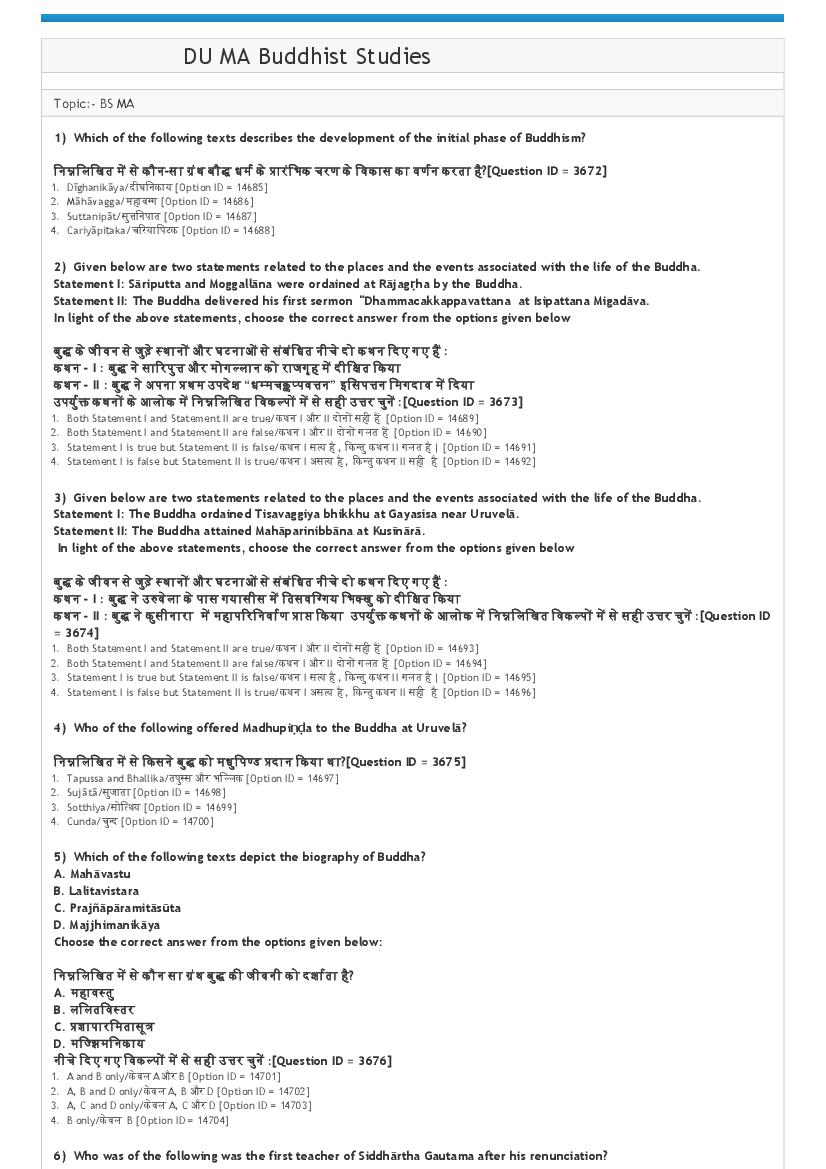
Page 1
Topic:‐ BS MA
1) Which of the following texts describes the development of the initial phase of Buddhism?
िन िलिखत म से क ौ न‐स ा ंथ ब ौ धम के ारं ि भक चरण के िवकास क ा वण न करता है?[Question ID = 3672]
1. Dīghanikāya/दीघिनकाय [Option ID = 14685]
2. Māhāvagga/महाव ग [Option ID = 14686]
3. Suttanipāt/सु िनपात [Option ID = 14687]
4. Cariyāpiṭaka/च रयािपटक [Option ID = 14688]
2) Given below are two statements related to the places and the events associated with the life of the Buddha.
Statement I: Sāriputta and Moggallāna were ordained at Rājagṛha by the Buddha.
Statement II: The Buddha delivered his first sermon "Dhammacakkappavattana at Isipattana Migadāva.
In light of the above statements, choose the correct answer from the options given below
बु के जीवन से जु ड़ े थान औ र घ ट न ा से सं ब ं ि धत नीचे द ो क थ न द ए ग ए ह :
क थ न ‐ I : बु ने सा रपु औ र मोग लान क ो राजगृ ह म द ी ि त कया
क थ न ‐ II : बु ने अपना थ म उपदे श “ध मच पव न” इिसप न िमगदाव म दया
उपयु क थ न के आलोक म िन िलिखत िवक प म से स ह ी उ र चु न :[Question ID = 3673]
1. Both Statement I and Statement II are true/कथन I और II दोन सही ह [Option ID = 14689]
2. Both Statement I and Statement II are false/कथन I और II दोन गलत ह [Option ID = 14690]
3. Statement I is true but Statement II is false/कथन I स य है , क तु कथन II गलत है | [Option ID = 14691]
4. Statement I is false but Statement II is true/कथन I अस य है , क तु कथन II सही है [Option ID = 14692]
3) Given below are two statements related to the places and the events associated with the life of the Buddha.
Statement I: The Buddha ordained Tisavaggiya bhikkhu at Gayasisa near Uruvelā.
Statement II: The Buddha attained Mahāparinibbāna at Kusīnārā.
In light of the above statements, choose the correct answer from the options given below
बु के जीवन से जु ड़ े थान औ र घ ट न ा से सं ब ं ि धत नीचे द ो क थ न द ए ग ए ह :
क थ न ‐ I : बु ने उ वे ल ा के प ा स गयासीस म ितसवि गय िभ खु क ो द ी ि त कया
क थ न ‐ II : बु ने कु स ीनारा म महाप रिनवा ण ा कया उपयु क थ न के आलोक म िन िलिखत िवक प म से स ह ी उ र चु न :[Question ID
= 3674]
1. Both Statement I and Statement II are true/कथन I और II दोन सही ह [Option ID = 14693]
2. Both Statement I and Statement II are false/कथन I और II दोन गलत ह [Option ID = 14694]
3. Statement I is true but Statement II is false/कथन I स य है , क तु कथन II गलत है | [Option ID = 14695]
4. Statement I is false but Statement II is true/कथन I अस य है , क तु कथन II सही है [Option ID = 14696]
4) Who of the following offered Madhupiṇḍa to the Buddha at Uruvelā?
िन िलिखत म से कसने बु क ो मधु ि प ड दान कया थ ा?[Question ID = 3675]
1. Tapussa and Bhallika/तपु स और भि लक [Option ID = 14697]
2. Sujātā/सुजाता [Option ID = 14698]
3. Sotthiya/सोि थय [Option ID = 14699]
4. Cunda/चु द [Option ID = 14700]
5) Which of the following texts depict the biography of Buddha?
A. Mahāvastu
B. Lalitavistara
C. Prajñāpāramitāsūta
D. Majjhimanikāya
Choose the correct answer from the options given below:
िन िलिखत म से क ौ न स ा ं थ बु क जीवनी क ो दशा ता है?
A. महाव तु
B. लिलतिव तर
C. ापारिमतासू
D. मि झमिनकाय
नीचे द ए ग ए िवक प म से स ह ी उ र चु न :[Question ID = 3676]
1. A and B only/केवल A और B [Option ID = 14701]
2. A, B and D only/केवल A, B और D [Option ID = 14702]
3. A, C and D only/केवल A, C और D [Option ID = 14703]
4. B only/केवल B [Option ID = 14704]
6) Who was of the following was the first teacher of Siddhārtha Gautama after his renunciation?
Page 2
1. Asita Kāladevala/अिसत कालदेवल [Option ID = 14705]
2. Koṇḍañña/को ड ञ [Option ID = 14706]
3. Mahānāma/महानाम [Option ID = 14707]
4. Ālāra Kālāma/आलार कालाम [Option ID = 14708]
7) Arrange sequentially (from the first to the last) the following four pre‐omens (pubbanimittāni), witnessed by Bodhisattva
Siddhārtha in order to visiting the town‐grove?
A. A patient
B. An old person
C. A hermit
D. A deceased
Choose the correct answer from the options given below
न ग र‐उ ान के मण के म म बोिधस व िस ाथ ारा दे ख े ग ए िन िलिखत चार पू व ‐िनिम (पु बिनिम ािन) क ो िमक प से (पहले से
अं ि तम त क) वि थत क िजए?
A. ए क रोगी
B. ए क बू ढ़ ा ि
C. ए क साधु
D. ए क मृ त क
नीचे द ए ग ए िवक प म से स ह ी उ र चु न :
[Question ID = 3678]
1. A, B, C, D
[Option ID = 14709]
2. A, B, D, C
[Option ID = 14710]
3. B, A, D, C
[Option ID = 14711]
4. A, D, B, C
[Option ID = 14712]
8) Which one of the following places is considered as the birth‐place of Bodhisattva Siddhārtha?
िन िलिखत थल म से कसे बोिधस व िस ाथ क ा ज म‐ थल म ा न ा जाता है?[Question ID = 3679]
1. Lumbinī/लुि बनी [Option ID = 14713]
2. Devadaha/देवदह [Option ID = 14714]
3. Kapilavastu/किपलव तु [Option ID = 14715]
4. Kuṇḍagrāma/कु ड ाम [Option ID = 14716]
9) Stupa is a symbolism of
तू प ______ क ा तीक है [Question ID = 3680]
1. Tipiṭaka/ितिपटक [Option ID = 14717]
2. Tathāgata/तथागत [Option ID = 14718]
3. Dhamma/ध म [Option ID = 14719]
4. Tantra/तं [Option ID = 14720]
10) At which one of the following places did Sujāta, the daughter of a local inhabitant offer a bowl of milk pudding to
Siddhārtha Gautama?
िन िलिखत म से क स थ ा न पर ए क थानीय िनवासी क पु ी सु ज ाता ने िस ाथ ग ौ त म क ो पायस दान कया?[Question ID = 3681]
1. Senāni‐gāma/सेनािन‐गाम [Option ID = 14721]
2. Veluva‐gāma/वेलुव‐गाम [Option ID = 14722]
3. Uruvelā/उ वेला [Option ID = 14723]
4. Gayāsīsa/गयासीस [Option ID = 14724]
11) Who of the following was the first lay disciple of Buddha?
िन िलिखत म से क ौ न बु के थ म उपासक थे?[Question ID = 3682]
1. Tapussu/तपु सु [Option ID = 14725]
2. Sāriputta/सा रपु [Option ID = 14726]
3. Upaka/उपक [Option ID = 14727]
4. Anāthapiṇḍika/अनाथ पिडक [Option ID = 14728]
12) Who of the following let loose the elephant, named Nālāgiri to kill Buddha?
िन िलिखत म से कसने नालािग र न ा म क ह ा थ ी क ो बु क ो मारने के िलए छ ो ड़ ा थ ा?[Question ID = 3683]
1. Devādatta/देवद [Option ID = 14729]
2. Ajātasattu/अजातस ु [Option ID = 14730]
Page 3
4. Upaka/उपक [Option ID = 14732]
13) Match List I with List II
List I List II
(Persons who made offerings to the Buddha.) (Offerings made to the Buddha.)
A. Bimbisāra I. Ambavana
B. Cundakammāra II. Sukaramaddava
C. Visākhā III. Pubbārāma
D. Jīvaka IV. Veluvana Kālandakanivāpa
Choose the correct answer from the options given below:
सू च ी ‐I क ो सू च ी ‐II से सु म े ि लत क िजए :
सू च ी ‐I सू च ी ‐II
A. बिबसार I. अ बवन
B. चु दक मार II. सु क रम व
C. िवसाखा III. पु बाराम
D. जीवक IV. वे ल ु व न कलं द किनवाप
नीचे द ए ग ए िवक प म से स ह ी उ र चु ि नए :
[Question ID = 3684]
1. A ‐ IV , B ‐ II, C ‐ III, D ‐ I/A ‐ IV, B ‐ II, C ‐ III, D ‐ I
[Option ID = 14733]
2. A ‐ I, B ‐ II, C ‐ III , D ‐IV/A ‐ I, B ‐ II, C ‐ III, D ‐ IV
[Option ID = 14734]
3. A ‐I , B ‐ II, C ‐ IV, D ‐ III/A ‐ I, B ‐ II, C ‐ IV, D ‐ III
[Option ID = 14735]
4. A ‐ IV, B ‐ II, C ‐ I, D ‐ III/A ‐ IV, B ‐ II, C ‐ I, D ‐ III
[Option ID = 14736]
14) Which of the following may be termed as the doctrine of Ajita Keśakamblī ?
िन िलिखत म से कसे अिजत के श कं ब ली क ा िस ां त क ह ा ज ा स क त ा है?[Question ID = 3685]
1. Śāsvatavāda/शा तवाद [Option ID = 14737]
2. Ucchedavāda/उ छेदवाद [Option ID = 14738]
3. Kriyāvāda/ यावाद [Option ID = 14739]
4. Akriyāvāda/अ यावाद [Option ID = 14740]
15) Who of the following strove to bring about a schism in the order during the life‐time of Buddha?
िन िलिखत म से कसने बु के जीवन‐क ल म सं घ‐भे द करने क ा यास कया?[Question ID = 3686]
1. Devādatta/देवद [Option ID = 14741]
2. Sudinna/सु द [Option ID = 14742]
3. Vajjiputtaka monks/व ीपु क [Option ID = 14743]
4. None of the above/उपरो म से कसी ने नह [Option ID = 14744]
16) Who of the following teachers was contemporary of the Buddha?
िन िलिखत म से क ौ न बु के समकालीन आचाय थे?[Question ID = 3687]
1. Makkhali Gosāla/म खली गोसाल [Option ID = 14745]
2. Nāgarjuna/नागाजुन [Option ID = 14746]
3. Moggaliputta Tissa/मोगलीपु ित स [Option ID = 14747]
4. Buddhadatta/बु द [Option ID = 14748]
17) Which of the following places witnessed the end of Buddha’s Dhamma‐journey?
िन िलिखत म से क ौ न‐स ा थ ा न बु क ध म‐या ा के अ त क ा सा य ब न ा?[Question ID = 3688]
1. Kusīnārā/कुसीनारा [Option ID = 14749]
2. Nālandā/नाल दा [Option ID = 14750]
3. Vaiśālī/वैशाली [Option ID = 14751]
Page 4
18) In which one of the following Cetiyas the girdle of the Gautama Buddha was preserved?
िन िलिखत म से क स चे ि तय म ग ौ त म बु क ा कमरब ध सं र ि त है?[Question ID = 3689]
1. Mukuṭabandhana Cetiya/मुकुटबंधन चेितय [Option ID = 14753]
2. Kāyabandhana Cetiya/कायबंधन चेितय [Option ID = 14754]
3. Dhammarājika Cetiya/ध मरािजक चेितय [Option ID = 14755]
4. Dhammekha stupa/ध मेख तूप [Option ID = 14756]
19) Who of the following is credited to stop an imminent battle for the possession of the mortal remains of Buddha?
िन िलिखत म से कसे बु के अि थ‐अवशे ष क ाि के िलए ए क आ स यु क ो रोकने क ा े य दया जाता है? [Question ID = 3690]
1. Doṇa/दोण [Option ID = 14757]
2. Mahākassapa/महाक सप [Option ID = 14758]
3. Upāli/उपािल [Option ID = 14759]
4. Subhadda/सुभ [Option ID = 14760]
20) Who of the following suggested Ajātaśatru to visit Buddha?
िन िलिखत म से कसने अजातश ु क ो बु के प ा स जाने क सलाह द ी?[Question ID = 3691]
1. Vassakāra/व सकार [Option ID = 14761]
2. Sunīdha/सुनीध [Option ID = 14762]
3. Jīvaka/जीवक [Option ID = 14763]
4. Devadatta/देवद [Option ID = 14764]
21) In which of the following contexts the first pārājika rule was formulated?
िन िलिखत म से कसके सं द भ म थ म पारािजक ि न य म ितपा दत कया ग य ा थ ा?[Question ID = 3692]
1. Sudinna/सु द [Option ID = 14765]
2. Devadatta/देवद [Option ID = 14766]
3. Visākhā/िवसाखा [Option ID = 14767]
4. Bābarī/बाबरी [Option ID = 14768]
22) Who of the following was known as Ahiṁsaka?
िन िलिखत म से कसे अ हसक के न ा म से जाना जाता थ ा?[Question ID = 3693]
1. Sāriputta/शारीपु [Option ID = 14769]
2. Buddha/बु [Option ID = 14770]
3. Moggallāna/मो ग लान [Option ID = 14771]
4. Aṅgulimāla/अंगुिलमाल [Option ID = 14772]
23) Which of the following are the last words of Buddha?
िन िलिखत म से क ौ न‐स ा बु क ा अं ि तम व च न है?[Question ID = 3694]
1. Vayadhammā saṅkhārā appamādena sampādetha/वयध मा संखारा अ पमादेन स पादेथ [Option ID = 14773]
2. Sabbe saṅkhārā aniccā/स बे संखारा अिन ा [Option ID = 14774]
3. Nibbānaṁ paramaṁ sukhaṁ/िन बानं परमं सुखं [Option ID = 14775]
4. Sabbe dhammā anattā/स बे ध मा अन ा [Option ID = 14776]
24) The Buddha compares his saṅgha to ______.
बु अपने सं घ क तु ल ना _______ से करते ह [Question ID = 3695]
1. An ocean/एक महासागर [Option ID = 14777]
2. A grove/एक उ ान [Option ID = 14778]
3. A river/एक नदी [Option ID = 14779]
4. A flower/एक पु प [Option ID = 14780]
25) Who among the following was considered the fittest person after the Buddha to preach the wheel of law?
िन िलिखत म से कसे बु के ब ा द धम ‐च क ा चार करने व ाल म सबसे यो य ि म ा न ा जाता थ ा?[Question ID = 3696]
1. Sāriputta/सा रपु [Option ID = 14781]
2. Moggallāna/मो ग लान [Option ID = 14782]
3. Ānanda/आनंद [Option ID = 14783]
4. Mahākassapa/महाक सप [Option ID = 14784]
26) In early Pali literature some of the famous teachers of India are mentioned as
A. Saṅghī
B. Gaṇī
C. Gaṇācariyo
D. Gaṇarāja
Choose the correct answer from the options given below:
Page 5
A. सं घ ी
B. गणी
C. गणाच रयो
D. गणराज
नीचे द ए ग ए िवक प म से स ह ी उ र चु न :[Question ID = 3697]
1. A, B and C only/केवल A, B और C [Option ID = 14785]
2. A, B, C, and D/केवल A, B, C और डी [Option ID = 14786]
3. A and B only/केवल A और B [Option ID = 14787]
4. A, C and D only/केवल A, C और D [Option ID = 14788]
27) Which of the following places Satttapaṇṇi cave is situated at?
िन िलिखत म से क स थ ा न पर स प णी गु फ ा ि थ त है?[Question ID = 3698]
1. Rajagṛha/राजगृह [Option ID = 14789]
2. Paṭaliputra/पाटिलपु [Option ID = 14790]
3. Vaisālī/वैशाली [Option ID = 14791]
4. Puruṣapura/पु षपुर [Option ID = 14792]
28) Which of the following statements is not true about Ānanda?
िन िलिखत म से क ौ न‐स ा क थ न आ न द के बारे म स य न ह है?[Question ID = 3699]
1. Ānanda was the personal teacher of the Buddha’s son Rāhul./आन द बु के पु रा ल के ि गत आचाय थे [Option ID = 14793]
2. Ānanda pleaded to grant admission of women in the Buddhist order./आन द ने बौ संघ म ना रय को वेश देने का अनुरोध कया [Option ID = 14794]
3. Ānanda recited Dhamma in the First Buddhist Council./ थम बौ संगीित म आन द ने ध म का संगायन कया [Option ID = 14795]
4. Ānanda was the personal attendant of the Buddha./आन द बु के ि गत सेवक थे [Option ID = 14796]
29) Who of the following was the patron of the First Buddhist Council?
िन िलिखत म से क ौ न थम बौ सं ग ीित क ा सं र क थ ा?[Question ID = 3700]
1. Kālāsoka/कालासोक [Option ID = 14797]
2. Ajātasattu/अजातस ु [Option ID = 14798]
3. Asoka/अशोक [Option ID = 14799]
4. Kaniṣka/किन क [Option ID = 14800]
30) Which of the following councils was presided by Sabbakāmī?
िन िलिखत म से क स सं ग ीित क अ य ता स बकामी ने क थ ी?[Question ID = 3701]
1. The First Buddhist Council/ थम बौ प रषद [Option ID = 14801]
2. The Third Buddhist Coucil/तीसरी बौ प रषद [Option ID = 14802]
3. The Second Buddhist Council/दूसरी बौ प रषद [Option ID = 14803]
4. The Fourth Buddhist Council/चौथी बौ प रषद [Option ID = 14804]
31) Given below are two statements about the Third Buddhist Council.
Statement I:The Third Buddhist Council was held in the reign of Kālāsoka.
Statement II: The Kathāvatthu was composed in the Third Buddhist Council. In light of the above statements,
choose the correct answer from the options given below
तृ त ीय ब ौ सं ग ीित के बारे म नीचे द ो क थ न द ए ग ए ह :
क थ न ‐ I : तृ त ीय ब ौ सं ग ीित कालासोक के शासनकाल म आयोिजत कया ग य ा
क थ न ‐ II : कथाव थु क रचना तृ त ीय ब ौ सं ग ीित म क ग ई
उपयु क थ न के आलोक म िन िलिखत िवक प म से स ह ी उ र चु न :
[Question ID = 3702]
1. Both Statement I and Statement II are true/कथन I और II दोन सही ह
[Option ID = 14805]
2. Both Statement I and Statement II are false/कथन I और II दोन गलत ह
[Option ID = 14806]
3. Statement I is true but Statement II is false/कथन I स य है , क तु कथन II गलत है |
[Option ID = 14807]
4. Statement I is false but Statement II is true/कथन I अस य है , क तु कथन II सही है
[Option ID = 14808]
32) Given below are two statements about the Dhamma‐missionaries, sent to disseminate Buddhism after the Third
Buddhist Council.
Statement I: Mahinda accompanied by Itthiya and Uttiya went to Sri Lanka.
Page 6
In light of the above statements, choose the correct answer from the options given below
तृ त ीय ब ौ सं ग ीित के प ात ब ौ ‐धम के चार‐ सार के िलए े ि षत ध म‐िमशन रय के बारे म नीचे द ो क थ न द ए ग ए ह :
क थ न ‐ I : म ह द के स ा थ इि थय औ र उि य ीलं क ा गये
क थ न ‐ II : म झि तक क ो म ह र भे ज ा ग य ा
उपयु क थ न के आलोक म िन िलिखत िवक प म से स ह ी उ र चु न :
[Question ID = 3703]
1. Both Statement I and Statement II are true/कथन I और II दोन सही ह
[Option ID = 14809]
2. Both Statement I and Statement II are false/कथन I और II दोन गलत ह
[Option ID = 14810]
3. Statement I is true but Statement II is false/कथन I स य है , क तु कथन II गलत है |
[Option ID = 14811]
4. Statement I is false but Statement II is true/कथन I अस य है , क तु कथन II सही है
[Option ID = 14812]
33) Who of the following was invited from Sāketa to help in the redaction of commentaries on Buddhist canon?
िन िलिखत म से कसे साके त से ब ौ धम ‐ ं थ पर भा य के स पादन म म द द के िलए आमं ि त कया ग य ा थ ा?[Question ID = 3704]
1. Pārśva/पा [Option ID = 14813]
2. Vasumitra/वसुिम [Option ID = 14814]
3. Aśvaghoṣa/अ घोष [Option ID = 14815]
4. Kamalaśīla/कमलशील [Option ID = 14816]
34) According to Tibetan sources who of the following did not approve the buddhavacana, recorded at the First Buddhist
Council?
ित बती ो त के अनु स ार िन िलिखत म से कसने थम बौ सं ग ीित म आले ि खत बु वचन क ो वीकार न ह कया?[Question ID = 3705]
1. Gavāmpati/गव पित [Option ID = 14817]
2. Pūrāṇa/पुराण [Option ID = 14818]
3. Subhadda/सुभ [Option ID = 14819]
4. Devadatta/देवद [Option ID = 14820]
35) Which of the following suttas mentioned about the Buddha’s apprehension that his teachings might suffer distortion,
and so, he cautioned his disciples about the four ways in which his instructions were to be verified?
िन िलिखत म से क स सु ने बु क इ स आशं क ा क ा उ ले ख कया है क उ न क िश ा म िवकृ ि त आ स क त ी है, औ र इसिलए, उ ह ने अपने
िश य क ो उ न चार तरीक के बारे म सचे त कया, िजनसे उनके िनद श क ो स यािपत कया जाना थ ा?[Question ID = 3706]
1. Ariyapariyesana sutta/अ रयप रयेसन सु [Option ID = 14821]
2. Mahāparinibbāna sutta/महाप रिन बाण सु [Option ID = 14822]
3. Mahāpadāna sutta/महापदान सु [Option ID = 14823]
4. Brahmajāla sutta/ जाल सु [Option ID = 14824]
36) Who of the following presided over the First Buddhist Council?
िन िलिखत म से कसने थम बौ सं ग ीित क अ य ता क ?[Question ID = 3707]
1. Upāli/उपािल [Option ID = 14825]
2. Mahākassapa/महाक सप [Option ID = 14826]
3. Mahākaccāyana/महाक ायन [Option ID = 14827]
4. Ānanda/आनंद [Option ID = 14828]
37) The earliest examples of Buddhist paintings belong to__________
बौ िच कला क ा सबसे ारि भक उदाहरण ......... से सं ब ि धत है [Question ID = 3708]
1. fourth century B.C./चतुथ सदी ई. पू. [Option ID = 14829]
2. second century B.C./ि तीय सदी ई.पू. [Option ID = 14830]
3. third century A.D/तृतीय सदी ई. [Option ID = 14831]
4. sixth century A.D/छ ी सदी ई. [Option ID = 14832]
38) Which of the following councils marked the evolution of new schools of Buddhist thought?
िन िलिखत सं ग ीितय म से कसने ब ौ िवचार के न ए सं दाय के िवकास क ो िचि हत कया?[Question ID = 3709]
1. First Buddhist Council/ थम बौ संगीित [Option ID = 14833]
2. Second Buddhist Council/ि तीय बौ संगीित [Option ID = 14834]
3. Third Buddhist Council/तृतीय बौ संगीित [Option ID = 14835]
4. Fourth Buddhist Council/चतुथ बौ संगीित [Option ID = 14836]
39) Given below are two statements about one of the dasavatthuni (ten points) practiced by the Vajjiputtaka monks.
Page 7
Statement II: Drinking of milk‐whey after meal infringes the Vinaya‐rule "Pācittiya‐35". In light of the above statements,
choose the correct answer from the options given below
वि पु क िभ ु ारा चिलत दसव थु न ी म से ए क के बारे म नीचे द ो क थ न द ए ग ए ह :
क थ न ‐ I : अमिथतक प क ा ता पय भोजन के प ात दू ध‐म ा पीने से है
क थ न ‐ II : भोजन के प ात दू ध‐म ा पीना ि व न य‐ि न य म "पािचि य ‐ 35" क ा उ लं घ न है
उपयु क थ न के आलोक म िन िलिखत िवक प म से स ह ी उ र चु न :
[Question ID = 3710]
1. Both Statement I and Statement II are true/कथन I और II दोन सही ह
[Option ID = 14837]
2. Both Statement I and Statement II are false/कथन I और II दोन गलत ह
[Option ID = 14838]
3. Statement I is true but Statement II is false/कथन I स य है , क तु कथन II गलत है |
[Option ID = 14839]
4. Statement I is false but Statement II is true/कथन I अस य है , क तु कथन II सही है
[Option ID = 14840]
40) Which of the following sects is not related to Hīnayāna Buddhism?
िन िलिखत म से क ौ न‐स ा स दाय हीनयान ब ौ धम से सं ब ि धत न ह है?[Question ID = 3711]
1. Vātsiputrīya/वाि सपु ीय [Option ID = 14841]
2. Madhyamaka/म यमक [Option ID = 14842]
3. Vaibhāṣika/वैभािषक [Option ID = 14843]
4. Sautrāntika/सौ ाि तक [Option ID = 14844]
41) Which one of the following stupas is erected to mark a sacred spot of Buddhism?
बौ धम के पिव थ ा न क ो िचि नत करने के िलए िन िलिखत म से क ौ न स ा तू प बनाया ग य ा है?[Question ID = 3712]
1. Dhammekha Stupa/ध मेख तूप [Option ID = 14845]
2. Sāṅcī Stupa/साँची तूप [Option ID = 14846]
3. Bharahuta Stupa/भर त तूप [Option ID = 14847]
4. None of the above/उपरो म से कोई नह [Option ID = 14848]
42) According to Buddhism which one of the following castes was considered superior?
िन िलिखत म से क स जाित क ो ब ौ धम म े म ा न ा जाता थ ा?[Question ID = 3713]
1. Śudra/शू [Option ID = 14849]
2. Kṣatriya/ ि य [Option ID = 14850]
3. Vaiśya/वै य [Option ID = 14851]
4. Brāhmaṇa/ ा ण [Option ID = 14852]
43) Which of the following Buddhist schools admits the human nature of the Buddha and he is often represented as having
human foibles, though it also recognizes him as possessing certain superhuman qualities?
िन िलिखत म से क ौ न‐स ा ब ौ स दाय बु के म ा न व वभाव क ो वीकार करता है औ र उ ह अ सर मानवीय कमजो रय से यु होने के पम
दशा या जाता है, हालां क य ह उ ह कु छ अितमानवी गु ण से भ ी यु म ा न त ा है?[Question ID = 3714]
1. Theravāda/थेरवाद [Option ID = 14853]
2. Lokottarvāda/लोको रवाद [Option ID = 14854]
3. Madhyamaka/म यमक [Option ID = 14855]
4. None of the above/उपरो म से कोई नह [Option ID = 14856]
44) According to Theravāda which of the following two elements constitute a being?
थे र वाद के अनु स ार िन िलिखत म से क ौ न से द ो त व ए क ाणी क ा िनमा ण करते ह ?[Question ID = 3715]
1. Saṁjñā and Rūpa/सं ा और प [Option ID = 14857]
2. Nāma and Rūpa/नाम और प [Option ID = 14858]
3. Saṅkhāra and Rūpa/संखार और प [Option ID = 14859]
4. Rūpa and Vijñāna/ प और िव ान [Option ID = 14860]
45) Which one of the following dharmas is a saṁskṛta dharma?
िन िलिखत ध म म से क ौ न‐स ा ए क सं कृ त धम है? [Question ID = 3716]
1. Pratisaṁkhyā nirodha/ ितसं या िनरोध [Option ID = 14861]
2. Apratisaṁkhyā nirodha/अ ितसं या िनरोध [Option ID = 14862]
3. Citta/िच [Option ID = 14863]
4. Ākāśa/आकाश [Option ID = 14864]
46) Given below are two statements the Buddhist School which believed that an Arahat was subject to retrogression.
Page 8
Statement II: The Vātsiputrīya School of Buddhism believed that an Arahat was subject to retrogression.
In light of the above statements, choose the correct answer from the options given below
बौ स दाय, ज ो य ह मानते थ ा क अरहत ितगमन क ा िवषय थे, से सं ब ि धत नीचे द ो क थ न द ए ग ए ह :
क थ न ‐ I : ब ौ ‐धम के सव ि तवाद स दाय क ा म ा न न ा थ ा क अरहत ितगमन के िवषय थे
क थ न ‐ II : ब ौ ‐धम के वाि सपु ीय स दाय क ा म ा न न ा थ ा क अरहत ितगमन के िवषय थे
उपयु क थ न के आलोक म िन िलिखत िवक प म से स ह ी उ र चु न :
[Question ID = 3717]
1. Both Statement I and Statement II are true/कथन I और II दोन सही ह
[Option ID = 14865]
2. Both Statement I and Statement II are false/कथन I और II दोन गलत ह
[Option ID = 14866]
3. Statement I is true but Statement II is false/कथन I स य है , क तु कथन II गलत है |
[Option ID = 14867]
4. Statement I is false but Statement II is true/कथन I अस य है , क तु कथन II सही है
[Option ID = 14868]
47) Which one of the following schools is named after its belief “All exist (sarvaṁ asti)”?
िन िलिखत म से क स स दाय क ा न ा म “सव म् अि त (स भ ी िव मान है) के िस ा त पर है?[Question ID = 3718]
1. Sarvāstivāda/सवाि तवाद [Option ID = 14869]
2. Sthaviravāda/ थिवरवाद [Option ID = 14870]
3. Puggalavāda/पु गलवाद [Option ID = 14871]
4. Mahāsāṅghika/महासांिघक [Option ID = 14872]
48) Which of the following sects is founded by Kumāra Lāta?
कु म ार ल ा त ने िन िलिखत म से क स सं दाय क थापना क ?[Question ID = 3719]
1. Sautrāntika/सौ ाि तक [Option ID = 14873]
2. Sarvāstivāda/सवाि तवाद [Option ID = 14874]
3. Mahiṁśāsaka/म हशासक [Option ID = 14875]
4. Pubba‐seliya/पु ब‐सेिलय [Option ID = 14876]
49) Which one of the following Suttas describes women as the reason for the greatness of mankind?
िन िलिखत म से क ौ न‐स ा सु ना रय क ो म ा न व जाित क महानता क ा कारण ब त ा त ा है?[Question ID = 3720]
1. Vasalasutta/वसलसु [Option ID = 14877]
2. Devatāsaṁyutta/देवतासंयु [Option ID = 14878]
3. Kosalasaṁyutta/कोसलसंयु [Option ID = 14879]
4. Visākhāsutta/िवसाखासु [Option ID = 14880]
50) Which of the following is also known as Rūpa‐kāya?
िन िलिखत म से कसे प‐क ा य भ ी क ह ा जाता है?[Question ID = 3721]
1. Nirmāṇa‐kāya/िनमाण‐काय [Option ID = 14881]
2. Dharma‐kāya/धम‐काय [Option ID = 14882]
3. Both (1) and (2)/दोन (1) और (2) [Option ID = 14883]
4. None of the above/उपयु म से कोई नह [Option ID = 14884]
51) Which of the following bodhisattvas represents the quality of prajñā?
िन िलिखत म से क ौ न स ा बोिधस व ा के गु ण क ा ितिनिध व करता है?[Question ID = 3722]
1. Bodhisattva Avalokiteśvara/बोिधस व अवलो कते र [Option ID = 14885]
2. Bodhisattva Mañjuśrī/बोिधस व मंजु ी [Option ID = 14886]
3. Bodhisattva Siddhārtha/बोिधस व िस ाथ [Option ID = 14887]
4. None of the above/उपरो म से कोई नह [Option ID = 14888]
52) Given below are two statements regarding the Mādhyamaka School of Buddhism.
Statement I: Vasubandhu was a noted philosopher of Mādhyamaka School of Buddhism.
Statement II: The philosophy of Mādhyamaka school of Buddhism could be traced in the works of Nāgarjuna. In light of the
above statements,
choose the correct answer from the options given below
ब ौ ‐धम के म य म क स दाय के बारे म नीचे द ो क थ न द ए ग ए ह :
Page 9
क थ न ‐ II : ब ौ ‐धम के म य म क सं दाय के दश न क जानकारी नागाजु न के कृ ि तय से ा क ज ा स क त ी है
उपयु क थ न के आलोक म िन िलिखत िवक प म से स ह ी उ र चु न :
[Question ID = 3723]
1. Both Statement I and Statement II are true/कथन I और II दोन सही ह
[Option ID = 14889]
2. Both Statement I and Statement II are false/कथन I और II दोन गलत ह
[Option ID = 14890]
3. Statement I is true but Statement II is false/कथन I स य है , क तु कथन II गलत है |
[Option ID = 14891]
4. Statement I is false but Statement II is true/कथन I अस य है , क तु कथन II सही है
[Option ID = 14892]
53) Who of the following was the first Tibetan king who adopted Buddhism?
िन िलिखत म से क ौ न ब ौ धम अपनाने वाले थ म ित बती राजा थे?[Question ID = 3724]
1. Khri‐son‐Ide‐btsan/ठी‐सोन‐दे‐चन [Option ID = 14893]
2. Srong‐tsan‐gam‐po/ ग‐चन‐गम‐पो [Option ID = 14894]
3. Khri‐gtsug‐Ide‐btsan/ठी‐छुग‐दे‐चन [Option ID = 14895]
4. None of the above/उपरो म से कोई नह [Option ID = 14896]
54) Who of the following attempted to extirpate Lamaism by destroying monasteries, burning books and driving Indian
monks out of Tibet?
िन िलिखत म से कसने म ठ क ो न करके, कताब क ो जलाकर औ र भारतीय िभ ु क ो ि त ब त से बाहर िनकालकर लामावाद क ो ख म करने
क ा यास कया?[Question ID = 3725]
1. Khri‐son‐Ide‐btsan/ठी‐सोन‐दे‐चन [Option ID = 14897]
2. Srong‐tsan‐gam‐po/ ग‐चन‐गम‐पो [Option ID = 14898]
3. Lang‐dar‐ma/लंग‐दर‐मा [Option ID = 14899]
4. Khri‐gtsug‐Ide‐btsan/ठी‐छुग‐दे‐चन [Option ID = 14900]
55) Who of the following Tibetan kings invited Padmasambhava to Tibet?
िन िलिखत म से क स ित बती राजा ने प सं भ व क ो ि त ब त आमं ि त कया?[Question ID = 3726]
1. Khri‐son‐Ide‐btsan/ठी‐सोन‐दे‐चन [Option ID = 14901]
2. Srong‐tsan‐gam‐po/ ग‐चन‐गम‐पो [Option ID = 14902]
3. Khri‐gtsug‐Ide‐btsan/ठी‐छुग‐दे‐चन [Option ID = 14903]
4. None of the above/उपरो म से कोई नह [Option ID = 14904]
56) Given below are two statements regarding the spread of Buddhism in China.
Statement I: Chinese King Ming‐ti sent an embassy to India to collect Buddhist Canon and to invite monks to come to China.
Statement II: Dipaṅkara Atiśa played a very important role in the spread of Buddhim in China. In light of the above
statements,
choose the correct answer from the options given below
चीन म बौ धम के सार से सं ब ि धत नीचे द ो क थ न द ए ग ए ह :
क थ न ‐ I : चीनी राजा म ग‐त ी ने ब ौ धम ‐ ं थ क ो एक करने औ र िभ ु क ो च ी न आने के िलए आमं ि त करने के िलए ए क दू त भारत भे ज ा
क थ न ‐ II : दीपं क र अितश ने च ी न म ब ौ धम के सार म ब त मह वपू ण भू ि मका िनभाई
उपयु क थ न के आलोक म िन िलिखत िवक प म से स ह ी उ र चु न :
[Question ID = 3727]
1. Both Statement I and Statement II are true/कथन I और II दोन सही ह
[Option ID = 14905]
2. Both Statement I and Statement II are false/कथन I और II दोन गलत ह
[Option ID = 14906]
3. Statement I is true but Statement II is false/कथन I स य है , क तु कथन II गलत है |
[Option ID = 14907]
4. Statement I is false but Statement II is true/कथन I अस य है , क तु कथन II सही है
[Option ID = 14908]
57) Who of the following is considered to be the founder of Lamaism?
िन िलिखत म से कसे लामावाद क ा सं थापक म ा न ा जाता है?[Question ID = 3728]
1. Dipaṅkara/दीपंकर [Option ID = 14909]
2. Padmasambhava/प संभव [Option ID = 14910]
Page 10
4. Dalai Lama/दलाई लामा [Option ID = 14912]
58) The formation of Buddhist Order for nuns (Bhikkhuni‐saṅgha) was a great step towards the empowerment of women. It
was formed at____.
िभ खु न ी‐सं घ क ा ग ठ न मिहला के सशि करण क दशा म ए क म ह ा न क द म थ ा इ स क ा ग ठ न _____ म कया ग य ा थ ा [Question ID = 3729]
1. Kapilavastu/किपलव तु. [Option ID = 14913]
2. Vaiśālī/वैशाली [Option ID = 14914]
3. Sāranātha/सारनाथ [Option ID = 14915]
4. Śrāvasti/ ाव ती [Option ID = 14916]
59) Which of the following commentaries was not written by Buddhaghosa?
िन िलिखत अ कथा म से क ौ न‐स ी बु घोष के ारा रिचत न ह है?[Question ID = 3730]
1. Sumaṅgalavilāsinī/सुमग
ं लिवलािसनी [Option ID = 14917]
2. Manorathapūraṇī/मनोरथपूरणी [Option ID = 14918]
3. Saddhammapajotikā/स मपजोितका [Option ID = 14919]
4. Sammohavinodanī/स मोहिवनोदनी [Option ID = 14920]
60) Which of the following pairs is incorrect?
िन िलिखत म से क ौ न‐स ा यु म ग ल त है?[Question ID = 3731]
1. Dīghanikāya – Suttapiṭaka/दीघिनकाय – सु िपटक [Option ID = 14921]
2. Mahāvagga – Vinayapiṭaka/महाव ग – िवनयिपटक [Option ID = 14922]
3. Samantapāsādikā ‐ Aṭṭhakathā/सम तपासा दका ‐ अ कथा [Option ID = 14923]
4. Mahāvaṁsa – Abhidhammapiṭaka /महावंस ‐ अिभध मिपटक [Option ID = 14924]
61) Which of the following texts is considered the magnum opus of Dharmakīrti?
िन िलिखत म से क ौ न‐स ा ं थ धम क त क ा म ह ा न ं थ म ा न ा जाता है?[Question ID = 3732]
1. Hetu‐bindu/हेतु‐ बदु [Option ID = 14925]
2. Pramāṇavārtikā/ माणवा तक [Option ID = 14926]
3. Pramāṇasamuccaya/ माणसमु य [Option ID = 14927]
4. Nyāya‐bindu/ याय‐ बदु [Option ID = 14928]
62) Which of the following is regarded as the constitution of Buddhist Order?
िन िलिखत म से कसे ब ौ व था क ा सं ि वधान म ा न ा जाता है?[Question ID = 3733]
1. Suttapiṭaka/सु िपटक [Option ID = 14929]
2. Abhidhammapiṭaka/अिभध मिपटक [Option ID = 14930]
3. Vinayapiṭaka/िवनयिपटक [Option ID = 14931]
4. Vimuttimagga/िवमुि म ग [Option ID = 14932]
63) Which one of the following texts is not included in the Khuddakaniāya (Suttapiṭaka)?
िन िलिखत म से क ौ न‐स ा ं थ खु किनकाय (सु िपटक) म सि मिलत न ह है?[Question ID = 3734]
1. Suttanipāta/सु िनपात [Option ID = 14933]
2. Dhammapada/ध मपद [Option ID = 14934]
3. Petavatthu/पेतव थु [Option ID = 14935]
4. Cullavagga/चु लव ग [Option ID = 14936]
64) Which one of the following is the only text of the Pāli Tripiṭaka, composed by a disciple of Buddha?
िन िलिखत म से क ौ न‐स ा पािल ि िपटक क ा एकमा ं थ है िजसक रचना बु के िश य ने क है?[Question ID = 3735]
1. Kathāvatthu/कथाव थु [Option ID = 14937]
2. Vibhaṅga/िवभंग [Option ID = 14938]
3. Suttanipāta/सु िनपात [Option ID = 14939]
4. Dhammapada/ध मपद [Option ID = 14940]
65) Who of the following is not a Pāli Commentator?
िन िलिखत म से क ौ न पािल अ कथाकार न ह ह ?[Question ID = 3736]
1. Buddhadatta/बु द [Option ID = 14941]
2. Buddhaghosa/बु घोस [Option ID = 14942]
3. Nāgasena/नागसेन [Option ID = 14943]
4. Dhammapāla/ध मपाल [Option ID = 14944]
66) Which of the following is regarded as the Kant of India?
िन िलिखत म से कसे भारत क ा कां ट म ा न ा जाता है?[Question ID = 3737]
1. Iśvarasena/ई रसेन [Option ID = 14945]
Page 11
3. Dharmakīrti/धमक त [Option ID = 14947]
4. Ratnakīrti/र क त [Option ID = 14948]
67) Who of the following was the Saṅgha‐sthavira of Nālandā Mahāvihāra when Dharmakīrti went to Nālandā?
िन िलिखत म से क ौ न नालं द ा महािवहार के सं घ‐ थिवर थे ज ब धम क त नालं द ा ग ए थे?[Question ID = 3738]
1. Diṅnāga/ द नाग [Option ID = 14949]
2. Dharmapāla/धमपाल [Option ID = 14950]
3. Śīlabhadra/शीलभ [Option ID = 14951]
4. Kulabhadra/कुलभ [Option ID = 14952]
68) What is true about Prajñāpāramitāsūtra?
ापारिमतासू के बारे म य ा स ह ी है?[Question ID = 3739]
1. It is a Hīnayāna literature./यह एक हीनयान सािह य है [Option ID = 14953]
2. It is commonly found in Mahāyāna literature./यह समा यतः महायान सािह य म पाया जाता है [Option ID = 14954]
3. It is composed in Pāli Language./यह पािल भाषा म रिचत है [Option ID = 14955]
4. It is a text on logic./यह तकशा का एक ंथ है [Option ID = 14956]
69) Which of the following is considered as the very basis of all progress in human life?
िन िलिखत म से कसे म ा न व जीवन म स भ ी गित क ा आ ध ा र म ा न ा जाता है?[Question ID = 3740]
1. Samādhi/समािध [Option ID = 14957]
2. Sīla/सील [Option ID = 14958]
3. Prajñā/ ा [Option ID = 14959]
4. Dhana/धन [Option ID = 14960]
70) Which of the following terminologies has been used by the Buddha to denote man’s indulgence in Kāma‐sukha and
Attakilamatha?
क ा म‐सु ख औ र अ कलमथ म मनु य के सं ि ल ता क ो दशा ने के िलए बु ने िन िलिखत म से क स श दावली क ा उपयोग कया ग य ा है?[Question
ID = 3741]
1. Vyādhi/ ािध [Option ID = 14961]
2. Antā/अ त [Option ID = 14962]
3. Paṭipādā/प टपदा [Option ID = 14963]
4. Samatha/समथ [Option ID = 14964]
71) Which one of the following is not regarded as a part of sīla?
िन िलिखत म से कसे स ी ल क ा भ ा ग न ह म ा न ा जाता है?[Question ID = 3742]
1. Sammā vāyāma/स मा वायाम [Option ID = 14965]
2. Sammā vācā/स मा वाचा [Option ID = 14966]
3. Sammā ājīva/स मा आजीव [Option ID = 14967]
4. Sammā kammanta/स मा क म त [Option ID = 14968]
72) Sammā vāyāma comes under the category of
स म ा व ा य म _____ क े ण ी म आ त ा है [Question ID = 3743]
1. Sīla/सील [Option ID = 14969]
2. Samādhi/समािध [Option ID = 14970]
3. Prajñā/ ा [Option ID = 14971]
4. Upāya/उपाय [Option ID = 14972]
73) Which of the following is not administered to a Buddhist lay‐devotee?
िन िलिखत म से य ा ए क ब ौ उपासक क ो पालन करने के िलए न ह द ी जाती है ______
[Question ID = 3744]
1. Pañca‐sīla/पंच‐सील
[Option ID = 14973]
2. Dasa‐sīla/दस‐सील
[Option ID = 14974]
3. Tisaraṇa‐sīla/ितसरण‐सील
[Option ID = 14975]
4. Gahaṭṭha‐sīla/गह ‐सील
[Option ID = 14976]
74) Which of the following is also described as unmade, unborn, signless etc.?
िन िलिखत म से कसे अकत, अज मा, अिनिम आ द के प म भ ी व णत कया ग य ा है?[Question ID = 3745]
Page 12
2. Dukkha/दु ख [Option ID = 14978]
3. Saṁyojana/संयोजन [Option ID = 14979]
4. Issara/इ सर [Option ID = 14980]
75) Which of the following principle is also known as the theory of “Cause and Effect”?
िन िलिखत म से क स िस ां त क ो "कारण औ र भाव" के िस ां त के प म भ ी जाना जाता है?[Question ID = 3746]
1. Anitya/अिन य [Option ID = 14981]
2. Pratītyasamutpāda/ ती यसमु पाद [Option ID = 14982]
3. Sasattavāda/सस वाद [Option ID = 14983]
4. Diṭṭhadhammanibbānavāda/ द ध मिन बानवाद [Option ID = 14984]
76) Which one of following factors is not a nīvaraṇa (obstacle)?
िन िलिखत त व म से क ौ न‐स ा नीवरण न ह है?[Question ID = 3747]
1. Kāma‐chanda (Sensual desire)/काम‐छंद (इं य‐सुख क इ छा) [Option ID = 14985]
2. Vicikicchā (Perplexity)/िविच क सा (संशय) [Option ID = 14986]
3. Uddhacca (Distraction)/उ (औ य) [Option ID = 14987]
4. Diṭṭhi (misconception)/ द (िम या‐अवधारणा) [Option ID = 14988]
77) The one‐pointedness of wholesome consciousness is known as_______.
कु श ल ि च त क एका ता _______ के प म जानी जाती है [Question ID = 3748]
1. Śīla/शील [Option ID = 14989]
2. Samādhi/समािध [Option ID = 14990]
3. Prajñā/ ा [Option ID = 14991]
4. Nirvāṇa/िनवाण [Option ID = 14992]
78) To endure with difficult is known as
दु करता से स ह न ा _____ के प म जाना जाता है [Question ID = 3749]
1. Dukkha/दु ख [Option ID = 14993]
2. Anatta/अन [Option ID = 14994]
3. Anicca/अिन [Option ID = 14995]
4. Saṅkhāra/संखार [Option ID = 14996]
79) Which of the following is the highest form of dāna?
िन िलिखत म से क ौ न‐स ा द ा न क ा उ त म प है?[Question ID = 3750]
1. Dhammadāna/ध मदान [Option ID = 14997]
2. Jaladāna/जलदान [Option ID = 14998]
3. Piṅḍadāna/ पडदान [Option ID = 14999]
4. Bhojanadāna/भोजनदान [Option ID = 15000]
80) According to Buddhism which one of the following terms refers to karma?
बौ धम के अनु स ार िन िलिखत म से क ौ न स ा श द कम क ो दशा ता है?[Question ID = 3751]
1. Vijñāna/िव ान [Option ID = 15001]
2. Cetanā/चेतना [Option ID = 15002]
3. Saṁjñā/सं ा [Option ID = 15003]
4. Āśrava/आ व [Option ID = 15004]
81) Which of the following is the highest form of meditation?
िन िलिखत म से क ौ न स ा यान क ा उ त म प है?[Question ID = 3752]
1. Rūpa‐samādhi/ प‐समािध [Option ID = 15005]
2. Arūpa‐samādhi/अ प‐समािध [Option ID = 15006]
3. Vipassanā/िवप सना [Option ID = 15007]
4. None of the above/उपरो म से कोई नह [Option ID = 15008]
82) Who of the following raised the monument, called Dharmarājika stupa at Sarnath?
िन िलिखत म से कसने सारनाथ म धम रािजक तू प न ा म क मारक क ा िनमा ण कया?[Question ID = 3753]
1. Asoka/अशोक [Option ID = 15009]
2. Harṣavarddhana/हषवधन [Option ID = 15010]
3. Kumāra Gupta I/कुमार गु थम [Option ID = 15011]
4. Chandra Gupta II/चं गु ि तीय [Option ID = 15012]
83) Who of the following established at Sarnath a colossal statue of Bodhisattva of red sandstone, together with a
proportionately large parasol?
Page 13
क ?[Question ID = 3754]
1. Bhikshu Bala/िभ ु बल [Option ID = 15013]
2. Bhikshu Nāgasena/िभ ु नागसेन [Option ID = 15014]
3. Asoka/अशोक [Option ID = 15015]
4. Kaniṣka/किन क [Option ID = 15016]
84) Who of the following was the spiritual preceptor of King Asoka?
िन िलिखत म से क ौ न राजा अशोक के आ याि मक गु थे?[Question ID = 3755]
1. Upagupta/उपगु [Option ID = 15017]
2. Śāriputra/सा रपु [Option ID = 15018]
3. Revata/रेवत [Option ID = 15019]
4. Yasa/यस [Option ID = 15020]
85) Who of the following was the founder of ancient Nālandā University?
िन िलिखत म से क ौ न ाचीन नाल दा िव िव ालय के सं थापक थे?[Question ID = 3756]
1. Śakrāditya/श ा द य [Option ID = 15021]
2. Vikramāditya/िव मा द य [Option ID = 15022]
3. Bālāditya/बाला द य [Option ID = 15023]
4. None of the above/उपरो म से कोई नह [Option ID = 15024]
86) Which of the following Mahāvihāras was set amidst Pāvārika‐ambavana?
िन िलिखत म से क ौ न‐स ा महािवहार पावा रक‐अं ब वन के ब ी च थािपत कया ग य ा थ ा?[Question ID = 3757]
1. Nālandā/नालंदा [Option ID = 15025]
2. Vallabhi/व लभी [Option ID = 15026]
3. Vikramaśilā/िव मिशला [Option ID = 15027]
4. Jagadalā/उपरो म से कोई नह [Option ID = 15028]
87) Which of the following kings consecrated the corporeal remains of Sāriputta, one of the foremost disciples of the
Buddha, with construction of a stupa at Nālandā?
िन िलिखत म से क स राजा ने बु के सबसे मु ख िश य म से ए क सा रपु के भौितक अवशे ष पर नालं द ा म ए क तू प क ा िनमा ण क र उ स क ा
अिभषे क कया?[Question ID = 3758]
1. Kaniṣka/किन क [Option ID = 15029]
2. Asoka/अशोक [Option ID = 15030]
3. Puṣyamitra/पु यिम [Option ID = 15031]
4. Ajātasattu/अजातस ु [Option ID = 15032]
88) According to Xuanzang who of the following kings is credited to build original Bodhi shrine at Bodha‐Gaya?
यू ए न जां ग के अनु स ार बोधगया म मू ल ब ो ि ध मं दर के िनमा ण करने क ा े य िन िलिखत म से क स राजा क ो जाता है?[Question ID = 3759]
1. Ajātaśatru/अजातश ु [Option ID = 15033]
2. Asoka/असोक [Option ID = 15034]
3. Kaniṣka/किन क [Option ID = 15035]
4. Harṣavarddhana/हष व न [Option ID = 15036]
89) Which of the following is credited to attract king Harṣa towards the Mahāyāna teachings?
िन िलिखत म से कसे राजा हष क ो महायान िश ा क ओ र आक षत करने क ा े य दया जाता है?
[Question ID = 3760]
1. Dharmakīrti/धमक त
[Option ID = 15037]
2. Xuan zang/ ान चांग
[Option ID = 15038]
3. Śāntarakṣita/शा तरि त
[Option ID = 15039]
4. Śīlabhadra/शीलभ
[Option ID = 15040]
90) Who of the following was the head of the University at the time Xuan zang visited the University of Nālandā?
िन िलिखत म से क ौ न ा न चां ग के नालं द ा िव िव ालय के मण के स म य िव िव ालय क ा मु ख थ ा?[Question ID = 3761]
1. Śīlabhadra/शीलभ [Option ID = 15041]
2. Śīlāditya/शीला द य [Option ID = 15042]
3. Śakrāditya/श ा द य [Option ID = 15043]
4. Śāntarakṣita/शांतरि त [Option ID = 15044]
Page 14
िन िलिखत म से क ौ न‐स ा थ ा न ब ौ धम के पिव थान क े ण ी म न ह आ त ा है?[Question ID = 3762]
1. Kusīnārā/कुसीनारा [Option ID = 15045]
2. Uruvelā/उ वेला [Option ID = 15046]
3. Pāṭaliputra/पाटिलपु [Option ID = 15047]
4. Lumbinī/लुि बनी [Option ID = 15048]
92) Which one of the following places comes under the category of subsequently added sanctified places of Buddhism?
िन िलिखत म से क ौ न‐स ा ए क थल ब ौ धम के पिव थल म ब ा द म जोड़े ग ए थल क े ण ी म आ त ा है?[Question ID = 3763]
1. Kusīnārā/कुसीनारा [Option ID = 15049]
2. Uruvelā/राजगृह [Option ID = 15050]
3. Vaiśālī/वैशाली [Option ID = 15051]
4. Lumbinī/पाटिलपु [Option ID = 15052]
93) Which one of the following cave temples is not situated in Maharashtra?
िन िलिखत म से क ौ न‐स ा गु फ ा मं दर महारा म ि थ त न ह है?[Question ID = 3764]
1. Karle/काल [Option ID = 15053]
2. Kanheri/क हेरी [Option ID = 15054]
3. Bhaja/भज [Option ID = 15055]
4. Barabara/बड़ाबर [Option ID = 15056]
94) Given below are two statements regarding Buddhist Art & Culture
Statement I: In the three centuries before and after the birth of Christ, India witnessed a phenomenal growth of Buddhist
Art and Culture.
Statement II: The wealth of the followers of the Buddha, who were largely merchants and royal votaties, made it possible
for the gigantic caityas and stupas to be built at different places of India.
In light of the above statements, choose the correct answer from the options given below
ब ौ क ल ा एवं सं कृ ि त के बारे म नीचे द ो क थ न द ए ग ए ह :
क थ न ‐ I : ई स ा के ज म से पू व औ र प ात क त ी न शताि दय म , भारत म ब ौ क ल ा औ र सं कृ ि त क ा अभू त पू व िवकास आ
क थ न ‐ II : बु के अनु य ाियय , ज ो अिधकां श तः ापारी औ र शाही उपासक थे, के ध न ने भारत के िविभ थान पर िवशाल चै य औ र तू प क ा
िनमा ण सं भ व ब न ा दया
उपयु क थ न के आलोक म िन िलिखत िवक प म से स ह ी उ र चु न :
[Question ID = 3765]
1. Both Statement I and Statement II are true/कथन I और II दोन सही ह
[Option ID = 15057]
2. Both Statement I and Statement II are false/कथन I और II दोन गलत ह
[Option ID = 15058]
3. Statement I is true but Statement II is false/कथन I स य है , क तु कथन II गलत है |
[Option ID = 15059]
4. Statement I is false but Statement II is true/कथन I अ स य है , क तु कथन II सही है
[Option ID = 15060]
95) Buddhist painting and sculpture depicts the
A. Glory of the Buddha
B. The life of the Buddha
C. The stories of the past births of the Buddha
D. The stories of Pañcatantra
E. All the above
Choose the correct answer from the options given below:
ब ौ िच कला औ र मू तकला िचि त करती है ___
A. बु क म ि ह म ा
B. बु क ा जीवन
C. बु के िपछले ज म क कहािनयां
D. पं च तं क कहािनयां
E. उपरो स भ ी
नीचे द ए ग ए िवक प म से स ह ी उ र चु न :
[Question ID = 3766]
1. A, B and C only/केवल A, B और C
[Option ID = 15061]
2. E only/केवल E
Page 15
3. B and C only/केवल B और C
[Option ID = 15063]
4. B, C and D only/केवल B, C और D
[Option ID = 15064]
96) Which one of the following is not a highest object of worship for the Buddhists?
िन िलिखत म से क ौ न ब ौ के िलए पू ज ा क सव व तु न ह है?[Question ID = 3767]
1. Buddha/बु [Option ID = 15065]
2. Dhamma/ध म [Option ID = 15066]
3. Saṅgha/संघ [Option ID = 15067]
4. Cīvara/चीवर [Option ID = 15068]
97) Given below are two statements related to the growth of Buddhist Art and Architecture.
Statement I: During the period of the three centuries before and after the birth of Christ, a large number of Caityas and
Stupas were built at different places of India.
Statement II: They were richly carved with scenes from the life of the Buddha and his previous births.
In light of the above statements, choose the most appropriate answer from the options given below
ब ौ क ल ा एवं थाप य से सं ब ि धत नीचे द ो क थ न द ए ग ए ह :
क थ न ‐ I : ई स ा के ज म से पू व औ र ब ा द क त ी न शताि दय क अविध के दौरान भारत के िविभ थान पर ब ड़ ी सं या म चै य औ र तू प बनाए
ग ए थे
क थ न ‐ II : उ ह बु के जीवन औ र उनके िपछले ज म के दृ य क ो बड़े पै म ाने पर उ क ण क र अलं क ृ त कया ग य ा थ ा
उपयु क थ न के आलोक म िन िलिखत िवक प म से स ह ी उ र चु न :
[Question ID = 3768]
1. Both Statement I and Statement II are correct/कथन I और II दोन सही ह
[Option ID = 15069]
2. Both Statement I and Statement II are incorrect/कथन I और II दोन गलत ह
[Option ID = 15070]
3. Statement I is correct but Statement II is incorrect/कथन I स य है , क तु कथन II गलत है |
[Option ID = 15071]
4. Statement I is incorrect but Statement II is correct/कथन I अस य है , क तु कथन II सही है
[Option ID = 15072]
98) The relics of the Buddha, the Arhats etc., called dhātu were conveniently classified into
बु , अरहत आ द के अवशे ष, िज ह धातु क ह ा जाता है, क ो आ स ा न ी से ______ म वग कृ त कया ग य ा थ ा [Question ID = 3769]
1. Three classes/तीन वग [Option ID = 15073]
2. Four classes/चार वग [Option ID = 15074]
3. Six classes/छः वग [Option ID = 15075]
4. Eight classes/आठ वग [Option ID = 15076]
99) Which of the following provisions was framed by the Buddha with the sole purpose to protect the grass and subtle
beings living therein?
बु ारा बनाए ग ए िन िलिखत ि न य म म से क स ि न य म क ा एकमा उ े य घ ा स औ र उसम रहने वाले सू म जीव क र ा करना थ ा?
[Question ID = 3770]
1. Gharāvāsa /घरावास [Option ID = 15077]
2. Vassāvāsa/व सावास [Option ID = 15078]
3. Caityavāsa/चै यवास [Option ID = 15079]
4. Guhāvāsa/गुहावास [Option ID = 15080]
100) The earliest Buddhist image is found at
बु क ारि भक ितमा ___________ म पायी जाती है [Question ID = 3771]
1. Sāranātha/सारनाथ [Option ID = 15081]
2. Mathurā/मथुरा [Option ID = 15082]
3. Bhaja/भज [Option ID = 15083]
4. Nālandā/नालंदा [Option ID = 15084]
Document Details
| Board / Org | NTA |
| Exam | DUET |
| Type | Question Paper |
| Pages | 15 |
| Language | english |
| Updated | 30 Apr 2026 |