CUSAT CAT 2017 Question Paper B.Tech LE
Finished viewing? Save it for later —
Download CUSAT CAT 2017 Question Paper B.Tech LE (PDF · 29 pages)About CUSAT CAT 2017 Question Paper B.Tech LE
CUSAT CAT 2017 Question Paper B.Tech LE is available here for free download. Published by Cochin University for CUSAT Common Admission Test, this question paper can be viewed online or downloaded as a PDF (29 pages). Candidates preparing for CUSAT Common Admission Test can use CUSAT CAT 2017 Question Paper B.Tech LE to understand the exam pattern, the type of questions asked, and the overall difficulty level.
Frequently Asked Questions
How can I download CUSAT CAT 2017 Question Paper B.Tech LE?
Open this page and click the Download button to save CUSAT CAT 2017 Question Paper B.Tech LE as a PDF. It is completely free on AglaSem Docs.
Is CUSAT CAT 2017 Question Paper B.Tech LE free to download?
Yes. CUSAT CAT 2017 Question Paper B.Tech LE can be viewed online and downloaded as a PDF free of cost on AglaSem Docs.
How many pages does CUSAT CAT 2017 Question Paper B.Tech LE have?
CUSAT CAT 2017 Question Paper B.Tech LE contains 29 pages, which you can read online or download together as a single PDF.
Where can I find more CUSAT Common Admission Test study material?
You can find more CUSAT Common Admission Test question papers, sample papers, syllabus, and answer keys on AglaSem Docs.
CUSAT CAT 2017 Question Paper B.Tech LE – Text
Read the full text of this question paper below — useful to quickly search, copy and reference the content online without downloading the PDF.
📄 View text version (29 pages)
Page 1
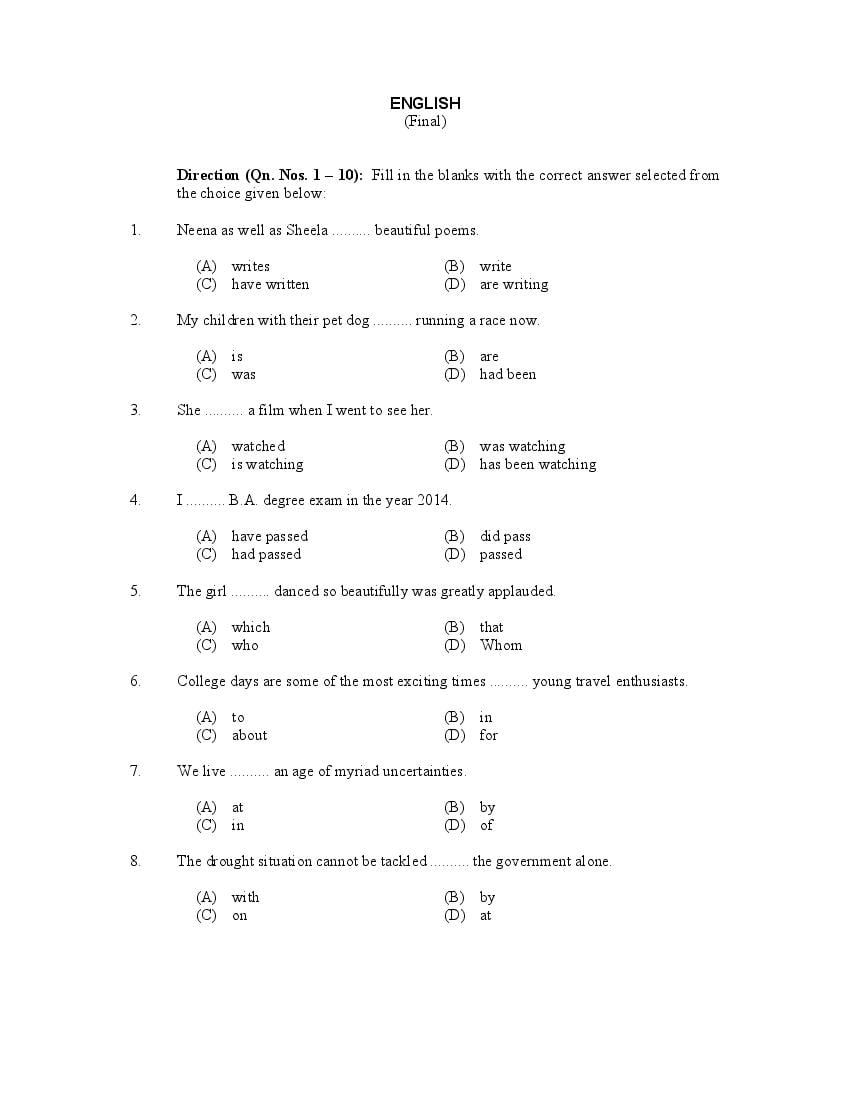
(Final)
Direction (Qn. Nos. 1 – 10): Fill in the blanks with the correct answer selected from
the choice given below:
1. Neena as well as Sheela .......... beautiful poems.
(A) writes (B) write
(C) have written (D) are writing
2. My children with their pet dog .......... running a race now.
(A) is (B) are
(C) was (D) had been
3. She .......... a film when I went to see her.
(A) watched (B) was watching
(C) is watching (D) has been watching
4. I .......... B.A. degree exam in the year 2014.
(A) have passed (B) did pass
(C) had passed (D) passed
5. The girl .......... danced so beautifully was greatly applauded.
(A) which (B) that
(C) who (D) Whom
6. College days are some of the most exciting times .......... young travel enthusiasts.
(A) to (B) in
(C) about (D) for
7. We live .......... an age of myriad uncertainties.
(A) at (B) by
(C) in (D) of
8. The drought situation cannot be tackled .......... the government alone.
(A) with (B) by
(C) on (D) at
Page 2
9. Preparations are .......... for implementing the new service rules from next month.
(A) off (B) about
(C) at (D) on
10. Your visit is .......... pleasant surprise for me.
(A) the (B) a
(C) an (D) in
Direction (Qn. Nos. 11 – 13): Select the correct question tag for the following:
11. She would have helped him, ..........?
(A) haven’t she (B) didn’t she
(C) has she (D) wouldn’t she
12. They loved him,..........?
(A) didn’t they (B) did they
(C) have they (D) were they
13. He walks fast,..........?
(A) don’t he (B) did he
(C) doesn’t he (D) will he
Direction (Qn. Nos. 14 – 16): Select the correct form of passive voice for the
following:
14. Who cleaned out the Aegean Stable?
(A) The Aegean Stable was cleaned out by whom?
(B) By whom was the Aegean Stable cleaned out?
(C) By whom had been the Aegean Stable cleaned out?
(D) By whom can be the Aegean Stable cleaned out?
15. Are you enjoying the film?
(A) Is the film enjoyed by you?
(B) Has the film been enjoyed by you?
(C) Is the film being enjoyed by you?
(D) Was the film enjoyed by you?
16. Does she like children?
(A) Are children liked by her?
(B) Is children liked by her?
(C) Have children been liked by her?
(D) Has children been liked by her?
Page 3
Direction (Qn. Nos. 17 – 20): Choose the word which is most similar in meaning to
the word given below:
17. thrift
(A) thrill (B) theft
(C) care in the use of money (D) gift
18. quadruped
(A) lame person (B) foolish fellow
(C) four legged table (D) four-footed animal
19. conceal
(A) steal (B) put down
(C) hide (D) press
20. ringlet
(A) small ring (B) small curl of hair
(C) small book (D) small flower
MATHEMATICS
21 to 70.
Page 4
meaningful) that can be made, each consisting of 3 consonants and 2 vowels,
is
(A) 24800 (B) 25100
(C) 25400 (D) 25200
2. A fair six-faced die is rolled 12 times. The probability that each face turns
up twice is equal to
12! 12
(A) 6!6!612 (B) 226 612
12!
(C) 26 612 (D) 6212!
612
3. The area of the region bounded by the curves y = x2 and x = y 2 is
(A) 31 (B) 21
(C) 14 (D) 3
4. Ram is visiting a friend. Ram knows that his friend has 2 children and 1 of
them is a boy. Assuming that a child is equally likely to be a boy or a girl,
then the probability that the other child is a girl, is
(A) 13 (B) 21
(C) 29 (D) 2
5. In a ∆ABC, a, b, c are the sides of the triangle opposite to the angles A, B, C
respectively. Then the value of a3 sin(A) + b3 sin(B) + c3 sin(C) is equal to
(A) 0 (B) 1
(C) 3 (D) 2
1
Page 5
(A) 2355
999
2355
(B) 1000
2355 2355
(C) 1111 (D) 1001
7. The three different face diagonals of cuboid (rectangular parallelepiped) have
lengths 39, 40 and 41. Then the length of the main diagonal which joins the
pair of opposite corners is
√
(A) 49 (B) 49 2
√
(C) 60 (D) 60 2
(0.75)3
8. The square root of 1−0.75
+ 0.75 + (0.75)2 + 1 is
(A) 1 (B) 2
(C) 3 (D) 4
2
9. The real roots of the equation 7log7 (x −4x+5) = x − 1 are
(A) 1 and 2 (B) 2 and 3
(C) 3 and 4 (D) 4 and 5
10. If (x − 1)3 is a factor of x4 + ax3 + bx2 + cx − 1, then the other factor is
(A) x − 3 (B) x + 1
(C) x + 2 (D) x − 2
11. At any instant of time the sum of the two angles formed by the hour and
minute rounds of a clock is 360o . Then the difference between the two angles
formed at time 6.15 is
(A) 165 (B) 170
(C) 175 (D) 145
2
Page 6
2!
+ 21
3!
+ 34
4!
+ 49
5!
+....
Then limn→∞ tn is
(A) e (B) 0
(C) e2 (D) 1
13. The smallest positive root of the equation tan x − x = 0 lies in
(A) (0, π2 ) (B) (π, π2 )
(C) (π, 3π2
) (D) ( 3π , π)
2 2
14. If x2/3 − 7x1/3 + 10 = 0 , then the value of x is in the set
(A) {125} (B) {8}
(C) φ (D) {125, 8}
15. The cosine of the angle between any two diagonals of a cube is
(A) 12 (B) 32
(C) 13 (D) √13
P13 n
√
16. The value of n=1 (i + in+1 ), i = −1, is
(A) i (B) i − 1
(C) 0 (D) −1
17. The number of ways of distributing 8 identical balls in 3 distinct boxes, so
that none of the boxes is empty, is
(A) 5 (B) 21
(C) 38 (D) 8 C3
3
Page 7
for some real number z. Then the circum radius is
6
√
(A) 2+√ 13
(B) 5
(C) 2 (D) 136
19. The area bounded by the parabolas y = x2 and y = 1 − x2 is
√ √
(A) 32 (B) 2 3 2
(C) 13 (D) 32
20. Standard Deviation of n observations a1 , a2 , a3 . . . , an is σ. Then the stan-
dard deviation of the observations λa1 , λa2 , . . . , λan is
(A) λσ (B) −λσ
(C) |λ|σ (D) λn σ
21. The equation x3 − yx2 + x − y = 0 represents
(A) a hyperbola and two straight lines
(B) a straight line
(C) a parabola and two straight lines
(D) a straight line and a circle
22. In a triangle ABC if sin A sin B = ab
c2
, then the triangle is
(A) equilateral (B) isosceles
(C) right angled (D) obtuse angled
23. The smallest value of 5 cos θ + 12 is
(A) 5 (B) 7
(C) 17 (D) 12
4
Page 8
24. If C = 2 cos θ , then the value of the determinant ∆ = 1 C 1 is
6 1 C
2sin2 2θ
(A) (B) 8cos3 θ − 4cos θ + 6
sin θ
2sin 2θ
(C) (D) 8cos3 θ + 4cos θ + 6
sin θ
25. The distance covered by a particle in t seconds is given by x = 3 + 8t − 4t2 .
After 1 second velocity will be
(A) 0 unit/second (B) 3 unit/second
(C) 1 unit/second (D) 7 unit/second
1
26. The conjugate of a complex number is . Then that complex number is
i−1
−1 1
(A) (B)
i−1 i+1
−1 1
(C) (D)
i+1 i−1
27. The equation whose roots are twice the roots of 2x2 − 5x + 2 = 0 is
(A) 4x2 − 10x + 4 = 0 (B) x2 − 5x/2 + 1 = 0
(C) 8x2 − 10x + 2 = 0 (D) x2 − 5x + 4 = 0
28. If x2 + y 2 = 1 x, y > 0, then the maximum value of x + y is
(A) 21 (B) 41
√
(C) 2 (D) 2
5
Page 9
(A) ab (B) 0
(C) (a − b)2 /4 (D) −(a − b)2 /4
30. For regular polygon of 6 sides, the number of triangles whose vertices are
joining non-adjacent vertices of the polygon is
(A) 12 (B) 6
(C) 4 (D) 2
31. The remainder obtained when 1! + 2! + · · · + 95! is divided by 10 is
(A) 2 (B) 3
(C) 1 (D) 4
32. If the system of equations 3x − 2y + z = 0, kx − 14y + 15z = 0, x + 2y + 3z = 0
has infinite number of solutions, then k =
(A) 81 (B) 87
(C) 29 (D) 27
33. If A is an n × n non-singular matrix and B is any n × n matrix, then
det(3A−1 BA) is
(A) 3 det(B) (B) 3n det(B)
(C) det(B) (D) 3n det(A)
34. Let A, B, C be n×n matrices, A and B being non-singular and C singular,
rank( A2 BC ) is
(A) = n (B) = n − 1
(C) < n (D) = n − 2
6
Page 10
r . Then the probability that A occurs but B does not is
(A) p − r (B) p − q
(C) p − qr (D) p − pq
36. A can solve a problem with probability 21 and B can solve the problem with
the probability 13 . The probability that the problem will be solved is
(A) 12 (B) 31
(C) 34 (D) 32
37. Let f be a function defined f (xy) = f (x) + f (y) for all integers x, y . If
f (12) = 24 and f (8) = 15 , the value of f (48) is
(A) 31 (B) 32
(C) 33 (D) 34
38. The period of the function f (x) = 3 sin(2x + 1) in radians is
(A) 2π (B) π
(C) π2 (D) −π
39. The triangle whose vertices are the points (1,2), (2,3), (4,7) is
(A) right angled (B) abuse angled
(C) acute angled (D) equilateral
40. The diagonals of a parallelogram ABCD are along the lines x + 3y = 4 and
6x − 2y = 7. Then the parallelogram ABCD must be a
(A) rectangle (B) trapezium
(C) cyclic quadrilateral (D) rhombus
7
Page 11
externally, then the value of c is
(A) 9 (B) 6
(C) 8 (D) 0
42. The equation of the common chord of the circles x2 + y 2 − 6x = 0 and
x2 + y 2 − 4y = 0 is
(A) 3x + 2y + 1 = 0 (B) 3x − 2y = 0
(C) 3x + 2y = 0 (D) 3x − 2y − 1 = 0
43. The length of tangent from (5,1) to the circle x2 + y 2 + 6x − 4y − 3 = 0 is
(A) 81 (B) 49
(C) 7 (D) 21
44. If two vectors a and b are such that |a| = 2 , |b| = 5 and |a × b| = 8 , then
a.b =
(A) 2 (B) 4
(C) 6 (D) 8
45. If a and b are vectors such that |a + b| = |a − b| , then
(A) they are parallel (B) they are perpendicular
(C) they are of equal magnitude (D) they are same
46. Let A be a set containing 10 elements. Then the number of subsets of A
containing 3 elements is
(A) 30 (B) 60
(C) 120 (D) 1200
8
Page 12
47. The value of limx→0 is
x
(A) 1 (B) -1
(C) 0 (D) not defined
48. The function f (x) = |x − 3|2 is
(A) continuous and differentiable
(B) continuous but not differentiable
(C) not continuous but differentiable
(D) neither continuous nor differentiable
49. The area bounded by the curve |x| + |y| = 1 is
(A) 21 (B) 2
(C) 1 (D) 14
50. A car travels from P to Q at 30 kilometers per hour and returns from Q to
P at 20 kilometers per hour by the same route. Its average speed in kilometers
per hour is
(A) 25 (B) 30
√
(C) 24 (D) 10 6
9
Page 13
ENGINEERING MECHANICS
71. The resultant of two forces P and Q inclined at an angle θ will be inclined at following
angle with respect to P
Q.sin
(A) (B) tan 1
2 P Q.cos
1
P.sin 1
Q.cos
(C) tan (D) tan
Q P.cos Q P.sin
72. The unit of mass moment of inertia is
(A) kg.m2 (B) m4
(C) kg/m2 (D) m2/kg
73. A rope is wrapped twice around a rough pole with a coefficient of friction μ. It is
subjected to a force F1 at one end. A gradually increasing force F2 is applied at the
other end till the rope just starts slipping. At this instant the ratio of F2 to F1 is
(A) 1 (B) e 4πμ
(C) e 2μ (D) e 360μ
74. The centre of gravity of a solid hemisphere lies on the central radius
(A) at distance 3r/2 from the plane base
(B) at distance 3r/4 from the plane base
(C) at distance 3r/5 from the plane base
(D) at distance 3r/8 from the plane base
75. According to theorem of perpendicular axes, if Ixx and Iyy be the moment of inertia of
a lamina about xx and yy axes, then moment of inertia about axis zz, which is
perpendicular to xx and yy, equal to
(A) I xx I yy (B) I xx I yy
(C) I xx / I yy (D) I yy / I xx
76. Moment of inertia of a circular area, whose diameter is d, about an axis perpendicular
to the area, passing though its centre is given by
(A) πd4/64 (B) πd4/32
(C) πd4/12 (D) πd4/16
77. Moment of inertia of a hollow circular cross section (inside diameter d and outside
diameter D) about horizontal axis is
(A) π(D4‒d4)/16 (B) π(D3‒d3)/16
Page 14
(C) π(D4‒d4)/32 (D) π(D4‒d4)/64
78. A circular disc of weight W rolls down an inclined plane of inclination θ. If the force of
friction is F, then the total net force on the disc parallel to the plane is equal to
(A) W – F sinθ (B) W sin θ ‒ F
(C) W cos θ ‒ F (D) W tan θ ‒ F
79. When a body slides down an inclined surface, the acceleration f of the body is given
by
(A) f = g (B) f = g. sinθ
(C) f = g. cosθ (D) f = g. tanθ
80. A particle while sliding down a smooth plane of 19.86 √2 m length acquires a velocity
of 19.86 m/s. The inclination of plane is
(A) 30o (B) 45o
(C) 60o (D) 75o
81. One Newton is equal to
(A) 107 dyne (B) 105 dyne
(C) 104 dyne (D) 103 dyne
82. If u1 and u2 are the velocities of approach of two moving bodies in the same direction
and their corresponding velocities of separation are v1 and v2 then, as per Newton’s
law of collision of elastic bodies, coefficient of restitution e is given by
(A) (v1 ‒ v2)/ (u1 ‒ u2) (B) (u2 ‒ u1)/ (v1 ‒ v2)
(C) (v2 ‒ v1)/ (u1 ‒ u2) (D) (v1 ‒ v2)/ (u2 ‒ u1)
83. Momentum is defined as
(A) force × distance (B) mass × acceleration
(C) mass×time (D) mass × velocity
84. Which of the following have same units?
(A) Momentum and impulse (B) Stress and pressure
(C) Work and kinetic energy (D) All of the above
85. If a ball which is dropped from a height of 2.25 m on a smooth floor attains the height
of bounce equal to 1 m, the coefficient of restitution between the ball and the floor is
equal to
(A) 0.25 (B) 0.5
(C) 0.67 (D) 0.33
Page 15
86. If a particle moves along a circumference of a circle of radius r with a uniform
angular velocity ω radians/s, the equation for the velocity of the particle is given by
(A) v = ω√(y2 – r2) (B) v = ω√(y – r)
(C) v = ω√( r2 – y2) (D) v = ω√( r2 + y2)
87. A stone falls from the top of a building 200 m high and at the same time another is
projected vertically upwards with a velocity of 50 m/s, then the two will meet
(A) after 1 second (B) after 2 seconds
(C) after 4 seconds (D) after 5 seconds
88. A rubber ball is dropped from a height of 2 metres. To what height will it rise if there
is no loss of velocity after rebounding?
(A) 4 m (B) 3 m
(C) 2 m (D) 1 m
89. When a body falls freely under gravitational force, it possesses
(A) maximum weight
(B) minimum weight
(C) no weight
(D) a weight depending upon the velocity
90. A jet engine works on the principle of
(A) conservation of energy
(B) conservation of linear momentum
(C) earth’s gravity
(D) gravitational energy
91. Horizontal range of a projectile fired with initial velocity u at angle α to horizontal is
equal to
(A) (u2 sin 2α)/g (B) (u2 cos 2α)/g
(C) (u2 sin α)/g (D) (u2 sin2α)/g
92. The resultant of two equal and mutually perpendicular forces of magnitude, ‘F’ each
is
(A) 2 (B) √2 ×
(C) √2 × (D)
93. A force of magnitude 100 kN acts 240o inclined anticlockwise to the positive
direction of the x-axis. Its components along the x and y axes are
(A) ‒50 kN and ‒86.6 kN (B) 50 kN and ‒86.6 kN
(C) 50 kN and 86.6 kN (D) ‒50 and 86.6 Kn
Page 16
94. A vector is a quantity having
(A) magnitude (B) direction
(C) magnitude and direction (D) none of the above
95. The moment of the resultant of a force system with respect to a point is equal to the
sum of the moments of the components of it with respect to the same point. This is
known as
(A) Newton’s law (B) D’Alembert’s principle
(C) Pascal’s law (D) Varignon’s theorem
96. The co-efficient of static friction is ………… co-efficient of kinetic friction.
(A) more than (B) less than
(C) equal to (D) equal to or less than
97. The second moment of an area about any axis is
(A) always positive (B) always negative
(C) either positive or negative (D) zero
98. For perfectly smooth surfaces in contact, the angle of friction is
(A) 90o (B) 60o
(C) 0o (D) 45o
99. The force required to produce unit deflection is known as
(A) flexibility (B) stiffness
(C) surface force (D) body force
100. The equation of motion of a particle is given as =2 − − 1. The acceleration of
the particle after 2 seconds is
(A) 12 ⁄ (B) 22 ⁄
(C) 24 ⁄ (D) 10 ⁄
101. The acceleration of a particle moving in a circle with a constant speed is
(A) zero
(B) directed along the tangent to the path
(C) always a variable
(D) directed towards the centre of the circle
102. If a ball is thrown at an angle of 45o with the horizontal direction, the ratio between its
horizontal range and vertical height attained is
(A) 4∶1 (B) 2∶1
(C) 1∶4 (D) 1∶2
Page 17
103. When the mass of a body is doubled and the acceleration is halved, the force acting on
the body
(A) remains unchanged (B) is doubled
(C) becomes four times the previous (D) becomes half of the previous
104. The work done by a force when the displacement is perpendicular to the line of action
of the force is
(A) positive (B) negative
(C) positive or negative (D) zero
105. A body of mass 300 kg moves with a uniform velocity of 90 km/hr. The force
required to stop it in 15 seconds is
(A) 0.5 kN (B) 5 kN
(C) 50 kN (D) 500 kN
106. The ratio between linear momentum and kinetic energy of a particle having a linear
velocity of ‘v’ is
(A) (B)
(C) (D)
107. Two masses of 2 kg and 5 kg are moving with equal linear momenta. The ratio of the
magnitudes of their kinetic energies is
(A) 1∶1 (B) 2∶1
(C) 2.5 ∶ 1 (D) 5∶1
108. To double the period of a simple pendulum, its length must be
(A) doubled (B) increased four times
(C) halved (D) reduced to one-fourth
109. Kinetic energy of a body undergoing rotation with respect to a fixed axis is (m – mass,
I – moment of inertia with respect to rotating axis, v – velocity along tangent to the
path, ω – angular velocity)
(A) (B)
(C) (D)
Page 18
110. If n represents rpm (rotations per minute) of a body in rotation and ω its angular
velocity in radians/second, then
(A) = (B) =
(C) = (D) =
ENGINEERING GRAPHICS
111. A drafter helps in drawing
(A) parallel and Perpendicular lines
(B) concentric circles
(C) smooth curves
(D) All of the above
112. Centre lines are drawn as
(A) continuous narrow lines
(B) dashed narrow lines
(C) long dashed dotted narrow lines
(D) long dashed double dotted lines
113. For drawing the components of a wrist watch, the scale used is
(A) reducing scale (B) full scale
(C) enlarging scale (D) Any of the above
114. Which of the following scale is used for converting miles into kilometers?
(A) diagonal scale (B) comparative scale
(C) vernier scale (D) retrograde Vernier scale
115. The RF of a scale is always
(A) less than 1 (B) greater than 1
(C) equal to 1 (D) Any of the above
116. When a bullet is shot in the air, the path traversed by the bullet is
(A) cycloid (B) parabola
(C) hyperbola (D) semicircle
117. The angle between the asymptotes of a rectangular hyperbolas is
(A) 30o (B) 45o
(C) 60o (D) 90o
Page 19
118. Name the curve traced out by a point on the circumference of a circle which rolls on
another circle of larger diameter
(A) epicycloid (B) involute
(C) spiral (D) atrococycloid
119. An involute curve is used in
(A) chains (B) gears
(C) cams (D) pulleys
120. In first angle projection, the right hand side view of the object is drawn
(A) above the elevation (B) left of the elevation
(C) below the elevation (D) right of the elevation
121. In orthographic projection, BIS recommends the following projection
(A) first angle projection (B) third angle projection
(C) second angle projection (D) fourth angle projection
122. If the apparent and the true inclinations of a line with HP are equal, the line is
(A) parallel to horizontal plane
(B) parallel to vertical plane
(C) parallel to profile plane
(D) inclined to both reference planes
123. The point at which the line intersects the VP, extended if necessary is known as
(A) profile trace (B) horizontal trace
(C) vertical trace (D) auxiliary trace
124. If the front view of a line is parallel to the xy line, its true length is shown in
(A) front view (B) top view
(C) side view (D) Both front and top views
125. The orthographic view of a hemisphere may appear as
(A) circle (B) ellipse
(C) parabola (D) hyperbola
126. A cube is resting on the HP with a solid diagonal perpendicular to it. The top view
will appear as
(A) square (B) rectangle
(C) rhombus (D) hexagon
Page 20
127. If a polyhedron is cut by any section plane, the true shape of section is a closed figure
made up of
(A) straight lines (B) curves
(C) combination of lines and curves (D) Any of the above
128. A square pyramid is resting on its base in the HP and with a side of base parallel to
the VP. It is cut by an AIP. Its true shape will be
(A) square (B) rectangle
(C) trapezium (D) parallelogram
129. When two prisms intersect at right angle, the curve of intersection is made up of
(A) circular arc (B) elliptical arc
(C) curved line (D) straight line
130. The curve of intersection of any solid with a line is
(A) a point (B) a line
(C) a closed loop (D) None of the above
131. The projectors in isometric view are
(A) converging
(B) diverging
(C) parallel to plane of projection
(D) perpendicular to plane of projection
132. A square in a regular multi view projection appears in an isometric view as
(A) Box (B) Square
(C) Parallelogram (D) Rhombus
133. The angle that the isometric lines make with each other is
(A) 45o (B) 60o
(C) 90o (D) 120o
134. In comparison to an isometric projection, the appearance of an isometric view is
(A) larger (B) smaller
(C) more accurate (D) more realistic
135. As the distance of the object from the observer increases, its size in the perspective
view
(A) remains constant (B) increases
(C) decreases (D) Any of the above
Page 21
136. The line joining any point on the object to the station point is known as
(A) axis of vision (B) visual ray
(C) center line (D) horizon line
137. Pictorial views are obtained by
(A) isometric projection (B) oblique projection
(C) perspective projection (D) All of the above
138. The number of points needed to draw a line using absolute coordinates is
(A) none (B) one
(C) two (D) four
139. The geometrical name of the curvature of the coil used in spiral binding is
(A) archimedean spiral (B) logarithmic spiral
(C) involute (D) None of the above
140. The number of stages that are necessary to get the orthographic views of a solid
having its axis inclined to both the reference planes is
(A) one (B) two
(C) three (D) four
141. When a line is parallel to both HP and VP
(A) side view give true length
(B) only top view give true length
(C) only front view give true length
(D) both front and top views give true length
142. When a tetrahedron is suspended on a string tied at a corner, its top view will be a
(A) square (B) triangle
(C) rhombus (D) isosceles triange
143. To get the true shape as the biggest possible triangle when a cone is cut
(A) cutting plane should cut the base
(B) cutting plane should pass through the apex
(C) cutting plane should be parallel to end generator
(D) cutting plane should contain the axis
Page 22
144. When a solid is cut by a plane perpendicular to both HP and VP
(A) no sectional view will give true shape of section
(B) sectional elevation will give true shape of section
(C) sectional plan will give true shape of section
(D) sectional side view will give true shape of section
145. Horizon plane in perspective projection is
(A) a plane passing through the axis of solid
(B) a plane passing through the eye parallel to ground plane
(C) a plane passing through the eye perpendicular to ground plane
(D) a plane passing through the horizontal axis of solid
146. When height on observer is equal to the height of the cylinder which is standing on its
base on ground plane, what is the shape of the perspective view of the top circular
face?
(A) A plane
(B) A point
(C) An ellipse which is fully visible
(D) An ellipse which is partially visible
147. The perspective view of an object becomes larger than the actual size if
(A) height of observer > height of object
(B) distance of observer from PP > height of observer
(C) PP in between object and observer
(D) object in between PP and observer
148. Isometric projection of a sphere with radius “R” is
(A) an ellipse with major axis 2R (B) an ellipse with major axis R
(C) a circle of radius R (D) a circle of radius (R×0.816)
149. What is meant by diameter of an ellipse?
(A) Major axis
(B) Line with end points on the curve, passing through the centre
(C) Distance between two foci
(D) (Major axis + minor axis) / 2
150. The curve satisfying Boyle’s Law is a
(A) rectangular hyperbola (B) parabola
(C) cycloid (D) hyperbola
Page 23
GENERAL ENGINEERING
151. The main constituent of Portland cement is
(A) lime (B) alumina
(C) iron oxide (D) magnesium oxide
152. Gypsum is added in the manufacture of Portland Cement in order to
(A) shorten the setting time of cement
(B) lengthen the setting time of cement
(C) decrease burning temperature
(D) decrease the grinding time
153. In RCC construction, the maximum size of coarse aggregate is limited to
(A) 10 mm (B) 15 mm
(C) 20 mm (D) 25 mm
154. When two or more footings are connected by a beam, it is called
(A) beam footing (B) combined footing
(C) strap footing (D) mat footing
155. The brick laid with its length parallel to the face of the wall is called as
(A) course (B) stretcher
(C) header (D) closer
156. In singly reinforced beams, steel reinforcement is provided in
(A) tensile zone
(B) compressive zone
(C) both tensile and compressive zone
(D) neutral zone
157. The modular ratio is the ratio of
(A) Young’s Modulus of steel to Young’s Modulus of concrete
(B) Young’s Modulus of concrete to Young’s Modulus of steel
(C) Load carried by concrete Load carried by steel
(D) None of the above
158. The representative fraction of 1/2500 means that the scale is
(A) 1 cm = 2.5 m (B) 1 cm = 15 m
(C) 1 cm = 25 m (D) 1 cm = 2.5 km
Page 24
159. The method of surveying used for determining the relative heights of points on the
surface of earth is called
(A) levelling (B) simple levelling
(C) longitudinal levelling (D) differential levelling
160. The contour lines can cross one another on map only in case of
(A) vertical cliff (B) overhanging cliff
(C) saddle (D) valley
161. A cycle consisting of one constant pressure, one constant volume and two isentropic
processes is known as
(A) Carnot cycle (B) Stirling cycle
(C) Otto cycle (D) Diesel cycle
162. An adiabatic process is one in which
(A) no heat enters or leaves the gas
(B) the temperature of the gas changes
(C) the change in internal energy is equal to the mechanical work done
(D) All of the above
163. Heat and Work are
(A) Point function (B) Path function
(C) Extensive property (D) Intensive property
164. The basis for measuring thermodynamic property of temperature is given by
(A) Zeroth Law of Thermodynamics
(B) First Law of Thermodynamics
(C) Avogadro’s hypothesis
(D) Second Law of Thermodynamics
165. For reversible adiabatic process the change in entropy is
(A) Maximum (B) Minimum
(C) Zero (D) Negative
166. In compression ignition (CI) engine, the compression ratio is
(A) Cylinder volume / Clearance volume
(B) Swept volume / Cylinder volume
(C) Clearance volume / Cylinder volume
(D) Cylinder volume / Swept volume
Page 25
167. In two stroke engine there is one power stroke in …………. of crankshaft rotation.
(A) 90o (B) 180°
(C) 270° (D) 360°
168. The compression ratio in a Compression Ignition (CI) engine is generally in between
(A) 8 to 13 (B) 14 to 23
(C) 20 to 28 (D) 25 to 32
169. Superheating of steam is done at
(A) Constant Volume (B) Constant Entropy
(C) Constant Pressure (D) Constant Temperature
170. While steam expands in turbines, theoretically the entropy
(A) remains constant (B) increases
(C) decreases (D) None of the above
171. A substance consisting of a coil of wire with an iron core and is only magnetized
when an electric current flows through it is called
(A) magnet (B) electromagnet
(C) battery (D) coil
172. Magnets nowadays are made of
(A) iron (B) steel
(C) Both (A) and (B) (D) copper
173. Direction of induced emf in a circuit is in accordance with the law of
(A) conservation of mass (B) conservation of charge
(C) conservation of energy (D) conservation of momentum
174. If the control spring of PMMC instrument is replaced by another spring whose spring
constant is higher than the previous one, then the damping ratio and natural frequency
respectively
(A) increases, decreases (B) increases, increases
(C) decreases, decreases (D) decreases, increases
175. In electrodynamic instruments, the operating field is produced by
(A) permanent magnet (B) fixed coil
(C) moving coil (D) All of the above
Page 26
176. The deflection angle in hot wire instruments is
(A) directly proportional to the current
(B) directly proportional to the square of current
(C) inversely proportional to the current
(D) inversely proportional to the square of current
177. Active power and apparent power are respectively represented by
(A) kW and kVAR (B) kVAR and kVA
(C) kVA and kVAR (D) kW and kVA
178. Phase advancers are used for which among the following machines?
(A) Transformer (B) Synchronous machines
(C) Induction motors (D) DC machines
179. The number of instantaneous values between zero and the peak value is
(A) zero (B) one
(C) eleven (D) infinity
180. Which among the following condition is true at the resonance?
(A) Xc > XL (B) Xc = XL
(C) Xc < XL (D) None of the above
181. A zener diode
(A) has a high forward voltage rating
(B) has a sharp breakdown at low reverse voltage
(C) is useful as an amplier
(D) has a negative resistance
182. Under small signal operation of diode
(A) its bulk resistance increase
(B) its junction resistance predominates
(C) it acts like a closed switch
(D) it behaves as a clipper
183. Early effect in BJT refers to
(A) avalanche breakdown (B) thermal runaway
(C) base narrowing (D) zener breakdown
Page 27
184. In a junction transistor, the collector cut off current ICBO reduces considerably by
doping the
(A) emitter with high level of impurity
(B) emitter with low level of impurity
(C) collector with high level of impurity
(D) collector with low level of impurity
185. Threshold of a measurement system is
(A) the smallest change in input which can be detected
(B) a measure of linearity of the system
(C) the smallest input which can be detected
(D) a measure of precision of the system
186. The electrical transducer is a device which converts
(A) non mechanical to mechanical output
(B) mechanical to non-mechanical output
(C) non electrical to electrical output
(D) electrical to non-electrical output
187. A half-wave rectifier circuit with a capacitive filter is connected to a 240 volts, 50 Hz
ac supply. The output voltage across the capacitor should be approximately
(A) 300 volts (B) 280 volts
(C) 180 volts (D) 336 volts
188. The temperature being sensed by a negative temperature coefficient (NTC) type
thermistor
(A) linearly increases with temperature
(B) exponentially increases with temperature
(C) linearly decreases with temperature
(D) exponentially decreases with temperature
189. An FM signal with modulation index mf is passed through a frequency Tripler. The
modulation index of the output signal will be
(A) mf (B) 3mf
(C) 9 mf (D) 27 mf
190. In phase modulation, the frequency deviation is
(A) independent of the modulating signal frequency
(B) inversely proportional to the modulating signal frequency
(C) directly proportional to the modulating signal frequency
(D) inversely proportional to the square root of the modulating frequency
Page 28
191. In which register the address of next instruction to be fetched is stored?
(A) memory data register (B) memory address register
(C) memory access register (D) program counter
192. Which of the following symbol is used to denote a bit wise Logical OR operator?
(A) ! (B) #
(C) & (D) !!
193. Return statement is used
(A) to go to the next iteration in a loop
(B) to come out of a loop
(C) to exit and return to the calling function
(D) to restart iterations from beginning of loop
194. A function that calls itself for its processing is known as
(A) Inline Function (B) Nested Function
(C) Overloaded Function (D) Recursive Function
195. Swapping
(A) works best with many small partitions
(B) allows many programs to use memory simultaneously
(C) allows each program in turn to use the memory
(D) does not work with overlaying
196. Which of the following organizations looks at standards for representation of data on
the Internet?
(A) ISOC (B) W3C
(C) IEEE (D) IETE
197. Which layer in the OSI reference model takes care of routing and addressing?
(A) Data Link (B) Network
(C) Transport (D) Session
198. In an E-R diagram attributes are represented by
(A) rectangle (B) square
(C) ellipse (D) triangle
Page 29
199. The idea of cache memory is based
(A) on the property of locality of reference
(B) on the fact that references generally tend to cluster
(C) on the heuristic 90-10 rule
(D) All of the above
200. Which of the following 802 standard provides for a collision free protocol?
(A) 802.2 (B) 802.3
(C) 802.5 (D) 802.6
***
Document Details
| Board / Org | Cochin University |
| Exam | CUSAT Common Admission Test |
| Type | Question Paper |
| Pages | 29 |
| Updated | 22 Jul 2026 |