Finished viewing? Save it for later —
Download CBSE Class 10 Question Paper 2025 Solution Mizo (PDF · 6 pages)About CBSE Class 10 Question Paper 2025 Solution Mizo
CBSE Class 10 Question Paper 2025 Solution Mizo is available here for free download. Published by CBSE for Class 10, this solution can be viewed online or downloaded as a PDF (6 pages). Candidates preparing for Class 10 can use CBSE Class 10 Question Paper 2025 Solution Mizo to understand the exam pattern, the type of questions asked, and the overall difficulty level.
Frequently Asked Questions
How can I download CBSE Class 10 Question Paper 2025 Solution Mizo?
Open this page and click the Download button to save CBSE Class 10 Question Paper 2025 Solution Mizo as a PDF. It is completely free on AglaSem Docs.
Is CBSE Class 10 Question Paper 2025 Solution Mizo free to download?
Yes. CBSE Class 10 Question Paper 2025 Solution Mizo can be viewed online and downloaded as a PDF free of cost on AglaSem Docs.
How many pages does CBSE Class 10 Question Paper 2025 Solution Mizo have?
CBSE Class 10 Question Paper 2025 Solution Mizo contains 6 pages, which you can read online or download together as a single PDF.
Where can I find more Class 10 study material?
You can find more Class 10 question papers, sample papers, syllabus, and answer keys on AglaSem Docs.
CBSE Class 10 Question Paper 2025 Solution Mizo – Text
Read the full text of this solution below — useful to quickly search, copy and reference the content online without downloading the PDF.
📄 View text version (6 pages)
Page 1
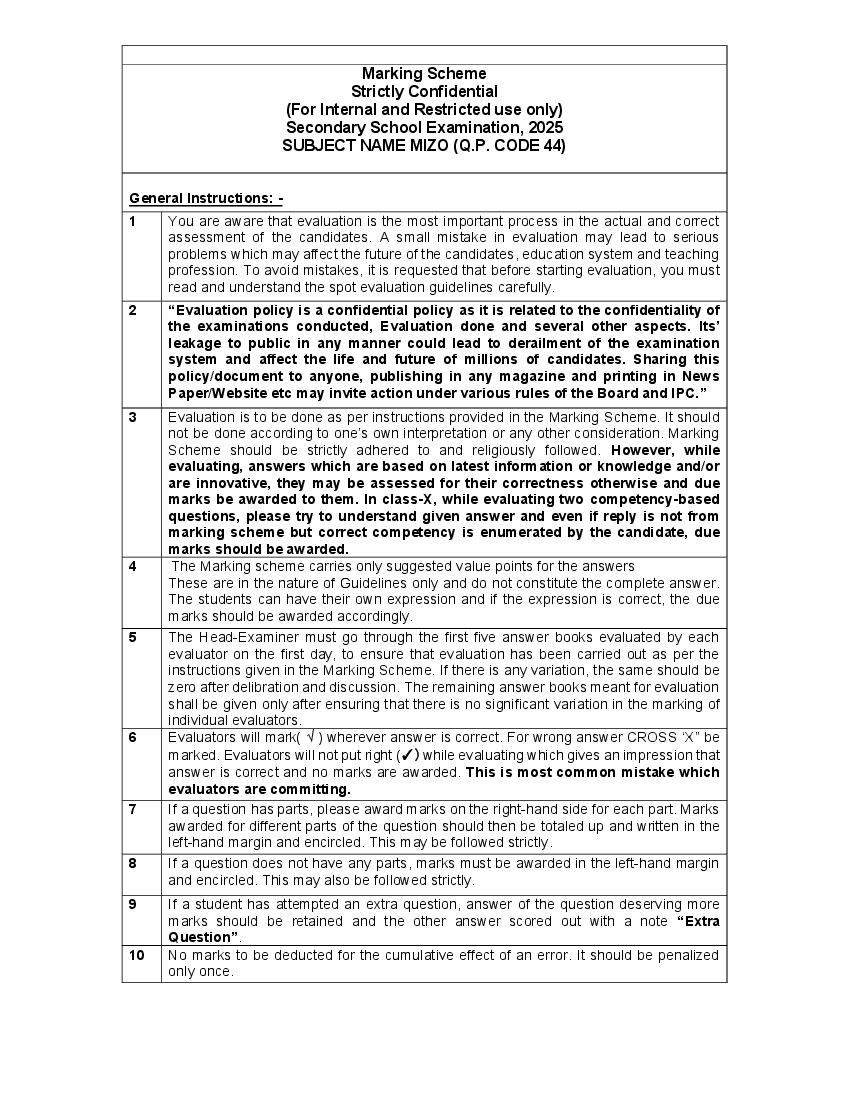
Strictly Confidential
(For Internal and Restricted use only)
Secondary School Examination, 2025
SUBJECT NAME MIZO (Q.P. CODE 44)
General Instructions: -
1 You are aware that evaluation is the most important process in the actual and correct
assessment of the candidates. A small mistake in evaluation may lead to serious
problems which may affect the future of the candidates, education system and teaching
profession. To avoid mistakes, it is requested that before starting evaluation, you must
read and understand the spot evaluation guidelines carefully.
2 “Evaluation policy is a confidential policy as it is related to the confidentiality of
the examinations conducted, Evaluation done and several other aspects. Its’
leakage to public in any manner could lead to derailment of the examination
system and affect the life and future of millions of candidates. Sharing this
policy/document to anyone, publishing in any magazine and printing in News
Paper/Website etc may invite action under various rules of the Board and IPC.”
3 Evaluation is to be done as per instructions provided in the Marking Scheme. It should
not be done according to one’s own interpretation or any other consideration. Marking
Scheme should be strictly adhered to and religiously followed. However, while
evaluating, answers which are based on latest information or knowledge and/or
are innovative, they may be assessed for their correctness otherwise and due
marks be awarded to them. In class-X, while evaluating two competency-based
questions, please try to understand given answer and even if reply is not from
marking scheme but correct competency is enumerated by the candidate, due
marks should be awarded.
4 The Marking scheme carries only suggested value points for the answers
These are in the nature of Guidelines only and do not constitute the complete answer.
The students can have their own expression and if the expression is correct, the due
marks should be awarded accordingly.
5 The Head-Examiner must go through the first five answer books evaluated by each
evaluator on the first day, to ensure that evaluation has been carried out as per the
instructions given in the Marking Scheme. If there is any variation, the same should be
zero after delibration and discussion. The remaining answer books meant for evaluation
shall be given only after ensuring that there is no significant variation in the marking of
individual evaluators.
6 Evaluators will mark( √ ) wherever answer is correct. For wrong answer CROSS ‘X” be
marked. Evaluators will not put right (✓)while evaluating which gives an impression that
answer is correct and no marks are awarded. This is most common mistake which
evaluators are committing.
7 If a question has parts, please award marks on the right-hand side for each part. Marks
awarded for different parts of the question should then be totaled up and written in the
left-hand margin and encircled. This may be followed strictly.
8 If a question does not have any parts, marks must be awarded in the left-hand margin
and encircled. This may also be followed strictly.
9 If a student has attempted an extra question, answer of the question deserving more
marks should be retained and the other answer scored out with a note “Extra
Question”.
10 No marks to be deducted for the cumulative effect of an error. It should be penalized
only once.
Page 2
Question Paper) has to be used. Please do not hesitate to award full marks if the answer
deserves it.
12 Every examiner has to necessarily do evaluation work for full working hours i.e., 8 hours
every day and evaluate 20 answer books per day in main subjects and 25 answer books
per day in other subjects (Details are given in Spot Guidelines).This is in view of the
reduced syllabus and number of questions in question paper.
13 Ensure that you do not make the following common types of errors committed by the
Examiner in the past:-
● Leaving answer or part thereof unassessed in an answer book.
● Giving more marks for an answer than assigned to it.
● Wrong totaling of marks awarded on an answer.
● Wrong transfer of marks from the inside pages of the answer book to the title page.
● Wrong question wise totaling on the title page.
● Wrong totaling of marks of the two columns on the title page.
● Wrong grand total.
● Marks in words and figures not tallying/not same.
● Wrong transfer of marks from the answer book to online award list.
● Answers marked as correct, but marks not awarded. (Ensure that the right tick mark
is correctly and clearly indicated. It should merely be a line. Same is with the X for
incorrect answer.)
● Half or a part of answer marked correct and the rest as wrong, but no marks
awarded.
14 While evaluating the answer books if the answer is found to be totally incorrect, it should
be marked as cross (X) and awarded zero (0)Marks.
15 Any un assessed portion, non-carrying over of marks to the title page, or totaling error
detected by the candidate shall damage the prestige of all the personnel engaged in the
evaluation work as also of the Board. Hence, in order to uphold the prestige of all
concerned, it is again reiterated that the instructions be followed meticulously and
judiciously.
16 The Examiners should acquaint themselves with the guidelines given in the “Guidelines
for spot Evaluation” before starting the actual evaluation.
17 Every Examiner shall also ensure that all the answers are evaluated, marks carried over
to the title page, correctly totaled and written in figures and words.
18 The candidates are entitled to obtain photocopy of the Answer Book on request on
payment of the prescribed processing fee. All Examiners/Additional Head
Examiners/Head Examiners are once again reminded that they must ensure that
evaluation is carried out strictly as per value points for each answer as given in the
Marking Scheme.
Page 3
Marking scheme
Mizo
1. I (B) II (D) III (C) IV (A) V (B) (5x1=5)
2. I (D) II (B) III (A) IV (C) V (C) (5X1=5)
3. I (C) II (A) III (D) IV (B) V (C) (5X1=5)
4. I (B) II (C) III (C) IV (C) V (B) (5X1=5)
5. (i) Tunhmaa Mizot eizawnna bulpui ber chu Lo neih hi a ni Loah chuan an rin pui ber chu an
ching thin. (2)
(ii) An ei ber buh tharna atang an hnathawh dan chu a in an thap avangin hausa leh rethei titi a
inrual pet thin (2)
(iii) An eizownna ber a inan vek avangin rhawkhen heh khawchhiat tumah an inlungtual thang
vek a ni (2)
(v) he article ‘mizo hlui leh Mizo thar’ tih thu ziaktu chu Vanneihthuanga a ni (2)
6. (iii) Kang ral (4X1=4)
(iv) Van mi
(v) Mihring
(vi) Mirethei
7. (i) I kawr suk zawh veleh ni raeh dah rawh. (3X1=3)
(ii) In I chhuahsan lunah Talain kalh tha zel rawh.
(iii) Kan vengah sikul tam tak a aron.
8. (i) Ka ,thranpa chu uichin chawkat a lo kal . (2X1=2)
(ii) I vaimim Kam chu a hnui thui hle.
9. (1X4=4)
(a) He hla chang hi ‘An a lhu em chilnung tinreng’ tih hla. Chali phuah, class-X Mizo zirlaibu,
Tlawng Atanga lek chhuah a ni a, chang thumna a ni.
He hlrat hian pathian thul siom mengcha zarong zarong to chuan amah an zaka, an thuh tawpin
siomtu pathean an chawimawi a ni. Tichuan hla phuahtu
Pi chali ngei pawh hian Lal Isua chu a ngaiin a hnen thlen hlan a nghakhlel hle a in
He hringnm hi lo ral mah se, pathian hnen thlen hlan Ka nghakhlel hle a, Ni tlak awn tawh lohna
vanram ka thlen hunah cgun ka lawmna zawng zawng chu a kim tawh ang a ti a ni
OR
(b) He hle chang hi ‘Thlangtiang Thlifim’ the hla v. Thangzama phuah class-X Mizo zirlaibu. Tawng
atangs hak chhuah a ni a, chang hnihna thar 3 no leh tlar 4 no a ni
(b) He hla chang hi ‘thlangting Thlifim’ the hla
v.Thlangtiang phuah class-X Mizo zirlaibu Tawng atangs lak chhuah a ni a, chang hnihna tlar 3 no
lah tlar 4 no a ni.
Page 4
sa hmuna cheng thui an in a. pathian nung a awm a uites an hre long thingbul lungbul te an be thin
a ni. Tichuan sap missionary ten lo nih dan a rawn sawina a ni.
Nitina zu in thin ten tunah elwan zu tel lovin kan lo khawsa thei la a, kan buaing zawng zawngte a
lo king a, I hnen lam kan lo hawi thei hian khawtinah hian hlimas min thlen to=a a ni
10. (4X2=8)
(i) kan kawngkhar ri he chu a ri ring hle a.
(ii) Inngeih taka kan awmdum lai ko ngaihtuah hian pasal min neih sam ka phal lo a ni.
(iii) He khawvel lungngaihna leh menganna hi kalsana pathian hnen thlen hlan a nghakhld ber a
ni.
(iv) Zaman hnawng hi hmawng zom chi, a zaman thing chu nghet taka phuar bet tkak thin a ni
a. A ngihzawng a dulna kham a phuar ngheh em avangin vankhama hiar nen intehkhinin,
” Zaman hmawng thing ang min phuar vela”, a ti hial a ni.
(v) Titi ho nikhua a malhni ngaih dan dik kak lo dueh sawi chhuah chinng ang chite hi an duh
zawng leh duh loh zawng hriat hran a har a, nel sual an awl a, an kiangah sawi hoh tur sawi
palh a hlauhawm thin chutiang mite lakah chuan fimkhur a ngai hla niin nihna tih ziaktu
hian a sawi.
(vi) Hun hi the ziaktu hian khawvel hi khelmual angin a sawi a. Mi chi hrang hrang, mi hausa
lah rethei, milian lah te, mitinin kamhun hman dan zawng zawng hi khelmuala inkhel angin
a sawi a ni.
11. (1X4=4)
Nu leh pa fing lote cher an hmuch leh hriatah an
inhaianlin an inhau fova,thiam zawk nils inchutian an
insawisel town to bawk a, nidangte mawi lohna leh that
lohna to fate hriatah an sawi fob awk. Hetiang rite hian an
fate nu leh pa zah lohna leh ngaihnepna an zirtir bakah nri
dangte tling lova hriatna an fate thinhungah an tah tibreng an
unhre lo.
12. (1x4=4)
Alexander dunias- a thukhowthang kan zirlaiin a torlan
chu.”He khawvel finna zawng zawng lri nghak la, beisei
rawth, tihah a infun kim vek a ni,” teb thu hi a-ni.
He thuin a sawi kum nia lang chu finna nei tur chuan beiserna
nghet tak neith a, dawhthei take nghah a ngai tih hi a viin ka hria.
13. (2x2=4)
(i) Kan zirlai buin a sawi damin chan tawka lungowi lohna
hian kan dinhmun aia ranga awm luhna leh tumne min
siamsaka, chu chuan hma lam pan tura min dinhmua sang
fawkah min hlang kai a, hmasawnna rahbi thar min neihtir
thai bawk a ni.
Page 5
thlir.
b) Hun liam towh hnu theihnghilha,hrialam hun
beiseina nena thlir.
Hun liam tawh, kan sian that theith tawtr loh ihu
theinghilh a, hmalam hunah hunt ha leh hlimawn rawn thelng
tura beiseina nei chunga hun thlir hi thler dan tha zawth a ni
a, kan thlir dan tur pawn a ui.
iii) Mi, a thiamna leh thgeihna , a remhriatna leh finna kan
tehsak a, a pher tawk aia sang nia kan hriat dinhmuna dingan
awm thei chung mite chuan tumrehna leh huaisenna,tlawn
mai tum lohna nen beiin, harsa tak chung pawha an beih talh
talhna avengin dinhmun tha,en thang tih kan ngaihtuah tel
viin kan hre ngawt thin. Chutiang mite chu Nihra tih ziaktulin
kan thik loh pa a tih chu a ni.
iv) Nungtha humhalh kawnga pawimawh ber chuthinlunga
sanctuary neith hiani kan thinlung ngaihtuahnate hi kan ehet
ehhuahpii thin avangiu kan thinlungah nungchate humhalh
duhna tak tak kan neih a ngai.
Nungchate humhalh luhna tak tak nei thei tur chuan
Pathian thilsian hlu tak an nihna ka hriat chian a, an hluztia
leh mihring tang an tangkaina kan trriat chian teihna tura
nasa taka kan zirtira tan tsan lak a pawinuawh.
14. A chhangtria a chhandanah a inaghat ang. (unseen) (8)
15. A chhangtria a chhandanah a inaghat ang. (unseen) (5)
16. A chhangtria a chhandanah a inaghat ang. (unseen) (4)
Nungchate humhalh duhna tak tak nei thei tur chuan Pathian
thet sian hlu tak an nihna ka hrat thian a an hlutgia leh
muihringhe tana an tangkaina kan hrial thian theihna tur
nasa taka kan girtir a, tan kan lak a paninrants.
14 (8)
(1) Essay ziah dawnin kan chhan thiam ber tir nia kan
hriata tak thran tur
(2) Zawhna namber leh kan essay ziak tur thupui
hawrappui emaw a hnuai rin pahia enaw ziak han phawt tur.
(3) Mizo tawng thiang pangngai theiang bera ziak tun tur a
nia. A thermal tlukpui zo tawnga a awm ngang to a nils shuan
tawng dang thumal hman loh hram hram tur aeri.
15. Dialogue writing ziah dawna hriat tur (5) pawimanth
zualte.
Page 6
hman tur aris.
Thu hriathram harsa lutuk hman loh hram hran tur a ni a
hnam dang tawng. Pawh a tlem theiang ber hman tum tur ani.
(2) topic fel tak thlam a ngaia, chu topic chlengchanga inbe tor, a changtule kan ti mai ang
chu, pahnih emaw, a aia tam enaw an awm a ngri.
(3) Inbiakna enw, chu zamhana leh chhanna zawng ziah thuha ni a. teuse hman dik a
paninawh.
16. A chhangtuin a chhandanah a innghat ang(unseen) (4)
Document Details
| Board / Org | CBSE |
| Exam | Class 10 |
| Type | Solution |
| Pages | 6 |
| Updated | 24 Sep 2026 |