MBSE Class 10 Syllabus 2022 Science
Finished viewing? Save it for later —
Download MBSE Class 10 Syllabus 2022 Science (PDF · 6 pages)About MBSE Class 10 Syllabus 2022 Science
MBSE Class 10 Syllabus 2022 Science is available here for free download. Published by Mizoram Board for Class 10, this syllabus can be viewed online or downloaded as a PDF (6 pages). Candidates preparing for Class 10 can use MBSE Class 10 Syllabus 2022 Science to understand the exam pattern, the type of questions asked, and the overall difficulty level.
Frequently Asked Questions
How can I download MBSE Class 10 Syllabus 2022 Science?
Open this page and click the Download button to save MBSE Class 10 Syllabus 2022 Science as a PDF. It is completely free on AglaSem Docs.
Is MBSE Class 10 Syllabus 2022 Science free to download?
Yes. MBSE Class 10 Syllabus 2022 Science can be viewed online and downloaded as a PDF free of cost on AglaSem Docs.
How many pages does MBSE Class 10 Syllabus 2022 Science have?
MBSE Class 10 Syllabus 2022 Science contains 6 pages, which you can read online or download together as a single PDF.
Where can I find more Class 10 study material?
You can find more Class 10 question papers, sample papers, syllabus, and answer keys on AglaSem Docs.
MBSE Class 10 Syllabus 2022 Science – Text
Read the full text of this syllabus below — useful to quickly search, copy and reference the content online without downloading the PDF.
📄 View text version (6 pages)
Page 1
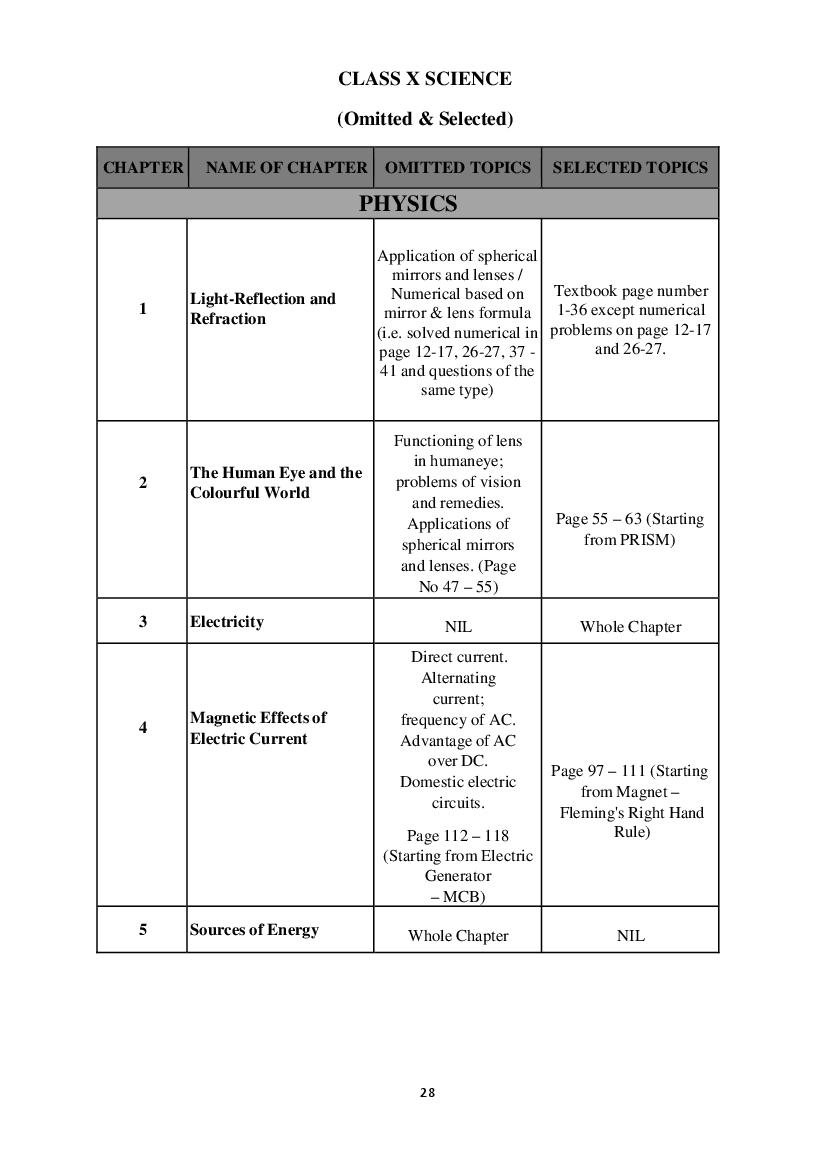
(Omitted & Selected)
CHAPTER NAME OF CHAPTER OMITTED TOPICS SELECTED TOPICS
PHYSICS
Application of spherical
mirrors and lenses /
Light-Reflection and Numerical based on Textbook page number
1 mirror & lens formula 1-36 except numerical
Refraction
(i.e. solved numerical in problems on page 12-17
page 12-17, 26-27, 37 - and 26-27.
41 and questions of the
same type)
Functioning of lens
in humaneye;
The Human Eye and the
2 problems of vision
Colourful World
and remedies.
Applications of Page 55 – 63 (Starting
spherical mirrors from PRISM)
and lenses. (Page
No 47 – 55)
3 Electricity NIL Whole Chapter
Direct current.
Alternating
current;
Magnetic Effects of frequency of AC.
4
Electric Current Advantage of AC
over DC.
Page 97 – 111 (Starting
Domestic electric
from Magnet –
circuits.
Fleming's Right Hand
Page 112 – 118 Rule)
(Starting from Electric
Generator
– MCB)
5 Sources of Energy Whole Chapter NIL
28
Page 2
Page No 150 – 167
Periodic Classification of
6 Page No 145 – 150 (Starting
Elements
from Modern Periodic
Table)
Chemical Reactions and
7 No Omission Whole Chapter
Equations
Page No 210 – Page No 195 – 210
8 Metals and Non-Metals 217 (Starting
from Metals & Page No 217 – 220
Metallurgy) (Startingfrom Alloys)
Page No 230 – 233 Page No 225 – 230
(Starting from dilution
9 Acid, Bases and Salts of acid – Role of water Page No 233 – 250
to explain thebasic (Startingfrom chemical
nature of bases) definition of base.
Page 277 – 291
Page No 255 – 277
(Starting from types of
Carbon and its structuralisomerism)
10
compounds
Page 294 - 296 Page No 292 - 294
(Starting from Synthetic (Starting from Soaps &
detergents) Detergents)
BIOLOGY
11 Life Processes NIL Whole Chapter
Control and
12 Whole Chapter NIL
Coordination
How do Organisms
13 NIL Whole Chapter
Reproduce?
Page 397 – 403 Page 391 – 397
14 Heredity and Evolution
(Evolution part) (Heredity part )
15 Our Environment NIL Whole Chapter
Management of Natural
16 Whole Chapter NIL
Resources
29
Page 3
Unit Topic Marks
1 Light
12
2 The Human Eye
3 Electricity
12
4 Magnetic Effects
5 Periodic Classification
07
6 Chemical Reactions
7 Metals and Non-Metals
10
8 Acids, Bases and Salts
9 Carbon 06
10 Life Process 09
12 How do Organisms Reproduce 05
13 Heredity and Evolution 04
14 Our Environment 05
Total 70
Weightage to Form of Questions :
Sl/no. Form of Questions No. of Questions Marks for each question Total Marks
2.1 Objective Type 14 1 14
2.2 Very Short Answer 07 1 07
2.2 Short Answer I 08 2 16
2.3 Short Answer II 07 3 21
2.4 Long Answer 03 4 12
TOTAL 39 70
Scheme of option :
There shall not be any overall choice in the question paper. However, internal choice on a
very selective basis shall be given based on same objective. It shall also have same mark allotment
and same difficulty level.
Scheme of Section :
There shall be three sections namely Section A (Physics), Section B (Chemistry) and Section
C (Biology).
30
Page 4
Page 5
1. To find the pH of the following samples by using pH paper/universal indicator.
i) Dilute Hydrochloric acid
ii) Dilute NaOH solution
iii) Dilute Ethanoic acid solution
iv) Lemon juice
v) Water
vi) Dilute Sodium Bicarbonate Solution.
7. To determine the equivalent resistance of two resistors when connected in parallel.
8. To prepare a temporary mount of a leaf peel to show stomata.
15. To study the following properties of acetic acid (ethanoic acid):
i) odour
ii) solubility in water
iii) effect on litmus
iv) reaction with sodium bicarbonate
Selected PRACTICALS 10
List of experiments
1. To study the properties of acids and bases HC1 & NaOH by their reaction with
i) Litmus solution (Blue/Red)
ii) Zinc metal
iii) Solid Sodium Carbonate
2. To determine the focal length of
a) Concave mirror
b) Convex lens by obtaining the image of a distant object.
3. To trace the path of a ray of light passing through a rectangular glass slab for different angles
of incidence. Measure the angle of incidence, angle of refraction, angle of emergence and
interpret the result.
4. To study the dependence of current (I) on the potential difference (V) across a resistor and
determine its resistance. Also plot a graph between V and I.
5. To determine the equivalent resistance of two resistors when connected in series.
6. To show experimentally that light is necessary for photosynthesis.
7. To show experimentally that carbon dioxide is given out during respiration.
8. To study (a) binary fission in Amoeba and (b) budding in yeast with the help of prepared
slides.
9. To determine the percentage of water absorbed by raisins.
32
Page 6
i) odour
ii) solubility in water
iii) effect on litmus paper
iv) action on acidified potassium dichromate solution.
11. a) To observe the action of Zn, Fe, Cu and Al metals on the following salt solutions,
i) ZnSO4(aq.)
ii) FeSO4 (aq.)
iii) CuSO4 (aq.)
iv) Al2(SO4)3(aq.)
b) Arrange Zn, Fe, Cu and Al metals in the decreasing order of reactivity based on the
above result.
33
Document Details
| Board / Org | Mizoram Board |
| Exam | Class 10 |
| Type | Syllabus |
| Pages | 6 |
| Updated | 22 Jul 2026 |