TN 12th Question Paper 2022 Bio Chemistry
Finished viewing? Save it for later —
Download TN 12th Question Paper 2022 Bio Chemistry (PDF · 8 pages)About TN 12th Question Paper 2022 Bio Chemistry
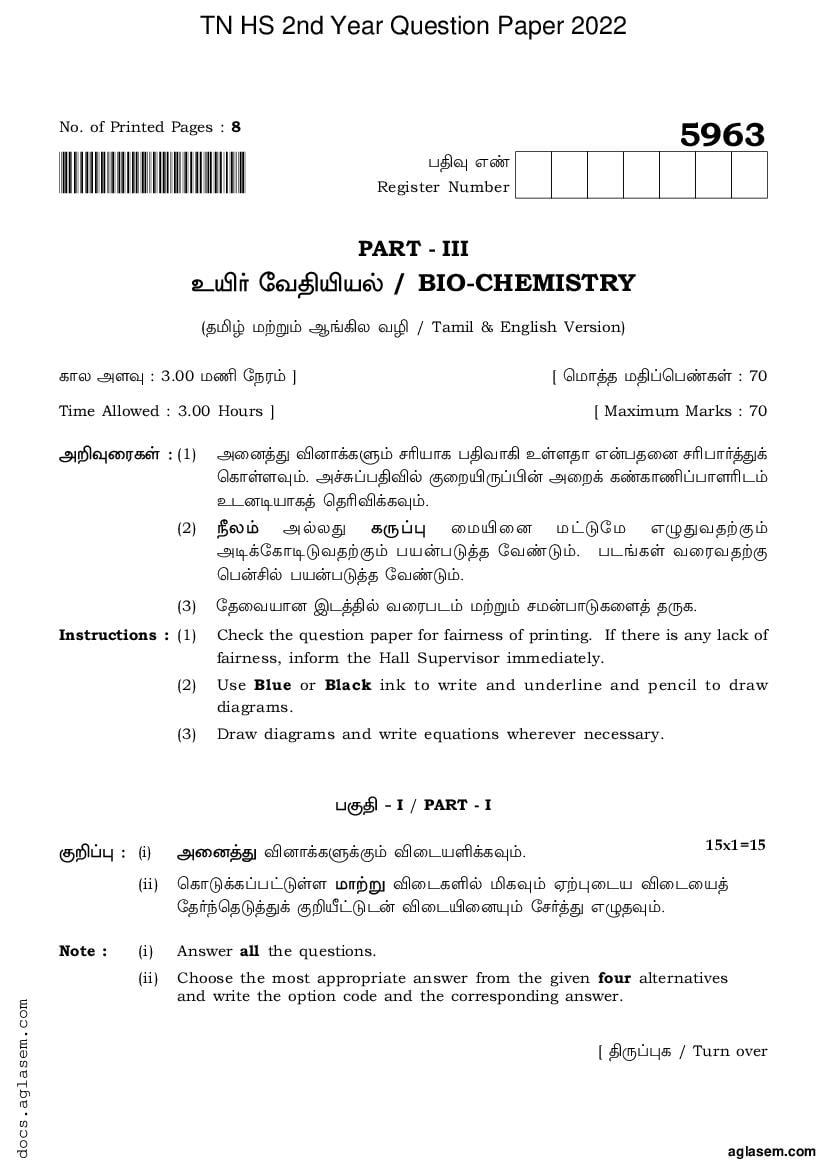
TN 12th Question Paper 2022 Bio Chemistry is available here for free download. Published by Tamil Nadu Board for Class 12, this question paper can be viewed online or downloaded as a PDF (8 pages). Candidates preparing for Class 12 can use TN 12th Question Paper 2022 Bio Chemistry to understand the exam pattern, the type of questions asked, and the overall difficulty level.
Frequently Asked Questions
How can I download TN 12th Question Paper 2022 Bio Chemistry?
Open this page and click the Download button to save TN 12th Question Paper 2022 Bio Chemistry as a PDF. It is completely free on AglaSem Docs.
Is TN 12th Question Paper 2022 Bio Chemistry free to download?
Yes. TN 12th Question Paper 2022 Bio Chemistry can be viewed online and downloaded as a PDF free of cost on AglaSem Docs.
How many pages does TN 12th Question Paper 2022 Bio Chemistry have?
TN 12th Question Paper 2022 Bio Chemistry contains 8 pages, which you can read online or download together as a single PDF.
Where can I find more Class 12 study material?
You can find more Class 12 question papers, sample papers, syllabus, and answer keys on AglaSem Docs.
TN 12th Question Paper 2022 Bio Chemistry – Text
Read the full text of this question paper below — useful to quickly search, copy and reference the content online without downloading the PDF.
📄 View text version (8 pages)
Page 1
5963
!5963BioChemistry! £vÄ Gs
Register Number
PART - III
E°º ÷Áv°¯À / BIO-CHEMISTRY
(uªÌ ©ØÖ® B[Q» ÁÈ / Tamil & English Version)
Põ» AÍÄ : 3.00 ©o ÷|µ® ] [ ö©õzu ©v¨ö£sPÒ : 70
Time Allowed : 3.00 Hours ] [ Maximum Marks : 70
AÔÄøµPÒ : (1) AøÚzx ÂÚõUPЮ \›¯õP £vÁõQ EÒÍuõ GߣuøÚ \›£õºzxU
öPõÒÍÄ®. Aa_¨£vÂÀ SøÓ°¸¨¤ß AøÓU PsPõo¨£õÍ›h®
EhÚi¯õPz öu›ÂUPÄ®.
(2) }»® AÀ»x P¸¨¦ ø©°øÚ ©mk÷© GÊxÁuØS®
AiU÷PõikÁuØS® £¯ß£kzu ÷Ásk®. £h[PÒ ÁøµÁuØS
ö£ß]À £¯ß£kzu ÷Ásk®.
(3) ÷uøÁ¯õÚ ChzvÀ Áøµ£h® ©ØÖ® \©ß£õkPøÍz u¸P.
Instructions : (1) Check the question paper for fairness of printing. If there is any lack of
fairness, inform the Hall Supervisor immediately.
(2) Use Blue or Black ink to write and underline and pencil to draw
diagrams.
(3) Draw diagrams and write equations wherever necessary.
£Sv & I / PART - I
SÔ¨¦ : (i) AøÚzx ÂÚõUPÐUS® Âøh¯ÎUPÄ®. 15x1=15
(ii) öPõkUP¨£mkÒÍ ©õØÖ ÂøhPÎÀ ªPÄ® Hئøh¯ Âøhø¯z
÷uº¢öukzxU SÔ±mkhß Âøh°øÚ²® ÷\ºzx GÊuÄ®.
Note : (i) Answer all the questions.
(ii) Choose the most appropriate answer from the given four alternatives
and write the option code and the corresponding answer.
Page 2
1. RBC \ƾÒÍ ¦µu® __________.
(A) SÐmhõøu÷¯õß (B) QÍõz›ß
(C) öµÛß (D) ìö£Um›ß
The protein present in RBC membrane is __________.
(a) Glutathione (b) Clathrin
(c) Renin (d) Spectrin
2. ¤ßÁ¸ÁÚÁØÖÒ GU÷\õö£¨i÷høé PshԯĮ.
(A) Põº£õUê ö£¨i÷hì (B) m›¨]ß
(C) ö£¨]ß (D) øP÷©õm›¨]ß
Find the exopeptidase.
(a) Carboxy Peptidase (b) Trypsin
(c) Pepsin (d) Chymotrypsin
3. EªÌ}º Aø©÷»ì ö\¯À£õmhõÀ E¸ÁõS® AvP QøÍPøÍ öPõsh
Aø©¨¦ __________.
(A) PÀ½µÀ öPõʨ¦ (B) Aø©÷»õì
(C) öhUìi›ß (D) Aø©÷»õö£Uiß
The highly branched structure formed after the action of salivary amylase is
called __________.
(a) Chylomicron (b) Amylose
(c) Dextrin (d) Amylopectin
4. Aø\÷£õk® E°›Ú[PÎÀ SÐU÷Põ]ß •ußø© ‰»® __________.
(A) ¦µ¨¤÷¯õ÷Úm (B) ¤µU÷hõì
(C) QÎ\µõÀ (D) ìhõºa
The major source of glucose in ruminants is __________.
(a) Propionate (b) Fructose
(c) Glycerol (d) Starch
5. __________ GßÝ® ö|õv ö©»Ûß öuõS¨¤À Dk£kQÓx.
(A) j&Põº£õU]÷»ì (B) øu÷µõ]÷Úì
(C) ÷hõ£ªß øímµõU]÷»ì (D) mµõßìö©zv÷»ì
The major enzyme involved in the synthesis of melanin is __________.
(a) Decarboxylase (b) Tyrosinase
(c) Dopamine hydroxylase (d) Transmethylase
Page 3
6. öPõ»ìiµõ¼ß ö£Öv¯õÚx __________.
(A) øÁmhªß E (B) øÁmhªß A (C) øÁmhªß D (D) øÁmhªß C
__________ is a derivative of cholesterol.
(a) Vitamin E (b) Vitamin A (c) Vitamin D (d) Vitamin C
7. £õ¼©÷µì öuõhº \[Q¼ ÂøÚ°À £¯ß£k® ö|õv __________.
(A) DNA øP÷µì (B) Taq £õ¼©÷µì
(C) RNA £õ¼©÷µì (D) ›÷£õ÷\õ®
The enzyme used in polymerase chain reaction is __________.
(a) DNA Gyrase (b) Taq polymerase
(c) RNA polymerase (d) Ribosome
8. __________ Gߣx xÁUP ÷Põhõß BS®.
(A) GUC (B) CCG (C) AUG (D) AAC
The start codon is __________.
(a) GUC (b) CCG (c) AUG (d) AAC
9. Cµzu EøÓuÀ ö\¯À•øÓ°À GzuøÚ PõµoPÒ Dk£kQßÓÚ ?
(A) 8 (B) 10 (C) 12 (D) 13
How many factors are involved in blood clotting process ?
(a) 8 (b) 10 (c) 12 (d) 13
10. ï÷©õ¥¼¯õ A &øÁ E¸ÁõUS® Põµo :
(A) Põµo VI (B) Põµo VIII (C) Põµo V (D) Põµo VII
Hemophilia A is caused by the following factor :
(a) Factor VI (b) Factor VIII (c) Factor V (d) Factor VII
11. G»Umµõß CǨø£ __________ GÚ ö£¯›h •i²®.
(A) BUêá÷ÚØÓ® (B) Áͺ]øu ©õØÓ®
(C) JkUP® (D) Áͺ©õØÓ®
Loss of electrons can be termed as :
(a) Oxidation (b) Metabolism
(c) Reduction (d) Anabolism
Page 4
12. Km ©ØÖ® Vmax BQ¯ÁØÔØS Cøh÷¯¯õÚ öuõhº¦ __________ GÚ AøÇUP¨
£kQÓx.
(A) Gso¯À Pøµ\À AqS•øÓ
(B) íõÀ÷hß \©ß£õk
(C) Q¨ì&öíÀ®÷íõÀmì \©ß£õk
(D) ø©U÷P¼ì ö©ßhß \©ß£õk
The relationship between Km and Vmax is also known as __________.
(a) Numerical solution approach
(b) Haldane equation
(c) Gibbs - Helmholtz equation
(d) Michaelis Menten equation
13. AønÄ IV &ß ö£¯º __________.
(A) \U]÷Úm iøímµá÷Úì
(B) NADH iøímµá÷Úì
(C) L¨³©÷µì
(D) ø\m÷hõS÷µõ® BUê÷hì
The name of complex IV is __________.
(a) Succinate dehydrogenase
(b) NADH dehydrogenase
(c) Fumarase
(d) Cytochrome oxidase
14. RÌUPshÁØÖÒ Gx C¯ØøP°ß öu›Äz ußø©¯ØÓ ÷|õ´ uøhUPõ¨£õS® ?
(A) C¯À£õÚ ÷|õ´ uøhUPõ¨¦
(B) ö£Ó¨£mh ÷|õ´ uøhUPõ¨¦
(C) ö\ÀÁÈ ÷|õ´ uøhUPõ¨¦
(D) Cµzu ÁÈ ÷|õ´ uøhUPõ¨¦
Which one of the following immunity is non-specific in nature ?
(a) Innate immunity
(b) Acquired immunity
(c) Cell mediated immunity
(d) Humoral immunity
Page 5
15. C¯ØøP°À Põn¨£k® ‰»UTÖPÎÀ Gx AvP EhØPõ¨¦ FUPz ußø©ø¯U
öPõskÒÍx ?
(A) ¼¨¤k (B) ¦µu®
(C) {³UÎU Aª»® (D) Põº÷£õøím÷µm
Which type of the biomolecule is more antigenic in nature ?
(a) Lipid (b) Protein
(c) Nucleic acid (d) Carbohydrates
£Sv & II / PART - II
SÔ¨¦ : H÷uÝ® BÖ ÂÚõUPÐUS Âøh¯ÎUPÄ®. ÂÚõ Gs 24 &US
Pmhõ¯©õP Âøh¯ÎUPÄ®. 6x2=12
Note : Answer any six questions. Question No. 24 is Compulsory.
16. uø\ ö|QÌÄ £ØÔ¯ Eß P¸zøu GÊxP.
Give your idea on tonicity.
17. QøÍU÷PõâÚõ¼]øé Áøµ¯ÖUPÄ®.
Define Glycogenolysis.
18. øu÷µõ]ß GÆÁõÖ ÷hõ£õS³÷ÚõÚõP ©õØÓ¨£kQÓx ?
How is tyrosine converted to dopaquinone ?
19. öuÂmi¯ {ø» Áøµ¯ÖUPÄ®.
Define the term Satiety.
20. ‰»UTÖ E°›¯¼ß ø©¯U÷Põm£õmøh _¸UP©õP GÊxP.
Write in brief about the central dogma of molecular biology.
21. SÐU÷Põì BÚx SÐU÷Põì-6-£õì÷£mhõP ©õØÓ¨£k® ÂøÚø¯ GÊxP.
Write the conversion reaction of glucose-6-phosphate to glucose.
22. BUêá÷ÚØÓ JkUP ªßÚÊzu® GßÓõÀ GßÚ ?
What is redox potential ?
Page 6
23. ÷í¨÷hßPÒ GßÓõÀ GßÚ ?
What are haptens ?
24. £õì÷£õ¼¨¤kPÒ GÆÁõÖ ÁøP¨£kzu£kQßÓÚ ?
How phospholipids are classified ?
£Sv & III / PART - III
SÔ¨¦ : H÷uÝ® BÖ ÂÚõUPÐUS Âøh¯ÎUPÄ®. ÂÚõ Gs 33 &US
Pmhõ¯©õP Âøh¯ÎUPÄ®. 6x3=18
Note : Answer any six questions. Question No. 33 is Compulsory.
25. Põº÷£õøím÷µmkPÒ EÔg\¨£kuø» £õvUS® H÷uÝ® ‰ßÖ PõµoPøÍ
GÊxP.
Write any three factors that affect the absorption of carbohydrates.
26. ö\À \ÆÂß ö©õø\U Aø©¨¤ß C¯UPÂ¯Ø £s¦PøÍ £mi¯¼kP.
List the dynamic properties of Fluid Mosaic Model of cell membrane.
27. SÐU÷PõöáÛU Aª÷Úõ Aª»® ©ØÖ® Rm÷hõöáÛU Aª÷Úõ Aª»®
GßÓõÀ GßÚ ? GkzxUPõmkPÒ u¸P.
What are glucogenic amino acids and ketogenic amino acids ? Give examples.
28. öPõʨ¦ Aª»[PÎß E°ºzöuõS¨¤À A]møhÀ CoA Cønzuh Aø©¨¤ß
SÔ¨¦ GÊxP.
Write a note on acetyl CoA shuttle system in the biosynthesis of fatty acids.
29. ©µ¦zuPÁÀ ö©õÈö£¯ºzu¾US¨¤ß {PÊ® ©õØÓ[Pøͨ £mi¯¼kP.
List the post translational modification events.
30. ÷h&\õUì ÷|õ°ß H÷uÝ® BÖ AÔSÔPøÍ GÊxP.
Write any six symptoms of Tay Sach’s disease.
31. «Íõ ö|õvz ukzuÀ GßÓõÀ GßÚ ? GkzxUPõmkPÒ u¸P.
What is irreversible enzyme inhibition ? Give examples.
Page 7
32. £õUj›¯õÂÀ Jmi EøÓuÀ ÂøÚø¯ ÂÍUSP.
Explain the bacterial agglutination test.
33. QøÍU÷PõöáÛ]ì ö\¯À•øÓ öuõhºÂøÚPøÍ TÖP.
Write the reaction sequences of glycogenesis.
£Sv & IV / PART - IV
SÔ¨¦ : AøÚzx ÂÚõUPÐUS® Âøh¯ÎUPÄ®. ÷uøÁ¯õÚ Ch[PÎÀ £h®
ÁøµP. 5x5=25
Note : Answer all the questions. Draw the diagrams wherever necessary.
34. (A) \ÆÅk £µÁ¼ß E°›¯À •UQ¯zxÁzøu u¸P.
AÀ»x
(B) G»Umµõß Phzxa \[Q¼°ß uk¨£õßPÒ £ØÔ ÂÁ›UPÄ®.
(a) Give the biological significance of osmosis.
OR
(b) Describe the inhibitors of Electron Transport Chain.
35. (A) Cøµ¨ø£°À ¦µu[PÎß ö\›zuÀ £ØÔ ÂÍUSP.
AÀ»x
(B) ÷PmiUPõ»«ßPÒ E¸ÁõuÀ ÂøÚ÷¯õk öuõhº¦øh¯ £i{ø»PøÍ
ÂÍUSP.
(a) Explain about the digestion of proteins in stomach.
OR
(b) Enumerate the steps involved in the formation of catecholamines.
36. (A) ÷Põ› _ÇØ] £ØÔ ÂÍUSP.
AÀ»x
(B) ö\ÀÂÊ[Su¼À {PÊ® £À÷ÁÖ •øÓPÒ ¯õøÁ ?
(a) Explain Cori cycle.
OR
(b) Explain the steps involved in Phagocytosis.
Page 8
37. (A) öPõ»ìiµõ¼ß •UQ¯©õÚ¨ ö£ÖvPøͨ £ØÔ SÔ¨¦ ÁøµP.
AÀ»x
(B) Q꼀 ø©¯® GßÓõÀ GßÚ ? AÁØÔß ö£õxÁõÚ £s¦PøÍ GÊxP.
(a) Write a note on important derivatives of cholesterol.
OR
(b) What is active site ? Write its common features.
38. (A) ÷P»U÷hõ]ª¯õÂß AÔSÔPÒ ©ØÖ® Põµn[PøÍ ÂÍUSP.
AÀ»x
(B) ö\ª Pß\º÷ÁiÆ ©õv›ø¯ EÖv ö\´²® ö©éÀ\ß&ìhõÀ ÷\õuøÚø¯
ÂÁ›UPÄ®.
(a) Explain the symptoms and causes of Galactosemia.
OR
(b) Describe the Meselson-Stahl experiment and the conformation of
semi-conservative model.
-oOo-
Document Details
| Board / Org | Tamil Nadu Board |
| Exam | Class 12 |
| Type | Question Paper |
| Pages | 8 |
| Updated | 30 Apr 2026 |