CBSE Class 10 Question Paper 2025 Solution Retail
Finished viewing? Save it for later —
Download CBSE Class 10 Question Paper 2025 Solution Retail (PDF · 10 pages)About CBSE Class 10 Question Paper 2025 Solution Retail
CBSE Class 10 Question Paper 2025 Solution Retail is available here for free download. Published by CBSE for Class 10, this solution can be viewed online or downloaded as a PDF (10 pages). Candidates preparing for Class 10 can use CBSE Class 10 Question Paper 2025 Solution Retail to understand the exam pattern, the type of questions asked, and the overall difficulty level.
Frequently Asked Questions
How can I download CBSE Class 10 Question Paper 2025 Solution Retail?
Open this page and click the Download button to save CBSE Class 10 Question Paper 2025 Solution Retail as a PDF. It is completely free on AglaSem Docs.
Is CBSE Class 10 Question Paper 2025 Solution Retail free to download?
Yes. CBSE Class 10 Question Paper 2025 Solution Retail can be viewed online and downloaded as a PDF free of cost on AglaSem Docs.
How many pages does CBSE Class 10 Question Paper 2025 Solution Retail have?
CBSE Class 10 Question Paper 2025 Solution Retail contains 10 pages, which you can read online or download together as a single PDF.
Where can I find more Class 10 study material?
You can find more Class 10 question papers, sample papers, syllabus, and answer keys on AglaSem Docs.
CBSE Class 10 Question Paper 2025 Solution Retail – Text
Read the full text of this solution below — useful to quickly search, copy and reference the content online without downloading the PDF.
📄 View text version (10 pages)
Page 1
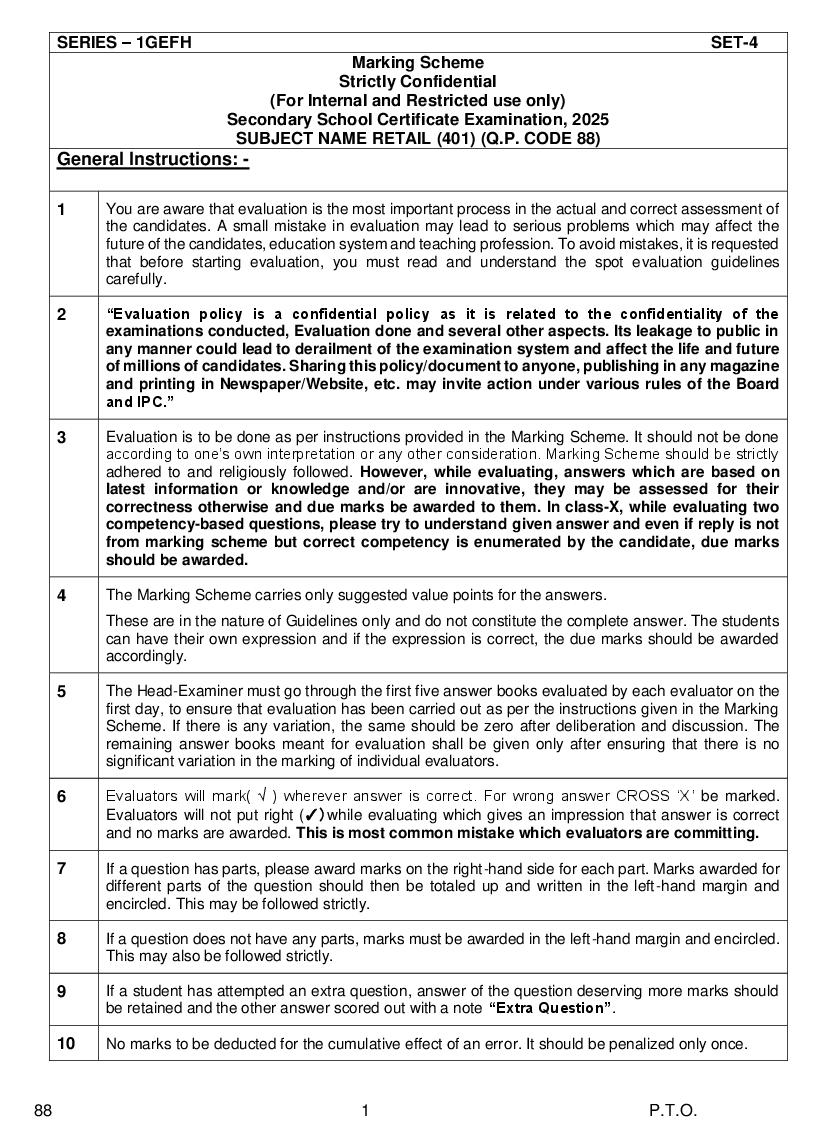
Marking Scheme
Strictly Confidential
(For Internal and Restricted use only)
Secondary School Certificate Examination, 2025
SUBJECT NAME RETAIL (401) (Q.P. CODE 88)
General Instructions: -
1 You are aware that evaluation is the most important process in the actual and correct assessment of
the candidates. A small mistake in evaluation may lead to serious problems which may affect the
future of the candidates, education system and teaching profession. To avoid mistakes, it is requested
that before starting evaluation, you must read and understand the spot evaluation guidelines
carefully.
2 “Evaluation policy is a confidential policy as it is related to the confidentiality of the
examinations conducted, Evaluation done and several other aspects. Its leakage to public in
any manner could lead to derailment of the examination system and affect the life and future
of millions of candidates. Sharing this policy/document to anyone, publishing in any magazine
and printing in Newspaper/Website, etc. may invite action under various rules of the Board
and IPC.”
3 Evaluation is to be done as per instructions provided in the Marking Scheme. It should not be done
according to one’s own interpretation or any other consideration. Marking Scheme should be strictly
adhered to and religiously followed. However, while evaluating, answers which are based on
latest information or knowledge and/or are innovative, they may be assessed for their
correctness otherwise and due marks be awarded to them. In class-X, while evaluating two
competency-based questions, please try to understand given answer and even if reply is not
from marking scheme but correct competency is enumerated by the candidate, due marks
should be awarded.
4 The Marking Scheme carries only suggested value points for the answers.
These are in the nature of Guidelines only and do not constitute the complete answer. The students
can have their own expression and if the expression is correct, the due marks should be awarded
accordingly.
5 The Head-Examiner must go through the first five answer books evaluated by each evaluator on the
first day, to ensure that evaluation has been carried out as per the instructions given in the Marking
Scheme. If there is any variation, the same should be zero after deliberation and discussion. The
remaining answer books meant for evaluation shall be given only after ensuring that there is no
significant variation in the marking of individual evaluators.
6 Evaluators will mark( √ ) wherever answer is correct. For wrong answer CROSS ‘X’ be marked.
Evaluators will not put right (✓)while evaluating which gives an impression that answer is correct
and no marks are awarded. This is most common mistake which evaluators are committing.
7 If a question has parts, please award marks on the right-hand side for each part. Marks awarded for
different parts of the question should then be totaled up and written in the left-hand margin and
encircled. This may be followed strictly.
8 If a question does not have any parts, marks must be awarded in the left-hand margin and encircled.
This may also be followed strictly.
9 If a student has attempted an extra question, answer of the question deserving more marks should
be retained and the other answer scored out with a note “Extra Question”.
10 No marks to be deducted for the cumulative effect of an error. It should be penalized only once.
88 1 P.T.O.
Page 2
be used. Please do not hesitate to award full marks if the answer deserves it.
12 Every examiner has to necessarily do evaluation work for full working hours i.e., 8 hours every day
and evaluate 20 answer books per day in main subjects and 25 answer books per day in other
subjects (Details are given in Spot Guidelines).This is in view of the reduced syllabus and number of
questions in question paper.
13 Ensure that you do not make the following common types of errors committed by the Examiner in the
past:-
● Leaving answer or part thereof unassessed in an answer book.
● Giving more marks for an answer than assigned to it.
● Wrong totaling of marks awarded on an answer.
● Wrong transfer of marks from the inside pages of the answer book to the title page.
● Wrong question wise totaling on the title page.
● Wrong totaling of marks of the two columns on the title page.
● Wrong grand total.
● Marks in words and figures not tallying/not same.
● Wrong transfer of marks from the answer book to online award list.
● Answers marked as correct, but marks not awarded. (Ensure that the right tick mark is correctly
and clearly indicated. It should merely be a line. Same is with the X for incorrect answer.)
● Half or a part of answer marked correct and the rest as wrong, but no marks awarded.
14 While evaluating the answer books if the answer is found to be totally incorrect, it should be marked
as cross (X) and awarded zero (0)Marks.
15 Any unassessed portion, non-carrying over of marks to the title page, or totaling error detected by the
candidate shall damage the prestige of all the personnel engaged in the evaluation work as also of
the Board. Hence, in order to uphold the prestige of all concerned, it is again reiterated that the
instructions be followed meticulously and judiciously.
16 The Examiners should acquaint themselves with the guidelines given in the “Guidelines for Spot
Evaluation” before starting the actual evaluation.
17 Every Examiner shall also ensure that all the answers are evaluated, marks carried over to the title
page, correctly totaled and written in figures and words.
18 The candidates are entitled to obtain photocopy of the Answer Book on request on payment of the
prescribed processing fee. All Examiners/Additional Head Examiners/Head Examiners are once
again reminded that they must ensure that evaluation is carried out strictly as per value points for
each answer as given in the Marking Scheme.
88 2
Page 3
MARKING SCHEME
RETAIL (401)
SECTION A
OBJECTIVE-TYPE QUESTIONS
Q.No. Question Source Material Unit/ Page Marks
(NCERT/ PSSCIVE/ Chap. No. of
CBSE study Source
material)
Q.1 Answer any 4 out of the given 6 questions on Employability Skills. (41=4)
i. (A) Public NCERT Unit 1 8 1
ii. (C) don’t know what is NCERT Unit 2 52 1
important
iii. (B) Goal setting NCERT Unit 2 55 1
iv. (C) .mp3 NCERT Unit 3 70 1
v. (A) wage employed NCERT Unit 4 100 1
person
vi (D) organic NCERT Unit 5 107 1
Q.2 Answer any 5 out of the given 6 questions (51=5)
i. (B) Universal Product NCERT Unit 1 91 1
Code
ii. Barcode, weighing NCERT Unit 1 92 1
iii. (C) Offline billing NCERT Unit 1 91 1
iv. (D) Markets NCERT Unit 1 98 1
v. (A) Electronic Data NCERT Unit 1 106 1
Interchange
vi. (A) Home NCERT Unit 1 107 1
88 3 P.T.O.
Page 4
i. (C) durable NCERT Unit 2 65 1
ii. (D) Products sold in NCERT Unit 2 65 1
Mother Dairy stores
iii. (C) Spine layout NCERT Unit 2 70 1
iv. Signage and graphics NCERT Unit 2 74 1
v. (C) Red cross on a white NCERT Unit 2 73 1
background
vi. (B) Sell the products NCERT Unit 2 66 1
Q.4 Answer any 5 out of the given 6 questions (51=5)
i. (C) industrial NCERT Unit 3 41 1
ii. (D) Public Limited NCERT Unit 3 42 1
Company
iii. (A) Sensory inputs NCERT Unit 3 52 1
iv. (D) Baskets NCERT Unit 3 52 1
v. (C) Managing site and NCERT Unit 3 46 1
location
vi. Trends and season NCERT Unit 3 42 1
Q.5 Answer any 5 out of the given 6 questions (51=5)
i. Private Security NCERT Unit 4 127 1
Agency Regulation
Act
ii. (B) Six NCERT Unit 4 127 1
iii. (A) Private security NCERT Unit 4 128 1
guards
iv. (A) Medical NCERT Unit 4 130 1
88 4
Page 5
of material handling (any
four):
Lifting, holding, putting
down , pushing, pulling,
carrying, moving
vi. (D) Forklift NCERT Unit 4 139 1
SECTION B : SUBJECTIVE-TYPE QUESTIONS
Answer any 3 out of the gives 5 questions on Employability Skills. Answer each question in
20 – 30 words. (32=6)
Q. 6 Four Components of a Good feedback in NCERT Unit 1 17 2
Communication are : (0.5 x 4 = 2 )
Helpful
Specific
Timely
Polite
Q. 7 Four steps for effective Time Management are NCERT Unit 2 60 2
: (0.5 x 4 = 2)
(1) Organise
(2) Prioritise
(3) Control
(4) Track
Q. 8 Theft : Theft means stealing of information or NCERT Unit 3 80 2
hardware . These are : physical, identity,
software piracy.
Virus : Viruses are computer programs that
can damage the data and software programs or
steal the information stored on a computer.
Major types of viruses are : Worms and Trojan
Horses. (1 x 2 = 2)
88 5 P.T.O.
Page 6
(1) Every business idea needs to be unique or
special.
(2) Person needs a lot of money to start a
business.
(3) Person having a big business is an
entrepreneur.
(4) Entrepreneurs are born, not made.
Q.10 Cutting of trees is leading to soil erosion and NCERT Unit 5 112 2
making land dry and unusable for cultivation.
Steps to protect life on land as an important
step towards sustainable development are :
Afforestation
Conserving Natural Habitats
Planting more trees
Reducing waste
Enacting policies to protect forests
(1 x 2 = 2)
Answer any 4 out of the given 6 questions in 20 – 30 words each (42=8)
Q.11 The Objectives of Retail Transportation are : NCERT Unit 1 98 2
To deliver goods to customer in a short
time.
To deliver goods at a least cost.
To reduce loading and unloading.
To improve safety measures during
transporting.
To adopt all legal requirement towards
transportation. (0.5 x 4 = 2)
Q.12 Store Atmosphere - The store atmosphere NCERT Unit 2 66 2
plays an important role in store image. The
store must offer a positive ambience to the
customers for them to enjoy their shopping and
leave with a smile. (any two) ( 1 x 2 = 2)
The store should not give a cluttered look.
The products should be properly
arranged.
There should be no foul smell in the
store.
The floor, ceiling, carpet, walls should
not have unwanted spots.
Keep dressing room clean.
Make sure the customers are well
attended.
Don’t allow customers to carry eatables
inside the store.
88 6
Page 7
(1 x 2 = 2)
(1) Loops facilitate impulsive buying.
(2) The latest or fashion merchandise should
be prominently displayed .
(3) Directional signs should give the location
of other departments.
(4) Enhances Shopping Experiences
Q.14 Merchandise Planning : It is a systematic NCERT Unit 3 40 2
approach. It is aimed at maximizing return on
investment through planning sales and
inventory in order to increase profitability.
OR
It means Merchandise Planning is useful to
the organizer for attracting customers ,
increase sales , profit maximization and
reducing expenses. (1 x 2 = 2)
Q.15 Steps to determine right assortment of NCERT Unit 3 42 2
merchandise are : (0.5 x 4 = 2)
Assessing the target market.
Collecting information.
Analyzing the data.
Determining breadth and depth of
merchandise offerings.
Q.16 In Mobile patrol, visits are carried out on NCERT Unit 4 122 2
a client’s property at irregular intervals.
The number of visits per shift may have
to be agreed with the client. (1 x 2 = 2)
88 7 P.T.O.
Page 8
Q.17 Problems is Retail Transportation are : (any NCERT Unit 1 99 4
four)
Maintaining supply chain efficiency in
face of increasing risk and
unpredictability
Natural Disasters like floods ,
earthquakes etc.
Labour strike or shortages
Terrorism
Heightened Supply Chain Security
Retail transport for cross borders is very
complex and costly
Increasing cost to manage inventory
Import and export of goods needed to
customer clearances before sending to
distribution centers.
(1 x 4 = 4 )
Q.18 The location of merchandise plays an NCERT Unit 2 75 4
important role in how customers navigate
through the store :
By strategically placing impulse and
demand/destination merchandise
throughout the store, retailers can
increase the chances that customers will
shop the entire store.
Customers’ attention will be focused on
the merchandise that the retailer is most
interested in selling.
In locating merchandise categories,
retailers need to consider typical
consumer shopping patterns.
Retailers utilize various forms of
atmospherics – lighting , colors , music
and scent – to influence shopping
behaviour.
(1 x 4 = 4 )
88 8
Page 9
design of a store. It is one of the final stages in
setting out a store in a way customers find
attractive and appealing. (2 + 2 = 4)
Elements used in visual merchandisers in
creating displays includes :
Colour
Lighting
Space
Product information
Sensory inputs
Q.20 The duties and responsibilities of a Junior NCERT Unit 3 56 4
Merchandiser are as follows : (1 x 4 = 4 )
(1) Planning – It is his duty and
responsibility to formulate the policies for
the areas in which they are responsible.
(2) Directing – It is his duty and
responsibility to guide and train buyers
as and when the need arises.
(3) Coordinating – It is his duty and
responsibility to supervise the work of
more than one buyer, hence they need to
coordinate the buying effort in terms of
how well it fits .
(4) Controlling – It is his duty and
responsibility to evaluate buying
performance on the basis of net sales .-It
is necessary to provide control and
maintain high performance results.
88 9 P.T.O.
Page 10
Reduced handling to ease the flow of
materials.
Fewer tripping and slipping accidents
Decreased fire hazards.
Lower worker exposures to hazardous
substances.
More efficient equipment cleanup and
maintenance.
More effective use of space.
Improved morale
Less janitorial work.
Better hygienic conditions
Better control of tools and materials
Reduced property damage by improving
preventive maintenance.
Improved productivity
(1 x 4 = 4)
88 10
Document Details
| Board / Org | CBSE |
| Exam | Class 10 |
| Type | Solution |
| Pages | 10 |
| Updated | 24 Sep 2026 |