TN 12th Question Paper 2022 Chemistry
Finished viewing? Save it for later —
Download TN 12th Question Paper 2022 Chemistry (PDF · 11 pages)About TN 12th Question Paper 2022 Chemistry
TN 12th Question Paper 2022 Chemistry is available here for free download. Published by Tamil Nadu Board for Class 12, this question paper can be viewed online or downloaded as a PDF (11 pages). Candidates preparing for Class 12 can use TN 12th Question Paper 2022 Chemistry to understand the exam pattern, the type of questions asked, and the overall difficulty level.
Frequently Asked Questions
How can I download TN 12th Question Paper 2022 Chemistry?
Open this page and click the Download button to save TN 12th Question Paper 2022 Chemistry as a PDF. It is completely free on AglaSem Docs.
Is TN 12th Question Paper 2022 Chemistry free to download?
Yes. TN 12th Question Paper 2022 Chemistry can be viewed online and downloaded as a PDF free of cost on AglaSem Docs.
How many pages does TN 12th Question Paper 2022 Chemistry have?
TN 12th Question Paper 2022 Chemistry contains 11 pages, which you can read online or download together as a single PDF.
Where can I find more Class 12 study material?
You can find more Class 12 question papers, sample papers, syllabus, and answer keys on AglaSem Docs.
TN 12th Question Paper 2022 Chemistry – Text
Read the full text of this question paper below — useful to quickly search, copy and reference the content online without downloading the PDF.
📄 View text version (11 pages)
Page 1
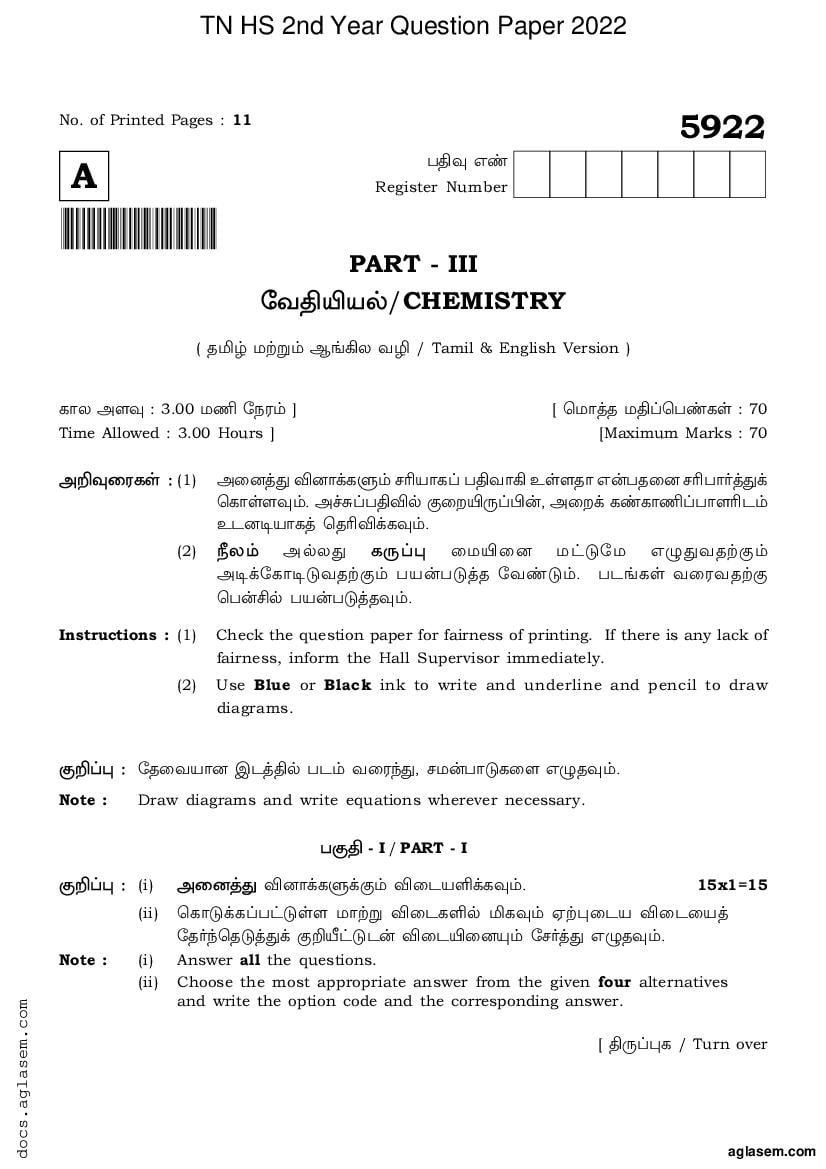
5922
£vÄ Gs
A Register Number
!5922Chemistry!
PART - III
÷Áv°¯À/CHEMISTRY
( uªÌ ©ØÖ® B[Q» ÁÈ / Tamil & English Version )
Põ» AÍÄ : 3.00 ©o ÷|µ® ] [ ö©õzu ©v¨ö£sPÒ : 70
Time Allowed : 3.00 Hours ] [Maximum Marks : 70
AÔÄøµPÒ : (1) AøÚzx ÂÚõUPЮ \›¯õP¨ £vÁõQ EÒÍuõ GߣuøÚ \›£õºzxU
öPõÒÍÄ®. Aa_¨£vÂÀ SøÓ°¸¨¤ß, AøÓU PsPõo¨£õÍ›h®
EhÚi¯õPz öu›ÂUPÄ®.
(2) }»® AÀ»x P¸¨¦ ø©°øÚ ©mk÷© GÊxÁuØS®
AiU÷PõikÁuØS® £¯ß£kzu ÷Ásk®. £h[PÒ ÁøµÁuØS
ö£ß]À £¯ß£kzuÄ®.
Instructions : (1) Check the question paper for fairness of printing. If there is any lack of
fairness, inform the Hall Supervisor immediately.
(2) Use Blue or Black ink to write and underline and pencil to draw
diagrams.
SÔ¨¦ : ÷uøÁ¯õÚ ChzvÀ £h® Áøµ¢x, \©ß£õkPøÍ GÊuÄ®.
Note : Draw diagrams and write equations wherever necessary.
£Sv - I / PART - I
SÔ¨¦ : (i) AøÚzx ÂÚõUPÐUS® Âøh¯ÎUPÄ®. 15x1=15
(ii) öPõkUP¨£mkÒÍ ©õØÖ ÂøhPÎÀ ªPÄ® Hئøh¯ Âøhø¯z
÷uº¢öukzxU SÔ±mkhß Âøh°øÚ²® ÷\ºzx GÊuÄ®.
Note : (i) Answer all the questions.
(ii) Choose the most appropriate answer from the given four alternatives
and write the option code and the corresponding answer.
[ v¸¨¦P / Turn over
Page 2
1. uÛ- © Á›- ø \ Am- h - Á - ø n- ° À, 15 &® öuõ- S v 3 &® Á›- ø \- ° À EÒÍ J¸
uÛ-©z-vß G»Um-µõß Aø©¨¦ :
(A) 1s2 2s2 2p6 3s2 3p2 (B) 1s2 2s2 2p4
(C) 1s2 2s2 2p6 3s2 3p3 (D) 1s2 2s2 2p3
An element belongs to group-15 and 3rd period of the periodic table. Its electronic
configuration would be :
(a) 1s2 2s2 2p6 3s2 3p2 (b) 1s2 2s2 2p4
(c) 1s2 2s2 2p6 3s2 3p3 (d) 1s2 2s2 2p3
2. £õU-øém-iß Cø¯-¦ :
(A) Al2O3⋅nH2O (B) Fe2O3⋅2H2O
(C) Al2O3 (D) CøÁ Gx-Ä-ªÀ-ø»
Bauxite has the composition :
(a) Al2O3⋅nH2O (b) Fe2O3⋅2H2O
(c) Al2O3 (d) None of the above
3. J¸ •uÀ ÁøP ÂøÚ-¯õ-Úx 60 {ª-h[-P-ÎÀ 75% {øÓ-Ä ö£Ö-Q-Ó-x. A÷u ÂøÚ,
A÷u {£¢-u-øÚ-P-ÎÀ 50% {øÓ-Ä ö£Óz ÷uøÁ-¯õÚ Põ-»® :
(A) 35 {ªh[PÒ (B) 20 {ªh[PÒ
(C) 75 {ªh[PÒ (D) 30 {ªh[PÒ
If 75% of a first order reaction was completed in 60 min, 50% of the same reaction
under the same conditions would be completed in :
(a) 35 minutes (b) 20 minutes
(c) 75 minutes (d) 30 minutes
A
Page 3
4. ¤ß- Á - ¸ - Á - Ú - Á Ø- Ö Ò G¢u ÂøÚU Põ- µ o ø|m- ÷ µõ ö£ß- ^ øÚ AÛ- ½ - Ú õP
©õØ-Ö-Q-Óx ?
(A) ZnHg/NaOH (B) Zn/NH4Cl
(C) Sn/HCl (D) CøÁ AøÚz-x®
Which of the following reagent can be used to convert nitrobenzene to aniline ?
(a) ZnHg/NaOH (b) Zn/NH4Cl
(c) Sn/HCl (d) All of these
5. HO−CH 2 −CH 2 −OH &I ö£º- A - ÷ ¯õ- i U Aª- » z- x - h ß öÁ¨- £ ¨- £ - k z- x ® ÷£õx
E¸ÁõÁx :
(A) ö©z-u-ÚÀ
(B) ö©z-u-Úõ-°U Aª-»®
(C) CO2
(D) QøÍ-¯õU-\õÀ
HO−CH2−CH2−OH on heating with periodic acid gives :
(a) Methanal
(b) Methanoic acid
(c) CO2
(d) Glyoxal
6. E÷»õP A¯- Û - ° ß BU- ê - á - ÷ ÚØÓ Gs §ä¯ ©v¨- ¤ - ø Ú¨ ö£Ø- Ô - ¸ U- S ®
Aøn-Äa ÷\º-©® :
(A) K4[Fe(CN)6] (B) [Fe(CN)3(NH3)3]
(C) [Fe(CO)5] (D) (B) ©Ø-Ö® (C) Cµs-k®
A complex in which the oxidation number of the metal is zero is :
(a) K4 [Fe(CN)6 ] (b) [Fe(CN)3 (NH 3)3 ]
(c) [Fe(CO)5 ] (d) Both (b) and (c)
A [ v¸¨¦P / Turn over
Page 4
7. ¤ß-Á-¸-Á-Ú-ÁØ-ÖÒ Gx ö»Í-›&¨-µõßì-hm Aª-»-©õ-P-Ä®, Põ-µ-©õ-P-Ä® ö\¯À-£h
•i-²-® ?
(A) HPO42− (B) HCl (C) Br− (D) SO42−
Which of the following can act as Lowry-Bronsted acid as well as base ?
(a) HPO42− (b) HCl (c) Br − (d) SO42−
8. ÷£õ-µõU-êß }ºU Pøµ-\-»õ-Úx :
(A) Põ-µz- ußø© Eøh-¯-x
(B) |k-{-ø»z ußø© Eøh-¯-x
(C) D›-¯À-¦z ußø© Eøh-¯-x
(D) Aª-»-z ußø© Eøh-¯-x
An aqueous solution of borax is :
(a) basic
(b) neutral
(c) amphoteric
(d) acidic
9. ¤ß-Á-¸-Á-Ú-ÁØ-ÖÒ Gx J¸-£-i-zuõÚ ÂøÚ-÷Á-P ©õØ-Óz-vØS Gkz-xU-Põmk ?
(A) Gs-ön-°ß øím-µ-á-÷ÚØ-Ó®
(B) ÷í£º •øÓ-°À A÷©õ-Û¯õ u¯õ-›z-uÀ
(C) }ºzu HCl •ß-Û-ø»-°À _U-÷µõ-]ß }µõØ-£-Sz-uÀ
(D) öuõk •øÓ-°À P¢-uP Aª-»® u¯õ-›z-uÀ
Which one of the following is an example for homogeneous catalysis ?
(a) Hydrogenation of oil
(b) Manufacture of ammonia by Haber’s process
(c) Hydrolysis of sucrose in presence of dil.HCl
(d) Manufacture of sulphuric acid by Contact process
A
Page 5
10. A]m-÷hõ-Û-¼-¸¢x \¯-÷Úõ-øím-›ß E¸-Áõ-S® ÂøÚ ¤ß-Á-¸-Á-Ú-ÁØ-ÖÒ GuØS
\õ-ßÓõP EÒÍx ?
(A) G»Um-µõß PÁº ÷\º¨¦ ÂøÚ
(B) P¸-P-Áº £v-½mk ÂøÚ
(C) P¸-P-Áº ÷\º¨¦ ÂøÚ
(D) G»Um-µõß PÁº £v-½mk ÂøÚ
The formation of cyanohydrin from acetone is an example of :
(a) electrophilic addition
(b) nucleophilic substitution
(c) nucleophilic addition
(d) electrophilic substitution
11. ¤ß-Á-¸® BU]-á-÷ÚØÓ {ø»-P-ÐÒ, »õ¢-u-Úõ´-k-P-Îß ö£õ-x-ÁõÚ BU]-á-÷ÚØÓ
{ø» ¯õx ?
(A) +5 (B) +4 (C) +3 (D) +2
Which of the following oxidation states is most common among the lanthanoids ?
(a) +5 (b) +4 (c) +3 (d) +2
12. L£õ-µ÷h ©õ-Ô-¼ __________ GÚ Áøµ-¯-ÖU-P¨-£-k-Q-Ó-x.
(A) J¸ ÷©õÀ ö£õ-¸øÍ Âk-ÂUP ÷uøÁ¨-£-k® ªß-Þm-h®
(B) 1 G»Um-µõ-ÚõÀ _©¢x ö\À-»¨-£-k® ªß-Þm-h®
(C) 6.22×10¹⁰ G»Um-µõ-ÚõÀ _©¢x ö\À-»¨-£-k® ªß-Þm-h®
(D) 1 ÷©õÀ G»Um-µõ-ÚõÀ _©¢x ö\À-»¨-£-k® ªß-Þm-h®
Faraday constant is defined as :
(a) Charge required to deposit one mole of substance
(b) Charge carried by 1 electron
(c) Charge carried by 6.22×10¹⁰ electrons
(d) Charge carried by one mole of electrons
A [ v¸¨¦P / Turn over
Page 6
13. ¤ß-Á-¸® Aª-÷Úõ Aª-»[-P-ÎÀ Gx ^ºø©²-øh-¯x ?
(A) ¦÷µõ-¼ß (B) A»-Ûß (C) QøÍ-^ß (D) ¼²-]ß
Which of the following amino acids are achiral ?
(a) Proline (b) Alanine (c) Glycine (d) Leucine
14. E÷»õP SøÓ-²ÒÍ SøÓ-£õk Põ-n¨-£-k® £i-P® :
(A) ZnO (B) NaCl (C) KCl (D) FeO
The crystal with a metal deficiency defect is :
(a) ZnO (b) NaCl (c) KCl (d) FeO
15. ‰k-£-Û Gß-£x GÆ-ÁøP TÌ-©® ?
(A) Áõ-²-ÂÀ }º-©® (B) Áõ²ÂÀ vs-©®
(C) }º-©z-vÀ Áõ-² (D) Áõ-²-ÂÀ Áõ-²
Fog is colloidal solution of :
(a) liquid in gas (b) solid in gas
(c) gas in liquid (d) gas in gas
A
Page 7
£Sv - II / PART - II
SÔ¨¦ : H÷u- Ý ® BÖ ÂÚõUPÐUS Âøh¯ÎUPÄ®. ÂÚõ Gs 24 &US
Pmhõ¯©õP Âøh¯ÎUPÄ®. 6x2=12
Note : Answer any six questions. Question No. 24 is compulsory.
16. PÛ-©® ©Ø-Ö® uõx BQ-¯-ÁØ-ÔØ-Q-øh-÷¯-¯õÚ ÷ÁÖ-£õ-k-PÒ ¯õøÁ ?
What are the differences between minerals and ores ?
17. Fe3+ ©Ø-Ö® Fe2+ &À Gx AvP {ø»¨-¦z ußø© Eøh-¯x ? Hß ?
Which is more stable Fe3+ or Fe2+ ? Why ?
18. AønÄ Gs – Áøµ-¯-ÖU-P-Ä®.
Define Coordination number.
19. \-P¨-¤-øn¨-¦¨ £i-P[-PÒ – Áøµ-¯-ÖU-P-Ä®.
Define covalent solids.
20. •uÀ ÁøP ÂøÚU-PõÚ Gkz-xU-Põm-k-PøÍ GÊ-x-P.
Give examples for the first order reaction.
21. AŸ-Û-¯ì öPõÒ-øP-°ß Áµ®-¦-PÒ ¯õøÁ ?
What are the limitations of Arrhenius concept ?
22. ªß-•-øÚU PÁºa] – SÔ¨¦ Áøµ-P.
Write a note on Electrophoresis.
A [ v¸¨¦P / Turn over
Page 8
23. IUPAC ö£¯-›-øÚU SÔ¨-¤-kP.
(A) (B)
Give the IUPAC names :
(a) (b)
24. ¤ß-Á-¸® ÂøÚÁ-›-ø\-°À EÒÍ A ©Ø-Ö® B ÷\º-©[-PøÍ Ps-h-Ô-P.
3NaN LiAlH
4 → B+ N
CH3 − Br → A 2
Identify A and B in the following sequence of reactions.
3NaN LiAlH
4 → B+ N
CH3 − Br → A 2
£Sv - III / PART - III
SÔ¨¦ : H÷u- Ý ® BÖ ÂÚõUPÐUS Âøh¯ÎUPÄ®. ÂÚõ Gs 33 &US
Pmhõ¯©õP Âøh¯ÎUPÄ®. 6x3=18
Note : Answer any six questions. Question No. 33 is compulsory.
25. íõ-»-á-Û-øha ÷\º-©[-PÒ Gß-ÓõÀ GßÚ ? Gkz-xU-Põmk u¸-P.
What are interhalogen compounds ? Give examples.
A
Page 9
26. Cøha-ö\-¸-PÀ ÷\º-©[-P-Îß £s-¦-PÒ ¯õøÁ ?
What are the properties of interstitial compounds ?
27. Aº-ï-Û-¯ì \©ß-£õm-iøÚ GÊ-v AvÀ Ch® ö£Ø-ÖÒÍÁØøÓ ÂÍU-S-P.
Write Arrhenius equation and explain the terms involved.
28. ªß-£-S-ÎU Phz-xz-v-ÓøÚ £õ-vU-S® Põ-µ-o-PÒ ¯õøÁ ?
What are the factors that affects electrolytic conductance ?
29. J¸-£-iz-uõÚ ÂøÚ-÷Á-P ©õØ-Ó® Gß-ÓõÀ GßÚ ? Gkz-xU-Põmk u¸-P.
What is homogeneous catalysis ? Give example.
30. øh Gz-vÀ Duº u¯õ-›U-S® H÷u-Ý® J¸ •øÓ-ø¯ GÊ-x-P.
Write any one method of preparation for diethyl ether.
31. ÷í÷»õ-L-£õº® ÂøÚ-ø¯ GÊ-x-P.
Write Haloform reaction.
32. G¤-©º-PÒ Gß-ÓõÀ GßÚ ? Gkz-xU-Põmk u¸-P.
What are Epimers ? Give example.
33. [Ag(NH3)2]+ &ß DÛ, ø©¯ E÷»õ-P A¯Û ©Ø-Ö® IUPAC ö£¯-øµ GÊ-x-P.
Write the following for the complex [Ag(NH3)2]+.
(a) Ligand (b) Central metal ion (c) IUPAC name
A [ v¸¨¦P / Turn over
Page 10
£Sv - IV / PART - IV
SÔ¨¦ : AøÚzx ÂÚõUPÐUS® Âøh¯ÎUPÄ®. 5x5=25
Note : Answer all the questions.
34. (A) (i) ¦Â Dº¨¦ •øÓ – SÔ¨¦ Áøµ-P.
(ii) {U-P-ø»z y´-ø©-¯õU-P¨ £¯ß-£-k® ©õsm •øÓ-°øÚ ÂÍU-S-P.
AÀ-»-x-
(B) (i) ©¢u Cøn ÂøÍÄ Gß-ÓõÀ GßÚ ?
(ii) ÷£õ-›U Aª-»z-vß £¯ß-PÒ ¯õøÁ ?
(a) (i) Write a note on gravity separation method.
(ii) Explain the Mond’s Process of refining nickel.
OR
(b) (i) What is inert pair effect ?
(ii) What are the uses of boric acid ?
35. (A) (i) BU-ê-á-Ûß £¯ß-PÒ ¯õøÁ ?
(ii) \»-øÁz-yÒ GÆ-ÁõÖ u¯õ-›U-P¨-£-k-Q-Óx ?
AÀ-»-x-
(B) öÁº-Úº öPõÒ-øP-°ß ÷Põm-£õ-k-PøÍU TÖ-P.
(a) (i) What are the uses of oxygen ?
(ii) How will you prepare bleaching powder ?
OR
(b) Write the postulates of Werner’s Theory.
A
Page 11
36. (A) £i-P vs-©[-PøÍ £i-P Ái-Á-©ØÓ vs-©[-P-Î-¼-¸¢x ÷ÁÖ-£-kz-x-P.
AÀ-»-x-
(B) (i) pH & Áøµ-¯-ÖU-P-Ä®.
(ii) ö£õx A¯Û ÂøÍøÁ J¸ Gkz-xU-Põm-k-hß ÂÍU-SP.
(a) Differentiate crystalline solids and amorphous solids.
OR
(b) (i) Define pH.
(ii) Explain common ion effect with example.
37. (A) ö|ºßìm \©ß-£õm-øhz u¸-ÂU-P-Ä®.
AÀ-»-x-
(B) ÂøÚ-÷Á-P ©õØ-Ô-°ß ]Ó¨-¤-¯À-¦-PÒ ¯õøÁ ?
(a) Derive an expression for Nernst equation.
OR
(b) What are the characteristics of catalyst ?
38. (A) L£õº-ªU Aª-»z-vß JkU-S® £s-¤øÚ Gkz-xU-Põm-k-hß ÂÍU-S-P.
AÀ-»-x-
(B) ]ÖSÔ¨¦ Áøµ-P.
(i) Põº-ø£-»-«ß ÂøÚ
(ii) Põ¨-›-¯À uõ-¼-ø©k öuõ-S¨-¦
(a) Explain the reducing action of formic acid with example.
OR
(b) Write a note on :
(i) Carbylamine reaction
(ii) Gabriel phthalimide synthesis
-o0o-
A [ v¸¨¦P / Turn over
Document Details
| Board / Org | Tamil Nadu Board |
| Exam | Class 12 |
| Type | Question Paper |
| Pages | 11 |
| Updated | 30 Apr 2026 |