KSP FSL Syllabus 2020 for Physics
Finished viewing? Save it for later —
Download KSP FSL Syllabus 2020 for Physics (PDF · 3 pages)About KSP FSL Syllabus 2020 for Physics
KSP FSL Syllabus 2020 for Physics is available here for free download. Published by Default for Govt Jobs Exams, this syllabus can be viewed online or downloaded as a PDF (3 pages). Candidates preparing for Govt Jobs Exams can use KSP FSL Syllabus 2020 for Physics to understand the exam pattern, the type of questions asked, and the overall difficulty level.
Frequently Asked Questions
How can I download KSP FSL Syllabus 2020 for Physics?
Open this page and click the Download button to save KSP FSL Syllabus 2020 for Physics as a PDF. It is completely free on AglaSem Docs.
Is KSP FSL Syllabus 2020 for Physics free to download?
Yes. KSP FSL Syllabus 2020 for Physics can be viewed online and downloaded as a PDF free of cost on AglaSem Docs.
How many pages does KSP FSL Syllabus 2020 for Physics have?
KSP FSL Syllabus 2020 for Physics contains 3 pages, which you can read online or download together as a single PDF.
Where can I find more Govt Jobs Exams study material?
You can find more Govt Jobs Exams question papers, sample papers, syllabus, and answer keys on AglaSem Docs.
KSP FSL Syllabus 2020 for Physics – Text
Read the full text of this syllabus below — useful to quickly search, copy and reference the content online without downloading the PDF.
📄 View text version (2 pages)
Page 1
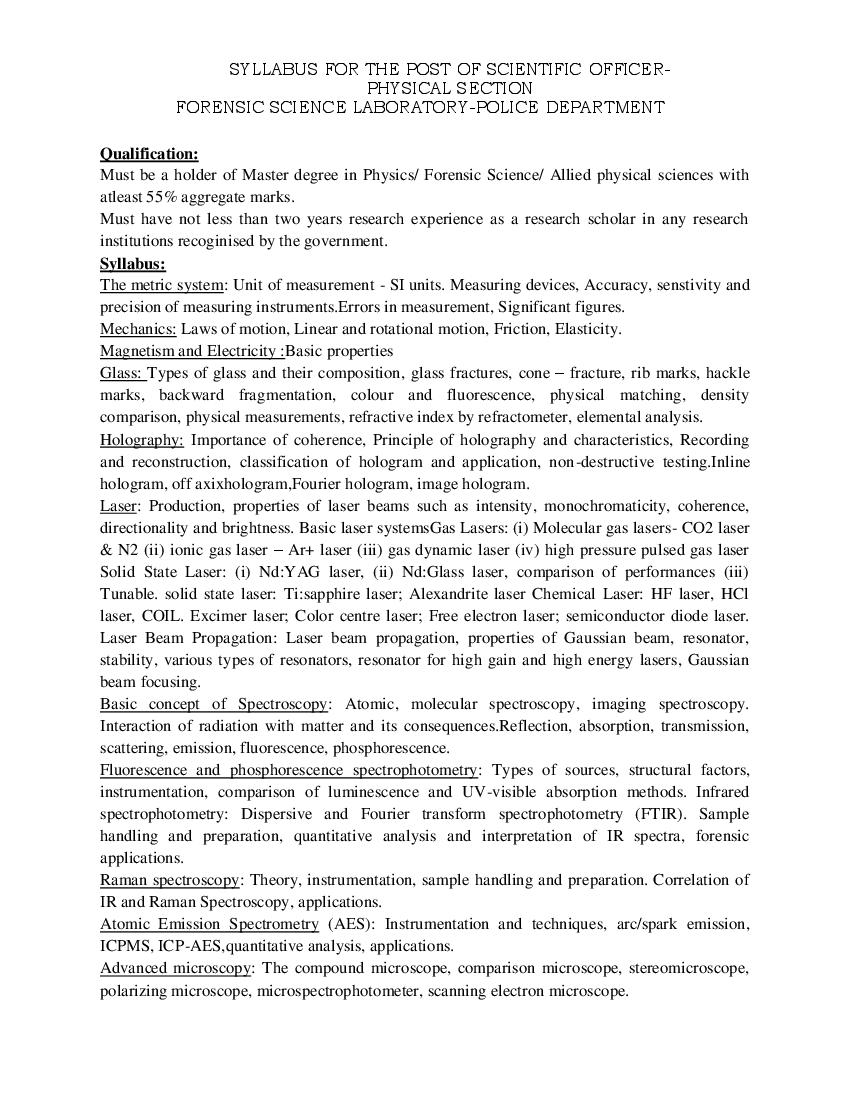
PHYSICAL SECTION
FORENSIC SCIENCE LABORATORY-POLICE DEPARTMENT
Qualification:
Must be a holder of Master degree in Physics/ Forensic Science/ Allied physical sciences with
atleast 55% aggregate marks.
Must have not less than two years research experience as a research scholar in any research
institutions recoginised by the government.
Syllabus:
The metric system: Unit of measurement - SI units. Measuring devices, Accuracy, senstivity and
precision of measuring instruments.Errors in measurement, Significant figures.
Mechanics: Laws of motion, Linear and rotational motion, Friction, Elasticity.
Magnetism and Electricity :Basic properties
Glass: Types of glass and their composition, glass fractures, cone – fracture, rib marks, hackle
marks, backward fragmentation, colour and fluorescence, physical matching, density
comparison, physical measurements, refractive index by refractometer, elemental analysis.
Holography: Importance of coherence, Principle of holography and characteristics, Recording
and reconstruction, classification of hologram and application, non-destructive testing.Inline
hologram, off axixhologram,Fourier hologram, image hologram.
Laser: Production, properties of laser beams such as intensity, monochromaticity, coherence,
directionality and brightness. Basic laser systemsGas Lasers: (i) Molecular gas lasers- CO2 laser
& N2 (ii) ionic gas laser – Ar+ laser (iii) gas dynamic laser (iv) high pressure pulsed gas laser
Solid State Laser: (i) Nd:YAG laser, (ii) Nd:Glass laser, comparison of performances (iii)
Tunable. solid state laser: Ti:sapphire laser; Alexandrite laser Chemical Laser: HF laser, HCl
laser, COIL. Excimer laser; Color centre laser; Free electron laser; semiconductor diode laser.
Laser Beam Propagation: Laser beam propagation, properties of Gaussian beam, resonator,
stability, various types of resonators, resonator for high gain and high energy lasers, Gaussian
beam focusing.
Basic concept of Spectroscopy: Atomic, molecular spectroscopy, imaging spectroscopy.
Interaction of radiation with matter and its consequences.Reflection, absorption, transmission,
scattering, emission, fluorescence, phosphorescence.
Fluorescence and phosphorescence spectrophotometry: Types of sources, structural factors,
instrumentation, comparison of luminescence and UV-visible absorption methods. Infrared
spectrophotometry: Dispersive and Fourier transform spectrophotometry (FTIR). Sample
handling and preparation, quantitative analysis and interpretation of IR spectra, forensic
applications.
Raman spectroscopy: Theory, instrumentation, sample handling and preparation. Correlation of
IR and Raman Spectroscopy, applications.
Atomic Emission Spectrometry (AES): Instrumentation and techniques, arc/spark emission,
ICPMS, ICP-AES,quantitative analysis, applications.
Advanced microscopy: The compound microscope, comparison microscope, stereomicroscope,
polarizing microscope, microspectrophotometer, scanning electron microscope.
Page 2
semiconductor detectors.
Statistics: Statistical evaluation of data obtained by instrumental methods. Tests of hypothesis-
tests of significance of attributes, Z-test of significance and coefficient of correlation, small
sample test, T-test, paired test, chi-square test, F-test for equality of variance, large sample test,
normal test.
FORENSIC PHYSICS:
1. Soil: Formation and types of soil, composition and colour of soil, particle size
distribution and turbidity test, microscopic examination, density gradient analysis,
ignition loss, differential thermal analysis, elemental analysis,
2. Paint: Types of paint and their composition, macroscopic & microscopic studies, pigment
distribution and colorimetry, micro-chemical analysis- solubility test, TLC, pyrolysis
chromatographic techniques, IR absorption spectroscopy of paint samples & X-ray
diffraction, elemental analysis.
3. Fibre: Classification of textile fibres - production, structure, and properties, the structure
of textiles - an introduction to the basics, ropes and cordage, visible & infrared
microscopical examination of fibres, instrumental methods used in fibre and dye
examination,
4. Impressions: Foot/Footwear/Tyre Impression, Collection, Tracing, Lifting, Casting of
impressions, Gait Pattern and Identification characteristics, Superimposition of
impression on footwear and foot imprints
5. Tool marks: Types of tool marks: compression marks, striated marks, combination of
compression and striated marks, repeated marks, class characteristics and individual
characteristics, tracing and lifting of marks, photographic examination of tool marks and
cut marks on clothes ,comparison of tool marks by comparison microscope.
Document Details
| Board / Org | Default |
| Exam | Govt Jobs Exams |
| Type | Syllabus |
| Pages | 3 |
| Updated | 30 Apr 2026 |