CBSE Class 10 Question Paper 2025 Solution Social Science
Finished viewing? Save it for later —
Download CBSE Class 10 Question Paper 2025 Solution Social Science (PDF · 36 pages)About CBSE Class 10 Question Paper 2025 Solution Social Science
CBSE Class 10 Question Paper 2025 Solution Social Science is available here for free download. Published by CBSE for Class 10, this solution can be viewed online or downloaded as a PDF (36 pages). Candidates preparing for Class 10 can use CBSE Class 10 Question Paper 2025 Solution Social Science to understand the exam pattern, the type of questions asked, and the overall difficulty level.
Frequently Asked Questions
How can I download CBSE Class 10 Question Paper 2025 Solution Social Science?
Open this page and click the Download button to save CBSE Class 10 Question Paper 2025 Solution Social Science as a PDF. It is completely free on AglaSem Docs.
Is CBSE Class 10 Question Paper 2025 Solution Social Science free to download?
Yes. CBSE Class 10 Question Paper 2025 Solution Social Science can be viewed online and downloaded as a PDF free of cost on AglaSem Docs.
How many pages does CBSE Class 10 Question Paper 2025 Solution Social Science have?
CBSE Class 10 Question Paper 2025 Solution Social Science contains 36 pages, which you can read online or download together as a single PDF.
Where can I find more Class 10 study material?
You can find more Class 10 question papers, sample papers, syllabus, and answer keys on AglaSem Docs.
CBSE Class 10 Question Paper 2025 Solution Social Science – Text
Read the full text of this solution below — useful to quickly search, copy and reference the content online without downloading the PDF.
📄 View text version (36 pages)
Page 1
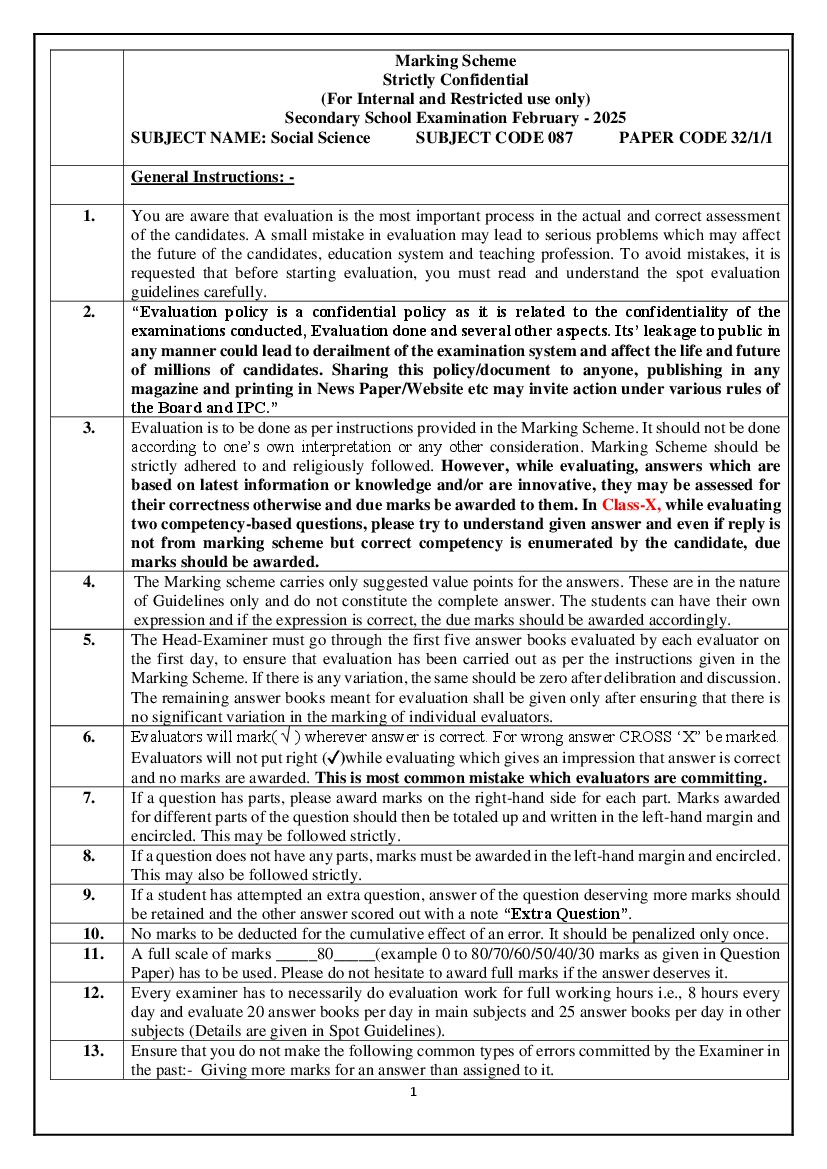
Strictly Confidential
(For Internal and Restricted use only)
Secondary School Examination February - 2025
SUBJECT NAME: Social Science SUBJECT CODE 087 PAPER CODE 32/1/1
General Instructions: -
1. You are aware that evaluation is the most important process in the actual and correct assessment
of the candidates. A small mistake in evaluation may lead to serious problems which may affect
the future of the candidates, education system and teaching profession. To avoid mistakes, it is
requested that before starting evaluation, you must read and understand the spot evaluation
guidelines carefully.
2. “Evaluation policy is a confidential policy as it is related to the confidentiality of the
examinations conducted, Evaluation done and several other aspects. Its’ leakage to public in
any manner could lead to derailment of the examination system and affect the life and future
of millions of candidates. Sharing this policy/document to anyone, publishing in any
magazine and printing in News Paper/Website etc may invite action under various rules of
the Board and IPC.”
3. Evaluation is to be done as per instructions provided in the Marking Scheme. It should not be done
according to one’s own interpretation or any other consideration. Marking Scheme should be
strictly adhered to and religiously followed. However, while evaluating, answers which are
based on latest information or knowledge and/or are innovative, they may be assessed for
their correctness otherwise and due marks be awarded to them. In Class-X, while evaluating
two competency-based questions, please try to understand given answer and even if reply is
not from marking scheme but correct competency is enumerated by the candidate, due
marks should be awarded.
4. The Marking scheme carries only suggested value points for the answers. These are in the nature
of Guidelines only and do not constitute the complete answer. The students can have their own
expression and if the expression is correct, the due marks should be awarded accordingly.
5. The Head-Examiner must go through the first five answer books evaluated by each evaluator on
the first day, to ensure that evaluation has been carried out as per the instructions given in the
Marking Scheme. If there is any variation, the same should be zero after delibration and discussion.
The remaining answer books meant for evaluation shall be given only after ensuring that there is
no significant variation in the marking of individual evaluators.
6. Evaluators will mark( √ ) wherever answer is correct. For wrong answer CROSS ‘X” be marked.
Evaluators will not put right (✓)while evaluating which gives an impression that answer is correct
and no marks are awarded. This is most common mistake which evaluators are committing.
7. If a question has parts, please award marks on the right-hand side for each part. Marks awarded
for different parts of the question should then be totaled up and written in the left-hand margin and
encircled. This may be followed strictly.
8. If a question does not have any parts, marks must be awarded in the left-hand margin and encircled.
This may also be followed strictly.
9. If a student has attempted an extra question, answer of the question deserving more marks should
be retained and the other answer scored out with a note “Extra Question”.
10. No marks to be deducted for the cumulative effect of an error. It should be penalized only once.
11. A full scale of marks _____80_____(example 0 to 80/70/60/50/40/30 marks as given in Question
Paper) has to be used. Please do not hesitate to award full marks if the answer deserves it.
12. Every examiner has to necessarily do evaluation work for full working hours i.e., 8 hours every
day and evaluate 20 answer books per day in main subjects and 25 answer books per day in other
subjects (Details are given in Spot Guidelines).
13. Ensure that you do not make the following common types of errors committed by the Examiner in
the past:- Giving more marks for an answer than assigned to it.
1
Page 2
● Wrong transfer of marks from the inside pages of the answer book to the title page.
Wrong question wise totaling on the title page.
● Leaving answer or part thereof unassessed in an answer book.
● Wrong totaling of marks of the two columns on the title page.
● Wrong grand total.
● Marks in words and figures not tallying/not same.
● Wrong transfer of marks from the answer book to online award list.
● Answers marked as correct, but marks not awarded. (Ensure that the right tick mark is
correctly and clearly indicated. It should merely be a line. Same is with the X for incorrect
answer.)
● Half or a part of answer marked correct and the rest as wrong, but no marks awarded.
14. While evaluating the answer books if the answer is found to be totally incorrect, it should be
marked as cross (X) and awarded zero (0)Marks.
15. Any un assessed portion, non-carrying over of marks to the title page, or totaling error detected by
the candidate shall damage the prestige of all the personnel engaged in the evaluation work as also
of the Board. Hence, in order to uphold the prestige of all concerned, it is again reiterated that the
instructions be followed meticulously and judiciously.
16. The Examiners should acquaint themselves with the guidelines given in the “Guidelines for spot
Evaluation” before starting the actual evaluation.
17. Every Examiner shall also ensure that all the answers are evaluated, marks carried over to the title
page, correctly totaled and written in figures and words.
18. The candidates are entitled to obtain photocopy of the Answer Book on request on payment of the
prescribed processing fee. All Examiners/Additional Head Examiners/Head Examiners are once
again reminded that they must ensure that evaluation is carried out strictly as per value points for
each answer as given in the Marking Scheme.
2
Page 3
Class X -Social Science (087)
SET-32/1/1
SET -1 MM-80
Q.No. Values Points Page Marks-
No.
Section A (20X1=20)
(Multiple Choice Questions)
1 (B) Venetia 21 H 1
2 (C) Only I, III and IV are correct 57, 58 1
H
3 (A) Marco Polo 54 H 1
Note- Due to lack of correct option, 1 mark should be awarded to all
students who attempted this question.
4 (D) Increased speed and accuracy of print 108 H 1
5 (B) I, II, III 15 G 1
6 (B) Rajasthan 15 G 1
7 (C) a-iv, b-i, c-ii, d-iii 24 G 1
8 (B) Maharashtra, Karnataka and Andhra Pradesh 23 G 1
9 (C) Wheat 32 G 1
10 (A)Both (A) and (R) are true and (R) is the correct explanation of (A) 42 G 1
11 (A) a-iii, b-i, c-iv, d-ii 45 G 1
12 (C) Federal 4P 1
13 (D) Spain- Federal 14 P 1
14 (A) Only I, II and III are correct 48 P 1
15 (B) India 13 E 1
16 (A) Primary 21 E 1
17 (D) Tertiary 19 E 1
Note: The following questions are for the Visually Impaired Candidates
only, in lieu of Question No.17. 21 E
(C) Basket weaver
18 (C) Only I, II and IV are correct 49 E 1
19 (C) Both poor households and households with few assets 49 E 1
20 (A)Both statements I and II are correct and statement II is the correct 62 E 1
explanation of statement I
3
Page 4
(Very Short Answer Type Questions)
21 (a) Explain the role of anti-colonial movement in the rise of ‘modern 29 H 2X1=2
nationalism’ in India.
(i) People began discovering their unity in the process of their
struggle with colonialism.
(ii) The sense of being oppressed under colonialism provided a
shared bond that tied many different groups together.
(iii) Each class and group felt the effects of colonialism differently,
their experiences were varied and their notions of freedom were
not always the same.
(iv) Anti-colonial movements like Non-Cooperation Movement,
Civil Disobedience Movement, Quit India Movement etc.
played a big role in the rise of the modern nationalism in India.
(v) Any other relevant point.
Any two points to be explained.
OR
(b) Why did Gandhiji say ‘Satyagraha is pure soul force’? Explain 31 H 2X1=2
by giving two arguments.
(i) Satyagraha is pure soul force because truth is the very
substance of the soul. That is why this force is called
Satyagraha.
(ii) The soul is informed with knowledge. In it burns the flame of
love. Non-violence is the supreme dharma.
(iii) According to Mahatma Gandhi, Satyagraha is not a physical
force.
(iv) A satyagrahi does not inflict pain on the adversity; he does not
seek his destruction. In the use of satyagraha, there is no ill-will
whatever.
(v) Any other relevant point.
Any two points to be explained.
4
Page 5
indiscriminate use of resources.
(i) Human beings use the resources indiscriminately and this has
led to major problems.
(ii) This has led to global ecological crisis such as global warming.
(iii) Ozone layer is being depleted.
(iv) It has increased environmental pollution.
(v) Land degradation is also increasing.
(vi) Any other relevant point
Any two points to be explained.
2X1=2
23 Suggest any two measures to remove gender inequality. 33 P 2X1=2
(i) By increasing the literacy rate among women
(ii) By increasing the political representation of women
(iii) By investing in education of girls.
(iv) Legal protection to women in the employment sector
(v) Any other relevant point.
Any two points to be suggested.
24 How did the process of liberalization initiated in India in the 1990s 64 E 2X1=2
promote globalization? Explain.
(i) The process of Liberalization i.e. removing barriers or restrictions
set by the government was started in the 1990s.
(ii) The government decided that the time had come for Indian
producers to compete with producers around the globe.
(iii) It has facilitated the MNCs to set up their factories in India. Thus,
Indian economy was integrated to the world economy and process
of globalization started in India.
(iv) Several steps were taken to attract foreign investment. Many SEZs
were established in the country.
(v) Several steps were taken so that goods could be imported and
exported easily and also foreign companies could set up factories
and offices here. It has increased India’s foreign trade.
(vi) Any other relevant point.
Any two points to be explained.
5
Page 6
(Short Answer Type Questions)
25 “Tribal peasants interpreted the message of Mahatma Gandhi and 36 H 3X1=3
the idea of ‘Swaraj’ in yet another way.” Explain the statement in the
context of Non-Cooperation Movement.
(i) The Non-Cooperation Movement was initially started in cities,
spread to the villages and tribal areas rapidly. All of them responded
to the call of swaraj, but the term meant different to different people.
(ii) Tribal peasants interpreted the message of Mahatma Gandhi and the
idea of swaraj in yet another way.
(iii) In the Gudem Hills of Andhra Pradesh, for instance, a militant
guerrilla movement spread in the early 1920s – not a form of
struggle that the Congress could approve.
(iv) In other forest regions, the colonial government had closed large
forest areas, preventing people from entering the forests to graze
their cattle, or to collect fuelwood and fruits. This enraged the hill
people.
(v) Not only were their livelihoods affected but they felt that their
traditional rights were being denied.
(vi) When the government began forcing them to contribute begar for
road building, the hill people revolted.
(vii) Their leader, Alluri Sitaram Raju, claimed that he had a variety of
special powers:
(viii) He was inspired by the Non-Cooperation Movement, and persuaded
people to wear khadi and give up drinking.
(ix) He asserted that India could be liberated only by the use of force,
not non-violence.
(x) The Gudem rebels attacked police stations, attempted to kill British
officials and carried on guerrilla warfare for achieving swaraj. Raju
was captured and executed in 1924, and over time became a folk
hero
(xi) Any other relevant point.
Any three points to be explained.
6
Page 7
Story of Rinjha
Rinjha lived with her family in a small village at the outskirts of Diphu
in Assam. She enjoys watching her family members clearing, slashing and
burning a patch of land for cultivation. She often helps them in irrigating
the fields with water running through a bamboo canal from the nearby
spring. She loves the surroundings and wants to stay here as long as she can,
but this little girl has no idea about the declining fertility of the soil and her
family’s search for a fresh patch of land in the next season.
What type of farming is Rinjha’s family doing? Describe any two of its
characteristics. 1+2=3
Type of farming- Primitive subsistence farming
Features of primitive subsistence farming:
(i) This farming is practiced on small patches of land.
(ii) It is done with the help of primitive tools like hoe, dao and
digging sticks.
(iii) It is done with the help of family or community labour.
(iv) This type of farming depends upon monsoon, natural fertility of
the soil and suitability of other environmental conditions to the
crops grown.
(v) Any other relevant point
Any two points to be described.
27 “That democratic system of government is considered good in which 64-72P 3X1=3
maximum number of citizens are made stakeholders in political
power.” Explain the statement with suitable arguments.
(i) The democratic system of government is considered good
because people are the source of all political power.
(ii) In a democracy people rule themselves through institutions of
self-government.
(iii) Democracy ensures active participation, representation and
decision-making opportunities for the people.
(iv) Democracy encourages public debates and opinions. These
public opinions are used in policy making.
(v) In democracy, people can make the government accountable as
the system gives enough scope for ensuring transparency.
7
Page 8
groups.
(vii) Democratic governments are elected by the people. It gives
legitimacy to the government. Thus, it is a good way to ensure the
stability of political order.
(viii) Any other relevant point.
Any three points to be explained.
28 (a) Explain the importance of political parties in democracy. 48,49 P 3X1=3
(i) Political parties are the most visible institution in a democracy.
(ii) They reflect fundamental political division in society.
(iii) Political parties contest elections.
(iv) Parties put forward different policies and programmes and the
voters chose them.
(v) Parties play a decisive role in making laws for the country.
(vi) Parties form and run government.
(vii) Parties play the role of opposition by voicing different views and
criticizing the government for its wrong policies.
(viii) Parties shape public opinion.
(ix) Parties provide people access to government machinery and
welfare schemes.
(x) Any other relevant point.
Any three examples to be explained.
OR
(b) Why did India adopt the multiparty system? Explain with 51 P 3X1=3
suitable arguments.
(i) Party system is not something any country can choose. Each
country develops a party system that is conditioned by its
special circumstances.
(ii) India adopted multi-party system due to its social diversity.
(iii) India has vast geographical diversity. So, in such a large
country diversity is not absorbed by two or even three
parties.
8
Page 9
to enjoy political representation.
(v) Any other relevant point.
Any three examples to be explained.
29 Explain the difference between public and private sector of Indian 33, 34E 3X1=3
economy with example.
(i) In the public sector the government owns most of the assets and
provides all the services while in the private sector the ownership
of assets and delivery of services is in the hands of private
individuals and companies.
(ii) Railways, Post office are examples of public sector whereas
companies like Tata Iron and Steel Company Limited (TISCO) or
Reliance Industries Limited are examples of private sector.
(iii) The motive of the public sector is not just to earn profits whereas
activities in the private sector are guided by the motive to earn
profit.
(iv) Government raises money through taxes to meet expenses
whereas private sector organizes its own funds.
(v) Public sector charges less for their services whereas private sector
charges much more.
(vi) Any other relevant point.
Any three points to be explained.
Section D (4X5=20)
(Long Answer Type Questions)
30 (a) Analyze the significance of the ‘Napoleonic Code’ in making the 20 H 5X1=5
administrative system rational and efficient.
The Civil Code of 1804 – usually known as the Napoleonic Code –
(i) It did away with all privileges based on birth,
(ii) It established equality before the law.
(iii) It secured the right to property.
(iv) Napoleonic Code simplified administrative divisions,
9
Page 10
and manorial dues.
(vi) In the towns too, guild restrictions were removed.
(vii) Transport and communication systems were improved.
(viii) Peasants, artisans, workers and new businessmen enjoyed a
newfound freedom.
(ix) Businessmen and small-scale producers began to realize that
uniform laws, standardized weights and measures and a
common national currency facilitated the movement and
exchange of goods and capital from one region to another.
(x) Any other relevant point.
Any Five points to be analyzed.
OR
(b)How was liberalism allied to national unity in Europe in the early 9H 5X1=5
decades of the 19th century? Analyze
(i) For the new middle classes in the 19th century Europe, liberalism
stood for freedom for the individual.
(ii) It also stood for equality of all before the law.
(iii) Politically, it emphasized the concept of government by consent.
(iv) Since the French Revolution, liberalism had stood for the end of
autocracy and clerical privileges, a constitution and
representative government through parliament.
(v) In the economic sphere, liberalism stood for the freedom of
markets and the abolition of state-imposed restrictions on the
movement of goods and capital.
(vi) Formation of Zollverein to promote economic growth
(vii) Any other relevant point.
Any Five points to be analyzed.
31 (a) “Manufacturing industries are considered the backbone of the 58 G 5X1=5
economic development of a country.” Justify the statement.
(i) The economic strength of a country is measured by the
development of manufacturing industries.
(ii) Manufacturing industries help in modernizing agriculture.
10
Page 11
(iv) Industrial development is a pre-condition for eradication of
unemployment and poverty.
(v) Export of manufactured goods expands trade and commerce
and brings much needed foreign exchange.
(vi) Countries that transform their raw material into a wide
variety of finished goods of higher values are prosperous.
(vii) It is also aimed at bringing down regional disparities by
establishing industries in tribal and backward areas.
(viii) Any other relevant point.
Any five points to be justified.
OR
(b) “Agriculture and industries complement each other.” Justify the 58,59G 5X1=5
statement.
(i) Agriculture and industries are not exclusive of each other. They
move hand in hand.
(ii) For instance, Agro-industries in India have given a major boost to
agriculture by raising its productivity.
(iii) Industries depend on agriculture for raw material and provide their
products for example, irrigation pumps, fertilizers, insecticides,
pesticides, plastic and PVC pipes, machines and tools etc to the
agricultural sector.
(iv) The development and competitiveness of manufacturing industries
has not only assisted agriculturists in increasing their productions
but also made production process very efficient.
(v) In the present day of globalization, our industries need to be more
efficient and competitive. This will increase the productivity of
agriculture sector as well.
(vi) Any other relevant point.
Any five points to be justified.
32 (a) Explain any five bases for assessing the outcomes of democracy. 64,65 P 5x1=5
The outcomes of democracy can be assessed on the following basis:
(i) Promotes equality among citizens.
(ii) Enhances the dignity of the individual.
11
Page 12
(iv) Provides methods to resolve conflicts.
(v) Allows room to correct mistakes.
(vi) Accommodates social diversity.
(vii) Produces a government that is accountable to the citizens.
(viii) Responsive to the needs and expectations of the citizens.
(ix) Based on ideas of deliberation and negotiations.
(x) Any other relevant point.
Any five points to be explained.
OR
(b) Explain any five values of democracy. 64,65 P 5x1=5
(i) Equal rights and opportunities.
(ii) Freedom to express oneself.
(iii) Choose their leaders and participate in the political process.
(iv) Based on respect, dignity and freedom.
(v) In a democracy, citizens have the right and means to
examine the process of decision making.
(vi) Accommodates social diversity.
(vii) Produces a government that is accountable to the citizens.
(viii) Responsive to the needs and expectations of the citizens.
(ix) Based on ideas of deliberation and negotiations.
(x) Any other relevant point.
Any five points to be explained.
33 (a) “Recent evidence suggests that the overuse of groundwater is 14E 5X1=5
becoming a serious threat in many parts of the country.” Evaluate
the statement in the context of sustainability of development.
(i) Sustainability refers to that kind of economic development that
should take place without damaging the environment and
development in the present should not compromise with the need
of the future generations.
(ii) Ground water is an example of renewable resources. These
resources are replenished by nature.
(iii) The over use ground water is becoming a serious threat in many
parts of the country due to population growth and agricultural
practices.
12
Page 13
water level.
(v) A lack of effective policies and regulation can lead to unsustainable
ground water use.
(vi) About 300 districts have reported a water level decline of over 4
meters during the past 20 years.
(vii) Nearly one third of the country is over using their ground water
reserves.
(viii) In another 25 years, 60 percent of the country would be doing the
same if the present way of using this resource continues.
(ix) Ground water overuse is particularly found in the agriculturally
prosperous regions of Punjab and Western Uttar Pradesh etc.
(x) Judicious use of water resources.
(xi) Control over dumping of excessive and toxic waste on land to
prevent pollution of ground water.
(xii) Any other relevant point.
Any five points to be evaluated.
OR
(b) “The development goals of different categories of people may 4,5E 5X1=5
differ.” Evaluate the statement.
(i) Each one of us seeks different things in our life.
(ii) People seek things that are most important for them, which can
fulfill their aspirations or desires.
(iii) At times, two persons or group of persons may seek things which
are conflicting.
(iv) For example, a girl expects as much freedom and opportunities as
her brother and that he also shares in the household work.
(v) What may be the development for one may not be the
development of others.
(vi) For example, an industrialist may want more dams for electricity
but for the people who are displaced might resent this.
(vii) Any other relevant point.
Any five points to be evaluated.
13
Page 14
(CASE /SOURCE- BASED QUESTIONS)
34 Read the given source and answer the questions that follow: 127 H
Print and Censorship
The power of the printed word is most often seen in the way
governments seek to regulate and suppress print. The colonial
government kept continuous track of all books and newspapers
published in India and passed numerous laws to control the press.
During the First World War, under the Defence of India Rules, 22
newspapers had to furnish securities. Of these, 18 shut down rather
than comply with government orders. The Sedition Committee Report
under Rowlatt in 1919 further strengthened controls that led to
imposition of penalties on various newspapers. At the outbreak of the
Second World War, the Defence of India Act was passed, allowing
censoring of reports of war-related topics. All reports about the Quit
India movement came under its purview. In August 1942, about 90
newspapers were suppressed.
(34.1) Explain the meaning of 'censor'. 1
(i) Censor means tracking of all books and newspaper published.
(ii) It means controlling the publication of books and newspapers that
are critical of government policies.
(iii)Any other relevant point.
Any one point to be explained.
(34.2) Why did the colonial administration keep an eye on books and 1
newspapers?
(i) Several books and newspapers were critical of the Britishers
misrule and encouraged nationalist activities.
(ii) Vernacular press was assertively nationalist.
(iii) The colonial government kept an eye on books and newspapers
because the government wanted to supress print and passed
numerous laws to control the press.
(iv) These books and newspapers created a sense of unity amongst
Indians.
(v) Any other relevant point.
Any one point to be explained.
14
Page 15
Rowlatt Act? Explain any two reasons.
(i) The Rowlatt Act gave the government enormous powers to
repress political activities.
(ii) The act allowed the detention of political prisoners without trial
for two years.
(iii) Any other relevant point.
Any two point to be explained.
35 Read the given source and answer the questions that follow: 26 P
An Experiment in Brazil
A city called Porto Alegre in Brazil has carried out an extraordinary
experiment in combining decentralisation with participative
democracy. The city has set up a parallel organisation operating
alongside the municipal council, enabling local inhabitants to take real
decisions for their city. The nearly 13 lakh people in this city get to
participate in making the budget for their own city. The city is divided
into many sectors or what we call wards. Each sector has a meeting,
like that of the gram sabha, in which anyone living in that area can
participate. There are some meetings to discuss issues that affect the
entire city. Any citizen of the city can participate in those meetings. The
budget of the city is discussed in these meetings. The proposals are put
to the municipality that takes a final decision about it.
(35.1) Explain the meaning of 'participatory democracy'. 1
(i) Participatory democracy means participation or direct involvement
in decision making process.
(35.2) In the context of separation of powers, the given example 1
defines which type of government?
(i) Local Self Government.
(35.3) Describe the structure of the system in India which is almost 2
similar to the above example of Brazil.
(i) Local Self Government- Panchayati Raj, Municipality and
Municipal Corporation.
15
Page 16
(iii) Gram Sabha in the Gram Panchayat where people of that area
participate directly.
(iv) Any other relevant point.
Any two points to be described.
36 Read the given source and answer the questions that follow: 47 E
Loans from Cooperatives
Besides banks, the other major source of cheap credit in rural areas are
the cooperative societies (or cooperatives). Members of a cooperative
pool their resources for cooperation in certain areas. There are several
types of cooperatives possible such as farmers cooperatives, weavers
cooperatives, industrial workers cooperatives, etc. Krishak
Cooperative functions in a village not very far away from Sonpur. It
has 2300 farmers as members. It accepts deposits from its members.
With these deposits as collateral, the Cooperative has obtained a large
loan from the bank. These funds are used to provide loans to members.
Once these loans are repaid, another round of lending can take place.
Krishak Cooperative provides loans for the purchase of agricultural
implements, loans for cultivation and agricultural trade, fishery loans,
loans for construction of houses and for a variety of other expenses.
(36.1) Cooperative societies come under which source of credit? 1
(i) Formal sources of credit
(36.2) Mention any two sources of capital of cooperative societies. ½+½= 1
(i) Deposits from the members of the cooperative
(ii) With the deposit as collateral the co-opearatives obtain large loans
from banks.
(iii) Interest earned on loans given by Cooperatives.
(iv) Any other relevant point.
Any two points to be mentioned.
(36.3) Explain the role of cooperative societies in increasing the 2
income of farmers.
(i) Co-operative societies provide loans on low interest rates which
can be further used for increasing crop production.
(ii) They also give interest on deposits. This promotes small saving
habits for the farmers.
16
Page 17
purchase of agricultural implements fisheries loans etc. which
further leads to increase the income of farmers.
(iv) Any other relevant point.
Any two points to be explained.
Section F (2+3=5)
(Map Skill-Based Question)
37 (a) Two places ‘A’ and ‘B’ have been marked on the given political 2x1=2
outline map of India (on page 27). Identify them with the help of
the following information and write their correct names on the
lines drawn near them.
A. The place where the session of the Indian National Congress was
held in 1920. Nagpur
B. The place where Gandhiji started Dandi March. Sabarmati
Note: The following questions are for the Visually Impaired Candidates
only, in lieu of Q. No. 37 (a)
(a)(i) Name the place where the session of Indian National Congress
was held in 1920.
2x1=2
Nagpur/Kolkata (Calcutta)
(ii) Name the place where Gandhiji started Dandi March.
Sabarmati
(b) On the same political outline map of India, locate and label any three
of the following with suitable symbols:
(i) Leading state in production of Jute- West Bengal
(ii) Atomic Power Plant located in Gujarat- Kakrapara
(iii) Iron and Steel Plant located in Jharkhand-Bokaro/Jamshedpur
(iv) Sri Guru Ram Das Jee International Airport-Amritsar
3x1=3
Note-For answers, see the attached map.
Note: The following questions are for the Visually Impaired Candidates
only, in lieu of Q. No. 37 (b)
(b)Attempt any three questions.
(i) Name the leading state in production of Jute.
West Bengal
(ii) Name the place where an Atomic Power Plant is located in
Gujarat.
Kakrapara
(iii)Name the place where an iron and Steel Plant is located in 3x1=3
Jharkhand.
Bokaro/ Jamshedpur
(iv) Name the place where Sri Guru Ram Das Jee International Airport
is located.
Amritsar
17
Page 18
Page 19
Strictly Confidential
(For Internal and Restricted use only)
Secondary School Examination February - 2025
SUBJECT NAME: Social Science SUBJECT CODE 087 PAPER CODE 32/1/1
General Instructions: -
1. You are aware that evaluation is the most important process in the actual and correct assessment
of the candidates. A small mistake in evaluation may lead to serious problems which may affect
the future of the candidates, education system and teaching profession. To avoid mistakes, it is
requested that before starting evaluation, you must read and understand the spot evaluation
guidelines carefully.
2. “Evaluation policy is a confidential policy as it is related to the confidentiality of the
examinations conducted, Evaluation done and several other aspects. Its’ leakage to public in
any manner could lead to derailment of the examination system and affect the life and future
of millions of candidates. Sharing this policy/document to anyone, publishing in any
magazine and printing in News Paper/Website etc may invite action under various rules of
the Board and IPC.”
3. Evaluation is to be done as per instructions provided in the Marking Scheme. It should not be done
according to one’s own interpretation or any other consideration. Marking Scheme should be
strictly adhered to and religiously followed. However, while evaluating, answers which are
based on latest information or knowledge and/or are innovative, they may be assessed for
their correctness otherwise and due marks be awarded to them. In Class-X, while evaluating
two competency-based questions, please try to understand given answer and even if reply is
not from marking scheme but correct competency is enumerated by the candidate, due
marks should be awarded.
4. The Marking scheme carries only suggested value points for the answers. These are in the nature
of Guidelines only and do not constitute the complete answer. The students can have their own
expression and if the expression is correct, the due marks should be awarded accordingly.
5. The Head-Examiner must go through the first five answer books evaluated by each evaluator on
the first day, to ensure that evaluation has been carried out as per the instructions given in the
Marking Scheme. If there is any variation, the same should be zero after delibration and discussion.
The remaining answer books meant for evaluation shall be given only after ensuring that there is
no significant variation in the marking of individual evaluators.
6. Evaluators will mark( √ ) wherever answer is correct. For wrong answer CROSS ‘X” be marked.
Evaluators will not put right (✓)while evaluating which gives an impression that answer is correct
and no marks are awarded. This is most common mistake which evaluators are committing.
7. If a question has parts, please award marks on the right-hand side for each part. Marks awarded
for different parts of the question should then be totaled up and written in the left-hand margin and
encircled. This may be followed strictly.
8. If a question does not have any parts, marks must be awarded in the left-hand margin and encircled.
This may also be followed strictly.
9. If a student has attempted an extra question, answer of the question deserving more marks should
be retained and the other answer scored out with a note “Extra Question”.
10. No marks to be deducted for the cumulative effect of an error. It should be penalized only once.
1
Page 20
Paper) has to be used. Please do not hesitate to award full marks if the answer deserves it.
12. Every examiner has to necessarily do evaluation work for full working hours i.e., 8 hours every
day and evaluate 20 answer books per day in main subjects and 25 answer books per day in other
subjects (Details are given in Spot Guidelines).
13. Ensure that you do not make the following common types of errors committed by the Examiner in
the past:- Giving more marks for an answer than assigned to it.
● Wrong totaling of marks awarded on an answer.
● Wrong transfer of marks from the inside pages of the answer book to the title page.
Wrong question wise totaling on the title page.
● Leaving answer or part thereof unassessed in an answer book.
● Wrong totaling of marks of the two columns on the title page.
● Wrong grand total.
● Marks in words and figures not tallying/not same.
● Wrong transfer of marks from the answer book to online award list.
● Answers marked as correct, but marks not awarded. (Ensure that the right tick mark is
correctly and clearly indicated. It should merely be a line. Same is with the X for incorrect
answer.)
● Half or a part of answer marked correct and the rest as wrong, but no marks awarded.
14. While evaluating the answer books if the answer is found to be totally incorrect, it should be
marked as cross (X) and awarded zero (0)Marks.
15. Any un assessed portion, non-carrying over of marks to the title page, or totaling error detected by
the candidate shall damage the prestige of all the personnel engaged in the evaluation work as also
of the Board. Hence, in order to uphold the prestige of all concerned, it is again reiterated that the
instructions be followed meticulously and judiciously.
16. The Examiners should acquaint themselves with the guidelines given in the “Guidelines for spot
Evaluation” before starting the actual evaluation.
17. Every Examiner shall also ensure that all the answers are evaluated, marks carried over to the title
page, correctly totaled and written in figures and words.
18. The candidates are entitled to obtain photocopy of the Answer Book on request on payment of the
prescribed processing fee. All Examiners/Additional Head Examiners/Head Examiners are once
again reminded that they must ensure that evaluation is carried out strictly as per value points for
each answer as given in the Marking Scheme.
2
Page 21
Class X -Social Science (087)
SET-32/1/1
SET -1 MM-80
प्रश्न मूल्य ब ंदु पृष्ठ सं . अंक
सं.
खंड क (20X1=20)
( हुबिकल्पीय प्रश्न)
1 (B) वेनेशिया 21 H 1
2 (C) केवल I, III और IV सही हैं | 57,58H 1
3 (A) माको पोलो 54 H 1
नोट- सही बिकल्प उपलब्ध नही ं होने के कारण, इस प्रश्न का प्रयास करने िाले
सभी छात्ों को 1 अंक बदया जाना चाबहए।
4 (D) शरिंट में तेज़ी और सटीकता में वृद्धि 108 H 1
5 (B) I, II, III 15 G 1
6 (B) राजस्थान 15 G 1
7 (C) a-iv, b-i, c-ii, d-iii 24 G 1
8 (B) महाराष्ट्र, कनाा टक और आिं ध्ररदे ि 23 G 1
9 (C) गेहूँ 32 G 1
10 (A) (A) और (R) दोनोिं सही हैं और (R), (A) की सही व्याख्या है | 42 G 1
11 (A) a-iii, b-i, c-iv, d-ii 45 G 1
12 (C)सिंघात्मक 4P 1
13 (D)स्पेन-सिंघात्मक 14 P 1
14 (A) केवल I, II और III सही हैं | 48 P 1
15 (B) भारत 13 E 1
16 (A) राथशमक 21 E 1
17 (D) तृतीयक 19 E 1
नोट-शनम्नशलद्धित रश्न केवल दृबि ाबित परीक्षाबथियों के शलए रश्न सिंख्या 17 के स्थान पर
है | 21 E
(C) टोकरी बुनकर
18 (C) केवल I, II और IV सही हैं | 49 E 1
19 (C) दोनोिं, गरीब और कम सिंपशि वाले पररवार 49 E 1
20 (A) कथन I और II दोनोिं सही हैं और कथन II, कथन I की सही व्याख्या है I 62 E 1
3
Page 22
(अबत लघु-उत्तरीय प्रश्न)
21 (क) भारत में ‘आिुबनक रािरिाद’ के उदय में उपबनिेशिाद बिरोिी आन्दोलन की 29 H 2X1=2
भूबमका को स्पि कीबजए |
(i) औपशनवेशिक िासकोिं के द्धिलाफ सिंघर्ा के दौरान लोग आपसी एकता को
पहचानने लगे थे ।
(ii) उपशनवेिवाद के अिंतगात उत्पीड़न और दमन के साझा भाव ने शवशभन्न समूहोिं
को एक दु सरे से बाूँ ध शदया था |
(iii) हर वगा और समूह पर उपशनवेिवाद का असर एक जैसा नहीिं था, उनके
अनुभव भी अलग थे और स्वतिंत्रता के मायने भी शभन्न थे |
(iv) असहयोग आिं दोलन, सशवनय अवज्ञा आिं दोलन, भारत छोड़ो आिं दोलन आशद
जैसे उपशनवेि शवरोधी आिं दोलनोिं ने भारत में आधुशनक राष्ट्रवाद के उदय में
बड़ा योगदान शदया।
(v) कोई अन्य रासिंशगक शबिंदु।
बकन्ी ं दो ब न्दु ओ ं की व्याख्या अपेबक्षत है |
अथिा
(ि) गांिीजी ने क्ों कहा बक ‘सत्याग्रह तो शुद्ध आत्म ल है ’ ? दो तकि दे कर स्पि 31 H 2x1=2
कीबजए |
(i) सत्याग्रह तो िुि आत्मबल है | सत्य ही आत्मा का आधार होता है इसशलए इस
बल को सत्याग्रह का नाम शदया गया है |
(ii) आत्मा ज्ञान से हमेिा लैस होती है | इसमें प्यार की लौ जलती है | अशहिं सा
सवोच्च धमा है |
(iii) महात्मा गािं धी के अनुसार, सत्याग्रह िारीररक बल नहीिं है ।
(iv) सत्याग्रही अपने ित्रु को कष्ट् नहीिं पहूँ चाता; वह अपने ित्रु का शवनाि नहीिं
चाहता | सत्याग्रह के रयोग में दु भाा वना के शलए कोई स्थान नहीिं होता |
(v) कोई अन्य रासिंशगक शबिंदु।
बकन्ी ं दो ब न्दु ओ ं की व्याख्या अपेबक्षत है |
22 संसािनों के अंिािुंि उपयोग के कारण उत्पन्न ‘िैबिक पाररस्थिबतकी’ की बकन्ी ं 2G 2X1=2
दो समस्याओं की व्याख्या कीबजए |
(i) मानव ने सिंसाधनोिं का अिंधाधुिंध उपयोग शकया है , शजससे अनेक समस्याएूँ पैदा
हो गयी हैं |
(ii) इससे वैशिक पाररद्धस्थशतकी सिंकट जैसे भूमिंडलीय तापन में वृद्धि हई है ।
(iii) ओजोन परत का अवक्षय हो रहा है ।
4
Page 23
(v) भू-शनम्नीकरण भी बढ रहा है ।
(vi) कोई अन्य रासिंशगक शबिंदु ।
बकन्ी ं दो ब न्दु ओ ं की व्याख्या अपेबक्षत है |
23 लैंबगक असमानता को दू र करने के कोई दो उपाय सुझाइए | 33 P 2X1=2
(i) मशहलाओिं के बीच साक्षरता दर बढाकर
(ii) मशहलाओिं के राजनीशतक रशतशनशधत्व को बढाकर
(iii) लड़शकयोिं की शिक्षा में शनवेि करके
(iv) रोजगार क्षेत्र में मशहलाओिं को कानूनी सुरक्षा रदान करके
(v) कोई अन्य रासिंशगक शबिंदु।
कोई दो सुझाि अपेबक्षत हैं |
24 भारत में 1990 के दशक में शुरू की गई उदारीकरण की प्रबिया ने बकस प्रकार 64 E 2X1=2
िैिीकरण को ढ़ािा बदया? स्पि कीबजए |
(i) उदारीकरण की रशिया, अथाात् सरकार द्वारा अवरोधोिं अथवा रशतबिंधोिं को
हटाने की रशिया, 1990 के दिक में िुरू हई।
(ii) सरकार ने शनणाय शलया शक भारतीय उत्पादकोिं के शलए वैशिक उत्पादकोिं के साथ
रशतस्पधाा करने का समय आ गया है ।
(iii) इसने बहराष्ट्रीय किंपशनयोिं को भारत में अपने कारिाने स्थाशपत करने में मदद
की। इस रकार, भारतीय अथाव्यवस्था वैशिक अथाव्यवस्था के साथ एकीकृत हई
और भारत में वैिीकरण की रशिया िुरू हई।
(iv) शवदे िी शनवेि को आकशर्ात करने के शलए कई कदम उठाए गए। दे ि में कई
शविेर् आशथाक क्षेत्र (SEZs) स्थाशपत शकए गए।
(v) वस्तुओिं के आयात और शनयाा त सुगम बनाने तथा शवदे िी किंपशनयािं अपने
कारिाने और कायाालय स्थाशपत कर सकें इसके शलए कई कदम उठाए गए |
इससे भारत का शवदे िी व्यापार बढा है ।
(vi) कोई अन्य रासिंशगक शबिंदु।
बकन्ी ं दो ब न्दु ओ ं की व्याख्या अपेबक्षत है |
खंड ग (5X3=15)
(लघु-उत्तरीय प्रश्न)
25 “आबदिासी बकसानों ने महात्मा गााँिी के सन्दे श और ‘स्वराज’ के बिचार का कुछ 36 H 3X1=3
और ही मतल बनकाला |” असहयोग आन्दोलन के सन्दभि में इस कथन की
व्याख्या कीबजए
5
Page 24
जनजातीय क्षेत्रोिं में फैल गया। सभी ने स्वराज के आह्वान को स्वीकार तो शकया,
लेशकन उनके शलए उसके अथा अलग-अलग थे ।
(ii) आशदवासी शकसानोिं ने महात्मा गािं धी के सिंदेि और स्वराज के शवचार का कुछ और
ही मतलब शनकाला ।
(iii) आिं ध्र रदे ि के गूडेम पहाशड़योिं में, 1920 के दिक की िुरुआत में एक उग्र
गुररल्ला आिं दोलन फैल गया | कािं ग्रेस इस तरह के सिंघर्ा को कभी स्वीकार नहीिं
कर सकती थी।
(iv) अन्य वन क्षेत्रोिं की तरह अिंग्रेजी सरकार ने बड़े -बड़े जिंगलोिं में लोगोिं के दाद्धिल
होने पर पाबन्दी लगा दी थी | लोग इन जिंगलोिं में न तो मवेशियोिं को चरा सकते थे
न ही जलावन के शलए लकड़ी और फल बीन सकते थे | इससे पहाड़ोिं के लोग
परे िान और गुस्सा थे |
(v) न केवल उनकी रोजी-रोटी पर असर पड़ा था बद्धि उन्हें लगता था शक उनके
परिं परागत अशधकार भी छीने जा रहे हैं ।
(vi) जब सरकार ने उन्हें सड़कोिं के शनमाा ण के शलए बेगार करने पर मजबूर शकया, तो
लोगोिं ने शवद्रोह कर शदया।
(vii) उनके नेता, अल्लूरी सीताराम राजू, ने दावा शकया शक उनके पास बहत सारी
शविेर् िद्धियािं हैं |
(viii) वे असहयोग आन्दोलन से रेररत थे तथा उन्होिंने लोगोिं को िादी पहनने तथा िराब
छोड़ने के शलए रेररत शकया ।
(ix) साथ ही उन्होिंने यह दावा भी शकया शक भारत अशहिं सा के बल पर नहीिं बद्धि केवल
बल रयोग के जररये ही स्वतिंत्र हो सकता है |
(x) गुडेम शवद्रोशहयोिं ने पुशलस थानोिं पर हमले शकये, शिशटि अशधकाररयोिं को मारने की
कोशिि की और स्वराज राद्धि के शलए गुररल्ला युि चलाते रहे । 1924 में राजू
को पकड़ शलया गया और फािंसी दे दी गई | राजू अपने लोगोिं के बीच लोक नायक
बन गए।
(xi) कोई अन्य रासिंशगक शबिंदु।
बकन्ी ं तीन ब न्दु ओ ं की व्याख्या अपेबक्षत है |
26 ररं झा की कहानी को पबढ़ए और उसके नीचे बदए गए प्रश्न का उत्तर दीबजए : 30,31G
ररं झा की कहानी
ररिं झा असम में शडफु के बाहरी क्षेत्र में अपने पररवार के साथ एक छोटे गाूँ व में रहती है ।
वह अपने पररवार के सदस्योिं द्वारा एक भूशम के टु कड़े पर उगी वनस्पशत को काटकर व
जलाकर साफ करते दे ि कर आनन्द का अनुभव करती है। वह राय: पररवार के सदस्योिं
6
Page 25
सहायता करती है । वह अपने पररस्थान से लगाव रिती है और जब तक सिंभव हो यहाूँ
रहना चाहती है । परन्तु इस छोटी बच्ची को अपने िेत में शमट्टी की घटती उवारता के बारे
में कुछ भी पता नहीिं है शजसके कारण उसके पररवार को अगले वर्ा नए भूशम के टु कड़े की
तलाि करनी होगी।
ररं झा का पररिार बकस प्रकार की खेती कर रहा है ? उसकी बकन्ी ं दो बिशेषताओं 1+2=3
का िणिन कीबजए ।
कृबष का प्रकार-रारिं शभक जीशवका शनवाा ह कृशर्
प्रारं बभक जीबिका बनिािह कृबष की बिशेषताएाँ :
(i) यह कृशर् भूशम के छोटे टु कड़ोिं पर की जाती है ।
(ii) यह राथशमक उपकरणोिं जैसे लकड़ी के हल, डाओ और ख़ुदाई करने वाली
छड़ी की मदद से की जाती है।
(iii) यह पररवार या समुदाय श्रम की मदद से की जाती है ।
(iv) इस रकार की कृशर् रायः मानसून, मृदा की राकृशतक उवारता और फसल
उगाने के शलए अन्य पयाा वरणीय पररद्धस्थशतयोिं की उपयुिता पर शनभार करती
है ।
(v) कोई अन्य रासिंशगक शबिंदु।
बकन्ी ं दो ब न्दु ओ ं की व्याख्या अपेबक्षत है |
27 “िह लोकतास्थिक शासन व्यििा अच्छी मानी जाती है बजसमें अबिक से अबिक 64-72P 3X1=3
नागररकों को राजनीबतक सत्ता में बहस्सेदार नाया जाए |” उपयुक्त तकों सबहत इस
कथन की व्याख्या कीबजए |
(i) लोकतािं शत्रक रणाली में लोग सभी राजनीशतक िद्धियोिं के स्रोत होते हैं इसशलए
इसे बेहतर माना जाता है ।
(ii) लोकतिंत्र में लोग स्व-िासन के सिंस्थानोिं के माध्यम से स्वयिं पर िासन करते हैं ।
(iii) लोकतिंत्र लोगोिं के शलए सशिय भागीदारी, रशतशनशधत्व और शनणाय लेने के
अवसर सुशनशित करता है ।
(iv) लोकतिंत्र सावाजशनक बहसोिं और शवचारोिं को रोत्साशहत करता है । इन
सावाजशनक शवचारोिं का उपयोग नीशत शनमाा ण में शकया जाता है ।
(v) लोकतिंत्र में, लोग सरकारोिं को जवाबदे ह बना सकते हैं क्ोिंशक लोकताद्धिक
रणाली पारदशिाता सुशनशित करने के शलए पयाा ि अवसर दे ती है ।
(vi) यह सामाशजक समूहोिं के बीच सिंघर्ा की सिंभावनाओिं को कम करने में मदद
करता है ।
7
Page 26
वैधता रदान करता है । इस रकार, यह राजनीशतक व्यवस्था की द्धस्थरता
सुशनशित करने का एक अच्छा तरीका है ।
(viii) कोई अन्य रासिंशगक शबिंदु।
बकन्ी ं तीन ब न्दु ओ ं की व्याख्या अपेबक्षत है |
28 (क) लोकतंत् में राजनीबतक दलों के महत्व की व्याख्या कीबजए । 48,49 P 3X1=3
(i) राजनीशतक दल लोकताद्धिक व्यवस्था की सिंस्थाओिं में अलग से शदिायी दे ते
हैं ।
(ii) वे समाज के बुशनयादी राजनीशतक शवभाजन को दिाा ते हैं ।
(iii) राजनीशतक दल चुनावोिं में भाग लेते हैं ।
(iv) दल शवशभन्न नीशतयोिं और कायािमोिं को मतदाताओिं के सामने रिते हैं और
मतदाता अपनी पसिंद की नीशतयोिं और कायािमोिं को चुनते हैं ।
(v) दल दे ि के शलए कानून बनाने में शनणाा यक भूशमका शनभाते हैं ।
(vi) दल सरकार बनाते और चलाते हैं ।
(vii) दल शवशभन्न शवचारोिं को व्यि करके और सरकार की गलत नीशतयोिं की
आलोचना करके शवपक्ष की भूशमका शनभाते हैं ।
(viii) दल जनमत शनमाा ण में महत्वपूणा भूशमका शनभाते हैं ।
(ix) दल लोगोिं को सरकारी मिीनरी और सरकार द्वारा चलाये जाने वाले कल्याण
कायािमोिं तक लोगोिं की पहिं च बनाते हैं |
(x) कोई अन्य रासिंशगक शबिंदु।
बकन्ी ं तीन ब न्दु ओ ं की व्याख्या अपेबक्षत है |
अथिा
(ख) भारत ने हुदलीय व्यििा को क्ों अपनाया ? उबचत तकों सबहत व्याख्या 51 P 3X1=3
कीबजए |
(i) दलीय व्यवस्था का चुनाव करना शकसी दे ि के हाथ में नहीिं है | यह एक लम्बे
दौर के काम काज के बाद िुद शवकशसत होती है |
(ii) भारत ने अपनी सामाशजक शवशवधता के कारण बहदलीय व्यवस्था अपनाई।
(iii) भारत में शविाल भौगोशलक शवशवधता है । इसशलए, दो या तीन पाशटा याूँ इतने बड़े
दे ि में शवशवधताओिं को समेट पाने में अक्षम है ।
(iv) बहदलीय व्यवस्था के अिंतगात शवशभन्न शहतोिं और शवचारोिं को राजनीशतक
रशतशनशधत्व शमल पाता है ।
(v) कोई अन्य रासिंशगक शबिंदु।
बकन्ी ं तीन ब न्दु ओ ं की व्याख्या अपेबक्षत है |
8
Page 27
स्पि कीबजए |
(i) सावाजशनक क्षेत्रक में अशधकािं ि पररसिंपशियोिं पर सरकार का स्वाशमत्व होता है
और सरकार ही सभी सेवाएूँ उपलब्ध कराती हैं जबशक शनजी क्षेत्रक में
पररसम्पशतयोिं पर स्वाशमत्व और सेवाओिं के शवतरण की शजम्मेदारी एकल व्यद्धि
या किंपनी के हाथोिं में होता है |
(ii) रे लवे, डाक घर सावाजशनक क्षेत्रक के उदहारण हैं जबशक टाटा आयरन एविं स्टील
कम्पनी शलशमटे ड (शटस्को) अथवा ररलायिंस इिं डस्टर ीज शलशमटे ड शनजी क्षेत्र के
उदहारण हैं |
(iii) सावाजशनक क्षेत्रक का ध्येय केवल लाभ कमाना नहीिं होता है जबशक शनजी क्षेत्रक
की गशतशवशधयोिं का ध्येय लाभ अशजात करना होता है |
(iv) सरकार िचों को पूरा करने के शलए करोिं के माध्यम से धन जुटाती है जबशक
शनजी क्षेत्र अपने धन की व्यवस्था स्वयिं करता है ।
(v) सावाजशनक क्षेत्र अपनी सेवाओिं के शलए कम िुि लेता है जबशक शनजी क्षेत्र बहत
अशधक िुि लेता है ।
(vi) कोई अन्य रासिंशगक शबिंदु ।
बकन्ी ं तीन ब न्दु ओ ं की व्याख्या अपेबक्षत है |
खंड घ (4X5=20)
(दीघि-उत्तरीय प्रश्न)
30 (क) प्रशासबनक व्यििा को तकिसंगत और कुशल नाने में ‘नेपोबलयन संबहता’ 20 H 5X1=5
के महत्व का बिश्लेषण कीबजए |
1804 की नागररक सिंशहता शजसे आमतौर पर नपोशलयन की सिंशहता के नाम से जाना जाता
है -
(i) इसने जन्म पर आधाररत शविेर्ाशधकार समाि कर शदए थे।
(ii) इसने कानून के समक्ष बराबरी को स्थाशपत शकया |
(iii) इसने सिंपशि के अशधकार को सुरशक्षत बनाया।
(iv) इसने रिासशनक शवभाजनोिं को सरल बनाया |
(v) इसने सामिंती व्यवस्था को ित्म शकया और शकसानोिं को भू - दासत्व और
जागीरदारी िुिोिं से मुद्धि शदलाई।
(vi) िहरोिं में भी कारीगरोिं के श्रेणी- सिंघोिं के शनयिंत्रणोिं को हटा शदया गया।
(vii) यातायात और सिंचार-व्यवस्थाओिं को सुधारा गया।
(viii) शकसानोिं, कारीगरोिं, मज़दू रोिं और नए उद्योगपशतयोिं ने नयी-नयी शमली आज़ादी
चिी।
9
Page 28
लगे शक एकसमान कानून, मानक भार तथा नाप और एक राष्ट्रीय मुद्रा से एक
इलाके से दु सरे इलाके में वस्तुओिं और पूूँजी के आवागमन में सहशलयत होगी |
(x) कोई अन्य रासिंशगक शबिंदु |
बकन्ी ं पांच ब न्दु ओ ं का बिश्लेषण अपेबक्षत है |
अथिा
(ख) उन्नीसिी सदी के शुरूआती दशकों में यूरोप में उदारिाद बकस प्रकार रािरीय 9H 5X1=5
एकता से जुड़ा हुआ था ? बिश्लेषण कीबजए |
(i) नए मध्य वगों के शलए उदारवाद का मतलब था व्यद्धि के शलए आज़ादी
(ii) इसका अथा था कानून के समक्ष सबकी बराबरी ।
(iii) राजनीशतक रूप से उदारवाद एक ऐसी सरकार पर जोर दे ता था जो सहमशत से
बनी हो ।
(iv) फ्ािं सीसी िािं शत के बाद से उदारवाद शनरिं कुि िासक और पादरीवगा के
शविेर्ाशधकारोिं की समाद्धि, सिंशवधान तथा सिंसदीय रशतशनशध सरकार का पक्षधर
था ।
(v) आशथाक क्षेत्र में, उदारवाद, बाज़ारोिं की मुद्धि और चीज़ोिं तथा पूूँजी के आवागमन
पर राज्य द्वारा लगाए गए शनयिंत्रणोिं को ित्म करने के पक्ष में था।
(vi) आशथाक शवकास को बढावा दे ने के शलए ज़ोल्वेराइन का गठन |
(vii) कोई अन्य महत्वपूणा शबिंदु |
बकन्ी ं पांच ब न्दु ओ ं का बिश्लेषण अपेबक्षत है |
31 (क) “बिबनमािण उद्योग बकसी दे श के आबथिक बिकास की रीढ़ समझे जाते हैं |” इस 58 G 5X1=5
कथन को न्यायसंगत ठहराइए |
(i) शकसी दे ि की आशथाक उन्नशत शवशनमाा ण उद्योगोिं के शवकास से मापी जाती है |
(ii) शवशनमाा ण उद्योग कृशर् के आधुशनकीकरण में सहायक हैं |
(iii) ये शद्वतीयक व तृतीयक सेवाओिं में रोजगार उपलब्ध करवाते हैं ।
(iv) दे ि में औद्योशगक शवकास बेरोजगारी तथा गरीबी उन्मूलन की एक आवश्यक
िता है ।
(v) शनशमात वस्तुओिं का शनयाा त वाशणज्य व्यापार को बढाता है शजससे अपेशक्षत शवदे िी
मुद्रा की राद्धि होती है ।
(vi) वे दे ि ही शवकशसत हैं जो कच्चे माल को शवशभन्न तथा अशधक मूल्यवान तैयार माल
में शवशनशमात करते हैं ।
(vii) जनजातीय तथा शपछड़े क्षेत्रोिं में उद्योगोिं की स्थापना का उद्दे श्य भी क्षेत्रीय
असमानताओिं को कम करना था |
10
Page 29
बकन्ी ं पांच ब न्दु ओ ं के द्वारा न्यायसंगत ठहराना अपेबक्षत है |
अथिा
(ख)“कृबष तथा उद्योग एक दू सरे के पूरक हैं |” इस कथन को न्यायसंगत ठहराइए| 58,59G 5X1=5
(i) कृशर् तथा उद्योग एक दू सरे से पृथक नहीिं हैं ये एक दू सरे के पूरक हैं ।
(ii) उदाहरणाथा, भारत में कृशर् पर आधाररत उद्योगोिं ने कृशर् पैदावार बढोतरी को
रोत्साशहत शकया है ।
(iii) ये उद्योग कच्चे माल के शलए कृशर् पर शनभार हैं तथा इनके द्वारा शनशमात उत्पाद
जैसे शसिंचाई के शलए पिंप, उवारक, कीटनािक दवाएूँ , प्लाद्धस्टक पाइप मिीनें व
कृशर् औजार आशद कृशर् क्षेत्र को रदान की जाती है ।
(iv) शवशनमाा ण उद्योग के शवकास तथा स्पधाा से न केवल कृशर् उत्पादन को बढावा
शमला है , अशपतु उत्पादन रशिया भी सक्षम हई है ।
(v) आज वैिीकरण के युग में हमारे उद्योगोिं को अशधक रशतस्पधी तथा सक्षम होने
की आवश्यकता है । इससे कृशर् क्षेत्र की उत्पादकता में बढोतरी होगी |
(vi) कोई अन्य महत्वपूणा शबिंदु |
बकन्ी ं पांच ब न्दु ओ ं के द्वारा न्यायसंगत ठहराना अपेबक्षत है |
32 (क) लोकतंत् के पररणामों का मुल्यांकन करने िाले बकन्ी ं पांच आिारों की व्याख्या 64,65 P 1x5=5
कीबजए |
लोकतिंत्र के पररणामोिं का मूल्यािं कन शनम्नशलद्धित आधार पर शकया जा सकता है :
(i) यह नागररकोिं के बीच समानता को बढावा दे ता है |
(ii) यह व्यद्धि की गररमा को बढाता है |
(iii) इससे फैसलोिं में बेहतरी आती है |
(iv) टकरावोिं को टालने-सूँभालने का तरीका दे ता है |
(v) इसमें गलशतयोिं को सुधारने की गुिंजाइि होती है |
(vi) सामाशजक शवशवधता को समायोशजत करता है |
(vii) एक ऐसी सरकार का शनमाा ण करता है जो नागररकोिं के रशत उिरदायी हो |
(viii) नागररकोिं की आवश्यकताओिं और अपेक्षाओिं के रशत सिंवेदनिील है |
(ix) यह बातचीत और मोलतोल के शवचार पर आधाररत है |
(x) कोई अन्य रासिंशगक शबिंदु।
बकन्ी ं पााँच ब न्दु ओ ं की व्याख्या अपेबक्षत है |
11
Page 30
(ख) लोकतंत् के बकन्ी ं पांच मूल्यों की व्याख्या कीबजए | 64,65 P 1x5=5
(i) समान अशधकार और अवसर |
(ii) अशभव्यद्धि की स्वतिंत्रता |
(iii) अपने िासक को चुनने और राजनीशतक रशिया में भाग लेने की स्वतिंत्रता |
(iv) यह सम्मान, गररमा और स्वतिंत्रता पर आधाररत है ।
(v) लोकतिंत्र में, नागररकोिं के पास शनणाय लेने की रशिया की जािंच करने का
अशधकार और साधन होता है ।
(vi) सामाशजक शवशवधताओिं में सामिंजस्य ।
(vii) ऐसी सरकार का शनमाा ण करता है जो नागररकोिं के रशत उिरदायी होती है ।
(viii) नागररकोिं की आवश्यकताओिं और अपेक्षाओिं के रशत सिंवेदनिील ।
(ix) बातचीत और मोलतोल के शवचार पर आधाररत ।
(x) कोई अन्य रासिंशगक शबिंदु।
बकन्ी ं पााँच ब न्दु ओ ं की व्याख्या अपेबक्षत है |
33 (क) “हाल के प्रमाण ताते हैं बक दे श के कई भागों में भूबमगत जल का अबत उपयोग 14E 5X1=5
एक गंभीर संकट नता जा रहा है |” बिकास की िारणीयता के सन्दभि में इस
कथन का मूल्यांकन कीबजए |
(i) धारणीयता का अथा है शक शवकास पयाा वरण को शबना नुक्सान पहिं चाए हो और
वतामान शवकास की रशिया भशवष्य की पीशढयोिं की आवश्यकता की अवहे लना
न करे |
(ii) भूशमगत जल नवीकरणीय साधन का उदाहरण है | इसकी पुनः पूशता रकृशत के
द्वारा शकया जाता है |
(iii) दे ि के कई भागोिं में जनसिंख्या वृद्धि और कृशर् सम्बन्धी कायों के कारण
भूशमगत जल के अशत-उपयोग होने का गिंभीर सिंकट है ।
(iv) शसिंचाई के शलए भूजल का अत्यशधक उपयोग भूजल स्तर को कम कर सकता
है ।
(v) रभावी नीशतयोिं और शनयमोिं की कमी से भूजल के अशतदोहन होने की सिंभावना
है |
(vi) 300 शज़लोिं से सूचना शमली है शक वहाूँ शपछले 20 सालोिं में पानी के स्तर में 4
मीटर से अशधक की शगरावट आयी है ।
(vii) दे ि का लगभग एक शतहाई भाग, भूशमगत जल भण्डारोिं का अशत- उपयोग कर
रहा है ।
12
Page 31
में दे ि का 60 रशतित भाग इस साधन का अशत उपयोग कर रहा होगा।
(ix) भूशमगत जल का अशत-उपयोग शविेर् रूप से पिंजाब और पशिमी उिर रदे ि
के कृशर् की दृशष्ट् से समृि क्षेत्रोिं में पायी जाती है |
(x) जल सिंसाधनोिं का शववेकपूणा उपयोग।
(xi) भूशम पर अत्यशधक और शवर्ाि अपशिष्ट् के डिं शपिंग पर शनयिंत्रण ताशक भूजल के
रदू र्ण को रोका जा सके।
(xii) कोई अन्य रासिंशगक शबिंदु।
अथिा
बकन्ी ं पांच ब न्दु ओ ं का मूल्यांकन अपेबक्षत है |
(ख) “बिबभन्न श्रेणी के लोगों के बिकास के लक्ष्य बभन्न हो सकते हैं |” इस कथन का 4,5E 5X1=5
मूल्यांकन कीबजए |
(i) हम में से रत्येक अपने जीवन में अलग-अलग चीजें पाना चाहता है ।
(ii) लोग ऐसी चीजें चाहते हैं जो उनके शलए सवाा शधक महत्वपूणा हैं अथाा त वे चीजें
जो उनकी आकाूँ क्षाओिं और इच्छाओिं को पूरा कर सके |
(iii) कभी-कभी, दो व्यद्धि या दो गुट ऐसी चीजें चाह सकते हैं शजनमें परस्पर शवरोध
हो सकता है |
(iv) उदाहरण के शलए, एक लड़की अपने भाई के समकक्ष स्वतिंत्रता और अवसर
शमलने और भाई भी घर के काम काज में हाथ बिंटाएगा, की आिा रिती है ।
(v) एक के शलए जो शवकास है , वह दु सरे के शलए शवकास ना हो ।
(vi) उदाहरण के शलए, अशधक शबजली पाने के शलए, उद्योगपशत ज्यादा बािं ध चाहते हैं
लेशकन जो शवस्थाशपत हो जाएूँ वे इसका शवरोध कर सकते हैं ।
(vii) कोई अन्य रासिंशगक शबिंदु।
बकन्ी ं पांच ब न्दु ओ ं का मूल्यांकन अपेबक्षत है |
खंड ड. 3X4=12
(केस/स्रोत-आिाररत प्रश्न)
34 बदए गए स्रोत को पबढ़ए और उसके नीचे बदए गए प्रश्नों के उत्तर दीबजए: 127 H
बप्रंट और प्रबत ंि
मुबित शब्द की ताक़त का अंदाजा अकसर सरकार द्वारा उसको बनयंबत्त करने की
कोबशशों से बमलता है । भारत में औपबनिेबशक प्रशासन हमेशा तमाम बकता ों और
पत्-पबत्काओं पर नजर रखता था तथा प्रेस पर बनयंत्ण रखने के बलए हुत से
कानून पाररत करता था ।
13
Page 32
दे नी पड़ी थी । इनमें से 18 ने सरकारी आदे श मानने की जगह खुद को ंद कर दे ना
उबचत समझा। रॉलट के अिीन कायिरत षड्यंत् सबमबत ने 1919 में बिबभन्न अख़ ारों
के बख़लाफ जुमािना आबद कारि िाइयों को और सख़्त ना बदया । बद्वतीय बिि युद्ध
की शुरुआत पर, भारतीय रक्षा अबिबनयम पाररत बकया गया, युद्ध-सं ंिी बिषयों को
सेंसर बकया जा सके। भारत छोड़ो आं दोलन से जुड़ी तमाम रपटें इसी के तहत सेंसर
होती थी ं। अगस्त 1942 में तक़री न 90 अख़ ारों का दमन बकया गया। 1
(34.1) 'सेंसर' का अथि स्पि कीबजए ।
(i) सेंसर का मतलब है सभी रकाशित पुस्तकोिं और समाचार पत्रोिं पर नज़र रिना ।
(ii) इसका मतलब है सरकार की नीशतयोिं की आलोचना करने वाली पुस्तकोिं और
समाचार पत्रोिं के रकािन को शनयिंशत्रत करना।
(iii) कोई अन्य रासिंशगक शबिंदु।
बकसी एक ब ंदु की व्याख्या अपेबक्षत है |
(34.2) औपबनिेबशक प्रशासन बकता ों और पत्-पबत्काओं पर क्ों नजर रखता 1
था?
(i) कई शकताबें और समाचार पत्र अिंग्रेजोिं के कुरिासन की आलोचना कर रहे थे
और राष्ट्रीयता की गशतशवशधयोिं को रोत्साशहत कर रहे थे।
(ii) दे सी रेस राष्ट्रवाद का मुिर समथान कर रहे थे ।
(iii) औपशनवेशिक िासकोिं ने शकताबोिं और समाचार पत्रोिं पर नज़र रिी क्ोिंशक
सरकार रेस को दबाना चाहती थी और रेस को शनयिंशत्रत करने के शलए कई
कानून पास शकए।
(iv) इन पुस्तकोिं और समाचारपत्रोिं से भारतीयोिं के मध्य एकता की भावना
शवकशसत हो रही थी |
(v) कोई अन्य रासिंशगक शबिंदु।
बकसी एक ब ंदु की व्याख्या अपेबक्षत है |
(34.3) गााँिीजी ने रॉलट एक्ट के बिरुद्ध दे शव्यापी सत्याग्रह क्ों शुरू बकया? 2
बकन्ी ं दो कारणों को स्पि कीबजए ।
(i) रॉलेट अशधशनयम ने सरकार को राजनीशतक गशतशवशधयोिं को कुचलने के शलए
अनेक िद्धियाूँ दी थी ।
(ii) इस अशधशनयम ने राजनीशतक कैशदयोिं को शबना मुकदमे के दो साल तक जेल
में रिने की अनुमशत दी थी ।
(iii) कोई अन्य रासिंशगक शबिंदु।
बकन्ी ं दो ब न्दु ओ ं की व्याख्या अपेबक्षत है |
14
Page 33
ब्राजील का एक प्रयोग
ब्राजील के शहर पोतो एलग्रे ने बिकेंिीकरण और नागररकों की सबिय भागीदारी
िाले लोकतंत् के मेल का एक बिलक्षण प्रयोग बकया है । इस शहर के नगर पररषद
के समांतर एक संगठन खड़ा बकया गया और अपने शहर के ारे में िास्तबिक फैसले
करने का अबिकार िानीय बनिाबसयों को बदया गया है । इस शहर के करी 13
लाख लोग अपने शहर का जट तैयार करने में भागीदारी करते हैं । शहर को अनेक
उप-क्षेत्ों में ााँटा गया है । लगभग िैसे ही बजन्ें हम िाडि कहते हैं । हर उप-क्षेत् की
अपनी-अपनी ैठक होती है बजसका स्वरूप ग्राम सभा की तरह है और इसमें उस
इलाक़े के सभी नागररक भाग ले सकते हैं । बफर, कुछ ैठकें पूरे शहर को प्रभाबित
करने िाले मुद्ों पर होती हैं और उसमें शहर का कोई भी नागररक भाग ले सकता
है । इसमें शहर के जट पर चचाि होती है । इसके ाद इन प्रस्तािों को नगरपाबलका
के सामने पेश बकया जाता है जो अंबतम फैसला लेती है ।
(35.1) 'सहभागी लोकतंत्' के अथि को स्पि कीबजए । 1
(i) भागीदारी लोकतिंत्र का अथा है शनणाय लेने की रशिया में नागररकोिं की भागीदारी
या रत्यक्ष सिंलग्नता।
(35.2) शस्थक्तयों के ाँटिारे के संदभि में , बदया गया उदाहरण बकस प्रकार की शासन 1
प्रणाली को पररभाबषत करता है ?
(i) स्थानीय स्व-िासन
(35.3) ब्राजील के उपयुिक्त उदाहरण से लगभग बमलती-जुलती भारत की व्यििा 2
के गठन का िणिन कीबजए ।
(i) स्थानीय स्विासन- पिंचायती राज, नगरपाशलका और नगर शनगम।
(ii) सभी स्थानीय स्विासन शनकाय का चुनाव लोगोिं के द्वारा चुना जाता है ।
(iii) ग्राम पिंचायत के अिंतगात ग्राम सभा में उस क्षेत्र के लोग सीधे भाग लेते हैं ।
(iv) कोई अन्य रासिंशगक शबिंदु |
बकन्ी ं दो ब न्दु ओ ं का िणिन अपेबक्षत है |
36 बदए गए स्रोत को पबढ़ए और उसके नीचे बदए गए प्रश्नों के उत्तर दीबजए: 47 E
सहकारी सबमबतयों से ऋण
ैंकों के अलािा ग्रामीण क्षे त्ों में सस्ते ऋण का एक अन्य प्रमुख स्रोत सहकारी
सबमबतयााँ हैं । सहकारी सबमबत के सदस्य अपने संसािनों को कुछ क्षेत्ों में सहयोग
के बलए एकत् करते हैं । कई प्रकार की सहकारी सबमबतयााँ संभि है , जैसे – बकसानों,
ुनकरों एिं औद्योबगक मजदू रों इत्याबद की सहकारी सबमबतयााँ । कृषक सहकारी
15
Page 34
हैं । यह अपने सदस्यों से जमा प्राप्त करती है । इस जमा पूाँजी को ऋणािार मान हुए,
इस सहकारी सबमबत ने ैंक से ड़ा ऋण प्राप्त बकया है । इस पूाँजी का इस्तेमाल
सदस्यों को कजि दे ने के बलए बकया जाता है । यह ऋण लौटाने के ाद कजि का दू सरा
दौर शुरू बकया जा सकता है ।
कृषक सहकारी सबमबत कृबष उपकरण खरीदने , खेती तथा कृबष व्यापार करने ,
मछली पकड़ने, घर नाने और अन्य बिबभन्न प्रकार के ख़चों के बलए ऋण मुहैया
कराती है ।
(36.1) सहकारी सबमबतयााँ ऋण के बकस स्रोत के अंतगित आती हैं ? 1
(i) ऋण का औपचाररक स्रोत
(36.2) सहकारी सबमबतयों की पूाँजी के बकन्ी ं दो स्रोतों का उल्लेख कीबजए । ½+½= 1
(i) सहकारी सशमशत के सदस्योिं से जमा
(ii) जमा को ऋणIधार के रूप में लेकर सहकारी सशमशतयाूँ बैंकोिं से बड़ा ऋण राि
करते हैं ।
(iii) सहकारी सशमशतयोिं द्वारा शदए गए ऋण पर अशजात ब्याज।
(iv) कोई अन्य रासिंशगक शबिंदु।
बकन्ी ं दो ब न्दु ओ ं का उल्लेख अपेबक्षत है |
(36.3) बकसानों की आय िृस्थद्ध में सहकारी सबमबतयों की भूबमका को स्पि कीबजए। 2
(i) सहकारी सशमशतयाूँ कम ब्याज दरोिं पर ऋण रदान करती हैं , शजसका उपयोग
फसल उत्पादन बढाने के शलए शकया जा सकता है ।
(ii) वे जमा पर भी ब्याज दे ती हैं । यह शकसानोिं के शलए छोटी बचत की आदतोिं को
बढावा दे ता है ।
(iii) सहकारी सशमशतयाूँ शवशभन्न िचों के शलए ऋण रदान करती हैं जैसे कृशर् उपकरणोिं
की िरीद, मत्स्य ऋण आशद, जो शकसानोिं की आय बढाने में सहायक होते हैं ।
(iv) कोई अन्य रासिंशगक शबिंदु।
बकन्ी ं दो ब न्दु ओ ं की व्याख्या अपेबक्षत है |
खंड च (2+3=5)
(मानबचत् कौशल-आिाररत प्रश्न)
37 (क) भारत के शदए गए राजनीशतक रे िा-मानशचत्र (पृष्ठ 27 पर), में दो स्थानोिं को ‘A’और ‘B’ 2x1=2
के रूप में अिंशकत शकया गया है | शनम्नशलद्धित जानकारी की सहायता से उन्हें
पहचाशनए और उनके सही नाम उनके समीप िीिंची गयी रे िाओिं पर शलद्धिए :
A. वह स्थान जहाूँ 1920 में भारतीय राष्ट्रीय कािं ग्रेस का अशधवेिन हआ था |
16
Page 35
B. वह स्थान जहाूँ से गाूँ धीजी ने दािं डी माचा की िुरुआत की थी |
सा रमती
नोट: शनम्नशलद्धित रश्न केवल दृबि ाबित परीक्षाबथियों के शलए रश्न सिंख्या 37 (क) के 2x1=2
स्थान पर है |
(क)(i) उस स्थान का नाम शलद्धिए जहाूँ 1920 में भारतीय राष्ट्रीय कािं ग्रेस का अशधवेिन
हआ था |
नागपुर/कोलकाता (कलकत्ता)
(i) उस स्थान का नाम शलद्धिए जहाूँ से गािं धीजी ने दािं डी माचा की िुरुआत की थी |
सा रमती
(ि) भारत के इसी राजनीशतक रे िा-मानशचत्र में, शनम्नशलद्धित में से शकन्हीिं तीन को 3x1=3
उपयुि शचन्होिं से दिाा इए और उसके नाम शलद्धिए :
(i) जूट उत्पादन में अग्रणी राज्य-पबिम ंगाल
(ii) गुजरात में द्धस्थत परमाणु उजाा सिंयिंत्र-काकरापारा
(iii) झारिण्ड में द्धस्थत रमुि लौह इस्पात सिंयिंत्र - ोकारो/जमशेदपुर
(iv) श्री गुरु राम दास जी अिंतराष्ट्रीय वायु पिन -अमृतसर
उत्तर के बलए कृपया सलंग्न मानबचत् दे खें |
नोट : शनम्नशलद्धित रश्न केवल दृबि ाबित परीक्षाबथियों के शलए रश्न सिंख्या 37 (ख ) के 3x1=3
स्थान पर है |
(ि) शकन्हीिं तीन रश्नोिं के उिर दीशजए |
(i) जूट उत्पादन में अग्रणी राज्य का नाम शलद्धिए |
पबिम ंगाल
(ii) उस स्थान का नाम शलद्धिए जहाूँ गुजरात में परमाणु उजाा सयिंत्र द्धस्थत है |
काकरापारा
(iii) उस स्थान का नाम शलद्धिए जहाूँ झारिण्ड में लौह-इस्पात सिंयिंत्र द्धस्थत है |
ोकारो/जमशेदपुर
(iv) उस स्थान का नाम शलद्धिए जहाूँ श्री गुरु राम दास जी अिंतरााष्ट्रीय वायु पिन द्धस्थत
है |
अमृतसर
17
Page 36
Document Details
| Board / Org | CBSE |
| Exam | Class 10 |
| Type | Solution |
| Pages | 36 |
| Updated | 24 Sep 2026 |