TN 12th Question Paper 2022 Microbiology
Finished viewing? Save it for later —
Download TN 12th Question Paper 2022 Microbiology (PDF · 9 pages)About TN 12th Question Paper 2022 Microbiology
TN 12th Question Paper 2022 Microbiology is available here for free download. Published by Tamil Nadu Board for Class 12, this question paper can be viewed online or downloaded as a PDF (9 pages). Candidates preparing for Class 12 can use TN 12th Question Paper 2022 Microbiology to understand the exam pattern, the type of questions asked, and the overall difficulty level.
Frequently Asked Questions
How can I download TN 12th Question Paper 2022 Microbiology?
Open this page and click the Download button to save TN 12th Question Paper 2022 Microbiology as a PDF. It is completely free on AglaSem Docs.
Is TN 12th Question Paper 2022 Microbiology free to download?
Yes. TN 12th Question Paper 2022 Microbiology can be viewed online and downloaded as a PDF free of cost on AglaSem Docs.
How many pages does TN 12th Question Paper 2022 Microbiology have?
TN 12th Question Paper 2022 Microbiology contains 9 pages, which you can read online or download together as a single PDF.
Where can I find more Class 12 study material?
You can find more Class 12 question papers, sample papers, syllabus, and answer keys on AglaSem Docs.
TN 12th Question Paper 2022 Microbiology – Text
Read the full text of this question paper below — useful to quickly search, copy and reference the content online without downloading the PDF.
📄 View text version (9 pages)
Page 1
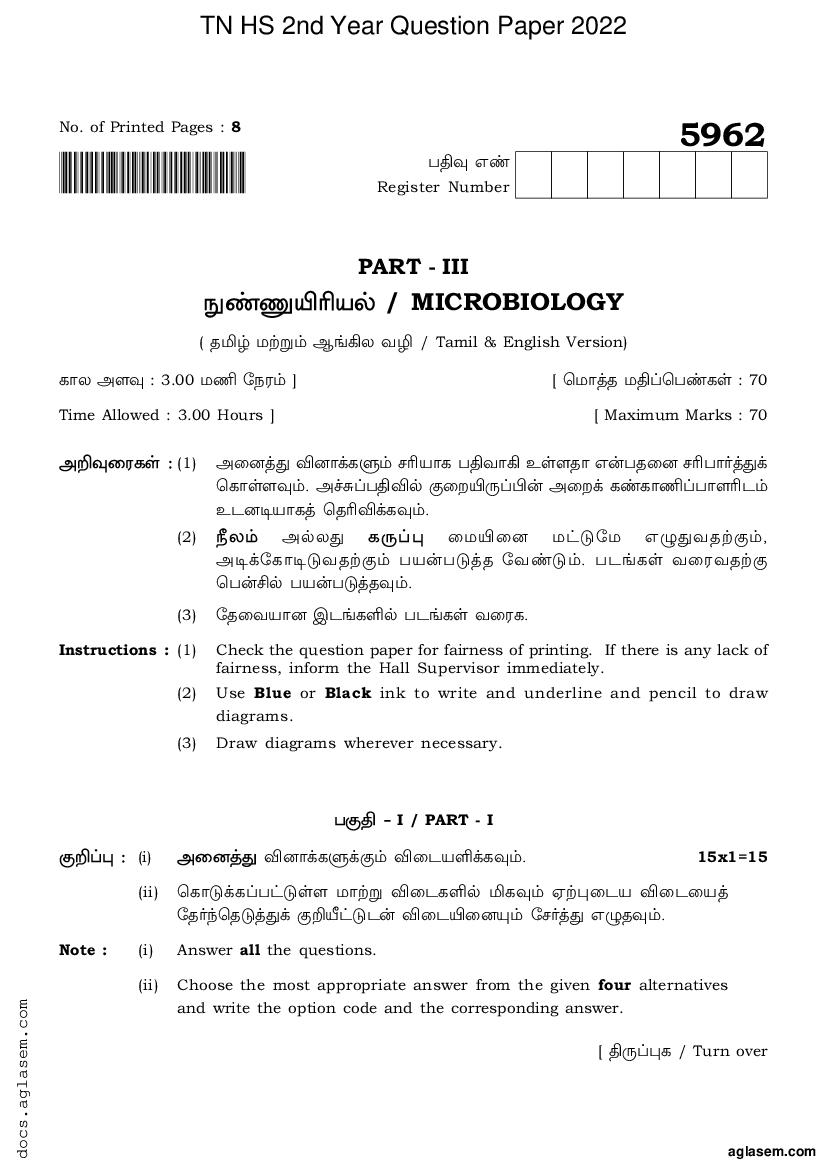
5962
!5962Microbiology! £vÄ Gs
Register Number
PART - III
~sq°›¯À / MICROBIOLOGY
( uªÌ ©ØÖ® B[Q» ÁÈ / Tamil & English Version)
Põ» AÍÄ : 3.00 ©o ÷|µ® ] [ ö©õzu ©v¨ö£sPÒ : 70
Time Allowed : 3.00 Hours ] [ Maximum Marks : 70
AÔÄøµPÒ : (1) AøÚzx ÂÚõUPЮ \›¯õP £vÁõQ EÒÍuõ GߣuøÚ \›£õºzxU
öPõÒÍÄ®. Aa_¨£vÂÀ SøÓ°¸¨¤ß AøÓU PsPõo¨£õÍ›h®
EhÚi¯õPz öu›ÂUPÄ®.
(2) }»® AÀ»x P¸¨¦ ø©°øÚ ©mk÷© GÊxÁuØS®,
AiU÷PõikÁuØS® £¯ß£kzu ÷Ásk®. £h[PÒ ÁøµÁuØS
ö£ß]À £¯ß£kzuÄ®.
(3) ÷uøÁ¯õÚ Ch[PÎÀ £h[PÒ ÁøµP.
Instructions : (1) Check the question paper for fairness of printing. If there is any lack of
fairness, inform the Hall Supervisor immediately.
(2) Use Blue or Black ink to write and underline and pencil to draw
diagrams.
(3) Draw diagrams wherever necessary.
£Sv & I / PART - I
SÔ¨¦ : (i) AøÚzx ÂÚõUPÐUS® Âøh¯ÎUPÄ®. 15x1=15
(ii) öPõkUP¨£mkÒÍ ©õØÖ ÂøhPÎÀ ªPÄ® Hئøh¯ Âøhø¯z
÷uº¢öukzxU SÔ±mkhß Âøh°øÚ²® ÷\ºzx GÊuÄ®.
Note : (i) Answer all the questions.
(ii) Choose the most appropriate answer from the given four alternatives
and write the option code and the corresponding answer.
Page 2
1. ISS Gߣx __________.
(A) C¢v¯ ÂsöÁÎ {ø»¯®
(B) C¢v¯ uµUPmk¨£õk {ÖÁÚ®
(C) £ßÚõmk ÂsöÁÎ {ø»¯®
(D) ÷©Øö\õßÚ GxĪÀø»
ISS stands for __________.
(a) Indian Space Station
(b) Indian Standard System
(c) International Space Station
(d) None of these
2. |õ÷Úõ xPÒPÎß AÍÄ __________.
(A) 100 nm AÀ»x AvP® (B) 10 nm SøÓÁõP
(C) 200 nm (D) 100 nm AÀ»x SøÓÁõP
Size of the Nano particles varies from :
(a) 100 nm or more (b) less than 10 nm
(c) 200 nm (d) 100 nm or less
3. ¤.].G® (PCM) ¯õµõÀ Psk¤iUP¨£mhx ?
(A) â¯õºä ìm÷µõUì (B) µõ£ºm ÷Põa
(C) Aö»Uéõshº ¤Íª[ (D) ¤›mì öéºÛU
Who invented the Phase Contrast Microscope (PCM) ?
(a) George Strokes (b) Robert Koch
(c) Alexander Fleming (d) Frits Zernike
4. £õÀ Gº¼a Psk¤izu \õÀÁº\ß ©¸¢x ________ ]Qaø\US £¯ß£kzu¨£mhx.
(A) {÷©õÛ¯õ (B) öPõ÷Úõ-›¯õ
(C) øh£õ´k (D) ]¤¼ì
Salvarsan was discovered by Paul Ehrlich is used to treat __________.
(a) Pneumonia (b) Gonorrhoea
(c) Typhoid (d) Syphilis
5. ~sq°›PÒ Á͵ HØÓ pH ©v¨¦ __________.
(A) 3.4 (B) 4.0 (C) 9.2 (D) 7.0
The micro-organisms grow best at pH value around __________.
(a) 3.4 (b) 4.0 (c) 9.2 (d) 7.0
Page 3
6. PõØÖÒÍ _Áõ]zu¼À CÖv¯õÚ G»Umµõß Hؤ Gߣx __________.
(A) øímµáß (B) BUêáß (C) O® (D) ø|mµáß
In an aerobic respiration the terminal electron acceptor is :
(a) Hydrogen (b) Oxygen (c) Helium (d) Nitrogen
7. öuõÈØ\õø» •UQ¯zxÁ® Áõ´¢u ~sq°›PøÍ £u¨£kzu vµÁ
ø|mµáÛÀ __________ öÁ¨£{ø»°À £¯ß£kzu¨£kQÓx.
(A) 72.08C (B) −1968C (C) −1768C (D) 62.88C
__________ temperature is used to preserve industrially important micro-organisms
in liquid nitrogen.
(a) 72.08C (b) −1968C (c) −1768C (d) 62.88C
8. ö©mhõS÷µõ©õiU SÖ©oPøÍ öPõskÒÍ __________ Qµõ® £õ]miÆ
£õ]Àø», ^Ú GÊzxUPøÍ ÷£õßÓ Aø©¨¤À Põn¨£k® £s¦PøÍ
öPõshøÁ.
(A) ÷£]À»ì B¢zµõ]ì
(B) PõºÛ£õUj›¯® i¨vŸ¯õ
(C) QÍõìi›i¯® ö£ºö£›ßöáßì
(D) ø©U÷Põ£õUj›¯® i³£ºS÷Íõêì
A Gram-Positive bacilli possessing metachromatic granules, showing Chinese
letters arrangement are characteristic of :
(a) Bacillus Anthracis
(b) Corynebacterium Diptheriae
(c) Clostridium Perfringens
(d) Mycobacterium Tuberculosis
9. ÃÀì ÷|õ´ ¤ßÁ¸® GÆÁøP £õUj›¯õÁõÀ EshõUP¨£kQÓx ?
(A) ö»¨÷hõìø£µõ Cßhº÷µõPßì
(B) \õÀ÷©õöÚÀ»õ øh¤
(C) ¨›÷¯õ Põ»÷µ
(D) Gèöå›]¯õ ÷Põø»
Weil’s disease is caused by which of the following bacteria ?
(a) Leptospira Interrogans
(b) Salmonella Typhi
(c) Vibrio Cholerae
(d) Escherichia Coli
Page 4
10. ½è÷©Û¯õ E°› ©ÛuÝUS __________ BÀ Phzu¨£kQÓx.
(A) öPõ_ (B) \õsm §a]
(C) öµkÂm §a] (D) ö\m] §a]
Leishmania organism are transmitted to human by :
(a) Mosquitoes (b) Sand Flies
(c) Reduviid Bug (d) Tsetse Flies
11. îì÷hõ¤Íõì÷©õêì __________ GßÓøÇUP¨£k®.
(A) ÷Pßii¯õ]ì (B) \õPõì ÷|õ´
(C) Q›¨÷hõPõU÷Põ]ì (D) hõº¼[ ÷|õ´
Histoplasmosis is also called as __________.
(a) Candidiasis (b) Chagas disease
(c) Cryptococcosis (d) Darling’s disease
12. ø\m÷hõö©Põ÷»õ øÁµìPÒ __________ GßÖ® AøÇUP¨£k®.
(A) |õͪÀ»õa _µ¨¤ øÁµì (B) EªÌ}º _µ¨¤ øÁµì
(C) ¤m³mh› _µ¨¤ øÁµì (D) ö|g\U Pøn¯a _µ¨¤ øÁµì
Cytomegalo Viruses is also called as __________.
(a) Endocrine gland virus (b) Salivary gland virus
(c) Pituitary gland virus (d) Thymus gland virus
13. ÷µ¥ì øÁµì __________ Sk®£zøu \õº¢ux.
(A) öµm÷µõ ›÷h (B) öí¨£õmÚõ ›÷h
(C) ¤Íõ ›÷h (D) ÷µ¨÷hõ ›÷h
Rabies virus belongs to the family __________.
(a) Retero Viridae (b) Hepadna Viridae
(c) Flaviviridae (d) Rhabdoviridae
14. EhÚi ªøP Tº EnºÄ __________ ø¯U SÔUQÓx.
(A) ø\÷éõ÷PõÛ ÂøÚ (B) AÚõø£»õUiU
(C) öµÚõÀmì&¤µõ÷h ÂøÚ (D) i³£ºUS¼ß ÂøÚ
Immediate hypersensitivity refers to __________.
(a) Schizogony Reaction (b) Anaphylactic
(c) Reynolds-Braude Reaction (d) Tuberculin Reaction
Page 5
15. _ØÖ¨¦Ózv¼¸¢x EøÓ¯ØÓ i.Gß.H&øÁ GkzxUöPõÒÐuÀ Gߣx
__________ GÚ¨£k®.
(A) iµõßìL£º÷©åß (B) iµõßìhUåß
(C) ø»]ì (D) Põßã÷Påß
The uptake of naked DNA from the surrounding is known as :
(a) Transformation (b) Transduction
(c) Lysis (d) Conjugation
£Sv & II / PART - II
SÔ¨¦ : GøÁ÷¯Ý® BÖ ÂÚõUPÐUS Âøh¯ÎUPÄ®. ÂÚõ Gs 24 &US
Pmhõ¯©õP Âøh¯ÎUPÄ®. 6x2=12
Note : Answer any six questions. Question No. 24 is Compulsory.
16. DNA Á›ø\¨£kzxu¼ß Cµsk •øÓPøÍ TÖP.
Write two DNA sequencing methods.
17. ¦Ñµ\ßì ~s÷nõUQ°¯¾US £¯ß£kzu¨£k® \õ¯[Pøͨ £mi¯¼kP.
List out the dyes used for fluroscence microscopy.
18. Bßiö\¨iU – Áøµ¯ÖUPÄ®.
Define Antiseptic.
19. JkUP® GßÓõÀ GßÚ ?
What is Reduction ?
20. EnÄ |g\õuÀ – Áøµ¯ÖUPÄ®.
Define Food Poisoning.
21. APõº \õ´Ä GßÓõÀ GßÚ ?
What is Agar Slope ?
22. Põ\÷|õ´US Gvº©¸¢xPÒ H÷uÝ® |õßQøÚ £mi¯¼kP.
List out any four antituberculosis drugs.
Page 6
23. ©xµõø©U÷Põ]ì GßÓõÀ GßÚ ?
What is Maduramycosis ?
24. LD £õiPÒ GßÓõÀ GßÚ ?
What are LD bodies ?
£Sv & III / PART - III
SÔ¨¦ : GøÁ÷¯Ý® BÖ ÂÚõUPÐUS Âøh¯ÎUPÄ®. ÂÚõ Gs 33 &US
Pmhõ¯©õP Âøh¯ÎUPÄ®. 6x3=18
Note : Answer any six questions. Question No. 33 is Compulsory.
25. TEM&°ß H÷uÝ® ‰ßÖ £s¦PøÍ £ØÔ GÊxP.
Write three properties of TEM.
26. 'E' & ÷\õuøÚ GßÓõÀ GßÚ ?
What is meant by E-test ?
27. ø»÷¯õ¤ø»÷\åß GßÓõÀ GßÚ ?
What is meant by Lyophilisation ?
28. EnÂÀ ~sq°›PÎß Buõµ[PÒ H÷uÝ® BÔøÚ £mi¯¼kP.
List out any six sources of micro-organisms in food.
29. Gsh«£õ îì÷hõ¼iUPõÂß m÷µõ÷£õ÷\õ°møh £h® Áøµ¢x £õP[PøÍU
SÔUPÄ®.
Draw the diagram of a Trophozoite of Entamoeba histolytica and label the parts.
30. öẮ SÇõ´ ÷\õuøÚ – Áøµ¯ÖUPÄ®.
Define Germ Tube Test.
31. âPõ Põ´a\À GßÓõÀ GßÚ ?
What is Zika Fever ?
Page 7
32. öÁìhß ¤Íõm öuõÈÀ~m£zvß £¯ßPÒ ¯õøÁ ?
Write the applications of Western Blot Techniques.
33. ÷|õ÷\õ÷Põª¯À ÷|õ´zöuõØÖ £ØÔ GÊxP.
Write about Nosocomial Infection.
£Sv & IV / PART - IV
SÔ¨¦ : AøÚzx ÂÚõUPÐUS® Âøh¯ÎUPÄ®. 5x5=25
Note : Answer all the questions.
34. (A) DNA Á›ø\¨£kzxuÀ •øÓPÒ £ØÔ ÂÁ›UPÄ®.
AÀ»x
(B) £õUj›]hÀ ©ØÖ® £õUj›÷¯õìhõiUQß ÷ÁÖ£õkPøÍ GÊxP.
(a) Write in detail about DNA sequencing methods.
OR
(b) Write the difference between Bactericidal and Bacteriostatic.
35. (A) ¦÷Íõµ\ßì ~s÷nõUQ°ß ö\¯À C¯[Pø©¨ø£ £hzxhß ÂÁ›UPÄ®.
AÀ»x
(B) MBRT &ö©zv½ß }» \õ¯ JkUP ÷\õuøÚø¯ ÂÁ›UPÄ®.
(a) Explain the working mechanism of Fluorescence Microscope.
OR
(b) Write in detail about Methylene Blue dye Reduction Test (MBRT).
36. (A) ö£Û]¼ß u¯õ›¨¦ •øÓPøÍ ÂÁ›UPÄ®.
AÀ»x
(B) Gsh«£õ îì÷hõ¼iUPõÂß ÁõÌUøP _ÇØ]ø¯ ÂÁ›UPÄ®.
(a) Explain the process of penicillin production.
OR
(b) Write in detail about the life cycle of E. Histolytica.
Page 8
37. (A) uõøh & G¾®¦ ¤i¨¦ ÷|õ°ß ÷|õ´z÷uõØÓ® £ØÔ ÂÁ›UPÄ®.
AÀ»x
(B) Gø»\õ GßÓõÀ GßÚ ? Auß uzxÁzøu ÂÁ›UPÄ®.
(a) Describe the Pathogenesis of Lock-Jaw disease.
OR
(b) What is meant by ELISA ? Explain the principles of ELISA.
38. (A) öí¨£øhiì A øÁµì £ØÔ ÂÁ›UPÄ®.
AÀ»x
(B) PCR ÷\õuøÚø¯¨ £ØÔ ÂÁ›UPÄ®.
(a) Explain in detail about Hepatitis A virus.
OR
(b) Explain PCR-Polymerase Chain Reaction.
-o0o-
Page 9
5963
!5963BioChemistry! £vÄ Gs
Register Number
PART - III
E°º ÷Áv°¯À / BIO-CHEMISTRY
(uªÌ ©ØÖ® B[Q» ÁÈ / Tamil & English Version)
Põ» AÍÄ : 3.00 ©o ÷|µ® ] [ ö©õzu ©v¨ö£sPÒ : 70
Time Allowed : 3.00 Hours ] [ Maximum Marks : 70
AÔÄøµPÒ : (1) AøÚzx ÂÚõUPЮ \›¯õP £vÁõQ EÒÍuõ GߣuøÚ \›£õºzxU
öPõÒÍÄ®. Aa_¨£vÂÀ SøÓ°¸¨¤ß AøÓU PsPõo¨£õÍ›h®
EhÚi¯õPz öu›ÂUPÄ®.
(2) }»® AÀ»x P¸¨¦ ø©°øÚ ©mk÷© GÊxÁuØS®
AiU÷PõikÁuØS® £¯ß£kzu ÷Ásk®. £h[PÒ ÁøµÁuØS
ö£ß]À £¯ß£kzu ÷Ásk®.
(3) ÷uøÁ¯õÚ ChzvÀ Áøµ£h® ©ØÖ® \©ß£õkPøÍz u¸P.
Instructions : (1) Check the question paper for fairness of printing. If there is any lack of
fairness, inform the Hall Supervisor immediately.
(2) Use Blue or Black ink to write and underline and pencil to draw
diagrams.
(3) Draw diagrams and write equations wherever necessary.
£Sv & I / PART - I
SÔ¨¦ : (i) AøÚzx ÂÚõUPÐUS® Âøh¯ÎUPÄ®. 15x1=15
(ii) öPõkUP¨£mkÒÍ ©õØÖ ÂøhPÎÀ ªPÄ® Hئøh¯ Âøhø¯z
÷uº¢öukzxU SÔ±mkhß Âøh°øÚ²® ÷\ºzx GÊuÄ®.
Note : (i) Answer all the questions.
(ii) Choose the most appropriate answer from the given four alternatives
and write the option code and the corresponding answer.
Document Details
| Board / Org | Tamil Nadu Board |
| Exam | Class 12 |
| Type | Question Paper |
| Pages | 9 |
| Updated | 30 Apr 2026 |