Page 1
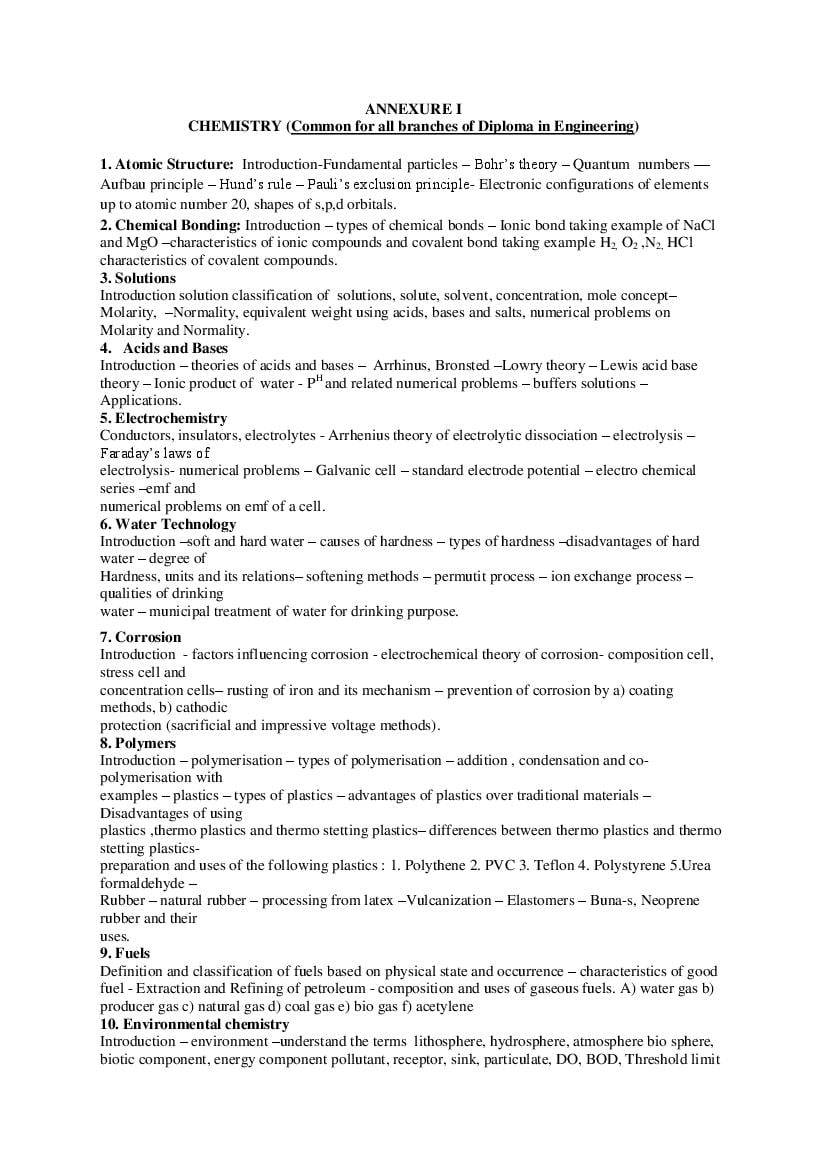
ANNEXURE I CHEMISTRY (Common for all branches of Diploma in Engineering) 1. Atomic Structure: Introduction-Fundamental particles – Bohr’s theory – Quantum numbers –– Aufbau principle – Hund’s rule – Pauli’s exclusion principle- Electronic configurations of elements up to atomic number 20, shapes of s,p,d orbitals. 2. Chemical Bonding: Introduction – types of chemical bonds – Ionic bond taking example of NaCl and MgO –characteristics of ionic compounds and covalent bond taking example H2, O2 ,N2, HCl characteristics of covalent compounds. 3. Solutions Introduction solution classification of solutions, solute, solvent, concentration, mole concept– Molarity, –Normality, equivalent weight using acids, bases and salts, numerical problems on Molarity and Normality. 4. Acids and Bases Introduction – theories of acids and bases – Arrhinus, Bronsted –Lowry theory – Lewis acid base theory – Ionic product of water - PH and related numerical problems – buffers solutions – Applications. 5. Electrochemistry Conductors, insulators, electrolytes - Arrhenius theory of electrolytic dissociation – electrolysis – Faraday’s laws of electrolysis- numerical problems – Galvanic cell – standard electrode potential – electro chemical series –emf and numerical problems on emf of a cell. 6. Water Technology Introduction –soft and hard water – causes of hardness – types of hardness –disadvantages of hard water – degree of Hardness, units and its relations– softening methods – permutit process – ion exchange process – qualities of drinking water – municipal treatment of water for drinking purpose. 7. Corrosion Introduction - factors influencing corrosion - electrochemical theory of corrosion- composition cell, stress cell and concentration cells– rusting of iron and its mechanism – prevention of corrosion by a) coating methods, b) cathodic protection (sacrificial and impressive voltage methods). 8. Polymers Introduction – polymerisation – types of polymerisation – addition , condensation and co- polymerisation with examples – plastics – types of plastics – advantages of plastics over traditional materials – Disadvantages of using plastics ,thermo plastics and thermo stetting plastics– differences between thermo plastics and thermo stetting plastics- preparation and uses of the following plastics : 1. Polythene 2. PVC 3. Teflon 4. Polystyrene 5.Urea formaldehyde – Rubber – natural rubber – processing from latex –Vulcanization – Elastomers – Buna-s, Neoprene rubber and their uses. 9. Fuels Definition and classification of fuels based on physical state and occurrence – characteristics of good fuel - Extraction and Refining of petroleum - composition and uses of gaseous fuels. A) water gas b) producer gas c) natural gas d) coal gas e) bio gas f) acetylene 10. Environmental chemistry Introduction – environment –understand the terms lithosphere, hydrosphere, atmosphere bio sphere, biotic component, energy component pollutant, receptor, sink, particulate, DO, BOD, Threshold limit
Page 2
value, COD- Air pollution - causes-Effects – acid rain, green house effect –ozone depletion – control of Air pollution – Water pollution – causes – effects – control measures. ANNEXURE II Number of Questions to be Set Unit Wise (TOTAL 25) UNIT No Topic Marks 1. Atomic Structure 3 2. Chemical Bonding 2 3. Solutions 3 4. Acids and Bases 2 5. Electrochemistry 4 6. Water Technology 3 7. Corrosion 2 8. Polymers 3 9. Fuels 1 10. Environmental Chemistry 2 ANNEXURE III MODEL QUESTIONS FOR CHEMISTRY 1. The normality of oxalic acid solution is found to be 0.05N. How many grams of oxalic acid is present in 100 ml of solution. 1) 1.26 2) 12.6 3) 126 4) 0.126 2. Which of the following is responsible for temporary hardness of water 1)Ca CO3 2) Ca Cl2 3) Ca SO4 4) Ca (HCO3)2 3. The monomer of Rubber is---- 1) Isoprene 2) Propene 3) Polyisoprene 4) Bakelite 4. Which one of the following is responsible for Global Warming 1)Particulate 2) Carbon dioxide 3) Hydrogen sulphide 4) Nitrous Oxide