Page 1
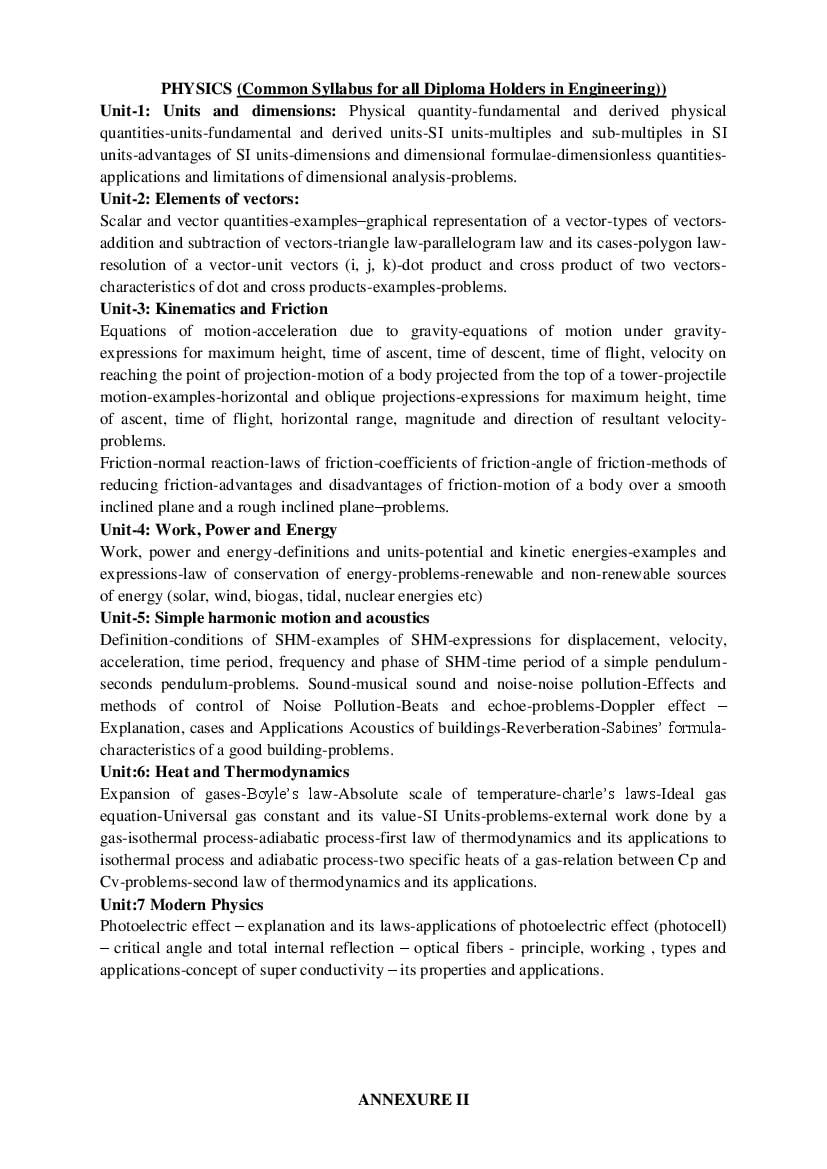
PHYSICS (Common Syllabus for all Diploma Holders in Engineering)) Unit-1: Units and dimensions: Physical quantity-fundamental and derived physical quantities-units-fundamental and derived units-SI units-multiples and sub-multiples in SI units-advantages of SI units-dimensions and dimensional formulae-dimensionless quantities- applications and limitations of dimensional analysis-problems. Unit-2: Elements of vectors: Scalar and vector quantities-examples–graphical representation of a vector-types of vectors- addition and subtraction of vectors-triangle law-parallelogram law and its cases-polygon law- resolution of a vector-unit vectors (i, j, k)-dot product and cross product of two vectors- characteristics of dot and cross products-examples-problems. Unit-3: Kinematics and Friction Equations of motion-acceleration due to gravity-equations of motion under gravity- expressions for maximum height, time of ascent, time of descent, time of flight, velocity on reaching the point of projection-motion of a body projected from the top of a tower-projectile motion-examples-horizontal and oblique projections-expressions for maximum height, time of ascent, time of flight, horizontal range, magnitude and direction of resultant velocity- problems. Friction-normal reaction-laws of friction-coefficients of friction-angle of friction-methods of reducing friction-advantages and disadvantages of friction-motion of a body over a smooth inclined plane and a rough inclined plane–problems. Unit-4: Work, Power and Energy Work, power and energy-definitions and units-potential and kinetic energies-examples and expressions-law of conservation of energy-problems-renewable and non-renewable sources of energy (solar, wind, biogas, tidal, nuclear energies etc) Unit-5: Simple harmonic motion and acoustics Definition-conditions of SHM-examples of SHM-expressions for displacement, velocity, acceleration, time period, frequency and phase of SHM-time period of a simple pendulum- seconds pendulum-problems. Sound-musical sound and noise-noise pollution-Effects and methods of control of Noise Pollution-Beats and echoe-problems-Doppler effect – Explanation, cases and Applications Acoustics of buildings-Reverberation-Sabines’ formula- characteristics of a good building-problems. Unit:6: Heat and Thermodynamics Expansion of gases-Boyle’s law-Absolute scale of temperature-charle’s laws-Ideal gas equation-Universal gas constant and its value-SI Units-problems-external work done by a gas-isothermal process-adiabatic process-first law of thermodynamics and its applications to isothermal process and adiabatic process-two specific heats of a gas-relation between Cp and Cv-problems-second law of thermodynamics and its applications. Unit:7 Modern Physics Photoelectric effect – explanation and its laws-applications of photoelectric effect (photocell) – critical angle and total internal reflection – optical fibers - principle, working , types and applications-concept of super conductivity – its properties and applications. ANNEXURE II
Page 2
Number of Questions to be Set Unit Wise (TOTAL 25) UNIT NO TOPICS MARKS I Units and Dimensions 02 II Elements of Vectors 02 III Kinematics and Friction 06 IV Work, Power and Energy 03 V Simple Harmonic Motion and Acoustics 05 VI Heat and Thermodynamics 05 VII Modern Physics 02 Total 25 ANNEXURE III MODEL QUESTIONS FOR PHYSICS 1. If young’s modulus ‘Y’, surface tension ‘S’ and velocity ‘V’ are chosen as fundamental quantities, the dimensional formula for force is 2. Y-5V-4S6 3. Y-3V5S5 4. Y-5V-4S5 5. Y-3V-4S6 2. A ballon moves up with constant velocity 10m/s. An object is dropped from it when it is at a height of 100 m above the ground. The distance between the object and the ballon after 5 sec is (g=10m/s2) 1. 120 m 2. 125 m 3. 100 m 4. 150 m 3. The time period of an oscillating simple pendulum is ‘T’. If its length is increased by 5 cm then the time period is ‘T1’ and the time period is ‘T2’ if the length is reduced by 5 cm. The relationship among T, T1, T2 1. T2 = T12+T22 2. T2/2 = T12+T22 3. 2T2 = T12+T22 4. 3T2 = T12+T22 4. A gas is heated through 4 K in a closed vessel. If its pressure is increased by 0.8%, the initial temperature of the gas is 1. 227 K 2. 454 K 3. 454 oC 4. 227 oC 5. If light travels through two media with velocities 2.5 x 10⁸ m/s and 2 x 10⁸ m/s respectively, the critical angle for the combination of the two media is 1. Sin-1(4/5) 2. Sin-1(3/5) 3. Sin-1(2/5) 4. Sin-1(1/5)