RTU 2016 Question Paper Semester IV Electrical and Electronics Engineering Electrical Machines II
Finished viewing? Save it for later —
Download RTU 2016 Question Paper Semester IV Electrical and Electronics Engineering Electrical Machines II (PDF · 4 pages)About RTU 2016 Question Paper Semester IV Electrical and Electronics Engineering Electrical Machines II
RTU 2016 Question Paper Semester IV Electrical and Electronics Engineering Electrical Machines II is available here for free download. Published by Default for Semester Exams, this question paper can be viewed online or downloaded as a PDF (4 pages). Candidates preparing for Semester Exams can use RTU 2016 Question Paper Semester IV Electrical and Electronics Engineering Electrical Machines II to understand the exam pattern, the type of questions asked, and the overall difficulty level.
Frequently Asked Questions
How can I download RTU 2016 Question Paper Semester IV Electrical and Electronics Engineering Electrical Machines II?
Open this page and click the Download button to save RTU 2016 Question Paper Semester IV Electrical and Electronics Engineering Electrical Machines II as a PDF. It is completely free on AglaSem Docs.
Is RTU 2016 Question Paper Semester IV Electrical and Electronics Engineering Electrical Machines II free to download?
Yes. RTU 2016 Question Paper Semester IV Electrical and Electronics Engineering Electrical Machines II can be viewed online and downloaded as a PDF free of cost on AglaSem Docs.
How many pages does RTU 2016 Question Paper Semester IV Electrical and Electronics Engineering Electrical Machines II have?
RTU 2016 Question Paper Semester IV Electrical and Electronics Engineering Electrical Machines II contains 4 pages, which you can read online or download together as a single PDF.
Where can I find more Semester Exams study material?
You can find more Semester Exams question papers, sample papers, syllabus, and answer keys on AglaSem Docs.
RTU 2016 Question Paper Semester IV Electrical and Electronics Engineering Electrical Machines II – Text
Read the full text of this question paper below — useful to quickly search, copy and reference the content online without downloading the PDF.
📄 View text version (4 pages)
Page 1
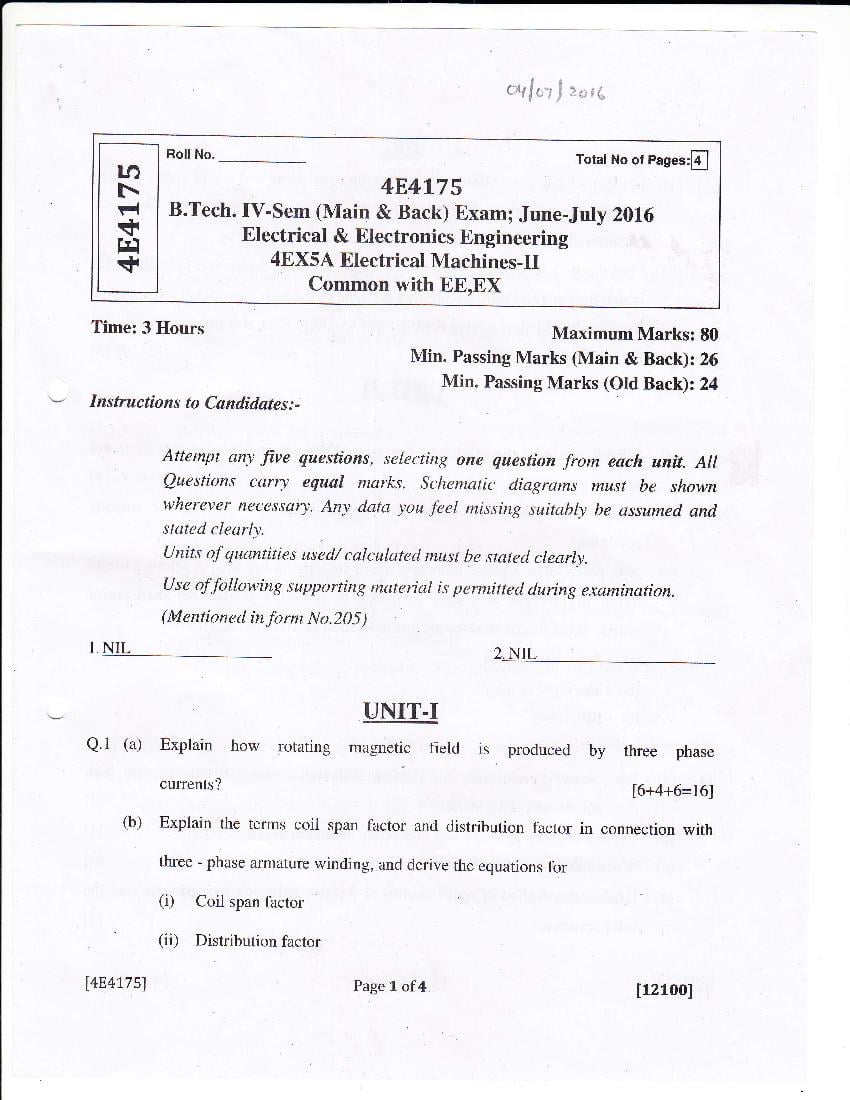
RollNo. TotalNo of Pages:fl
m
f- 484L75
F{ B.Tech. IV-Sem (Main & Back) Examl June-July 2016
$ Electrical & Electronics Engineering
EI
$ 4EX5A Electrical Machines-Il
Common with EE,EX
Time: 3 Hours Maximum Marks: E0
Min. Passing Marks (Main & Back): 26
Min. Passing Marks (OId Back): 24
Instructions to Candi.date s : -
Attempt any five questions, selecting one question
from each unit. All
Questions carry equal marks. Schematic diagrams must be shown
wherever necessary. Any data you feel missing suitably be assumed and
stated clearly.
(Inits of quantities used,/ calculated must be stated
clearly.
lJse of fottowing supporting material is permitted during examination.
( Mentioned in form No.205 )
1. NIL 2. NIL
UNIT.I
Q.1 (a) Explain how rorating magnetic field is produced by three phase
currents?
[6+4+6=16]
(b) Explain the terms coil span factor and distribution factor in connection with
three - phase arrnature winding. and derive the equations for
(i) Coil span factor
(ii) Distributionfactor
l4E4L7sl Page 1 of4
Page 2
Q.1(a)Explainwhataretheeffectsofdistributionofwindinganduseofshort.pitched
coil.onthemagnitudeofgeneratedvoltagebyacarmaturewinding.Writethe
considering the effects of
above'
equation of generated voltage'
(b)Findtheno.loadphasevoltageofastar-connected,3-phase,6-polealternator
whichrunsat1200rpm,havingfluxperpoleof0.lwebSrnusoidlllydistributed. coil
Each coil has 8 turns and
ao,,ur" layer winding.
Its stator has 54 slots having
[6+10=16]
is carded bY one slot'
UNIT.II
induction motor? Why must slip be present for
Q.2 (a) What is meant by slip in an
[2+6+8=16]
action? _--^ r^, nrhn
(b) Derivetheequationfortorqueof3-plaseinductionmotorunderrunnlng
condition' develoPs a useful
motor running on fuIl load
(c) A 6- pole, S[Hz,3-phase induction
torqueofl50N-matarotorfrequencyofl.5Hz.Calculatetheshaftpower
output.Ifthemechanicaltorquelostinfrictionbel0N-M,determine
(i) Rotor coPPer loss
(ii) The inPut to motor
(c) EfficiencY
OR
Q.2 (a) Whystarterisnecessarytbrstartinginductionmotors?Brieflyexplainwith[4]
diagram, the star-delta starter.
i4l
in 3-phase induction motor'
(b) Explain cogging and crawling
[4]
(c) Write a short note 'oon Induction
generator"
(d) Explainthemethodofspeedcontrolof3-phaseinductionrnotorbyvaryingthet4l
rotor resistance'
Page? of4
l4B4t7sl
Page 3
theory of single- phase induction motor and
Q.3 (a) ExPlain the double field revolving
derive the equation for net torque developed in the motor, explain why this
[6]
is not self starting'
motor based
(b)Drawandexplaintheequivalentcircuitofsingle-phaseinduction
lsl
upon double field revolving theory'
(c) Explain construction and principle of operation of a single-Phase sYnchronous
tsl
motor.
OR
principle of operation of reluctance motor'
Q.3 (a) Briefly explain the construction and
Draw a typical torque speed characteristic of motor and
explain' t6]
(b)250watt,230volt,50Hzcapacitor-startmotorhasthefollowingconstantsfor
t10l
the main and auxiliary windings'
Main winding: Z^= (4'5 + j 3'7) O
Auxiliary winding: Za = (9 '5 + j 3'5) A
main winding and auxiliary
Determine the value of capacitor that will place the
winding currents in quadrature at starting'
of auxiliary winding'
where, zm= lrtagfretising impedance za=impedance
UNIT.IV
is preferred in synchronous generators
Q.4 (a) Explain why a rotating field system
t6l
instead of stationary field sYstem?
(b) Explain with neat diagram, the brushless excitation system of synchronous
tsl
generations.
(c) Explain the Potier- triangle method of finding the voltage regulation of an
rsl
alternator.
Page 3 of4 [121001
l4E417sl
Page 4
Q.4 (a) What is two reaction theory applicable to salient pole synchronous machines?
Draw and explain the phasor diagram of salient pole synchronous machine based
upon two reaction theory. t6l
(b) Show that the power developed by the salient pole synchronous machine is given
bv p=8,
vt
rina*
v,'
I t -llrinz.a
" xd 2 xd.l
Lxq
Where Xd & Xq are direct axis and quadrature axis reactance, 6 is load angle,
Vt= terminal voltage and E1= emf induced, P - power per phase. tsl
(c) What is the synchronizing power? Find the equation for synchronizing torque on
no-load of a 3-phase synchronous machrne. tsl
Q.5 (a) Explain briefly with neat diagrams the effect of varying excitation upon annature
current and power-factor of a synchronous motor when input power to motor is
maintained constant. Draw V- curves and state their significance. t8l
(b) A 2300'volt, 3-phase, star connected synchronous motor has a resistance of 0.2C1
per phase and a synchronous reactance of 2.2 C) per phase. The motor is
operating at 0.5 power factor leading with a line current of 200 Amp. Determine
the value of generated emf per phase. t8l
OR
Q.5 (a) Explain with neat sketches the principle of operation of a 3-phase synchronous
motor. Also explain why it will not run at other than synchronous speed. 15]
(b) What is synchronous phase modifier? Explain with the help of phasor diagram its
operation. tsl
(c) A 3-phase 150 KW, 2300 volt, 50 H2,1000 rpm salient pale synchronous motor
has Xd = 32 A /ph, Xq = 20 Ql phase. Neglecting losses, calculate the power
developed by the motor if field excitation is so adjusted as to make the back emf
twice the applied voltage and load angle is 16o. t6l
Where: Xd = direct axis synch reactancelphaSe and
Xq = quadrature synch reactance/ phase
148417sl Page 4 of 4 [12100]
Document Details
| Board / Org | Default |
| Exam | Semester Exams |
| Type | Question Paper |
| Pages | 4 |
| Updated | 30 Apr 2026 |