TS Inter 1st Year Syllabus 2027 Commerce (ACE Group)
Finished viewing? Save it for later —
Download TS Inter 1st Year Syllabus 2027 Commerce (ACE Group) (PDF · 3 pages)About TS Inter 1st Year Syllabus 2027 Commerce (ACE Group)
TS Inter 1st Year Syllabus 2027 Commerce (ACE Group) is available here for free download. Published by Telangana Board for Class 11, this syllabus can be viewed online or downloaded as a PDF (3 pages). Candidates preparing for Class 11 can use TS Inter 1st Year Syllabus 2027 Commerce (ACE Group) to understand the exam pattern, the type of questions asked, and the overall difficulty level.
Frequently Asked Questions
How can I download TS Inter 1st Year Syllabus 2027 Commerce (ACE Group)?
Open this page and click the Download button to save TS Inter 1st Year Syllabus 2027 Commerce (ACE Group) as a PDF. It is completely free on AglaSem Docs.
Is TS Inter 1st Year Syllabus 2027 Commerce (ACE Group) free to download?
Yes. TS Inter 1st Year Syllabus 2027 Commerce (ACE Group) can be viewed online and downloaded as a PDF free of cost on AglaSem Docs.
How many pages does TS Inter 1st Year Syllabus 2027 Commerce (ACE Group) have?
TS Inter 1st Year Syllabus 2027 Commerce (ACE Group) contains 3 pages, which you can read online or download together as a single PDF.
Where can I find more Class 11 study material?
You can find more Class 11 question papers, sample papers, syllabus, and answer keys on AglaSem Docs.
TS Inter 1st Year Syllabus 2027 Commerce (ACE Group) – Text
Read the full text of this syllabus below — useful to quickly search, copy and reference the content online without downloading the PDF.
📄 View text version (4 pages)
Page 1
TS Inter 1st Year
Syllabus 2027
Commerce (ACE
Group)
EXAM YEAR TYPE SUBJECT
TS Class 11 2027 Syllabus Commerce
Notes · Sample Papers · Previous Year Papers · Mock Tests
Page 2
e m
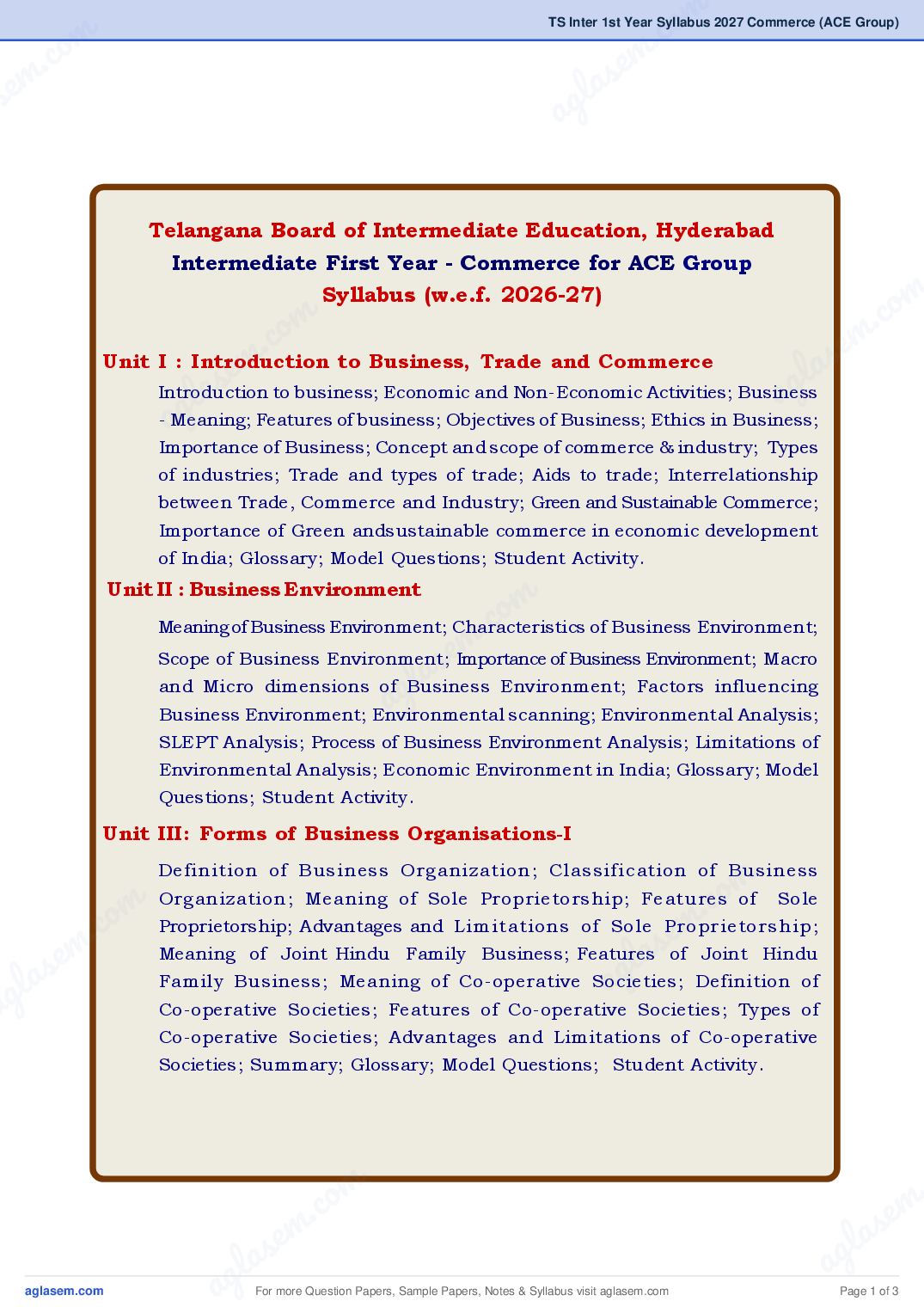
Telangana Board of Intermediate Education, Hyderabad
Intermediate First Year - Commerce for ACE Group
m
Syllabus (w.e.f. 2026-27)
c. o s e m
m
e to business; Economic and Non-Economic Activities; Businessl a
a s g
Unit I : Introduction to Business, Trade and Commerce
a
gl Features of business; Objectives of Business; Ethics in Business;
-a
Introduction
Meaning;
Importance of Business; Concept and scope of commerce & industry; Types
of industries; Trade and types of trade; Aids to trade; Interrelationship
between Trade, Commerce and Industry; Green and Sustainable Commerce;
Importance of Green andsustainable commerce in economic development
of India; Glossary; Model Questions; Student Activity.
m
Unit II : Business Environment
m
eImportance
Meaning of Business Environment; Characteristics of Business Environment;
l a
Scope of Business Environment;s of Business Environment; Macro
and Micro dimensions of gBusiness
a
Environment; Factors influencing
Business Environment; Environmental scanning; Environmental Analysis;
SLEPT Analysis; Process of Business Environment Analysis; Limitations of
Environmental Analysis; Economic Environment in India; Glossary; Model
Unit III: Forms of Business Organisations-I
o m Sole
Definition of Business Organization; Classification of Business
m .c
c. o Proprietorship; Advantages and Limitations of Sole sProprietorship;
m
Organization; Meaning of Sole Proprietorship; Features of
m eof Joint Hindu
s e g l a
la a
Meaning of Joint Hindu Family Business; Features
ag
Family Business; Meaning of Co-operative Societies; Definition of
Co-operative Societies; Features of Co-operative Societies; Types of
Co-operative Societies; Advantages and Limitations of Co-operative
Societies; Summary; Glossary; Model Questions; Student Activity.
.co s e m
e m la
l a s a g
ag For more Question Papers, Sample Papers, Notes & Syllabus visit Page 1 of 3
Page 3
Introduction and Meaning of Partnership Firm; Definition of Partnership
Firm; Features of Partnership Firm;Advantages and Disadvantages of
Partnership Firm; Types of Partners; Concept of Limited Liability
Partnership; Features of Limited Liability Partnership; Advantages of
Limited Liability Partnership; Registration of Partnership Firm; Partnership
Deed; Rights and Duties of Partners; Summary; Glossary; Model
Unit V : Formation of Joint Stock Company
Definition; Features as per the Companies Act 2013; Classification of Joint
Stock Companies; Partnership vs. Joint Stock Company; Differences
between Private and Public Companies; Public Private Partnership (PPP);
Shareholders; Concept of Promotion; Meaning and Role of Promoters; Types
of Promoters; Responsibilities; Steps and Legal Formalities; Preparation of
Important Documents; Memorandum of Association (MOA); Articles of
Association (AOA); Prospectus; Types of Prospectus; Summary; Glossary;
Model Questions; Student Activity.
Unit VI : Entrepreneurship
Introduction; Meaning of Entrepreneur; Enterprise and Entrepreneurship;
Functions of an Entrepreneur; Types of Entrepreneurs; Characteristics of
Entrepreneurs; Process of Setting up a Business; Entrepreneurial
Opportunities in Telangana; Start Ups; Telangana Innovation Policy, 2016;
Summary; Glossary; Model Questions; Student Activity.
Unit VII : Sources of Business Finance and Financial Institutions
Introduction to Business Finance; Meaning and Definition of Business
Finance; Nature of Business Finance; Need of Business Finance;
Significance of Business Finance; Classification of Sources of Business
Finance; Factors Influencing the Selection of Sources of Finance; Financial
Intuitions-Meaning; Types (Development Banks, Commercial Banks, NBFCs,
etc); Summary; Glossary; Model Questions; Student Activity.
For more Question Papers, Sample Papers, Notes & Syllabus visit Page 2 of 3
Page 4
e m
Unit VIII : Micro, Small and Medium Enterprises (MSMEs)
Meaning; Definition of MSMEs; Features of MSMEs; Significance of
m
MSMEs in Economic Development; Problems and Challenges faced by
c o
Telangana. MSMEs Policy 2024; Promotional Measures, Government
MSMEs; Classification and Registration Under MSMED Act 2006;
e m
m
e & Incentives for MSMEs; Case Studies of Selected MSMEs ingl a s
l a s
Support
a
g
aActivity.
Telangana & India; Summary; Glossary; Model Questions; Student
Unit IX : MSMEs, Global Enterprises and E - Business
Introduction to Global Enterprises; Concept of Global Enterprises; Definition
& Relevance of Global Enterprises; E - Business; Definition of E-Business;
Scope of E-Business; Benefits of E- Business; Opportunities and
m
Challenges of E-Business in the 21st Century; Digital and Online
m of Digital Transactions; Security
Transactions; Concept of Digital and Online Transactions; Types of Digital
e
s Payments; Summary; Glossary; Model
a
and Online Transactions; Importance
l
ag
and Safety Measures in Digital
Unit X : Artificial Intelligence in Business
Concept of Artificial Intelligence; Components of AI; Artificial Intelligence
Vs. Machine Learning (ML); Types of AI; Applications of AI in Business
decisions; Uses of AI in Marketing, Customer Service and Operations;
m
Benefits/Advantages of AI; Challenges of AI in Business Processes; Future
of AI; Summary; Glossary; Model Questions; Student Activity.
m
em la se
las a g
ag
.co s e m
e m la
l a s a g
ag For more Question Papers, Sample Papers, Notes & Syllabus visit Page 3 of 3
Document Details
| Board / Org | Telangana Board |
| Exam | Class 11 |
| Type | Syllabus |
| Pages | 3 |
| Updated | 13 Nov 2026 |