SEBA Class 10 Sample Paper Social Science
Finished viewing? Save it for later —
Download SEBA Class 10 Sample Paper Social Science (PDF · 26 pages)About SEBA Class 10 Sample Paper Social Science
SEBA Class 10 Sample Paper Social Science is available here for free download. Published by Assam Board for Class 10, this sample paper can be viewed online or downloaded as a PDF (26 pages). Candidates preparing for Class 10 can use SEBA Class 10 Sample Paper Social Science to understand the exam pattern, the type of questions asked, and the overall difficulty level.
Frequently Asked Questions
How can I download SEBA Class 10 Sample Paper Social Science?
Open this page and click the Download button to save SEBA Class 10 Sample Paper Social Science as a PDF. It is completely free on AglaSem Docs.
Is SEBA Class 10 Sample Paper Social Science free to download?
Yes. SEBA Class 10 Sample Paper Social Science can be viewed online and downloaded as a PDF free of cost on AglaSem Docs.
How many pages does SEBA Class 10 Sample Paper Social Science have?
SEBA Class 10 Sample Paper Social Science contains 26 pages, which you can read online or download together as a single PDF.
Where can I find more Class 10 study material?
You can find more Class 10 question papers, sample papers, syllabus, and answer keys on AglaSem Docs.
SEBA Class 10 Sample Paper Social Science – Text
Read the full text of this sample paper below — useful to quickly search, copy and reference the content online without downloading the PDF.
📄 View text version (26 pages)
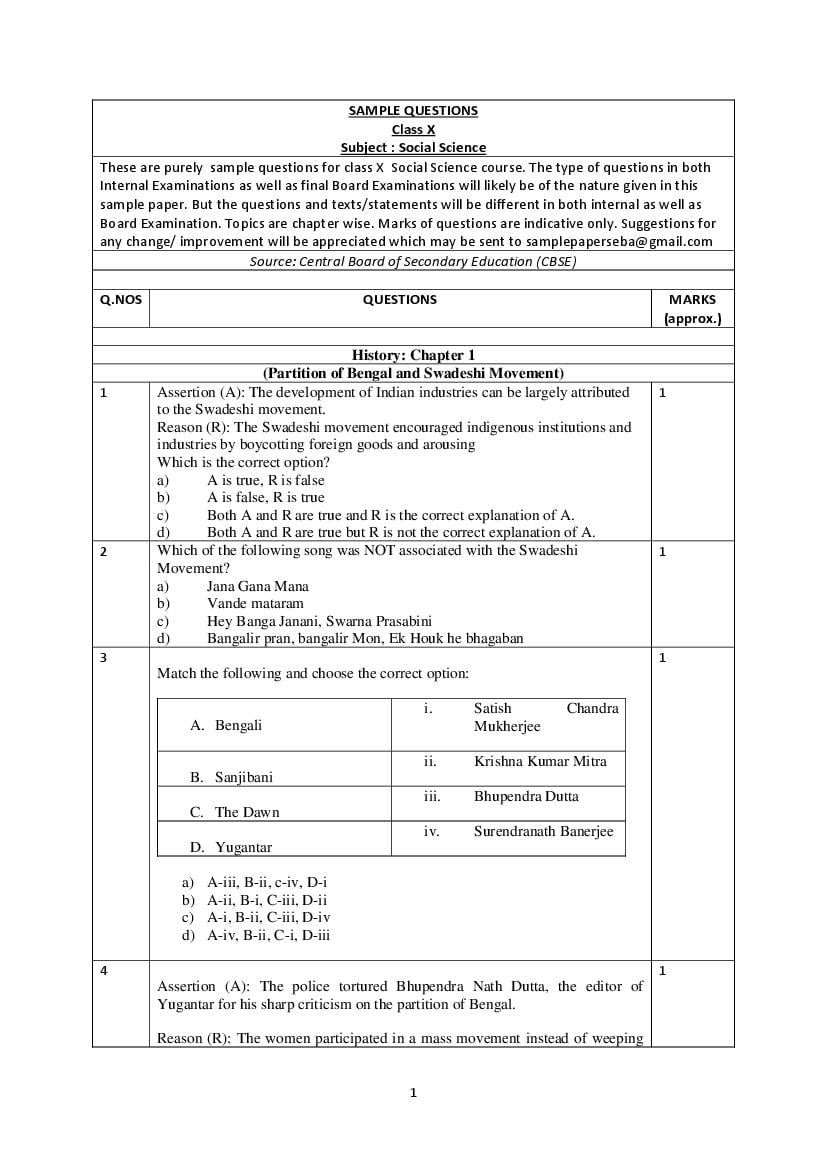
Page 1
Class X
Subject : Social Science
These are purely sample questions for class X Social Science course. The type of questions in both
Internal Examinations as well as final Board Examinations will likely be of the nature given in this
sample paper. But the questions and texts/statements will be different in both internal as well as
Board Examination. Topics are chapter wise. Marks of questions are indicative only. Suggestions for
any change/ improvement will be appreciated which may be sent to [email protected]
Source: Central Board of Secondary Education (CBSE)
Q.NOS QUESTIONS MARKS
(approx.)
History: Chapter 1
(Partition of Bengal and Swadeshi Movement)
1 Assertion (A): The development of Indian industries can be largely attributed 1
to the Swadeshi movement.
Reason (R): The Swadeshi movement encouraged indigenous institutions and
industries by boycotting foreign goods and arousing
Which is the correct option?
a) A is true, R is false
b) A is false, R is true
c) Both A and R are true and R is the correct explanation of A.
d) Both A and R are true but R is not the correct explanation of A.
2 Which of the following song was NOT associated with the Swadeshi 1
Movement?
a) Jana Gana Mana
b) Vande mataram
c) Hey Banga Janani, Swarna Prasabini
d) Bangalir pran, bangalir Mon, Ek Houk he bhagaban
3 1
Match the following and choose the correct option:
i. Satish Chandra
A. Bengali Mukherjee
ii. Krishna Kumar Mitra
B. Sanjibani
iii. Bhupendra Dutta
C. The Dawn
iv. Surendranath Banerjee
D. Yugantar
a) A-iii, B-ii, c-iv, D-i
b) A-ii, B-i, C-iii, D-ii
c) A-i, B-ii, C-iii, D-iv
d) A-iv, B-ii, C-i, D-iii
4 1
Assertion (A): The police tortured Bhupendra Nath Dutta, the editor of
Yugantar for his sharp criticism on the partition of Bengal.
Reason (R): The women participated in a mass movement instead of weeping
1
Page 2
Which is the correct option?
a) A is true, R is false
b) A is false, R is true
c) Both A and R are true and R is the correct explanation of A.
d) Both A and R are true but R is not the correct explanation of A.
5 3
During the Swadeshi Movement, artist nurtured nationalist feelings through
their art in Bengal. Illustrate with example.
6 1+2=3
Satishchandra Mukherjee called the University of Calcutta as the “house of
slaves” (Golam Khana). Based on it answer the following:
1) Whom did Mukherjee refer to as “slaves”?
2) Why were “they” called “slaves”?
7 The Daily Telegraph, London on 11th October 1907 wrote, “The Bengal 4
women are the most obstinate and most dangerous antagonist of English.”
What was the reason behind the above statement on Bengal women?
8 How did the Swadeshi movement help in the growth of national education? 4
9 In what ways did Rabindranath Tagore protest against the partition of Bengal 5
(1905)?
10
What were the anti-movement measures taken by the British to dominate 5
Swadeshi movement?
11 How did the national industries develop during Swadeshi movement? 5
History: Chapter 2
(Rise of Gandhi and the Freedom Movement of India)
1 1
Which of the following is an essential component of Satyagraha?
a) Non-Violence
b) Truth
c) Penance
d) All the above
2 1
In protest of which of the following event, Rabindranath Tagore renounced his
knighthood?
a) Partition of Bengal
b) Jallianwalla Bagh massacre
c) Khilafat Movement
2
Page 3
3 Consider the following events: 1
1. Kheda Satyagraha
2. Rowlatt Satyagraha
3. Khilafat Movement
4. Jallianwala Bagh massacre
Which of the following chronological order is correct?
i. 1234
ii. 1324
iii. 2431
iv. 1243
4 1
Which of the following is NOT a positive aspect of the non-cooperation
movement?
a) Promotion of Hindu-Muslim Unity
b) Revival of hand spinning and weaving
c) Boycott of Legislatures
d) Removal of untouchability
5 1
Which of the following statements about the Chauri Chaura incident are
correct?
a) Gandhi suspended the Non-cooperation movement.
b) Gandhi realised that people need training in discipline and
restraint.
c) All the Congress leaders supported the suspension of Non-
cooperation by Gandhi.
d) Gandhi instigated the Chauri Chaura violence
Options:
i) a,b
ii) a,c
iii) b,c
iv) b, d
6 1
Which of the following was established by Gandhi?
a) Indian National Congress
b) Natal Indian Congress
c) Dawn Society
d) None of the above
7 1+1=02
Who was the editor of the newspaper, Indian Opinion? What was the aim of
the paper?
3
Page 4
9 Why did the Second Round Table Conference, 1931 fail? 2
10 1+1=2
1. What was the reason behind the procession shown in the above
picture?
2. Why did Simon come to India?
11 5
“Gandhi’s activities in South Africa transformed him into a mature and idealist
leader.” What were those activities?
History: Chapter 3
History/Anti British Rising and Peasant Revolt in Assam.
1 In which year the British Government stopped slavery system in Assam? 1
A.1843
B.1826
C.1824
D.1841
2 Which of the following are the main causes for the failure of the Revolt of 1
1857 in Assam .
i. The number of rebels in Assam was very small.
ii. The rebels of Assam failed to maintain the secrecy of their
activity.
iii. The Assamese people who served under British
Government did not support the rebels.
iv. The rebel in Assam had no access to arms ammunitions as
was required
Options:
A. i, ii, iv
B. i, ii, iii
C. ii, iii, iv
D. i, ii, iii, iv
4
Page 5
‘Raijmells’ (People’s assembly)?
v. ‘Raijmell’ were political organization.
vi. ‘Raijmell’exalts the the power and positions of the public
and community.
vii. ‘Raijmell’ do their best to make the peasant and other
common people politically concious.
viii. Everyone irrespective of cast, creed, community and
religion could participate in the ‘Raijmell’.
Options:
A. i,ii, iv
B. i, iii, iv
C. ii, iii, iv
D. i,ii,iii and iv
4 Which revolt was raided for the first time in Assam, by the exploited 1
peasants against the British policy of economic exploitation.
A. Phuloguri Dhawa
B. Peasant revolt of Lachima.
C. Peasant revolt of Patharughat
D. Peasant revolt of Rangia.
5 The revolutionarists of revolt of 1857 in India wanted to end “The British 1
Rule in India for ever”. They wanted to place one leader as Moghul
Emperor. Who was he?
A. Bahadur Shah Zafar II
B. Nana Saheb.
C. Gani Khan Abdul Gafar Khan
D. Mangal Pandey
6 What kind of shift can be observed in Maniram Dewan’s relationship with the 2
British?
7 How did the British administration suppress the revolt of Phulaguri with a 3
strong hand?
8 Why did the peasant revolt of Patharughat begin ? Write the consequences of 1+3=4
the revolt.
9 Write the causes of the failure of the revolt of 1857. 5
10 Write about the revenue system implemented by the British in Assam. 5
History: Chapter 4
(Indian Freedom Movement and National Awakening in Assam)
1 1
Which of the following statements are correct about the Jaintia Revolt?
5
Page 6
b) Dolois were independent of the British administration
c) British banned community fishing
d) Dolois played an important role in the Jaintia Revolt.
Options:
i) a,b,c
ii) a,c,d
iii) b,c,d
iv) a,b,c,d
2 1
Which of the following statements on Assam Association is correct?
a) It was established to apprise the Government of the aspirations
of the people of Assam.
b) Till World War I, it was the most influential organisation.
c) It believed in direct confrontation with the authorities.
d) It merged with the Assam Provincial Congress Committee.
Options:
i) a,b,c
ii) a, c,d
iii) a,b,d
iv) a,b,c,d
3 1
Consider the following associations. Choose the correct chronological order
from the following options.
a) The Muslim League
b) The Ahom Sabha
c) Indian National Congress
d) Jorhat Sarbajanik Sabha
Options:
i) d, c, b, a
ii) c,d, a,b
iii) c, a, d,b
iv) d,c, a,b
4 1
Which of the following observation is NOT true about the Quit India
Movement of 1942?
a) It was spontaneous.
b) Major Congress leaders were arrested
c) It was non-violent.
d) Jyotiprasad Agarwala carried out underground activities.
6
Page 7
Assertion (A): Gandhi Launched the Quit India Movement in 1942.
Reason (R): The Quit India was a mass movement.
a)A is true, R is false
b) A is false, R is true
c)Both A and R are true and R is the correct explanation of A.
d)Both A and R are true but R is not the correct explanation of A.
6 2
How Phulaguri Dhawa turned into a mass revolt?
7 How did the British perceive the Phulaguri Dhawa? Was that an accurate 1+2=3
perception?
8 Who was John Berry White? Why do the people of Assam remember him? 1+1=2
9 How did Maniram Dewan lead the Revolt of 1857 in Assam? 3
10 Analyze the problems that Assam had to face immediately after the partition of 5
India.
11 What was the purpose of establishing Tilak Memorial School in Guwahati in 2
1921?
12 When did the British abolish slavery in Assam? What was its impact on the 1+2=3
slaves?
13 The deficit budget (1857-58) of the British Government in Assam rose to 14 4
million pounds. To make up the budget what measures were introduced by the
British?
History: Chapter 5
Cultural Heritage of India and North East Region
1 1
Assertion (A): India has a rich and diverse cultural heritage.
Reason (R): Different hoards of people – Proto-Austroloids, Austrics,
Mongoloids, Aryans migrated and settled down in India.
a)A is true, R is false
b) A is false, R is true
c)Both A and R are true and R is the correct explanation of A.
d)Both A and R are true but R is not the correct explanation of A.
2 1
Match the following:
A.Kautilya i.Rajtarangini
B. Kalhan ii.Saptakanda Ramayana
C. Madhab Kandali iii. Hastibidyarnava
D.Sukumar Borkaith iv. Arthasastra
7
Page 8
a) A- iv, B-ii, C-i, D-iii
b) A-iv, B-iii, C-i, D-ii
c) A-iv, B-i, C-ii, D-iii
d) A-i, B-ii, C-iii, D-iv
3 1
Observe the following statements regarding Bihu. Find out the correct
statement/s.
a) Bihu has not changed over the years.
b) Ahom King Rudra Singha first organized Bihu in a Public place.
c) During British rule, some conservative Assamese people looked
down upon Bihu.
Options:
i) a,b
ii) b,c
iii) a,c
iv) a,b,c
4 1
The dance form shown in the picture belongs to which of the following states?
a) Arunachal Pradesh
b) Mizoram
c) Manipur
d) Nagaland
5 Mention two contributions of Austrics to Indian culture. 2
6
What are the factors that create unity among cultural diversity in India ? 3
7
How does the geography of India play a role in creating cultural diversity of 4
India?
8 4
“Yoga is a traditional Indian culture .It is a gift to the entire humanity”.Write
few lines in support of this .
8
Page 9
“Indus valley civilization has a significant contribution towards formation of
Indian culture and Hindu religion.” Write a few lines in support of this .
10 India despite being a diverse country has continued to be united. What has 5
contributed to keeping the ‘unity in diversity’ a living spirit?
Geography: Chapter 1
Economic Geography – Subject Matter and Resource
1 The materials found on the earth, which are no way useful or 1
harmful to man are called –
A. Neutral Stuff
B. Resistance
C. Resource
D. Wealth
2 The resources which are found everywhere or available in all places 1
on the earth are called –
A. Renewable Resource
B. Ubiquitous Resource
C. Exhaustible Resource
D. International Resource
3 Which government organisation is responsible for formulation of 1
laws related to environment protection and conservation of natural
resources in India?
A. Centre for Science and Environment (CSE)
B. Wildlife Trust if India (WTI)
C. Greenpeace India
D. Indian Council of Forestry Research and Education (ICFRE)
4 Which is the example of an alternative resource? 1
A. Synthetic rubber in place of natural rubber
B. Coal in place of hydro-electricity
C. Mineral oil in place of bio-fuel
D. Cotton fibre in place of synthetic fibre
5 ‘Education’ is considered as which category of resource? 1
A. National Resource
B. International Resource
C. Individual Resource
D. Natural Resource
6 Following are the names of few major productive occupations / 3
activities developed in different regions of the earth’s surface.
Arrange these occupations with it’s appropriate region in the blank
space of the given table.
9
Page 10
Fishing, Tea/Coffee Plantation, Forestry
Sl. No. Region Major Activity
1 Grass Land
2 Plateau Region
3 River plain
4 Hill Slopes
5 Coastal Area
6 Mountain
7 Following are some of the examples of resources. Arrange these 4
resources into two categories viz. ‘Renewable’ and ‘Non-Renewable’
resources.
Gold, Atmosphere, Air, Coal, Iron-Ore, Mineral Oil,
Sunlight, Temperature
8 ‘Use of resources and its conservation are closely associated’. 4
Explain the statement.
9 According to Zimmermann, to become a resource there should be 2
two properties. Mention the two properties.
10 Mention five (5) measures of resource conservation with brief 5
explanation.
11 “Resource is dynamic” – Explain the statement. 5
12 Following are the examples of economic activities or occupations of 4
man. Classify them under the four (4) major categories of economic
activities, i.e. Primary, Secondary, Tertiary and Quaternary
Occupation.
Manufacturing Works; Bank; Marketing; Mineral resource
collection; Retail Selling; Forest Resource Collection; Education
and Research; Repairing Works.
13 Following are some of the subject matters of Economic Geography 3
and Resource Geography. Classify them under these two branches in
the table given below.
10
Page 11
resources; It studies about human activities in terms of space and
time; It is a branch of Human Geography; It is just a part of
Economic Geography; It’s scope is narrow; It’s scope is wide in
nature.
Sl. No. Economic Geography Resource Geography
1
2
3
14 Following are some of the characteristics of ‘Renewable’ and ‘Non- 3
Renewable’ resources. Classify them under these two categories of
resources in the table given below.
These resources can be kept unexhausted after use through the
process of regeneration; These resources cannot be regenerated
after use and get completely exhausted after use; These resources
originate very easily on the earth; Once used, such resources get
exhausted forever; Sunshine, air, water, animals, human beings, etc
are examples of this resource; Coal, mineral oil, natural gas, iron
ore, etc are examples of this resource.
Sl. Renewable Resource Non-Renewable Resource
No.
1
2
3
15 4
Sl. No. Organisations Full Form Role/Responsibility
1 IUCN
2 WWF
3 CSE
4 MOEF
The above table shows the name of few organisations associated
with resource conservation. Write the full forms and one role /
responsibility of each organisation related to resource conservation
in the blank boxes of the table.
11
Page 12
‘Human Resource’.
Sl. No. Man-made Resource Human Resource
1
2
Geography: Chapter 2
Environment and Environmental Problems
1 Which one of the following gases is not responsible for global 1
warming?
A. Carbon-di-oxide
B. Nitrous Oxide
C. Methane
D. Ozone
2 The seas and oceans have formed the earth’s hydrosphere which 1
covers about ________ of the earth”s surface.
A. 30%
B. 35%
C. 71%
D. 75%
3 The elements which have life are called _________________? 1
A. Abiotic Elements
B. Biotic Elements
C. Ecological Elements
D. Atmospheric Elements
4 Which of the following options represent potential measures that can be 1
taken to mitigate the threats posed on the tiger population and biodiversity?
i. Banning hunting, giving legal protection to their habitats, and restricting
trade in wildlife
ii. Prohibiting the visit of public into forest area.
iii. Establishing wildlife sanctuaries and National Parks
iv. Converting forests into Reserved and Protected forests
Options:
a. Statement i and ii are correct.
b. Statement ii, iii & iv are correct
c. Statement ii is correct.
d. Statement (i), (iii) & (iv) are correct.
5 Match the following : 1
12
Page 13
A. a-I, b-IV, c-III, d-II
B. a-II, b-I, c-IV, d-III
C. a-IV, b-I , c-IV, d-II
D. a-I, b-IV, c-II, d-III
6 Which one of the following conferences was convened to discuss 1
environmental protection and socio-economic development at the
global level in 1992?
A. Kyoto Protocol
B. Montreal Protocol
C. Rio de Janeiro Earth Summit
D. World Summit on Sustainable Development
7 Which one of the following human activities has contributed 1
significantly in land degradation?
A. Deforestation
B. Crop rotation
C. Shelter belts
D. Ploughing
8 Write three (3) causes of increase in the atmospheric temperature
and mention two (2) suitable measures to check global warming.
3+2=5
9 “Environment is an outcome of the interaction among land, water, 5
air and life” – Peter Haggett
Elaborate the above statement by mentioning the relation among
the four major components of environment.
10
Write three (3) major causes of desertification and
Mention two (2) possible measures to stop desertification. 3+2=5
11 Some environmental problems are mentioned in the box given 3
below. Classify these problems into three (3) different groups of
environmental problems as mentioned in the blank table given
below.
Land pollution created by a small scale industry; global warming;
problem of water pollution in a vast industrial area; melting of
polar ice; drinking water shortage in a city; problem of soil erosion
in a river basin; rise of sea water level; bank erosion problem
created by a river; desertification; landslide in a hill range
13
Page 14
1 Local Problem
2 Regional Problem
3 Global Problem
12 Some sources of pollution are mentioned in the box given below. 3
Classify these problems into three (3) major types of pollution as
mentioned in the blank table given below.
Domestic wastes; Emission of vehicles; Use of chemical fertilisers
and pesticides; Oil Spills; volcanic eruption; deposit of refused
plastics, metals and broken glass; Forest fires; Industrial effluents;
Erosion and deforestation
Sl. No. Types of Pollution Sources of Pollution
1 Air Pollution
2 Water Pollution
3 Soil Pollution
13 ‘Use of resources and its conservation are closely associated’. 4
Explain the statement.
14 Following are the facts and information about some of the 3
environmental issues. Classify them under the three (3) major
categories of environmental problems, i.e. Pollution, Desertification
and Global Warming.
The increased green-house gases like Carbon dioxide, Methane and
Nitrous oxide trap the solar energy and Earth’s temperature is
rising abnormally, which resulted melting of polar snows, rising of
sea level, fall of crop output, loss and extinction of plants and
animals, etc. Deforestation, burning of fossil fuels, use of chemical
fertilisers, etc resulted increase of pollutants like Zinc, Sulpher di-
Oxide, Carbon-monoxide, etc which resulted pollution of land, air
and water in large scale. Human activities like overgrazing,
expansion of agriculture and deforestation are responsible for
14
Page 15
15 Which is the most polluted river of India? Mention 3 factors 1+3=4
responsible for pollution of water of this river.
16 “According to some World Health Organization (WHO) findings, 1+3=4
noise pollution is one of the largest environmental problems both
for human health and the environment.”
1) What do you understand by ‘noise pollution’?
2) What are the major sources/causes of noise pollution?
Geography: Chapter 3
Geography of World
1 Bering-Okhotsk-Japan-Philippine are the four (4) major ........... under 1
the Pacific Ocean?
A. Islands
B. Ridge
C. Sea
D. Oceanic Trenches
2 Which is the smallest ocean in the world? 1
A. Indian Ocean
B. Southern Ocean
C. Atlantic Ocean
D. Arctic Ocean
3 Which is the lowest populated continent in the World as per 2014 1
estimates?
A. Oceania
B. South America
C. Africa
D. North America
4 How many Integrated Infrastructure Development Centre (IIDC) are 1
there in Assam?
A. 10
B. 12
C. 13
D. 11
5 Death Valley of North America is lowest place of the continent with 1
a depth of ……… meter below sea level.
A. 68 meter
B. 86 meter
C. 85 meter
D. 65 meter
6 Column A represents ‘Country Name’ and column B represents 1
‘Capital’.
15
Page 16
matches the country name and it’s capitals.
Column A Column B
Country Name Capital
a) Denmark i) Canberra
b) Kenya ii) Cairo
c) Egypt iii) Copenhagen
d) Australia iv) Bern
e) Switzerland v) Nairobi
A. a-iii; b-v; c-ii; d-i; e-iv
B. a-ii; b-iv; c-i; d-iii; e-v
C. a-i; b-ii; c-iii; d-iv; e-v
D. a-iv; b-v; c-ii; d-iii; e-i
7 Which physical elements/features determine the boundaries 2+1=3
between the continents? Why is it not possible to determine the
exact boundaries of all the oceans in the earth?
8 What is the difference between sea and ocean? Answer with 4
examples.
9 Write the name of the physical features /elements, which determine 2
the boundaries between the continents mentioned below.
Sl. Continents Physical
No. Features/Elements
1 North America – South America
2 Europe and Africa
3 Asia and Africa
4 Europe and Asia
10 “Asia is the largest by size and the highest populated continent with 5
a population of about 430 crores of the World. It has diverse
physical features like mountains, plateaus, rivers valleys, low-lands,
coastal plains, islands, deserts, etc. But all the regions of Asia are not
equally developed. “
Explain the above statement on the basis of your own point of view.
11 Based on the features given in the following table, compare the 5
Indian Ocean and the Atlantic Ocean. Write your responses in the
table.
Sl. No. Features Indian Ocean Atlantic Ocean
1 Location (Boundary)
2 Land Area
3 Average Depth
4 Major Islands (any 2)
5 Major seas in the
ocean (any 2)
16
Page 17
evidences to support the above statement with data in comparison
to other continents.
13 “Ninety (90) percent of the World’s total population concentrate in 1+1=2
the northern hemisphere”.
Write at least 2 (two) evidence to support the above statement with
fact and figures.
Geography: Chapter 4
Geography of Assam
1 The National Highway No. 31 starts and ends in which two places? 1
A. Pancharatna (Goalpara) – Saikhowaghat (Tinsukia)
B. Basirhat (West Bengal) – Amingaon (Kamrup)
C. Makum (Tinsukia) – Lekhapani (Golaghat)
D. Nagaon – Nagaland Border
2 Column A represents two major types of cultivation in the hilly and 1
mountain regions. Whereas, column B represents different
characteristics of these two types of cultivation.
Look at the table carefully and choose the option that correctly
matches the characteristics (column B) with the types of cultivation
(column A).
Column A Column B
Types of Cultivation Characteristics
i) It’s a mixed type of
cultivation, but production is
(a) Jhum Cultivation limited.
ii) It’s temporary with
traditional method of
cultivation.
iii) It’s a permanent and modern
scientific method of
(b) Terrace cultivation.
Cultivation iv) After few years, shifts to
another new plot for
cultivation.
v) It’s eco-friendly, forest areas
can be protected.
vi) Usually one-crop is cultivated
in this type of cultivation and
production is more.
A. a-i,ii,iv; b-iii,v,vi
B. a-iii,v,vi; b-i,ii,iv
C. a-v,i,iv; b-iii,vi,ii
17
Page 18
3 Which among the following statements are TRUE about the 1
economy of Assam?
i) Assam produces about 25% of total natural gas
production of India.
ii) More than 63 percent of the working population of Assam
are directly or indirectly engaged in the agricultural
sector.
iii) Assam produces about 53% of total tea production of
India.
iv) At present, about 55 industrial estates /areas have been
established in different districts of Assam.
v) About 35% of total population of Assam belongs to the
youth age group of 15-34 years.
vi) Assam produces about 66 percent of total Eri production
of India.
A. ii, iv, vi
B. i, iii, v
C. i, ii, iv
D. ii, iii, v
4 Presently, Assam is one of the states of India which is full of ethnic 1
and linguistic diversities. Various groups of people migrated to
Assam from different regions in different time period.
In the following table Column A represents major communities of
Assam and Column B represents ethnic groups and source region of
migration of these major communities. Look at the table carefully
and choose the option that correctly matches the ‘Major Community’
and its ‘Ethnic group’ and ‘Source Region of Migration’.
Column A Column B
Major Ethnic Groups / Source Region of Migration
Community
a) Khasis- i) Mangoloid Group of people, migrated
Jaintias from China-Myanmar
b) Islamic ii) Austric Group of people, migrated from
People Chotanagpur Plateau of Central India.
c) Bodo- iii) Mongoloid Group of people migrated
Mishing from Central Asia (Tibet)
d) Brahmins iv) Indo-Aryan group of people, migrated
from Turk-Afghan region.
e) Ahoms v) Austric Group of people migrated from
South-East Asia.
f) Tea Tribes vi) Caucasoid Group of people, migrated
from Kashmir (North India).
18
Page 19
B. a-vi; b-v; c-ii; d-iv; e-iii; f-i
C. a-ii; b-iii; c-v; d-i; e-vi; f-iv
D. a-i; b-iv; c-iii; d-ii; e-v; f-vi
5 Which is NOT an agro-based industry? 1
A. Rubber Industry
B. Paper Industry
C. Eri Silk Industry
D. Synthetic Fibre Industry
6 “Agriculture is the foundation of Assam’s economy and the 3
agricultural sector is the main driving force of it’s economy”.
What is the implication of the above statement? Explain in 50-60
words.
7 “The distribution of population and settlement is not uniform in all 4
the regions or places in Assam”.
Write four (4) major factors responsible for the uneven distribution
of population in Assam.
8 “The tribal people of hill regions of Assam practice Jhum or shifting 5
cultivation”.
Write briefly about the Jhum or shifting cultivation carried out in
the hilly region of Assam?
9 Based on the features given in the following table, compare the 5
Brahmaputra Valley and the Barak Valley. Write your responses in
the table.
Sl. No. Features Brahmaputra Barak Valley
Valley
1 Geographical Area
2 Population (2011)
3 Population Density
4 Major tributaries
5 Major Hills
10 The list of few tribes of Assam is given in the following table. Write 3
the name of the districts where these tribal populations are
concentrated most in the blank space provided in the table.
Sl. No. Tribes of Assam Concentrated districts
1 Karbi
2 Garo
19
Page 20
4 Dimasa Kachari
5 Deori
6 Barman
11 “Assam Tourism Industry has completed about 50 years 2+2=4
successfully. But, in spite of immense scope and potentiality for
development of tourism industry in Assam, this sector is not yet
properly developed in the state”.
1) On the basis of above information provided above, mention
two (2) factors, which helped in the development of tourism
industry in Assam.
2) Write two (2) factors why tourism industry in Assam is not
properly developed.
12 “Due to little progress in the energy and transport sector in recent 2+2=4
period, the environment of industrialisation has been gradually
improving in the state of Assam”.
Write at least 2 (two) evidence to support the above statement with
fact and figures.
13 Based on the features given in the following table, write your 5
responses in the respective column ‘facts’ in the table.
Sl. Features Facts
No.
1 Total geographical area of Assam
2 Total population of Assam (2011
census)
3 Total number of districts in Assam
4 Total number of Integrated
Infrastructure Development Centres
(IIDC) in Assam
5 Mega Food Park of Assam
14 Draw a sketch map of Assam and locate therein the following (any 3
three):
- Bamboo Technology Park,
- Jute Park,
- Tea Park,
- Biotechnology Park,
- Software Technology Park
20
Page 21
Indian Democracy
1 In which year did the Cabinet Mission come to India? 1
a. March,1946
b. March,1947
c. February,1946
d. July,1945
2 How does Judiciary act as an umpire in a federal nation? 1
A. Judiciary rules over Centre and State
B. Centre and Judiciary work collectively
C. Courts can change structure of Constitution
D. Courts use the power to interpret the Constitution
3 Identify the administrative system of Indian Government with the help of 1
the following information.
Power shared between Central and State Governments to Local
Governments.
It is called as a third tier of the Government.
The State Governments are required to share some powers and
revenue with them.
Select the appropriate option from the following.
A. Federal system
B. Unitary Federal system
C. Decentralised system
D. Unitary system
4 Which of the following options prove that India is a quasi-federal state?
I. More powers with Centre
II. Residuary subjects with Centre
III. Equal subjects with Centre and States
IV. Currency and Railways with Centre
Options:
A. I, III & IV
B. I, II & IV
C. II, III & IV
D. II, III & IV
5 Identify the correct statement/s about the theory of Federalism in the Indian 1
Constitution.
I. The Constitution declared India as a Union of States.
II. Sharing of power between the Union Government and the State
governments is basic to the structure of the Constitution.
III. It is easy to make changes to this power sharing arrangement.
IV. The Parliament can on its own change this arrangement.
Options:
A. I &II
21
Page 22
C. I & III
D. II & IV
6 When and why did the British send the Cabinet Mission to India? 1+2=3
7 Under whose initiative, the Constituent Assembly was formed? When did 1+1=2
the Constituent Assembly hold its first sitting?
8 What does the words,”We the people of India”in the Preamble mean? 2
9 “India is a Sovereign State” Explain 2
10 From which Latin word, the English term “Federation” has been derived? 1+2=3
What do you mean by a Federal State?
11 “ The Political System of India is Federal in form but Unitary in spirit”. 3
Explain.
12 Write about the provision of Citizenship of USA and that of India. 3
13 What do you mean by Parliamentary Democracy? Which Indian Act had 2
introduced Limited Parliamentary Democracy in pre-independence India?
14 How is the Indian Parliament constituted? 4
Political Science: Chapter 2
International Organisation- The United Nations Organisation And Others
1 On which date is the UN day observed all over the world? 1
a. 24th October
b. 24th November
c. 26th October
d. 26th November
2 Which among the following is /are the organs of UNO? 1
i.General Assembly
ii.Economic and Social Council
iii.Secretariat
iv.All of the above
3 Which article of the UN Charter refers to the formation of the Trusteeship 1
Council?
a. Article 76
b. Article 55
c. Article 97
d. None of the above
4 Which organ is the Judicial Organ of the UNO? 1
a. International Court of Justice
b. Secretariat
c. General Assembly
d. None of the above
5 Which organ of the UNO executes and implements all the decisions taken 1
by the UNO?
a. Secretariat
b. General Assembly
c. Security Council
d. None of the above
6 How many countries are members of the UNO at present? Where is the 2
Headquarters of the UNO situated?
7 How many Temporary members are elected to the Security Council? Who 2
22
Page 23
8 When and Why was the League of Nations formed? 3
9 What is meant by Human Rights? Who adopted the Human Rights 2
Declaration?
10 Discuss the bold steps taken by UNO for World Peace. 3
11 In which year and why was the Human Rights Commission of the UNO set 2
up?
12 In which year and who formed the National Human Rights Commission in 2
India? When did this Commission become an Act?
Economics: Chapter 1
Money and Banking
1 Read the data given below and answer the question. 1
Educational Achievement of Rural Population of Uttar Pradesh
As per the data given above who has the least percentage of literacy rate in
rural population?
a. Male
b. Children
c. Male& Female
d. Female
2 Select the correct set of alternatives considering the following statements 1
relating Cheque Money.
A. Cheque money possess general acceptability as a medium of
exchange
B. An individual may refuse to accept payment in cheque.
C. A cheque is a legal tender money
i. Statements A and B
ii. Statements A and C
iii. Statements A, B and C
iv. Statements B and C
3 “The Central Bank examines the account of all the member banks.” Why? 1
i. Because the Central bank is the bankers’ bank.
ii. Because the Central Bank issues currency.
iii. Because the Central Bank controls the volume of credit.
iv. The Central bank functions as the clearing house of the member
banks
23
Page 24
Figure A
Figure B
Figure C
Q. From the given set of figures, identity the item/items issued and
circulated by the Reserve Bank of India only.
1. C only
2. A and C only
3. B and C only
4. A, B and C
5
“The Central Bank is the financier, advisor and agent to the government.”
Which bank in India performs this function as the Central bank?
1. Reserve Bank of India
2. Central Bank of India
3. State Bank of India
4. NABARD
6 Mention any two problems associated with ‘Coinage’ as a medium of 2
exchange.
7 How do the Central Bank functions as the bankers’ bank? 3
8 How do the Central bank functions as the clearing house of the member 2
banks?
24
Page 25
credit money?
10 Write any two differences between legal tender money and non-legal 2
tender
money.
12 “Money must have liquidity” What does the term Liquidity indicate here? 1+3=4
Also state any 2 other characteristics of money.
Economics: Chapter 2
Economic Development
1 Two statements are given in the question below as Assertion (A) and 1
Reasoning (R). Read the statements and choose the appropriate option.
Assertion (A): Human Development mentions how much socio-
economic development has happened in a country.
Reason (R): Comparison of national income of two countries explains
Human Development Index.
Options:
A. Both A and R are true, and R is the correct explanation of A.
B. Both A and R are true, but R is not the correct explanation of A.
C. A is true but R is false.
D. A is false but R is true.
2 The process of integration between different countries is called as . 1
a. Privatization
b. Globalization
c. Liberalization
d. Competition
3 Identify the correct set of alternatives considering the statements 1
mentioned below:
A. Economic Development is a broader concept than Economic
Growth
B. Economic Growth aims at sustainable development
C. Economic Growth is basically a quantitative concept.
D. Economic Development is a quantitative concept only
1. A,C
2. A,B
3. A,C,D
4. A,B,C
4 What does Green Revolution imply? 1
1. The increase in agricultural output brought about by the
application of modern technology to agriculture.
2. Planned afforestation programme initiated by the Central
government as a pollution control measure
3. The rise in industrial output as result of increased application of
modern technology.
4. Increase in agricultural output brought about by the application
of organic methods of farming.
25
Page 26
the term ‘Decentralisation of Power’ imply?
1. Only the people participate in different stages of policy making.
2. Only the Chairman of Planning Commission participate in
different stages of policy making.
3. Only the Council of Ministers participate in different stages of
policy making
4. Only the President of India participate in different stages of
policy making.
6 Mention the two parts of the five-year planning period in India. Also 2+2=4
state a feature of Indian economy for each part of the planning period.
7 Mention any three objectives of five-year planning in India during the 2
pre-reform period.
8 Mention any three examples of activities that ensure increased volume 3
of output or income in the economy but economic development is
compromised.
9 Mention any three factors responsible for unsatisfactory rate of growth 3
of Indian economy during the period from 1951-52 to 1990-91?
10 State any three factors responsible for introduction of liberalization, 3
privatization and globalization measures in India in the year 1991?
26
Document Details
| Board / Org | Assam Board |
| Exam | Class 10 |
| Type | Sample Paper |
| Pages | 26 |
| Updated | 29 Aug 2026 |