SEBA Class 10 Sample Paper Maths
Finished viewing? Save it for later —
Download SEBA Class 10 Sample Paper Maths (PDF · 23 pages)About SEBA Class 10 Sample Paper Maths
SEBA Class 10 Sample Paper Maths is available here for free download. Published by Assam Board for Class 10, this sample paper can be viewed online or downloaded as a PDF (23 pages). Candidates preparing for Class 10 can use SEBA Class 10 Sample Paper Maths to understand the exam pattern, the type of questions asked, and the overall difficulty level.
Frequently Asked Questions
How can I download SEBA Class 10 Sample Paper Maths?
Open this page and click the Download button to save SEBA Class 10 Sample Paper Maths as a PDF. It is completely free on AglaSem Docs.
Is SEBA Class 10 Sample Paper Maths free to download?
Yes. SEBA Class 10 Sample Paper Maths can be viewed online and downloaded as a PDF free of cost on AglaSem Docs.
How many pages does SEBA Class 10 Sample Paper Maths have?
SEBA Class 10 Sample Paper Maths contains 23 pages, which you can read online or download together as a single PDF.
Where can I find more Class 10 study material?
You can find more Class 10 question papers, sample papers, syllabus, and answer keys on AglaSem Docs.
SEBA Class 10 Sample Paper Maths – Text
Read the full text of this sample paper below — useful to quickly search, copy and reference the content online without downloading the PDF.
📄 View text version (23 pages)
Page 1
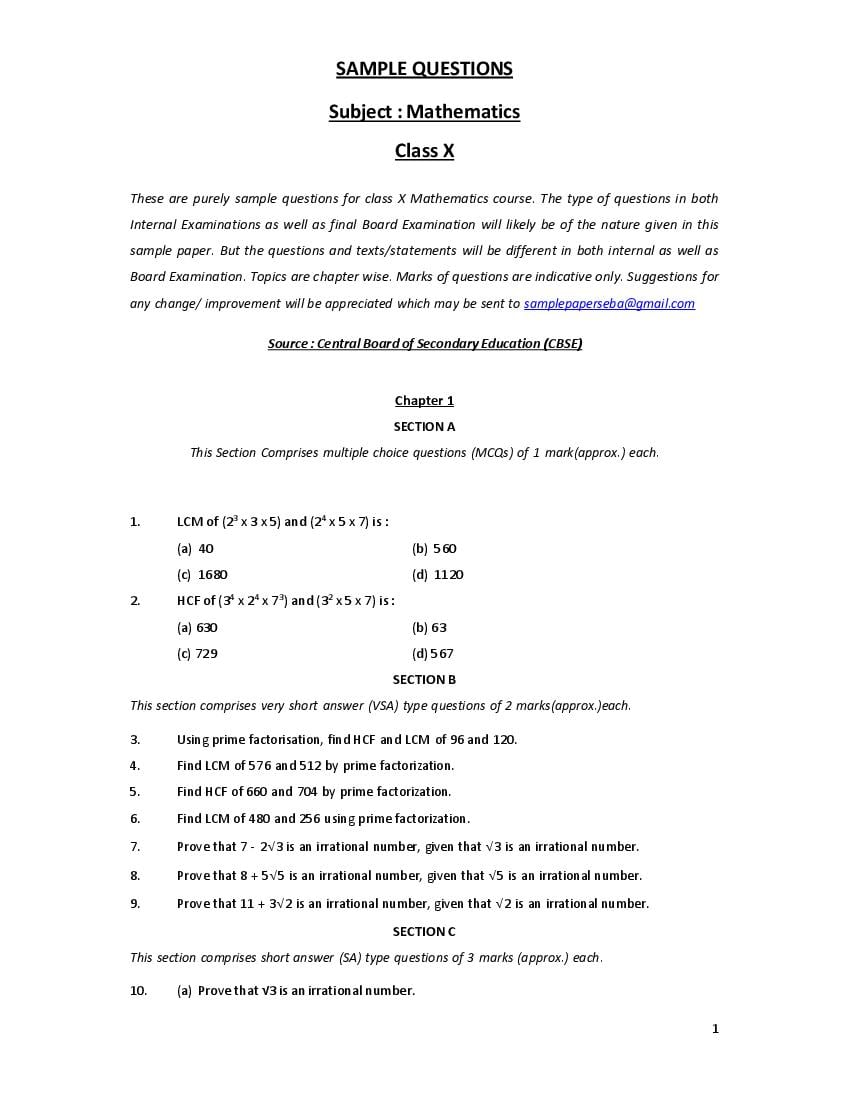
Subject : Mathematics
Class X
These are purely sample questions for class X Mathematics course. The type of questions in both
Internal Examinations as well as final Board Examination will likely be of the nature given in this
sample paper. But the questions and texts/statements will be different in both internal as well as
Board Examination. Topics are chapter wise. Marks of questions are indicative only. Suggestions for
any change/ improvement will be appreciated which may be sent to [email protected]
Source : Central Board of Secondary Education (CBSE)
Chapter 1
SECTION A
This Section Comprises multiple choice questions (MCQs) of 1 mark(approx.) each.
1. LCM of (23 x 3 x 5) and (24 x 5 x 7) is :
(a) 40 (b) 560
(c) 1680 (d) 1120
2. HCF of (34 x 24 x 73) and (32 x 5 x 7) is :
(a) 630 (b) 63
(c) 729 (d) 567
SECTION B
This section comprises very short answer (VSA) type questions of 2 marks(approx.)each.
3. Using prime factorisation, find HCF and LCM of 96 and 120.
4. Find LCM of 576 and 512 by prime factorization.
5. Find HCF of 660 and 704 by prime factorization.
6. Find LCM of 480 and 256 using prime factorization.
7. Prove that 7 - 2√3 is an irrational number, given that √3 is an irrational number.
8. Prove that 8 + 5√5 is an irrational number, given that √5 is an irrational number.
9. Prove that 11 + 3√2 is an irrational number, given that √2 is an irrational number.
SECTION C
This section comprises short answer (SA) type questions of 3 marks (approx.) each.
10. (a) Prove that √3 is an irrational number.
1
Page 2
seconds and 108 seconds respectively. If they change simultaneously at 7 a.m., at what
time will they change together next ?
Chapter 2
SECTION A
This Section Comprises multiple choice questions (MCQs) of 1 mark(approx.) each.
11. The number of polynomials having zeroes -1 and 2 is :
(a) exactly 2 (b) only 1
(c) at most 2 (d) infinite
12. The number of polynomials having zeroes -3 and5 is :
(a) only one (b) infinite
(c) exactly two (d) at most two
2
13. If one zero of the quadratic polynomial kx + 3x + k is 2, then the value of k is :
(a) -6/5 (b) 6/5
(c) 5/6 (d) -5/6
SECTION E
This section comprises case study based questions of 4 marks(approx.) each.
14. Rainbow is an arch of colours that is visible in the sky after rain or when water droplets are
present in the atmosphere. The colours of the rainbow are generally, red, orange, yellow,
green, blue, indigo and violet. Each colour of the rainbow makes a parabola. We know that
2
any quadratic polynomial p(x) = ax + bx + c (a ≠ 0) represents a parabola on the graph paper.
Based on the above, answer the following questions :
(i) The graph of a rainbow y = f(x) is shown in the figure. Write the number of zeroes of the
curve.
(ii) If the graph of a rainbow does not intersect the x-axis but intersects y-axis at one point,
then how many zeroes will it have?
2
Page 3
(iii) (a) If a rainbow is represented by the quadratic polynomial p(x) = x + (a + 1) x + b,
whose zeroes are 2 and - 3, find the value of a and b.
OR
2
(iii) (b) The polynomial x - 2x - (7p + 3) represents a rainbow. If - 4 is a zero of it, find the
value of p.
15. In a pool at an aquarium, a dolphin jumps out of the water travelling at 20 cm per second. Its
2
height above water level after t seconds is given by h = 20t - 16t .
Based on the above, answer the following questions :
2
(i) Find zeroes of polynomial p(t) = 20t - 16t
(ii) Which of the following types of graph represents p(t) ?
(iii) (a) What would be the value of h at t = 3/2? Interpret the result.
OR
(iii) (b) How much distance has the dolphin covered before hitting the water level again ?
3
Page 4
SECTION A
This Section Comprises multiple choice questions (MCQs) of 1 mark(approx.) each.
2 2
16. The solution of the pair of equations x + y = a + b and ax - by = a – b is :
(a) x = b,y= a (b) x = -a , y = b
(c) x = a , y = b (d) x = a, y = - b
17. The pair of equations ax + 2y = 9 and 3x + by = 18 represent parallel lines, where a, b are
integers, if :
(a)a = b (b)3а = 2b
(c)2a = 3b (d)ab = 6
18. If the lines represented by equations 3x + 2my = 2 and 2x + 5y + 1 = 0 are parallel, then the
value of m is :
(a) 2/5 (b) – 5/4
(c) 3/2 (d) 15/4
SECTION C
This section comprises short answer (SA) type questions of 3 marks(approx.) each.
19. (a) Sabina went to a bank ATM to withdraw ₹ 2,000. She received ₹ 50 and ₹ 100 notes only.
If Sabina got 25 notes in all, how many notes of ₹ 50 and ₹ 100 did she receive ?
OR
(b) Five years ago, Amit was thrice as old as Baljeet. Ten years hence, Amit shall be twice as
old as Baljeet. What are their present ages?
20. (a) Divide 16 into two parts such that twice the square of the greater part, exceeds the
square of the smaller part by 164.
OR
(b) A motor boat whose speed is 18 km/h in still water takes 1 hour more to go 24 km
upstream, than to return to the same point. Find the speed of the stream and total time
of the journey.
21. Two people are 16 km apart on a straight road. They start walking at the same time. If they
walk towards each other with different speeds, they will meet in 2 hours. Had they walked in the
same direction with same speed as before, they would have met in 8 hours. Find their walking
speed.
4
Page 5
digits is 18 less than the given number. Find the given number.
23. A fraction becomes 1/3 when 1 is subtracted from the numerator. It becomes 1/4 when 8 is
added to the denominator. Find the fraction.
SECTION D
This section comprises long answer (LA) type questions of 4/5 marks(approx.)each.
24. (a) A train travels at a certain average speed for a distance of 54 km and then travels a
distance of 63 km at an average speed of 6 km/h more than the first speed. If it takes 3
hours to complete the journey, what was its first average speed?
OR
(b) Two pipes together can fill a tank in 15/8 hours. The pipe with larger diameter takes 2
hours less than the pipe with smaller diameter to fill the tank separately. Find the time in
which each pipe can fill the tank separately.
Chapter 4
SECTION A
This Section Comprises multiple choice questions (MCQs) of 1 mark(approx.) each.
25. A quadratic equation whose roots are (3-√2) and (3 + √2) is :
2 2
(a) x - 6x + 7 = 0 (b) x +6x + 7 = 0
2 2
(c) 9x - 2 = 0 (d) x - 7 = 0
26. A quadratic equation whose roots are (2 + √3) and (2 - √3) is :
2 2
(a) x - 4x + 1 = 0 (b) x + 4x + 1 = 0
2 2
(c) 4x - 3 = 0 (d) x - 1 = 0
The two roots of the equation 3x - 2√6 x + 2 = 0 are :
2
27.
(a) real and distinct (b) not real
(c) real and equal (đ) rational
2
28. The value(s) of k for which the roots of quadratic equation x + 4x + k = 0 are real, is :
(a) k ≥ 4 (b) k ≤ 4
(c) k ≥ -4 (d) k ≤ -4
5
Page 6
This section comprises short answer (SA) type questions of 3 marks(approx.)each.
29. (a) The difference of two numbers is 5 and the difference of their reciprocals is 10. Find the
numbers.
OR
2
(b) Find all the values of k for which the quadratic equation 2x + kx + 8 = 0 has equal roots.
Also, find the roots.
30. (a) A 2-digit number is four times the sum of its digits and twice the product of its digits.
Find the number.
OR
(b) The length of the rectangle exceeds its breadth by 8 cm and the area of the rectangle is
2
240 cm . Find the dimensions of the rectangle.
Chapter 5
SECTION A
This Section Comprises multiple choice questions (MCQs) of 1 mark(approx.) each.
th
31. The common difference of the A.P. whose n term is given by an = 5n – 7is :
(a)- 7 (b) 7
(c) 5 (d) -2
th
32. The 13 term from the end of the A.P.: 20, 13, 6, -1,….., -148 is :
(a) 57 (b)- 57
(c) 64 (d) - 64
th
33. The 11 term from the end of the A.P.: 10, 7,4, … -62is :
(a) 25 (b) 16
(c) -32 (d) 0
th
34. The common difference of the A.P. whose n term is given by an = 3n + 7is :
(a)7 (b) 3
(c) 3n (d) 1
th
35. The 8th term of an A.P. is 17 and its 14 term is 29. The common difference of this A.P. is :
(а) 3 (b) 2
(c) 5 (d) – 2
36. The sum of the first 100 even natural numbers is :
(a) 10100 (b) 2550
(c) 5050 (d) 10010
6
Page 7
(a) 5000 (b) 2500
(c) 2550 (d) 5050
SECTION B
This section comprises very short answer (VSA) type questions of 2 marks (approx.)each.
38. Find the sum of the first 20 terms of the A.P. : 1/15, 1/12, 1/10, ……. .
39. Find the sum of the first 15 terms of the A.P. : 2/3, 0, -2/3, -4/3, ……. .
40. Find the sum of the first 20 terms of the A.P. : - 29/3, -9, -25/3, -23/3, …… .
SECTION C
This section comprises short answer (SA) type questions of 3 marks(approx.)each.
2 th
41. In an A.P., the sum of the first n terms is given by Sn = 6n – n . Find its 30 term.
42. Find the common difference of an A.P. Whose first term is 8, the last term is 65 and sum of
all terms is 730.
th th th
43. If p term of an A.P. is q and q term is p, then prove that its n term is (p+q-n).
Chapter 6
SECTION A
This Section Comprises multiple choice questions (MCQs) of 1 mark (approx.)each.
AB BC
44. In △ ABC and △ DEF, = . Which of the following makes the two triangles similar ?
DE FD
(a) ∠A = ∠D (b) ∠B = ∠D
(c) ∠B = ∠E (d) ∠A = ∠F
45. In the given figure, DE || BC. The value of x is :
(a) 6 (b) 12.5
(c) 8 (d) 10
7
Page 8
If AB = 10 cm, then DE equals :
(a) 8 cm (c) 7.5 cm
(b) 15 cm (d) 5√3 cm
47. In the given figure, AD = 2 cm, DB = 3 cm, DE = 2.5 cm and DE || BC.
The value of x is :
(a) 6 cm (b) 3.75 cm
(c) 6.25 cm (d) 7.5 cm
AB PQ
48. In two triangles △PQR and △ABC, it is given that = . For these two triangles to be
BC PR
similar, which of the following should be true?
(a) ∠A = ∠P (b) ∠B = ∠Q
(c) ∠B = ∠P (d) CA = QR
49. In the given figure, ABC is a triangle in which AD = 1.6 cm, BD = 48 cm, AE = 1.1 cm and EC =
2.2 cm. Then :
(a) DE || BC
(b) DE = 1/2 BC
(c) DE = BC
(d) DE is not parallel to BC (DE ∦ BC)
SECTION B
This section comprises very short answer (VSA) type questions of 2 marks(approx.) each.
50. If a line is drawn parallel to one side of a triangle to intersect the other two sides at distinct
points, then prove that the other two sides are divided in the same ratio.
8
Page 9
This section comprises short answer (SA) type questions of 3 marks(approx.) each.
51. (a) In the given figure, CD is the perpendicular bisector of AB. EF is perpendicular to CD. AE
intersects CD at G. Prove that CF/CD = FG/DG.
OR
(b) In the given figure, ABCD is a parallelogram. BE bisects CD at M and intersects AC at L.
Prove that EL = 2BL.
Chapter 7
SECTION A
This Section Comprises multiple choice questions (MCQs) of 1 mark (approx.) each.
52. If end points of a diameter of a circle are (-5, 4) and (1, 0), then the radius of the circle is :
(a) 2 √13 units (b) √13 units
(c) 4√2 units (d) 2√2 units
53. The distance between the points P(-11/3,5) and Q(-2/3,5) is :
(a) 6 units (b) 4 units
(c) 2 units (d) 3 units
54. The distance between the points A(0, 6) and B(-6, 2) is :
(a) 6 units (b) 2√6 units
(c) 2√13 units (d) 13√2 units
9
Page 10
(a) 6√2 units (b) 12 units
(c) 2√6 units (d) 6 units
SECTION B
This section comprises very short answer (VSA) type questions of 2 marks(approx.) each.
56. Find the ratio in which y axis divides the line segment joining the points(5, -6) and (-1, -4).
57. Find the ratio in which line y = x divides the line segment joining the points (6, -3)
- and (1, 6).
58. (a) The line segment joining the points A(4, - 5) and B(4, 5) is divided by the point P such
that AP : AB = 2 : 5. Find the coordinates of P.
OR
(b) Point P(x, y) is equidistant from points A(5, 1) and B(1, 5). Prove that x = y.
SECTION C
This section comprises short answer (SA) type questions of 3 marks(approx.) each.
59. (a) Show that A(1, 2), B(5, 4), C(3, 8) and D(-1, 6) are vertices of a parallelogram ABCD.
OR
(b) Show that the points A(3, 0), B(6, 4) and C(-1, 3) are vertices of a right-angled
angled triangle.
60. (a) Determine the ratio in which the point P(a, - 2) divides the line segment joining the points
A(-4, 3) and B(2, - 4). Also, find the value of ‘a’.
OR
(b) In the given figure, in △ ABC, points D and E are mid-points
points of sides BC and AC
respectively. If given vertices are A(4, - 2), B(2, - 2) and C(-6, - 7), then verify the result
1
DE = . AB
2
10
Page 11
SECTION A
This Section Comprises multiple choice questions (MCQs) of 1 mark (approx.) each.
1
61. If sec θ – tan θ = . , then the value of (sec θ + tan θ) is :
3
1 2
(a) . (b) .
3 3
1
(c) . (d)3
3
1 – tan2 30°
62. is equal to :
1+ tan2 30°
(a)sin 60° (b) cos 60°
(c) tan 60° (d) cos 30°
2 tan 30°
63. Is equal to :
1+ tan2 30°
0 0
(a) sin 60 (b) cos 60
0 0
(c) tan 60 (d) sin 30
5
64. If tan Ɵ = ,then the value of sin Ɵ + cos Ɵ is :
12 sin Ɵ – cos Ɵ
(a) -17/7 (b) 17/7
(c)17/13 (d) -7/13
a o 0
65. If sin θ = , then sec θ is equal to (0 ≤ θ ≤ 90 ) :
b
a b
(a)
√b2–a2
. (b)
√b2–a2
.
√b2–a2 √b2–a2
(c) (d)
a b
3 (sec2 Q – 1) cos2 Q
66. If sin Q = then equals :
4 sin Q
3 3
(a) (b)
5 4
4 9
(c) (d)
3 16
11
Page 12
67. If cos θ = , then is equal to :
7 1 – sin2 θ
3 3
(a) (b)
√40 7
7 7
(c) (d)
3 √40
SECTION B
This section comprises very short answer (VSA) type questions of 2 marks (approx.) each.
68. (a) If a cos Ɵ + b sin Ɵ = m and a sin Ɵ - b cos Ɵ = n, then prove that
2 2 2 2
a +b =m +n .
OR
(b) Prove that:
√
𝐬𝐞𝐜 𝐀–𝟏
𝐬𝐞𝐜 𝐀+𝟏
+ √𝐬𝐞𝐜 𝐀+𝟏
𝐬𝐞𝐜 𝐀–𝟏
= 2 cosec A
69. (a) Evaluate :
Sin 30° + tan 45°
sec 30° + cot 45°
OR
(b) For A = 30° and B = 60°, verify that :
sin (A + B) = sin A cos B + cos A sin B.
70. Prove that :
1
(cosec A – sin A) (sec A – cos A) =
tan A + cot A
71. Prove that:
sin θ + cos θ sin θ− cos θ 2 sec2θ
+ =
sin θ – cos θ sin θ+ cos θ tan 2θ–1
72. Prove that:
sec Ɵ –1 sec Ɵ+1
√
sec Ɵ+1
+ √ sec Ɵ–1 = 2 cosec θ
12
Page 13
This section comprises short answer (SA) type questions of 3 marks(approx.) each.
73. Prove that :
tan Ɵ cotƟ
+ = 1 +sec Ɵ cosec Ɵ
1 – cot Ɵ 1 – tan Ɵ
74. Prove that :
𝐭𝐚𝐧 𝐀 𝐭𝐚𝐧 𝐀
- = 2 cosec A
𝟏+𝐬𝐞𝐜 𝐀 𝟏–𝐬𝐞𝐜𝐜 𝐀
Chapter 10
SECTION A
This Section Comprises multiple choice questions (MCQs) of 1 mark (approx.) each.
75. PQ is a tangent to a circle at O. If the radius of the circle is 5cm, then the length of the
tangent PQ is :
(a) 5√3 cm (b) 10/√3 cm
(c) 10 cm (d) 5/√3 cm
76. In the given figure, AC and AB are tangents to a circle centered at O. If ∠ COD = 120°, then
∠BAO is equal to :
(a) 30° (b) 60°
(c) 45° (d) 90°
13
Page 14
∠OAB =30°, then the radius of the circle is :
(a) 3 cm (b) 3√3 cm
(c)2 cm (d) √3 cm
78. In the given figure, AB = BC = 10 cm. If AC = 7 cm, then the length of BPis :
(a) 3.5 cm (b) 7 cm
(c) 6.5 cm (d) 5 cm
79. In the given figure, O is the centre of a circle, PQ is a chord and the tangent PT at P makes an
angle of 50° with PQ. The measure of ∠ POQ is :
(a) 130° (b) 100°
(c) 90° (d) 75°
80. A circle is of radius 3 cm. The distance between two of its parallel tangents is :
(a) 12 cm (c) 6 cm
(b) 3 cm (d) 4.5 cm
14
Page 15
This section comprises very short answer (VSA) type questions of 2 marks (approx.) each.
81. Prove that the tangent drawn at the ends of a diameter of a circle are parallel.
82. In the given figure, PQ is a chord of the circle centered at O. PT is a tangent to the circle at P.
If ∠ QPT = 55°, then find ∠ PRQ.
SECTION C
This section comprises short answer (SA) type questions of 3 marks (approx.) each.
83. In the given figure, PT is a tangent to the circle centered at O. OC is perpendicular to chord AB.
2 2
Prove that PA.PB = PC -AC .
84. In the given figure, O is the centre of the circle and PA is a tangent to the circle.
If ∠ OAB = 60°, then ∠ OPA is equal to :
(a) 60° (b) 30°
(a) 15° (b) 20°
85. In the given figure, tangents AB and AC are drawn to a circle centred at O. If ∠ OAB = 60° and
OB = 5 cm, find lengths OA and AC.
15
Page 16
Prove that BC is bisected at E.
SECTION D
This section comprises long answer (LA) type questions of 4/5 marks (approx.)each.
87. (a) A triangle ABC is drawn to circumscribe a circle of radius 4 cm such that the segments BD
and DC are of lengths 10 cm and 8 cm respectively. Find the lengths of the sides AB and
2
AC, if it is given that area △ ABC = 90 cm .
OR
(b) Two circles with centres O and O' of radii 6 cm and 8 cm, respectively intersect at two
points P and Q such that OP and O'P are tangents to the two circles. Find the length of
the common chord PQ.
16
Page 17
SECTION C
This section comprises short answer (SA) type questions of 3 marks (approx.)each.
88. A horse is tied to a peg at one corner of a square shaped grass field of side 15 m by means of
a 5 m long rope. Find the area of that part of the field in which the horse can graze. Also,
find the increase in grazing area if length of rope is increased to 10 m. (Use π = 3.14).
89. (a) In the given figure, AB is a chord of a circle of radius 7 cm and centred at O. Find the area
of the shaded region if ∠ AOB = 90°.
Also, find length of minor arc AB.
OR
(b) AB and CD are arcs of two concentric circles of radii 3.5 cm and 10.5 cm respectively
and centred at O. Find the area of the shaded region if ∠ AOB = 60°. Also, find the length
of arc CD.
Chapter 13
SECTION A
This Section comprises multiple choice questions (MCQs) of 1 mark (approx.) each.
90. Water in a river which is 3 m deep and 40 m wide is flowing at the rate of 2 km/h. How much
water will fall into the sea in 2 minutes ?
3 3
(a) 800 m (b) 4000 m
3 3
(c) 8000 m (d) 2000 m
17
Page 18
This section comprises case study based questions of 4 marks(approx.) each.
91. Singing bowls (hemispherical in shape) are commonly used in sound healing practices.
Mallet (cylindrical in shape) is used to strike the bowl in a sequence to produce sound and
vibration.
One such bowl is shown here whose dimensions are :
Hemispherical bowl has outer radius 6 cm and inner radius 5 cm.
Mallet has height of 10 cm and radius 2 cm.
Based on the above, answer the following questions :
(i) What is the volume of the material used in making the mallet?
(ii) The bowl is to be polished from inside. Find the inner surface area of the bowl.
(iii) (a) Find the volume of metal used to make the bowl.
OR
(iii) (b) Find total surface area of the mallet. (Use π = 3.14)
92. A golf ball is spherical with about 300 - 500 dimples that help increase its velocity while in
play. Golf balls are traditionally white but available in colours also. In the given figure, a golf
ball has diameter 4.2 cm and the surface has 315 dimples (hemi-spherical) of radius 2 mm.
Based on the above, answer the following questions :
18
Page 19
(ii) Find the volume of the material dug out to make one dimple.
(iii) (a) Find the total surface area exposed to the surroundings.
OR
(iii) (b) Find the volume of the golf ball.
Chapter 14
SECTION A
This Section Comprises multiple choice questions (MCQs) of 1 mark (approx.) each.
93. If the mean and the mode of a distribution are 15 and 18 respectively, then the median of
the distribution is :
(a) 17 (b) 15
(c) 16 (d) 18
94. If every term of the statistical data consisting of n terms is decreased by2, then the mean of
the data :
(a) decreases by 2 (b)remains unchanged
(c)decreases by 2n (d)decreases by 1
95. If the mean and the median of a data are 12 and 15 respectively, then its mode is :
(a) 13.5 (b)21
(c)6 (d) 14
96. The median class for the data given below is :
Class 20 – 40 40 – 60 60 – 80 80 – 100 100 – 120
Frequency 10 12 14 13 17
(a) 80 – 100 (b) 20 – 40
(d) 40 – 60 (c) 60 – 80
97. Mean and median of some data are 32 and 30 respectively. Using empirical relation, mode
of the data is :
(а) 36 (b) 26
(c) 30 (d) 20
19
Page 20
This section comprises short answer (SA) type questions of 3 marks (approx.) each.
98. Find mean of the following data :
Class 0 – 15 15 – 30 30 – 45 45 – 60 60 – 75 75-90
Frequency 12 15 11 20 16 6
99. Find the mean of the following distribution :
Class 0 – 15 15 – 30 30 – 45 45 – 60 60 – 75 75-90
Frequency 17 20 18 21 15 9
100. Find the mean of the following distribution :
Class 25 – 30 30 – 35 35 – 40 40 – 45 45 – 50 50 – 55 55 – 60
Frequency 14 22 16 6 5 3 4
Chapter 15
SECTION A
This Section Comprises multiple choice questions (MCQs) of 1 mark (approx.) each.
101. One card is drawn at random from a well shuffled deck of 52 playing cards. The probability
that the drawn card is a queen is :
(a) 4/13 (b) 4/52
(c) 2/13 (d) 1/26
102. Two dice are rolled together. What is the probability of getting a sum greater than 10?
(a) 1/9 (b) 1/6
(c) 1/12 (d) 5/18
103. Which of the following numbers cannot be the probability of happening of an event ?
(a) 0 (b)7/0.01
(c) 0.07 (d) 0.07/3
104. Two coins are tossed together. What is the probability of getting at least one tail?
(a) 1/4 (b) 1/2
(c) 3/4 (d) 1
20
Page 21
of getting ‘4 of hearts ‘ ?
(a) 1/52 (b) 1/13
(c) 1/26 (d) 1/6
106. Two dice are rolled together. The probability that the sum of the numbers that appeared is
9, is :
(a) 5/36 (b) 1/9
(c) 1/12 (d) 1/6
107. One card is drawn at random from a well shuffled deck of 52 playing cards. The probability
that it is a red king is :
(a) 1/52 (b) 1/26
(c) 2/26 (d) 2/13
SECTION E
This section comprises case study based questions of 4 marks (approx.) each.
108. Some students were asked to list their favourite colour. The measure of each colour
isshown by the central angle of a pie chart given below :
Study the pie chart and answer the following questions :
(i) If a student is chosen at random, then find the probability of his/her favourite
colourbeing white ?
(ii) What is the probability of his/her favourite colour being blue or green ?
(iii) (a) If 15 students liked the colour yellow, how many students participated in the
survey?
21
Page 22
(iii) (b) What is the probability of the favourite colour being red or blue ?
109. A middle school decided to run the following spinner game as a fund-raiser on Christmas
Carnival.
Making Purple: Spin each spinner once. Blue and red make purple. So, if one spinner shows Red (R)
and another Blue (B), then you ‘win’. One such outcome is written as ‘RB’.
Based on the above, answer the following questions :
(i) List all possible outcomes of the game.
(ii) Find the probability of ‘Making Purple’.
(iii) (a) For each win, a participant gets ₹ 10, but if he/she loses, he/she has to pay ₹ 5 to
the school. If 99 participants played, calculate how much fund could the school have
collected.
OR
(iii) (b) If the same amount of ₹ 5 has been decided for winning or losing the game, then
how much fund had been collected by school ? (Number of participants = 99)
Questions Based on Assertion and Reasoning
Assertion and Reason based questions carrying 1 mark (approx.) each. Two statements are given,
one labelled as Assertion (A) and the other is labelled as Reason (R). Select the correct answer to
these questions from the codes (a), (b), (c) and (d) as given below.
(a) Both Assertion (A) and Reason (R) are true and Reason (R) is the correct explanation of
the Assertion (A).
(b) Both Assertion (A) and Reason (R) are true, but Reason (R) is not the correct explanation
of the Assertion (A).
(c) Assertion (A) is true, but Reason (R) is false.
(d) Assertion (A) is false, but Reason (R) is true.
22
Page 23
value of x is 2.
Reason(R):Centre of a circle is the mid-point of each chord of the circle.
n
111. Assertion (A) : The number 5 cannot end with the digit 0, where n is anatural number.
Reason (R): Prime factorisation of 5 has only two factors, 1 and 5.
112. Assertion (A) : The surface area of largest sphere that can be inscribed in a hollow cube of
2 2
side 'a' cm is πa cm .
4 3
Reason (R) : The surface area of a sphere of radius ‘r’ is πr .
3
113. Assertion (A) : When two coins are tossed together, the probability of getting no tail is 1/4
Reason (R): The probability P(E) of an event E satisfies 0 ≤ P(E) ≤ 1.
N.B.1:Assertions and Reason based questions may be set from any chapter of the book which are
included in the syllabus.
N.B.2:Students, Teachers may visit kagojornao.com for the video classes available in the website.
------------X-------------
23
Document Details
| Board / Org | Assam Board |
| Exam | Class 10 |
| Type | Sample Paper |
| Pages | 23 |
| Updated | 29 Aug 2026 |