JEE Advanced 2022 Syllabus Physics
Finished viewing? Save it for later —
Download JEE Advanced 2022 Syllabus Physics (PDF · 3 pages)About JEE Advanced 2022 Syllabus Physics
JEE Advanced 2022 Syllabus Physics is available here for free download. Published by IIT for Joint Entrance Examination Advanced, this syllabus can be viewed online or downloaded as a PDF (3 pages). Candidates preparing for Joint Entrance Examination Advanced can use JEE Advanced 2022 Syllabus Physics to understand the exam pattern, the type of questions asked, and the overall difficulty level.
Frequently Asked Questions
How can I download JEE Advanced 2022 Syllabus Physics?
Open this page and click the Download button to save JEE Advanced 2022 Syllabus Physics as a PDF. It is completely free on AglaSem Docs.
Is JEE Advanced 2022 Syllabus Physics free to download?
Yes. JEE Advanced 2022 Syllabus Physics can be viewed online and downloaded as a PDF free of cost on AglaSem Docs.
How many pages does JEE Advanced 2022 Syllabus Physics have?
JEE Advanced 2022 Syllabus Physics contains 3 pages, which you can read online or download together as a single PDF.
Where can I find more Joint Entrance Examination Advanced study material?
You can find more Joint Entrance Examination Advanced question papers, sample papers, syllabus, and answer keys on AglaSem Docs.
JEE Advanced 2022 Syllabus Physics – Text
Read the full text of this syllabus below — useful to quickly search, copy and reference the content online without downloading the PDF.
📄 View text version (3 pages)
Page 1
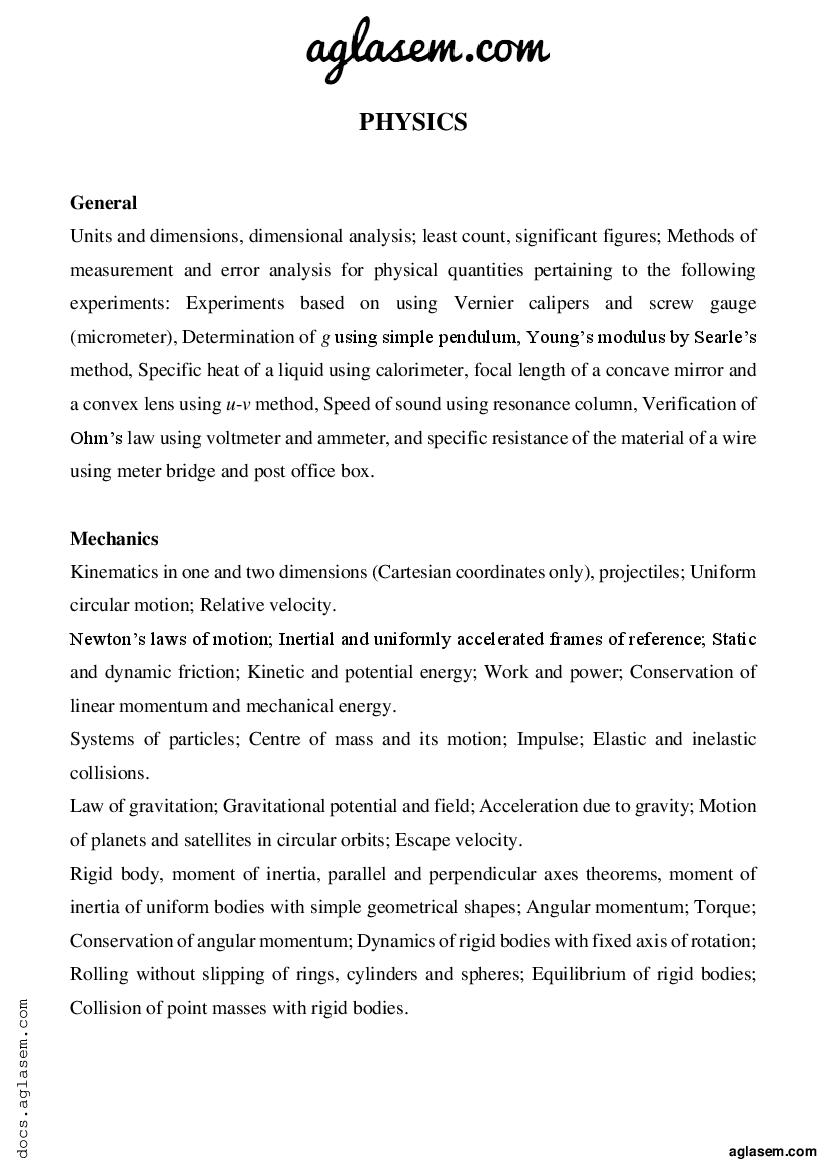
General
Units and dimensions, dimensional analysis; least count, significant figures; Methods of
measurement and error analysis for physical quantities pertaining to the following
experiments: Experiments based on using Vernier calipers and screw gauge
(micrometer), Determination of g using simple pendulum, Young’s modulus by Searle’s
method, Specific heat of a liquid using calorimeter, focal length of a concave mirror and
a convex lens using u-v method, Speed of sound using resonance column, Verification of
Ohm’s law using voltmeter and ammeter, and specific resistance of the material of a wire
using meter bridge and post office box.
Mechanics
Kinematics in one and two dimensions (Cartesian coordinates only), projectiles; Uniform
circular motion; Relative velocity.
Newton’s laws of motion; Inertial and uniformly accelerated frames of reference; Static
and dynamic friction; Kinetic and potential energy; Work and power; Conservation of
linear momentum and mechanical energy.
Systems of particles; Centre of mass and its motion; Impulse; Elastic and inelastic
collisions.
Law of gravitation; Gravitational potential and field; Acceleration due to gravity; Motion
of planets and satellites in circular orbits; Escape velocity.
Rigid body, moment of inertia, parallel and perpendicular axes theorems, moment of
inertia of uniform bodies with simple geometrical shapes; Angular momentum; Torque;
Conservation of angular momentum; Dynamics of rigid bodies with fixed axis of rotation;
Rolling without slipping of rings, cylinders and spheres; Equilibrium of rigid bodies;
Collision of point masses with rigid bodies.
Page 2
Hooke’s law, Young’s modulus.
Pressure in a fluid; Pascal’s law; Buoyancy; Surface energy and surface tension, capillary
rise; Viscosity (Poiseuille’s equation excluded), Stoke’s law; Terminal velocity,
Streamline flow, equation of continuity, Bernoulli’s theorem and its applications.
Wave motion (plane waves only), longitudinal and transverse waves, superposition of
waves; Progressive and stationary waves; Vibration of strings and air columns;
Resonance; Beats; Speed of sound in gases; Doppler effect (in sound).
Thermal physics
Thermal expansion of solids, liquids and gases; Calorimetry, latent heat; Heat conduction
in one dimension; Elementary concepts of convection and radiation; Newton’s law of
cooling; Ideal gas laws; Specific heats (Cv and Cp for monoatomic and diatomic gases);
Isothermal and adiabatic processes, bulk modulus of gases; Equivalence of heat and
work; First law of thermodynamics and its applications (only for ideal gases); Blackbody
radiation: absorptive and emissive powers; Kirchhoff’s law; Wien’s displacement law,
Stefan’s law.
Electricity and magnetism
Coulomb’s law; Electric field and potential; Electrical potential energy of a system of
point charges and of electrical dipoles in a uniform electrostatic field; Electric field lines;
Flux of electric field; Gauss’s law and its application in simple cases, such as, to find
field due to infinitely long straight wire, uniformly charged infinite plane sheet and
uniformly charged thin spherical shell.
Capacitance; Parallel plate capacitor with and without dielectrics; Capacitors in series
and parallel; Energy stored in a capacitor.
Electric current; Ohm’s law; Series and parallel arrangements of resistances and cells;
Kirchhoff’s laws and simple applications; Heating effect of current.
Page 3
wire, along the axis of a circular coil and inside a long straight solenoid; Force on a
moving charge and on a current-carrying wire in a uniform magnetic field.
Magnetic moment of a current loop; Effect of a uniform magnetic field on a current loop;
Moving coil galvanometer, voltmeter, ammeter and their conversions.
Electromagnetic induction: Faraday’s law, Lenz’s law; Self and mutual inductance; RC,
LR and LC circuits with d.c. and a.c. sources.
Optics
Rectilinear propagation of light; Reflection and refraction at plane and spherical surfaces;
Total internal reflection; Deviation and dispersion of light by a prism; Thin lenses;
Combinations of mirrors and thin lenses; Magnification.
Wave nature of light: Huygen’s principle, interference limited to Young’s double-slit
experiment.
Modern physics
Atomic nucleus; α, β and γ radiations; Law of radioactive decay; Decay constant; Half-
life and mean life; Binding energy and its calculation; Fission and fusion processes;
Energy calculation in these processes.
Photoelectric effect; Bohr’s theory of hydrogen-like atoms; Characteristic and continuous
X-rays, Moseley’s law; de Broglie wavelength of matter waves.
Document Details
| Board / Org | IIT |
| Exam | Joint Entrance Examination Advanced |
| Type | Syllabus |
| Pages | 3 |
| Language | english |
| Updated | 22 Jul 2026 |