JEE Advanced 2027 Sample Paper 1
Finished viewing? Save it for later —
Download JEE Advanced 2027 Sample Paper 1 (PDF · 15 pages)About JEE Advanced 2027 Sample Paper 1
JEE Advanced 2027 Sample Paper 1 is available here for free download. Published by IIT for JEE Advanced, this sample paper can be viewed online or downloaded as a PDF (15 pages). Candidates preparing for JEE Advanced can use JEE Advanced 2027 Sample Paper 1 to understand the exam pattern, the type of questions asked, and the overall difficulty level.
Frequently Asked Questions
How can I download JEE Advanced 2027 Sample Paper 1?
Open this page and click the Download button to save JEE Advanced 2027 Sample Paper 1 as a PDF. It is completely free on AglaSem Docs.
Is JEE Advanced 2027 Sample Paper 1 free to download?
Yes. JEE Advanced 2027 Sample Paper 1 can be viewed online and downloaded as a PDF free of cost on AglaSem Docs.
How many pages does JEE Advanced 2027 Sample Paper 1 have?
JEE Advanced 2027 Sample Paper 1 contains 15 pages, which you can read online or download together as a single PDF.
Where can I find more JEE Advanced study material?
You can find more JEE Advanced question papers, sample papers, syllabus, and answer keys on AglaSem Docs.
JEE Advanced 2027 Sample Paper 1 – Text
Read the full text of this sample paper below — useful to quickly search, copy and reference the content online without downloading the PDF.
📄 View text version (15 pages)
Page 1
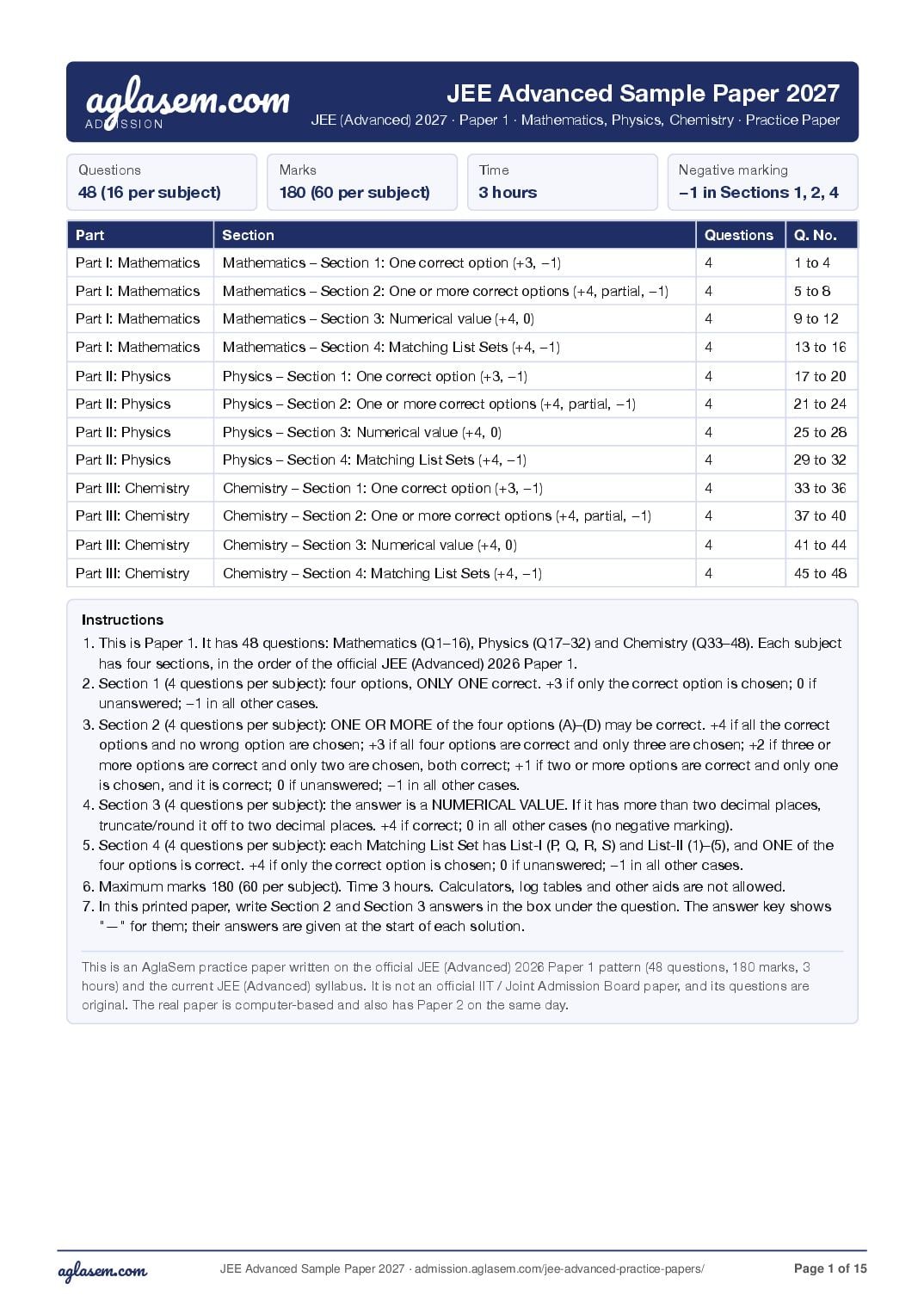
JEE Advanced Sample Paper 2027
JEE (Advanced) 2027 · Paper 1 · Mathematics, Physics, Chemistry · Practice Paper
Questions Marks Time Negative marking
48 (16 per subject) 180 (60 per subject) 3 hours −1 in Sections 1, 2, 4
Part Section Questions Q. No.
Part I: Mathematics Mathematics – Section 1: One correct option (+3, −1) 4 1 to 4
Part I: Mathematics Mathematics – Section 2: One or more correct options (+4, partial, −1) 4 5 to 8
Part I: Mathematics Mathematics – Section 3: Numerical value (+4, 0) 4 9 to 12
Part I: Mathematics Mathematics – Section 4: Matching List Sets (+4, −1) 4 13 to 16
Part II: Physics Physics – Section 1: One correct option (+3, −1) 4 17 to 20
Part II: Physics Physics – Section 2: One or more correct options (+4, partial, −1) 4 21 to 24
Part II: Physics Physics – Section 3: Numerical value (+4, 0) 4 25 to 28
Part II: Physics Physics – Section 4: Matching List Sets (+4, −1) 4 29 to 32
Part III: Chemistry Chemistry – Section 1: One correct option (+3, −1) 4 33 to 36
Part III: Chemistry Chemistry – Section 2: One or more correct options (+4, partial, −1) 4 37 to 40
Part III: Chemistry Chemistry – Section 3: Numerical value (+4, 0) 4 41 to 44
Part III: Chemistry Chemistry – Section 4: Matching List Sets (+4, −1) 4 45 to 48
Instructions
1. This is Paper 1. It has 48 questions: Mathematics (Q1–16), Physics (Q17–32) and Chemistry (Q33–48). Each subject
has four sections, in the order of the official JEE (Advanced) 2026 Paper 1.
2. Section 1 (4 questions per subject): four options, ONLY ONE correct. +3 if only the correct option is chosen; 0 if
unanswered; −1 in all other cases.
3. Section 2 (4 questions per subject): ONE OR MORE of the four options (A)–(D) may be correct. +4 if all the correct
options and no wrong option are chosen; +3 if all four options are correct and only three are chosen; +2 if three or
more options are correct and only two are chosen, both correct; +1 if two or more options are correct and only one
is chosen, and it is correct; 0 if unanswered; −1 in all other cases.
4. Section 3 (4 questions per subject): the answer is a NUMERICAL VALUE. If it has more than two decimal places,
truncate/round it off to two decimal places. +4 if correct; 0 in all other cases (no negative marking).
5. Section 4 (4 questions per subject): each Matching List Set has List-I (P, Q, R, S) and List-II (1)–(5), and ONE of the
four options is correct. +4 if only the correct option is chosen; 0 if unanswered; −1 in all other cases.
6. Maximum marks 180 (60 per subject). Time 3 hours. Calculators, log tables and other aids are not allowed.
7. In this printed paper, write Section 2 and Section 3 answers in the box under the question. The answer key shows
"—" for them; their answers are given at the start of each solution.
This is an AglaSem practice paper written on the official JEE (Advanced) 2026 Paper 1 pattern (48 questions, 180 marks, 3
hours) and the current JEE (Advanced) syllabus. It is not an official IIT / Joint Admission Board paper, and its questions are
original. The real paper is computer-based and also has Paper 2 on the same day.
JEE Advanced Sample Paper 2027 · admission./jee-advanced-practice-papers/ Page 1 of 15
Page 2
Mathematics – Section 1: One correct option (+3, −1)
1. Let S be the set of all complex numbers z satisfying |z − 3 − 4i| = 2. For z ∈ S, the expression |z|² + |z − 6
− 8i|²:
(A) is constant and equals 54
(B) is constant and equals 58
(C) has greatest value 58 and least value 50
(D) has greatest value 66 and least value 50
2. Let P(x) be a polynomial of degree 3 such that P(k) = 1/k for k = 1, 2, 3, 4. Then P(5) equals:
(A) 2/5 (B) 0
(C) −1/5 (D) 1/5
3. A fair die is rolled repeatedly until a six appears for the first time. The probability that the number of rolls
needed is even is:
(A) 1/2 (B) 5/12
(C) 5/11 (D) 6/11
4. The value of lim (x → 0) [(1 + x)^(1/x) − e]/x is:
(A) 0 (B) −e
(C) e/2 (D) −e/2
Mathematics – Section 2: One or more correct options (+4, partial, −1)
5. Let f(x) = x³ − 3x + 1. Which of the following statements is/are correct? (One or more options may be
correct.)
(A) The product of the real roots of f(x) = 0 is 1.
(B) f(x) = 0 has exactly one root in the interval (0, 1).
(C) 2 cos(2π/9) is a root of f(x) = 0.
(D) The sum of the squares of the roots of f(x) = 0 is 6.
6. Consider the lines L₁: (x − 1)/2 = (y − 2)/3 = (z − 3)/4 and L₂: (x − 2)/3 = (y − 4)/4 = (z − 5)/5. Which of the
following statements is/are correct? (One or more options may be correct.)
(A) L₁ and L₂ are skew lines.
(B) The shortest distance between L₁ and L₂ is 1/√6.
(C) The plane containing L₁ and parallel to L₂ is x − 2y + z = 0.
(D) The perpendicular distance of the origin from the plane in (C) is 1/√6.
7. ₙ
For n ≥ 0, let I = ∫₀^(π/2) sinⁿx dx. Which of the following statements is/are correct? (One or more
options may be correct.)
ₙ ₙ
(A) I = ((n − 1)/n)·I ₋₂ for every n ≥ 2.
(B) I₅ = 16/15.
ₙₙ
(C) n·I ·I ₋₁ = π/2 for every n ≥ 1.
ₙₙ
(D) lim (n → ∞) I /I ₊₁ = 1.
JEE Advanced Sample Paper 2027 · admission./jee-advanced-practice-papers/ Page 2 of 15
Page 3
may be correct.)
(A) Its eccentricity is 2/3.
(B) The tangent at the point (2, 5/3) meets the major axis at a point lying on the auxiliary circle x² + y² =
9.
(C) The area of the quadrilateral formed by the tangents at the four ends of the two latera recta is 27
square units.
(D) The sum of the distances of any point of the ellipse from the two foci is 2√5.
Mathematics – Section 3: Numerical value (+4, 0)
9. The number of functions f : {1, 2, 3, 4, 5} → {1, 2, 3, 4, 5} such that f(f(x)) = x for every x is _____.
10. Let [t] denote the greatest integer less than or equal to t. The value of ∫₀² [x²] dx, correct to two decimal
places, is _____.
11. Let ω = cos(2π/7) + i sin(2π/7). The value of |1 + ω + ω² + ω⁴|² is _____.
12. The number of 2 × 2 matrices whose entries are all from the set {0, 1, 2} and whose determinant is zero
is _____.
Mathematics – Section 4: Matching List Sets (+4, −1)
13. Match each entry in List-I to the correct entry in List-II and choose the correct option.
List-I
(P) lim (x → 0) (1 − cos 2x)/x²
(Q) The number of points at which f(x) = |x² − 1| + |x| is not differentiable on ℝ
(R) ∫₀^(π/2) (sin x − cos x)/(1 + sin x cos x) dx
(S) The remainder when 2²⁰²⁷ is divided by 7
List-II
(1) 0; (2) 1; (3) 2; (4) 3; (5) 4
(A) (P)→(3), (Q)→(4), (R)→(1), (S)→(5)
(B) (P)→(2), (Q)→(4), (R)→(1), (S)→(5)
(C) (P)→(3), (Q)→(4), (R)→(2), (S)→(4)
(D) (P)→(3), (Q)→(3), (R)→(2), (S)→(5)
JEE Advanced Sample Paper 2027 · admission./jee-advanced-practice-papers/ Page 3 of 15
Page 4
List-I
(P) The radius of the circle x² + y² − 4x + 6y − 12 = 0
(Q) The length of the focal chord of the parabola y² = 4x that makes an angle of 45° with its axis
(R) The perpendicular distance of a focus of the hyperbola x²/16 − y²/9 = 1 from either of its asymptotes
(S) The length of the common chord of the circles x² + y² = 25 and x² + y² − 8x + 7 = 0
List-II
(1) 3; (2) 4; (3) 5; (4) 6; (5) 8
(A) (P)→(4), (Q)→(5), (R)→(1), (S)→(3)
(B) (P)→(3), (Q)→(4), (R)→(1), (S)→(4)
(C) (P)→(3), (Q)→(5), (R)→(1), (S)→(4)
(D) (P)→(3), (Q)→(5), (R)→(2), (S)→(4)
15. Match each entry in List-I to the correct entry in List-II and choose the correct option.
List-I
(P) Two distinct numbers are chosen at random from {1, 2, 3, 4, 5, 6}. The probability that their sum is
even
(Q) Urn A has 3 red and 2 black balls; urn B has 2 red and 3 black balls. An urn is chosen by tossing a
fair coin and a ball drawn from it is red. The probability that it came from urn A
(R) The probability that in three tosses of a fair coin the number of heads exceeds the number of tails
(S) A and B toss a fair coin alternately, A first; the first to get a head wins. The probability that B wins
List-II
(1) 1/3; (2) 2/5; (3) 1/2; (4) 3/5; (5) 2/3
(A) (P)→(2), (Q)→(4), (R)→(5), (S)→(1)
(B) (P)→(2), (Q)→(5), (R)→(3), (S)→(1)
(C) (P)→(2), (Q)→(4), (R)→(3), (S)→(1)
(D) (P)→(4), (Q)→(2), (R)→(3), (S)→(1)
16. Match each entry in List-I to the correct entry in List-II and choose the correct option.
List-I
(P) det A, where A is a 3 × 3 real matrix with A² = A and A ≠ I
(Q) tr A, where A is a 2 × 2 real matrix with A² − 3A + 2I = O, A ≠ I and A ≠ 2I
(R) det(adj A), where A is a 3 × 3 matrix with det A = −2
(S) The number of 3 × 3 real diagonal matrices D with D² = I
List-II
(1) 0; (2) 1; (3) 3; (4) 4; (5) 8
(A) (P)→(2), (Q)→(3), (R)→(4), (S)→(5)
(B) (P)→(1), (Q)→(2), (R)→(4), (S)→(5)
(C) (P)→(1), (Q)→(3), (R)→(4), (S)→(5)
(D) (P)→(1), (Q)→(3), (R)→(3), (S)→(5)
Part II: Physics
Physics – Section 1: One correct option (+3, −1)
17. A uniform solid sphere is released from rest on a rough plane inclined at 30° to the horizontal. The
minimum coefficient of static friction for which it rolls without slipping is:
(A) 1/(3√3) (B) 1/(2√3)
(C) 5/(7√3) (D) 2/(7√3)
JEE Advanced Sample Paper 2027 · admission./jee-advanced-practice-papers/ Page 4 of 15
Page 5
then disconnected from the battery. A dielectric slab of dielectric constant 3, thickness d/2 and the
same area as the plates is now inserted between the plates. The new potential difference between the
plates is:
(A) V₀/2 (B) 3V₀/4
(C) V₀/3 (D) 2V₀/3
19. Light of wavelength 300 nm falling on a metal surface gives a stopping potential of 2.0 V. If light of
wavelength 200 nm is used on the same surface, the stopping potential will be about (take hc = 1240 eV
nm):
(A) 4.07 V (B) 6.20 V
(C) 3.00 V (D) 2.07 V
20. A string of length 1.5 m and linear mass density 5 g/m is fixed at both ends. Two successive resonant
frequencies of the string are 420 Hz and 490 Hz. The tension in the string is:
(A) 220.5 N (B) 441 N
(C) 110.25 N (D) 55.1 N
Physics – Section 2: One or more correct options (+4, partial, −1)
21. One mole of a monatomic ideal gas at pressure P₀, volume V₀ and temperature T₀ expands to volume
2V₀ in a quasi-static process in which PV² remains constant. Which of the following statements is/are
correct? (One or more options may be correct.)
(A) The final temperature of the gas is T₀/2.
(B) The work done by the gas is P₀V₀/2.
(C) The gas absorbs heat during the process.
(D) The molar heat capacity of the gas in this process is R/2.
22. A conducting rod of mass m and length l slides without friction on two long horizontal parallel rails
joined at one end by a resistor R, in a uniform vertical magnetic field B. Ignore the resistance of the rod
and the rails and the self-inductance of the circuit. An external force keeps the rod moving at constant
speed v₀ perpendicular to its length; at t = 0 the force is removed. Which of the following statements
is/are correct? (One or more options may be correct.)
(A) While the rod moves at constant speed v₀, the external agent supplies power B²l²v₀²/(2R).
(B) While the rod moves at constant speed v₀, the current in the circuit is Blv₀/R.
(C) After the force is removed, the rod comes to rest in a finite time.
(D) After the force is removed, the rod travels a total distance mv₀R/(B²l²).
JEE Advanced Sample Paper 2027 · admission./jee-advanced-practice-papers/ Page 5 of 15
Page 6
placed 30 cm from it on its principal axis. Which of the following statements is/are correct? (One or
more options may be correct.)
(A) The image is real, inverted and twice the size of the object.
(B) If the object is moved 10 cm towards the lens, the image forms at infinity.
(C) If the lower half of the lens is covered with black paper, a complete image is still formed, but it is less
bright.
(D) If the lens and object are immersed in water of refractive index 4/3, the focal length of the lens
becomes 80 cm.
24. A satellite of mass m moves in a circular orbit of radius 2R around the Earth (mass M, radius R, g =
GM/R² at the surface). Ignore the Earth's rotation and air drag. Which of the following statements is/are
correct? (One or more options may be correct.)
(A) The period of the satellite is 2π√(2R/g).
(B) The orbital speed of the satellite is √(gR/2).
(C) The escape speed from the orbit is √2 times the orbital speed.
(D) The minimum energy needed to shift the satellite to a circular orbit of radius 3R is GMm/(12R).
Physics – Section 3: Numerical value (+4, 0)
25. A block of mass 2 kg rests on a smooth horizontal floor, attached to a fixed wall by a light horizontal
spring of spring constant 800 N/m. A lump of putty of mass 0.5 kg moving at 10 m/s along the spring's
axis strikes the block and sticks to it. The amplitude of the resulting oscillation, in cm, is _____.
26. An ideal 12 V battery is connected in series with a 4 Ω resistor and a 2 Ω resistor. A 5 μF capacitor is
connected across the 2 Ω resistor. The energy stored in the capacitor in the steady state, in μJ, is _____.
27. Two radioactive samples X and Y have half-lives of 1 hour and 2 hours respectively, and they have equal
activities at t = 0. The ratio of the activity of Y to that of X at t = 4 hours is _____.
28. A large open tank standing on level ground holds water to a depth of 5 m. A small hole is made in its
vertical side 1.8 m below the free surface. Taking g = 10 m/s², the horizontal distance from the tank wall
at which the water jet strikes the ground, in m, is _____.
JEE Advanced Sample Paper 2027 · admission./jee-advanced-practice-papers/ Page 6 of 15
Page 7
29. Match each physical quantity in List-I with its dimensional formula in List-II and choose the correct
option. (h: Planck's constant, e: electronic charge, L: inductance, R: resistance, ε₀: permittivity of free
space, μ₀: permeability of free space, E: electric field)
List-I
(P) h/e
(Q) L/R
(R) ε₀E²
(S) 1/√(μ₀ε₀)
List-II
(1) [T]; (2) [L T⁻¹]; (3) [M L⁻¹ T⁻²]; (4) [M L² T⁻² A⁻¹]; (5) [M L² T⁻³ A⁻¹]
(A) (P)→(4), (Q)→(1), (R)→(2), (S)→(3)
(B) (P)→(4), (Q)→(1), (R)→(3), (S)→(2)
(C) (P)→(5), (Q)→(1), (R)→(3), (S)→(2)
(D) (P)→(4), (Q)→(3), (R)→(1), (S)→(2)
30. A series LCR circuit with R = 10 Ω, inductive reactance X_L = 20 Ω and capacitive reactance X_C = 10
Ω is connected to an AC source of rms voltage 100 V. Match each quantity in List-I with its value in List-
II (SI units) and choose the correct option.
List-I
(P) Impedance of the circuit
(Q) rms current
(R) Average power drawn from the source
(S) rms voltage across the inductor
List-II
(1) 500; (2) 100√2; (3) 10√2; (4) 1000; (5) 5√2
(A) (P)→(5), (Q)→(3), (R)→(1), (S)→(2)
(B) (P)→(3), (Q)→(5), (R)→(4), (S)→(2)
(C) (P)→(3), (Q)→(4), (R)→(1), (S)→(2)
(D) (P)→(3), (Q)→(5), (R)→(1), (S)→(2)
31. For an electron in the n-th Bohr orbit of a hydrogen atom, match each quantity in List-I with the way it
depends on n in List-II and choose the correct option.
List-I
(P) Radius of the orbit
(Q) Time period of revolution
(R) Kinetic energy of the electron
(S) Magnetic field at the nucleus due to the orbiting electron
List-II
(1) varies as n⁻⁵; (2) varies as n⁻²; (3) varies as n²; (4) varies as n³; (5) varies as n⁻¹
(A) (P)→(3), (Q)→(4), (R)→(1), (S)→(2)
(B) (P)→(4), (Q)→(3), (R)→(2), (S)→(1)
(C) (P)→(3), (Q)→(4), (R)→(2), (S)→(1)
(D) (P)→(3), (Q)→(4), (R)→(5), (S)→(1)
JEE Advanced Sample Paper 2027 · admission./jee-advanced-practice-papers/ Page 7 of 15
Page 8
option. (M: mass, L: length of the rod, R: radius)
List-I
(P) Thin uniform rod, about an axis through one end perpendicular to the rod
(Q) Uniform solid sphere, about a tangent
(R) Thin uniform ring, about a diameter
(S) Thin uniform disc, about a tangent lying in its own plane
List-II
(1) MR²/2; (2) 5MR²/4; (3) 7MR²/5; (4) 3MR²/2; (5) ML²/3
(A) (P)→(5), (Q)→(1), (R)→(3), (S)→(2)
(B) (P)→(3), (Q)→(5), (R)→(1), (S)→(2)
(C) (P)→(5), (Q)→(3), (R)→(1), (S)→(4)
(D) (P)→(5), (Q)→(3), (R)→(1), (S)→(2)
Part III: Chemistry
Chemistry – Section 1: One correct option (+3, −1)
33. At a certain temperature, N₂O₄(g) ⇌
2NO₂(g) shows a degree of dissociation of 0.2 at a total equilibrium
pressure of 1 atm. At the same temperature, the degree of dissociation will be 0.1 when the total
equilibrium pressure is:
(A) 4.125 atm (B) 2.000 atm
(C) 4.000 atm (D) 3.960 atm
34. Which of the following shows the correct order of bond angle?
(A) NH₃ > PH₃ > AsH₃ (B) NF₃ > NH₃ > PH₃
(C) H₂S > H₂O > H₂Se (D) PF₃ > PCl₃ > PBr₃
35. The correct order of basic strength of the following in aqueous solution is:
(A) (CH₃)₃N > (CH₃)₂NH > CH₃NH₂ > NH₃
(B) (CH₃)₂NH > CH₃NH₂ > (CH₃)₃N > NH₃
(C) CH₃NH₂ > (CH₃)₂NH > NH₃ > (CH₃)₃N
(D) (CH₃)₂NH > (CH₃)₃N > CH₃NH₂ > NH₃
36. The major product formed when 3-methylbut-1-ene reacts with HBr (in the absence of peroxide) is:
(A) 2-bromo-2-methylbutane (B) 1-bromo-2-methylbutane
(C) 2-bromo-3-methylbutane (D) 1-bromo-3-methylbutane
Chemistry – Section 2: One or more correct options (+4, partial, −1)
37. For the cell Zn(s) | Zn²⁺(aq, 1 M) ‖ Cu²⁺(aq, 1 M) | Cu(s), E°cell = 1.10 V at 298 K. Which of the following
statements is/are correct? (F = 96500 C mol⁻¹; 2.303RT/F = 0.0591 V) (One or more options may be
correct.)
(A) Electrons flow from the zinc electrode to the copper electrode through the external circuit.
(B) ΔG° for the cell reaction is −212.3 kJ mol⁻¹.
(C) Increasing [Zn²⁺] while keeping [Cu²⁺] fixed increases the cell emf.
(D) log K for the cell reaction is about 37.2.
JEE Advanced Sample Paper 2027 · admission./jee-advanced-practice-papers/ Page 8 of 15
Page 9
aqueous NaOH? (One or more options may be correct.)
(A) Benzaldehyde
(B) Acetaldehyde
(C) Methanal
(D) 2,2-Dimethylpropanal
39. Which of the following statements about diborane (B₂H₆) is/are correct? (One or more options may be
correct.)
(A) It contains two three-centre two-electron (3c–2e) B–H–B bonds.
(B) All six B–H bonds in it are of equal length.
(C) It is an electron-precise molecule.
(D) The two boron atoms and the four terminal hydrogen atoms lie in one plane.
40. Consider 0.1 molal aqueous solutions of glucose, urea, NaCl and K₂SO₄ at the same temperature.
Assume ideal behaviour and complete dissociation of the salts. Which of the following statements is/are
correct? (One or more options may be correct.)
(A) The vapour pressure of the NaCl solution is higher than that of the glucose solution.
(B) The K₂SO₄ solution has the lowest freezing point.
(C) The glucose and urea solutions have the same elevation of boiling point.
(D) The osmotic pressure of the NaCl solution is about twice that of the glucose solution.
Chemistry – Section 3: Numerical value (+4, 0)
41. The total number of stereoisomers possible for hepta-2,5-dien-4-ol, CH₃–CH=CH–CH(OH)–CH=CH–
CH₃, is _____.
42. The gas-phase first-order decomposition A(g) → 2B(g) + C(g) is carried out in a closed vessel of fixed
volume at constant temperature, starting with pure A at 200 mm Hg. The total pressure after 20 minutes
is 400 mm Hg. The total pressure after 40 minutes, in mm Hg, is _____.
43. Among the following species, the number having square planar geometry is _____.
XeF₄, SF₄, [Ni(CN)₄]²⁻, [NiCl₄]²⁻, ICl₄⁻, XeO₄, [PtCl₄]²⁻, BrF₄⁻, CCl₄, [Zn(NH₃)₄]²⁺
JEE Advanced Sample Paper 2027 · admission./jee-advanced-practice-papers/ Page 9 of 15
Page 10
pm. Taking N_A = 6.022 × 10²³ mol⁻¹, the density of the metal, in g cm⁻³, is _____.
Chemistry – Section 4: Matching List Sets (+4, −1)
45. Match each named reaction in List-I with the reagent(s) it uses in List-II and choose the correct option.
List-I
(P) Etard reaction
(Q) Gattermann–Koch reaction
(R) Rosenmund reduction
(S) Stephen reaction
List-II
(1) H₂, Pd–BaSO₄
(2) SnCl₂/HCl, then H₃O⁺
(3) CrO₂Cl₂ in CS₂, then H₃O⁺
(4) CO, HCl, anhydrous AlCl₃/CuCl
(5) Zn–Hg, concentrated HCl
(A) (P)→(4), (Q)→(3), (R)→(1), (S)→(2)
(B) (P)→(3), (Q)→(2), (R)→(1), (S)→(4)
(C) (P)→(3), (Q)→(4), (R)→(1), (S)→(2)
(D) (P)→(3), (Q)→(4), (R)→(5), (S)→(2)
46. Match each species in List-I with its bond order (from molecular orbital theory) in List-II and choose the
correct option.
List-I
(P) O₂²⁻
(Q) O₂⁻
(R) N₂⁺
(S) C₂²⁻
List-II
(1) 2.5; (2) 1; (3) 3; (4) 2; (5) 1.5
(A) (P)→(2), (Q)→(1), (R)→(5), (S)→(3)
(B) (P)→(2), (Q)→(5), (R)→(1), (S)→(3)
(C) (P)→(2), (Q)→(5), (R)→(1), (S)→(4)
(D) (P)→(5), (Q)→(2), (R)→(1), (S)→(3)
JEE Advanced Sample Paper 2027 · admission./jee-advanced-practice-papers/ Page 10 of 15
Page 11
correct option.
List-I
(P) [Ni(CO)₄]
(Q) [Ni(CN)₄]²⁻
(R) [Fe(CN)₆]⁴⁻
(S) [FeF₆]³⁻
List-II
(1) dsp², diamagnetic
(2) sp³d², five unpaired electrons
(3) sp³, diamagnetic
(4) sp³, two unpaired electrons
(5) d²sp³, diamagnetic
(A) (P)→(3), (Q)→(5), (R)→(4), (S)→(2)
(B) (P)→(3), (Q)→(1), (R)→(5), (S)→(2)
(C) (P)→(4), (Q)→(1), (R)→(5), (S)→(2)
(D) (P)→(3), (Q)→(1), (R)→(2), (S)→(5)
48. Match each reaction in List-I with its major organic product in List-II and choose the correct option.
List-I
(P) Propanone + CH₃MgBr in dry ether, then H₃O⁺
(Q) Ethanal + HCN, then hydrolysis with dilute acid on heating
(R) Benzamide + Br₂ + aqueous NaOH
(S) Phenol + CHCl₃ + aqueous NaOH, then H₃O⁺
List-II
(1) 2-Hydroxybenzaldehyde
(2) Aniline
(3) 2-Methylpropan-2-ol
(4) 2-Hydroxypropanoic acid
(5) Benzoic acid
(A) (P)→(4), (Q)→(3), (R)→(2), (S)→(1)
(B) (P)→(3), (Q)→(4), (R)→(5), (S)→(1)
(C) (P)→(3), (Q)→(2), (R)→(4), (S)→(1)
(D) (P)→(3), (Q)→(4), (R)→(2), (S)→(1)
JEE Advanced Sample Paper 2027 · admission./jee-advanced-practice-papers/ Page 11 of 15
Page 12
1 B 2 B 3 C 4 D 5 B,C,D 6 A,B,C 7 A,C,D 8 A,C 9 26 10 1.85
11 2 12 31 13 A 14 C 15 C 16 C 17 D 18 D 19 A 20 A
21 A,B,D 22 B,D 23 A,B,C,D 24 B,C,D 25 11.18 26 40 27 4 28 4.8 29 B 30 D
31 C 32 D 33 A 34 A 35 B 36 A 37 A,B,D 38 A,C,D 39 A,D 40 B,C,D
41 4 42 500 43 5 44 6.64 45 C 46 B 47 B 48 D
Solutions
Mathematics – Section 1: One correct option (+3, −1)
1. (B) Let c = 3 + 4i, so z = c + u with |u| = 2, and 6 + 8i = 2c. Then |z|² + |z − 2c|² = |c + u|² + |c − u|² = 2|c|² + 2|u|² =
2(25) + 2(4) = 58 for every z on the circle.
2. (B) Q(x) = xP(x) − 1 has degree 4 and roots 1, 2, 3, 4, so Q(x) = c(x − 1)(x − 2)(x − 3)(x − 4). Q(0) = −1 gives 24c = −1,
c = −1/24. Then Q(5) = −24/24 = −1, so 5P(5) − 1 = −1 and P(5) = 0.
3. (C) P(first six on roll k) = (5/6)^(k−1)(1/6). Summing over k = 2, 4, 6, …: (1/6)(5/6)/(1 − 25/36) = (5/36)/(11/36) = 5/11.
4. (D) (1 + x)^(1/x) = e^(ln(1 + x)/x) = e^(1 − x/2 + x²/3 − …) = e(1 − x/2 + O(x²)). So [(1 + x)^(1/x) − e]/x → −e/2.
Mathematics – Section 2: One or more correct options (+4, partial, −1)
5. (B,C,D) Correct options: (B), (C), (D). f(−2) = −1, f(−1) = 3, f(0) = 1, f(1) = −1, f(2) = 3, so all three roots are real (one
each in (−2, −1), (0, 1), (1, 2)); f is decreasing on (−1, 1), so exactly one root lies in (0, 1). The product of the roots is −1,
not 1, so (A) is false. Put x = 2cos θ: 8cos³θ − 6cos θ + 1 = 2cos 3θ + 1 = 0, i.e. cos 3θ = −1/2, which holds for θ =
2π/9, so (C) is true. Sum of roots = 0 and sum of products in pairs = −3, so the sum of squares = 0 − 2(−3) = 6.
6. (A,B,C) Correct options: (A), (B), (C). d₁ × d₂ = (2, 3, 4) × (3, 4, 5) = (−1, 2, −1), so the lines are not parallel. With a =
(1, 2, 3), b = (2, 4, 5): (b − a)·(d₁ × d₂) = (1, 2, 2)·(−1, 2, −1) = 1 ≠ 0, so the lines do not meet: they are skew, and the
shortest distance is |1|/√6 = 1/√6. The plane through (1, 2, 3) with normal (1, −2, 1) is x − 2y + z = 1 − 4 + 3 = 0. The
origin lies on this plane, so its distance is 0 and (D) is false.
7. (A,C,D) Correct options: (A), (C), (D). Integrating sinⁿ⁻¹x · sin x by parts gives the reduction formula (A). Then I₅ = (4/5)
ₙₙ ₙ ₙ
(2/3)I₁ = 8/15, so (B) is false. Using (A), n·I ·I ₋₁ = (n − 1)·I ₋₁·I ₋₂, so the product is constant and equals 1·I₁·I₀ = π/2.
ₙ ₙ ₙ ₙₙ ₙ ₙ
Since 0 ≤ sin x ≤ 1, I ₊₁ ≤ I ≤ I ₋₁, so 1 ≤ I /I ₊₁ ≤ I ₋₁/I ₊₁ = (n + 1)/n → 1, which proves (D).
8. (A,C) Correct options: (A), (C). a = 3, b² = 5, e = √(1 − 5/9) = 2/3, foci (±2, 0); (2, 5/3) is an end of a latus rectum since
b²/a = 5/3. The tangent there is 2x/9 + y/3 = 1, i.e. 2x + 3y = 9, which meets the x-axis at (9/2, 0), on the directrix x =
a/e, not on the circle of radius 3, so (B) is false. By symmetry the four tangents form a rhombus with vertices (±9/2, 0),
(0, ±3): area = (9 × 6)/2 = 27. The sum of focal distances is 2a = 6, so (D) is false.
Mathematics – Section 3: Numerical value (+4, 0)
9. (26) Answer: 26. Such an f is a permutation made only of fixed points and 2-cycles. Identity: 1; exactly one 2-cycle:
⁵C₂ = 10; exactly two 2-cycles: (⁵C₂ × ³C₂)/2 = 15. Total 1 + 10 + 15 = 26.
10. (1.85) Answer: 1.85. [x²] = 0 on [0, 1), 1 on [1, √2), 2 on [√2, √3), 3 on [√3, 2). Integral = (√2 − 1) + 2(√3 − √2) + 3(2 −
√3) = 5 − √2 − √3 = 5 − 1.4142 − 1.7321 = 1.8537 ≈ 1.85.
11. (2) Answer: 2. Let η = ω + ω² + ω⁴; its conjugate is η̄ = ω⁶ + ω⁵ + ω³. Then η + η̄ = ω + ω² + … + ω⁶ = −1, and
multiplying out, ηη̄ = 3 + (ω + ω² + … + ω⁶) = 3 − 1 = 2. So |1 + η|² = (1 + η)(1 + η̄ ) = 1 + (η + η̄ ) + ηη̄ = 1 − 1 + 2 = 2.
12. (31) Answer: 31. For [[a, b], [c, d]] we need ad = bc. A product xy with x, y ∈ {0, 1, 2} equals 0 in 5 ways, 1 in 1 way,
2 in 2 ways and 4 in 1 way. So the count is 5² + 1² + 2² + 1² = 25 + 1 + 4 + 1 = 31.
Mathematics – Section 4: Matching List Sets (+4, −1)
13. (A) (P) (1 − cos 2x)/x² = 2 sin²x/x² → 2, so (3). (Q) |x² − 1| has corners at x = ±1 and |x| at x = 0, and no two corners
cancel, so 3 points: (4). (R) The substitution x → π/2 − x changes the integrand into its negative, so the integral is 0: (1).
(S) 2³ = 8 ≡ 1 (mod 7) and 2027 = 3 × 675 + 2, so 2²⁰²⁷ ≡ 2² = 4: (5).
JEE Advanced Sample Paper 2027 · admission./jee-advanced-practice-papers/ Page 12 of 15
Page 13
(5). (R) Focus (5, 0), asymptote 3x − 4y = 0: distance = 15/5 = 3 (it always equals b): (1). (S) Subtracting the equations
gives 8x − 7 = 25, x = 4, so y² = 9 and the chord joins (4, ±3): length 6: (4).
15. (C) (P) Both even or both odd: (³C₂ + ³C₂)/⁶C₂ = 6/15 = 2/5: (2). (Q) Bayes: (½·3/5)/(½·3/5 + ½·2/5) = 3/5: (4). (R) At
least 2 heads in 3 tosses: 4/8 = 1/2: (3). (S) P(A wins) = (1/2)/(1 − 1/4) = 2/3, so P(B wins) = 1/3: (1).
16. (C) (P) A(A − I) = O; if det A ≠ 0, multiplying by A⁻¹ gives A = I, which is excluded, so det A = 0: (1). (Q) A is not a
scalar matrix, so its minimal polynomial is (x − 1)(x − 2) and its eigenvalues are 1 and 2: trace 3: (3). (R) det(adj A) = (det
A)ⁿ⁻¹ = (−2)² = 4: (4). (S) Each diagonal entry is ±1: 2³ = 8: (5).
Physics – Section 1: One correct option (+3, −1)
17. (D) For rolling, a = g sin θ/(1 + I/mR²) = (5/7)g sin θ and friction f = mg sin θ − ma = (2/7)mg sin θ. Need f ≤ μ mg cos
θ, so μ ≥ (2/7) tan 30° = 2/(7√3). (1/(3√3) would be for a disc, 1/(2√3) for a ring.)
18. (D) With the slab, C = ε₀A/(d − t + t/K) = ε₀A/(d/2 + d/6) = ε₀A/(2d/3) = 3C₀/2. The charge stays the same (battery
disconnected), so V = Q/C = V₀/(3/2) = 2V₀/3.
19. (A) Photon energy at 300 nm = 1240/300 = 4.13 eV, so the work function φ = 4.13 − 2.0 = 2.13 eV. At 200 nm the
energy is 6.20 eV, so eV₀ = 6.20 − 2.13 = 4.07 eV and V₀ ≈ 4.07 V.
20. (A) For a string fixed at both ends successive harmonics differ by the fundamental, so f₁ = 490 − 420 = 70 Hz.
Wave speed v = 2Lf₁ = 2 × 1.5 × 70 = 210 m/s. T = μv² = 0.005 × 210² = 220.5 N.
Physics – Section 2: One or more correct options (+4, partial, −1)
21. (A,B,D) Correct options: (A), (B), (D). Final pressure = P₀/4, so PV = P₀V₀/2 and T = T₀/2. For PVⁿ = constant with n
= 2, W = (P₁V₁ − P₂V₂)/(n − 1) = P₀V₀ − P₀V₀/2 = P₀V₀/2. ΔU = (3/2)R(T₀/2 − T₀) = −(3/4)P₀V₀, so Q = ΔU + W = −P₀V₀/4:
heat is released, and (C) is false. C = C_V + R/(1 − n) = 3R/2 − R = R/2 (check: Q = C·ΔT = (R/2)(−T₀/2) = −RT₀/4).
22. (B,D) Correct options: (B), (D). The emf is Blv₀ and I = Blv₀/R. The magnetic force BIl = B²l²v₀/R must be balanced,
so the power supplied is B²l²v₀²/R (all dissipated in R), not half of it: (A) is false. After removal, m dv/dt = −(B²l²/R)v, so v
= v₀e^(−t/τ) with τ = mR/(B²l²): the speed only tends to zero, so (C) is false. Writing m v dv/dx = −(B²l²/R)v gives dv/dx =
−B²l²/(mR), so the total distance is mv₀R/(B²l²).
23. (A,B,C,D) Correct options: (A), (B), (C), (D). 1/v = 1/20 − 1/30 = 1/60, so v = +60 cm and m = −60/30 = −2: real,
inverted, twice the size. At u = 20 cm the object is at the focus, so the image is at infinity. Every part of the lens forms
the whole image, so covering half only cuts the light. In water, f_w/f_a = (1.5 − 1)/(1.5/(4/3) − 1) = 0.5/0.125 = 4, so f_w
= 80 cm.
24. (B,C,D) Correct options: (B), (C), (D). v = √(GM/2R) = √(gR²/2R) = √(gR/2). T = 2π√(r³/GM) = 2π√(8R³/(gR²)) =
2π√(8R/g), so (A) is false. Escape speed at radius r is √(2GM/r) = √2 × orbital speed. Orbital energy is −GMm/(2r): E(3R)
− E(2R) = −GMm/(6R) + GMm/(4R) = GMm/(12R).
Physics – Section 3: Numerical value (+4, 0)
25. (11.18) Answer: 11.18. Momentum conservation: v = (0.5 × 10)/2.5 = 2 m/s. ω = √(k/M) = √(800/2.5) = √320 = 17.89
rad/s. The collision happens at the equilibrium position, so A = v/ω = 2/17.89 = 0.1118 m = 11.18 cm.
26. (40) Answer: 40. In the steady state no current flows into the capacitor, so I = 12/(4 + 2) = 2 A and the voltage
across the 2 Ω resistor (and the capacitor) is 4 V. U = ½CV² = ½ × 5 μF × 16 V² = 40 μJ.
27. (4) Answer: 4. Activity falls as A₀(1/2)^(t/T½) whatever the number of nuclei. After 4 h, A_X = A₀/2⁴ = A₀/16 and A_Y
= A₀/2² = A₀/4, so A_Y/A_X = 4.
28. (4.8) Answer: 4.8. Efflux speed v = √(2gh) = √(2 × 10 × 1.8) = 6 m/s (Torricelli). The hole is 5 − 1.8 = 3.2 m above the
ground, so the fall time is √(2 × 3.2/10) = 0.8 s. Range = 6 × 0.8 = 4.8 m (= 2√(h(H − h)) = 2√(1.8 × 3.2)).
Physics – Section 4: Matching List Sets (+4, −1)
29. (B) (P) h/e = [M L² T⁻¹]/[A T] = [M L² T⁻² A⁻¹] (the dimension of magnetic flux): (4). (Q) L/R is the time constant of an
LR circuit: [T]: (1). (R) ε₀E² is (twice) an energy density, energy per volume: [M L⁻¹ T⁻²]: (3). (S) 1/√(μ₀ε₀) is the speed of
light: [L T⁻¹]: (2). [M L² T⁻³ A⁻¹] is the dimension of potential difference.
30. (D) (P) Z = √(R² + (X_L − X_C)²) = √(100 + 100) = 10√2 Ω: (3). (Q) I = 100/(10√2) = 5√2 A: (5). (R) P = I²R = 50 × 10 =
500 W: (1). (S) V_L = I X_L = 5√2 × 20 = 100√2 V: (2).
JEE Advanced Sample Paper 2027 · admission./jee-advanced-practice-papers/ Page 13 of 15
Page 14
31. (C) r varies as n² and v varies as 1/n. (P) (3). (Q) T = 2πr/v varies as n²/n⁻¹ = n³: (4). (R) KE = ½mv² varies as n⁻²: (2).
(S) The equivalent current I = e/T varies as n⁻³, and B = μ₀I/(2r) varies as n⁻³/n² = n⁻⁵: (1).
32. (D) (P) ML²/12 + M(L/2)² = ML²/3: (5). (Q) 2MR²/5 + MR² = 7MR²/5: (3). (R) By the perpendicular-axis theorem, 2I_d =
MR², so I_d = MR²/2: (1). (S) Disc about a diameter is MR²/4, so about a parallel tangent in its plane it is MR²/4 + MR² =
5MR²/4: (2). (3MR²/2 is the disc about a tangent perpendicular to its plane.)
Chemistry – Section 1: One correct option (+3, −1)
33. (A) For α dissociation at total pressure P, Kp = 4α²P/(1 − α²). With α = 0.2, P = 1: Kp = 0.16/0.96 = 1/6. For α = 0.1:
0.04P/0.99 = 1/6, so P = 0.99/0.24 = 4.125 atm.
34. (A) Down group 15 the central atom gets larger and less electronegative, so bond pairs move apart and the angle
falls: NH₃ (≈107°) > PH₃ (≈94°) > AsH₃ (≈92°). NF₃ (≈102°) is smaller than NH₃, H₂O (104.5°) is larger than H₂S (≈92°),
and PF₃ (≈98°) is smaller than PCl₃ (≈100°).
35. (B) In water, basicity depends on the +I effect, H-bonded solvation of the ammonium ion and steric hindrance
together. pKb: (CH₃)₂NH 3.27, CH₃NH₂ 3.38, (CH₃)₃N 4.22, NH₃ 4.75. The order (CH₃)₃N > (CH₃)₂NH > CH₃NH₂ holds
only in the gas phase.
36. (A) Markovnikov addition of H⁺ gives the secondary carbocation CH₃–C⁺H–CH(CH₃)₂, which rearranges by a 1,2-
hydride shift to the more stable tertiary cation CH₃CH₂–C⁺(CH₃)₂. Br⁻ adds there, giving 2-bromo-2-methylbutane.
Chemistry – Section 2: One or more correct options (+4, partial, −1)
37. (A,B,D) Correct options: (A), (B), (D). Zinc is the anode (oxidation), so electrons leave it through the wire. ΔG° =
−nFE° = −2 × 96500 × 1.10 J = −212.3 kJ mol⁻¹. E = E° − (0.0591/2) log([Zn²⁺]/[Cu²⁺]), so raising [Zn²⁺] lowers the emf:
(C) is false. log K = nE°/0.0591 = 2.20/0.0591 ≈ 37.2.
38. (A,C,D) Correct options: (A), (C), (D). The Cannizzaro reaction needs an aldehyde with no α-hydrogen. C₆H₅CHO,
HCHO and (CH₃)₃C–CHO have none, so each disproportionates into an alcohol and a carboxylate. CH₃CHO has three
α-hydrogens and undergoes aldol condensation instead.
39. (A,D) Correct options: (A), (D). Each boron uses roughly sp³ orbitals: two form normal 2c–2e bonds to terminal H
atoms and two take part in the B–H–B bridges, which are 3c–2e 'banana' bonds. The bridge B–H bonds (≈133 pm) are
longer than the terminal ones (≈119 pm), so (B) is false. B₂H₆ has only 12 valence electrons for 8 bonding contacts: it is
electron-deficient, so (C) is false. The B₂H₄ unit is planar and the two bridging H atoms lie above and below that plane.
40. (B,C,D) Correct options: (B), (C), (D). Colligative effects depend on i × m: glucose and urea 0.1, NaCl 0.2, K₂SO₄
0.3. More solute particles mean a lower vapour pressure, so the NaCl solution has the lower vapour pressure: (A) is
false. K₂SO₄ (i = 3) shows the greatest depression of freezing point; glucose and urea (i = 1) give the same ΔTb; π =
iCRT, so NaCl gives about twice the osmotic pressure of glucose.
Chemistry – Section 3: Numerical value (+4, 0)
41. (4) Answer: 4. Each C=C can be E or Z. In the (2E,5E) and (2Z,5Z) forms, C-4 carries two identical propenyl groups,
so it is not a stereocentre and each form is a single achiral compound. In the (2E,5Z) form, C-4 carries H, OH, an E-
propenyl and a Z-propenyl group, so it is a chiral centre and gives a pair of enantiomers. Total 1 + 1 + 2 = 4.
42. (500) Answer: 500. If A falls by x, the total pressure is (200 − x) + 2x + x = 200 + 2x. At 20 min, 400 = 200 + 2x
gives x = 100, so half of A has gone and t½ = 20 min. At 40 min (two half-lives) A has fallen by 150, so P = 200 + 300 =
500 mm Hg.
43. (5) Answer: 5. Square planar: XeF₄, ICl₄⁻ and BrF₄⁻ (4 bond pairs + 2 lone pairs, octahedral electron geometry), and
[Ni(CN)₄]²⁻ and [PtCl₄]²⁻ (d⁸, dsp²). SF₄ is see-saw; [NiCl₄]²⁻ (weak-field ligand), XeO₄, CCl₄ and [Zn(NH₃)₄]²⁺ (d¹⁰) are
tetrahedral.
44. (6.64) Answer: 6.64. In fcc, atoms touch along the face diagonal: 4r = √2a, so a = 2√2r = 2√2 × 100√2 = 400 pm =
4.00 × 10⁻⁸ cm, and a³ = 6.4 × 10⁻²³ cm³. With Z = 4: ρ = ZM/(N_Aa³) = (4 × 64)/(6.022 × 10²³ × 6.4 × 10⁻²³) = 256/38.54
= 6.64 g cm⁻³.
JEE Advanced Sample Paper 2027 · admission./jee-advanced-practice-papers/ Page 14 of 15
Page 15
45. (C) (P) Etard: toluene + chromyl chloride gives a chromium complex that is hydrolysed to benzaldehyde: (3). (Q)
Gattermann–Koch: benzene + CO/HCl with anhydrous AlCl₃/CuCl gives benzaldehyde: (4). (R) Rosenmund: acyl
chloride + H₂ over Pd–BaSO₄ (poisoned) gives an aldehyde: (1). (S) Stephen: a nitrile is reduced by SnCl₂/HCl to an
imine salt, which is hydrolysed to an aldehyde: (2). Zn–Hg/HCl is the Clemmensen reduction.
46. (B) Bond order = (bonding − antibonding electrons)/2. (P) O₂²⁻ (18 electrons): (10 − 8)/2 = 1: (2). (Q) O₂⁻ (17): (10 −
7)/2 = 1.5: (5). (R) N₂⁺ (13): (9 − 4)/2 = 2.5: (1). (S) C₂²⁻ (14 electrons, isoelectronic with N₂): 3: (3).
47. (B) (P) Ni(0), 3d¹⁰ (CO pairs up the 4s electrons): sp³, diamagnetic: (3). (Q) Ni²⁺ d⁸ with strong-field CN⁻: square
planar dsp², diamagnetic: (1). (R) Fe²⁺ d⁶ with CN⁻: low-spin t₂g⁶, inner-orbital d²sp³, diamagnetic: (5). (S) Fe³⁺ d⁵ with
weak-field F⁻: high spin, outer-orbital sp³d², five unpaired electrons: (2). 'sp³, two unpaired' fits [NiCl₄]²⁻.
48. (D) (P) CH₃MgBr adds to the ketone to give (CH₃)₃C–OH: (3). (Q) The cyanohydrin CH₃CH(OH)CN hydrolyses to
lactic acid, CH₃CH(OH)COOH: (4). (R) Hofmann bromamide degradation removes one carbon: C₆H₅CONH₂ →
C₆H₅NH₂: (2). (S) Reimer–Tiemann reaction puts a CHO group ortho to OH: salicylaldehyde: (1).
JEE Advanced Sample Paper 2027 · admission./jee-advanced-practice-papers/ Page 15 of 15
Document Details
| Board / Org | IIT |
| Exam | JEE Advanced |
| Type | Sample Paper |
| Pages | 15 |
| Language | english |
| Updated | 27 Oct 2026 |